

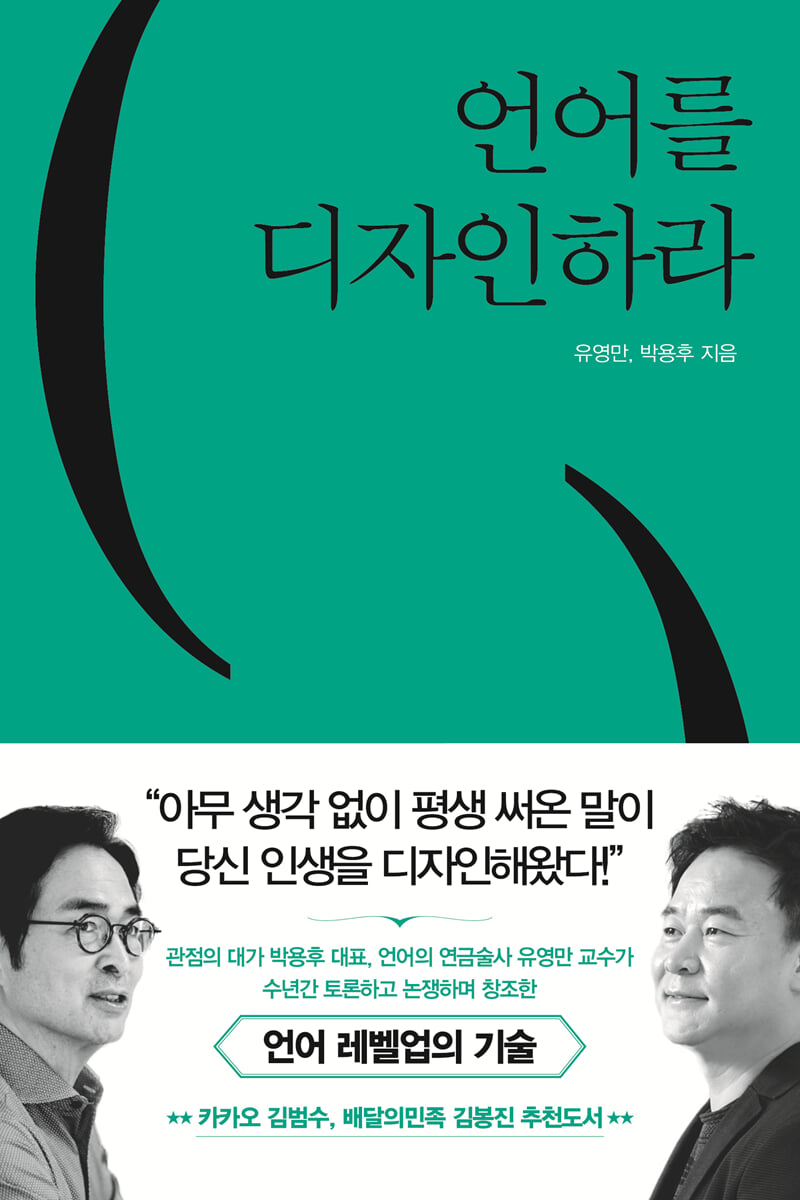
Design the language
 |
Description
Book Introduction
“The words you’ve been using without thinking all your life have designed your life!?”
CEO Yong-Hoo Park, a master of perspective design, and Professor Young-Man Yoo, an alchemist of language
The "Language Leveling Technique" created through years of discussion and debate.
Language is always the problem.
A single word, a single line of writing can ruin work and love.
A person's level is fully revealed in the 'language' he uses.
A person's language is like the scales of a fish; looking at the language he uses reveals the currents he has navigated, who he has associated with, and the choices he has made.
So, the person is the personality, and my language level is my life level.
So, if your life is going wrong, it's time to look back at the language you've been using without thinking.
So how can we level up our language skills? To address this question, perspective design expert Yong-Hoo Park and linguistic alchemist Professor Young-Man Yoo joined forces.
Two of Korea's top experts diagnosed the language crisis of our time and discussed solutions.
And in his new book, "Design Language," he reveals in detail the techniques for leveling up language to a higher level.
CEO Yong-Hoo Park, a master of perspective design, and Professor Young-Man Yoo, an alchemist of language
The "Language Leveling Technique" created through years of discussion and debate.
Language is always the problem.
A single word, a single line of writing can ruin work and love.
A person's level is fully revealed in the 'language' he uses.
A person's language is like the scales of a fish; looking at the language he uses reveals the currents he has navigated, who he has associated with, and the choices he has made.
So, the person is the personality, and my language level is my life level.
So, if your life is going wrong, it's time to look back at the language you've been using without thinking.
So how can we level up our language skills? To address this question, perspective design expert Yong-Hoo Park and linguistic alchemist Professor Young-Man Yoo joined forces.
Two of Korea's top experts diagnosed the language crisis of our time and discussed solutions.
And in his new book, "Design Language," he reveals in detail the techniques for leveling up language to a higher level.
- You can preview some of the book's contents.
Preview
index
Prologue_ The level of your language is the level of your life.
Part 1.
Clothes of Thought, House of Concepts
1.
The language you speak is who you are.
The stains and patterns of life become the scales of language.
Crash landing in the world of welders
Language is the clothing of thought.
2.
How to understand without misunderstanding
Do I have my own subjective language?
“All prejudice comes from the gut.”
3.
The more you read, the deeper your thoughts become.
Intelligence lung capacity
New problems are solved with new languages.
How to Create an 'Intellectual Reading Circuit' in Your Brain
Deep Reading: Connecting Thinking
Reading is ultimately completed by writing.
[Park Yong-hoo's Perspective] Language is Life
4.
If you look roughly, you can only think roughly
I'm distracted and you're busy
'F-shaped reading' is not reading, it's scanning
The End of Thought
5.
The length of the book, the length of the thought
Popcorn Brain with Reduced Gray Matter
Inverse relationship between search and thinking skills
6.
If you lack blood, you get anemia, if you lack speech, you get slurred speech.
If you don't know 'Chinese characters', your vocabulary will be pathetic.
7.
Why design language?
Some people are different from others, starting with the language they use.
My world opens up as much as the languages I know.
Breaking free from linguistic inertia
8.
Why You Shouldn't Live Without Concepts
The world I see changes only when I change the lens of my concepts.
Do you have a high resolution language?
When we share the inner meaning of language, our common home becomes stronger.
Can I become a good adult if I lack the concepts?
Part 2.
7 Concepts You Must Create Before You Die
9.
“This one dictionary could put the world at risk.”
It's important to have another language
Building a book by stacking words one by one
The world is different depending on who interprets it.
10.
Be Specific about Your Beliefs: Dictionary of Beliefs
Let's write three of our own definitions a day.
Conceptual gardens for cultivating language exist everywhere.
11.
Have your own unique perspective: A Dictionary of Perspectives
First, redefine who I am.
Words are the medium that carries desire.
What People Who Change the Flow Have in Common
Steal the insights of writers and the wit of advertising copy.
Flipping words is like a handstand of thought
[Park Yong-hoo's Perspective] How can we cultivate the ability to see the same thing differently?
12.
Creativity is Connection: An Associative Dictionary
Iron plate and full moon
A 'point of time' is the sum total of experiences
The moment a common noun changes into a proper noun
I create my own unique work that doesn't exist in the world.
My world is only what I see
13.
The Heart Feels, Not the Head: A Dictionary of Emotions
My own Korean-Korean dictionary
A dictionary of emotions that aligns knowledge and life
Empathy + compassion = poetry
14.
Digging into the Essence: A Dictionary of Metaphors
Connecting two unrelated words
Metaphor is the cannon of learning
15.
A Journey to the Roots of Words: Etymological Dictionary
The meaning of life is contained in the broken Chinese characters.
The best history, culture, and liberal arts training method
Breaking down words reveals hidden meanings
16.
Core Values Determine Everything: Dictionary of Values
5 Stars to Solve Life's Dilemmas
Is there a 'last word' that could be exchanged for life?
Just thinking about it makes me excited and hopeful, that's it
[Park Yong-hoo's Perspective] Aren't the words that are important to him his life?
17.
Language is a biased lens through which we see the world.
Sai expert, Homo différance
If you want to bring a grand piano into your home
18.
How to break out of the mold of the stereotypical me
Find irony and use humor
When you grasp one word, a universe opens up.
Study of cross-cutting and vertical cutting
Between Jokes and Seriousness, Counseling Is Needed
Epilogue_ When I tear down the house of existence with a sharpened knife
Part 1.
Clothes of Thought, House of Concepts
1.
The language you speak is who you are.
The stains and patterns of life become the scales of language.
Crash landing in the world of welders
Language is the clothing of thought.
2.
How to understand without misunderstanding
Do I have my own subjective language?
“All prejudice comes from the gut.”
3.
The more you read, the deeper your thoughts become.
Intelligence lung capacity
New problems are solved with new languages.
How to Create an 'Intellectual Reading Circuit' in Your Brain
Deep Reading: Connecting Thinking
Reading is ultimately completed by writing.
[Park Yong-hoo's Perspective] Language is Life
4.
If you look roughly, you can only think roughly
I'm distracted and you're busy
'F-shaped reading' is not reading, it's scanning
The End of Thought
5.
The length of the book, the length of the thought
Popcorn Brain with Reduced Gray Matter
Inverse relationship between search and thinking skills
6.
If you lack blood, you get anemia, if you lack speech, you get slurred speech.
If you don't know 'Chinese characters', your vocabulary will be pathetic.
7.
Why design language?
Some people are different from others, starting with the language they use.
My world opens up as much as the languages I know.
Breaking free from linguistic inertia
8.
Why You Shouldn't Live Without Concepts
The world I see changes only when I change the lens of my concepts.
Do you have a high resolution language?
When we share the inner meaning of language, our common home becomes stronger.
Can I become a good adult if I lack the concepts?
Part 2.
7 Concepts You Must Create Before You Die
9.
“This one dictionary could put the world at risk.”
It's important to have another language
Building a book by stacking words one by one
The world is different depending on who interprets it.
10.
Be Specific about Your Beliefs: Dictionary of Beliefs
Let's write three of our own definitions a day.
Conceptual gardens for cultivating language exist everywhere.
11.
Have your own unique perspective: A Dictionary of Perspectives
First, redefine who I am.
Words are the medium that carries desire.
What People Who Change the Flow Have in Common
Steal the insights of writers and the wit of advertising copy.
Flipping words is like a handstand of thought
[Park Yong-hoo's Perspective] How can we cultivate the ability to see the same thing differently?
12.
Creativity is Connection: An Associative Dictionary
Iron plate and full moon
A 'point of time' is the sum total of experiences
The moment a common noun changes into a proper noun
I create my own unique work that doesn't exist in the world.
My world is only what I see
13.
The Heart Feels, Not the Head: A Dictionary of Emotions
My own Korean-Korean dictionary
A dictionary of emotions that aligns knowledge and life
Empathy + compassion = poetry
14.
Digging into the Essence: A Dictionary of Metaphors
Connecting two unrelated words
Metaphor is the cannon of learning
15.
A Journey to the Roots of Words: Etymological Dictionary
The meaning of life is contained in the broken Chinese characters.
The best history, culture, and liberal arts training method
Breaking down words reveals hidden meanings
16.
Core Values Determine Everything: Dictionary of Values
5 Stars to Solve Life's Dilemmas
Is there a 'last word' that could be exchanged for life?
Just thinking about it makes me excited and hopeful, that's it
[Park Yong-hoo's Perspective] Aren't the words that are important to him his life?
17.
Language is a biased lens through which we see the world.
Sai expert, Homo différance
If you want to bring a grand piano into your home
18.
How to break out of the mold of the stereotypical me
Find irony and use humor
When you grasp one word, a universe opens up.
Study of cross-cutting and vertical cutting
Between Jokes and Seriousness, Counseling Is Needed
Epilogue_ When I tear down the house of existence with a sharpened knife
Detailed image
.jpg)
Into the book
The world can always be understood and interpreted to the extent that I have the conceptual breadth and depth to do so.
Because the limits of language are the limits of thought.
If we think about this in reverse, it means that 'by overcoming the limitations of language, we can also overcome the limitations of perception.'
He who transcends the limits of language transcends the limits of the world.
Language is always the problem.
If we do not understand the meaning that language contains, thinking stops at that point, communication is cut off, and the thoughts of many people do not grow.
No matter how many ideas you have, if you can't express them in a language that the listener can understand, they will remain just thoughts in your head.
To bring an idea into the real world, you need to translate it into language.
Just as car tires wear out and need to be replaced when they reach the end of their lifespan, language also needs to be replaced with new words.
---From "The Limits of My Language Are the Limits of My World"
How can we cultivate our own language without being unilaterally subordinated to the thinking of others? Reflecting on my own experience, I constantly connected with the linguistic thinking of countless people who experienced different worlds, thought differently, and viewed the world differently.
And I also practiced subjectively reinterpreting the impact and meaning it had on my life.
It was a small practice, but I repeated it earnestly.
As digital distraction technologies advance, the ability of humans to read and reflect, the brain's ability to deeply consider the author's message, is gradually disappearing.
While it is important for writers to work hard to find language, as readers we must incorporate that language into our own thought systems.
Only then can you create your own thought system in your own language.
This is the starting point for building your own linguistic home through subjective interpretation.
---From "How to Understand Without Misunderstanding"
A book can only be read as long as the life I have lived.
It means that I can only interpret as much as my bowl can hold.
There is no book that surpasses my experience, much less one that I can read or write.
When we discover in a book the life questions we have struggled with, or when we read traces of enlightenment or awakening gained by others through similar experiences, we feel deeply empathized and moved.
Along with that, you also learn how to use language correctly.
In the book “How to Read by Mr. Uchida”10 by Tatsuro Uchida, a Japanese philosopher known as a “thinker of the streets,” a new concept called “lung capacity of intellect” appears.
The 'lung capacity of intellect' that the author speaks of is 'intellectual patience' that is cultivated in the process of suppressing the urgent desire to simplify and quickly present a solution when faced with a complex problem, and solving it one by one like untangling a tangled thread while maintaining the complexity.
---From "The Lung Capacity of Intelligence"
I have a habit that I developed when I was a reporter.
When I come across a word whose meaning is ambiguous while reading or writing, I always look it up in a dictionary.
Sometimes, when a familiar word feels unfamiliar, I look it up in the dictionary and check again.
After a few minutes, the wavering thoughts are clearly organized in my head.
In the past, it was a paper dictionary, but now, if you just type a word into a search portal, the exact meaning contained in the word will appear in an instant, at the speed of light.
There are many insights gleaned from this process of 'thinking through chains of thought' in search of answers to questions like 'What does this word mean?' and 'How did it come to be used?'
Sentences written with the exact meaning of the words in mind are reborn as precise sentences that properly express the meaning of the thoughts.
To accurately express your thoughts in sentences, you must start by choosing the right words that fit your intention.
If this becomes a habit, it will be of great help in expressing and conveying my thoughts accurately, as well as in accurately reading the intentions of others.
Clarity in communication is created and grows through this process.
---From “[Park Yong-hoo’s Perspective] Language is Life”
The life of someone who tries to live differently is full of danger.
The language used to express his adventures, which break the mold and shake up the world, cannot help but be unconventional.
Can unconventional, radical thinking be expressed in ordinary words? Unexpected meanings can only be captured in unconventional language.
The reason why they appear so different even though they have similar achievements is because they use different language to express their results.
For example, I spent my gray youth welding steel plates, so I created the concept of 'knowledge welding' instead of 'knowledge fusion'.
It is the result of thinking about the 'alchemy of knowledge', which creates new knowledge by welding heterogeneous knowledge.
The path of an adventurer begins when you create a new concept that incorporates your own passion and philosophy rather than remaining stuck in existing concepts.
One thing to add is that some people use positive language.
If I use positive language, I become positive, and if I use negative language, I become negative in everything.
If I use the language of passion and challenge, I become a passionate challenger, but if I use the language of frustration and despair, I will never be able to escape the swamp of frustration and despair.
When you use the language of hope and possibility, a world of unexpected possibilities opens up.
In what language will I build the home of my existence? Depending on the house I inhabit, my thoughts, actions, and even my life will change.
---From "Something Different About Other People: The Language They Use"
Is there a word that particularly makes your heart race? If so, that's your core value.
If I redefine those languages in my own language and put them together, I will have my own dictionary of values that cannot be found in any dictionary in the world.
Now all that's left is to think and act according to those values and create your own story.
A life with a story is a happy life.
American philosopher Richard Rorty proposed the concept of the 'last vocabulary'.
The 'last word' is the word we need to justify our actions, beliefs, and lives.
It is the one and only 'belief word' that an individual or group relies on until the end when facing a dilemma, making a decision, or making a decision.
It usually hides beneath our consciousness, but when we experience an event that shakes our entire life, it rises to the surface.
So some people resolutely protect this 'last word', even at the risk of death.
---From "Is there a 'last word' that can be exchanged for life?"
The strong will break, but the flexible will endure the strong.
I think the same goes for the system of reasoning.
I believe that those who have created a flexible world of thought through the depth of their thinking and the depth of their enlightenment, rather than those who are stuck in their own experiences, possess strong resilience.
If I write down 10 important words in my life and try to define their meaning for myself, I will see so many things.
A person's priorities are closely related to his or her philosophy, and the definition of a word reflects the meaning of what he or she considers important.
My dictionary of values consists of 10 words.
Family, friends, love, us, consideration, goodness, empathy, a good world, present, future, etc.
Perhaps someone else has written the same words in their dictionary of values as I have.
However, priorities will be different for each person, and even definitions of the same word will be different.
So human lives are different.
What word is important to him? How does he define it? In a way, isn't this his life?
The Dictionary of Values opens up a new world to those who are ready to publish a new edition at any moment.
Because the limits of language are the limits of thought.
If we think about this in reverse, it means that 'by overcoming the limitations of language, we can also overcome the limitations of perception.'
He who transcends the limits of language transcends the limits of the world.
Language is always the problem.
If we do not understand the meaning that language contains, thinking stops at that point, communication is cut off, and the thoughts of many people do not grow.
No matter how many ideas you have, if you can't express them in a language that the listener can understand, they will remain just thoughts in your head.
To bring an idea into the real world, you need to translate it into language.
Just as car tires wear out and need to be replaced when they reach the end of their lifespan, language also needs to be replaced with new words.
---From "The Limits of My Language Are the Limits of My World"
How can we cultivate our own language without being unilaterally subordinated to the thinking of others? Reflecting on my own experience, I constantly connected with the linguistic thinking of countless people who experienced different worlds, thought differently, and viewed the world differently.
And I also practiced subjectively reinterpreting the impact and meaning it had on my life.
It was a small practice, but I repeated it earnestly.
As digital distraction technologies advance, the ability of humans to read and reflect, the brain's ability to deeply consider the author's message, is gradually disappearing.
While it is important for writers to work hard to find language, as readers we must incorporate that language into our own thought systems.
Only then can you create your own thought system in your own language.
This is the starting point for building your own linguistic home through subjective interpretation.
---From "How to Understand Without Misunderstanding"
A book can only be read as long as the life I have lived.
It means that I can only interpret as much as my bowl can hold.
There is no book that surpasses my experience, much less one that I can read or write.
When we discover in a book the life questions we have struggled with, or when we read traces of enlightenment or awakening gained by others through similar experiences, we feel deeply empathized and moved.
Along with that, you also learn how to use language correctly.
In the book “How to Read by Mr. Uchida”10 by Tatsuro Uchida, a Japanese philosopher known as a “thinker of the streets,” a new concept called “lung capacity of intellect” appears.
The 'lung capacity of intellect' that the author speaks of is 'intellectual patience' that is cultivated in the process of suppressing the urgent desire to simplify and quickly present a solution when faced with a complex problem, and solving it one by one like untangling a tangled thread while maintaining the complexity.
---From "The Lung Capacity of Intelligence"
I have a habit that I developed when I was a reporter.
When I come across a word whose meaning is ambiguous while reading or writing, I always look it up in a dictionary.
Sometimes, when a familiar word feels unfamiliar, I look it up in the dictionary and check again.
After a few minutes, the wavering thoughts are clearly organized in my head.
In the past, it was a paper dictionary, but now, if you just type a word into a search portal, the exact meaning contained in the word will appear in an instant, at the speed of light.
There are many insights gleaned from this process of 'thinking through chains of thought' in search of answers to questions like 'What does this word mean?' and 'How did it come to be used?'
Sentences written with the exact meaning of the words in mind are reborn as precise sentences that properly express the meaning of the thoughts.
To accurately express your thoughts in sentences, you must start by choosing the right words that fit your intention.
If this becomes a habit, it will be of great help in expressing and conveying my thoughts accurately, as well as in accurately reading the intentions of others.
Clarity in communication is created and grows through this process.
---From “[Park Yong-hoo’s Perspective] Language is Life”
The life of someone who tries to live differently is full of danger.
The language used to express his adventures, which break the mold and shake up the world, cannot help but be unconventional.
Can unconventional, radical thinking be expressed in ordinary words? Unexpected meanings can only be captured in unconventional language.
The reason why they appear so different even though they have similar achievements is because they use different language to express their results.
For example, I spent my gray youth welding steel plates, so I created the concept of 'knowledge welding' instead of 'knowledge fusion'.
It is the result of thinking about the 'alchemy of knowledge', which creates new knowledge by welding heterogeneous knowledge.
The path of an adventurer begins when you create a new concept that incorporates your own passion and philosophy rather than remaining stuck in existing concepts.
One thing to add is that some people use positive language.
If I use positive language, I become positive, and if I use negative language, I become negative in everything.
If I use the language of passion and challenge, I become a passionate challenger, but if I use the language of frustration and despair, I will never be able to escape the swamp of frustration and despair.
When you use the language of hope and possibility, a world of unexpected possibilities opens up.
In what language will I build the home of my existence? Depending on the house I inhabit, my thoughts, actions, and even my life will change.
---From "Something Different About Other People: The Language They Use"
Is there a word that particularly makes your heart race? If so, that's your core value.
If I redefine those languages in my own language and put them together, I will have my own dictionary of values that cannot be found in any dictionary in the world.
Now all that's left is to think and act according to those values and create your own story.
A life with a story is a happy life.
American philosopher Richard Rorty proposed the concept of the 'last vocabulary'.
The 'last word' is the word we need to justify our actions, beliefs, and lives.
It is the one and only 'belief word' that an individual or group relies on until the end when facing a dilemma, making a decision, or making a decision.
It usually hides beneath our consciousness, but when we experience an event that shakes our entire life, it rises to the surface.
So some people resolutely protect this 'last word', even at the risk of death.
---From "Is there a 'last word' that can be exchanged for life?"
The strong will break, but the flexible will endure the strong.
I think the same goes for the system of reasoning.
I believe that those who have created a flexible world of thought through the depth of their thinking and the depth of their enlightenment, rather than those who are stuck in their own experiences, possess strong resilience.
If I write down 10 important words in my life and try to define their meaning for myself, I will see so many things.
A person's priorities are closely related to his or her philosophy, and the definition of a word reflects the meaning of what he or she considers important.
My dictionary of values consists of 10 words.
Family, friends, love, us, consideration, goodness, empathy, a good world, present, future, etc.
Perhaps someone else has written the same words in their dictionary of values as I have.
However, priorities will be different for each person, and even definitions of the same word will be different.
So human lives are different.
What word is important to him? How does he define it? In a way, isn't this his life?
The Dictionary of Values opens up a new world to those who are ready to publish a new edition at any moment.
---From “[Park Yong-hoo’s Perspective] Aren’t the words that are important to him his life?”
Publisher's Review
“Something about the ‘language’ people use is different.”
Even without quoting Wittgenstein, who said, “The limits of my language are the limits of my world,” we know this.
Something about the language that other people use is different.
The reason people are so enthusiastic about Steve Jobs' and Yoon Yeo-jeong's quotes is because they accurately expressed their own unique concepts in their own special language.
The 'uniqueness' expressed in this way surprises the world, seeps into the hearts of others, and elicits likeability and respect.
Language is always the problem.
Haven't we been living our lives unaware that our thoughtless words are driving our lives in a negative direction, eroding our relationships? The sudden downfall of a politician, the rise of an unknown actor to stardom, often stem from language.
This is why hundreds of similar books on speaking skills and techniques are published every year and continue to sell.
"Design Language" is a book that teaches you the techniques for "leveling up your language" on a whole new level.
The fact that it was written by Yong-Hoo Park, a master of perspective design, and Professor Young-Man Yoo, an alchemist of language, has garnered attention.
CEO Yong-Hoo Park is the author of the 400,000-selling bestseller, Design Your Perspective, and is Korea's first perspective designer, having overseen communication strategies for companies such as Woowa Brothers and Kakao.
Professor Yoo Young-man is an author and translator of over 90 books. He is more famous as a “knowledge ecologist” who makes a living from intellectual escape than as a professor at Hanyang University.
South Korea's two leading experts on 'perspective' and 'language' have debated and argued for years over the question, 'How can we raise the level of language?'
This is the book that contains that content.
“What level of language is yours?”
Write a dictionary of 7 concepts that will level up your life.
One of the many techniques for leveling up your language skills suggested in this book is to use a dictionary of seven concepts.
These are the dictionary of beliefs, the dictionary of viewpoints, the dictionary of associations, the dictionary of emotions, the dictionary of metaphors, the dictionary of etymology, and the dictionary of values.
When you encounter a new word, you should look it up in the dictionary to find out its exact meaning, and then try to come up with your own definition that breaks down any common sense or preconceptions contained within it.
This is a practice of building one's own unique perspective, one that does not exist in the world, based on beliefs and values, and delving into the essence through metaphors and associations.
The process itself is a series of intense intellectual stimulation.
It's also worth trying the practice of finding your own 'last word' that you can exchange for your life.
Through these unique language level-up exercises, you can experience the exhilarating feeling of breaking out of your 'conventional self'.
The two authors, masters of perspective and masters of language, say this:
“If the language I used last year is at a similar level to the language I use this year, then I’ve been locked up for a year.
The world opens up differently than it did yesterday as I learn more languages.
“If I don’t input a new language, the output of my life doesn’t change.”
Language is the 'clothing of thought' and the 'house of concepts'.
What clothes will I dress my thoughts today? What language will I use to build a house of concepts in my head? Will I use language so crude and vulgar that it pales in comparison to the luxury goods that envelop my arms and legs? Will I build a house of concepts in my head out of garbage, excreting random words and phrases? Will I simply repeat the same old words without any new input? Leveling up your language is the fastest and most accurate shortcut to leveling up your life.
By breaking free from linguistic inertia and having your own language, you can resolve life's dilemmas while protecting your own perspective and values, and get closer to a more 'real' and great life.
Even without quoting Wittgenstein, who said, “The limits of my language are the limits of my world,” we know this.
Something about the language that other people use is different.
The reason people are so enthusiastic about Steve Jobs' and Yoon Yeo-jeong's quotes is because they accurately expressed their own unique concepts in their own special language.
The 'uniqueness' expressed in this way surprises the world, seeps into the hearts of others, and elicits likeability and respect.
Language is always the problem.
Haven't we been living our lives unaware that our thoughtless words are driving our lives in a negative direction, eroding our relationships? The sudden downfall of a politician, the rise of an unknown actor to stardom, often stem from language.
This is why hundreds of similar books on speaking skills and techniques are published every year and continue to sell.
"Design Language" is a book that teaches you the techniques for "leveling up your language" on a whole new level.
The fact that it was written by Yong-Hoo Park, a master of perspective design, and Professor Young-Man Yoo, an alchemist of language, has garnered attention.
CEO Yong-Hoo Park is the author of the 400,000-selling bestseller, Design Your Perspective, and is Korea's first perspective designer, having overseen communication strategies for companies such as Woowa Brothers and Kakao.
Professor Yoo Young-man is an author and translator of over 90 books. He is more famous as a “knowledge ecologist” who makes a living from intellectual escape than as a professor at Hanyang University.
South Korea's two leading experts on 'perspective' and 'language' have debated and argued for years over the question, 'How can we raise the level of language?'
This is the book that contains that content.
“What level of language is yours?”
Write a dictionary of 7 concepts that will level up your life.
One of the many techniques for leveling up your language skills suggested in this book is to use a dictionary of seven concepts.
These are the dictionary of beliefs, the dictionary of viewpoints, the dictionary of associations, the dictionary of emotions, the dictionary of metaphors, the dictionary of etymology, and the dictionary of values.
When you encounter a new word, you should look it up in the dictionary to find out its exact meaning, and then try to come up with your own definition that breaks down any common sense or preconceptions contained within it.
This is a practice of building one's own unique perspective, one that does not exist in the world, based on beliefs and values, and delving into the essence through metaphors and associations.
The process itself is a series of intense intellectual stimulation.
It's also worth trying the practice of finding your own 'last word' that you can exchange for your life.
Through these unique language level-up exercises, you can experience the exhilarating feeling of breaking out of your 'conventional self'.
The two authors, masters of perspective and masters of language, say this:
“If the language I used last year is at a similar level to the language I use this year, then I’ve been locked up for a year.
The world opens up differently than it did yesterday as I learn more languages.
“If I don’t input a new language, the output of my life doesn’t change.”
Language is the 'clothing of thought' and the 'house of concepts'.
What clothes will I dress my thoughts today? What language will I use to build a house of concepts in my head? Will I use language so crude and vulgar that it pales in comparison to the luxury goods that envelop my arms and legs? Will I build a house of concepts in my head out of garbage, excreting random words and phrases? Will I simply repeat the same old words without any new input? Leveling up your language is the fastest and most accurate shortcut to leveling up your life.
By breaking free from linguistic inertia and having your own language, you can resolve life's dilemmas while protecting your own perspective and values, and get closer to a more 'real' and great life.
GOODS SPECIFICS
- Date of issue: August 31, 2022
- Page count, weight, size: 324 pages | 524g | 140*210*19mm
- ISBN13: 9791165346010
- ISBN10: 116534601X
You may also like
카테고리
korean


korean

![GQ KOREA Mark (Monthly): December [2025]](http://librairie.coreenne.fr/cdn/shop/files/8ef265dbbfbf186523ed75ba7319009d.jpg?v=1765340328&width=3840)


