

Slow Sinking
 |
Description
Book Introduction
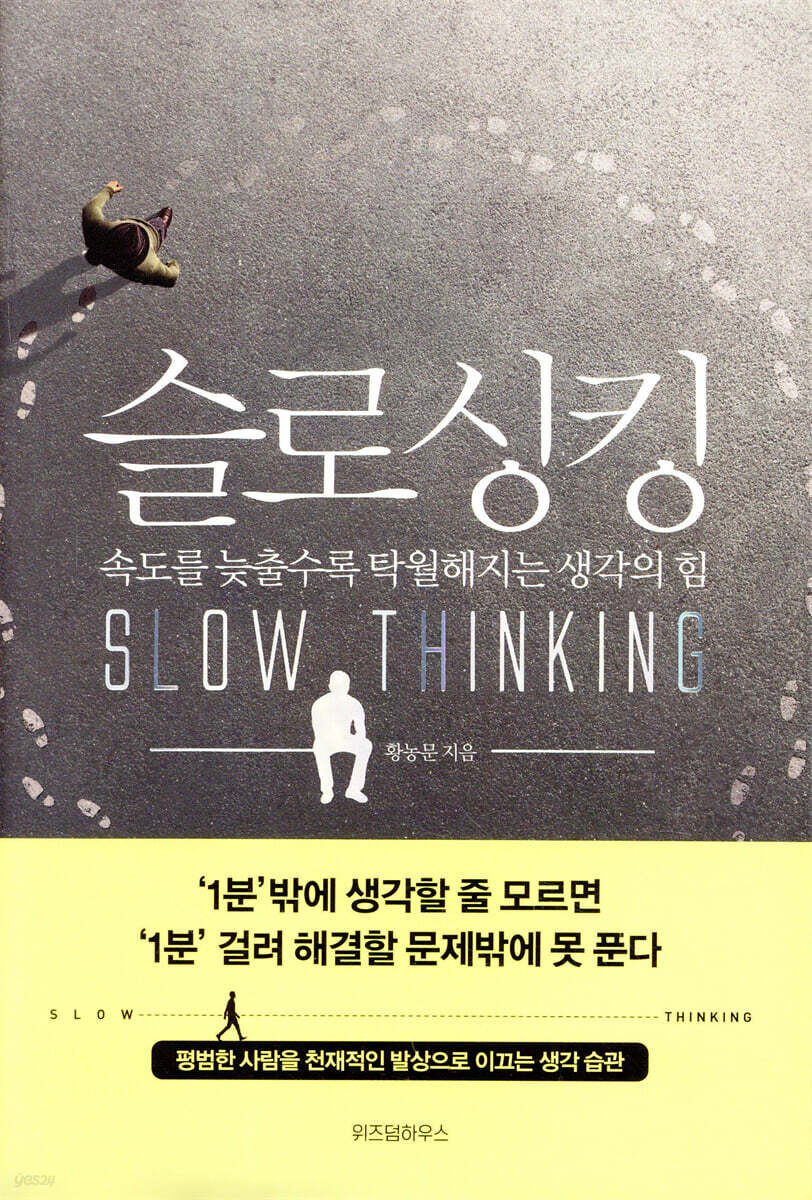
Slow Thinking: A Way of Thinking That Eliminates Distraction and Stress and Sparks Outstanding Ideas The habit of wandering thoughts without depth is the main culprit that reduces the performance of work or studies, and can also be the cause of stress, distraction, anxiety, and burnout syndrome. Immersion expert Dr. Hwang Nong-moon has published a book titled "Slow Thinking," which recommends reorganizing your thinking habits. Slow Sinking is a way of thinking that focuses on maintaining a comfortable, relaxed state of mind and body without stress, but without letting go of the thread of thought for even a second. This book introduces the principles and specific methods of slow sinking, which lead to excellent results the more you think slowly. |
- You can preview some of the book's contents.
Preview
index
Introduction_A person who knows the power of thinking, a slow-sinker
PART 1 People Who Change Their Thinking Habits
CHAPTER 01 I just thought and thought, and my life changed.
Solving life's problems that can't be solved with 'small but certain happiness'
-The happiness that comes when you change your thinking habits
CHAPTER 02 Slow Sinker, the Pioneer of Habits That Transformed the Brain
-If there was a way to train anything 24 hours a day without stopping
The Secret to Turning What You Need to Do into What You Love
CHAPTER 03 People who took their first steps into slow-sinking
-The simplest yet most powerful 'core engine of thought'
The power of slow-sinking to strengthen even the 'glass mentality'
CHAPTER 04 Excellent people think slowly
The Simple Secret of Geniuses Who Changed the World
-The difference between genius and mediocrity is the time spent thinking.
PART 2 Slow Thinking: The More You Think, the Better You Get
CHAPTER 05 Slow Thinking: The Art of Relaxing and Not Letting Go
An awakened brain memorizes, while a relaxed brain generates new ideas.
-The moment of genius that comes when you think and doze off and think again
CHAPTER 06 What Happens in the Slow-Sinking Brain
Even if it feels like you've hit a wall, your brain keeps moving forward.
-A stage of thought performance unfolding before an unconscious audience
-To change your life, direct the stage of your consciousness.
CHAPTER 07 A solid way of thinking that humanity has long refined
-Buddhist slow-sinking meditation, "Rest, rest, rest again."
-Slow-Sinking "Gyeong" in Neo-Confucianism: Cultivating Personality Through Immersion
-Toegye's study and Andrew Wiles' attic
: The best ideas are found in sleep and dreams.
PART 3: HOW DOES SLOSINKING WORK?
CHAPTER 08 Slow-Sinking Immersion Principles to Remember When Studying for Long Periods
- Slow Sinking: Principles of Long-Term Immersion 11
1. Sleep time is review time.
2. Slow sinking and 20-minute naps are a habit.
3.1 Practice without losing your mind for even a second
4. Regular exercise for 30 minutes a day
5. Focus on one subject for more than a week rather than studying several subjects in one day.
6. Thinking and understanding will help you remember things longer than just memorizing them.
7. Create an experience where you can solve unknown problems on your own.
8. Anxiety is controlled when you focus on the process rather than the outcome.
9. Choose and focus wisely
10. Use infinite repetition in various ways
11. Finding the reason I study
CHAPTER 09 Things that change while you continue slow-sinking
-“Immersion is the power that allows you to live as your ‘most special self.’”
-“I just feel like I’m the happiest person.”
CHAPTER 10: How to Use Slow Sinking to Get the Best Results in a Short Period of Time
If you have an upcoming exam, use intentional immersion.
-The more important the presentation, the less likely you are to memorize the manuscript.
CHAPTER 11 Slow-Sinking: A Side Dish for Office Workers Who Have a Hard Time Concentrating
12 Tips for Slow Sinking at Work
-Use your spare time to immerse yourself in something economical
- Post-its and infinite loops are helpful when the work environment is distracting.
- Aiming for synergy through organizational immersion
PART 4 Creative Thinking Optimized for the Human Brain
CHAPTER 12: A Look Back at Creativity: A Power Unique to the Human Brain
The coming 4th Industrial Revolution: What should we prepare for?
-Now is the time for inspiration, not sweat.
Why Creativity Education Should Become a Korean Project
: Jewish creative education focusing on brain and mental maturity
CHAPTER 13 How Talent Becomes Excellence
-What can I ask of a brain that never betrays me?
-All talent and creativity are acquired.
: Geniuses of the Century Born Prematurely
CHAPTER 14 Creativity is not a gift from God
-The power of thinking for yourself is more important than learning
Creative people take on challenges persistently and grow quickly.
The Secret of the 'Hungarian Phenomenon' That Produced So Many Geniuses
-Why so many Nobel Prize winners come from Japan
CHAPTER 15: Teaching Creativity Through Slow-Sinking Training
The secret to student J's transformation into a creative talent in just six months.
-3,000 Hours of Slow Sinking with the Last-Ranking Middle School Student
CHAPTER 16 The brain is most creative when solving unknown problems.
-“I am now completely free from anxiety and nervousness.”
-“Once one small idea comes to mind, everything else flows smoothly.”
-“It was a valuable time that allowed my brain to function perfectly.”
CHAPTER 17 If you don't stop thinking, you won't stop growing.
-First, take on a challenge that is bound to succeed.
-How I Climbed the Hill of Thought
-Easy challenges, moderate challenges, and even challenges that seem nearly impossible.
main
PART 1 People Who Change Their Thinking Habits
CHAPTER 01 I just thought and thought, and my life changed.
Solving life's problems that can't be solved with 'small but certain happiness'
-The happiness that comes when you change your thinking habits
CHAPTER 02 Slow Sinker, the Pioneer of Habits That Transformed the Brain
-If there was a way to train anything 24 hours a day without stopping
The Secret to Turning What You Need to Do into What You Love
CHAPTER 03 People who took their first steps into slow-sinking
-The simplest yet most powerful 'core engine of thought'
The power of slow-sinking to strengthen even the 'glass mentality'
CHAPTER 04 Excellent people think slowly
The Simple Secret of Geniuses Who Changed the World
-The difference between genius and mediocrity is the time spent thinking.
PART 2 Slow Thinking: The More You Think, the Better You Get
CHAPTER 05 Slow Thinking: The Art of Relaxing and Not Letting Go
An awakened brain memorizes, while a relaxed brain generates new ideas.
-The moment of genius that comes when you think and doze off and think again
CHAPTER 06 What Happens in the Slow-Sinking Brain
Even if it feels like you've hit a wall, your brain keeps moving forward.
-A stage of thought performance unfolding before an unconscious audience
-To change your life, direct the stage of your consciousness.
CHAPTER 07 A solid way of thinking that humanity has long refined
-Buddhist slow-sinking meditation, "Rest, rest, rest again."
-Slow-Sinking "Gyeong" in Neo-Confucianism: Cultivating Personality Through Immersion
-Toegye's study and Andrew Wiles' attic
: The best ideas are found in sleep and dreams.
PART 3: HOW DOES SLOSINKING WORK?
CHAPTER 08 Slow-Sinking Immersion Principles to Remember When Studying for Long Periods
- Slow Sinking: Principles of Long-Term Immersion 11
1. Sleep time is review time.
2. Slow sinking and 20-minute naps are a habit.
3.1 Practice without losing your mind for even a second
4. Regular exercise for 30 minutes a day
5. Focus on one subject for more than a week rather than studying several subjects in one day.
6. Thinking and understanding will help you remember things longer than just memorizing them.
7. Create an experience where you can solve unknown problems on your own.
8. Anxiety is controlled when you focus on the process rather than the outcome.
9. Choose and focus wisely
10. Use infinite repetition in various ways
11. Finding the reason I study
CHAPTER 09 Things that change while you continue slow-sinking
-“Immersion is the power that allows you to live as your ‘most special self.’”
-“I just feel like I’m the happiest person.”
CHAPTER 10: How to Use Slow Sinking to Get the Best Results in a Short Period of Time
If you have an upcoming exam, use intentional immersion.
-The more important the presentation, the less likely you are to memorize the manuscript.
CHAPTER 11 Slow-Sinking: A Side Dish for Office Workers Who Have a Hard Time Concentrating
12 Tips for Slow Sinking at Work
-Use your spare time to immerse yourself in something economical
- Post-its and infinite loops are helpful when the work environment is distracting.
- Aiming for synergy through organizational immersion
PART 4 Creative Thinking Optimized for the Human Brain
CHAPTER 12: A Look Back at Creativity: A Power Unique to the Human Brain
The coming 4th Industrial Revolution: What should we prepare for?
-Now is the time for inspiration, not sweat.
Why Creativity Education Should Become a Korean Project
: Jewish creative education focusing on brain and mental maturity
CHAPTER 13 How Talent Becomes Excellence
-What can I ask of a brain that never betrays me?
-All talent and creativity are acquired.
: Geniuses of the Century Born Prematurely
CHAPTER 14 Creativity is not a gift from God
-The power of thinking for yourself is more important than learning
Creative people take on challenges persistently and grow quickly.
The Secret of the 'Hungarian Phenomenon' That Produced So Many Geniuses
-Why so many Nobel Prize winners come from Japan
CHAPTER 15: Teaching Creativity Through Slow-Sinking Training
The secret to student J's transformation into a creative talent in just six months.
-3,000 Hours of Slow Sinking with the Last-Ranking Middle School Student
CHAPTER 16 The brain is most creative when solving unknown problems.
-“I am now completely free from anxiety and nervousness.”
-“Once one small idea comes to mind, everything else flows smoothly.”
-“It was a valuable time that allowed my brain to function perfectly.”
CHAPTER 17 If you don't stop thinking, you won't stop growing.
-First, take on a challenge that is bound to succeed.
-How I Climbed the Hill of Thought
-Easy challenges, moderate challenges, and even challenges that seem nearly impossible.
main
Detailed image
Into the book
“You shouldn’t think about this problem like I do.
Don't think too quickly.
“You have to think slowly, leisurely, and without stress to solve it.” --- p.4
The reason people have trouble getting into a state of immersion is because there is always a 'flow barrier' between a distracted state and a state of high immersion.
We tend to take the easy way out in life and instinctively try to avoid obstacles.
--- p.27
Slow thinking differs from simple concentration in that it maintains a focused state, but rather than allowing your thoughts to remain in one place, you engage your brain dynamically to solve the problem.
As you practice and become more comfortable with slow thinking, you will find yourself replacing your old habits of thinking urgently and shallowly with habits of thinking slowly and deeply.
Learning slow thinking is a process of changing your thinking habits.
--- p.28
However, many people do not understand the concept of slow sinking.
'Thinking' is always a headache and a struggle, so how can we think 'comfortably and without stress'?
Some say it sounds absurd to be highly immersed while relaxing your body and mind.
But when you actually try it, slow sinking is not difficult at all.
Anyone can do it easily if they know how.
--- p.43
Therefore, it can be seen that it is advantageous to do rote learning, which focuses on memory storage, in an awake state, and think-based learning, which focuses on memory retrieval, in a relaxed state.
In other words, when memorizing words or listening to a lecture, an aroused state is advantageous, and when understanding content or solving an unknown problem, a relaxed state is more advantageous.
This is precisely why slow thinking is said to be advantageous for solving unknown problems and generating ideas.
--- p.72
Thinking in this 'lazy' position usually makes you sleepy, so you just keep that position and lean your neck back to sleep.
Rather than 'fighting' against sleepiness and falling asleep, it would be more appropriate to say 'welcoming' sleepiness.
It's a light nap while sitting up, so I wake up on my own after no more than 20 minutes.
When I wake up like that, my thoughts naturally continue.
--- p.74
Through deliberate immersion and slow-sinking, we can fill the stage of consciousness with as much content as we need.
In that sense, a slow sinker can be said to be someone who does not lose control of their life and leads their life in the direction they want.
--- p.87
The immersion we seek is to solve the big and small problems we encounter in our daily lives and to maximize our potential.
However, the effect is not much different from that pursued in Ganhwaseon or Jeongja meditation in that by focusing highly on the task given to me in a relaxed state, I achieve creative enlightenment, reach a peaceful and happy mental state, and ultimately lead to a change in values.
--- p.104
“It was a real wake-up call.
I thought I didn't use my smartphone much, but when I looked at my KakaoTalk conversation history, I realized I've been chatting with friends a lot.
There were also many traces of mindless internet surfing.
I didn't realize that until now.
“It was such a shame to think that the immersion I had worked so hard to build up was suddenly ruined by something like this.” --- p.122
It is revealed that through long-term immersion experiences, they have developed values that are clearly different from those of their peers.
This change in values is because I have gained confidence in life as I have learned how to do my best and be happy.
--- p.154
It's not just the lack of time that's encouraging office workers to utilize their spare time.
If you set aside time for slow-sinking, you can easily feel pressured to achieve good results.
However, if you utilize the spare time that is 'time that would otherwise be wasted', you can slow sink comfortably without this burden and pressure.
--- p.183
When a problem is difficult, distracting thoughts come in without any progress in thinking.
There is absolutely no need to worry about that.
When immersion is low, distracting thoughts arise not because you are out of your mind, but because it is a natural phenomenon, like a law of nature.
As soon as you realize that you have lost yourself in a distracting thought, simply bring the original problem you were thinking about back onto the stage of consciousness.
--- p.281
The very act of thinking about a problem brings excitement and fun, and miraculous ideas that help solve the problem come to mind with a high frequency.
Every time that happens, I feel joy and thrill.
At such times, life becomes dazzlingly brilliant, and this experience continues, inspiring one's own life and leading to self-realization, which brings out deeply hidden potential.
Don't think too quickly.
“You have to think slowly, leisurely, and without stress to solve it.” --- p.4
The reason people have trouble getting into a state of immersion is because there is always a 'flow barrier' between a distracted state and a state of high immersion.
We tend to take the easy way out in life and instinctively try to avoid obstacles.
--- p.27
Slow thinking differs from simple concentration in that it maintains a focused state, but rather than allowing your thoughts to remain in one place, you engage your brain dynamically to solve the problem.
As you practice and become more comfortable with slow thinking, you will find yourself replacing your old habits of thinking urgently and shallowly with habits of thinking slowly and deeply.
Learning slow thinking is a process of changing your thinking habits.
--- p.28
However, many people do not understand the concept of slow sinking.
'Thinking' is always a headache and a struggle, so how can we think 'comfortably and without stress'?
Some say it sounds absurd to be highly immersed while relaxing your body and mind.
But when you actually try it, slow sinking is not difficult at all.
Anyone can do it easily if they know how.
--- p.43
Therefore, it can be seen that it is advantageous to do rote learning, which focuses on memory storage, in an awake state, and think-based learning, which focuses on memory retrieval, in a relaxed state.
In other words, when memorizing words or listening to a lecture, an aroused state is advantageous, and when understanding content or solving an unknown problem, a relaxed state is more advantageous.
This is precisely why slow thinking is said to be advantageous for solving unknown problems and generating ideas.
--- p.72
Thinking in this 'lazy' position usually makes you sleepy, so you just keep that position and lean your neck back to sleep.
Rather than 'fighting' against sleepiness and falling asleep, it would be more appropriate to say 'welcoming' sleepiness.
It's a light nap while sitting up, so I wake up on my own after no more than 20 minutes.
When I wake up like that, my thoughts naturally continue.
--- p.74
Through deliberate immersion and slow-sinking, we can fill the stage of consciousness with as much content as we need.
In that sense, a slow sinker can be said to be someone who does not lose control of their life and leads their life in the direction they want.
--- p.87
The immersion we seek is to solve the big and small problems we encounter in our daily lives and to maximize our potential.
However, the effect is not much different from that pursued in Ganhwaseon or Jeongja meditation in that by focusing highly on the task given to me in a relaxed state, I achieve creative enlightenment, reach a peaceful and happy mental state, and ultimately lead to a change in values.
--- p.104
“It was a real wake-up call.
I thought I didn't use my smartphone much, but when I looked at my KakaoTalk conversation history, I realized I've been chatting with friends a lot.
There were also many traces of mindless internet surfing.
I didn't realize that until now.
“It was such a shame to think that the immersion I had worked so hard to build up was suddenly ruined by something like this.” --- p.122
It is revealed that through long-term immersion experiences, they have developed values that are clearly different from those of their peers.
This change in values is because I have gained confidence in life as I have learned how to do my best and be happy.
--- p.154
It's not just the lack of time that's encouraging office workers to utilize their spare time.
If you set aside time for slow-sinking, you can easily feel pressured to achieve good results.
However, if you utilize the spare time that is 'time that would otherwise be wasted', you can slow sink comfortably without this burden and pressure.
--- p.183
When a problem is difficult, distracting thoughts come in without any progress in thinking.
There is absolutely no need to worry about that.
When immersion is low, distracting thoughts arise not because you are out of your mind, but because it is a natural phenomenon, like a law of nature.
As soon as you realize that you have lost yourself in a distracting thought, simply bring the original problem you were thinking about back onto the stage of consciousness.
--- p.281
The very act of thinking about a problem brings excitement and fun, and miraculous ideas that help solve the problem come to mind with a high frequency.
Every time that happens, I feel joy and thrill.
At such times, life becomes dazzlingly brilliant, and this experience continues, inspiring one's own life and leading to self-realization, which brings out deeply hidden potential.
--- p.323
Publisher's Review
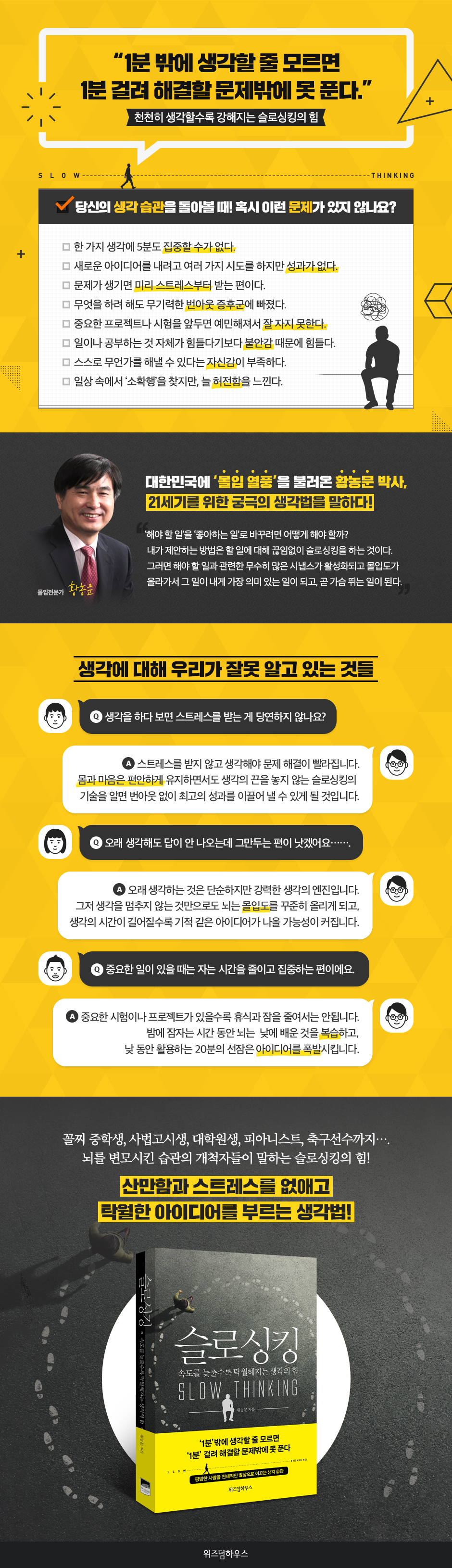
Stress, distraction, burnout, lethargy… Modern-day chronic diseases caused by faulty thinking habits.
If life doesn't go as planned, it's time to look back on your thinking habits.
There is something that is most difficult for modern people who live as one with their smartphones.
It's about slowly concentrating on one thought.
For modern people who have no choice but to live with their attention robbed, Dr. Hwang Nong-moon, an engineer and immersion expert, has published a book titled "Slow Thinking" that recommends reorganizing the "habits of thinking."
The habit of moving thoughts around without depth is the main culprit that reduces the performance of work or studies, and it can also cause stress, distraction, anxiety, and burnout syndrome.
So, how can we expand the limits of our thinking and improve its quality? Having coached countless people in immersive thinking, the author felt the need to distinguish between the way people generally think and his or her own unique way of thinking.
I came to realize that the reason I was able to stay in a state of high immersion for months or years without feeling tired or exhausted was not because I just thought, but because I used my own way of thinking. That's why I created the concept of 'slow thinking', and I've been introducing this way of thinking to people who want to become immersed.
How to think slowly, leisurely, and stress-free
The simplest and most powerful core engine of thought: Slow Thinking.
Dr. Hwang Nong-moon says the secret to solving difficult problems or coming up with miraculous ideas is actually simple.
It's about thinking about one topic for as long as possible without losing sight of it.
Simply by maintaining a focus on your thoughts for a long time, your level of immersion will continue to increase, which will increase the likelihood of coming up with novel ideas and improve learning efficiency.
However, it is not easy for ordinary people to think for a long time because they are afraid of thinking or get tired easily due to the prejudice that 'thinking is a pain in the ass'.
For those people, the slow thinking introduced in this book can be said to be a 'core engine of thought' that allows them to think comfortably for a long time.
Slow thinking is a way of thinking that involves maintaining a comfortable, relaxed state of mind and body without stress, while concentrating so much that you don't let go of your thoughts for even a second.
The book introduces the principles of slow sinking and specific practical methods, including the '11 Principles of Long-Term Slow Sinking Immersion' that can be applied to study or work.
It guides readers to a new way of thinking by presenting various examples of geniuses who were actually 'slow sinkers' as well as those who experienced the effectiveness of slow sinking immersion under the guidance of Dr. Hwang Nong-moon.
Our brain becomes stronger the more we think slowly!
The power of slow-sinking to awaken dormant creativity and lead to happiness and satisfaction.
People who have experienced immersion based on slow sinking often share the surprising experience of initially only trying to achieve results in their studies or work, but then feeling a sense of extreme happiness and even a change in their outlook on life.
By completely immersing myself in the 'right now' of work or study, I was able to change 'what I have to do' into 'what I like and find fun.'
Dr. Hwang Nong-moon calls this process the realm of self-realization and the 'conquest of happiness.'
In this process, our brains begin to draw out 100% of their potential, developing uniquely human capabilities—creativity and inspiration—that cannot be replaced by artificial intelligence.
In this way, slow sinking leads us into a world of amazing immersion.
Discover Slow Thinking, the ultimate 21st-century way of thinking that empowers you to maximize your potential in learning and work, while also fostering mental maturity and stability, and fostering creativity and inspiration.
If life doesn't go as planned, it's time to look back on your thinking habits.
There is something that is most difficult for modern people who live as one with their smartphones.
It's about slowly concentrating on one thought.
For modern people who have no choice but to live with their attention robbed, Dr. Hwang Nong-moon, an engineer and immersion expert, has published a book titled "Slow Thinking" that recommends reorganizing the "habits of thinking."
The habit of moving thoughts around without depth is the main culprit that reduces the performance of work or studies, and it can also cause stress, distraction, anxiety, and burnout syndrome.
So, how can we expand the limits of our thinking and improve its quality? Having coached countless people in immersive thinking, the author felt the need to distinguish between the way people generally think and his or her own unique way of thinking.
I came to realize that the reason I was able to stay in a state of high immersion for months or years without feeling tired or exhausted was not because I just thought, but because I used my own way of thinking. That's why I created the concept of 'slow thinking', and I've been introducing this way of thinking to people who want to become immersed.
How to think slowly, leisurely, and stress-free
The simplest and most powerful core engine of thought: Slow Thinking.
Dr. Hwang Nong-moon says the secret to solving difficult problems or coming up with miraculous ideas is actually simple.
It's about thinking about one topic for as long as possible without losing sight of it.
Simply by maintaining a focus on your thoughts for a long time, your level of immersion will continue to increase, which will increase the likelihood of coming up with novel ideas and improve learning efficiency.
However, it is not easy for ordinary people to think for a long time because they are afraid of thinking or get tired easily due to the prejudice that 'thinking is a pain in the ass'.
For those people, the slow thinking introduced in this book can be said to be a 'core engine of thought' that allows them to think comfortably for a long time.
Slow thinking is a way of thinking that involves maintaining a comfortable, relaxed state of mind and body without stress, while concentrating so much that you don't let go of your thoughts for even a second.
The book introduces the principles of slow sinking and specific practical methods, including the '11 Principles of Long-Term Slow Sinking Immersion' that can be applied to study or work.
It guides readers to a new way of thinking by presenting various examples of geniuses who were actually 'slow sinkers' as well as those who experienced the effectiveness of slow sinking immersion under the guidance of Dr. Hwang Nong-moon.
Our brain becomes stronger the more we think slowly!
The power of slow-sinking to awaken dormant creativity and lead to happiness and satisfaction.
People who have experienced immersion based on slow sinking often share the surprising experience of initially only trying to achieve results in their studies or work, but then feeling a sense of extreme happiness and even a change in their outlook on life.
By completely immersing myself in the 'right now' of work or study, I was able to change 'what I have to do' into 'what I like and find fun.'
Dr. Hwang Nong-moon calls this process the realm of self-realization and the 'conquest of happiness.'
In this process, our brains begin to draw out 100% of their potential, developing uniquely human capabilities—creativity and inspiration—that cannot be replaced by artificial intelligence.
In this way, slow sinking leads us into a world of amazing immersion.
Discover Slow Thinking, the ultimate 21st-century way of thinking that empowers you to maximize your potential in learning and work, while also fostering mental maturity and stability, and fostering creativity and inspiration.
GOODS SPECIFICS
- Publication date: November 19, 2020
- Page count, weight, size: 332 pages | 532g | 145*215*30mm
- ISBN13: 9791191119640
- ISBN10: 1191119645
You may also like
카테고리
korean


korean

![GQ KOREA Mark (Monthly): December [2025]](http://librairie.coreenne.fr/cdn/shop/files/8ef265dbbfbf186523ed75ba7319009d.jpg?v=1765340328&width=3840)


