

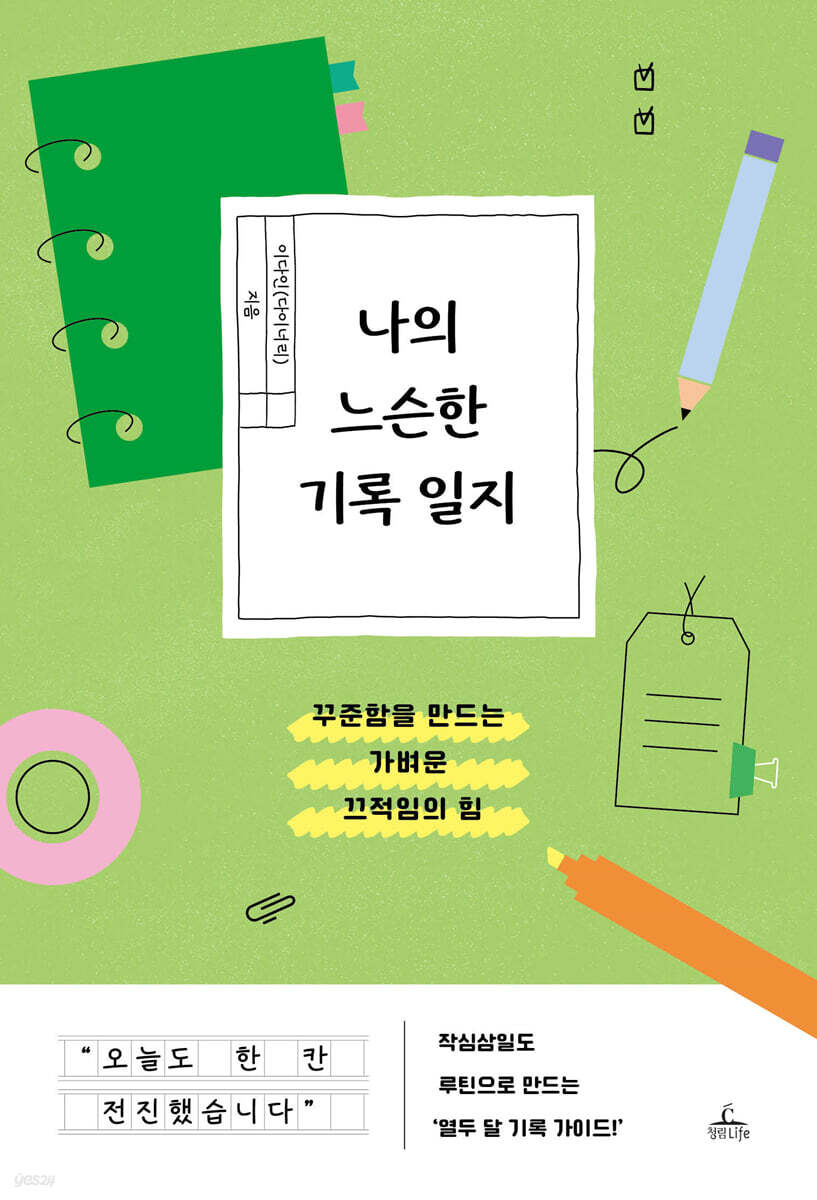
My Loose Record Journal
 |
Description
Book Introduction
“Nothing lasts forever, but it can last a long time.”
Even if not every day, continuously,
Record practice that makes me never give up!
"My Loose Record Journal" is a book for those who have never kept a diary to the end, or who like to keep a diary but are hesitant because they are afraid of failing again. It introduces a new recording method, one per month for a total of twelve months, and explains how to reduce the burden of keeping a diary and how anyone can live a life of keeping a diary.
The author, who is a self-proclaimed "record nerd" and runs a record-related account, proposes a loose and flexible record-keeping method that anyone can use to keep a steady record, based on his experience of writing and giving up on countless diaries.
This book contains various methods of recording, from simple writing to easy recording with photos and videos, to organizing your day with checklists and mood trackers, and even how to make the most of weekly and monthly diaries.
It also contains tips, TMI records, and travel journaling methods for those who feel burdened by handwritten records, making it more sensible and practical.
This book teaches not how to keep records, but how not to stop.
After countless trials and errors, the author realized that the key to persistence is the courage to rewrite, rather than the desire for perfection, and that a slightly looser attitude toward recording is the strength that allows him to continue recording for a long time.
If you've always vowed to yourself, "I'm going to finish my diary this year," every time a new year comes around, try creating your own four seasons at your own pace with this book.
Even if not every day, continuously,
Record practice that makes me never give up!
"My Loose Record Journal" is a book for those who have never kept a diary to the end, or who like to keep a diary but are hesitant because they are afraid of failing again. It introduces a new recording method, one per month for a total of twelve months, and explains how to reduce the burden of keeping a diary and how anyone can live a life of keeping a diary.
The author, who is a self-proclaimed "record nerd" and runs a record-related account, proposes a loose and flexible record-keeping method that anyone can use to keep a steady record, based on his experience of writing and giving up on countless diaries.
This book contains various methods of recording, from simple writing to easy recording with photos and videos, to organizing your day with checklists and mood trackers, and even how to make the most of weekly and monthly diaries.
It also contains tips, TMI records, and travel journaling methods for those who feel burdened by handwritten records, making it more sensible and practical.
This book teaches not how to keep records, but how not to stop.
After countless trials and errors, the author realized that the key to persistence is the courage to rewrite, rather than the desire for perfection, and that a slightly looser attitude toward recording is the strength that allows him to continue recording for a long time.
If you've always vowed to yourself, "I'm going to finish my diary this year," every time a new year comes around, try creating your own four seasons at your own pace with this book.
- You can preview some of the book's contents.
Preview
index
prolog
Chapter 1.
I write it down because I want to remember it
What records mean to me
Countless unfilled diaries
A record that makes me more and more distinct
Chapter 2.
A special one-year record routine
Find the perfect recording method for you with the 'Twelve Month Record Sampler'
(January) Get started with photos and videos
(February) It's okay even if it's not handwritten
(March) Creating a Routine with a Checklist
(April) A small but certain sense of pride, a one-line diary entry
(May) Getting started with Monthly
(June) Apply Monthly
(July) Start of the Weekly Record
(August-September) Write about various topics
(October) Recording special days
(November) Digging into your tastes
(December) Year-end summary
Chapter 3.
Nothing lasts forever, but it can last a long time.
My goal is to last a long time
A new challenge called the Record Meeting
It's okay to be slow, at my own pace
Epilogue
Appendix Ask me anything!
Chapter 1.
I write it down because I want to remember it
What records mean to me
Countless unfilled diaries
A record that makes me more and more distinct
Chapter 2.
A special one-year record routine
Find the perfect recording method for you with the 'Twelve Month Record Sampler'
(January) Get started with photos and videos
(February) It's okay even if it's not handwritten
(March) Creating a Routine with a Checklist
(April) A small but certain sense of pride, a one-line diary entry
(May) Getting started with Monthly
(June) Apply Monthly
(July) Start of the Weekly Record
(August-September) Write about various topics
(October) Recording special days
(November) Digging into your tastes
(December) Year-end summary
Chapter 3.
Nothing lasts forever, but it can last a long time.
My goal is to last a long time
A new challenge called the Record Meeting
It's okay to be slow, at my own pace
Epilogue
Appendix Ask me anything!
Detailed image

Into the book
As I write this, I am a fairly distinct person.
These days, the style that people pursue is called 'Chugumi'.
I have my own distinct taste, not only in clothing, but also in the composition and colors of my photos and even the accessories in my bag.
Of course, my tastes change from time to time and I try new things, but I think all of those processes come together to create the 'self' I have today.
It is entirely thanks to the records that expressing myself like this has become natural.
I came to understand what I like more deeply, and I loved it even more.
---From "Records That Make Me More and More Clear"
There's a saying that if you want to know someone completely, you have to spend all four seasons with them.
I think the same goes for records.
To truly understand the concept of records and let them naturally permeate your life, I recommend spending the four seasons together with sincerity, even if it's a little slower.
Keeping records isn't a hobby that only special people can pursue.
Anyone who wants to feel a small sense of relief after a busy day and say, "Yes, I did well today," who doesn't want to lose themselves in the midst of a hectic daily life, or who simply wants to start something rather than wanting to do something well can definitely keep writing.
---From "The Twelve Month Record Sampler: Finding the Recording Method That's Right for You"
When I first started keeping a one-line diary, I thought, "I just write about my commute to work, my commute home, my workouts, and what I eat. Is it really necessary to keep doing this?"
But I wrote it down anyway.
But as I kept writing, it started to show up.
The thing is, no two days are the same.
Although I had a similar schedule every day, the details, such as the clothes I wore, the food I ate, the music I listened to, the scenery I passed by, and the weather, were all different.
I also felt that even if the weather is similar every day, I could express it differently by writing it out in sentences.
So it's important to write even just one line a day.
Time just passing by is invisible, but when we visualize it in the form of a record, it begins to become visible.
---From "A Small but Certain Pleasure, a One-Line Diary"
To keep a record, it is important to have repeated success experiences, even if they are not big.
As you gain experience like that, you won't be afraid of bigger challenges and you'll gain the confidence to keep going without putting them off.
It's like when someone finishes their first 5 kilometers in a race, they think, 'Maybe I can do 10 kilometers next time?'
I didn't complete a one-year diary from the beginning either.
After completing several thin diaries, I gained confidence that I could now write for a year.
In the process, I experienced a growth in my confidence and even a rise in my self-esteem.
---From "The Beginning of Weekly Records"
How about writing about things so trivial that they don't even need mentioning? Write down the smallest things that happened today, the little moments that might not mean much to others but are memorable to you.
For example, I had kimchi stew for lunch today and was surprised to see that there was a lot more tofu in it than usual, or I fell asleep while doing Pilates today.
This kind of record allows me to look back on my day with a new perspective.
Just thinking, "That's right, that happened too," can make an ordinary day feel a little more special. Writing TMI can be fun, so I highly recommend it.
---From "Writing on Various Topics"
By holding a record gathering, I was able to meet people who lived truly colorful lives.
Although we were brought together by a common interest in records, it was new and enjoyable to meet people with completely different occupations and backgrounds.
What I enjoy most of all is seeing the people who participated in the gathering become closer to each other and later meet up separately to share hobbies.
It makes me proud and happy to see our relationship expanding based on the commonality of records.
---From "A New Challenge: Record Gathering"
If you ask me what my secret to writing consistently is, I would say 'shamelessness.'
There's no special secret.
As I've said before, even if I get pushed, I just write again.
Even if you miss a few days, open your diary again without stressing.
It doesn't matter how many pages or lines are empty, it just keeps going.
When you start writing like that again, at some point you will naturally feel like writing again.
The important thing is not to have a perfect record, but to never stop recording.
These days, the style that people pursue is called 'Chugumi'.
I have my own distinct taste, not only in clothing, but also in the composition and colors of my photos and even the accessories in my bag.
Of course, my tastes change from time to time and I try new things, but I think all of those processes come together to create the 'self' I have today.
It is entirely thanks to the records that expressing myself like this has become natural.
I came to understand what I like more deeply, and I loved it even more.
---From "Records That Make Me More and More Clear"
There's a saying that if you want to know someone completely, you have to spend all four seasons with them.
I think the same goes for records.
To truly understand the concept of records and let them naturally permeate your life, I recommend spending the four seasons together with sincerity, even if it's a little slower.
Keeping records isn't a hobby that only special people can pursue.
Anyone who wants to feel a small sense of relief after a busy day and say, "Yes, I did well today," who doesn't want to lose themselves in the midst of a hectic daily life, or who simply wants to start something rather than wanting to do something well can definitely keep writing.
---From "The Twelve Month Record Sampler: Finding the Recording Method That's Right for You"
When I first started keeping a one-line diary, I thought, "I just write about my commute to work, my commute home, my workouts, and what I eat. Is it really necessary to keep doing this?"
But I wrote it down anyway.
But as I kept writing, it started to show up.
The thing is, no two days are the same.
Although I had a similar schedule every day, the details, such as the clothes I wore, the food I ate, the music I listened to, the scenery I passed by, and the weather, were all different.
I also felt that even if the weather is similar every day, I could express it differently by writing it out in sentences.
So it's important to write even just one line a day.
Time just passing by is invisible, but when we visualize it in the form of a record, it begins to become visible.
---From "A Small but Certain Pleasure, a One-Line Diary"
To keep a record, it is important to have repeated success experiences, even if they are not big.
As you gain experience like that, you won't be afraid of bigger challenges and you'll gain the confidence to keep going without putting them off.
It's like when someone finishes their first 5 kilometers in a race, they think, 'Maybe I can do 10 kilometers next time?'
I didn't complete a one-year diary from the beginning either.
After completing several thin diaries, I gained confidence that I could now write for a year.
In the process, I experienced a growth in my confidence and even a rise in my self-esteem.
---From "The Beginning of Weekly Records"
How about writing about things so trivial that they don't even need mentioning? Write down the smallest things that happened today, the little moments that might not mean much to others but are memorable to you.
For example, I had kimchi stew for lunch today and was surprised to see that there was a lot more tofu in it than usual, or I fell asleep while doing Pilates today.
This kind of record allows me to look back on my day with a new perspective.
Just thinking, "That's right, that happened too," can make an ordinary day feel a little more special. Writing TMI can be fun, so I highly recommend it.
---From "Writing on Various Topics"
By holding a record gathering, I was able to meet people who lived truly colorful lives.
Although we were brought together by a common interest in records, it was new and enjoyable to meet people with completely different occupations and backgrounds.
What I enjoy most of all is seeing the people who participated in the gathering become closer to each other and later meet up separately to share hobbies.
It makes me proud and happy to see our relationship expanding based on the commonality of records.
---From "A New Challenge: Record Gathering"
If you ask me what my secret to writing consistently is, I would say 'shamelessness.'
There's no special secret.
As I've said before, even if I get pushed, I just write again.
Even if you miss a few days, open your diary again without stressing.
It doesn't matter how many pages or lines are empty, it just keeps going.
When you start writing like that again, at some point you will naturally feel like writing again.
The important thing is not to have a perfect record, but to never stop recording.
---From "It's Okay to Be Slow, At My Own Pace"
Publisher's Review
Finding a recording method that suits me
A loose 'Twelve Month Record Guide'!
We've all probably had the experience of vowing to finish writing a diary, only to find ourselves staring blankly at the blank space of the notebook a few days later, not knowing what to write.
"My Loose Record Journal" is a "record guidebook" that compiles only the core of the various methods the author, who has repeated such experiences, has tried to finally establish record keeping as a habit.
The author introduces one recording method each month through the format of a 'twelve-month recording sampler'.
Starting with simple questions like, "What did I eat today?", we introduce various recording methods such as a "checklist" to remember what needs to be done, a "mood tracker" to record today's mood with color, and a "photo monthly" to record the month with photos instead of words.
Through this process, readers can organize their daily lives, face their emotions, and experience a clearer picture of the countless tastes that make up their lives.
After twelve months of practice, writing will no longer be a monotonous habit, but will become a task that makes me distinct.
Sharing, not giving up
That's the power that ultimately sustains the record
The author, who initially recorded his daily life on his own, expanded the recording from a hobby of his own to a way of life enjoyed with others.
You can create a social media account dedicated to records to share your interests, or create your own record club to share what you like with others, find comfort and inspiration, and further expand the joy of records.
This shows that records can be a valuable medium for sharing empathy and inspiration with others beyond personal tastes and reflections.
In "My Loose Record Journal," the author repeatedly emphasizes, "It's okay if the records pile up or if you take a few days off."
The important thing is the will to start recording again, that's one thing.
For those who find writing difficult, those who want to keep it consistent but keep giving up, and those looking for new inspiration for writing, this book will be a solid companion on your journey.
You don't have to write nicely or try to write every day without fail.
It's okay if it's not perfect.
If we continue to keep our own records, even if they are a little clumsy and loose, with this book, we will all eventually be able to become 'record-makers.'
A loose 'Twelve Month Record Guide'!
We've all probably had the experience of vowing to finish writing a diary, only to find ourselves staring blankly at the blank space of the notebook a few days later, not knowing what to write.
"My Loose Record Journal" is a "record guidebook" that compiles only the core of the various methods the author, who has repeated such experiences, has tried to finally establish record keeping as a habit.
The author introduces one recording method each month through the format of a 'twelve-month recording sampler'.
Starting with simple questions like, "What did I eat today?", we introduce various recording methods such as a "checklist" to remember what needs to be done, a "mood tracker" to record today's mood with color, and a "photo monthly" to record the month with photos instead of words.
Through this process, readers can organize their daily lives, face their emotions, and experience a clearer picture of the countless tastes that make up their lives.
After twelve months of practice, writing will no longer be a monotonous habit, but will become a task that makes me distinct.
Sharing, not giving up
That's the power that ultimately sustains the record
The author, who initially recorded his daily life on his own, expanded the recording from a hobby of his own to a way of life enjoyed with others.
You can create a social media account dedicated to records to share your interests, or create your own record club to share what you like with others, find comfort and inspiration, and further expand the joy of records.
This shows that records can be a valuable medium for sharing empathy and inspiration with others beyond personal tastes and reflections.
In "My Loose Record Journal," the author repeatedly emphasizes, "It's okay if the records pile up or if you take a few days off."
The important thing is the will to start recording again, that's one thing.
For those who find writing difficult, those who want to keep it consistent but keep giving up, and those looking for new inspiration for writing, this book will be a solid companion on your journey.
You don't have to write nicely or try to write every day without fail.
It's okay if it's not perfect.
If we continue to keep our own records, even if they are a little clumsy and loose, with this book, we will all eventually be able to become 'record-makers.'
GOODS SPECIFICS
- Date of issue: July 30, 2025
- Page count, weight, size: 188 pages | 256g | 128*188*12mm
- ISBN13: 9791193842423
- ISBN10: 1193842425
You may also like
카테고리
korean


korean

![GQ KOREA Mark (Monthly): December [2025]](http://librairie.coreenne.fr/cdn/shop/files/8ef265dbbfbf186523ed75ba7319009d.jpg?v=1765340328&width=3840)


