

Jewish commercialism
 |
Description
Book Introduction
“Learn the secrets of making money from the merchants of Ginza, Japan!”
A famous book published by an outside publisher under an official contract,
Billionaire Den Fujida's "Jewish Salesmanship"
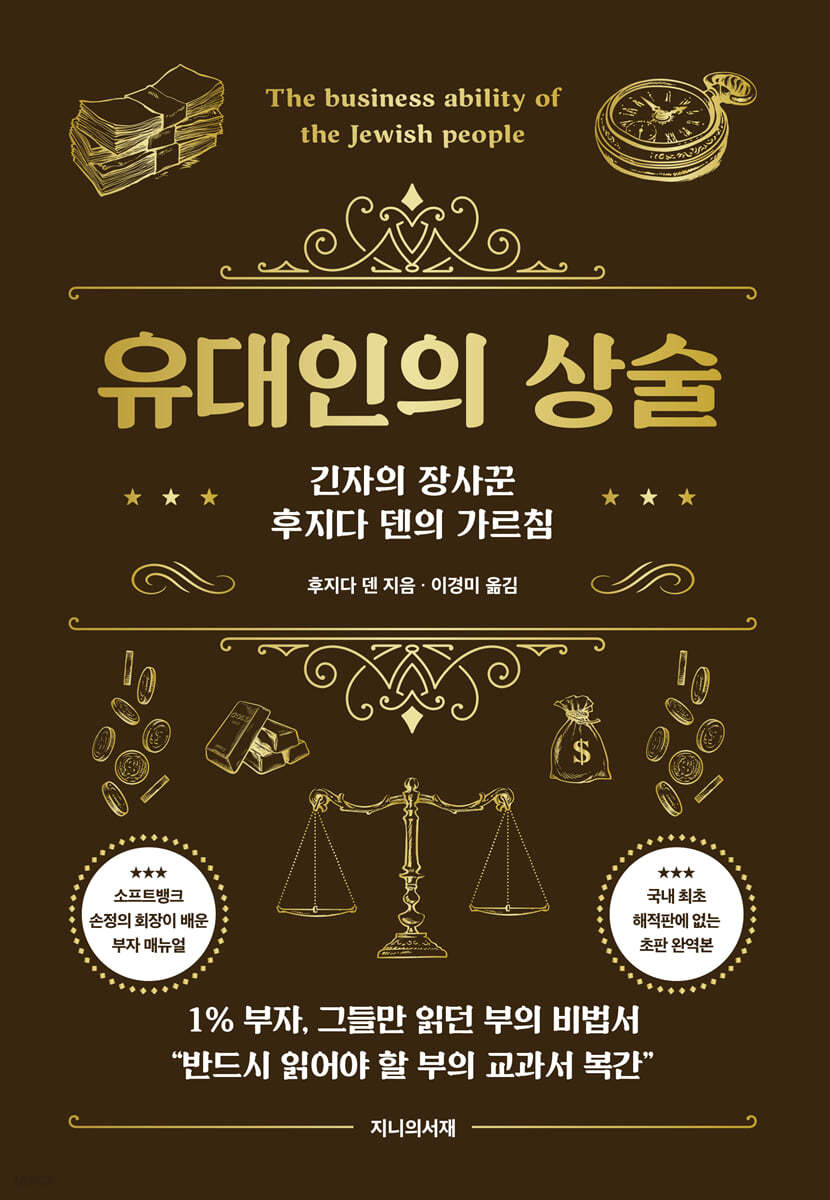
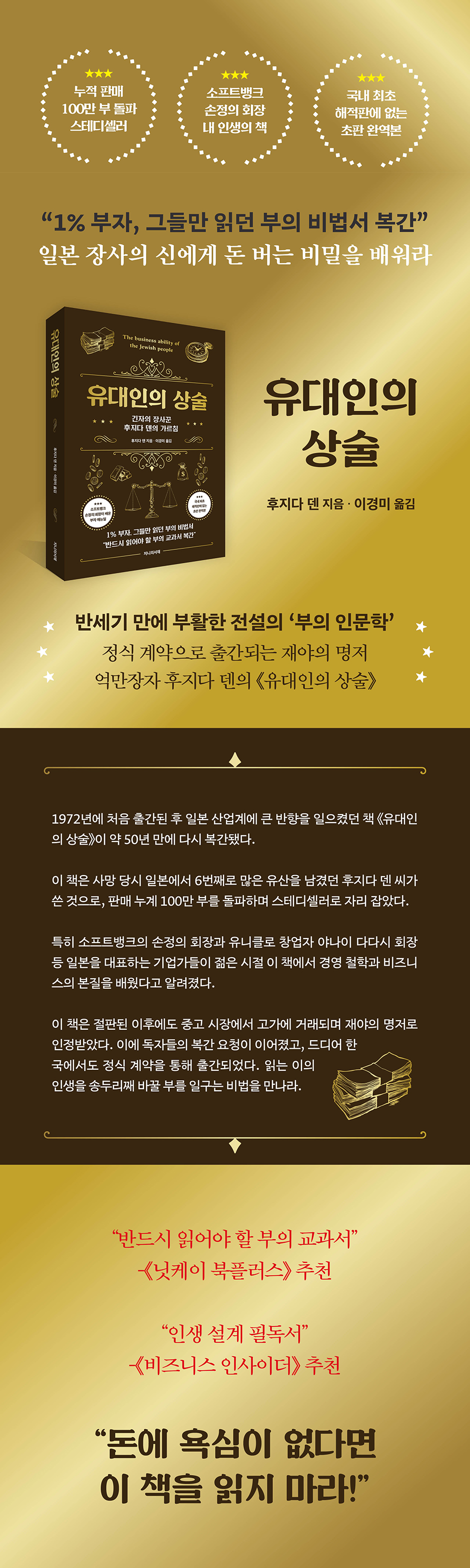
First published in 1972, 『Jewish Business Tactics』 by Den Fujida, a billionaire who left behind the sixth largest inheritance in Japanese history at the time of his death, caused a great stir in the Japanese business world.
It won 4th place in the Business Practice category of the Readers' Choice Business Book Grand Prix, and was republished after 50 years to much acclaim.
In particular, it is known that leading Japanese entrepreneurs, such as SoftBank Chairman Son Jeong-ui and Uniqlo founder Tadashi Yanai, learned management philosophy and the essence of business from this book in their youth, and it has become a steady seller with cumulative sales exceeding 1 million copies.
While attending the Faculty of Law at the University of Tokyo, Fujida Den worked part-time as an interpreter at the Supreme Commander for the Allied Powers (GHQ), where he had the opportunity to interact with Jewish businessmen.
Based on the business know-how he learned from them, he founded McDonald's in Japan in 1971, bringing innovation to the Japanese restaurant industry.
This book conveys to readers the wisdom he acquired as a Jewish merchant, presented in concise and practical advice.
For example, "Keep your contracts" preaches the importance of trust in business, and "Time is a commodity" reminds us that efficient time management is the key to success.
It also conveys to readers the realistic and intuitive idea that 'there is no such thing as clean money or dirty money in business.'
Even after going out of print, this book was still sold at high prices on the used market and was recognized as a classic among the public.
This led to continued requests from readers for its re-publication, and finally, responding to the demands of the new era, it was re-published in Japan with great fanfare, and finally reached readers in Korea through an official contract.
Minoru Yamazaki, the editor of the Japanese publishing company that planned the reissue, said, “I wanted to help the younger generation develop their own survival strategies in the changing work environment,” and emphasized that “Jewish Commerce” will convey surprising wealth wisdom to readers today.
Even in an era where the digital economy and immaterial assets are gaining traction, Fujita Den's business philosophy, centered on the real economy, remains timeless, offering readers a life philosophy that goes beyond simply learning how to make money.
A famous book published by an outside publisher under an official contract,
Billionaire Den Fujida's "Jewish Salesmanship"
First published in 1972, 『Jewish Business Tactics』 by Den Fujida, a billionaire who left behind the sixth largest inheritance in Japanese history at the time of his death, caused a great stir in the Japanese business world.
It won 4th place in the Business Practice category of the Readers' Choice Business Book Grand Prix, and was republished after 50 years to much acclaim.
In particular, it is known that leading Japanese entrepreneurs, such as SoftBank Chairman Son Jeong-ui and Uniqlo founder Tadashi Yanai, learned management philosophy and the essence of business from this book in their youth, and it has become a steady seller with cumulative sales exceeding 1 million copies.
While attending the Faculty of Law at the University of Tokyo, Fujida Den worked part-time as an interpreter at the Supreme Commander for the Allied Powers (GHQ), where he had the opportunity to interact with Jewish businessmen.
Based on the business know-how he learned from them, he founded McDonald's in Japan in 1971, bringing innovation to the Japanese restaurant industry.
This book conveys to readers the wisdom he acquired as a Jewish merchant, presented in concise and practical advice.
For example, "Keep your contracts" preaches the importance of trust in business, and "Time is a commodity" reminds us that efficient time management is the key to success.
It also conveys to readers the realistic and intuitive idea that 'there is no such thing as clean money or dirty money in business.'
Even after going out of print, this book was still sold at high prices on the used market and was recognized as a classic among the public.
This led to continued requests from readers for its re-publication, and finally, responding to the demands of the new era, it was re-published in Japan with great fanfare, and finally reached readers in Korea through an official contract.
Minoru Yamazaki, the editor of the Japanese publishing company that planned the reissue, said, “I wanted to help the younger generation develop their own survival strategies in the changing work environment,” and emphasized that “Jewish Commerce” will convey surprising wealth wisdom to readers today.
Even in an era where the digital economy and immaterial assets are gaining traction, Fujita Den's business philosophy, centered on the real economy, remains timeless, offering readers a life philosophy that goes beyond simply learning how to make money.
- You can preview some of the book's contents.
Preview
index
To begin with
Anyone who wants to make money, please read this.
Part 1 This is Jewish commerce
The universal law of '78 to 22'
How to Make Money Through the Rich
Let's introduce numbers into our lives.
The ruler of the world, his name is 'Jewish Merchant'
There is no such thing as clean money or dirty money.
Depositing money in a bank to earn interest is a loss.
Safe deposit boxes are not safe
Women's consumer culture led by commercialism
Why Money Rolls In When You Target the 'Mouth'
Foreign languages are essential for business success.
Be good at mental arithmetic
Be sure to take note
Arm yourself with diverse knowledge
Don't drag today's fight into tomorrow.
Jewish Hand-Cutting Techniques That Don't Cross the Danger Line
The CEO must create a profitable company.
A contract is a promise with God.
A contract is also a product
Pull the hanged man's feet
Nationality also becomes a means of making money.
Earn more than your taxes
Time is also a commodity
Know that an unexpected guest is a thief.
Make an appointment in advance, it makes things easier.
Part 2 My Own Jewish Marketing
An easy name to pronounce attracts money.
Fight discrimination with money
Jewish business tactics learned in the military
The match is decided by timing.
Even if the loss is great, you must meet the delivery date.
A rational response to unscrupulous merchants
Read one step ahead
How to sell for a fair price
Jewish commerce and Osaka commerce
Make it popular among the rich
Earn money with the free-spirited salesmanship
Jewish names
Part 3 The Heart of Jewish Commerce
Don't eat to work, work to eat.
Don't put your work on the table
A rich person is a great person, a poor person is an ugly person
The only person you can trust is yourself.
Start financial education from a young age.
Trust no one, not even your wife.
A case where a unique idea led to success
Don't trust others based on assumptions.
Give national sovereignty to a dog.
Ask questions until you understand
Know your enemy and know yourself
Be sure to rest for your health
Passing is 60 points out of 100.
Become a Jew
Business transcends ideology
Calculate your lifespan
Deception is forbidden among Jews.
Think about how you use your time
Part 4 Jewish Quotes from Ginza
Pull out the Jewish spine
The poor are foolish and incompetent
Get rid of the snow stamp culture
Japanese people are too small to be accepted
Graduates of the University of Tokyo should not become high-ranking public officials.
Sick leave is another face of irresponsibility.
If you can't make a profit by working 5 days a week, give up on that business.
Big companies are stupid
Don't show off just because you have money.
There is no ideology before money.
An incompetent politician is the head of state.
First impressions of Japanese people
Jewish merchant's slang
Part 5: Jewish tactic of sucking up the yen
If you are a merchant, sell first.
If big profits are a business, then not losing money is also a business.
Incompetence is a crime
The "cancellation tactic" of making money while sitting still
Stop at the red light
A brief history of Japanese Jews
Part 6 Jewish Commerce and the Hamburger
Create opportunities through national public roads.
Flexible thinking leads to success
Word of mouth is the best marketing tool
Grab hold of human desires
Strategies to capture women's tastes and mouths
Sell the items you want to avoid
I guarantee you immense wealth
Jewish scriptures
Anyone who wants to make money, please read this.
Part 1 This is Jewish commerce
The universal law of '78 to 22'
How to Make Money Through the Rich
Let's introduce numbers into our lives.
The ruler of the world, his name is 'Jewish Merchant'
There is no such thing as clean money or dirty money.
Depositing money in a bank to earn interest is a loss.
Safe deposit boxes are not safe
Women's consumer culture led by commercialism
Why Money Rolls In When You Target the 'Mouth'
Foreign languages are essential for business success.
Be good at mental arithmetic
Be sure to take note
Arm yourself with diverse knowledge
Don't drag today's fight into tomorrow.
Jewish Hand-Cutting Techniques That Don't Cross the Danger Line
The CEO must create a profitable company.
A contract is a promise with God.
A contract is also a product
Pull the hanged man's feet
Nationality also becomes a means of making money.
Earn more than your taxes
Time is also a commodity
Know that an unexpected guest is a thief.
Make an appointment in advance, it makes things easier.
Part 2 My Own Jewish Marketing
An easy name to pronounce attracts money.
Fight discrimination with money
Jewish business tactics learned in the military
The match is decided by timing.
Even if the loss is great, you must meet the delivery date.
A rational response to unscrupulous merchants
Read one step ahead
How to sell for a fair price
Jewish commerce and Osaka commerce
Make it popular among the rich
Earn money with the free-spirited salesmanship
Jewish names
Part 3 The Heart of Jewish Commerce
Don't eat to work, work to eat.
Don't put your work on the table
A rich person is a great person, a poor person is an ugly person
The only person you can trust is yourself.
Start financial education from a young age.
Trust no one, not even your wife.
A case where a unique idea led to success
Don't trust others based on assumptions.
Give national sovereignty to a dog.
Ask questions until you understand
Know your enemy and know yourself
Be sure to rest for your health
Passing is 60 points out of 100.
Become a Jew
Business transcends ideology
Calculate your lifespan
Deception is forbidden among Jews.
Think about how you use your time
Part 4 Jewish Quotes from Ginza
Pull out the Jewish spine
The poor are foolish and incompetent
Get rid of the snow stamp culture
Japanese people are too small to be accepted
Graduates of the University of Tokyo should not become high-ranking public officials.
Sick leave is another face of irresponsibility.
If you can't make a profit by working 5 days a week, give up on that business.
Big companies are stupid
Don't show off just because you have money.
There is no ideology before money.
An incompetent politician is the head of state.
First impressions of Japanese people
Jewish merchant's slang
Part 5: Jewish tactic of sucking up the yen
If you are a merchant, sell first.
If big profits are a business, then not losing money is also a business.
Incompetence is a crime
The "cancellation tactic" of making money while sitting still
Stop at the red light
A brief history of Japanese Jews
Part 6 Jewish Commerce and the Hamburger
Create opportunities through national public roads.
Flexible thinking leads to success
Word of mouth is the best marketing tool
Grab hold of human desires
Strategies to capture women's tastes and mouths
Sell the items you want to avoid
I guarantee you immense wealth
Jewish scriptures
Detailed image
Into the book
There are rules in Jewish commerce.
That law is in accordance with the great law of the universe, and no matter how hard we struggle, we can never escape from the law of this universe.
Jews also never suffer losses by using tricks based on this great law.
--- From the text
It is scientifically explained that businesses that deal with things that go into the mouth are profitable.
Anything that enters the mouth must be digested and excreted.
Even a 50 yen ice cream or a 1,000 yen plate of steak will turn into waste after a few hours.
In other words, the product that enters the mouth is consumed piece by piece, and after a few hours, you have no choice but to look for a new product.
--- From the text
The Jews are called the 'nation of the covenant.'
The essence of Jewish business is in the ‘contract.’
Jews keep their contracts no matter what.
Therefore, we strictly demand that the other party also perform according to the contract.
We absolutely do not tolerate any requests for leniency or sloppiness in not doing as per the contract.
--- From the text
Even in transactions between Jews, disputes sometimes arise.
In such cases, both parties seek mediation from a Jewish rabbi.
This is a life wisdom that arose as a last resort because in the past, Jews could not use Christian courts to resolve disputes.
This continues to this day.
--- From the text
For Jews who do business with the world, the nationality of the other party is not an issue.
When Jews deal with non-Jews, they call them all "foreigners" without distinguishing between them, such as Germans or French.
Because nationality is not an important issue for Jews.
--- From the text
Japanese people remain suspicious even after signing a contract, but Jews completely trust the other party once a contract is signed.
However, if the contract is broken or trust is broken, damages will be claimed in the amount of trust given.
It never goes over well.
--- From the text
Jewish commerce has its own unique rules.
The saying, “A contract must be kept” and “Attack a woman’s mouth” are two such examples.
To make Jewish commerce your own, you must thoroughly digest the principles introduced in this book in your own way.
--- From the text
In the Jewish business world, which aims to make a lot of money, the most popular product is 'currency'.
In currency transactions, there is no need to worry about ordering goods, delivery times, or quality.
It can be said to be the easiest business.
Moreover, there is no need to work hard or sweat.
--- From the text
We don't need a government that only harms its people.
The world somehow goes on without politicians.
Then, at least there would be no need to feed the civil servants who just play around with tax money.
--- From the text
A master of business sells things he doesn't like.
Since it's something I hate, I start to seriously think about how I can sell it.
You will find yourself desperately trying to overcome your weaknesses.
That law is in accordance with the great law of the universe, and no matter how hard we struggle, we can never escape from the law of this universe.
Jews also never suffer losses by using tricks based on this great law.
--- From the text
It is scientifically explained that businesses that deal with things that go into the mouth are profitable.
Anything that enters the mouth must be digested and excreted.
Even a 50 yen ice cream or a 1,000 yen plate of steak will turn into waste after a few hours.
In other words, the product that enters the mouth is consumed piece by piece, and after a few hours, you have no choice but to look for a new product.
--- From the text
The Jews are called the 'nation of the covenant.'
The essence of Jewish business is in the ‘contract.’
Jews keep their contracts no matter what.
Therefore, we strictly demand that the other party also perform according to the contract.
We absolutely do not tolerate any requests for leniency or sloppiness in not doing as per the contract.
--- From the text
Even in transactions between Jews, disputes sometimes arise.
In such cases, both parties seek mediation from a Jewish rabbi.
This is a life wisdom that arose as a last resort because in the past, Jews could not use Christian courts to resolve disputes.
This continues to this day.
--- From the text
For Jews who do business with the world, the nationality of the other party is not an issue.
When Jews deal with non-Jews, they call them all "foreigners" without distinguishing between them, such as Germans or French.
Because nationality is not an important issue for Jews.
--- From the text
Japanese people remain suspicious even after signing a contract, but Jews completely trust the other party once a contract is signed.
However, if the contract is broken or trust is broken, damages will be claimed in the amount of trust given.
It never goes over well.
--- From the text
Jewish commerce has its own unique rules.
The saying, “A contract must be kept” and “Attack a woman’s mouth” are two such examples.
To make Jewish commerce your own, you must thoroughly digest the principles introduced in this book in your own way.
--- From the text
In the Jewish business world, which aims to make a lot of money, the most popular product is 'currency'.
In currency transactions, there is no need to worry about ordering goods, delivery times, or quality.
It can be said to be the easiest business.
Moreover, there is no need to work hard or sweat.
--- From the text
We don't need a government that only harms its people.
The world somehow goes on without politicians.
Then, at least there would be no need to feed the civil servants who just play around with tax money.
--- From the text
A master of business sells things he doesn't like.
Since it's something I hate, I start to seriously think about how I can sell it.
You will find yourself desperately trying to overcome your weaknesses.
--- From the text
Publisher's Review
The legendary "Humanities of Wealth" revived after half a century
Fujita Den is famous for his provocative remark that “People who can’t make money are fools and lack ability.”
He confidently states in this book that anyone can make money by simply following the core business strategies he learned from Jewish merchants.
The Jewish merchant philosophy he speaks of reveals the essence of business that still applies today.
In particular, the author emphasizes the 'two goods' spoken of by the Jewish merchant.
The first is a product that women need.
The reason is simple.
Since women run the household and lead consumption, if you want to make money, you have to target women, who are the main consumers.
The second is ‘goods that go into the mouth’, that is, food.
Food is something that everyone needs and consumes every day, and because it is purchased again, you can expect a stable income.
He recommends it to beginner entrepreneurs, saying, “Food is a business that anyone can do, even without special talent.”
In this book, you can find the author's unique insights into wealth, such as, "Don't eat to work, work to eat" and "60 out of 100 is a passing score."
Beyond simply compiling past success secrets, "Jewish Business" offers business strategies and shortcuts to wealth that are still relevant today.
This is a must-read for anyone who wants to make money and be successful.
Recommended by Nikkei Book Plus
“The Must-Read Textbook on Wealth”
Recommended by Business Insider
“A Must-Read for Life Planning”
It is not about selling at a low profit margin but selling at a high profit margin that is important!
Fujita Den breaks our stereotypes about how to make money.
One of his remarkable insights, presented in the book, is that he dismisses the widely accepted practice of selling large quantities at low prices to increase profits as “something only fools do.”
Jewish merchants explain that they do not understand this method and ask, “Why do you deliberately earn less when you should have more money for the products that sell the most?”
In fact, Jewish merchants are famous for never lowering the price of their confident goods.
To achieve this, we use data to fully explain quality and value and help customers understand them.
It is about making consumers accept high prices with confidence and persuasiveness.
Jewish merchants have developed efficient and profitable trading techniques throughout their long history.
They realized long ago that the competition between multiple companies tends to be fierce, with each producing less profit.
If this happens, it will ultimately lead to mutual destruction.
The core of Jewish salesmanship is that rather than thinking about selling a little cheaper, you should think about how to make a little more profit.
How did this book make young Son Jeong-ui a multi-trillionaire?
Chairman Son Jeong-ui was a young man with extraordinary passion since childhood.
Since high school, he has had a strong belief that “business must be the center of my life,” and that belief has not just been a thought, but has led to action.
At that time, Chairman Son was deeply impressed after reading this book, “Jewish Commercialism.”
While reading the book, I realized that 'making money is not a bad thing.
Fujita Den's message that 'there is no cleanliness or dirtiness in money' was strongly imprinted in his mind.
Through this book, Chairman Son began to break down existing stereotypes and establish his own business philosophy.
Eventually, he dropped out of high school and came up to Tokyo alone from his small hometown in southern Japan.
His only goal was to meet Fujita Den in person and get his advice.
It was a reckless challenge that no one could easily take on, but Son Jeong-ui was not afraid.
He visited McDonald's headquarters in Japan, where Fujida Den was located, and requested a direct interview.
To his surprise, Fujida invited this passionate boy to his office.
There, Chairman Son was able to receive extraordinary advice from Fujita.
He is said to have said this:
“If I were you, I would try a computer-related business.”
These words gave Son a groundbreaking realization and became a powerful compass for his future.
Son took those words to heart and immediately left for the United States.
He decided to move on to a bigger stage to learn the skills that would lead a new era and realize his own business vision.
Afterwards, he succeeded in transferring to the prestigious UC Berkeley Department of Economics in California in a short period of time.
In the United States, Son had a fateful encounter with a microcomputer, and realized once again how important Den Fujita's advice was.
He intuitively sensed that the world he would lead would be reorganized around computers and digital technology, and based on this, he began designing the SoftBank empire.
His passion did not end with his meeting with Fujita; he continued to refine his business philosophy by reading and rereading his book, "Jewish Business," dozens of times.
In this process, he established his attitude and mindset as an entrepreneur and laid the foundation for his growth into a world-class manager.
Son's journey demonstrates how incredible results can be achieved when passion and action combine.
He didn't just dream.
He turned the advice of a respected senior entrepreneur into reality and successfully launched a business revolution on a global stage.
His meeting with Fujida Den was one of the most important starting points in his success story.
I hope that many readers in Korea will be able to dream of becoming a second Masayoshi Son through encountering this book.
Fujita Den is famous for his provocative remark that “People who can’t make money are fools and lack ability.”
He confidently states in this book that anyone can make money by simply following the core business strategies he learned from Jewish merchants.
The Jewish merchant philosophy he speaks of reveals the essence of business that still applies today.
In particular, the author emphasizes the 'two goods' spoken of by the Jewish merchant.
The first is a product that women need.
The reason is simple.
Since women run the household and lead consumption, if you want to make money, you have to target women, who are the main consumers.
The second is ‘goods that go into the mouth’, that is, food.
Food is something that everyone needs and consumes every day, and because it is purchased again, you can expect a stable income.
He recommends it to beginner entrepreneurs, saying, “Food is a business that anyone can do, even without special talent.”
In this book, you can find the author's unique insights into wealth, such as, "Don't eat to work, work to eat" and "60 out of 100 is a passing score."
Beyond simply compiling past success secrets, "Jewish Business" offers business strategies and shortcuts to wealth that are still relevant today.
This is a must-read for anyone who wants to make money and be successful.
Recommended by Nikkei Book Plus
“The Must-Read Textbook on Wealth”
Recommended by Business Insider
“A Must-Read for Life Planning”
It is not about selling at a low profit margin but selling at a high profit margin that is important!
Fujita Den breaks our stereotypes about how to make money.
One of his remarkable insights, presented in the book, is that he dismisses the widely accepted practice of selling large quantities at low prices to increase profits as “something only fools do.”
Jewish merchants explain that they do not understand this method and ask, “Why do you deliberately earn less when you should have more money for the products that sell the most?”
In fact, Jewish merchants are famous for never lowering the price of their confident goods.
To achieve this, we use data to fully explain quality and value and help customers understand them.
It is about making consumers accept high prices with confidence and persuasiveness.
Jewish merchants have developed efficient and profitable trading techniques throughout their long history.
They realized long ago that the competition between multiple companies tends to be fierce, with each producing less profit.
If this happens, it will ultimately lead to mutual destruction.
The core of Jewish salesmanship is that rather than thinking about selling a little cheaper, you should think about how to make a little more profit.
How did this book make young Son Jeong-ui a multi-trillionaire?
Chairman Son Jeong-ui was a young man with extraordinary passion since childhood.
Since high school, he has had a strong belief that “business must be the center of my life,” and that belief has not just been a thought, but has led to action.
At that time, Chairman Son was deeply impressed after reading this book, “Jewish Commercialism.”
While reading the book, I realized that 'making money is not a bad thing.
Fujita Den's message that 'there is no cleanliness or dirtiness in money' was strongly imprinted in his mind.
Through this book, Chairman Son began to break down existing stereotypes and establish his own business philosophy.
Eventually, he dropped out of high school and came up to Tokyo alone from his small hometown in southern Japan.
His only goal was to meet Fujita Den in person and get his advice.
It was a reckless challenge that no one could easily take on, but Son Jeong-ui was not afraid.
He visited McDonald's headquarters in Japan, where Fujida Den was located, and requested a direct interview.
To his surprise, Fujida invited this passionate boy to his office.
There, Chairman Son was able to receive extraordinary advice from Fujita.
He is said to have said this:
“If I were you, I would try a computer-related business.”
These words gave Son a groundbreaking realization and became a powerful compass for his future.
Son took those words to heart and immediately left for the United States.
He decided to move on to a bigger stage to learn the skills that would lead a new era and realize his own business vision.
Afterwards, he succeeded in transferring to the prestigious UC Berkeley Department of Economics in California in a short period of time.
In the United States, Son had a fateful encounter with a microcomputer, and realized once again how important Den Fujita's advice was.
He intuitively sensed that the world he would lead would be reorganized around computers and digital technology, and based on this, he began designing the SoftBank empire.
His passion did not end with his meeting with Fujita; he continued to refine his business philosophy by reading and rereading his book, "Jewish Business," dozens of times.
In this process, he established his attitude and mindset as an entrepreneur and laid the foundation for his growth into a world-class manager.
Son's journey demonstrates how incredible results can be achieved when passion and action combine.
He didn't just dream.
He turned the advice of a respected senior entrepreneur into reality and successfully launched a business revolution on a global stage.
His meeting with Fujida Den was one of the most important starting points in his success story.
I hope that many readers in Korea will be able to dream of becoming a second Masayoshi Son through encountering this book.
GOODS SPECIFICS
- Date of issue: February 14, 2025
- Page count, weight, size: 288 pages | 147*212*20mm
- ISBN13: 9791198881984
- ISBN10: 1198881984
You may also like
카테고리
korean


korean

![GQ KOREA Mark (Monthly): December [2025]](http://librairie.coreenne.fr/cdn/shop/files/8ef265dbbfbf186523ed75ba7319009d.jpg?v=1765340328&width=3840)


