

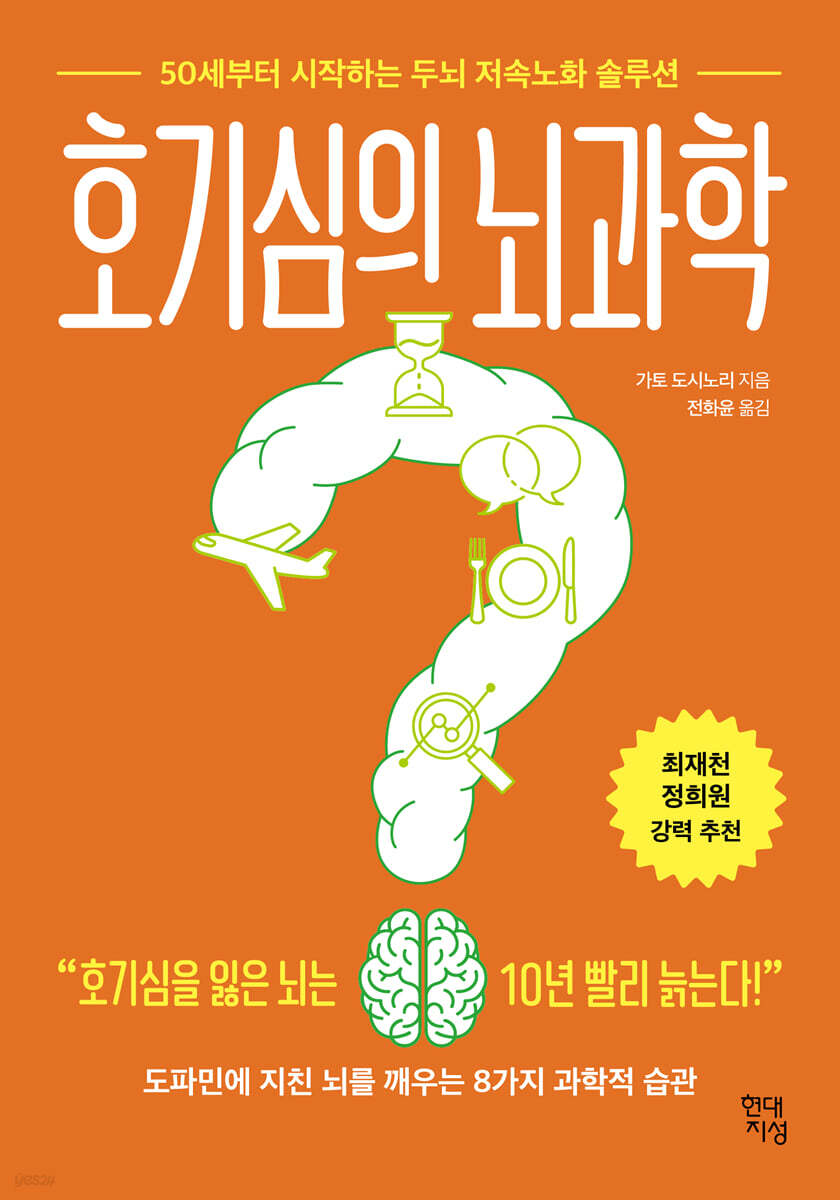
The Brain Science of Curiosity
 |
Description
Book Introduction
“Life begins to unfold with curiosity.”
“Finally, a book written exclusively for the 4050 generation has been published.”
Professor Choi Jae-cheon
“It’s not too late.
“You can create a brain that becomes stronger as you grow!”
Jeong Hee-won (Internal Medicine Specialist, Author of "Slow Aging Habits")
How does your brain change after you turn 40?
· Memory loss, even for trivial matters
· A daily life that is becoming less and less fun
· A tiring day without doing anything…
A world-renowned neuroscientist who analyzed the brains of 10,000 people says:
The cause of a brain that lacks motivation is a lack of curiosity.
The Secret to Reversing Aging Revealed Through MRI Analysis of 10,000 People
The core of brain function decline lies not in simple aging, but in "lost curiosity."
Does your brain really age with age? World-renowned neuroscientist Toshinori Kato, who analyzed 10,000 brain MRIs, asserts a resounding "no."
The decline in brain function is not simply due to aging, but rather due to 'loss of curiosity.'
Curiosity is the fuel that keeps the brain alive.
The brain's circuitry expands again in the face of new stimuli and exciting emotions, and aged circuits are revived.
Based on the latest brain science data, this book clearly presents a path to "reverse aging," which allows the brain to grow and revitalize even after middle age.
In particular, the author introduces a scientific method that shows that by stimulating eight brain sectors (memory, emotion, hearing, understanding, etc.) through curiosity-filled activities in daily life, concentration, drive, and even creativity can be revived even after the age of 4050.
What we need now is not 'good genes' but 'awakened curiosity'.
When your brain becomes younger, your whole life becomes younger.
“Finally, a book written exclusively for the 4050 generation has been published.”
Professor Choi Jae-cheon
“It’s not too late.
“You can create a brain that becomes stronger as you grow!”
Jeong Hee-won (Internal Medicine Specialist, Author of "Slow Aging Habits")
How does your brain change after you turn 40?
· Memory loss, even for trivial matters
· A daily life that is becoming less and less fun
· A tiring day without doing anything…
A world-renowned neuroscientist who analyzed the brains of 10,000 people says:
The cause of a brain that lacks motivation is a lack of curiosity.
The Secret to Reversing Aging Revealed Through MRI Analysis of 10,000 People
The core of brain function decline lies not in simple aging, but in "lost curiosity."
Does your brain really age with age? World-renowned neuroscientist Toshinori Kato, who analyzed 10,000 brain MRIs, asserts a resounding "no."
The decline in brain function is not simply due to aging, but rather due to 'loss of curiosity.'
Curiosity is the fuel that keeps the brain alive.
The brain's circuitry expands again in the face of new stimuli and exciting emotions, and aged circuits are revived.
Based on the latest brain science data, this book clearly presents a path to "reverse aging," which allows the brain to grow and revitalize even after middle age.
In particular, the author introduces a scientific method that shows that by stimulating eight brain sectors (memory, emotion, hearing, understanding, etc.) through curiosity-filled activities in daily life, concentration, drive, and even creativity can be revived even after the age of 4050.
What we need now is not 'good genes' but 'awakened curiosity'.
When your brain becomes younger, your whole life becomes younger.
- You can preview some of the book's contents.
Preview
index
Recommendation
Introduction: When your focus changes, everything in your life changes.
The One Thing Successful People Have in Common: Focus | Simple Training Can Improve Your Focus | The Secret to My Explosive Success: Tripled My Income from Burnout
Recommendation
Before Reading | Curiosity Gets Your Brain Dancing Again
Prologue | When You're No Longer Excited, Your Brain Is at Risk
· Why do I find everything annoying?
· The time when the left brain's emotions awaken, around age 45
· The real cause of memory loss: emotional deprivation
· When curiosity is alive, the brain becomes younger.
Chapter 1.
When the Sleeping Brain Awakens: A New World Opened by Curiosity
Brain Growth After 40: Unleash Your Potential
· Everyone's brain has its own personality.
· The brain continues to grow until death.
· The treasure in the brain, potential cells
Your brain's prime isn't here yet.
· Aging substances that increase rapidly from the late 40s
· Super Brain Three Areas
· There is no aging in the growing brain.
· The dangers of forgetfulness
Why Curiosity Matters More After Forty
· Healthy and motivated middle-aged women
· The only reason for such a big difference
· Does the speed of hippocampal development determine personality?
· Don't ask a man about the future, or a woman about the past.
Curiosity, the brain-wake switch
Curiosity that enriches the branches of the brain
· A virtuous cycle of curiosity
· The real cause of memory loss is not aging.
· A New Prescription for Brain Health: The Power of Virtue
Curious Brain: The Key to a Greater Life for Those in Their 40s and 50s
· The more honest a person is, the more likely he or she is to fall into a trap.
· Blind spots of the automated brain
· The future trap created by lazy brains
· The moment you break the familiar, your brain grows.
· A curious brain is the key to a growing life.
Chapter 2.
Shift to a Curious Brain: 8 Neuroscience-Based Reboot Strategies
The first thing you need to change for your brain
· Aging problems that were known but overlooked
Factors that impede brain growth ① Brain fatigue
Factors that hinder brain growth ② Lack of exercise
Factors that hinder brain growth ③ Lack of sleep
· Factors that impede brain growth ④ Malnutrition
· Factors hindering brain growth ⑤ Insufficient oxygen supply to the brain
· Factors that impede brain growth ⑥ Adult diseases
· Factors hindering brain growth ⑦ Lack of interaction with neighbors
· Factors that hinder brain growth ⑧ Lack of self-esteem
· Factors hindering brain growth ⑨ Habitual emotional suppression
· Factors that hinder brain growth ⑩ Closed daily life
· Factors that hinder brain growth ⑪ Sensory dullness due to information overload
· Do a self-diagnosis every three months
Solution 1: Clearing the Memory Room Will Make Your Heart Beat Again
Curiosity is already within me: Self-awareness
· Illuminating the Present with the Light of the Past: A Journey of Self-Awareness
· That Heart-Pounding Moment: Awakening Your Dormant Curiosity
· Finding yourself in someone else's mirror
· The link between blood ties, delays, and gratitude: the soil that fosters curiosity.
Solution 2: When you encounter an unfamiliar place, your hidden curiosity awakens.
· Go where your curiosity blossoms
· Travel, the best opportunity to get inspired
· A new world presented by encounters
· Another self I meet across borders
· A gift of curiosity from nature
Solution 3: Meet people who broaden your perspective.
· Meet someone you've never met before
· The power of diverse perspectives
· Become friends with people who live with a 'curious brain'
Solution ④ Sleep is the brain's working time
· Sleep is an investment in tomorrow's curiosity.
· The busier the day, the earlier you should go to bed.
· How to find the right sleep schedule for you
· Sleep comes first, then schedule.
· A Trailer to a Good Night's Sleep: Creating a "Sleep Ritual"
· How to adjust eating habits to maintain sleep rhythm
· Adjust your sleep schedule every 1-2 weeks.
Learn More | How Scientific Sleep Can Transform Your Brain
· Sleep is the time to cleanse the brain.
· Sleep is the best antidote for the brain.
Long-term memories consolidated through sleep
· Sleep and light, the forces that drive the body clock
· Sleep is the time when growth hormones work.
· Sleep is the best brain training
Solution ⑤ What you eat becomes your brain.
· The brain and intestines are connected as one lifeline
Neurotransmitters, the chemical chains that move the brain
Serotonin moves the brain and gut simultaneously.
Essential Nutrients for the Brain and Gut ① Omega 3
Essential nutrients for the brain and intestines ② Dietary fiber and fermented foods
· Essential Nutrient for the Brain and Guts ③ Tryptophan, which increases serotonin
· Essential nutrients for the brain and intestines ④ Iron for cognitive function
How to use health supplements
Solution ⑥ Clear out your old brain cache.
· To add memory, you must first empty it.
Why Working From Home Slows Down Your Brain
· 4 cache classification methods to lighten your brain
· Positive in the evening, categorizing in the morning: The brain's dual routine for organizing thoughts
· If you want to clear your mind, get some sleep first.
· Negative emotions, if handled well, can become opportunities.
Before your thoughts become heavy, turn your brain off and on again.
· To move a lazy brain, give it a verbal command.
Solution ⑦ Curiosity begins in the ears.
When we don't empathize, we become monsters.
· The reason I become a villain without knowing it
· The listener's brain works differently.
Empathy begins with shared experiences.
· Don't teach, just listen
· If you want to be loved, start by loving yourself and those around you.
· Those who know how to lean will not fall.
How to shake off loneliness and irritation together
Solution ⑧ Create a brain that isn't swayed by information.
· Stimulate all five senses equally
· Reduce information, but leave curiosity.
· Give your brain time to reset.
· Choose with your own strength
· Revive the habit of remembering and calculating.
· Take your eyes off the small screen
· Empty your brain before receiving information.
A job chosen out of curiosity is difficult but enjoyable.
· More important than the result is the feeling that 'I made the choice'
Failure sparks new curiosity
Learn More | Everyday Habits That Age Your Brain
Bad Brain Habit ① Spending your holidays dozing off
Bad Brain Habit ② Taking your smartphone to the bedroom
· Bad habit for the brain ③ Irregular meal times
· Bad habits for the brain ④ Overeating or drinking too much
· Bad brain habit ⑤ Breathing with your mouth open
Chapter 3.
The Brain Changes as You Use It: 8 Curiosity Training Sectors
Awaken the 8 sectors of your brain that foster curiosity.
· The brain also has addresses, divided into 'sectors'
Think, feel, and connect. Your brain operates in eight sectors.
· Even damaged brains grow back
When you move your body, your brain starts connecting.
· The brain sector also needs rest and circulation.
· When you move your body, your brain wakes up too.
· The brain's self-activating switch begins with curiosity.
8 Curiosity Stimulation Techniques to Reawaken Your Sleeping Brain
· My Brain, Unknown to Me: Curiosity Checklist
· The brain you use now makes you who you are.
· Get out of your comfort zone
· The curiosity you need now, the curiosity you need to let go of
· Shake the auditory sector, the gateway to awakening the brain.
Curiosity Unleashes Memory: 5 Exercises to Restore Your Memory
· The brain needs shift work: The Curiosity Shift Method to eliminate brain fatigue
· A 5-minute daily feedback routine to awaken your memory
· Brain-stimulating photo feedback
· Three keys to recalling memories: the chain of thoughts, emotions, and memories
· Change begins with records.
Learn More | Brain-boosting Lifestyle Habits You Should Start Today
· Brain-Good Lifestyle Habits ① A Lifestyle Routine That Stimulates Your Body, Feet, and Mouth
· Brain-Healthy Lifestyle Habits ② Listening to the Radio
· Brain-Healthy Lifestyle Habits ③ Slightly Change Your Method
· Brain-Healthy Lifestyle Habits ④ Staying Offline in Nature
· Brain-Healthy Lifestyle Habit ⑤ Take 3 minutes of slow, deep breathing every day
Epilogue | Curiosity is the key to a successful life.
References and Sources
Introduction: When your focus changes, everything in your life changes.
The One Thing Successful People Have in Common: Focus | Simple Training Can Improve Your Focus | The Secret to My Explosive Success: Tripled My Income from Burnout
Recommendation
Before Reading | Curiosity Gets Your Brain Dancing Again
Prologue | When You're No Longer Excited, Your Brain Is at Risk
· Why do I find everything annoying?
· The time when the left brain's emotions awaken, around age 45
· The real cause of memory loss: emotional deprivation
· When curiosity is alive, the brain becomes younger.
Chapter 1.
When the Sleeping Brain Awakens: A New World Opened by Curiosity
Brain Growth After 40: Unleash Your Potential
· Everyone's brain has its own personality.
· The brain continues to grow until death.
· The treasure in the brain, potential cells
Your brain's prime isn't here yet.
· Aging substances that increase rapidly from the late 40s
· Super Brain Three Areas
· There is no aging in the growing brain.
· The dangers of forgetfulness
Why Curiosity Matters More After Forty
· Healthy and motivated middle-aged women
· The only reason for such a big difference
· Does the speed of hippocampal development determine personality?
· Don't ask a man about the future, or a woman about the past.
Curiosity, the brain-wake switch
Curiosity that enriches the branches of the brain
· A virtuous cycle of curiosity
· The real cause of memory loss is not aging.
· A New Prescription for Brain Health: The Power of Virtue
Curious Brain: The Key to a Greater Life for Those in Their 40s and 50s
· The more honest a person is, the more likely he or she is to fall into a trap.
· Blind spots of the automated brain
· The future trap created by lazy brains
· The moment you break the familiar, your brain grows.
· A curious brain is the key to a growing life.
Chapter 2.
Shift to a Curious Brain: 8 Neuroscience-Based Reboot Strategies
The first thing you need to change for your brain
· Aging problems that were known but overlooked
Factors that impede brain growth ① Brain fatigue
Factors that hinder brain growth ② Lack of exercise
Factors that hinder brain growth ③ Lack of sleep
· Factors that impede brain growth ④ Malnutrition
· Factors hindering brain growth ⑤ Insufficient oxygen supply to the brain
· Factors that impede brain growth ⑥ Adult diseases
· Factors hindering brain growth ⑦ Lack of interaction with neighbors
· Factors that hinder brain growth ⑧ Lack of self-esteem
· Factors hindering brain growth ⑨ Habitual emotional suppression
· Factors that hinder brain growth ⑩ Closed daily life
· Factors that hinder brain growth ⑪ Sensory dullness due to information overload
· Do a self-diagnosis every three months
Solution 1: Clearing the Memory Room Will Make Your Heart Beat Again
Curiosity is already within me: Self-awareness
· Illuminating the Present with the Light of the Past: A Journey of Self-Awareness
· That Heart-Pounding Moment: Awakening Your Dormant Curiosity
· Finding yourself in someone else's mirror
· The link between blood ties, delays, and gratitude: the soil that fosters curiosity.
Solution 2: When you encounter an unfamiliar place, your hidden curiosity awakens.
· Go where your curiosity blossoms
· Travel, the best opportunity to get inspired
· A new world presented by encounters
· Another self I meet across borders
· A gift of curiosity from nature
Solution 3: Meet people who broaden your perspective.
· Meet someone you've never met before
· The power of diverse perspectives
· Become friends with people who live with a 'curious brain'
Solution ④ Sleep is the brain's working time
· Sleep is an investment in tomorrow's curiosity.
· The busier the day, the earlier you should go to bed.
· How to find the right sleep schedule for you
· Sleep comes first, then schedule.
· A Trailer to a Good Night's Sleep: Creating a "Sleep Ritual"
· How to adjust eating habits to maintain sleep rhythm
· Adjust your sleep schedule every 1-2 weeks.
Learn More | How Scientific Sleep Can Transform Your Brain
· Sleep is the time to cleanse the brain.
· Sleep is the best antidote for the brain.
Long-term memories consolidated through sleep
· Sleep and light, the forces that drive the body clock
· Sleep is the time when growth hormones work.
· Sleep is the best brain training
Solution ⑤ What you eat becomes your brain.
· The brain and intestines are connected as one lifeline
Neurotransmitters, the chemical chains that move the brain
Serotonin moves the brain and gut simultaneously.
Essential Nutrients for the Brain and Gut ① Omega 3
Essential nutrients for the brain and intestines ② Dietary fiber and fermented foods
· Essential Nutrient for the Brain and Guts ③ Tryptophan, which increases serotonin
· Essential nutrients for the brain and intestines ④ Iron for cognitive function
How to use health supplements
Solution ⑥ Clear out your old brain cache.
· To add memory, you must first empty it.
Why Working From Home Slows Down Your Brain
· 4 cache classification methods to lighten your brain
· Positive in the evening, categorizing in the morning: The brain's dual routine for organizing thoughts
· If you want to clear your mind, get some sleep first.
· Negative emotions, if handled well, can become opportunities.
Before your thoughts become heavy, turn your brain off and on again.
· To move a lazy brain, give it a verbal command.
Solution ⑦ Curiosity begins in the ears.
When we don't empathize, we become monsters.
· The reason I become a villain without knowing it
· The listener's brain works differently.
Empathy begins with shared experiences.
· Don't teach, just listen
· If you want to be loved, start by loving yourself and those around you.
· Those who know how to lean will not fall.
How to shake off loneliness and irritation together
Solution ⑧ Create a brain that isn't swayed by information.
· Stimulate all five senses equally
· Reduce information, but leave curiosity.
· Give your brain time to reset.
· Choose with your own strength
· Revive the habit of remembering and calculating.
· Take your eyes off the small screen
· Empty your brain before receiving information.
A job chosen out of curiosity is difficult but enjoyable.
· More important than the result is the feeling that 'I made the choice'
Failure sparks new curiosity
Learn More | Everyday Habits That Age Your Brain
Bad Brain Habit ① Spending your holidays dozing off
Bad Brain Habit ② Taking your smartphone to the bedroom
· Bad habit for the brain ③ Irregular meal times
· Bad habits for the brain ④ Overeating or drinking too much
· Bad brain habit ⑤ Breathing with your mouth open
Chapter 3.
The Brain Changes as You Use It: 8 Curiosity Training Sectors
Awaken the 8 sectors of your brain that foster curiosity.
· The brain also has addresses, divided into 'sectors'
Think, feel, and connect. Your brain operates in eight sectors.
· Even damaged brains grow back
When you move your body, your brain starts connecting.
· The brain sector also needs rest and circulation.
· When you move your body, your brain wakes up too.
· The brain's self-activating switch begins with curiosity.
8 Curiosity Stimulation Techniques to Reawaken Your Sleeping Brain
· My Brain, Unknown to Me: Curiosity Checklist
· The brain you use now makes you who you are.
· Get out of your comfort zone
· The curiosity you need now, the curiosity you need to let go of
· Shake the auditory sector, the gateway to awakening the brain.
Curiosity Unleashes Memory: 5 Exercises to Restore Your Memory
· The brain needs shift work: The Curiosity Shift Method to eliminate brain fatigue
· A 5-minute daily feedback routine to awaken your memory
· Brain-stimulating photo feedback
· Three keys to recalling memories: the chain of thoughts, emotions, and memories
· Change begins with records.
Learn More | Brain-boosting Lifestyle Habits You Should Start Today
· Brain-Good Lifestyle Habits ① A Lifestyle Routine That Stimulates Your Body, Feet, and Mouth
· Brain-Healthy Lifestyle Habits ② Listening to the Radio
· Brain-Healthy Lifestyle Habits ③ Slightly Change Your Method
· Brain-Healthy Lifestyle Habits ④ Staying Offline in Nature
· Brain-Healthy Lifestyle Habit ⑤ Take 3 minutes of slow, deep breathing every day
Epilogue | Curiosity is the key to a successful life.
References and Sources
Detailed image

Into the book
It costs nothing to restore curiosity.
No separate brain training or brain activation activities are required.
There is no age limit.
The brain is an organ that grows regardless of age.
It means that you shouldn’t give up and say, “What else can I do at this age?”
Observe closely people who always live young.
They are true to their left-brain emotions and are willing to put into practice what they want to do.
These are the people with the strongest 'curious brains'.
This book consists of three chapters.
Chapter 1 examines the relationship between brain potential and curiosity from a neuroscientific perspective.
Chapter 2 introduces eight specific ways to discover and nurture the seeds of curiosity.
Chapter 3 then guides you through how to develop a ‘curious brain’ in each brain sector.
By the time you turn the last page, you'll be the owner of a vibrant "curious brain," free from anxiety and worry and enjoying everyday life.
--- p.18, from "Prologue"
Dopamine is known to activate human cognitive functions, not only by improving memory but also by stimulating motivation.
Likewise, serotonin, which lowers anxiety and stress levels, and oxytocin, which increases empathy, are neurotransmitters that are originally called 'happiness hormones' and provide a sense of happiness.
When these neurotransmitters are secreted in large quantities, motivation and happiness increase, excitement and thrill are generated, and curiosity is expressed.
This is the virtuous cycle of curiosity.
--- p.58, from “Curiosity, the switch that wakes up the brain / Chapter 1”
Curiosity is not something that can be gifted or forced upon someone.
Curiosity only comes to life when we seek it out and nurture it voluntarily.
Living a life filled with curiosity not only promotes brain growth, preventing forgetfulness and cognitive impairment, but also contributes to anti-aging, so there is no emotion more beneficial to the brain.
A beautiful flower blooms at the end where our brain extends.
For us who live in an era where people live to be 100, middle age is another starting point.
With the belief that “the golden years of life start right now,” if we continue to take on the curious challenges of brain development, our possibilities will unfold endlessly.
The future of such a person will naturally shine brightly.
--- p.67, from “Curiosity Brain, Key to a Leap in Life in Your 40s and 50s / Chapter 1”
Lack of sleep definitely puts a constant strain on your brain and body.
Our body is an organism made up of tens of trillions of cells.
Cells have a limited endurance, and overuse shortens their lifespan.
Conversely, there are reports that people who sleep excessively, especially those who sleep more than 9 hours on average, are at a higher risk of depression and death.
Ultimately, you need to secure an average of 'about 8 hours' of sleep to properly turn on your brain activity and curiosity.
From now on, let's start the journey to find our optimal sleep time, aiming for 8 hours of sleep a day.
--- p.112, from “Solution ④ Sleep is the brain’s working time / Chapter 2”
If we expand to the entire cerebral hemisphere, we can see that there are more than 100 major functional units in the brain.
That is, the human brain is structured into at least 100 different areas to perform detailed cognitive, motor, sensory, and emotional functions.
You don't need to know all of these features.
However, it is necessary to deeply understand the eight core sectors that are frequently used in daily life and play a crucial role in organizing curiosity and developing the brain.
These are the eight brain sectors that control thinking, communication, movement, emotion, understanding, hearing, vision, and memory.
--- p.186, from “Cultivate Curiosity in Your Brain, Awaken the 8 Sectors / Chapter 3”
The message I wanted to convey through this book is simple.
If we revive the 'true heart' that has been living within us since childhood, that is, the left brain emotions, and recover our curiosity, our brain and our entire life will completely change.
I, too, am practicing the methods introduced in this book in my daily life.
Even now, I am amazed by new things and encounters every day, and I feel my curiosity alive.
As I've said before, curiosity can help you look at anxiety and worry differently.
The same situation can also be transformed into a more positive and proactive perspective.
A curious brain changes everyday life like that.
Life is slowly but surely starting to flow in the direction I want.
Let's recall the question at the beginning of the book.
“Is there anything you want to do now?” There are probably a lot more now than before.
New ideas, dreams you've been putting off, and perhaps even vague directions may become more concrete.
If this book was the starting point, that would be enough.
No separate brain training or brain activation activities are required.
There is no age limit.
The brain is an organ that grows regardless of age.
It means that you shouldn’t give up and say, “What else can I do at this age?”
Observe closely people who always live young.
They are true to their left-brain emotions and are willing to put into practice what they want to do.
These are the people with the strongest 'curious brains'.
This book consists of three chapters.
Chapter 1 examines the relationship between brain potential and curiosity from a neuroscientific perspective.
Chapter 2 introduces eight specific ways to discover and nurture the seeds of curiosity.
Chapter 3 then guides you through how to develop a ‘curious brain’ in each brain sector.
By the time you turn the last page, you'll be the owner of a vibrant "curious brain," free from anxiety and worry and enjoying everyday life.
--- p.18, from "Prologue"
Dopamine is known to activate human cognitive functions, not only by improving memory but also by stimulating motivation.
Likewise, serotonin, which lowers anxiety and stress levels, and oxytocin, which increases empathy, are neurotransmitters that are originally called 'happiness hormones' and provide a sense of happiness.
When these neurotransmitters are secreted in large quantities, motivation and happiness increase, excitement and thrill are generated, and curiosity is expressed.
This is the virtuous cycle of curiosity.
--- p.58, from “Curiosity, the switch that wakes up the brain / Chapter 1”
Curiosity is not something that can be gifted or forced upon someone.
Curiosity only comes to life when we seek it out and nurture it voluntarily.
Living a life filled with curiosity not only promotes brain growth, preventing forgetfulness and cognitive impairment, but also contributes to anti-aging, so there is no emotion more beneficial to the brain.
A beautiful flower blooms at the end where our brain extends.
For us who live in an era where people live to be 100, middle age is another starting point.
With the belief that “the golden years of life start right now,” if we continue to take on the curious challenges of brain development, our possibilities will unfold endlessly.
The future of such a person will naturally shine brightly.
--- p.67, from “Curiosity Brain, Key to a Leap in Life in Your 40s and 50s / Chapter 1”
Lack of sleep definitely puts a constant strain on your brain and body.
Our body is an organism made up of tens of trillions of cells.
Cells have a limited endurance, and overuse shortens their lifespan.
Conversely, there are reports that people who sleep excessively, especially those who sleep more than 9 hours on average, are at a higher risk of depression and death.
Ultimately, you need to secure an average of 'about 8 hours' of sleep to properly turn on your brain activity and curiosity.
From now on, let's start the journey to find our optimal sleep time, aiming for 8 hours of sleep a day.
--- p.112, from “Solution ④ Sleep is the brain’s working time / Chapter 2”
If we expand to the entire cerebral hemisphere, we can see that there are more than 100 major functional units in the brain.
That is, the human brain is structured into at least 100 different areas to perform detailed cognitive, motor, sensory, and emotional functions.
You don't need to know all of these features.
However, it is necessary to deeply understand the eight core sectors that are frequently used in daily life and play a crucial role in organizing curiosity and developing the brain.
These are the eight brain sectors that control thinking, communication, movement, emotion, understanding, hearing, vision, and memory.
--- p.186, from “Cultivate Curiosity in Your Brain, Awaken the 8 Sectors / Chapter 3”
The message I wanted to convey through this book is simple.
If we revive the 'true heart' that has been living within us since childhood, that is, the left brain emotions, and recover our curiosity, our brain and our entire life will completely change.
I, too, am practicing the methods introduced in this book in my daily life.
Even now, I am amazed by new things and encounters every day, and I feel my curiosity alive.
As I've said before, curiosity can help you look at anxiety and worry differently.
The same situation can also be transformed into a more positive and proactive perspective.
A curious brain changes everyday life like that.
Life is slowly but surely starting to flow in the direction I want.
Let's recall the question at the beginning of the book.
“Is there anything you want to do now?” There are probably a lot more now than before.
New ideas, dreams you've been putting off, and perhaps even vague directions may become more concrete.
If this book was the starting point, that would be enough.
--- pp.223-224, from “Life Begins to Go Well with Curiosity / Epilogue”
Publisher's Review
curiosity,
The most powerful natural vitamin for your brain
A female patient in her mid-40s came to Dr. Kato with sudden memory loss and concentration problems.
She had lived a hard life and was conscientious both at home and at work, but she was gradually losing confidence.
Brain scans showed her brain was in 'autopilot mode'.
The brain was not receiving new stimulation as it was exposed to the same routine, same thoughts, and same environment every day.
Dr. Kato suggested that she keep a 'curiosity diary'.
It was a simple task of recording new discoveries and questions every day, but after six months, her brain showed remarkable changes.
The brain's circuitry was activated, and blood flow increased, particularly in the hippocampus and prefrontal regions.
“It’s like a fog has lifted from my life,” she said happily.
"The Brain Science of Curiosity" scientifically explores the true nature of the brain changes experienced by the 40-50 age group and presents a "Reclaim Curiosity" program that anyone can implement.
What the 4050 generation especially needs most is “rediscovery of curiosity.”
In this book, you'll learn why curiosity becomes more important as you get older and how to cultivate it in your everyday life.
Medically, ‘curiosity’ is not just an emotion.
It is a powerful catalyst that stimulates the active secretion of neurotransmitters such as dopamine, serotonin, and oxytocin in the brain.
These neurotransmitters play a crucial role in activating brain circuits, creating new neural connections, and, most importantly, maintaining brain plasticity.
Simply put, curiosity is the most powerful nutrient and natural vitamin for your brain.
45: Your Brain Prepares for a New Life
What happens to our brains as we pass the halfway point of our lives? Dr. Kato calls the period around age 45 "a major turning point for the brain."
During this time, important changes occur in our brain.
This is when the ‘left brain emotion’ awakens.
Until the age of 45, most people live their lives meeting the expectations of others.
As we fulfill our roles as parents, spouses, and employees, we often put our true desires on the back burner.
This way of life is largely driven by 'right-brain emotion', which is related to the ability to read and empathize with the emotions of others.
However, around the age of 45, the 'left brain emotion' begins to awaken.
Left brain emotions are deeply connected to our desires, curiosity, and creativity.
What happens if we fail to properly express our left-brain emotions during this transition? According to the author, this is precisely the cause of the lethargy, lack of motivation, and even depression experienced by many middle-aged people.
On the other hand, if you discover your own curiosity and activate your left brain emotions during this period, a new chapter in your life will open.
The story of a 53-year-old male patient is particularly striking.
Although he was a successful company employee, he was experiencing severe anxiety and depression as he approached retirement age.
In response to his comment, “I don’t know what to do next,” Dr. Kato suggested the method of “tracing past curiosity.”
It was a task of finding one's true interests by recalling moments of immersion from childhood until now.
As a result, he rediscovered that he had long had a deep interest in astronomy.
What started out as a hobby has now become a popular lecturer conducting educational programs at local observatories.
His brain scans showed remarkable changes.
Areas related to creativity in particular were activated, and cognitive functions were significantly improved.
This book shows you how to use the brain changes after 40 as a strategic opportunity in life.
A step-by-step guide to awakening your left brain emotions, discovering your own curiosity, and using this to foster brain growth and change.
A three-dimensional map of curiosity,
How to Activate 8 Brain Sectors
Although the human brain has over 100 functional areas, there are eight sectors that are crucial to daily life and growth.
These eight areas, which govern thought, communication, movement, emotion, understanding, hearing, vision, and memory, are closely connected and are activated by curiosity.
The problem is that most people overuse certain areas.
Especially for the 40-50 age group, as professional expertise increases, the areas of the brain they use become more limited.
If this imbalance persists, other areas of the brain gradually decline.
The method to stimulate all eight brain sectors evenly is surprisingly simple.
These are various forms of ‘curiosity activities’.
The book introduces customized curiosity-stimulating methods for each sector.
For example, a great way to activate your auditory sector is to listen to new music.
Just listening to a genre of music you don't normally listen to provides new stimulation to your brain.
For the visual sector, try visiting an art museum or experiencing something new, and for the movement sector, try trying a new physical activity.
The author particularly emphasizes the 'cross-stimulation method'.
It is a method of stimulating multiple sectors simultaneously through one activity.
For example, learning a new language simultaneously stimulates the auditory, visual, memory, and comprehension sectors.
Learning to dance stimulates the movement, hearing, and memory sectors, while cooking stimulates the senses of sight, smell, taste, touch, and even creativity.
A 49-year-old man experienced amazing changes after trying this method.
He has been working in the same job for over 20 years, using only certain parts of his brain.
Suffering from memory loss and a loss of motivation, he followed the author's advice and started the '8-Sector Curiosity Program'.
As one of my small practices, I practiced 'emptying my brain cache' for 10 minutes every night.
I wrote down all of my daily tasks and worries, and categorized them into "solvable" and "let go."
Although it started out as a formality, after a month he noticed an improvement in the quality of his sleep and that he was waking up with a clearer head in the morning.
After three months, my work efficiency had improved significantly, and most importantly, I had regained interest in hobbies I had put off for a long time.
His brain freed itself from unnecessary worries and made room for new curiosities.
This book is not simply a book on brain science theory.
Based on decades of clinical experience and analyses of 10,000 brains, we present practical methods that people in their 40s and 50s can implement right now.
From sleep, diet, and exercise to relationships and hobbies, our comprehensive approach to activating your brain will open up new possibilities for change in your life.
When curiosity awakens, your brain becomes younger, and when your brain becomes younger, your life changes.
What kind of curiosity is your brain anticipating right now? With "The Brain Science of Curiosity," let's begin the experience of life unfolding smoothly through curiosity alone.
The most powerful natural vitamin for your brain
A female patient in her mid-40s came to Dr. Kato with sudden memory loss and concentration problems.
She had lived a hard life and was conscientious both at home and at work, but she was gradually losing confidence.
Brain scans showed her brain was in 'autopilot mode'.
The brain was not receiving new stimulation as it was exposed to the same routine, same thoughts, and same environment every day.
Dr. Kato suggested that she keep a 'curiosity diary'.
It was a simple task of recording new discoveries and questions every day, but after six months, her brain showed remarkable changes.
The brain's circuitry was activated, and blood flow increased, particularly in the hippocampus and prefrontal regions.
“It’s like a fog has lifted from my life,” she said happily.
"The Brain Science of Curiosity" scientifically explores the true nature of the brain changes experienced by the 40-50 age group and presents a "Reclaim Curiosity" program that anyone can implement.
What the 4050 generation especially needs most is “rediscovery of curiosity.”
In this book, you'll learn why curiosity becomes more important as you get older and how to cultivate it in your everyday life.
Medically, ‘curiosity’ is not just an emotion.
It is a powerful catalyst that stimulates the active secretion of neurotransmitters such as dopamine, serotonin, and oxytocin in the brain.
These neurotransmitters play a crucial role in activating brain circuits, creating new neural connections, and, most importantly, maintaining brain plasticity.
Simply put, curiosity is the most powerful nutrient and natural vitamin for your brain.
45: Your Brain Prepares for a New Life
What happens to our brains as we pass the halfway point of our lives? Dr. Kato calls the period around age 45 "a major turning point for the brain."
During this time, important changes occur in our brain.
This is when the ‘left brain emotion’ awakens.
Until the age of 45, most people live their lives meeting the expectations of others.
As we fulfill our roles as parents, spouses, and employees, we often put our true desires on the back burner.
This way of life is largely driven by 'right-brain emotion', which is related to the ability to read and empathize with the emotions of others.
However, around the age of 45, the 'left brain emotion' begins to awaken.
Left brain emotions are deeply connected to our desires, curiosity, and creativity.
What happens if we fail to properly express our left-brain emotions during this transition? According to the author, this is precisely the cause of the lethargy, lack of motivation, and even depression experienced by many middle-aged people.
On the other hand, if you discover your own curiosity and activate your left brain emotions during this period, a new chapter in your life will open.
The story of a 53-year-old male patient is particularly striking.
Although he was a successful company employee, he was experiencing severe anxiety and depression as he approached retirement age.
In response to his comment, “I don’t know what to do next,” Dr. Kato suggested the method of “tracing past curiosity.”
It was a task of finding one's true interests by recalling moments of immersion from childhood until now.
As a result, he rediscovered that he had long had a deep interest in astronomy.
What started out as a hobby has now become a popular lecturer conducting educational programs at local observatories.
His brain scans showed remarkable changes.
Areas related to creativity in particular were activated, and cognitive functions were significantly improved.
This book shows you how to use the brain changes after 40 as a strategic opportunity in life.
A step-by-step guide to awakening your left brain emotions, discovering your own curiosity, and using this to foster brain growth and change.
A three-dimensional map of curiosity,
How to Activate 8 Brain Sectors
Although the human brain has over 100 functional areas, there are eight sectors that are crucial to daily life and growth.
These eight areas, which govern thought, communication, movement, emotion, understanding, hearing, vision, and memory, are closely connected and are activated by curiosity.
The problem is that most people overuse certain areas.
Especially for the 40-50 age group, as professional expertise increases, the areas of the brain they use become more limited.
If this imbalance persists, other areas of the brain gradually decline.
The method to stimulate all eight brain sectors evenly is surprisingly simple.
These are various forms of ‘curiosity activities’.
The book introduces customized curiosity-stimulating methods for each sector.
For example, a great way to activate your auditory sector is to listen to new music.
Just listening to a genre of music you don't normally listen to provides new stimulation to your brain.
For the visual sector, try visiting an art museum or experiencing something new, and for the movement sector, try trying a new physical activity.
The author particularly emphasizes the 'cross-stimulation method'.
It is a method of stimulating multiple sectors simultaneously through one activity.
For example, learning a new language simultaneously stimulates the auditory, visual, memory, and comprehension sectors.
Learning to dance stimulates the movement, hearing, and memory sectors, while cooking stimulates the senses of sight, smell, taste, touch, and even creativity.
A 49-year-old man experienced amazing changes after trying this method.
He has been working in the same job for over 20 years, using only certain parts of his brain.
Suffering from memory loss and a loss of motivation, he followed the author's advice and started the '8-Sector Curiosity Program'.
As one of my small practices, I practiced 'emptying my brain cache' for 10 minutes every night.
I wrote down all of my daily tasks and worries, and categorized them into "solvable" and "let go."
Although it started out as a formality, after a month he noticed an improvement in the quality of his sleep and that he was waking up with a clearer head in the morning.
After three months, my work efficiency had improved significantly, and most importantly, I had regained interest in hobbies I had put off for a long time.
His brain freed itself from unnecessary worries and made room for new curiosities.
This book is not simply a book on brain science theory.
Based on decades of clinical experience and analyses of 10,000 brains, we present practical methods that people in their 40s and 50s can implement right now.
From sleep, diet, and exercise to relationships and hobbies, our comprehensive approach to activating your brain will open up new possibilities for change in your life.
When curiosity awakens, your brain becomes younger, and when your brain becomes younger, your life changes.
What kind of curiosity is your brain anticipating right now? With "The Brain Science of Curiosity," let's begin the experience of life unfolding smoothly through curiosity alone.
GOODS SPECIFICS
- Date of issue: May 16, 2025
- Page count, weight, size: 232 pages | 290g | 140*200*15mm
- ISBN13: 9791139721997
- ISBN10: 1139721992
You may also like
카테고리
korean


korean

![GQ KOREA Mark (Monthly): December [2025]](http://librairie.coreenne.fr/cdn/shop/files/8ef265dbbfbf186523ed75ba7319009d.jpg?v=1765340328&width=3840)


