

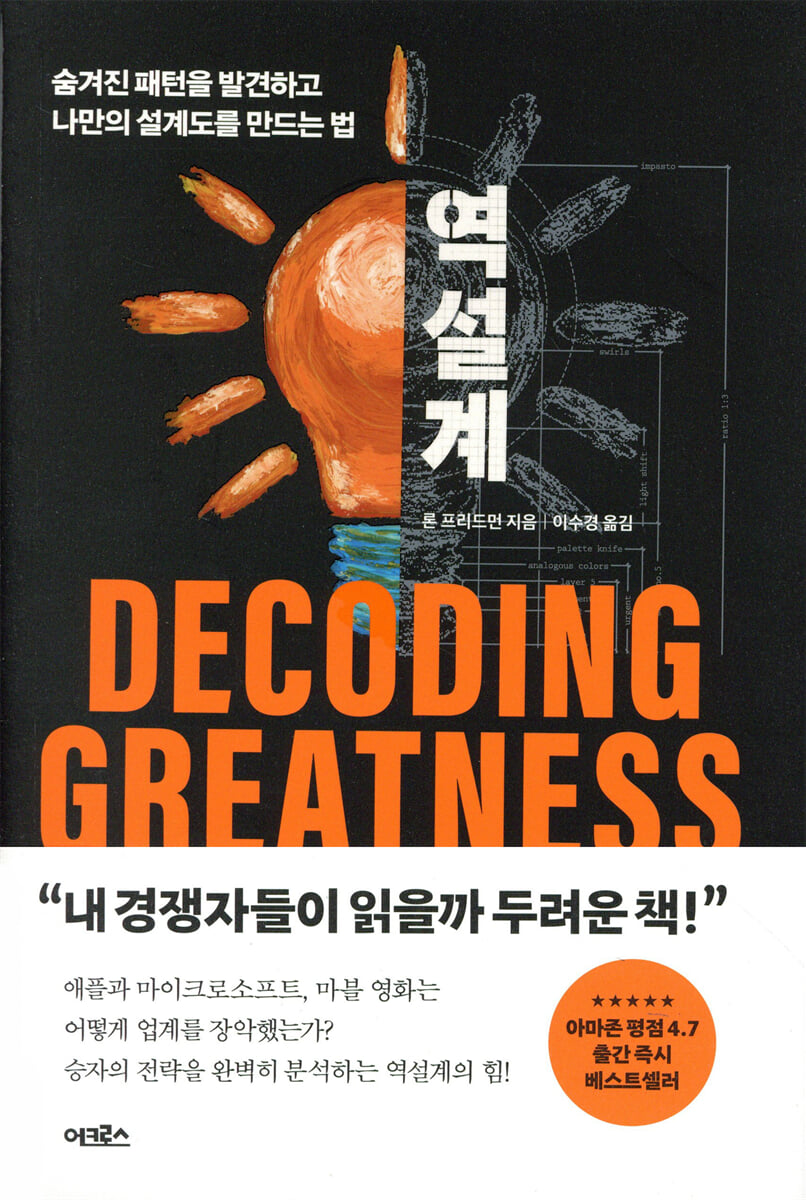
reverse engineering
 |
Description
Book Introduction
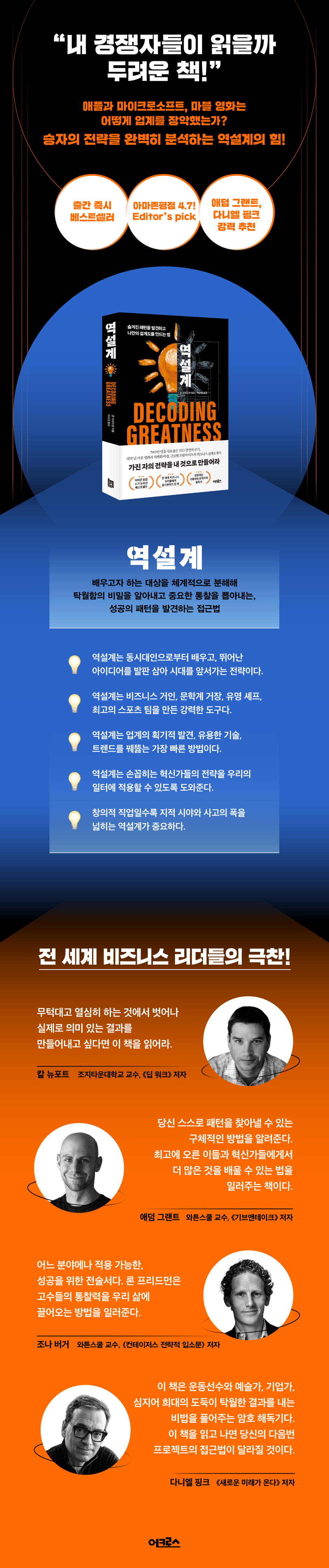
This book is the first business strategy book on the reverse engineering approach, systematically deconstructing the object of your aspirations to uncover the secrets of excellence and extract crucial insights—in other words, discovering patterns of success. Business giants, literary luminaries, and top sports teams have used reverse engineering to gather information, identify trends, and acquire useful skills to rise to the top. Ron Friedman, a psychologist and behavior change expert, reveals their secrets through brilliant storytelling and research from a variety of fields including neuroscience, evolutionary biology, human motivation, and sports psychology. You can meet outstanding strategists who have honed their own weapons through reverse engineering, such as a bestselling author who transformed from a poor imitation into a captivating narrative, and a contemporary politician who went from a perennial primary candidate to a renowned speaker who moved audiences. We also take a reverse-engineering approach to examine how the best in their fields achieved their positions, including the secrets of TED talks that captivated 70 million people, the secrets to Marvel movies' success in differentiating themselves with each release, and the strategies that turned local restaurants into global franchises. Praised by business leaders like Adam Grant, Cal Newport, Daniel Pink, Jonah Berger, and Dorie Clark, this Amazon nonfiction bestseller is a valuable guide that shows you the fastest way to become the best in your field. |
- You can preview some of the book's contents.
Preview
index
Introduction: The most useful technique for making the strategies of the haves your own.
Part 1: A Reverse Engineering Approach to Decoding Excellence
Chapter 1.
What makes the best different?
What heart-touching stories have in common / The secrets of a 5-million-copy-selling cookbook and a star chef / How a local restaurant becomes a global franchise / Reverse engineering is a market-dominating strategy / Why reverse engineering is crucial in creative professions
Chapter 2.
How to Read Hidden Patterns
What we can learn from AI chefs / The habits that made Warhol, Tarantino, and Hemingway masters / Identify the key characteristics of success with "Find the difference" / The zoom-out strategy that ignores details / The secret to the TED talk that captivated 70 million people / Reverse-engineering Samsung and Apple's websites
Chapter 3.
A divine move that transcends familiarity
How to be creative / Finding the optimal newness / The introduction that turned a 'common song' into an immortal classic / The identity of the production team that created the blockbuster Marvel movie / The content you consume makes a difference / Absolut's advertising strategy that took over the vodka market / 'How to write like Malcolm Gladwell' is the wrong question
Part 2: Four Techniques for Completing Your Own Blueprint
What the Legendary Bank Robber Left Behind / When You Feel Self-Destructive Between Ideals and Reality / How Taste Helps You Achieve Greatness / The Ability to Filter Out 90 Percent of the Waste
Chapter 4.
The Scoreboard Principle: Measure Yourself
The secret weapon of a company that built a hotel empire / Measuring alone can make a difference / Why do we love to accumulate points? / The end of a startup obsessed with vanity metrics / The power of numbers that improved Roger Federer's performance / What should we measure? / What happens when you have a clear point goal / When the numbers themselves become the goal / Some ways to create an effective scoreboard
Chapter 5.
Take risks wisely
3 Reasons It's Hard to Grow at Work / What GE Management Didn't Foresee / Use a Discardable Name / How to Sell a Non-Existent Product / Think Like a Venture Capitalist
Chapter 6.
We need strategic practice, not just plain practice.
Experts get the best results with less energy / Analysis tools from great sports coaches and Hollywood directors / The power of 3 minutes to improve performance / A guide to reflective practice / Why Wayne Rooney is obsessed with his game uniform / The negative effects of training to imagine success / How to properly utilize mental simulation / 162 mistakes made by the New York Yankees / How repetitive practice hinders our progress / Cross-training for improved performance
Chapter 7.
How to Get Valuable Advice from Experts
The Curse of Knowledge / Why the Best Experts Make the Worst Teachers / Questions to Elicit Expert Insights / Learn from Focus Group Leaders / When Feedback Actually Destroys Performance / How Creators Should Keep Feedback in Mind / 3 Strategies to Make Negative Feedback Useful
Conclusion: The Path to Excellence
10 Things You Must Remember
Part 1: A Reverse Engineering Approach to Decoding Excellence
Chapter 1.
What makes the best different?
What heart-touching stories have in common / The secrets of a 5-million-copy-selling cookbook and a star chef / How a local restaurant becomes a global franchise / Reverse engineering is a market-dominating strategy / Why reverse engineering is crucial in creative professions
Chapter 2.
How to Read Hidden Patterns
What we can learn from AI chefs / The habits that made Warhol, Tarantino, and Hemingway masters / Identify the key characteristics of success with "Find the difference" / The zoom-out strategy that ignores details / The secret to the TED talk that captivated 70 million people / Reverse-engineering Samsung and Apple's websites
Chapter 3.
A divine move that transcends familiarity
How to be creative / Finding the optimal newness / The introduction that turned a 'common song' into an immortal classic / The identity of the production team that created the blockbuster Marvel movie / The content you consume makes a difference / Absolut's advertising strategy that took over the vodka market / 'How to write like Malcolm Gladwell' is the wrong question
Part 2: Four Techniques for Completing Your Own Blueprint
What the Legendary Bank Robber Left Behind / When You Feel Self-Destructive Between Ideals and Reality / How Taste Helps You Achieve Greatness / The Ability to Filter Out 90 Percent of the Waste
Chapter 4.
The Scoreboard Principle: Measure Yourself
The secret weapon of a company that built a hotel empire / Measuring alone can make a difference / Why do we love to accumulate points? / The end of a startup obsessed with vanity metrics / The power of numbers that improved Roger Federer's performance / What should we measure? / What happens when you have a clear point goal / When the numbers themselves become the goal / Some ways to create an effective scoreboard
Chapter 5.
Take risks wisely
3 Reasons It's Hard to Grow at Work / What GE Management Didn't Foresee / Use a Discardable Name / How to Sell a Non-Existent Product / Think Like a Venture Capitalist
Chapter 6.
We need strategic practice, not just plain practice.
Experts get the best results with less energy / Analysis tools from great sports coaches and Hollywood directors / The power of 3 minutes to improve performance / A guide to reflective practice / Why Wayne Rooney is obsessed with his game uniform / The negative effects of training to imagine success / How to properly utilize mental simulation / 162 mistakes made by the New York Yankees / How repetitive practice hinders our progress / Cross-training for improved performance
Chapter 7.
How to Get Valuable Advice from Experts
The Curse of Knowledge / Why the Best Experts Make the Worst Teachers / Questions to Elicit Expert Insights / Learn from Focus Group Leaders / When Feedback Actually Destroys Performance / How Creators Should Keep Feedback in Mind / 3 Strategies to Make Negative Feedback Useful
Conclusion: The Path to Excellence
10 Things You Must Remember
Detailed image
Into the book
There's a reason why reverse engineering has flourished in the IT field.
Because agile information gathering and learning are essential for success in this field where the pace of change is incredibly fast.
If you want to succeed in Silicon Valley, you shouldn't learn about important industry innovations through magazine articles or professional conferences.
By then it's already too late.
To stay ahead, you need to stay on top of groundbreaking discoveries, useful technologies, and important trends.
--- p.19
Humans are inherently good at finding patterns.
Indeed, for centuries the ability to find patterns has been essential to human survival.
Since time immemorial, our ancestors have relied on pattern recognition to determine everything from where to find food, which colors of plants are poisonous, and when it's safe to wander the grasslands.
To survive danger, you had to accurately perceive your surroundings and infer what would happen next.
While pattern-finding skills are no longer a life-or-death decision, psychologists believe that strong pattern recognition skills still play a significant role in predicting success and are a key indicator of high intellectual ability.
--- p.65
Robinson's presentation style is, of course, excellent.
But not everyone can give a lecture that includes jokes every 30 seconds and a wealth of anecdotes, nor does everyone want to give such a lecture.
The style of speaking one wants to emulate may vary from person to person.
So, find another lecturer of your preferred type.
Watch his lecture, write a reverse outline, quantify the characteristics, and construct a framework for the lecture.
This is a very useful way to dissect various results to discover effective structures, and then you can use those structures and formulas in your own way.
--- p.94
If you read these characteristics summarized in a single paragraph, isn't the formula obvious? Then, the following question inevitably arises.
Why does Marvel manage to captivate moviegoers year after year? Why does it never get boring, even when it uses similar characters, storylines, and themes? What's the secret to creating a sense of freshness even when using established formulas?
--- p.121
What changed Federer's performance? The answer lies in the numbers.
Looking at the numbers from the 2017 Australian Open final against Nadal, two things immediately stand out.
The first is the number of backhand winners Federer has recorded.
Remember that Federer's weakness was his backhand.
The more an opponent can force Federer's backhand, the more likely he is to win the point.
However, in the 2017 Australian Open final, Federer hit 14 backhand winners against Nadal.
That was a 350 percent increase from the last time the two met on the same court.
Federer has turned his biggest weakness into a major strength.
--- p.177
In short, experts think differently than non-experts.
They take shortcuts they are not even aware of, don't think deeply about what they do, and can't imagine not knowing what they know.
When asked to analyze and tell us the behaviors necessary for successful work, they leave out 70 percent.
And the 30 percent who explain it? They explain it in language that most people find a little difficult, or even impossible, to understand.
So how can we learn from experts?
Because agile information gathering and learning are essential for success in this field where the pace of change is incredibly fast.
If you want to succeed in Silicon Valley, you shouldn't learn about important industry innovations through magazine articles or professional conferences.
By then it's already too late.
To stay ahead, you need to stay on top of groundbreaking discoveries, useful technologies, and important trends.
--- p.19
Humans are inherently good at finding patterns.
Indeed, for centuries the ability to find patterns has been essential to human survival.
Since time immemorial, our ancestors have relied on pattern recognition to determine everything from where to find food, which colors of plants are poisonous, and when it's safe to wander the grasslands.
To survive danger, you had to accurately perceive your surroundings and infer what would happen next.
While pattern-finding skills are no longer a life-or-death decision, psychologists believe that strong pattern recognition skills still play a significant role in predicting success and are a key indicator of high intellectual ability.
--- p.65
Robinson's presentation style is, of course, excellent.
But not everyone can give a lecture that includes jokes every 30 seconds and a wealth of anecdotes, nor does everyone want to give such a lecture.
The style of speaking one wants to emulate may vary from person to person.
So, find another lecturer of your preferred type.
Watch his lecture, write a reverse outline, quantify the characteristics, and construct a framework for the lecture.
This is a very useful way to dissect various results to discover effective structures, and then you can use those structures and formulas in your own way.
--- p.94
If you read these characteristics summarized in a single paragraph, isn't the formula obvious? Then, the following question inevitably arises.
Why does Marvel manage to captivate moviegoers year after year? Why does it never get boring, even when it uses similar characters, storylines, and themes? What's the secret to creating a sense of freshness even when using established formulas?
--- p.121
What changed Federer's performance? The answer lies in the numbers.
Looking at the numbers from the 2017 Australian Open final against Nadal, two things immediately stand out.
The first is the number of backhand winners Federer has recorded.
Remember that Federer's weakness was his backhand.
The more an opponent can force Federer's backhand, the more likely he is to win the point.
However, in the 2017 Australian Open final, Federer hit 14 backhand winners against Nadal.
That was a 350 percent increase from the last time the two met on the same court.
Federer has turned his biggest weakness into a major strength.
--- p.177
In short, experts think differently than non-experts.
They take shortcuts they are not even aware of, don't think deeply about what they do, and can't imagine not knowing what they know.
When asked to analyze and tell us the behaviors necessary for successful work, they leave out 70 percent.
And the 30 percent who explain it? They explain it in language that most people find a little difficult, or even impossible, to understand.
So how can we learn from experts?
--- p.291
Publisher's Review
★★★ Amazon Nonfiction Bestseller!
★★★ Highly recommended by business leaders including Adam Grant, Cal Newport, and Daniel Pink!
★★★ A must-read for growing planners and creators.
The innovation that changed the course of global business history began with reverse engineering.
How did the innovative products of Microsoft and Apple, two companies that have left significant marks on business history beyond the IT industry, come to be? In fact, Apple's Macintosh was born from reverse engineering a product from the copier company Xerox.
The Alto, a personal computer made by Xerox in the 1970s, was an innovative product that used a graphical user interface and a mouse.
But Xerox executives viewed it as a product that would only be of interest to universities or businesses.
Steve Jobs immediately recognized the potential of the Alto and began meticulously analyzing its features, specifications, and design in every detail.
Using the information obtained in this way, it was possible to create a popular personal computer.
Around the same time, Microsoft's Bill Gates was also reverse-engineering Xerox products to create what would later become the world's most successful operating system.
That's Windows.
Both Jobs and Gates saw the underutilized potential of Xerox products and each sought to improve them in their own ways.
The way these two men analyzed the work of their contemporaries, extracted important insights, and applied them to develop new products perfectly illustrates the characteristics and value of reverse engineering.
That's why we should pay attention to the stories of innovators who learn from each other, integrate ideas from multiple sources, and build on previous generations of products and technologies to create new outcomes.
A reverse engineering approach that leverages human pattern recognition as a weapon for success.
Reverse engineering is also an approach that best suits human characteristics.
In this book, Ron Friedman mentions that humans are inherently good at finding patterns.
For centuries, the ability to find patterns has been essential to human survival.
Since time immemorial, our ancestors have relied on pattern recognition to navigate and reason through all sorts of situations, from figuring out where to find food, which colors of plants are poisonous, to figuring out when it's safe to roam the grasslands. While pattern-finding skills no longer dictate life or death, psychologists still consider strong pattern recognition skills a crucial predictor of success and a key indicator of high intellectual ability.
These facts demonstrate why the reverse engineering approach, which uncovers the hidden patterns of the best, provides the fastest path to success and why most innovators are born with a reverse engineering bent.
Reverse engineering is a strategy actively used in Silicon Valley, where agile information gathering and learning are essential.
Rapid change and fierce competition are now occurring not only in the technology industry but in all fields.
Reverse engineering is the most suitable learning method for today's world, where we must update our knowledge and information on our own before someone else can teach us.
That's why you need to learn the reverse engineering approach now.
Tools for deciphering hidden patterns, from literature and art to the business world.
Reverse engineering is the most common method used by the most accomplished giants in their fields to acquire skills and achieve mastery.
This book provides a well-organized overview of the reverse engineering process.
Among them, we introduce tools for identifying and analyzing the characteristics of a subject to discover hidden patterns, such as questioning, zoom-out strategies, and quantification, along with fascinating case studies.
In the early 1950s, when Polaroid cameras were becoming popular, Wellington Mara, the executive director of the New York Giants professional football team, took a Polaroid camera he had received as a Christmas gift to work and showed it to Vince Lombardi, the team's coach.
At that moment, a brilliant idea occurred to Lombardi.
Every time there was a home game, I would take a Polaroid picture of the opposing team from the highest point in the stands.
Mara secretly filmed the opposing team's formation just before the game began and threw it to the bench, and the information he relayed led to the New York Giants' unprecedented winning streak.
This episode is a good example of the characteristics of the 'zoom-out strategy'.
The zoom-out strategy is to look at the whole picture to find patterns in objects that are not visible up close.
Ron Friedman emphasizes that while many people focus on the details when experiencing great work, recognizing patterns requires discarding the details and adopting a more abstract and comprehensive view of the subject.
There is also another tool called 'quantification'.
Just as hospitals measure specific things like body temperature, weight, blood pressure, and heart rate to assess our condition and get clues about what we need, expressing important characteristics in numbers makes it easier to compare how many of those characteristics are present in different cases.
In his book, Ron Friedman reverse-engineers the TED Talk [Are Schools Killing Creativity?] by creativity expert Ken Robinson, which has garnered 70 million views, to reveal the secrets of a moving talk.
According to him, contrary to popular belief, objective statistical data is not important in persuasive presentations.
In Ken Robinson's lecture, statistical data is mentioned only once.
Electrical stories and anecdotes accounted for 35%, while arguments related to logic accounted for a whopping 52%.
Factual data or practical strategies were rarely presented.
By quantifying specific items like this, you can identify success factors more accurately than someone who just looks at them.
This is the power of reverse engineering.
Malcolm Gladwell, Barack Obama, Marvel movies…
The secrets of the masters who made the strategies of the haves their own are revealed.
Following the incredible success of the global bestseller Twilight, countless English adult novels featuring vampires have been released, but none have achieved even half the success of the original series.
Why? Ron Friedman says it's not because Twilight imitations are bad, but because readers' expectations have changed.
Fans are no longer drawn to ideas that once appealed to them, and character types and plots that once captivated them now feel flat and stale.
It is easy to misunderstand that reverse engineering is a strategy that simply copies the rules of success.
Of course, in reverse engineering, the imitation process plays an important role in identifying the desired object.
Even novelists like Stephen King, who are considered creative geniuses, and great painters like Monet, Van Gogh, and Picasso spent a lot of time copying the works of previous generations.
However, creativity is not expressed in the work of directly replicating a specific work.
It is important to adapt it appropriately to your own situation.
In this book, Ron Friedman reveals the secrets of masters who have completed their own blueprints by 'twisting' the patterns of success discovered through reverse engineering, such as how top athletes practice strategically, how top hotel companies check the right metrics, and how superstars in creative professions experiment with ideas and get useful feedback.
Barack Obama was campaigning for a seat in the federal congressional primary when he was still a political newcomer.
However, his speech, which was in the format of a law school lecture, was so poor that it failed to resonate with the audience.
His close associates, unable to bear to watch, suggested that he closely observe the preaching style of the church pastor.
When Obama ran for the U.S. Senate a few years later, his speaking style had changed completely.
He quoted the story richly, controlled his intonation to convey his emotions, and paused briefly at important parts to increase concentration.
He brought the techniques commonly used by church pastors into the realm of politics and developed his own speaking style, eventually becoming a renowned orator.
Even the blockbuster Marvel movies have some notable points.
The fact is that Marvel's films consistently receive rave reviews despite relying on a certain formula.
How do films with similar characters and storylines manage to feel fresh and novel, yet remain fresh and relevant? A 2019 study by INSEAD Business School found that one of the keys to success was introducing new elements to the film.
Marvel has successfully used the "experienced inexperienced" strategy of choosing directors with limited experience in the superhero genre rather than relying on the same production team every time, giving audiences a sense of freshness with each film.
Ron Friedman writes in his book, “The right question to ask is not, ‘How can I write like Malcolm Gladwell?’
“How can I transform Gladwell’s formula into my own formula?” he emphasizes.
The value of this book lies not in 'following the methods of the masters' but in 'making it your own'.
After reading this book, you'll find yourself with a list of things you'd like to reverse engineer, and you'll find yourself looking at them with the eyes of an analyst, not with vague longing.
★★★ Highly recommended by business leaders including Adam Grant, Cal Newport, and Daniel Pink!
★★★ A must-read for growing planners and creators.
The innovation that changed the course of global business history began with reverse engineering.
How did the innovative products of Microsoft and Apple, two companies that have left significant marks on business history beyond the IT industry, come to be? In fact, Apple's Macintosh was born from reverse engineering a product from the copier company Xerox.
The Alto, a personal computer made by Xerox in the 1970s, was an innovative product that used a graphical user interface and a mouse.
But Xerox executives viewed it as a product that would only be of interest to universities or businesses.
Steve Jobs immediately recognized the potential of the Alto and began meticulously analyzing its features, specifications, and design in every detail.
Using the information obtained in this way, it was possible to create a popular personal computer.
Around the same time, Microsoft's Bill Gates was also reverse-engineering Xerox products to create what would later become the world's most successful operating system.
That's Windows.
Both Jobs and Gates saw the underutilized potential of Xerox products and each sought to improve them in their own ways.
The way these two men analyzed the work of their contemporaries, extracted important insights, and applied them to develop new products perfectly illustrates the characteristics and value of reverse engineering.
That's why we should pay attention to the stories of innovators who learn from each other, integrate ideas from multiple sources, and build on previous generations of products and technologies to create new outcomes.
A reverse engineering approach that leverages human pattern recognition as a weapon for success.
Reverse engineering is also an approach that best suits human characteristics.
In this book, Ron Friedman mentions that humans are inherently good at finding patterns.
For centuries, the ability to find patterns has been essential to human survival.
Since time immemorial, our ancestors have relied on pattern recognition to navigate and reason through all sorts of situations, from figuring out where to find food, which colors of plants are poisonous, to figuring out when it's safe to roam the grasslands. While pattern-finding skills no longer dictate life or death, psychologists still consider strong pattern recognition skills a crucial predictor of success and a key indicator of high intellectual ability.
These facts demonstrate why the reverse engineering approach, which uncovers the hidden patterns of the best, provides the fastest path to success and why most innovators are born with a reverse engineering bent.
Reverse engineering is a strategy actively used in Silicon Valley, where agile information gathering and learning are essential.
Rapid change and fierce competition are now occurring not only in the technology industry but in all fields.
Reverse engineering is the most suitable learning method for today's world, where we must update our knowledge and information on our own before someone else can teach us.
That's why you need to learn the reverse engineering approach now.
Tools for deciphering hidden patterns, from literature and art to the business world.
Reverse engineering is the most common method used by the most accomplished giants in their fields to acquire skills and achieve mastery.
This book provides a well-organized overview of the reverse engineering process.
Among them, we introduce tools for identifying and analyzing the characteristics of a subject to discover hidden patterns, such as questioning, zoom-out strategies, and quantification, along with fascinating case studies.
In the early 1950s, when Polaroid cameras were becoming popular, Wellington Mara, the executive director of the New York Giants professional football team, took a Polaroid camera he had received as a Christmas gift to work and showed it to Vince Lombardi, the team's coach.
At that moment, a brilliant idea occurred to Lombardi.
Every time there was a home game, I would take a Polaroid picture of the opposing team from the highest point in the stands.
Mara secretly filmed the opposing team's formation just before the game began and threw it to the bench, and the information he relayed led to the New York Giants' unprecedented winning streak.
This episode is a good example of the characteristics of the 'zoom-out strategy'.
The zoom-out strategy is to look at the whole picture to find patterns in objects that are not visible up close.
Ron Friedman emphasizes that while many people focus on the details when experiencing great work, recognizing patterns requires discarding the details and adopting a more abstract and comprehensive view of the subject.
There is also another tool called 'quantification'.
Just as hospitals measure specific things like body temperature, weight, blood pressure, and heart rate to assess our condition and get clues about what we need, expressing important characteristics in numbers makes it easier to compare how many of those characteristics are present in different cases.
In his book, Ron Friedman reverse-engineers the TED Talk [Are Schools Killing Creativity?] by creativity expert Ken Robinson, which has garnered 70 million views, to reveal the secrets of a moving talk.
According to him, contrary to popular belief, objective statistical data is not important in persuasive presentations.
In Ken Robinson's lecture, statistical data is mentioned only once.
Electrical stories and anecdotes accounted for 35%, while arguments related to logic accounted for a whopping 52%.
Factual data or practical strategies were rarely presented.
By quantifying specific items like this, you can identify success factors more accurately than someone who just looks at them.
This is the power of reverse engineering.
Malcolm Gladwell, Barack Obama, Marvel movies…
The secrets of the masters who made the strategies of the haves their own are revealed.
Following the incredible success of the global bestseller Twilight, countless English adult novels featuring vampires have been released, but none have achieved even half the success of the original series.
Why? Ron Friedman says it's not because Twilight imitations are bad, but because readers' expectations have changed.
Fans are no longer drawn to ideas that once appealed to them, and character types and plots that once captivated them now feel flat and stale.
It is easy to misunderstand that reverse engineering is a strategy that simply copies the rules of success.
Of course, in reverse engineering, the imitation process plays an important role in identifying the desired object.
Even novelists like Stephen King, who are considered creative geniuses, and great painters like Monet, Van Gogh, and Picasso spent a lot of time copying the works of previous generations.
However, creativity is not expressed in the work of directly replicating a specific work.
It is important to adapt it appropriately to your own situation.
In this book, Ron Friedman reveals the secrets of masters who have completed their own blueprints by 'twisting' the patterns of success discovered through reverse engineering, such as how top athletes practice strategically, how top hotel companies check the right metrics, and how superstars in creative professions experiment with ideas and get useful feedback.
Barack Obama was campaigning for a seat in the federal congressional primary when he was still a political newcomer.
However, his speech, which was in the format of a law school lecture, was so poor that it failed to resonate with the audience.
His close associates, unable to bear to watch, suggested that he closely observe the preaching style of the church pastor.
When Obama ran for the U.S. Senate a few years later, his speaking style had changed completely.
He quoted the story richly, controlled his intonation to convey his emotions, and paused briefly at important parts to increase concentration.
He brought the techniques commonly used by church pastors into the realm of politics and developed his own speaking style, eventually becoming a renowned orator.
Even the blockbuster Marvel movies have some notable points.
The fact is that Marvel's films consistently receive rave reviews despite relying on a certain formula.
How do films with similar characters and storylines manage to feel fresh and novel, yet remain fresh and relevant? A 2019 study by INSEAD Business School found that one of the keys to success was introducing new elements to the film.
Marvel has successfully used the "experienced inexperienced" strategy of choosing directors with limited experience in the superhero genre rather than relying on the same production team every time, giving audiences a sense of freshness with each film.
Ron Friedman writes in his book, “The right question to ask is not, ‘How can I write like Malcolm Gladwell?’
“How can I transform Gladwell’s formula into my own formula?” he emphasizes.
The value of this book lies not in 'following the methods of the masters' but in 'making it your own'.
After reading this book, you'll find yourself with a list of things you'd like to reverse engineer, and you'll find yourself looking at them with the eyes of an analyst, not with vague longing.
GOODS SPECIFICS
- Publication date: September 13, 2022
- Page count, weight, size: 376 pages | 606g | 145*217*22mm
- ISBN13: 9791167740694
- ISBN10: 1167740696
You may also like
카테고리
korean


korean

![GQ KOREA Mark (Monthly): December [2025]](http://librairie.coreenne.fr/cdn/shop/files/8ef265dbbfbf186523ed75ba7319009d.jpg?v=1765340328&width=3840)


