

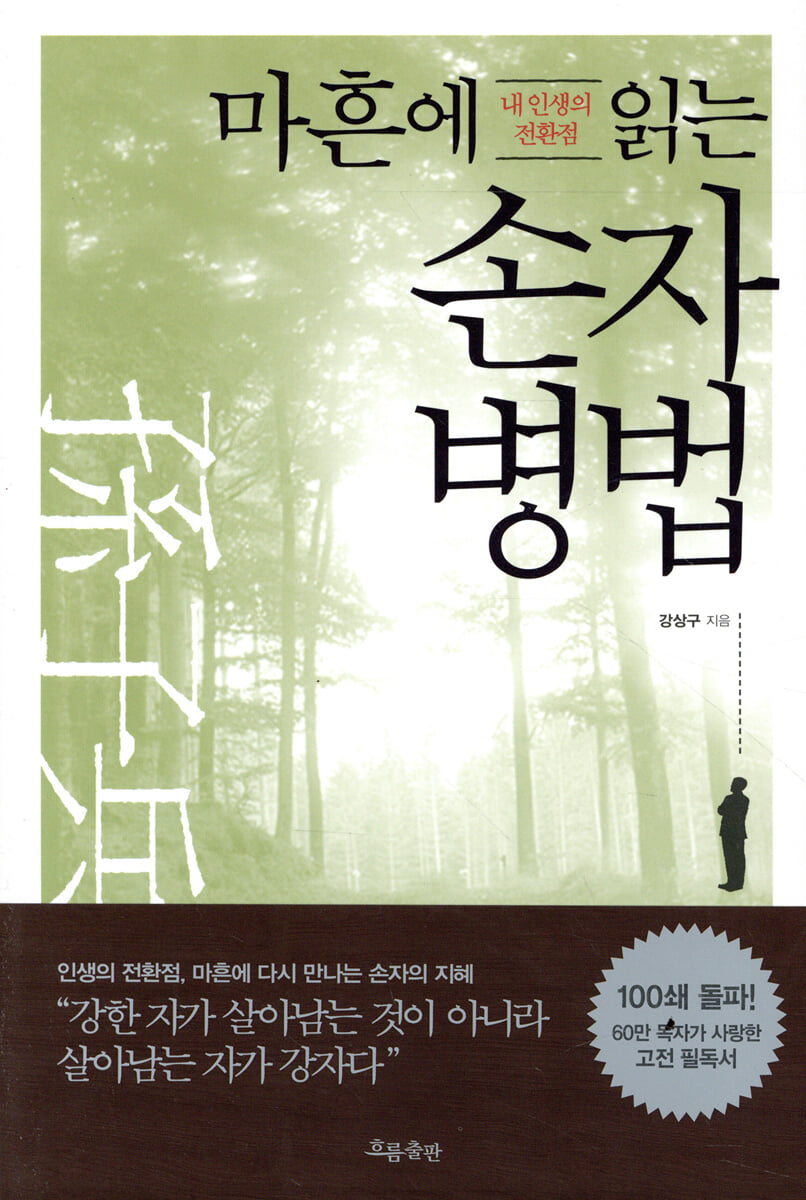
Reading the Art of War at Forty
 |
Description
Book Introduction
Life and Management Wisdom Learned from the Art of War A book that teaches wisdom about life and management through “The Art of War,” which can be called the “bible of politics and management.” Above all, the author presents a new philosophy from The Art of War, which he reread at the age of 'forty'. Through the empathy and reflection felt while personally experiencing each and every phrase of the classics over the course of 40 years, he teaches readers that “at the bottom of the teachings of The Art of War lies the philosophy of recognizing competitors as companions who live together with us.” On the surface, The Art of War is a 'fighting technique'. However, the author, who says that the inside is 'respect for one another', shows the interpretation that "what we learn from Sun Tzu today is not the outside but the inside." The book introduces the 'philosophy of cowardice', 'the art of survival', and 'the philosophy of coexistence' found in The Art of War, and cites them in the history of the Korean War, encouraging readers to read The Art of War and Samguk Sagi together. In particular, this book is not a typical self-help book that suggests applying The Art of War to organizational life and daily life, but rather, the author confidently speaks about what he has experienced in real life, making it enjoyable to read as a practical book. Through this book, which interprets the meaning of the age of forty in its own way through The Art of War, readers will be able to gain wisdom about life and management. *Watch the video "The Art of War for Forty-Somethings" |
- You can preview some of the book's contents.
Preview
index
preface.
The Art of War, the Philosophy of Cowardice
1.
Clockwork: What is War?
War must be started with careful consideration.
The conditions of war and the qualities of the general are crucial.
War is a deception
The outcome is decided before the fight.
2.
Operation: A war that drags on is a waste of time.
War costs a thousand gold pieces a day.
Haste is better than haste
Steal the enemy's food
War should not be prolonged.
3.
Po-gong's strategy: Winning without fighting is true victory.
You can only truly win if you win without fighting.
Don't let them even think about fighting
Don't throw punches recklessly
We must fight for the whole world
If you're outnumbered, don't fight.
The center of the fight is the general.
There is only one correct chain of command
5 Conditions for Victory
If you know your enemy and know yourself, you will not be imperiled in a hundred battles.
4.
Military form: Only fight battles that can be won
Prepare and wait without fail
Victory can be known, but not created.
Attack when you can win
Win against those who have already lost
Politics is the beginning of war.
Fight with the momentum of a pouring stream
5.
Battle Strategy: Hitting a rock with an egg? Hitting an egg with a rock!
Treating ten thousand people as one person
There is no right answer in fighting.
Create the momentum of flowing water
If you think you're being pushed, you'll become weaker
Move the enemy with profit
Don't hold people accountable
Make people believe that non-existent facts are real.
6.
Falsehood and Reality: Selection and Focus
First, take your position and block the attack.
Are you dragging or being dragged?
Attack the unexpected
Hide your intentions
If you exploit a weak point, there is no defense.
It's up to me not to fight
If you guard everywhere, everything becomes weak.
Even if there are many, you can just keep your arms crossed
Victory is something you create
The highest level of tactics has no form.
Tactics are like water
7.
Military Conflict: There are no shortcuts.
You can't force a horse to drink water.
The detour is the shortcut
If you prioritize profit, the fight is dangerous.
If you don't leave strength, you will perish.
Know to enjoy the benefits
Like the wind, like the forest, like fire and like the mountains
Don't even think about filling my pockets.
Keep your eyes and ears open
Make me tired, hungry, and dizzy
Don't be complacent about small victories
The moment you think you've won is the moment of danger.
8.
Nine Changes in the Word: Conditions for Longevity
There are orders that must not be obeyed
You have to see things you don't want to see
Show only what you want to show
Don't trust your enemies, trust yourself.
Five Risk Factors for Longevity
9.
Marching: The essence is hidden
There are principles to moving forward.
Read big changes from small signs
A good fighting general is unkind.
When circumstances are urgent, rewards and punishments are abused.
Even small actions have a reason.
The military should move only enough to win.
It is an order that must be obeyed
10.
Topography: Reasons for the defeat
Different situations lead to different actions.
Defeat is the general's fault
Is the rebellion justified?
Emotion is powerful
Conditions for winning every battle
Once you move, you won't hesitate.
11.
Guji: If your true intentions are revealed, you lose.
Work has priorities
Disperse the enemy's forces
Take away the most precious thing first
With a desperate determination, there is nothing you cannot do.
Beware of rumors
Leave no place to run
In times of crisis, we become comrades.
The problem is leadership
If your true intentions are revealed, you lose
Make them follow blindly
You can't form an alliance without knowing the intentions.
When the balance is broken, it collides
How to move people
It's like being chased and being chased
Security is life
Start like a virgin, attack like a rabbit
12.
Fire attack: If there is nothing to gain, don't come forward.
A fatal attack carries fatal risks.
A question we must never forget: Why do we fight?
Fighting is not about venting anger.
If you can't do it, don't do it.
13.
Yonggan: Knowledge is power
Trying to save money can ruin your life.
He who knows wins
5 Ways to Get Information
Information is interpretation
Understanding personal information is fundamental.
Bring the enemy to our side
Information is a national strategy.
Conclusion.
The Art of War, a philosophy of coexistence
The Art of War, the Philosophy of Cowardice
1.
Clockwork: What is War?
War must be started with careful consideration.
The conditions of war and the qualities of the general are crucial.
War is a deception
The outcome is decided before the fight.
2.
Operation: A war that drags on is a waste of time.
War costs a thousand gold pieces a day.
Haste is better than haste
Steal the enemy's food
War should not be prolonged.
3.
Po-gong's strategy: Winning without fighting is true victory.
You can only truly win if you win without fighting.
Don't let them even think about fighting
Don't throw punches recklessly
We must fight for the whole world
If you're outnumbered, don't fight.
The center of the fight is the general.
There is only one correct chain of command
5 Conditions for Victory
If you know your enemy and know yourself, you will not be imperiled in a hundred battles.
4.
Military form: Only fight battles that can be won
Prepare and wait without fail
Victory can be known, but not created.
Attack when you can win
Win against those who have already lost
Politics is the beginning of war.
Fight with the momentum of a pouring stream
5.
Battle Strategy: Hitting a rock with an egg? Hitting an egg with a rock!
Treating ten thousand people as one person
There is no right answer in fighting.
Create the momentum of flowing water
If you think you're being pushed, you'll become weaker
Move the enemy with profit
Don't hold people accountable
Make people believe that non-existent facts are real.
6.
Falsehood and Reality: Selection and Focus
First, take your position and block the attack.
Are you dragging or being dragged?
Attack the unexpected
Hide your intentions
If you exploit a weak point, there is no defense.
It's up to me not to fight
If you guard everywhere, everything becomes weak.
Even if there are many, you can just keep your arms crossed
Victory is something you create
The highest level of tactics has no form.
Tactics are like water
7.
Military Conflict: There are no shortcuts.
You can't force a horse to drink water.
The detour is the shortcut
If you prioritize profit, the fight is dangerous.
If you don't leave strength, you will perish.
Know to enjoy the benefits
Like the wind, like the forest, like fire and like the mountains
Don't even think about filling my pockets.
Keep your eyes and ears open
Make me tired, hungry, and dizzy
Don't be complacent about small victories
The moment you think you've won is the moment of danger.
8.
Nine Changes in the Word: Conditions for Longevity
There are orders that must not be obeyed
You have to see things you don't want to see
Show only what you want to show
Don't trust your enemies, trust yourself.
Five Risk Factors for Longevity
9.
Marching: The essence is hidden
There are principles to moving forward.
Read big changes from small signs
A good fighting general is unkind.
When circumstances are urgent, rewards and punishments are abused.
Even small actions have a reason.
The military should move only enough to win.
It is an order that must be obeyed
10.
Topography: Reasons for the defeat
Different situations lead to different actions.
Defeat is the general's fault
Is the rebellion justified?
Emotion is powerful
Conditions for winning every battle
Once you move, you won't hesitate.
11.
Guji: If your true intentions are revealed, you lose.
Work has priorities
Disperse the enemy's forces
Take away the most precious thing first
With a desperate determination, there is nothing you cannot do.
Beware of rumors
Leave no place to run
In times of crisis, we become comrades.
The problem is leadership
If your true intentions are revealed, you lose
Make them follow blindly
You can't form an alliance without knowing the intentions.
When the balance is broken, it collides
How to move people
It's like being chased and being chased
Security is life
Start like a virgin, attack like a rabbit
12.
Fire attack: If there is nothing to gain, don't come forward.
A fatal attack carries fatal risks.
A question we must never forget: Why do we fight?
Fighting is not about venting anger.
If you can't do it, don't do it.
13.
Yonggan: Knowledge is power
Trying to save money can ruin your life.
He who knows wins
5 Ways to Get Information
Information is interpretation
Understanding personal information is fundamental.
Bring the enemy to our side
Information is a national strategy.
Conclusion.
The Art of War, a philosophy of coexistence
Into the book
As the days go by, the boundaries between good and evil become more and more blurred.
Rather than dividing into black and white, we rediscover the value of gray.
Because you come to realize that the purpose of life is not some absolute 'something' but 'life' itself.
Sometimes it's messy and ugly, and it makes you cowardly, but learning that that's what life is all about is also living.
This book may perhaps be read as a book of conversion reflecting on my youth.
Or it could be read as a declaration of surrender to the world from a commoner in his forties.
This is a truly embarrassing self-confession.
But you can't overcome reality by denying it.
Sun Tzu's teaching is that knowing how to accept reality and bow down without mercy when it's time to give in is also courage.
As cowards often say, 'It is not the strongest who survive, but the one who survives who is strong.' ---p.8
If you know yourself and your enemy, you will not be in danger in a hundred battles.
If you know your enemy and know yourself, you will not be imperiled in a hundred battles.
However, if you look at the sentences that follow, Sun Tzu takes knowing oneself for granted and focuses on knowing one's enemy.
Even if we play rock-paper-scissors, it is true that it is difficult to know about the enemy because we know what we will play but not what the opponent will play.
But as we live in this world, there are times when knowing ourselves is more difficult than knowing others.
It is human nature to be blind to one's own ten flaws and only see the small flaws of others.
No matter how bright your eyes are, you can't see your own nose.
Even Samcheon Gapja Dongbangsak did not know the day he would die.
When you know your enemy and know yourself, the most important thing is 'cool-headedness'.
I need to empty my mind and look at myself from the enemy's perspective, and I need to look at the enemy from the enemy's perspective.
What I see of my enemy is not everything, and what I see of myself is not everything. ---p.82
The so-called superiors, represented by wages, have no way of admitting their own mistakes.
Even if the judgment of a subordinate, represented by a general, is later determined to be correct, the feeling is only something like, 'Yeah, your poop is thick.'
The moment of awakening to the idea that “this guy can go against me at any time” and “this guy is not my son” only becomes the basis for the king to realize that “this guy is the pillar of the country”.
Rather than dividing into black and white, we rediscover the value of gray.
Because you come to realize that the purpose of life is not some absolute 'something' but 'life' itself.
Sometimes it's messy and ugly, and it makes you cowardly, but learning that that's what life is all about is also living.
This book may perhaps be read as a book of conversion reflecting on my youth.
Or it could be read as a declaration of surrender to the world from a commoner in his forties.
This is a truly embarrassing self-confession.
But you can't overcome reality by denying it.
Sun Tzu's teaching is that knowing how to accept reality and bow down without mercy when it's time to give in is also courage.
As cowards often say, 'It is not the strongest who survive, but the one who survives who is strong.' ---p.8
If you know yourself and your enemy, you will not be in danger in a hundred battles.
If you know your enemy and know yourself, you will not be imperiled in a hundred battles.
However, if you look at the sentences that follow, Sun Tzu takes knowing oneself for granted and focuses on knowing one's enemy.
Even if we play rock-paper-scissors, it is true that it is difficult to know about the enemy because we know what we will play but not what the opponent will play.
But as we live in this world, there are times when knowing ourselves is more difficult than knowing others.
It is human nature to be blind to one's own ten flaws and only see the small flaws of others.
No matter how bright your eyes are, you can't see your own nose.
Even Samcheon Gapja Dongbangsak did not know the day he would die.
When you know your enemy and know yourself, the most important thing is 'cool-headedness'.
I need to empty my mind and look at myself from the enemy's perspective, and I need to look at the enemy from the enemy's perspective.
What I see of my enemy is not everything, and what I see of myself is not everything. ---p.82
The so-called superiors, represented by wages, have no way of admitting their own mistakes.
Even if the judgment of a subordinate, represented by a general, is later determined to be correct, the feeling is only something like, 'Yeah, your poop is thick.'
The moment of awakening to the idea that “this guy can go against me at any time” and “this guy is not my son” only becomes the basis for the king to realize that “this guy is the pillar of the country”.
---p.241
Publisher's Review
The Art of War: The Ultimate Strategy for Life at Forty
The Art of War does not teach the art of ‘fighting.’
It is the philosophy of 'cowardice', the art of 'survival', and the philosophy of 'coexistence'!
If you look into the bookshelves of CEOs these days, you'll find that in addition to business-related books, there are also books on the humanities, especially classics.
In particular, The Art of War, along with The Analects of Confucius, Lao-tzu, and The Book of Changes, is one of the four great classics of China, and is considered the most treasured book by leaders.
SoftBank Chairman Son Jeong-ui, POSCO Chairman Chung Joon-yang, former Samsung Electronics Vice Chairman Yoon Jong-yong, and Konosuke Matsushita keep "The Art of War" by their bedsides and use it as a management strategy book and a guide for character development.
Even if you are not necessarily a leader, when you reach the age of forty, halfway through your life, you will feel that your perspective on the world has changed.
As your status in society rises, you become more acutely aware that life is not as easy as you thought.
In these times, “The Art of War for Those in Their Forties” teaches us the wisdom of life and management through “The Art of War,” which can be called the “bible of politics and management.”
Above all, the author retrieves a new philosophy from The Art of War, which he reread at the age of 'forty'.
“At the heart of the teachings of The Art of War lies the philosophy of recognizing competitors as companions who live together with us.
On the surface, The Art of War is a 'fighting technique'.
But the inside is 'respect for each other'.
“What we learn from our grandson today is not the superficial, but the internal.”
This is exactly what the author realized when he hit his knee at the age of 'forty' or in the position of 'leader'.
The author's unique interpretation was possible because he personally experienced and reflected on each and every phrase of the classics over a period of 40 years.
This is the philosophy of The Art of War that the author read when he was forty, and the message he wants to convey to readers about being forty.
Why Leaders Pick The Art of War as Their Favorite Book
Recently, the Samsung Economic Research Institute conducted a survey of 535 SERI CEO members asking, “What factors are detrimental to an organization as a leader?” and based on the results, presented “Five Dangers Generals Can Fall Into,” as described in “The Art of War.”
1st place.
'Bunsoku Gamoya', meaning that one exposes one's weakness by not being able to control one's anger: 28%
2nd place.
'Pilsaenggaroya (必生可虜也)', which criticizes the timid attitude of only worrying about one's own safety in order to survive a fight: 25.4%
3rd place.
A desperate attempt to charge forward with only courage: 17.9%
4th place.
Being too principled and losing sight of practicality is a shameful thing: 15.0%
5th place.
Aemin Gabanya (13.3%), who loses the courage to drive by being tied down by feelings of guilt
In the first volume, “Shiji (始計),” Sun Tzu puts forward “wisdom, trustworthiness, benevolence, courage, and severity” as the five qualities a general should possess, and says, “War is judged by the ‘conditions of war’ and the ‘qualities of the general.’”
Just as the world of fierce competition for survival is reminiscent of a battlefield, the strategies and tactics of The Art of War can be applied to various fields, including politics, economics, and human relations.
This is probably the reason why The Art of War went beyond its initial military book status and became a favorite reading for writers, scholars, and businessmen.
Forty, a turning point in my life, I found a new philosophy in the Art of War.
1.
The Art of War is a philosophy of cowardice.
In fact, even if you read the same book or read the same passage, the feeling you get from it can be quite different depending on the time, place, and situation you are in.
This was also the author's motivation for writing this book.
If you read The Art of War in your 20s or 30s, when you were bold in your arguments, bold in your work, and ready to take on the world, you would probably remember it as the 'art of fighting' and the 'secret to victory.'
Forty is the age when you no longer have to answer to the orders of your superiors, with whom you used to argue confidently, and you start asking for favors from your juniors rather than giving them orders.
Sun Tzu said, “A truly good fighter is one who wins fights that should be easy to win.”
The Art of War, which you read at age 40, is a 'philosophy of cowardice' that says, 'Be weak in front of the strong and strong in front of the weak.'
2.
The Art of War is the art of survival.
Unlike my youth, which was brimming with energy, when I turned forty and looked around, I saw that the world was full of people stronger than me.
It's not easy to find someone who is easy to deal with.
Perhaps, it may be more urgent to survive without losing than to fight and win against them.
Before we talk about stealing someone else's rice bowl, we must think about how to prevent our own rice bowl from being stolen. That is how we live our lives.
In that sense, The Art of War is no longer a fighting technique, but closer to the 'art of survival'.
3.
The Art of War is a philosophy of coexistence.
The world we live in is entangled in competition.
In a competitive society where countless people live together, I cannot deal with countless people alone.
You have to cooperate with someone.
At the same time, we must not forget someone's betrayal.
What we must not forget is that our competitors are also members who create society together with us.
Sometimes I have to destroy my competitors to win, but they are also people who live with me.
The Art of War contains the fatalistic line, “The basis of war is deception,” but hidden beneath that teaching is the “philosophy of coexistence,” which recognizes competitors as companions who live together with us.
The Art of War, read at age 40, teaches 'respect for one another.'
Citing the history of the Korean War, we read The Art of War and Samguk Sagi together.
The greatest strength of this book is that it reinterprets a difficult-to-read classic in a modern way.
When reading a classic, there are many cases where, contrary to the initial intention of 'I will definitely read it all,' you gradually become distant.
The same goes for The Art of War, which is smaller in volume than other classics.
Although he uses 'parables' to interpret the writings of the unkind grandson, most of them are unfamiliar as they are Chinese anecdotes or European anecdotes.
Taking this point into account, the author took most of the examples in this book from the Samguk Sagi.
Not only does it allow for a high level of understanding and concentration as it unfolds the history of war that we are familiar with, but it also allows you to read the entire "Art of War" and even get a taste of the "Samguk Sagi" in one volume, killing two birds with one stone.
Unlike existing classic commentaries that highlight only one phrase without knowing the context, it is also worth boasting that it is structured identically to the original text of The Art of War.
This book, which is easy to read and yet friendly, can be said to have been reborn as an 'easy classic reading.'
A practical book that can be used in everyday life, not just a simple commentary on the original text.
Above all, the author interprets The Art of War from the perspective of a leader in his forties and living an organizational life, highlighting many realistic aspects.
To quote a few parts:
“If you try to catch a wild rabbit, you will lose the domestic rabbit.”
They pretend to catch two rabbits, but in reality, they are trying to catch both because they are confused about which one is more beneficial.
And usually, you don't catch even one." (Page 143, from 'If you guard everywhere, everything becomes weak')
“The personnel appointment must be made as quickly as possible.
If the organization is shaken, the enemy will collapse without you lifting a finger.
An enemy is someone who must make you tired, hungry, and dizzy.
“There is no reason to exhaust yourself.” (Page 177, from “Make yourself tired, hungry, and dizzy”)
“The interest that doesn’t miss even a single detail in the soldiers’ private lives is the beginning of everything.
To the untrained eye, a broken window is nothing special, but to the discerning eye, a single broken window holds a lot of meaning.
A general can command his soldiers when he discovers the hidden meaning contained in the broken glass.
“Facing the enemy comes later.” (Page 212, from “There Are Principles for Moving Forward”)
“It is said that even if silk is very beautiful, there is nothing as beautiful as a horse.
A general must persuade his king before considering disobedience.
We must find a way to avoid touching the sore spots, but also not lose the fight.
You may be preoccupied with fighting the enemy right in front of you, but you must also consider the interests of the king behind you.
If you call it flattery, then it is flattery. If you call it flattery, then it is flattery.
But the general is a being who must live with sensitive tentacles that give meaning to even a single broken window.
The target of that touch may be subordinates, but at the same time it may also be the king.
There's no need to complain about wasting your energy on useless things.
That is the fate given to the general.
“That’s why it’s difficult to live a long life.” (Page 244, from “Is Disobedience Justified?”)
These are the parts that captivate readers.
While it is important to re-arm your mind each time you read the original text of "The Art of War," the author's unique perspective and commentary, which may seem to be blurted out but contains quite a deep meaning, are deeply ingrained in your mind and are not easily forgotten.
This is a more practical approach for those who want to incorporate classics into their daily lives.
Rather than the common self-help approach of applying The Art of War to organizational life and daily life, the author's confident way of speaking about what he has experienced in real life makes this book enjoyable to read as a practical guide.
Life and Management Wisdom Learned from the Art of War
Beginning _ What is War?
A war must begin with victory.
If you don't have confidence in winning, you shouldn't start.
War _ If war drags on, it's a waste of time.
War is a fight against time.
It is better to end a fight that is not easily resolved early, even if it means suffering losses.
Strategy _ Winning without fighting is true victory.
The best victory is to play nice and get what you want.
If you achieve your goal, the fight is won, no matter what it looks like.
Military _ Only fight battles that can be won
Fighting isn't about losing.
When you are sure that you can win the fight, then you should start the fight.
Battle _ Hitting a rock with an egg Hitting an egg with a rock!
The fight is decided by Sega.
But the count is not predetermined.
Can be created.
Fiction and Reality _ Selection and Focus
If you guard everywhere, everything becomes weak.
Military War _ There are no shortcuts
As the saying goes, the more urgent it is, the more you have to go back. If you are only in a hurry, you can't get anything done.
The fight begins with controlling the mind.
Nine Changes _ Conditions for Longevity
A general must weaken the enemy's power and maximize his own power with wisdom, trust, benevolence, courage, and strictness.
Marching _ The essence is hidden
I look at my own work from a distance, and look at other people's work from a step closer.
The right answer is to change your perspective.
Geography _ Reason for defeat
In a fight, there is an external variable called the ever-changing situation.
All of these factors must be taken into consideration when fighting.
Nine Grounds - If your true intentions are revealed, you lose
To win the hearts of many soldiers and get them to fight, you have to impress them and make them determined.
Fire Attack - If there is nothing to gain, don't come forward
War is not a venting of anger.
We must coldly consider the benefits.
Usefulness _ Knowledge is power
“If you know your enemy and know yourself, the battle will not be dangerous.”
Knowing your enemy is the key to victory.
The Art of War does not teach the art of ‘fighting.’
It is the philosophy of 'cowardice', the art of 'survival', and the philosophy of 'coexistence'!
If you look into the bookshelves of CEOs these days, you'll find that in addition to business-related books, there are also books on the humanities, especially classics.
In particular, The Art of War, along with The Analects of Confucius, Lao-tzu, and The Book of Changes, is one of the four great classics of China, and is considered the most treasured book by leaders.
SoftBank Chairman Son Jeong-ui, POSCO Chairman Chung Joon-yang, former Samsung Electronics Vice Chairman Yoon Jong-yong, and Konosuke Matsushita keep "The Art of War" by their bedsides and use it as a management strategy book and a guide for character development.
Even if you are not necessarily a leader, when you reach the age of forty, halfway through your life, you will feel that your perspective on the world has changed.
As your status in society rises, you become more acutely aware that life is not as easy as you thought.
In these times, “The Art of War for Those in Their Forties” teaches us the wisdom of life and management through “The Art of War,” which can be called the “bible of politics and management.”
Above all, the author retrieves a new philosophy from The Art of War, which he reread at the age of 'forty'.
“At the heart of the teachings of The Art of War lies the philosophy of recognizing competitors as companions who live together with us.
On the surface, The Art of War is a 'fighting technique'.
But the inside is 'respect for each other'.
“What we learn from our grandson today is not the superficial, but the internal.”
This is exactly what the author realized when he hit his knee at the age of 'forty' or in the position of 'leader'.
The author's unique interpretation was possible because he personally experienced and reflected on each and every phrase of the classics over a period of 40 years.
This is the philosophy of The Art of War that the author read when he was forty, and the message he wants to convey to readers about being forty.
Why Leaders Pick The Art of War as Their Favorite Book
Recently, the Samsung Economic Research Institute conducted a survey of 535 SERI CEO members asking, “What factors are detrimental to an organization as a leader?” and based on the results, presented “Five Dangers Generals Can Fall Into,” as described in “The Art of War.”
1st place.
'Bunsoku Gamoya', meaning that one exposes one's weakness by not being able to control one's anger: 28%
2nd place.
'Pilsaenggaroya (必生可虜也)', which criticizes the timid attitude of only worrying about one's own safety in order to survive a fight: 25.4%
3rd place.
A desperate attempt to charge forward with only courage: 17.9%
4th place.
Being too principled and losing sight of practicality is a shameful thing: 15.0%
5th place.
Aemin Gabanya (13.3%), who loses the courage to drive by being tied down by feelings of guilt
In the first volume, “Shiji (始計),” Sun Tzu puts forward “wisdom, trustworthiness, benevolence, courage, and severity” as the five qualities a general should possess, and says, “War is judged by the ‘conditions of war’ and the ‘qualities of the general.’”
Just as the world of fierce competition for survival is reminiscent of a battlefield, the strategies and tactics of The Art of War can be applied to various fields, including politics, economics, and human relations.
This is probably the reason why The Art of War went beyond its initial military book status and became a favorite reading for writers, scholars, and businessmen.
Forty, a turning point in my life, I found a new philosophy in the Art of War.
1.
The Art of War is a philosophy of cowardice.
In fact, even if you read the same book or read the same passage, the feeling you get from it can be quite different depending on the time, place, and situation you are in.
This was also the author's motivation for writing this book.
If you read The Art of War in your 20s or 30s, when you were bold in your arguments, bold in your work, and ready to take on the world, you would probably remember it as the 'art of fighting' and the 'secret to victory.'
Forty is the age when you no longer have to answer to the orders of your superiors, with whom you used to argue confidently, and you start asking for favors from your juniors rather than giving them orders.
Sun Tzu said, “A truly good fighter is one who wins fights that should be easy to win.”
The Art of War, which you read at age 40, is a 'philosophy of cowardice' that says, 'Be weak in front of the strong and strong in front of the weak.'
2.
The Art of War is the art of survival.
Unlike my youth, which was brimming with energy, when I turned forty and looked around, I saw that the world was full of people stronger than me.
It's not easy to find someone who is easy to deal with.
Perhaps, it may be more urgent to survive without losing than to fight and win against them.
Before we talk about stealing someone else's rice bowl, we must think about how to prevent our own rice bowl from being stolen. That is how we live our lives.
In that sense, The Art of War is no longer a fighting technique, but closer to the 'art of survival'.
3.
The Art of War is a philosophy of coexistence.
The world we live in is entangled in competition.
In a competitive society where countless people live together, I cannot deal with countless people alone.
You have to cooperate with someone.
At the same time, we must not forget someone's betrayal.
What we must not forget is that our competitors are also members who create society together with us.
Sometimes I have to destroy my competitors to win, but they are also people who live with me.
The Art of War contains the fatalistic line, “The basis of war is deception,” but hidden beneath that teaching is the “philosophy of coexistence,” which recognizes competitors as companions who live together with us.
The Art of War, read at age 40, teaches 'respect for one another.'
Citing the history of the Korean War, we read The Art of War and Samguk Sagi together.
The greatest strength of this book is that it reinterprets a difficult-to-read classic in a modern way.
When reading a classic, there are many cases where, contrary to the initial intention of 'I will definitely read it all,' you gradually become distant.
The same goes for The Art of War, which is smaller in volume than other classics.
Although he uses 'parables' to interpret the writings of the unkind grandson, most of them are unfamiliar as they are Chinese anecdotes or European anecdotes.
Taking this point into account, the author took most of the examples in this book from the Samguk Sagi.
Not only does it allow for a high level of understanding and concentration as it unfolds the history of war that we are familiar with, but it also allows you to read the entire "Art of War" and even get a taste of the "Samguk Sagi" in one volume, killing two birds with one stone.
Unlike existing classic commentaries that highlight only one phrase without knowing the context, it is also worth boasting that it is structured identically to the original text of The Art of War.
This book, which is easy to read and yet friendly, can be said to have been reborn as an 'easy classic reading.'
A practical book that can be used in everyday life, not just a simple commentary on the original text.
Above all, the author interprets The Art of War from the perspective of a leader in his forties and living an organizational life, highlighting many realistic aspects.
To quote a few parts:
“If you try to catch a wild rabbit, you will lose the domestic rabbit.”
They pretend to catch two rabbits, but in reality, they are trying to catch both because they are confused about which one is more beneficial.
And usually, you don't catch even one." (Page 143, from 'If you guard everywhere, everything becomes weak')
“The personnel appointment must be made as quickly as possible.
If the organization is shaken, the enemy will collapse without you lifting a finger.
An enemy is someone who must make you tired, hungry, and dizzy.
“There is no reason to exhaust yourself.” (Page 177, from “Make yourself tired, hungry, and dizzy”)
“The interest that doesn’t miss even a single detail in the soldiers’ private lives is the beginning of everything.
To the untrained eye, a broken window is nothing special, but to the discerning eye, a single broken window holds a lot of meaning.
A general can command his soldiers when he discovers the hidden meaning contained in the broken glass.
“Facing the enemy comes later.” (Page 212, from “There Are Principles for Moving Forward”)
“It is said that even if silk is very beautiful, there is nothing as beautiful as a horse.
A general must persuade his king before considering disobedience.
We must find a way to avoid touching the sore spots, but also not lose the fight.
You may be preoccupied with fighting the enemy right in front of you, but you must also consider the interests of the king behind you.
If you call it flattery, then it is flattery. If you call it flattery, then it is flattery.
But the general is a being who must live with sensitive tentacles that give meaning to even a single broken window.
The target of that touch may be subordinates, but at the same time it may also be the king.
There's no need to complain about wasting your energy on useless things.
That is the fate given to the general.
“That’s why it’s difficult to live a long life.” (Page 244, from “Is Disobedience Justified?”)
These are the parts that captivate readers.
While it is important to re-arm your mind each time you read the original text of "The Art of War," the author's unique perspective and commentary, which may seem to be blurted out but contains quite a deep meaning, are deeply ingrained in your mind and are not easily forgotten.
This is a more practical approach for those who want to incorporate classics into their daily lives.
Rather than the common self-help approach of applying The Art of War to organizational life and daily life, the author's confident way of speaking about what he has experienced in real life makes this book enjoyable to read as a practical guide.
Life and Management Wisdom Learned from the Art of War
Beginning _ What is War?
A war must begin with victory.
If you don't have confidence in winning, you shouldn't start.
War _ If war drags on, it's a waste of time.
War is a fight against time.
It is better to end a fight that is not easily resolved early, even if it means suffering losses.
Strategy _ Winning without fighting is true victory.
The best victory is to play nice and get what you want.
If you achieve your goal, the fight is won, no matter what it looks like.
Military _ Only fight battles that can be won
Fighting isn't about losing.
When you are sure that you can win the fight, then you should start the fight.
Battle _ Hitting a rock with an egg Hitting an egg with a rock!
The fight is decided by Sega.
But the count is not predetermined.
Can be created.
Fiction and Reality _ Selection and Focus
If you guard everywhere, everything becomes weak.
Military War _ There are no shortcuts
As the saying goes, the more urgent it is, the more you have to go back. If you are only in a hurry, you can't get anything done.
The fight begins with controlling the mind.
Nine Changes _ Conditions for Longevity
A general must weaken the enemy's power and maximize his own power with wisdom, trust, benevolence, courage, and strictness.
Marching _ The essence is hidden
I look at my own work from a distance, and look at other people's work from a step closer.
The right answer is to change your perspective.
Geography _ Reason for defeat
In a fight, there is an external variable called the ever-changing situation.
All of these factors must be taken into consideration when fighting.
Nine Grounds - If your true intentions are revealed, you lose
To win the hearts of many soldiers and get them to fight, you have to impress them and make them determined.
Fire Attack - If there is nothing to gain, don't come forward
War is not a venting of anger.
We must coldly consider the benefits.
Usefulness _ Knowledge is power
“If you know your enemy and know yourself, the battle will not be dangerous.”
Knowing your enemy is the key to victory.
GOODS SPECIFICS
- Date of publication: July 20, 2011
- Page count, weight, size: 328 pages | 602g | 153*224*30mm
- ISBN13: 9788965960126
- ISBN10: 8965960126
You may also like
카테고리
korean


korean

![GQ KOREA Mark (Monthly): December [2025]](http://librairie.coreenne.fr/cdn/shop/files/8ef265dbbfbf186523ed75ba7319009d.jpg?v=1765340328&width=3840)


