

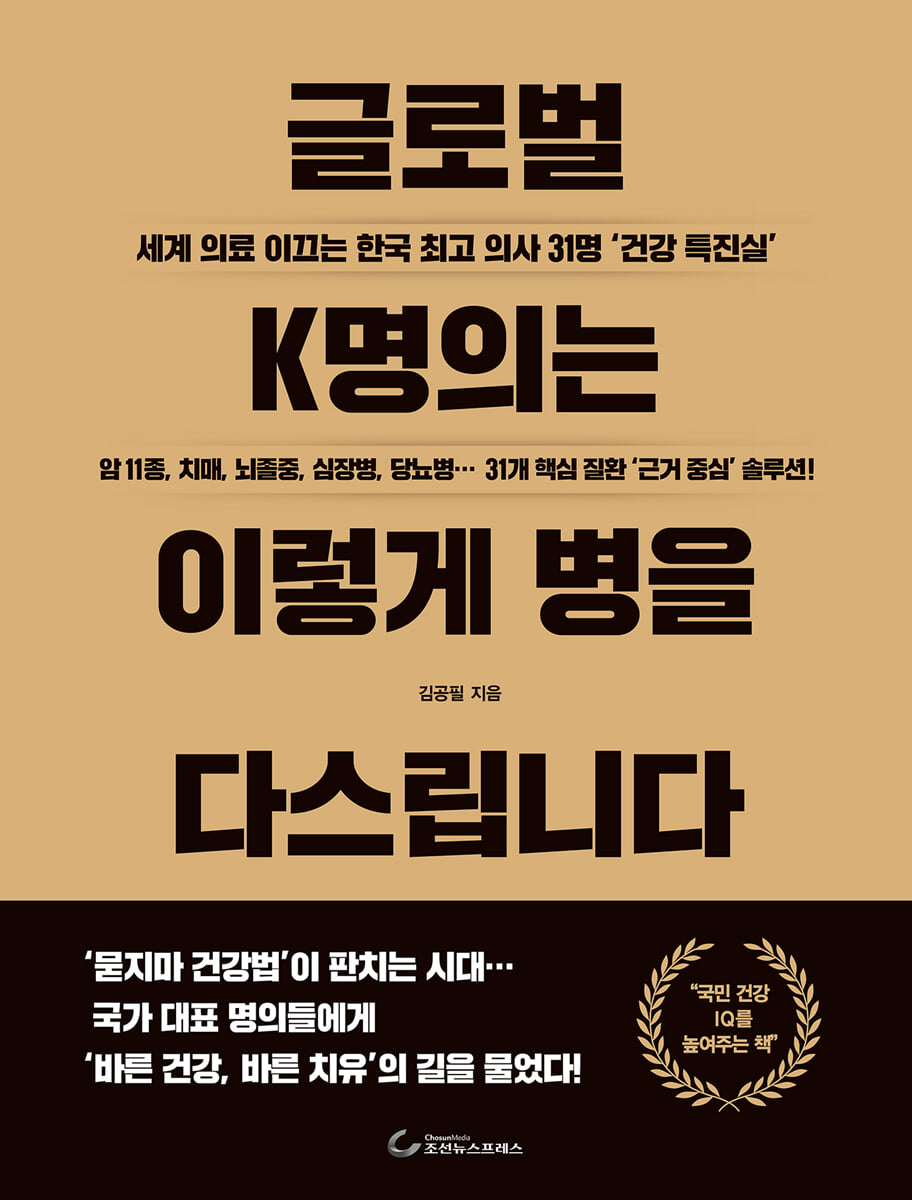
This is how global K doctors treat illness.
 |
Description
Book Introduction
Evidence-based solutions for 31 key diseases: 11 types of cancer, dementia, stroke, heart disease, diabetes, and more!
In an era where 'don't ask health tips' are prevalent... to the nation's leading doctors
Asked the way to 'proper health, proper healing'!
A ‘real master’ is not simply a transmitter of knowledge,
A philosopher and commentator who penetrates the essence of disease.
■If you get sick, the doctor is the answer.
When you get sick, seeing a doctor is the first and last step.
When we are healthy, we search for and read health information, watch health programs, and take health supplements, but when we become ill, there is not much we can do on our own.
Especially for life-threatening diseases such as cancer, cardiovascular disease, and stroke, the doctor you see determines your prognosis.
"This is how a global K-medicine doctor cures illnesses" started with the question, "Who is a real doctor?"
The purpose of this book is to hear real health stories from real doctors.
■Meet 31 of the most famous people
This book is a record of the author, who is active as a medical journalist, meeting with 31 leading Korean doctors and having conversations lasting over two hours.
In an era when it is difficult to even meet with a full-time doctor at a university hospital for three minutes, it is not easy to meet with a renowned doctor for a long time and hear the essence of a disease.
The interviewees were so sincere and touching that it was touching.
Some doctors gave half a day, some prepared presentations, and some continued the interview in scrubs.
They personally reviewed the final manuscript and even did a thorough fact-check.
This completed book is not simply a collection of interviews with doctors, but rather a record containing the wisdom, insight, and philosophy of true doctors.
In an era where 'don't ask health tips' are prevalent... to the nation's leading doctors
Asked the way to 'proper health, proper healing'!
A ‘real master’ is not simply a transmitter of knowledge,
A philosopher and commentator who penetrates the essence of disease.
■If you get sick, the doctor is the answer.
When you get sick, seeing a doctor is the first and last step.
When we are healthy, we search for and read health information, watch health programs, and take health supplements, but when we become ill, there is not much we can do on our own.
Especially for life-threatening diseases such as cancer, cardiovascular disease, and stroke, the doctor you see determines your prognosis.
"This is how a global K-medicine doctor cures illnesses" started with the question, "Who is a real doctor?"
The purpose of this book is to hear real health stories from real doctors.
■Meet 31 of the most famous people
This book is a record of the author, who is active as a medical journalist, meeting with 31 leading Korean doctors and having conversations lasting over two hours.
In an era when it is difficult to even meet with a full-time doctor at a university hospital for three minutes, it is not easy to meet with a renowned doctor for a long time and hear the essence of a disease.
The interviewees were so sincere and touching that it was touching.
Some doctors gave half a day, some prepared presentations, and some continued the interview in scrubs.
They personally reviewed the final manuscript and even did a thorough fact-check.
This completed book is not simply a collection of interviews with doctors, but rather a record containing the wisdom, insight, and philosophy of true doctors.
- You can preview some of the book's contents.
Preview
index
PART 1 Cancer, Global K's Special Investigation Room
[Stomach Cancer] 12,000 Surgeries Performed by "Dr. Monster"
Professor Noh Seong-hoon of the Department of Gastroenterology at Gangnam Severance Hospital
[Lung Cancer] Leading the Development of 'South Korea's First Global Anticancer Drug'
Professor Cho Byeong-cheol, Department of Oncology, Severance Hospital
[Colon Cancer] A World-Class Expert in Minimally Invasive Surgery
Professor Jeong Seung-yong of the Department of Colorectal Surgery at Seoul National University Hospital
[Pancreatic Cancer] A Doctor Creating Global Treatment Guidelines
Professor Jang Jin-young of the Department of Hepatobiliary and Pancreatic Surgery at Seoul National University Hospital
[Prostate Cancer] Surgery? Drug Treatment: A World-Class Expert
Professor Kwak Cheol of the Department of Urology at Seoul National University Hospital
[Breast Cancer] The Most Surgeons, Lowest Recurrence Rate
Han Won-sik, Professor of Breast Endocrine Surgery at Seoul National University Hospital
[Liver Cancer] A Doctor Creating the 'World's First Surgical Technique'
Professor Seo Kyung-seok of the Department of Surgery at Seoul National University
[Head and Neck Cancer] The World's First Robotic Laryngeal Cancer Surgery
Kim Se-heon, Professor of Otolaryngology, Severance Hospital
[Bladder Cancer] World Leader in Artificial Bladder Surgery
Professor Lee Dong-Hyeon, Department of Urology, Ewha Womans University Mokdong Hospital
[Leukemia] A doctor who creates standards for targeted anticancer treatment.
Kim Dong-wook, Professor of Hematology and Oncology at Uijeongbu Eulji Hospital
[General Cancer] Named "America's Best Doctor" 11 times
Kim Eui-shin, Professor Emeritus at MD Anderson Cancer Center
PART 2: Cardiovascular Disease, Global K's Specialized Treatment Room
Development of a Blood Test Method for Early Dementia Diagnosis
Kim Sang-yoon, Professor of Neurology at Seoul National University Bundang Hospital
[Cardiovascular Disease] World-renowned heart disease expert
Professor Kim Hyo-soo of the Department of Cardiology, Seoul National University Hospital
[Arrhythmia] A world authority with 15,000 arrhythmia procedures performed
Kim Young-hoon, Professor Emeritus, Korea University Anam Hospital
[Progress] World authority on ultrasound brain surgery
Professor Jang Jin-woo of the Department of Neurosurgery at Korea University Anam Hospital
[Stroke] Innovative treatment for subarachnoid hemorrhage under development.
Professor Lee Seung-hoon of the Department of Neurology at Seoul National University Hospital
[Aortic Disease] Presenting the World Standard for Aortic Surgery
Song Seok-won, Professor of Cardiovascular and Thoracic Surgery at Ewha Womans University Seoul Hospital
PART 3 Chronic Diseases, Global K's Special Treatment Room
[Diabetes] The Doctor Who Changed the World's Diabetes Textbook
Professor Emeritus Yoon Geon-ho of the Department of Endocrinology, Seoul St. Mary's Hospital, Catholic University of Korea
[Liver Disease] A doctor who evaluates papers by doctors around the world
Sang-Hoon Ahn, Professor of Gastroenterology at Severance Hospital
[Kidney Disease] Global Glomerulonephritis Genome Study
Kim Dong-gi, Professor of Nephrology at Seoul National University Hospital
[Insomnia] Circadian Rhythm Research? Treatment Expert
Professor Lee Heon-jeong of the Department of Psychiatry, Korea University Anam Hospital
[Dizziness] Oxford University's Vertigo Textbook Author
Kim Ji-soo, Professor of Neurology at Seoul National University Bundang Hospital
[Allergy] Lead author of the World Allergy Textbook
Park Hae-sim, Professor of Allergy at Ajou University Hospital
PART 4: Incurable? Rare Diseases: A Global K-Person Specialized Treatment Center
[Hearing Loss? Tinnitus] 2025 World Tinnitus Congress President
Park Si-nae, Professor of Otolaryngology, Seoul St. Mary's Hospital, Catholic University of Korea
[Alopecia] Research on a treatment that's gaining global attention
Professor Kwon Oh-sang of the Department of Dermatology at Seoul National University Hospital
[Pain] The world's authority on botox treatment
Park Hyu-jeong, Professor of Anesthesiology and Pain Medicine, Seoul St. Mary's Hospital, Catholic University of Korea
[Infertility? Difficulty in Childbirth] A Master in Maternal-Fetal Medicine
Park Joong-shin, Professor of Obstetrics and Gynecology at Seoul National University Hospital
[Senility? Sarcopenia] A doctor who sets diagnostic criteria for senility? Sarcopenia
Won Jang-won, Professor of Family Medicine, Kyung Hee University Hospital
[Pediatric Rare Diseases] Building a Rare Disease Network with Doctors Worldwide
Professor Chae Jong-hee, Department of Clinical Genomic Medicine, Seoul National University Hospital
[Moyamoya Disease] World Authority on Adult Moyamoya Disease
Kim Jeong-eun, Professor of Neurosurgery at Seoul National University Hospital
[Severe fracture] A doctor who fixes bones that could not be fixed at other hospitals
Professor Oh Jong-geon of the Department of Orthopedic Surgery at Korea University Guro Hospital
[Stomach Cancer] 12,000 Surgeries Performed by "Dr. Monster"
Professor Noh Seong-hoon of the Department of Gastroenterology at Gangnam Severance Hospital
[Lung Cancer] Leading the Development of 'South Korea's First Global Anticancer Drug'
Professor Cho Byeong-cheol, Department of Oncology, Severance Hospital
[Colon Cancer] A World-Class Expert in Minimally Invasive Surgery
Professor Jeong Seung-yong of the Department of Colorectal Surgery at Seoul National University Hospital
[Pancreatic Cancer] A Doctor Creating Global Treatment Guidelines
Professor Jang Jin-young of the Department of Hepatobiliary and Pancreatic Surgery at Seoul National University Hospital
[Prostate Cancer] Surgery? Drug Treatment: A World-Class Expert
Professor Kwak Cheol of the Department of Urology at Seoul National University Hospital
[Breast Cancer] The Most Surgeons, Lowest Recurrence Rate
Han Won-sik, Professor of Breast Endocrine Surgery at Seoul National University Hospital
[Liver Cancer] A Doctor Creating the 'World's First Surgical Technique'
Professor Seo Kyung-seok of the Department of Surgery at Seoul National University
[Head and Neck Cancer] The World's First Robotic Laryngeal Cancer Surgery
Kim Se-heon, Professor of Otolaryngology, Severance Hospital
[Bladder Cancer] World Leader in Artificial Bladder Surgery
Professor Lee Dong-Hyeon, Department of Urology, Ewha Womans University Mokdong Hospital
[Leukemia] A doctor who creates standards for targeted anticancer treatment.
Kim Dong-wook, Professor of Hematology and Oncology at Uijeongbu Eulji Hospital
[General Cancer] Named "America's Best Doctor" 11 times
Kim Eui-shin, Professor Emeritus at MD Anderson Cancer Center
PART 2: Cardiovascular Disease, Global K's Specialized Treatment Room
Development of a Blood Test Method for Early Dementia Diagnosis
Kim Sang-yoon, Professor of Neurology at Seoul National University Bundang Hospital
[Cardiovascular Disease] World-renowned heart disease expert
Professor Kim Hyo-soo of the Department of Cardiology, Seoul National University Hospital
[Arrhythmia] A world authority with 15,000 arrhythmia procedures performed
Kim Young-hoon, Professor Emeritus, Korea University Anam Hospital
[Progress] World authority on ultrasound brain surgery
Professor Jang Jin-woo of the Department of Neurosurgery at Korea University Anam Hospital
[Stroke] Innovative treatment for subarachnoid hemorrhage under development.
Professor Lee Seung-hoon of the Department of Neurology at Seoul National University Hospital
[Aortic Disease] Presenting the World Standard for Aortic Surgery
Song Seok-won, Professor of Cardiovascular and Thoracic Surgery at Ewha Womans University Seoul Hospital
PART 3 Chronic Diseases, Global K's Special Treatment Room
[Diabetes] The Doctor Who Changed the World's Diabetes Textbook
Professor Emeritus Yoon Geon-ho of the Department of Endocrinology, Seoul St. Mary's Hospital, Catholic University of Korea
[Liver Disease] A doctor who evaluates papers by doctors around the world
Sang-Hoon Ahn, Professor of Gastroenterology at Severance Hospital
[Kidney Disease] Global Glomerulonephritis Genome Study
Kim Dong-gi, Professor of Nephrology at Seoul National University Hospital
[Insomnia] Circadian Rhythm Research? Treatment Expert
Professor Lee Heon-jeong of the Department of Psychiatry, Korea University Anam Hospital
[Dizziness] Oxford University's Vertigo Textbook Author
Kim Ji-soo, Professor of Neurology at Seoul National University Bundang Hospital
[Allergy] Lead author of the World Allergy Textbook
Park Hae-sim, Professor of Allergy at Ajou University Hospital
PART 4: Incurable? Rare Diseases: A Global K-Person Specialized Treatment Center
[Hearing Loss? Tinnitus] 2025 World Tinnitus Congress President
Park Si-nae, Professor of Otolaryngology, Seoul St. Mary's Hospital, Catholic University of Korea
[Alopecia] Research on a treatment that's gaining global attention
Professor Kwon Oh-sang of the Department of Dermatology at Seoul National University Hospital
[Pain] The world's authority on botox treatment
Park Hyu-jeong, Professor of Anesthesiology and Pain Medicine, Seoul St. Mary's Hospital, Catholic University of Korea
[Infertility? Difficulty in Childbirth] A Master in Maternal-Fetal Medicine
Park Joong-shin, Professor of Obstetrics and Gynecology at Seoul National University Hospital
[Senility? Sarcopenia] A doctor who sets diagnostic criteria for senility? Sarcopenia
Won Jang-won, Professor of Family Medicine, Kyung Hee University Hospital
[Pediatric Rare Diseases] Building a Rare Disease Network with Doctors Worldwide
Professor Chae Jong-hee, Department of Clinical Genomic Medicine, Seoul National University Hospital
[Moyamoya Disease] World Authority on Adult Moyamoya Disease
Kim Jeong-eun, Professor of Neurosurgery at Seoul National University Hospital
[Severe fracture] A doctor who fixes bones that could not be fixed at other hospitals
Professor Oh Jong-geon of the Department of Orthopedic Surgery at Korea University Guro Hospital
Detailed image
Into the book
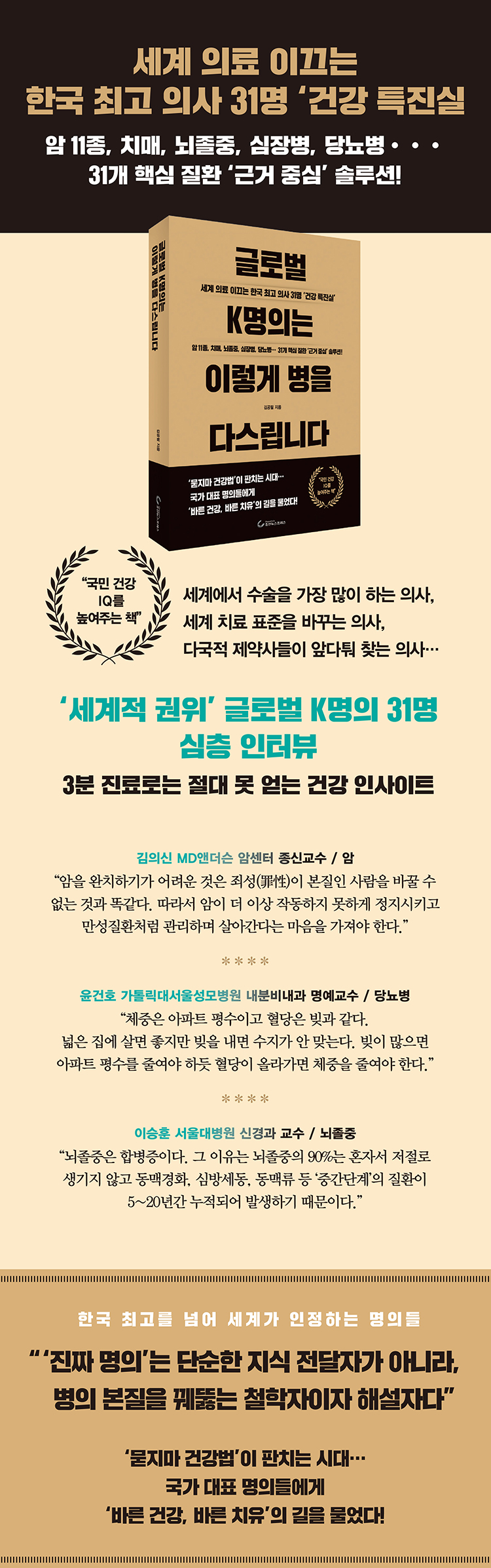
In-depth interviews with 31 global K experts, known for their global authority…
Health insights you can never get from a 3-minute consultation!
“It is difficult to cure cancer, and it is equally difficult to change people.
Sending the criminal to prison and doing everything you can to him won't change anything.
It is because of the evil heart, or sin, that humans have.
The clergy also have a sinful nature.
So the best way is to stop the cancer from functioning any longer.
“Therefore, we must have the mindset that cancer is a chronic disease that we will live with until we die.” (Kim Eui-shin, MD Anderson Cancer Center, Professor/General Cancer)
"PSA (prostate-specific antigen) is an enzyme produced only in the prostate gland. High levels of PSA in a blood test suggest prostate cancer. PSA dissolves the protein semenogellin, which surrounds sperm, transforming it into fertilizable sperm. PSA is supposed to be found only in the prostate gland, but when prostate cancer develops, it leaks into the bloodstream, leading to a suspicion of prostate cancer." (Professor Kwak Cheol, Department of Urology, Seoul National University Hospital/Prostate Cancer)
“If the tumor invades the muscle layer of the bladder, a cystectomy is performed.
If the bladder is completely removed, there is no path for urine to be excreted, so an artificial bladder surgery is performed to create a bladder and urinary tract.
In artificial bladder surgery, the end of the small intestine is cut to a length of 40 to 70 cm, a balloon-shaped pouch is created, and the pouch is connected to the ureter near the kidney and the lower part to the urethra to allow urine to drain.
“The bladder capacity is initially 250 cc, but gradually increases to 500 cc, functioning as a normal bladder.” (Dong-Hyeon Lee, Professor of Urology, Seoul National University Hospital/Bladder Cancer)
“Our hearts beat with electrical force.
If there is a problem with the electrical system, abnormal conditions such as the heart beating too fast (tachycardia), too slow (bradycardia), or quivering (fibrillation) occur.
This is called arrhythmia.
The heart has circuits through which electricity flows, just like an electrical appliance.
Arrhythmia is a condition in which electricity flows through an incorrect circuit or an electrical spark occurs in an incorrect location, as if a leakage current has occurred.
“Even if the sinoatrial node, which generates electricity, is not generating electricity properly, arrhythmia can occur, just like when the central broadcast is not working properly, local broadcasts are active.” (Kim Young-hoon, Professor Emeritus, Korea University Anam Hospital/Arrhythmia)
“Stroke is a complication.
This is because 90% of strokes do not occur on their own, but rather occur as a result of the accumulation of 'intermediate-stage' diseases such as arteriosclerosis over 5 to 20 years.
Intermediate stage diseases of cerebral infarction are atherosclerosis and atrial fibrillation.
Intermediate diseases of cerebral hemorrhage are aneurysms and small vessel arteriosclerosis.
Therefore, these intermediate-stage diseases must be treated.” (Seung-Hoon Lee, Professor of Neurology, Seoul National University Hospital/Stroke)
“Weight is like the square footage of an apartment, and blood sugar is like debt.
It would be nice to live in a big house, but if you go into debt, it won't be profitable.
Just as you should reduce the size of your apartment if you have a lot of debt, the best thing to do if your blood sugar is high is to lose weight.
Losing just 15% of body weight can return 80% of people with early-onset diabetes to normal.
How you eat is just as important as what you eat.
The key is to fast for 12 hours after dinner until morning.
“If you eat dinner late or eat something at night and do not exercise, your energy metabolism will not be sufficient, and the extra energy used up throughout the night will be converted into fat, increasing the accumulation of abdominal fat.” (Professor Emeritus Yoon Geon-ho, Seoul St. Mary’s Hospital/Diabetes)
“It is more important for liver health to avoid eating the wrong foods or taking medicines than to eat good foods.
If you eat something that is good for your liver, your liver has to work harder to detoxify it.
Because the liver is a biochemical factory, it primarily synthesizes and breaks down essential nutrients such as proteins, fats, and carbohydrates, but it must also detoxify and process new substances as they continue to enter the body.
“Exercise is good for cardiopulmonary function and muscle development, but strenuous exercise is not good for the liver because blood supply to the liver is reduced during exercise.” (Professor Sang-Hoon Ahn, Department of Gastroenterology, Severance Hospital/Liver Disease)
“We do not recommend reducing salt and protein intake by applying the same standards to all patients with chronic kidney disease.
It is important to consume the right amount of salt and protein, as less is better for the kidneys.
Excessive protein restriction can cause nutritional deficiencies such as muscle loss, so you should consume the appropriate amount through individualized nutritional counseling.
“Because each patient’s situation is different, fitting it into a principle can lead to the error of generalization.” (Professor Kim Dong-gi, Department of Nephrology, Seoul National University Hospital/Chronic Kidney Disease)
“Insomnia is often caused by a delayed circadian clock, so getting enough morning light helps you fall asleep earlier at night and get better quality sleep.
It is recommended to go outside early, right after waking up.
You need to take an outdoor walk for at least 30 minutes.
Sleeping pills inevitably lead to dependence and tolerance.
“It’s better to continue sleeping well than to sleep well for a few days. Taking sleeping pills is like cheating on a test instead of studying for it to get a good grade.” (Lee Heon-jeong, Professor of Psychiatry, Korea University Anam Hospital/Insomnia)
“Most allergic diseases are diseases that require living with symptoms controlled, like diabetes or high blood pressure.
You can live like a normal person, and if symptoms appear occasionally, you can manage them by taking medication.
Patients ask why they can't be cured.
Rather than being incurable, we should focus on the fact that, like diabetes or high blood pressure, if we control it and take medication properly, we can live to be 100 years old without any special disabilities, just like a normal person.” (Professor Park Hae-sim, Department of Allergy, Ajou University Hospital/Allergy)
“90% of tinnitus is sensorineural tinnitus.
Sensorineural tinnitus is caused by a malfunction in the brain's compensatory mechanisms.
When a sound in a certain range of frequencies does not reach the brain, the auditory center of the brain creates its own sound, thinking, "Why isn't this range of frequencies coming in? I need to help."
In reality, no sound comes from outside, but a sound of that range is created, and the person feels a 'phantom sound'.
“It is most important to normalize hearing in the range of sounds that are difficult to hear so that the brain does not create ‘phantom sounds.’” (Professor Park Si-nae, Department of Otolaryngology, Seoul St. Mary’s Hospital/Hearing Loss/Tinnitus)
“There are people who say that their hair volume has noticeably increased after receiving hospital treatment.
If there are relatively many dormant roots, the treatment of hair loss can be more effective.
The principle of hair growth is not to create new roots, but to awaken dormant roots.
Normally, out of about 100,000 hairs, 90% grow and 10% rest as a reserve force.
However, if the reserve force exceeds 10%, hair loss progresses, and in severe cases, 30-40% of the hair falls out.
“For these people, treatment for hair loss shows dramatic results because the hair that was previously dormant grows back relatively more.” (Professor Kwon Oh-sang, Department of Dermatology, Seoul National University Hospital/Hair Loss)
Health insights you can never get from a 3-minute consultation!
“It is difficult to cure cancer, and it is equally difficult to change people.
Sending the criminal to prison and doing everything you can to him won't change anything.
It is because of the evil heart, or sin, that humans have.
The clergy also have a sinful nature.
So the best way is to stop the cancer from functioning any longer.
“Therefore, we must have the mindset that cancer is a chronic disease that we will live with until we die.” (Kim Eui-shin, MD Anderson Cancer Center, Professor/General Cancer)
"PSA (prostate-specific antigen) is an enzyme produced only in the prostate gland. High levels of PSA in a blood test suggest prostate cancer. PSA dissolves the protein semenogellin, which surrounds sperm, transforming it into fertilizable sperm. PSA is supposed to be found only in the prostate gland, but when prostate cancer develops, it leaks into the bloodstream, leading to a suspicion of prostate cancer." (Professor Kwak Cheol, Department of Urology, Seoul National University Hospital/Prostate Cancer)
“If the tumor invades the muscle layer of the bladder, a cystectomy is performed.
If the bladder is completely removed, there is no path for urine to be excreted, so an artificial bladder surgery is performed to create a bladder and urinary tract.
In artificial bladder surgery, the end of the small intestine is cut to a length of 40 to 70 cm, a balloon-shaped pouch is created, and the pouch is connected to the ureter near the kidney and the lower part to the urethra to allow urine to drain.
“The bladder capacity is initially 250 cc, but gradually increases to 500 cc, functioning as a normal bladder.” (Dong-Hyeon Lee, Professor of Urology, Seoul National University Hospital/Bladder Cancer)
“Our hearts beat with electrical force.
If there is a problem with the electrical system, abnormal conditions such as the heart beating too fast (tachycardia), too slow (bradycardia), or quivering (fibrillation) occur.
This is called arrhythmia.
The heart has circuits through which electricity flows, just like an electrical appliance.
Arrhythmia is a condition in which electricity flows through an incorrect circuit or an electrical spark occurs in an incorrect location, as if a leakage current has occurred.
“Even if the sinoatrial node, which generates electricity, is not generating electricity properly, arrhythmia can occur, just like when the central broadcast is not working properly, local broadcasts are active.” (Kim Young-hoon, Professor Emeritus, Korea University Anam Hospital/Arrhythmia)
“Stroke is a complication.
This is because 90% of strokes do not occur on their own, but rather occur as a result of the accumulation of 'intermediate-stage' diseases such as arteriosclerosis over 5 to 20 years.
Intermediate stage diseases of cerebral infarction are atherosclerosis and atrial fibrillation.
Intermediate diseases of cerebral hemorrhage are aneurysms and small vessel arteriosclerosis.
Therefore, these intermediate-stage diseases must be treated.” (Seung-Hoon Lee, Professor of Neurology, Seoul National University Hospital/Stroke)
“Weight is like the square footage of an apartment, and blood sugar is like debt.
It would be nice to live in a big house, but if you go into debt, it won't be profitable.
Just as you should reduce the size of your apartment if you have a lot of debt, the best thing to do if your blood sugar is high is to lose weight.
Losing just 15% of body weight can return 80% of people with early-onset diabetes to normal.
How you eat is just as important as what you eat.
The key is to fast for 12 hours after dinner until morning.
“If you eat dinner late or eat something at night and do not exercise, your energy metabolism will not be sufficient, and the extra energy used up throughout the night will be converted into fat, increasing the accumulation of abdominal fat.” (Professor Emeritus Yoon Geon-ho, Seoul St. Mary’s Hospital/Diabetes)
“It is more important for liver health to avoid eating the wrong foods or taking medicines than to eat good foods.
If you eat something that is good for your liver, your liver has to work harder to detoxify it.
Because the liver is a biochemical factory, it primarily synthesizes and breaks down essential nutrients such as proteins, fats, and carbohydrates, but it must also detoxify and process new substances as they continue to enter the body.
“Exercise is good for cardiopulmonary function and muscle development, but strenuous exercise is not good for the liver because blood supply to the liver is reduced during exercise.” (Professor Sang-Hoon Ahn, Department of Gastroenterology, Severance Hospital/Liver Disease)
“We do not recommend reducing salt and protein intake by applying the same standards to all patients with chronic kidney disease.
It is important to consume the right amount of salt and protein, as less is better for the kidneys.
Excessive protein restriction can cause nutritional deficiencies such as muscle loss, so you should consume the appropriate amount through individualized nutritional counseling.
“Because each patient’s situation is different, fitting it into a principle can lead to the error of generalization.” (Professor Kim Dong-gi, Department of Nephrology, Seoul National University Hospital/Chronic Kidney Disease)
“Insomnia is often caused by a delayed circadian clock, so getting enough morning light helps you fall asleep earlier at night and get better quality sleep.
It is recommended to go outside early, right after waking up.
You need to take an outdoor walk for at least 30 minutes.
Sleeping pills inevitably lead to dependence and tolerance.
“It’s better to continue sleeping well than to sleep well for a few days. Taking sleeping pills is like cheating on a test instead of studying for it to get a good grade.” (Lee Heon-jeong, Professor of Psychiatry, Korea University Anam Hospital/Insomnia)
“Most allergic diseases are diseases that require living with symptoms controlled, like diabetes or high blood pressure.
You can live like a normal person, and if symptoms appear occasionally, you can manage them by taking medication.
Patients ask why they can't be cured.
Rather than being incurable, we should focus on the fact that, like diabetes or high blood pressure, if we control it and take medication properly, we can live to be 100 years old without any special disabilities, just like a normal person.” (Professor Park Hae-sim, Department of Allergy, Ajou University Hospital/Allergy)
“90% of tinnitus is sensorineural tinnitus.
Sensorineural tinnitus is caused by a malfunction in the brain's compensatory mechanisms.
When a sound in a certain range of frequencies does not reach the brain, the auditory center of the brain creates its own sound, thinking, "Why isn't this range of frequencies coming in? I need to help."
In reality, no sound comes from outside, but a sound of that range is created, and the person feels a 'phantom sound'.
“It is most important to normalize hearing in the range of sounds that are difficult to hear so that the brain does not create ‘phantom sounds.’” (Professor Park Si-nae, Department of Otolaryngology, Seoul St. Mary’s Hospital/Hearing Loss/Tinnitus)
“There are people who say that their hair volume has noticeably increased after receiving hospital treatment.
If there are relatively many dormant roots, the treatment of hair loss can be more effective.
The principle of hair growth is not to create new roots, but to awaken dormant roots.
Normally, out of about 100,000 hairs, 90% grow and 10% rest as a reserve force.
However, if the reserve force exceeds 10%, hair loss progresses, and in severe cases, 30-40% of the hair falls out.
“For these people, treatment for hair loss shows dramatic results because the hair that was previously dormant grows back relatively more.” (Professor Kwon Oh-sang, Department of Dermatology, Seoul National University Hospital/Hair Loss)
--- From the text
Publisher's Review
■Names of K-doctors Leading the World in Medicine
All the famous doctors appearing in the book are names that are receiving attention from the global medical community.
Professor Noh Sung-hoon of Gangnam Severance Hospital has performed over 12,000 stomach cancer surgeries, setting a world record, and Professor Han Won-sik of Seoul National University Hospital has established Korean surgical standards by performing 15,000 breast cancer surgeries.
Professor Emeritus Kim Young-hoon of Korea University Anam Hospital is the world's leading arrhythmia treatment expert, and Professor Kim Se-heon of Severance Hospital was the first in the world to successfully perform robotic laryngeal cancer surgery.
Professor Song Seok-won of Seoul National University Hospital has set a new global surgical standard by lowering the mortality rate for aortic surgery from the US average of 20% to 3%.
There are also doctors who have raised K-medical care to world-class levels in the areas of research and technology.
Professor Cho Byeong-cheol of Severance Hospital led the development of Korea's first targeted anticancer drug for lung cancer, and Professor Yoon Geon-ho of Seoul St. Mary's Hospital changed the content of internal medicine textbooks around the world with his research that "Asians develop diabetes even if they are not fat."
Professor Jin-Young Jang of Seoul National University Hospital participated in revising the pancreatic cancer treatment guidelines as a member of the International Pancreatic Society's treatment guidelines committee, and Professor Hae-Sim Park of Ajou University Hospital was listed as the lead author of the world's allergy textbook.
Professor Kim Ji-soo of Seoul National University Bundang Hospital ranks first in the world in the number of research papers on benign paroxysmal positional vertigo and also participated in writing a textbook for Oxford University.
These are the 'leading figures of K-medicine' who are quietly but firmly making Korea's name shine on the world stage of medicine, although they are not as flashy as K-pop, K-food, or K-movies.
Doctors who teach us how to 'understand' disease
What makes this book special is that it doesn't simply portray the doctors as 'doctors with excellent healing skills.'
The author focuses on their treatment philosophy and view of disease.
Professor Kim Eui-shin of MD Anderson University School of Medicine suggests a shift in perspective on cancer, saying, “Cancer is not a localized disease that can be resolved with surgery, but a systemic and chronic disease.”
Professor Kwak Cheol of Seoul National University Hospital explains the principles of early diagnosis of prostate cancer using PSA testing in everyday language, and Professor Yoon Geon-ho emphasizes the importance of putting it into practice in daily life with the analogy, “Weight is like the size of an apartment, and blood sugar is like debt.”
Professor Sang-Hoon Ahn of Severance Hospital overturns common health wisdom by saying, “It is much more important to avoid bad things than to force yourself to eat things that are good for your liver.”
In this way, each doctor helps patients understand the 'principle' of the disease and face the disease with rational insight instead of fear.
■4 PARTS, A Quest for the Essence of Disease
"This is how a global K-doctor cures diseases" is not a book that simply lists diseases.
It is structured to understand the root cause of disease and explore the essence of treatment.
First, we covered 11 major cancer types in depth, including lung cancer, stomach cancer, colon cancer, breast cancer, pancreatic cancer, and prostate cancer.
Second, cardiovascular diseases such as myocardial infarction, arrhythmia, stroke, and aortic disease; third, chronic diseases requiring long-term management such as diabetes, chronic kidney disease, liver disease, allergies, and insomnia; and fourth, incurable and rare diseases such as tinnitus, alopecia, rare childhood diseases, and moyamoya disease.
For each disease, the leading expert in the field directly explains the disease's principles and treatment philosophy.
This is an in-depth health guide that you won't find through an internet search.
A health book that goes beyond information and provides insight.
Health content is overflowing these days.
However, most of the information is limited to fragmentary information such as “If you eat this, you will get better” or “If you do this, you will be cured.”
This book distances itself from that trend.
It goes one step further than ‘knowledge for understanding disease’ and presents a ‘philosophy for viewing health.’
It doesn't just provide simple health information, but also provides attitudes, mindsets, and healing wisdom toward health.
All the famous doctors appearing in the book are names that are receiving attention from the global medical community.
Professor Noh Sung-hoon of Gangnam Severance Hospital has performed over 12,000 stomach cancer surgeries, setting a world record, and Professor Han Won-sik of Seoul National University Hospital has established Korean surgical standards by performing 15,000 breast cancer surgeries.
Professor Emeritus Kim Young-hoon of Korea University Anam Hospital is the world's leading arrhythmia treatment expert, and Professor Kim Se-heon of Severance Hospital was the first in the world to successfully perform robotic laryngeal cancer surgery.
Professor Song Seok-won of Seoul National University Hospital has set a new global surgical standard by lowering the mortality rate for aortic surgery from the US average of 20% to 3%.
There are also doctors who have raised K-medical care to world-class levels in the areas of research and technology.
Professor Cho Byeong-cheol of Severance Hospital led the development of Korea's first targeted anticancer drug for lung cancer, and Professor Yoon Geon-ho of Seoul St. Mary's Hospital changed the content of internal medicine textbooks around the world with his research that "Asians develop diabetes even if they are not fat."
Professor Jin-Young Jang of Seoul National University Hospital participated in revising the pancreatic cancer treatment guidelines as a member of the International Pancreatic Society's treatment guidelines committee, and Professor Hae-Sim Park of Ajou University Hospital was listed as the lead author of the world's allergy textbook.
Professor Kim Ji-soo of Seoul National University Bundang Hospital ranks first in the world in the number of research papers on benign paroxysmal positional vertigo and also participated in writing a textbook for Oxford University.
These are the 'leading figures of K-medicine' who are quietly but firmly making Korea's name shine on the world stage of medicine, although they are not as flashy as K-pop, K-food, or K-movies.
Doctors who teach us how to 'understand' disease
What makes this book special is that it doesn't simply portray the doctors as 'doctors with excellent healing skills.'
The author focuses on their treatment philosophy and view of disease.
Professor Kim Eui-shin of MD Anderson University School of Medicine suggests a shift in perspective on cancer, saying, “Cancer is not a localized disease that can be resolved with surgery, but a systemic and chronic disease.”
Professor Kwak Cheol of Seoul National University Hospital explains the principles of early diagnosis of prostate cancer using PSA testing in everyday language, and Professor Yoon Geon-ho emphasizes the importance of putting it into practice in daily life with the analogy, “Weight is like the size of an apartment, and blood sugar is like debt.”
Professor Sang-Hoon Ahn of Severance Hospital overturns common health wisdom by saying, “It is much more important to avoid bad things than to force yourself to eat things that are good for your liver.”
In this way, each doctor helps patients understand the 'principle' of the disease and face the disease with rational insight instead of fear.
■4 PARTS, A Quest for the Essence of Disease
"This is how a global K-doctor cures diseases" is not a book that simply lists diseases.
It is structured to understand the root cause of disease and explore the essence of treatment.
First, we covered 11 major cancer types in depth, including lung cancer, stomach cancer, colon cancer, breast cancer, pancreatic cancer, and prostate cancer.
Second, cardiovascular diseases such as myocardial infarction, arrhythmia, stroke, and aortic disease; third, chronic diseases requiring long-term management such as diabetes, chronic kidney disease, liver disease, allergies, and insomnia; and fourth, incurable and rare diseases such as tinnitus, alopecia, rare childhood diseases, and moyamoya disease.
For each disease, the leading expert in the field directly explains the disease's principles and treatment philosophy.
This is an in-depth health guide that you won't find through an internet search.
A health book that goes beyond information and provides insight.
Health content is overflowing these days.
However, most of the information is limited to fragmentary information such as “If you eat this, you will get better” or “If you do this, you will be cured.”
This book distances itself from that trend.
It goes one step further than ‘knowledge for understanding disease’ and presents a ‘philosophy for viewing health.’
It doesn't just provide simple health information, but also provides attitudes, mindsets, and healing wisdom toward health.
GOODS SPECIFICS
- Date of issue: November 4, 2025
- Page count, weight, size: 333 pages | 526g | 150*200*20mm
- ISBN13: 9791155785140
- ISBN10: 1155785142
You may also like
카테고리
korean


korean

![GQ KOREA Mark (Monthly): December [2025]](http://librairie.coreenne.fr/cdn/shop/files/8ef265dbbfbf186523ed75ba7319009d.jpg?v=1765340328&width=3840)


