

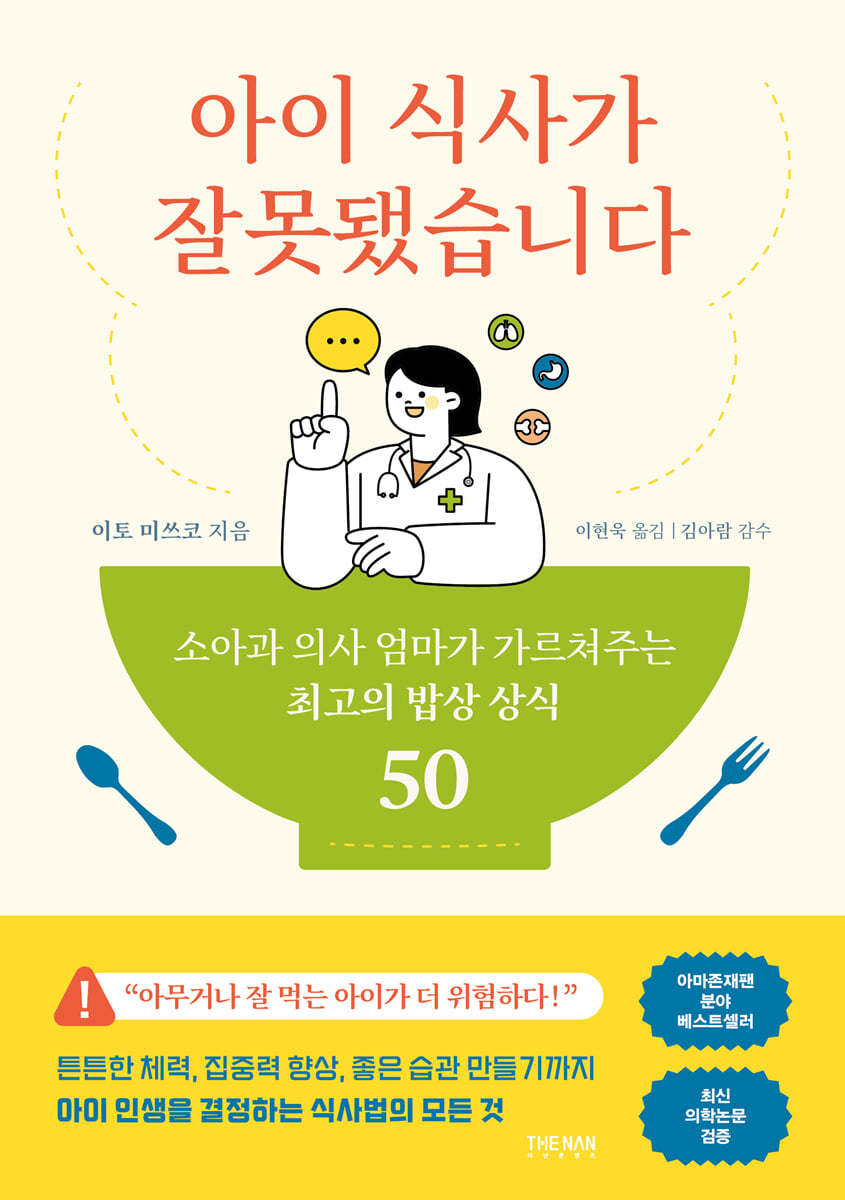
The child's meal was wrong.
 |
Description
Book Introduction
“Children who eat anything are more at risk!”
Tokyo University School of Medicine Pediatrics Doctor Mom Tells Us
The best diet for our children
From promoting brain development and improving immunity to allergies and improving lifestyle habits.
There is a separate 'best meal' that affects a child's brain and health!
Genes, environment, and food are often cited as the three major factors that determine health.
Among these, the only thing we have a choice about is food.
Our choices when it comes to food are endless, from what to eat, where to buy it, how to cook it, and when to eat it.
To paraphrase this, we can interpret the lives of people who choose the best ingredients and eating habits for every meal and those who choose the worst ingredients and eating habits to create a huge gap over time.
Especially since parents have full authority over their children's eating habits, establishing good habits at a young age, even by one year, has a huge impact on their lives.
This book is a compilation of 50 basic tips on children's eating habits and diet, verified through medical research and papers from around the world by the author, a pediatrician and mother who graduated from the University of Tokyo School of Medicine.
The biggest feature is that it is composed of basic information that is relatively easy to follow while carefully selecting 50 medically proven items from the overflowing information.
You don't have to do them in order; just start with the easy ones.
Although 'food' is the main topic, it also covers things that parents should pay attention to, such as sleep, exercise, stress management, and environmental management, in addition to ingredients and diet.
While slow-aging content is popular across generations, in an era where people are still crazy about spicy, sweet, and salty foods, this book will show parents who are concerned about their children's health and eating habits but find it burdensome to prepare healthy meals for every meal for various practical reasons that it is possible to prepare nutritious meals at a low cost and in a short amount of time.
From diets that help alleviate minor physical symptoms in children who frequently get sick, to simple tips that add flavor and nutrition with simple recipe changes, let's make mealtimes with children enjoyable and happy moments with these 50 essential mealtime tips that you can't throw away.
Tokyo University School of Medicine Pediatrics Doctor Mom Tells Us
The best diet for our children
From promoting brain development and improving immunity to allergies and improving lifestyle habits.
There is a separate 'best meal' that affects a child's brain and health!
Genes, environment, and food are often cited as the three major factors that determine health.
Among these, the only thing we have a choice about is food.
Our choices when it comes to food are endless, from what to eat, where to buy it, how to cook it, and when to eat it.
To paraphrase this, we can interpret the lives of people who choose the best ingredients and eating habits for every meal and those who choose the worst ingredients and eating habits to create a huge gap over time.
Especially since parents have full authority over their children's eating habits, establishing good habits at a young age, even by one year, has a huge impact on their lives.
This book is a compilation of 50 basic tips on children's eating habits and diet, verified through medical research and papers from around the world by the author, a pediatrician and mother who graduated from the University of Tokyo School of Medicine.
The biggest feature is that it is composed of basic information that is relatively easy to follow while carefully selecting 50 medically proven items from the overflowing information.
You don't have to do them in order; just start with the easy ones.
Although 'food' is the main topic, it also covers things that parents should pay attention to, such as sleep, exercise, stress management, and environmental management, in addition to ingredients and diet.
While slow-aging content is popular across generations, in an era where people are still crazy about spicy, sweet, and salty foods, this book will show parents who are concerned about their children's health and eating habits but find it burdensome to prepare healthy meals for every meal for various practical reasons that it is possible to prepare nutritious meals at a low cost and in a short amount of time.
From diets that help alleviate minor physical symptoms in children who frequently get sick, to simple tips that add flavor and nutrition with simple recipe changes, let's make mealtimes with children enjoyable and happy moments with these 50 essential mealtime tips that you can't throw away.
- You can preview some of the book's contents.
Preview
index
Reviewer's Note 004
Prologue 009
PART 1: Children's Eating Basics - The 10 Basics
01 | Eat an egg every morning 018
02 | Get Vitamin D from Salmon and Sardines 022
03 | Get Iron from Meat and Vegetables 026
04 | Eat 1 tablespoon of ground sesame seeds every day. 030
05 | Mixing grains when cooking rice 034
06 | Use olive oil instead of margarine or butter 038
07 | Eat bananas and kiwis for breakfast 041
08 | Replace white sugar with beet sugar or corn sugar. 044
09 | Eat 2 tablespoons of anchovies 048
10 | Sprinkle with bonito flakes as a topping 051
COLUMN Childhood Sleep Depends on Your Future
PART 2: 30 Basics to Get You Started Right Away
11 | Eat two types of protein at every meal 056
12 | Choose Greek Yogurt 059
13 | When you want to supplement with protein, try protein powder 062
14 | Consciously Supplement with Zinc 065
15 | If you eat fish, choose blue-backed fish. 069
16 | Take 1 teaspoon of linseed oil or safflower oil. 074
17 | Powdered broth is fine too 077
18 | Choose your cereal from barley, wheat bran, or oatmeal. 080
19 | Commercially available vegetable powders are incredibly useful. 085
20 | Mushrooms and seaweed are good to eat every day. 088
21 | Actively Consume Pickled Foods 091
22 | It's okay to eat two bowls of miso soup every day. 095
23 | Sprinkle ground sesame seeds on the yogurt 099
24 | Discard used oil 103
25 | Strengthen Your Heart and Blood Vessels with Sesame Oil 106
26 | Trim the fat from the meat and the skin off the chicken. 109
27 | Eat only a little fried food 112
28 | I only eat rice bowls, ramen, and udon once a week. 115
29 | Eat broccoli sprouts 117
30 | Honey is given to children over the age of 120
31 | Be careful not to drink too much electrolyte drink 123
32 | Consume water and tea. 127
33 | Eat snacks that aren't sweet 131
34 | Preserving Vegetable Nutrients through Freezing 135
35 | Uses a lot of spices and herbs 139
36 | Choose BPA-free canned food whenever possible. 143
37 | You Don't Have to Be Gluten-Free 145
38 | Drink only one glass of milk a day 148
39 | Eat ham and sausage without additives whenever possible. 151
40 | Just do what you can 154
COLUMN: Reduce your sweet-eating habits as much as possible.
PART 3: 10 Basics You Need to Know About Your Child's Diet
41 | Even if you dislike an ingredient, put it on the table 8-15 times. 158
42 | Cooking with Kids 159
43 | When buying side dishes, choose low-sodium options. 160
44 | Let's Study Pesticides and Additives 162
45 | Set a meal time 165
46 | Don't eat while doing other activities 167
47 | Avoid eating alone whenever possible. 168
48 | Pack as many snacks as you can eat 169
49 | Weaning food is available from 5 to 6 months of age.
50 | Actively Use Children's Nutritional Supplements 172
COLUMN 'Herbal Medicine' is Effective for Children Too
PART 4: Your Child's Dietary Prescription - 9 Solutions for Each Concern
? High anxiety and behavioral problems 176
? I keep having problems with my friends 181
I'm worried because my skin is sensitive. 186
? My skin is dry so I keep scratching. 189
? I have diarrhea and my appetite is unstable. 193
? Suffering from constipation 196
? I have a cold and a fever 199
? I only eat sweets and white rice 202
? I'm having a hard time because I have no appetite 206
COLUMN Exercise is as important as diet.
PART 5: Kids' Meal Tips - Simple Recipes & Brilliant Ideas to Solve Your Dinner Table Worries
Simple recipes that kids love
Avocado Ice Cream 210
Healthy Lean Hamburger Steak 211
Unique Egg Roll 212
Rice Bowl with Yam, Okra, and Natto 213
Bean Sprout Salad with Sesame Sauce 214
Avocado Dip 215
Vegetable Soup 216
Fish Fillet Hamburger Steak 217
Recipes to relieve symptoms
Cereals for Healthy Guts 218
Nutritious Porridge 219
Happy Egg Roll 220
Salmon with Almonds and Herbs 221
Almond Anchovy and Katsuobushi Salad 222
Comforting Molochia Soup 223
Just 5 more seconds! 224 small ideas to add to your child's favorite foods
Making Various Decorations to Make Mealtime More Enjoyable 226
COLUMN 'Smartphone viewing time' is 0 minutes for children under 1 year old and 1 hour for children under 5 years old.
Reference 228
Epilogue 236
Prologue 009
PART 1: Children's Eating Basics - The 10 Basics
01 | Eat an egg every morning 018
02 | Get Vitamin D from Salmon and Sardines 022
03 | Get Iron from Meat and Vegetables 026
04 | Eat 1 tablespoon of ground sesame seeds every day. 030
05 | Mixing grains when cooking rice 034
06 | Use olive oil instead of margarine or butter 038
07 | Eat bananas and kiwis for breakfast 041
08 | Replace white sugar with beet sugar or corn sugar. 044
09 | Eat 2 tablespoons of anchovies 048
10 | Sprinkle with bonito flakes as a topping 051
COLUMN Childhood Sleep Depends on Your Future
PART 2: 30 Basics to Get You Started Right Away
11 | Eat two types of protein at every meal 056
12 | Choose Greek Yogurt 059
13 | When you want to supplement with protein, try protein powder 062
14 | Consciously Supplement with Zinc 065
15 | If you eat fish, choose blue-backed fish. 069
16 | Take 1 teaspoon of linseed oil or safflower oil. 074
17 | Powdered broth is fine too 077
18 | Choose your cereal from barley, wheat bran, or oatmeal. 080
19 | Commercially available vegetable powders are incredibly useful. 085
20 | Mushrooms and seaweed are good to eat every day. 088
21 | Actively Consume Pickled Foods 091
22 | It's okay to eat two bowls of miso soup every day. 095
23 | Sprinkle ground sesame seeds on the yogurt 099
24 | Discard used oil 103
25 | Strengthen Your Heart and Blood Vessels with Sesame Oil 106
26 | Trim the fat from the meat and the skin off the chicken. 109
27 | Eat only a little fried food 112
28 | I only eat rice bowls, ramen, and udon once a week. 115
29 | Eat broccoli sprouts 117
30 | Honey is given to children over the age of 120
31 | Be careful not to drink too much electrolyte drink 123
32 | Consume water and tea. 127
33 | Eat snacks that aren't sweet 131
34 | Preserving Vegetable Nutrients through Freezing 135
35 | Uses a lot of spices and herbs 139
36 | Choose BPA-free canned food whenever possible. 143
37 | You Don't Have to Be Gluten-Free 145
38 | Drink only one glass of milk a day 148
39 | Eat ham and sausage without additives whenever possible. 151
40 | Just do what you can 154
COLUMN: Reduce your sweet-eating habits as much as possible.
PART 3: 10 Basics You Need to Know About Your Child's Diet
41 | Even if you dislike an ingredient, put it on the table 8-15 times. 158
42 | Cooking with Kids 159
43 | When buying side dishes, choose low-sodium options. 160
44 | Let's Study Pesticides and Additives 162
45 | Set a meal time 165
46 | Don't eat while doing other activities 167
47 | Avoid eating alone whenever possible. 168
48 | Pack as many snacks as you can eat 169
49 | Weaning food is available from 5 to 6 months of age.
50 | Actively Use Children's Nutritional Supplements 172
COLUMN 'Herbal Medicine' is Effective for Children Too
PART 4: Your Child's Dietary Prescription - 9 Solutions for Each Concern
? High anxiety and behavioral problems 176
? I keep having problems with my friends 181
I'm worried because my skin is sensitive. 186
? My skin is dry so I keep scratching. 189
? I have diarrhea and my appetite is unstable. 193
? Suffering from constipation 196
? I have a cold and a fever 199
? I only eat sweets and white rice 202
? I'm having a hard time because I have no appetite 206
COLUMN Exercise is as important as diet.
PART 5: Kids' Meal Tips - Simple Recipes & Brilliant Ideas to Solve Your Dinner Table Worries
Simple recipes that kids love
Avocado Ice Cream 210
Healthy Lean Hamburger Steak 211
Unique Egg Roll 212
Rice Bowl with Yam, Okra, and Natto 213
Bean Sprout Salad with Sesame Sauce 214
Avocado Dip 215
Vegetable Soup 216
Fish Fillet Hamburger Steak 217
Recipes to relieve symptoms
Cereals for Healthy Guts 218
Nutritious Porridge 219
Happy Egg Roll 220
Salmon with Almonds and Herbs 221
Almond Anchovy and Katsuobushi Salad 222
Comforting Molochia Soup 223
Just 5 more seconds! 224 small ideas to add to your child's favorite foods
Making Various Decorations to Make Mealtime More Enjoyable 226
COLUMN 'Smartphone viewing time' is 0 minutes for children under 1 year old and 1 hour for children under 5 years old.
Reference 228
Epilogue 236
Detailed image

Into the book
We are made of 'air', 'water', 'environment', and 'food' along with the genetic information we inherited from our parents.
Here, 'environment' refers to the climate, politics, culture, history, religion, economy, family, etc. of the place where you live.
It is difficult to directly select the 'air' to breathe.
Managing the quality of ‘water’ is also not easy.
The 'environment' is not unchangeable, but it is difficult to choose a different environment right now.
But you can choose 'food'.
You can choose to buy your groceries at a grocery store, a supermarket, a convenience store, or online.
When you crave something sweet, you can choose whether to eat a donut or an apple.
When cooking, you can choose whether to fry, grill, or steam.
So we always have multiple choices, and we are free to choose whatever we want.
The initiative lies with the child's parents, the guardians.
It's difficult for children to make appropriate choices because they don't yet have enough information about healthy foods.
So it's important for parents to take the lead.
--- pp.9~10
It is often difficult to get enough vitamin D from food alone.
Some children don't eat fish very well.
In cases like these, it is a good idea to make good use of nutritional supplements.
Liquid vitamin D, safe for children to consume, is now available as a nutritional supplement.
There are also small pill types that can be taken without problems by children over 4 years of age.
Although it is difficult to get enough vitamin D from food alone, it can be improved by taking a daily supplement.
--- p.25
Zinc also plays an important role in emotional and mental health.
Blood tests on children with emotional distress or anxiety often reveal zinc deficiency.
Numerous studies have shown that supplementing sufficient zinc at this time can improve the condition.
In fact, our hospital also prescribes zinc after a blood test.
--- p.31
When we talk about 'healthy rice', brown rice usually comes to mind.
Brown rice is richer in minerals than white rice, but the amount of dietary fiber is not much different.
It is better to mix brown rice with other grains rather than eating only brown rice, as it often contains arsenic and pesticide residues.
--- p.35
It is very important to become accustomed to the taste of soup from a young age.
It also leads to the development of taste, and because taste is directly connected to the brain, it also helps brain development.
The brain development we are talking about here refers to the development of the brain's nerves, that is, the neural network's branches grow densely and connect, which improves brain function.
--- p.52
Among the ideals of public health are 'Health for All' and 'Leave no one behind.'
As a pediatrician and public health professional, I encounter patients with this mindset every day.
This book was written as a first step toward widely sharing 'foods that make children healthy' based on information from the latest research.
We hope you'll apply the latest knowledge on how to choose and eat food to your daily life.
I hope that children's bodies, minds, and brains will develop healthily based on their knowledge of food and nutrition, and that society as a whole will become prosperous and peaceful.
Here, 'environment' refers to the climate, politics, culture, history, religion, economy, family, etc. of the place where you live.
It is difficult to directly select the 'air' to breathe.
Managing the quality of ‘water’ is also not easy.
The 'environment' is not unchangeable, but it is difficult to choose a different environment right now.
But you can choose 'food'.
You can choose to buy your groceries at a grocery store, a supermarket, a convenience store, or online.
When you crave something sweet, you can choose whether to eat a donut or an apple.
When cooking, you can choose whether to fry, grill, or steam.
So we always have multiple choices, and we are free to choose whatever we want.
The initiative lies with the child's parents, the guardians.
It's difficult for children to make appropriate choices because they don't yet have enough information about healthy foods.
So it's important for parents to take the lead.
--- pp.9~10
It is often difficult to get enough vitamin D from food alone.
Some children don't eat fish very well.
In cases like these, it is a good idea to make good use of nutritional supplements.
Liquid vitamin D, safe for children to consume, is now available as a nutritional supplement.
There are also small pill types that can be taken without problems by children over 4 years of age.
Although it is difficult to get enough vitamin D from food alone, it can be improved by taking a daily supplement.
--- p.25
Zinc also plays an important role in emotional and mental health.
Blood tests on children with emotional distress or anxiety often reveal zinc deficiency.
Numerous studies have shown that supplementing sufficient zinc at this time can improve the condition.
In fact, our hospital also prescribes zinc after a blood test.
--- p.31
When we talk about 'healthy rice', brown rice usually comes to mind.
Brown rice is richer in minerals than white rice, but the amount of dietary fiber is not much different.
It is better to mix brown rice with other grains rather than eating only brown rice, as it often contains arsenic and pesticide residues.
--- p.35
It is very important to become accustomed to the taste of soup from a young age.
It also leads to the development of taste, and because taste is directly connected to the brain, it also helps brain development.
The brain development we are talking about here refers to the development of the brain's nerves, that is, the neural network's branches grow densely and connect, which improves brain function.
--- p.52
Among the ideals of public health are 'Health for All' and 'Leave no one behind.'
As a pediatrician and public health professional, I encounter patients with this mindset every day.
This book was written as a first step toward widely sharing 'foods that make children healthy' based on information from the latest research.
We hope you'll apply the latest knowledge on how to choose and eat food to your daily life.
I hope that children's bodies, minds, and brains will develop healthily based on their knowledge of food and nutrition, and that society as a whole will become prosperous and peaceful.
--- p.238
Publisher's Review
“Children who eat anything are more at risk!”
From building strong physical strength, improving concentration, to creating good habits.
Everything You Need to Know About Diet That Determines Your Child's Life
We all know how important childhood eating habits are, but there are some truths we tend to overlook.
We live in an era where people say our children will live to be over 100 years old, maybe even 120 years old, but will today's children actually be able to live 'long' and 'healthily'?
Mitsuko Ito, a pediatrician and public health specialist at the University of Tokyo School of Medicine and a mother herself, researches proper eating habits for children based on well-verified information.
“What and how a child eats changes the state of his or her body, mind, brain, and personality.
This will soon lead to the power to survive in the world.”
The oxygen we breathe and the water we drink can be improved temporarily with home appliances, but it is difficult to achieve fundamental change without a fundamental change in the environment itself. However, food is different.
Parents only need to pay a little attention to whether their children will eat bread or ice cream as a snack, fresh seasonal fruit, or boiled or fried meat.
For a child, food is the most direct and powerful factor that promotes growth and development, and recovery of body and mind, at least three times a day.
So, it is safe to say that the question of what kind of food to give a child and what kind of eating habits to form will affect the child's life.
The factor that has the greatest negative impact on the health of today's children and the younger generation is comfort, which is 'minimizing pain and stimulation while easily and quickly increasing the amount of pleasure and enjoyment.'
All kinds of snacks and restaurant menus that are representative of 'spicy, sweet, and salty', short videos that you watch without realizing the passage of time, and a lifestyle that involves sitting all day accumulate and ruin your appetite, body shape, and health in an instant.
Setting the table for children always puts parents at a crossroads.
"It's a hassle, but should I order delivery today?", "Prices have gone up a lot these days. Should I get a meal kit today instead?", "He doesn't want to eat, but it's better to give him snacks than to starve him, right?"
If you want to solve a simple meal with this kind of thought today, I recommend you read this book, “Children’s Eating is Wrong,” and think about it again.
A healthy meal doesn't have to be expensive or complicated.
If a few minutes of sincerity can come together and change a child's life in the future, why wouldn't you do it?
“What did our child eat today?”
A child's life changes when he or she changes his or her food!
What makes a healthy, vibrant, calm, and stable child different?
'They say you don't have to worry so much about atopy or ADHD these days.
It's not just my child, the world has become a better place and there are many good medicines.
Don't stress too much.'
Many parents try to provide healthy meals for their children and always remind them to eat a balanced diet, but why do our children suffer from obesity, allergies, poor concentration, indigestion, frequent colds, and atopic dermatitis?
The author points out that our common sense about 'healthy children's meals' is all wrong.
Recent research has shown that what we have known as a 'healthy diet' is not truly a healthy diet.
You need to be a picky eater who also chooses healthy foods.
And there are not many foods that are necessary and helpful for a child's growth and development.
You don't have to spend a lot of money buying different ingredients every time or waste time searching for effective recipes. With just a few simple tips, you can prepare meals that support your child's growth and development.
This book is divided into five parts, and each part contains '10 most basic eating common sense', '30 eating principles you can start now', '10 eating secrets you should know more about', '9 eating prescriptions' to alleviate symptoms that often appear in children, and 'eating tips' to make mealtimes more enjoyable with simple recipes and ideas.
This book contains 50 pieces of common sense information, including how to feed essential protein to growing children, how to use margarine, butter, and sugar, which are essential ingredients in cooking, to prepare healthier meals, how to choose ingredients that children like, such as milk, ham, sausage, meat, and yogurt, more wisely, what are the good principles to keep in mind at mealtimes to form good eating habits, and what foods can alleviate common symptoms children experience, such as skin health and intestinal health. This book adds to its value in that not a single piece of common sense is wasted.
It's full of useful tips that will help you make the most of children's nutritional supplements, whether it's okay to feed your child protein powder, and what to keep in mind when choosing fish or canned food. It can also be useful when preparing meals for parents.
The greatest gift you can give your child is
Proper eating and lifestyle habits
Looking at the results of the National Health and Nutrition Survey recently published by the Korea Disease Control and Prevention Agency, we can see that lifestyle-related diseases caused by poor eating habits are becoming a serious problem throughout our society.
The incidence of chronic diseases such as diabetes, hypertension, and hyperlipidemia is increasing, and it is pointed out that one of the root causes of these diseases is poor eating habits formed over a long period of time.
These results have led people to realize the importance of diet and become more interested in it. Unfortunately, it is also true that many people do not practice proper eating habits until their bodies actually show abnormal signs.
Eating habits that have already become ingrained are difficult to improve simply by knowing more information, and especially since tastes that are once formed often last a lifetime, it is more important than ever to maintain healthy eating habits from childhood.
This book clearly and easily explains what foods we should provide our children. It goes beyond simply imparting theory and knowledge, and provides easy and friendly guidance on how to apply them right away at home. This book will help growing children consume the right nutrition and lay the foundation for lifelong health.
From building strong physical strength, improving concentration, to creating good habits.
Everything You Need to Know About Diet That Determines Your Child's Life
We all know how important childhood eating habits are, but there are some truths we tend to overlook.
We live in an era where people say our children will live to be over 100 years old, maybe even 120 years old, but will today's children actually be able to live 'long' and 'healthily'?
Mitsuko Ito, a pediatrician and public health specialist at the University of Tokyo School of Medicine and a mother herself, researches proper eating habits for children based on well-verified information.
“What and how a child eats changes the state of his or her body, mind, brain, and personality.
This will soon lead to the power to survive in the world.”
The oxygen we breathe and the water we drink can be improved temporarily with home appliances, but it is difficult to achieve fundamental change without a fundamental change in the environment itself. However, food is different.
Parents only need to pay a little attention to whether their children will eat bread or ice cream as a snack, fresh seasonal fruit, or boiled or fried meat.
For a child, food is the most direct and powerful factor that promotes growth and development, and recovery of body and mind, at least three times a day.
So, it is safe to say that the question of what kind of food to give a child and what kind of eating habits to form will affect the child's life.
The factor that has the greatest negative impact on the health of today's children and the younger generation is comfort, which is 'minimizing pain and stimulation while easily and quickly increasing the amount of pleasure and enjoyment.'
All kinds of snacks and restaurant menus that are representative of 'spicy, sweet, and salty', short videos that you watch without realizing the passage of time, and a lifestyle that involves sitting all day accumulate and ruin your appetite, body shape, and health in an instant.
Setting the table for children always puts parents at a crossroads.
"It's a hassle, but should I order delivery today?", "Prices have gone up a lot these days. Should I get a meal kit today instead?", "He doesn't want to eat, but it's better to give him snacks than to starve him, right?"
If you want to solve a simple meal with this kind of thought today, I recommend you read this book, “Children’s Eating is Wrong,” and think about it again.
A healthy meal doesn't have to be expensive or complicated.
If a few minutes of sincerity can come together and change a child's life in the future, why wouldn't you do it?
“What did our child eat today?”
A child's life changes when he or she changes his or her food!
What makes a healthy, vibrant, calm, and stable child different?
'They say you don't have to worry so much about atopy or ADHD these days.
It's not just my child, the world has become a better place and there are many good medicines.
Don't stress too much.'
Many parents try to provide healthy meals for their children and always remind them to eat a balanced diet, but why do our children suffer from obesity, allergies, poor concentration, indigestion, frequent colds, and atopic dermatitis?
The author points out that our common sense about 'healthy children's meals' is all wrong.
Recent research has shown that what we have known as a 'healthy diet' is not truly a healthy diet.
You need to be a picky eater who also chooses healthy foods.
And there are not many foods that are necessary and helpful for a child's growth and development.
You don't have to spend a lot of money buying different ingredients every time or waste time searching for effective recipes. With just a few simple tips, you can prepare meals that support your child's growth and development.
This book is divided into five parts, and each part contains '10 most basic eating common sense', '30 eating principles you can start now', '10 eating secrets you should know more about', '9 eating prescriptions' to alleviate symptoms that often appear in children, and 'eating tips' to make mealtimes more enjoyable with simple recipes and ideas.
This book contains 50 pieces of common sense information, including how to feed essential protein to growing children, how to use margarine, butter, and sugar, which are essential ingredients in cooking, to prepare healthier meals, how to choose ingredients that children like, such as milk, ham, sausage, meat, and yogurt, more wisely, what are the good principles to keep in mind at mealtimes to form good eating habits, and what foods can alleviate common symptoms children experience, such as skin health and intestinal health. This book adds to its value in that not a single piece of common sense is wasted.
It's full of useful tips that will help you make the most of children's nutritional supplements, whether it's okay to feed your child protein powder, and what to keep in mind when choosing fish or canned food. It can also be useful when preparing meals for parents.
The greatest gift you can give your child is
Proper eating and lifestyle habits
Looking at the results of the National Health and Nutrition Survey recently published by the Korea Disease Control and Prevention Agency, we can see that lifestyle-related diseases caused by poor eating habits are becoming a serious problem throughout our society.
The incidence of chronic diseases such as diabetes, hypertension, and hyperlipidemia is increasing, and it is pointed out that one of the root causes of these diseases is poor eating habits formed over a long period of time.
These results have led people to realize the importance of diet and become more interested in it. Unfortunately, it is also true that many people do not practice proper eating habits until their bodies actually show abnormal signs.
Eating habits that have already become ingrained are difficult to improve simply by knowing more information, and especially since tastes that are once formed often last a lifetime, it is more important than ever to maintain healthy eating habits from childhood.
This book clearly and easily explains what foods we should provide our children. It goes beyond simply imparting theory and knowledge, and provides easy and friendly guidance on how to apply them right away at home. This book will help growing children consume the right nutrition and lay the foundation for lifelong health.
GOODS SPECIFICS
- Date of issue: October 20, 2025
- Page count, weight, size: 240 pages | 398g | 150*210*15mm
- ISBN13: 9791193785485
- ISBN10: 1193785480
You may also like
카테고리
korean


korean

![GQ KOREA Mark (Monthly): December [2025]](http://librairie.coreenne.fr/cdn/shop/files/8ef265dbbfbf186523ed75ba7319009d.jpg?v=1765340328&width=3840)


