

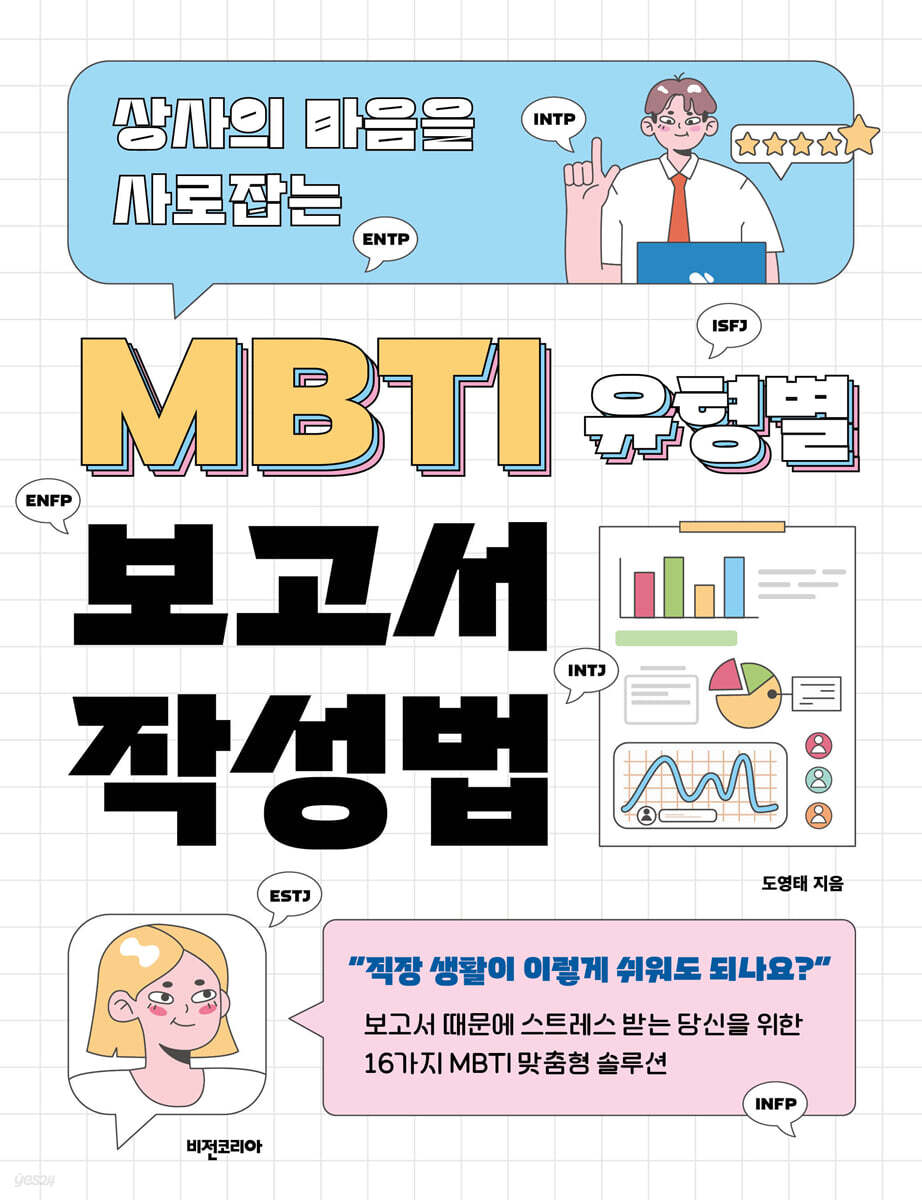
How to Write a Report by MBTI Type
 |
Description
Book Introduction
“Knowing your MBTI will make going to work more enjoyable and getting off work faster.”
From ESTJs to INFPs, the secret to creating perfect chemistry with your boss:
Report writing is one of the most interesting psychological games played in organizations.
Some people can get through it in one sitting, but for others, it's a difficult puzzle that requires staying up all night to solve.
The MBTI, the key to solving such dilemmas, is a great tool for identifying the other person's type and writing a customized report.
Vision Korea's new book, "MBTI Report Writing by Type," specifically presents the preferred thinking and writing styles, as well as the differences in effective report writing, for each of the 16 MBTI personality types. Through MBTI, you can understand yourself and others (such as your boss or client), and then craft customized reports that resonate with them. From meticulous, trust-building reports tailored to organizational and accountability types like ISTJ and ISFJ, to idea generation and problem-solving reports optimized for creative and innovative types like ENFP and ENTP, this book offers a variety of practical strategies for persuading and building rapport with your readers (bosses, colleagues, and team members).
From ESTJs to INFPs, the secret to creating perfect chemistry with your boss:
Report writing is one of the most interesting psychological games played in organizations.
Some people can get through it in one sitting, but for others, it's a difficult puzzle that requires staying up all night to solve.
The MBTI, the key to solving such dilemmas, is a great tool for identifying the other person's type and writing a customized report.
Vision Korea's new book, "MBTI Report Writing by Type," specifically presents the preferred thinking and writing styles, as well as the differences in effective report writing, for each of the 16 MBTI personality types. Through MBTI, you can understand yourself and others (such as your boss or client), and then craft customized reports that resonate with them. From meticulous, trust-building reports tailored to organizational and accountability types like ISTJ and ISFJ, to idea generation and problem-solving reports optimized for creative and innovative types like ENFP and ENTP, this book offers a variety of practical strategies for persuading and building rapport with your readers (bosses, colleagues, and team members).
- You can preview some of the book's contents.
Preview
index
prolog
Chapter 1: Why MBTI and Report Writing?
Knowing your MBTI will make going to work more enjoyable and leaving work sooner.
Even for the same report, feedback varies depending on the type.
The secret to keeping your job even after changing bosses four times
Reference Materials General Characteristics by MBTI Type
What type of report writer am I?
References - General Tendencies & Report Writing Styles by MBTI Type
Chapter 2: Team Leader, you're type T! Do you know how to use it?
Mr. E Energizer, what should I do?
I need to wake up my timid boss.
The god of S details has descended
N Somehow my imagination runs wild
F Above all, expressing emotions is important!
T Sometimes logically, sometimes pettyly
P I wrote it with care, but you changed it without permission!
J was the 'predetermined answer man'
Chapter 3 I write the report you want.
Reference - Characteristics of each MBTI type when writing a report
ISTJ: Calm and meticulous report writer - detail-oriented
ISFJ: Deep and Analytical Report Writer - Master Analyst
INTJ Logical and Structured Report Writer - Seeker of the Rules
ISTP Concise and Practical Report Writer - Summary Expert
ISFP Sensitive and Emotional Report Writer - Report Counselor
INFP Creative and Idealistic Report Writer - Dream Builder
INTP: Conceptual and analytical report writer - the ultimate logician
ESTP: A prompt and practical report writer - a report action leader
ESFP Intuitive and Flexible Report Writer - Master of Communication
ENTP: Passionate and Ever-Changing Report Writer - Ever-Changing Planner
ENFP Creative and Free-spirited Report Writer - Story Wizard
ESTJ: Systematic and Clear Report Writer - Report Manager
ESFJ Friendly and Harmonious Report Writer - Communication Manager
ENFJ: Emotional and Persuasive Report Writer - Master of Empathetic Documentation
ENTJ: Goal-Oriented, Strategic Report Writer - The Strategic Report Killer
Chapter 4: The Best Chemistry Is in Writing
References - Writing Basics and MBTI Preferences
ES write easily
Write TP briefly
Throw away NP writing
Use SJ standard language
Follow ST notation
Benchmark TJ's well-written articles.
Reference - 10 Sentence Polishing Techniques
Chapter 5: Becoming a Report Writing Master with MBTI
Reference - How to Become a Report Writing Expert Using the MBTI
NT Combines Creativity and Logic
Follow the SJ writing steps
TJ, convey the core first
ST Support with reliable information
FJ Review from the other party's perspective
Practice a report writing routine
Chapter 1: Why MBTI and Report Writing?
Knowing your MBTI will make going to work more enjoyable and leaving work sooner.
Even for the same report, feedback varies depending on the type.
The secret to keeping your job even after changing bosses four times
Reference Materials General Characteristics by MBTI Type
What type of report writer am I?
References - General Tendencies & Report Writing Styles by MBTI Type
Chapter 2: Team Leader, you're type T! Do you know how to use it?
Mr. E Energizer, what should I do?
I need to wake up my timid boss.
The god of S details has descended
N Somehow my imagination runs wild
F Above all, expressing emotions is important!
T Sometimes logically, sometimes pettyly
P I wrote it with care, but you changed it without permission!
J was the 'predetermined answer man'
Chapter 3 I write the report you want.
Reference - Characteristics of each MBTI type when writing a report
ISTJ: Calm and meticulous report writer - detail-oriented
ISFJ: Deep and Analytical Report Writer - Master Analyst
INTJ Logical and Structured Report Writer - Seeker of the Rules
ISTP Concise and Practical Report Writer - Summary Expert
ISFP Sensitive and Emotional Report Writer - Report Counselor
INFP Creative and Idealistic Report Writer - Dream Builder
INTP: Conceptual and analytical report writer - the ultimate logician
ESTP: A prompt and practical report writer - a report action leader
ESFP Intuitive and Flexible Report Writer - Master of Communication
ENTP: Passionate and Ever-Changing Report Writer - Ever-Changing Planner
ENFP Creative and Free-spirited Report Writer - Story Wizard
ESTJ: Systematic and Clear Report Writer - Report Manager
ESFJ Friendly and Harmonious Report Writer - Communication Manager
ENFJ: Emotional and Persuasive Report Writer - Master of Empathetic Documentation
ENTJ: Goal-Oriented, Strategic Report Writer - The Strategic Report Killer
Chapter 4: The Best Chemistry Is in Writing
References - Writing Basics and MBTI Preferences
ES write easily
Write TP briefly
Throw away NP writing
Use SJ standard language
Follow ST notation
Benchmark TJ's well-written articles.
Reference - 10 Sentence Polishing Techniques
Chapter 5: Becoming a Report Writing Master with MBTI
Reference - How to Become a Report Writing Expert Using the MBTI
NT Combines Creativity and Logic
Follow the SJ writing steps
TJ, convey the core first
ST Support with reliable information
FJ Review from the other party's perspective
Practice a report writing routine
Detailed image

Into the book
After submitting a report, we've probably all heard this from our boss at least once.
"What on earth is the conclusion? Tell me the answer first."
“Why are you so subjective? Is there any basis for it?”
“Please suggest more specific step-by-step response measures.”
“Aren’t there any more diverse alternatives?”
How should you respond to this situation? You need to know your boss's MBTI personality type. The MBTI is a useful tool for diagnosing and identifying personality types and patterns.
The eight preference indicators that make up the MBTI represent general tendencies.
The four reactions when submitting the report exemplified above represent types E, T, J, and P, in that order.
A key strategy to increasing the success rate of your report is to analyze your boss's 16 MBTI pattern types by combining them through each preference indicator and then write a report based on this.
--- p.15, from “Chapter 1: Why MBTI and Report Writing?”
“Manager, the performance analysis report is ready.”
“Oh, Manager, this report seems to have been written too orthodoxly.
I think it would be better to look at reality with a more radical standard than this...
Don't judge solely on sales performance data; conduct field group interviews (FGIs) and visit stores yourself.
Then, let's take our time and write it again."
Manager Oh wants to throw the report at Manager Yoo, who changes things as he pleases.
Wait a minute! MBTI Checkpoint
What could be the problem?
A step-by-step, systematic approach clashes with flexibility.
- I responded to my boss, who gave me a lot of impromptu and unexpected instructions, according to the rules.
- I was unable to respond to the ever-changing situation.
- I'm feeling tired of my boss changing his judgment and decisions based on his mood.
What type is it?
The flexible manager is P type.
- I tend to respond flexibly depending on the situation.
- It's a style that rushes in right before the deadline, so there are frequent last-minute rushes.
- I prefer to think and act spontaneously rather than making plans.
--- p.86-87, from "Chapter 2: Team Leader is Type T! Do you know how to use it?"
ESTPs, with their immediate and practical nature, also excel at demonstrating their skills and resourcefulness when writing reports.
Focus on the present situation and structure your content based on real-life experiences and concrete facts.
Additionally, we write reports with efficiency and a results-oriented attitude.
Save time by avoiding lengthy descriptions and conveying key information concisely and clearly.
With his unique sociable nature, he creates witty and flexible content.
We are also interested in the visual appeal and presentation of reports.
This approach also fits well with the MZ generation's tendency to pursue digital platform-based, non-face-to-face, and practical needs.
However, it shows some shortcomings in areas that require long-term planning or deep emotions.
If I'm not careful, I
There is also concern that the dragon may write a poor 'form-and-form' report.
Knowledge of theories and concepts
Due to their lack of skills and unpredictability, they often show an improvisational attitude and just want to write a report and move on.
--- p.136, from “Chapter 3 I Write the Report You Want”
A good piece of writing is one that is easy to understand.
The ES type, with its strong sense of reality and ability to write detailed reports, has the advantage of writing in a way that others can easily understand.
The best writing is the one that the other person can read and understand in one breath.
To write easily, you should avoid using technical expressions as much as possible.
This is a drug description from a pharmaceutical company.
This medicine is a relatively large, colored tablet, and there is a risk that it may become lodged in the esophagus and disintegrate when taken.
Please be aware that there may be difficulty swallowing and that excessive use may rarely cause symptoms such as headache.
The bolded part is something that cannot be understood without the Chinese characters.
Let's try to revise it into simpler language.
This medicine is a relatively large, peach-colored pill that can get stuck in the esophagus and dissolve when taken.
Please be aware that it may be difficult to swallow and that in rare cases, symptoms such as headaches may become more severe in case of overdose.
--- p.173-174, from “Chapter 4: The Best Chemistry is in Writing”
To be effective, reports must convey key messages quickly and clearly.
Especially for the TJ type (Thinking & Judging), who prefers logical and goal-oriented thinking, getting to the point first is a good approach.
However, many reports make the mistake of putting off the main point and providing unnecessary background first.
In this case, important information may be buried, the core message may not be conveyed, and the conclusion may be ambiguous, making it less persuasive.
When writing a report, it is important to place the key points first and then supplement the details (top-down structure).
You can effectively convey your core message by using the 'What - Why - How' three-step reporting technique.
"What on earth is the conclusion? Tell me the answer first."
“Why are you so subjective? Is there any basis for it?”
“Please suggest more specific step-by-step response measures.”
“Aren’t there any more diverse alternatives?”
How should you respond to this situation? You need to know your boss's MBTI personality type. The MBTI is a useful tool for diagnosing and identifying personality types and patterns.
The eight preference indicators that make up the MBTI represent general tendencies.
The four reactions when submitting the report exemplified above represent types E, T, J, and P, in that order.
A key strategy to increasing the success rate of your report is to analyze your boss's 16 MBTI pattern types by combining them through each preference indicator and then write a report based on this.
--- p.15, from “Chapter 1: Why MBTI and Report Writing?”
“Manager, the performance analysis report is ready.”
“Oh, Manager, this report seems to have been written too orthodoxly.
I think it would be better to look at reality with a more radical standard than this...
Don't judge solely on sales performance data; conduct field group interviews (FGIs) and visit stores yourself.
Then, let's take our time and write it again."
Manager Oh wants to throw the report at Manager Yoo, who changes things as he pleases.
Wait a minute! MBTI Checkpoint
What could be the problem?
A step-by-step, systematic approach clashes with flexibility.
- I responded to my boss, who gave me a lot of impromptu and unexpected instructions, according to the rules.
- I was unable to respond to the ever-changing situation.
- I'm feeling tired of my boss changing his judgment and decisions based on his mood.
What type is it?
The flexible manager is P type.
- I tend to respond flexibly depending on the situation.
- It's a style that rushes in right before the deadline, so there are frequent last-minute rushes.
- I prefer to think and act spontaneously rather than making plans.
--- p.86-87, from "Chapter 2: Team Leader is Type T! Do you know how to use it?"
ESTPs, with their immediate and practical nature, also excel at demonstrating their skills and resourcefulness when writing reports.
Focus on the present situation and structure your content based on real-life experiences and concrete facts.
Additionally, we write reports with efficiency and a results-oriented attitude.
Save time by avoiding lengthy descriptions and conveying key information concisely and clearly.
With his unique sociable nature, he creates witty and flexible content.
We are also interested in the visual appeal and presentation of reports.
This approach also fits well with the MZ generation's tendency to pursue digital platform-based, non-face-to-face, and practical needs.
However, it shows some shortcomings in areas that require long-term planning or deep emotions.
If I'm not careful, I
There is also concern that the dragon may write a poor 'form-and-form' report.
Knowledge of theories and concepts
Due to their lack of skills and unpredictability, they often show an improvisational attitude and just want to write a report and move on.
--- p.136, from “Chapter 3 I Write the Report You Want”
A good piece of writing is one that is easy to understand.
The ES type, with its strong sense of reality and ability to write detailed reports, has the advantage of writing in a way that others can easily understand.
The best writing is the one that the other person can read and understand in one breath.
To write easily, you should avoid using technical expressions as much as possible.
This is a drug description from a pharmaceutical company.
This medicine is a relatively large, colored tablet, and there is a risk that it may become lodged in the esophagus and disintegrate when taken.
Please be aware that there may be difficulty swallowing and that excessive use may rarely cause symptoms such as headache.
The bolded part is something that cannot be understood without the Chinese characters.
Let's try to revise it into simpler language.
This medicine is a relatively large, peach-colored pill that can get stuck in the esophagus and dissolve when taken.
Please be aware that it may be difficult to swallow and that in rare cases, symptoms such as headaches may become more severe in case of overdose.
--- p.173-174, from “Chapter 4: The Best Chemistry is in Writing”
To be effective, reports must convey key messages quickly and clearly.
Especially for the TJ type (Thinking & Judging), who prefers logical and goal-oriented thinking, getting to the point first is a good approach.
However, many reports make the mistake of putting off the main point and providing unnecessary background first.
In this case, important information may be buried, the core message may not be conveyed, and the conclusion may be ambiguous, making it less persuasive.
When writing a report, it is important to place the key points first and then supplement the details (top-down structure).
You can effectively convey your core message by using the 'What - Why - How' three-step reporting technique.
--- p.217-218, from “Chapter 5 Becoming a Report Master with MBTI”
Publisher's Review
Introducing the first customized report writing technique using MBTI.
This book is the first to apply the theory of the MBTI personality type instrument to analyze how "type-specific thinking structures" are reflected in report writing. From types like ISTJs who favor logical and systematic reporting to those like ENFPs who excel at emotional persuasion and creative thinking, the author suggests ways to optimize "personalized reports" and "performance-producing reports." This practical approach, which evolves the MBTI from a tool for "self-understanding" to a tool for "job competency development," is also significant.
Through this book, readers can kill two birds with one stone: learn about MBTI and write reports with certainty.
??
Author Do Young-tae, who has been a report lecture expert for over 20 years, systematically guides readers in this book on how the MBTI can be more than just a self-analysis tool; it can also serve as a communication manual that can be practically utilized in the workplace.
In addition, it provides practical tips that can be immediately applied in corporate and organizational settings, such as 'Do & Don't' by MBTI type, examples of key sentences, samples of actual reports, and appropriate writing, thereby suggesting a strategic direction for report writing and contributing to communication, teamwork, and performance creation within the organization.
Communication Solutions for MZ Workers by Boss Type
This book faithfully reflects the changing work environment and digital smart style of the MZ generation, and proposes a report structure and expression method based on MBTI type in line with the trend that values quick reporting, concise conclusions, and data-driven persuasion. By doing so, it presents a realistic solution for the most efficient report communication.
In particular, it has differentiated value as a practical guide that resonates with generations, covering short and clear message delivery in the era of SNS and AI, as well as the inter-type coordination required in a collaborative environment.
Furthermore, it provides practical guidance for understanding supervisor feedback patterns and developing customized communication strategies in organizations where differences in generation and personality are intertwined. Based on the reporting culture favored by the MZ generation, it reinterprets the tone and sentence structure of reports by type, offering a new perspective on maximizing work efficiency.
Ultimately, this book can be said to be a practical work manual that expands the MBTI into the language of organizational communication through the medium of a report, narrowing the generational gap and transforming individual tendencies into organizational competitiveness.
This book is the first to apply the theory of the MBTI personality type instrument to analyze how "type-specific thinking structures" are reflected in report writing. From types like ISTJs who favor logical and systematic reporting to those like ENFPs who excel at emotional persuasion and creative thinking, the author suggests ways to optimize "personalized reports" and "performance-producing reports." This practical approach, which evolves the MBTI from a tool for "self-understanding" to a tool for "job competency development," is also significant.
Through this book, readers can kill two birds with one stone: learn about MBTI and write reports with certainty.
??
Author Do Young-tae, who has been a report lecture expert for over 20 years, systematically guides readers in this book on how the MBTI can be more than just a self-analysis tool; it can also serve as a communication manual that can be practically utilized in the workplace.
In addition, it provides practical tips that can be immediately applied in corporate and organizational settings, such as 'Do & Don't' by MBTI type, examples of key sentences, samples of actual reports, and appropriate writing, thereby suggesting a strategic direction for report writing and contributing to communication, teamwork, and performance creation within the organization.
Communication Solutions for MZ Workers by Boss Type
This book faithfully reflects the changing work environment and digital smart style of the MZ generation, and proposes a report structure and expression method based on MBTI type in line with the trend that values quick reporting, concise conclusions, and data-driven persuasion. By doing so, it presents a realistic solution for the most efficient report communication.
In particular, it has differentiated value as a practical guide that resonates with generations, covering short and clear message delivery in the era of SNS and AI, as well as the inter-type coordination required in a collaborative environment.
Furthermore, it provides practical guidance for understanding supervisor feedback patterns and developing customized communication strategies in organizations where differences in generation and personality are intertwined. Based on the reporting culture favored by the MZ generation, it reinterprets the tone and sentence structure of reports by type, offering a new perspective on maximizing work efficiency.
Ultimately, this book can be said to be a practical work manual that expands the MBTI into the language of organizational communication through the medium of a report, narrowing the generational gap and transforming individual tendencies into organizational competitiveness.
GOODS SPECIFICS
- Date of issue: November 12, 2025
- Page count, weight, size: 236 pages | 494g | 173*225*14mm
- ISBN13: 9788963222325
- ISBN10: 8963222322
You may also like
카테고리
korean


korean

![ELLE 엘르 스페셜 에디션 A형 : 12월 [2025]](http://librairie.coreenne.fr/cdn/shop/files/b8e27a3de6c9538896439686c6b0e8fb.jpg?v=1766436872&width=3840)


