

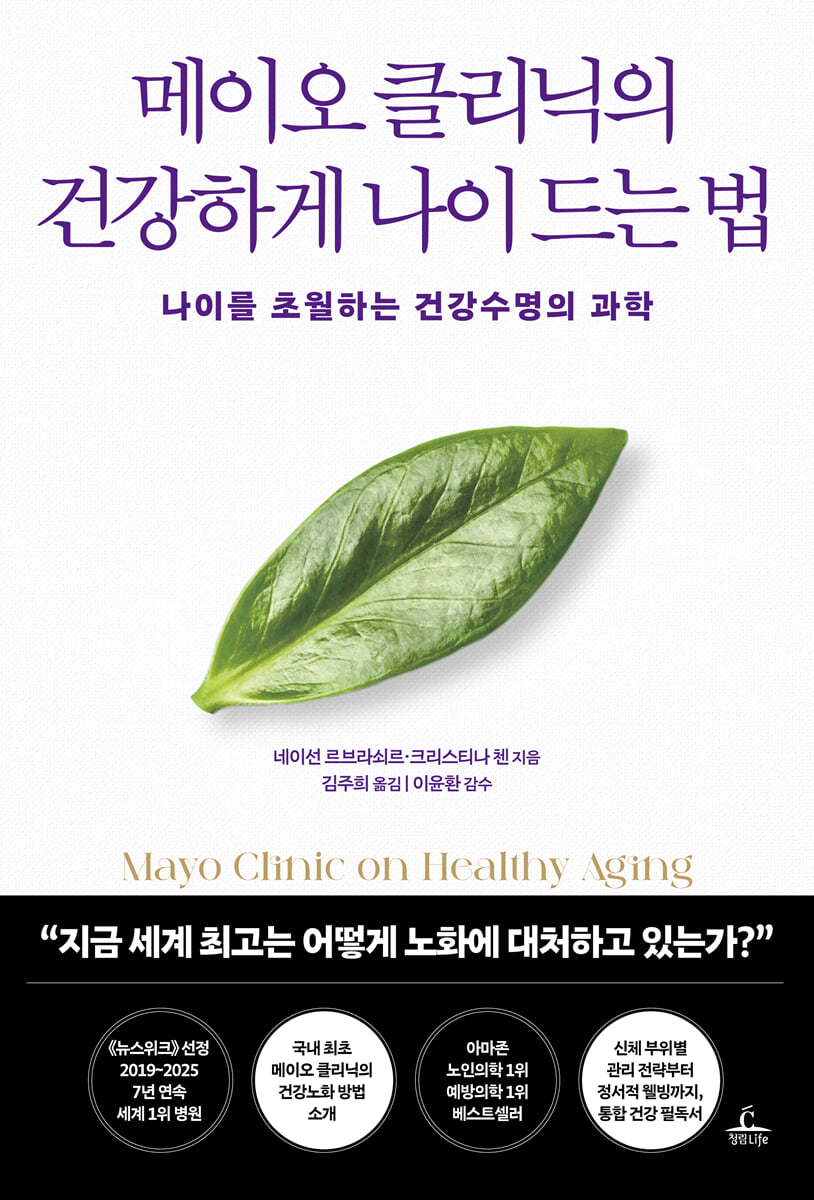
Mayo Clinic's Guide to Healthy Aging
 |
Description
Book Introduction
“How are the world’s best coping with aging today?”
Ranked the world's No. 1 hospital for seven consecutive years from 2019 to 2025 by Newsweek
Mayo Clinic's Guide to Selective Aging
Newsweek, a global weekly news magazine, has been selecting and announcing the world's best hospitals every year since 2019.
The Mayo Clinic, located in Minnesota, USA, is the world's best hospital, consistently ranking first every year, beating out well-known hospitals like Johns Hopkins Hospital and Cleveland Clinic.
Of course, I can't help but be curious.
So how do the world's best hospitals deal with aging?
This book is a compilation of Mayo Clinic's tips for aging healthily and happily.
As we age, we may experience some aches and pains, but the choices we make and the actions we take can significantly change the outcome.
Mayo Clinic researchers emphasize this "selective aging," systematically elucidating the biology of aging—the reasons why humans age—and exploring concrete, actionable approaches across all areas of life.
It covers all aspects of aging, including how to cope with health threats, how to activate the brain and body, how to maintain nutrition and balance, resilience and mindfulness, relationships and life satisfaction, retirement planning and living a fulfilling life.
For each topic, we provide practical methods you can implement right now to help you live a healthy and purposeful life.
From aging mechanisms by body part and the immune system to exercise, diet, relationships, wellness vision, and social skills, now discover the world's leading hospitals' comprehensive guide to selective aging.
Ranked the world's No. 1 hospital for seven consecutive years from 2019 to 2025 by Newsweek
Mayo Clinic's Guide to Selective Aging
Newsweek, a global weekly news magazine, has been selecting and announcing the world's best hospitals every year since 2019.
The Mayo Clinic, located in Minnesota, USA, is the world's best hospital, consistently ranking first every year, beating out well-known hospitals like Johns Hopkins Hospital and Cleveland Clinic.
Of course, I can't help but be curious.
So how do the world's best hospitals deal with aging?
This book is a compilation of Mayo Clinic's tips for aging healthily and happily.
As we age, we may experience some aches and pains, but the choices we make and the actions we take can significantly change the outcome.
Mayo Clinic researchers emphasize this "selective aging," systematically elucidating the biology of aging—the reasons why humans age—and exploring concrete, actionable approaches across all areas of life.
It covers all aspects of aging, including how to cope with health threats, how to activate the brain and body, how to maintain nutrition and balance, resilience and mindfulness, relationships and life satisfaction, retirement planning and living a fulfilling life.
For each topic, we provide practical methods you can implement right now to help you live a healthy and purposeful life.
From aging mechanisms by body part and the immune system to exercise, diet, relationships, wellness vision, and social skills, now discover the world's leading hospitals' comprehensive guide to selective aging.
- You can preview some of the book's contents.
Preview
index
preface
Reviewer's note
Part 1.
How does aging occur?
: Distinguish between the changes and abnormal signs that come with aging.
Chapter 1.
Transcending Age: On Lifespan and Aging
Chapter 2.
A physically, mentally, and emotionally healthy brain
Chapter 3.
What changes in the sense organs mean
Chapter 4.
The heart and lungs are controllable organs.
Chapter 5.
Gain physical independence by managing your bones, muscles, and joints.
Chapter 6.
How to properly take care of your digestive health
Chapter 7.
Lowering Risk with Urologic Health Management
Chapter 8.
Increase the efficiency of your immune system
Chapter 9.
Weight, sleep, skin, and sexual health for a satisfying life
Chapter 10.
What can you do to lower your risk of cancer?
Chapter 11.
How to Recover Your Body from Aging and Damage
Part 2.
What to choose and how to choose
: From lifestyle habits to social skills, a comprehensive guide to healthy longevity.
Chapter 12.
Establish a wellness vision
Chapter 13.
The Amazing Power of Relationships, Connections, and Purpose
Chapter 14.
Reduce the rate of decline in physical function through exercise habits.
Chapter 15.
Reduce your risk of disease with an anti-inflammatory diet
Chapter 16.
Holistic health encompassing mind, body, and spirit
Chapter 17.
All About Vaccinations and Health Checkups
Chapter 18.
Plan Ahead: Life After Retirement
Chapter 19.
The story of all of us living a fulfilling old age
Reference site
Reviewer's note
Part 1.
How does aging occur?
: Distinguish between the changes and abnormal signs that come with aging.
Chapter 1.
Transcending Age: On Lifespan and Aging
Chapter 2.
A physically, mentally, and emotionally healthy brain
Chapter 3.
What changes in the sense organs mean
Chapter 4.
The heart and lungs are controllable organs.
Chapter 5.
Gain physical independence by managing your bones, muscles, and joints.
Chapter 6.
How to properly take care of your digestive health
Chapter 7.
Lowering Risk with Urologic Health Management
Chapter 8.
Increase the efficiency of your immune system
Chapter 9.
Weight, sleep, skin, and sexual health for a satisfying life
Chapter 10.
What can you do to lower your risk of cancer?
Chapter 11.
How to Recover Your Body from Aging and Damage
Part 2.
What to choose and how to choose
: From lifestyle habits to social skills, a comprehensive guide to healthy longevity.
Chapter 12.
Establish a wellness vision
Chapter 13.
The Amazing Power of Relationships, Connections, and Purpose
Chapter 14.
Reduce the rate of decline in physical function through exercise habits.
Chapter 15.
Reduce your risk of disease with an anti-inflammatory diet
Chapter 16.
Holistic health encompassing mind, body, and spirit
Chapter 17.
All About Vaccinations and Health Checkups
Chapter 18.
Plan Ahead: Life After Retirement
Chapter 19.
The story of all of us living a fulfilling old age
Reference site
Detailed image
Into the book
However, not everyone who experiences brain changes associated with dementia shows signs of dementia.
Why is that? Suppose two people share similar characteristics of amyloid plaques and neurofibrillary tangles, hallmarks of Alzheimer's disease.
However, one person may have memory loss while another may have no memory problems at all.
Experts say the difference between the two comes down to 'cognitive reserve.'
simply
In other words, cognitive reserve refers to the brain's ability to adapt well when pathological changes occur, such as changes in brain regions associated with dementia.
Experts say that an individual's cognitive reserve is not set at birth.
Cognitive reserve develops and expands throughout life and may offset some of the changes that lead to dementia.
Some activities are particularly helpful in developing cognitive reserve.
Activities that moderately stimulate the brain, such as learning a new skill or language, are thought to be most helpful for building cognitive reserve.
--- p.44
In one study, scientists divided participants into two groups.
One group did aerobic exercise, while the other group did stretching and balance exercises.
A year later, scientists found that the group that did aerobic exercise had a larger hippocampus, the brain region involved in creating new memories, than the other group.
In another study, scientists found that people with a gene that predisposes them to Alzheimer's disease could delay the onset of the disease by several years if they exercised more than 150 minutes a week.
Conversely, people with Alzheimer's disease-causing genes who exercised less than 150 minutes per week developed Alzheimer's disease earlier.
It's not clear whether exercise can reduce the risk of Alzheimer's disease, but the studies mentioned suggest that it might.
--- p.53
The formation of the bone skeleton is similar to the endless work of repairing a house.
Bone is continually removed and replaced with new bone throughout life through a process called bone remodeling.
Bone remodeling occurs simultaneously in millions of small areas on the bone surface.
Bone remodeling occurs for several important reasons.
The first is simply repairing damage caused by wear and tear.
Second, it helps ensure that enough calcium and other minerals circulate in the bloodstream to perform mineral-dependent bodily functions.
Finally, bone remodeling occurs in response to physical activity.
The skeleton adapts to heavier weight and greater pressure by forming new bone.
--- p.132
Sleep deprivation can lead to impulsive behavior, poor judgment, and irritability, and sleep deprivation can make decision-making difficult.
Interestingly, studies show that for every additional hour spent awake during the day, the likelihood of making healthy food choices decreases by 2%.
Research also shows that sleep and the immune system have a two-way relationship.
While immune system activation following an infection can disrupt sleep, it can also help maintain deep, long sleep, allowing the body to store the energy it needs to recover.
Poor sleep quality can lead to cellular stress, which can trigger mild but chronic activation of the body's inflammatory response.
Sleep helps your body heal and reduce the daily damage caused by inflammation.
If you're too sleep-deprived, you're dealing with a double whammy: existing inflammatory damage isn't repaired, while more cellular damage accumulates.
--- p.220
Aim to eat three nutritious meals a day that include fruits, vegetables, protein, healthy fats, whole grains, and low-fat dairy.
In particular, make sure to consume enough protein.
The recommended daily intake of protein for weight maintenance is 0.8 grams per kilogram, so for a person weighing 68 kilograms, this is approximately 54 grams.
Even though you need to consume more protein than this to build muscle, most older people don't consume this much.
As you age, it may be beneficial to consume more protein than the recommended daily allowance.
This is because the body may become less efficient at using protein as it ages.
Chronic inflammation due to infection or disease causes protein
The amount required may increase.
And some drugs can draw protein from your muscles, reducing muscle mass and strength if you don't get enough protein in your diet.
--- p.280
We tend to become accustomed to our own behavior and habits.
Even if they are not healthy, familiar behaviors and habits provide order and stability to our lives.
So most people are reluctant to change familiar behaviors.
Changing your diet can be difficult, but it's not impossible.
Most people underestimate their ability to change, but small behavioral changes can lead to huge changes in health.
Let me give you a simple example.
Many people replace whole milk (regular milk) with skim milk.
They may have gradually reduced their milk intake or changed it drastically all at once.
Somehow they achieved a change they thought was impossible.
Skim milk may taste bland at first, but once you get used to the taste, whole milk actually tastes too rich and thick.
It's a small change, but assuming you drink two glasses of milk a day, simply replacing whole milk with skim milk could lead to a weight loss of about 6 kilograms a year.
Why is that? Suppose two people share similar characteristics of amyloid plaques and neurofibrillary tangles, hallmarks of Alzheimer's disease.
However, one person may have memory loss while another may have no memory problems at all.
Experts say the difference between the two comes down to 'cognitive reserve.'
simply
In other words, cognitive reserve refers to the brain's ability to adapt well when pathological changes occur, such as changes in brain regions associated with dementia.
Experts say that an individual's cognitive reserve is not set at birth.
Cognitive reserve develops and expands throughout life and may offset some of the changes that lead to dementia.
Some activities are particularly helpful in developing cognitive reserve.
Activities that moderately stimulate the brain, such as learning a new skill or language, are thought to be most helpful for building cognitive reserve.
--- p.44
In one study, scientists divided participants into two groups.
One group did aerobic exercise, while the other group did stretching and balance exercises.
A year later, scientists found that the group that did aerobic exercise had a larger hippocampus, the brain region involved in creating new memories, than the other group.
In another study, scientists found that people with a gene that predisposes them to Alzheimer's disease could delay the onset of the disease by several years if they exercised more than 150 minutes a week.
Conversely, people with Alzheimer's disease-causing genes who exercised less than 150 minutes per week developed Alzheimer's disease earlier.
It's not clear whether exercise can reduce the risk of Alzheimer's disease, but the studies mentioned suggest that it might.
--- p.53
The formation of the bone skeleton is similar to the endless work of repairing a house.
Bone is continually removed and replaced with new bone throughout life through a process called bone remodeling.
Bone remodeling occurs simultaneously in millions of small areas on the bone surface.
Bone remodeling occurs for several important reasons.
The first is simply repairing damage caused by wear and tear.
Second, it helps ensure that enough calcium and other minerals circulate in the bloodstream to perform mineral-dependent bodily functions.
Finally, bone remodeling occurs in response to physical activity.
The skeleton adapts to heavier weight and greater pressure by forming new bone.
--- p.132
Sleep deprivation can lead to impulsive behavior, poor judgment, and irritability, and sleep deprivation can make decision-making difficult.
Interestingly, studies show that for every additional hour spent awake during the day, the likelihood of making healthy food choices decreases by 2%.
Research also shows that sleep and the immune system have a two-way relationship.
While immune system activation following an infection can disrupt sleep, it can also help maintain deep, long sleep, allowing the body to store the energy it needs to recover.
Poor sleep quality can lead to cellular stress, which can trigger mild but chronic activation of the body's inflammatory response.
Sleep helps your body heal and reduce the daily damage caused by inflammation.
If you're too sleep-deprived, you're dealing with a double whammy: existing inflammatory damage isn't repaired, while more cellular damage accumulates.
--- p.220
Aim to eat three nutritious meals a day that include fruits, vegetables, protein, healthy fats, whole grains, and low-fat dairy.
In particular, make sure to consume enough protein.
The recommended daily intake of protein for weight maintenance is 0.8 grams per kilogram, so for a person weighing 68 kilograms, this is approximately 54 grams.
Even though you need to consume more protein than this to build muscle, most older people don't consume this much.
As you age, it may be beneficial to consume more protein than the recommended daily allowance.
This is because the body may become less efficient at using protein as it ages.
Chronic inflammation due to infection or disease causes protein
The amount required may increase.
And some drugs can draw protein from your muscles, reducing muscle mass and strength if you don't get enough protein in your diet.
--- p.280
We tend to become accustomed to our own behavior and habits.
Even if they are not healthy, familiar behaviors and habits provide order and stability to our lives.
So most people are reluctant to change familiar behaviors.
Changing your diet can be difficult, but it's not impossible.
Most people underestimate their ability to change, but small behavioral changes can lead to huge changes in health.
Let me give you a simple example.
Many people replace whole milk (regular milk) with skim milk.
They may have gradually reduced their milk intake or changed it drastically all at once.
Somehow they achieved a change they thought was impossible.
Skim milk may taste bland at first, but once you get used to the taste, whole milk actually tastes too rich and thick.
It's a small change, but assuming you drink two glasses of milk a day, simply replacing whole milk with skim milk could lead to a weight loss of about 6 kilograms a year.
--- p.387
Publisher's Review
★ The Mayo Clinic Center for Aging's Healthy Aging Methods are first introduced in Korea.
★ Amazon's #1 Geriatrics & Preventive Medicine
★ A must-read for integrated health, encompassing everything from physical health to emotional and social well-being.
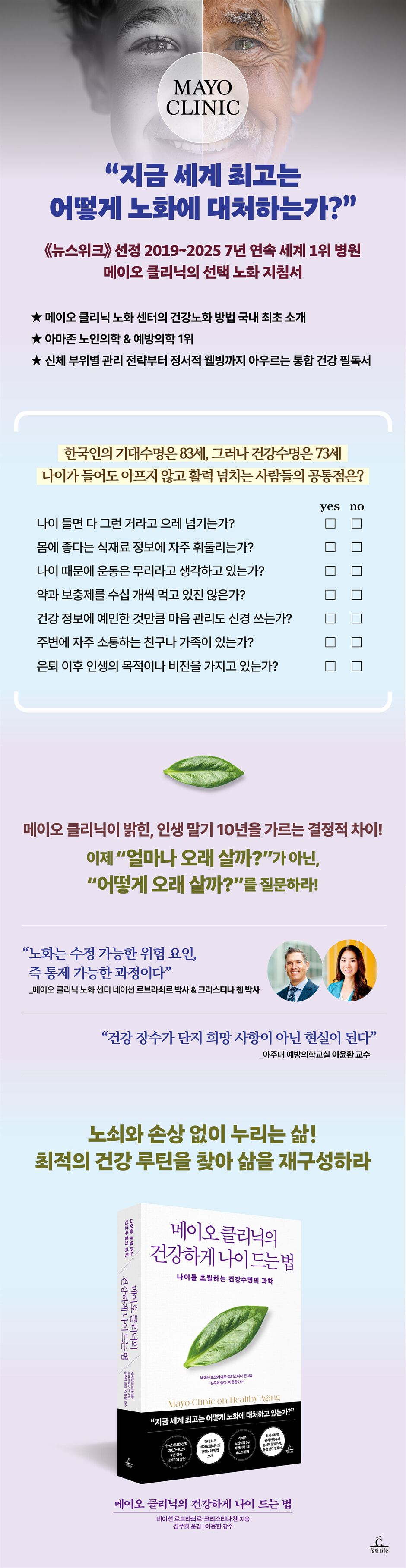
According to recent news, the life expectancy of Koreans is 83 years, and the actual healthy life expectancy is 73 years.
Whether we like it or not, we are expected to live to the average age of 83, which means we will spend about 10 years suffering from various diseases or in a state of frailty that makes it difficult for us to even move.
As concerns and fears about how to spend the last 10 to 15 years of life increase, interest in how to age healthily is also growing.
In the past, we were simply concerned about specific diseases like cancer or dementia, but now we are pursuing a more comprehensive approach of a healthy body that is free of illness and full of vitality.
In that context, Mayo Clinic, the world's best hospital, is famous for managing quality of life by considering not only physical health but also emotional and social health.
Mayo Clinic, which has been ranked number one in the world for seven consecutive years by the global current affairs magazine Newsweek, is also well-known as the hospital that Korean medical professionals requested to cooperate with when former Samsung Chairman Lee Kun-hee collapsed.
This book is the first aging prevention guide in Korea to introduce the comprehensive health methods of the Mayo Clinic Aging Center.
It is a bestseller that immediately reached the #1 spot in geriatrics and preventive medicine on Amazon in the US, and it covers integrated health so that you can check various physical diseases as well as cognitive health and emotional health.
“How does selective aging occur?”
As a management strategy for the rate of decline in physical function and disease risk
A life free from aging and damage
So how does selective aging work? The book's author, director of the Mayo Clinic's Kogod Center on Aging, defines healthy aging as "living as healthily as possible to reduce the risk of cumulative health problems and maintaining a good mood so you can enjoy life, even with some limitations."
To this end, we propose two physical health strategies.
One is a disease risk management strategy that understands the mechanisms of aging, distinguishes between natural changes that occur with age and abnormal signs that should be caught early, and responds appropriately.
The more dangerous the disease, the more important it is to detect and respond to it early, but many people think that it is just a natural progression as they age and let the disease progress past its proper time.
For example, many people take it for granted that hearing loss is normal as they age, but one study found that people who have untreated hearing loss in middle age have a higher risk of developing dementia.
These risks are supported by scientific evidence that hearing impairment adversely affects the brain's ability to encode and remember information.
Another strategy is to lower the rate of decline in physical function by properly managing physical functions that decline with age.
For example, basic bodily functions begin to decline at a rate of about 1 to 2 percent per year after age 30.
This is an undeniable fact of the aging process.
However, exercise can slow this decline to about 0.5% per year.
That is, a person who does not engage in any physical activity at all will lose about 70% of their physical function by the age of 90, while a person who exercises regularly will lose only 30% of their physical ability by the age of 90.
In addition to exercise, diet, sleep, resilience, purpose, and social connectedness also influence the rate of decline in physical function.
This book provides essential information for protecting your body from aging and disease, divided by body organ and topic, establishing a solid framework for selective aging.
To eliminate the gap between life expectancy and healthy life expectancy,
Reimagine your life by finding the optimal health routine!
Strategies for managing decline in physical function and disease risk are linked to choices and habits across all areas of life.
That means, to effectively utilize these strategies in your daily life, you need to restructure your life by finding the optimal health routine that works for you.
That's why, while most health books focus on specific topics like diet, exercise, brain health, and obesity, this book focuses on restructuring life and covers all areas of life to provide the information you need to know for a healthy lifespan.
First, we will introduce in detail how aging occurs in each part of the body, why diseases occur, and how to manage them.
In addition to introducing key features of each body organ and practical strategies to slow down the aging process, it presents organic ways to activate the brain and increase cognitive reserve.
Next, we will introduce everything from aerobic exercise to balance exercise to help you create an exercise program that suits your goals, and we will introduce the principles of diet planning actually used at the Mayo Clinic.
It also provides a self-assessment checklist for your overall life and outlines social and emotional factors that enhance resilience, helping you establish a wellness vision for your body and mind.
By examining the guidelines and practices we need to follow for a healthy lifespan, including diet, exercise, interpersonal relationships, and purpose, we will be able to organically examine how our individual choices affect our overall healthy lifespan.
Now, let's create a health optimization plan that encompasses body, mind, and soul.
★ Amazon's #1 Geriatrics & Preventive Medicine
★ A must-read for integrated health, encompassing everything from physical health to emotional and social well-being.
According to recent news, the life expectancy of Koreans is 83 years, and the actual healthy life expectancy is 73 years.
Whether we like it or not, we are expected to live to the average age of 83, which means we will spend about 10 years suffering from various diseases or in a state of frailty that makes it difficult for us to even move.
As concerns and fears about how to spend the last 10 to 15 years of life increase, interest in how to age healthily is also growing.
In the past, we were simply concerned about specific diseases like cancer or dementia, but now we are pursuing a more comprehensive approach of a healthy body that is free of illness and full of vitality.
In that context, Mayo Clinic, the world's best hospital, is famous for managing quality of life by considering not only physical health but also emotional and social health.
Mayo Clinic, which has been ranked number one in the world for seven consecutive years by the global current affairs magazine Newsweek, is also well-known as the hospital that Korean medical professionals requested to cooperate with when former Samsung Chairman Lee Kun-hee collapsed.
This book is the first aging prevention guide in Korea to introduce the comprehensive health methods of the Mayo Clinic Aging Center.
It is a bestseller that immediately reached the #1 spot in geriatrics and preventive medicine on Amazon in the US, and it covers integrated health so that you can check various physical diseases as well as cognitive health and emotional health.
“How does selective aging occur?”
As a management strategy for the rate of decline in physical function and disease risk
A life free from aging and damage
So how does selective aging work? The book's author, director of the Mayo Clinic's Kogod Center on Aging, defines healthy aging as "living as healthily as possible to reduce the risk of cumulative health problems and maintaining a good mood so you can enjoy life, even with some limitations."
To this end, we propose two physical health strategies.
One is a disease risk management strategy that understands the mechanisms of aging, distinguishes between natural changes that occur with age and abnormal signs that should be caught early, and responds appropriately.
The more dangerous the disease, the more important it is to detect and respond to it early, but many people think that it is just a natural progression as they age and let the disease progress past its proper time.
For example, many people take it for granted that hearing loss is normal as they age, but one study found that people who have untreated hearing loss in middle age have a higher risk of developing dementia.
These risks are supported by scientific evidence that hearing impairment adversely affects the brain's ability to encode and remember information.
Another strategy is to lower the rate of decline in physical function by properly managing physical functions that decline with age.
For example, basic bodily functions begin to decline at a rate of about 1 to 2 percent per year after age 30.
This is an undeniable fact of the aging process.
However, exercise can slow this decline to about 0.5% per year.
That is, a person who does not engage in any physical activity at all will lose about 70% of their physical function by the age of 90, while a person who exercises regularly will lose only 30% of their physical ability by the age of 90.
In addition to exercise, diet, sleep, resilience, purpose, and social connectedness also influence the rate of decline in physical function.
This book provides essential information for protecting your body from aging and disease, divided by body organ and topic, establishing a solid framework for selective aging.
To eliminate the gap between life expectancy and healthy life expectancy,
Reimagine your life by finding the optimal health routine!
Strategies for managing decline in physical function and disease risk are linked to choices and habits across all areas of life.
That means, to effectively utilize these strategies in your daily life, you need to restructure your life by finding the optimal health routine that works for you.
That's why, while most health books focus on specific topics like diet, exercise, brain health, and obesity, this book focuses on restructuring life and covers all areas of life to provide the information you need to know for a healthy lifespan.
First, we will introduce in detail how aging occurs in each part of the body, why diseases occur, and how to manage them.
In addition to introducing key features of each body organ and practical strategies to slow down the aging process, it presents organic ways to activate the brain and increase cognitive reserve.
Next, we will introduce everything from aerobic exercise to balance exercise to help you create an exercise program that suits your goals, and we will introduce the principles of diet planning actually used at the Mayo Clinic.
It also provides a self-assessment checklist for your overall life and outlines social and emotional factors that enhance resilience, helping you establish a wellness vision for your body and mind.
By examining the guidelines and practices we need to follow for a healthy lifespan, including diet, exercise, interpersonal relationships, and purpose, we will be able to organically examine how our individual choices affect our overall healthy lifespan.
Now, let's create a health optimization plan that encompasses body, mind, and soul.
GOODS SPECIFICS
- Date of issue: May 28, 2025
- Page count, weight, size: 464 pages | 856g | 152*224*29mm
- ISBN13: 9791193842348
- ISBN10: 1193842344
You may also like
카테고리
korean


korean

![GQ KOREA Mark (Monthly): December [2025]](http://librairie.coreenne.fr/cdn/shop/files/8ef265dbbfbf186523ed75ba7319009d.jpg?v=1765340328&width=3840)


