

The most beautiful completion of my life
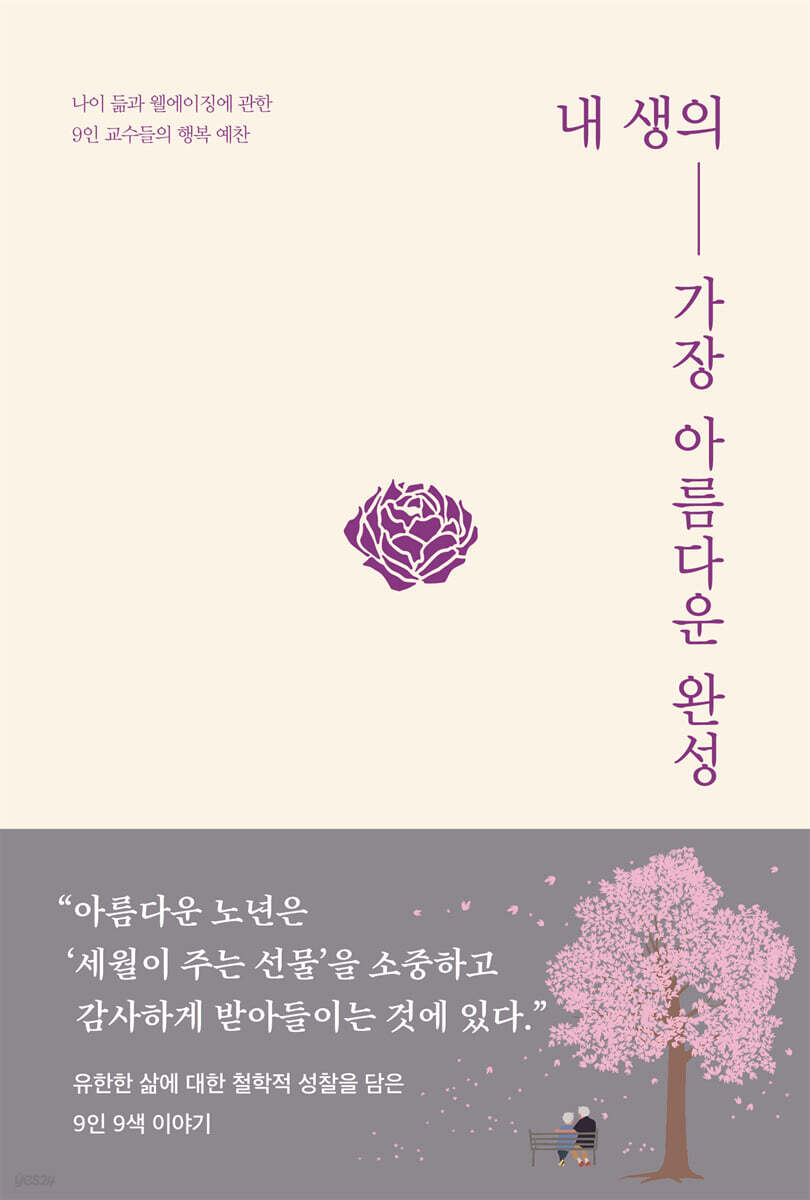 |
Description
Book Introduction
A philosophical reflection on aging
9 People, 9 Different Stories
No human being can avoid aging.
We all grow older, and one day we will retire from active life and enter old age.
After leaving behind the time spent focusing on work and achievement amidst intense worry and effort, you face the rest of your life with a realization of the finiteness of life.
This book contains philosophical reflections on old age, including lectures given at a humanities lecture held at the humanities group 'Studia Humanitatis 8th Square' on the topic of 'aging and well-aging.'
The nine authors view old age as a 'blessing that can beautifully complete life.'
Based on Cicero's "On Old Age," art, and Eastern thought, it deeply reflects on old age and suggests ways to live a fulfilling and meaningful life.
It could be another stimulus for the elderly who rely solely on geriatric medicine and social security.
9 People, 9 Different Stories
No human being can avoid aging.
We all grow older, and one day we will retire from active life and enter old age.
After leaving behind the time spent focusing on work and achievement amidst intense worry and effort, you face the rest of your life with a realization of the finiteness of life.
This book contains philosophical reflections on old age, including lectures given at a humanities lecture held at the humanities group 'Studia Humanitatis 8th Square' on the topic of 'aging and well-aging.'
The nine authors view old age as a 'blessing that can beautifully complete life.'
Based on Cicero's "On Old Age," art, and Eastern thought, it deeply reflects on old age and suggests ways to live a fulfilling and meaningful life.
It could be another stimulus for the elderly who rely solely on geriatric medicine and social security.
- You can preview some of the book's contents.
Preview
index
introduction
Chapter 1.
Old age, the beautiful completion of life_Choi Jin-han
1.
alienation in old age
2.
The wise maturity of old age
3.
The beautiful completion of life lies in the joy of the present.
4.
How to achieve well-aging?
Chapter 2.
The Blessing of Old Age: Focusing on Cicero's On Aging_Kim Jin-sik
1.
Traditional old age statues from ancient times
2.
The traditional image of old age in 『On Old Age』
3.
The paradox of 『On Aging』
Chapter 3.
Life and Self-Care in Old Age_Gong Byeong-hye
1.
Self-care and housing
2.
Aging and Self-Care
3.
Elder care as a residence
4.
Body Memory and Self-Care
5.
Body Memory and Elder Care
Chapter 4.
Identity in Old Age_Kim Soo-bae
1.
Limitations of the concept of biological aging
2.
Identity issues in older adults
3.
The concept of time and space that defines the elderly
4.
The significance of aging and elderly discourse
Chapter 5.
Overcoming Negative Emotions in Old Age_Lee Gwan-pyo
1.
Negativity as a fundamental human condition
2.
The exacerbation of age-related negativity in everyday life
3.
The Philosophical Significance of Old Age as an Extremization of Negativity
Chapter 6.
Well-Aging: A Time to Discover Your Values_Kim Seon-hee
1.
Is there a model for aging well?
2.
Self-reflection and values thought experiment in old age
3.
Reflections on Life in Old Age and the Eternal Recurrence Thought Experiment
4.
Meditation on Death and the Time of Old Age
5.
A beautiful old age, doing what is truly valuable to you.
6.
Time to end your life with honest reasons
Chapter 7.
Well-Aging for Scholars_Jongsu Ahn
1.
Scholars' schedule
2.
Scholars and Reading
3.
Scholar and Calligraphy
4.
Scholar and Sijo Chang
5.
Scholars and musical instruments
6.
Flower viewing with a scholar
7.
Scholar and Meditation
8.
Hwalinsimbang (活人心方)
Chapter 8.
Aging through Art: Temporality and Self-Recording_Kim Kyung-mi
1.
The god of old age in Greek mythology
2.
Roman Portrait Sculpture: A Realistic Record of the Individual
3.
The Middle Ages and the Renaissance: The Universality of Death and the Finitude of Human Existence
4.
17th-Century Dutch Still Life: The Abundance and Transience of Life (Vanitas)
5.
19th-Century Romantic Landscape Painting: Allegories of Old Age
6.
After the 20th Century: Temporality and Self-Recording
7.
Some old age and finite light
Chapter 9.
Taoism and the Wisdom of Life in the Face of Death_Lee Ki-ho
1.
Time, precious youths are all growing old.
2.
Laozi, Zhuangzi and Taoism
3.
The true meaning of 'Tao'
4.
Returning is the movement of Tao
5.
Life and death are one - Hyeonhae
6.
Death = Home to return to ·
7.
clean paper
About the Author
Chapter 1.
Old age, the beautiful completion of life_Choi Jin-han
1.
alienation in old age
2.
The wise maturity of old age
3.
The beautiful completion of life lies in the joy of the present.
4.
How to achieve well-aging?
Chapter 2.
The Blessing of Old Age: Focusing on Cicero's On Aging_Kim Jin-sik
1.
Traditional old age statues from ancient times
2.
The traditional image of old age in 『On Old Age』
3.
The paradox of 『On Aging』
Chapter 3.
Life and Self-Care in Old Age_Gong Byeong-hye
1.
Self-care and housing
2.
Aging and Self-Care
3.
Elder care as a residence
4.
Body Memory and Self-Care
5.
Body Memory and Elder Care
Chapter 4.
Identity in Old Age_Kim Soo-bae
1.
Limitations of the concept of biological aging
2.
Identity issues in older adults
3.
The concept of time and space that defines the elderly
4.
The significance of aging and elderly discourse
Chapter 5.
Overcoming Negative Emotions in Old Age_Lee Gwan-pyo
1.
Negativity as a fundamental human condition
2.
The exacerbation of age-related negativity in everyday life
3.
The Philosophical Significance of Old Age as an Extremization of Negativity
Chapter 6.
Well-Aging: A Time to Discover Your Values_Kim Seon-hee
1.
Is there a model for aging well?
2.
Self-reflection and values thought experiment in old age
3.
Reflections on Life in Old Age and the Eternal Recurrence Thought Experiment
4.
Meditation on Death and the Time of Old Age
5.
A beautiful old age, doing what is truly valuable to you.
6.
Time to end your life with honest reasons
Chapter 7.
Well-Aging for Scholars_Jongsu Ahn
1.
Scholars' schedule
2.
Scholars and Reading
3.
Scholar and Calligraphy
4.
Scholar and Sijo Chang
5.
Scholars and musical instruments
6.
Flower viewing with a scholar
7.
Scholar and Meditation
8.
Hwalinsimbang (活人心方)
Chapter 8.
Aging through Art: Temporality and Self-Recording_Kim Kyung-mi
1.
The god of old age in Greek mythology
2.
Roman Portrait Sculpture: A Realistic Record of the Individual
3.
The Middle Ages and the Renaissance: The Universality of Death and the Finitude of Human Existence
4.
17th-Century Dutch Still Life: The Abundance and Transience of Life (Vanitas)
5.
19th-Century Romantic Landscape Painting: Allegories of Old Age
6.
After the 20th Century: Temporality and Self-Recording
7.
Some old age and finite light
Chapter 9.
Taoism and the Wisdom of Life in the Face of Death_Lee Ki-ho
1.
Time, precious youths are all growing old.
2.
Laozi, Zhuangzi and Taoism
3.
The true meaning of 'Tao'
4.
Returning is the movement of Tao
5.
Life and death are one - Hyeonhae
6.
Death = Home to return to ·
7.
clean paper
About the Author
Detailed image

Into the book
Old age is a period of life in which the future shrinks, but it is also a time in life in which all-encompassing reason and humor reign.
Old age, when it can laugh with all-encompassing power, transcends the limitations of the world that everyone must acknowledge.
The limits of the world are the limits of experience and the limits of a shrunken life.
The laughter of old age transcends these limitations, transcending the limitations of youth that succumbed to harsh reality, and is a triumph of free action over actions that were unavoidable.
--- From “Old Age, the Beautiful Completion of Life”
Cicero believes that old age, when one is naturally free from physical desires and free from the pursuit of fame, wealth, and power, is not a time of unhappiness or suffering, but rather a starting point toward happiness.
In old age, he has escaped the turbulent sea of desire and has now reached the shore where he can rest according to the inevitability of nature.
If at this time one lives a life of quiet and peaceful contemplation, a life of seeking wisdom, then, according to Cicero, such a person will attain the greatest happiness.
--- From “The Blessing of Old Age - Focusing on Cicero’s ‘On Old Age’”
Well-aging is about finding your own value, and the time spent finding your best value is the time needed in old age.
It is a time to simultaneously meditate on life and death, and a process of moving towards the best life.
Through the three questions above about well-aging, finding one's own values is both a task for older age and a matter for self-reflection.
‘Aging well’ means recognizing one’s calling and fulfilling one’s role in order to complete one’s life as a whole.
--- From “Well-aging, a time to find my own value”
The crossroads of time that a person goes through from birth to death is ‘old age.’
These two are universal realities that confront everyone, yet must we live in fear and regard them as such unfortunate events? It seems that countless people, regardless of time or place, have sought comforting answers to these concerns.
There are people like Socrates who say that 'even when a person dies, his soul is immortal', and there are many religions that regard the event of death as 'salvation by God'.
Old age, when it can laugh with all-encompassing power, transcends the limitations of the world that everyone must acknowledge.
The limits of the world are the limits of experience and the limits of a shrunken life.
The laughter of old age transcends these limitations, transcending the limitations of youth that succumbed to harsh reality, and is a triumph of free action over actions that were unavoidable.
--- From “Old Age, the Beautiful Completion of Life”
Cicero believes that old age, when one is naturally free from physical desires and free from the pursuit of fame, wealth, and power, is not a time of unhappiness or suffering, but rather a starting point toward happiness.
In old age, he has escaped the turbulent sea of desire and has now reached the shore where he can rest according to the inevitability of nature.
If at this time one lives a life of quiet and peaceful contemplation, a life of seeking wisdom, then, according to Cicero, such a person will attain the greatest happiness.
--- From “The Blessing of Old Age - Focusing on Cicero’s ‘On Old Age’”
Well-aging is about finding your own value, and the time spent finding your best value is the time needed in old age.
It is a time to simultaneously meditate on life and death, and a process of moving towards the best life.
Through the three questions above about well-aging, finding one's own values is both a task for older age and a matter for self-reflection.
‘Aging well’ means recognizing one’s calling and fulfilling one’s role in order to complete one’s life as a whole.
--- From “Well-aging, a time to find my own value”
The crossroads of time that a person goes through from birth to death is ‘old age.’
These two are universal realities that confront everyone, yet must we live in fear and regard them as such unfortunate events? It seems that countless people, regardless of time or place, have sought comforting answers to these concerns.
There are people like Socrates who say that 'even when a person dies, his soul is immortal', and there are many religions that regard the event of death as 'salvation by God'.
--- From “Lao-Tzu, the Wisdom of Life in the Face of Death”
Publisher's Review
The Two Faces of Old Age: Alienation and Maturity
Concerns about old age are not unique to modern times.
Between birth and death, 'aging' is a universal process of human existence.
As times change, new questions about old age are emerging.
This book discusses various perspectives on how to view and accept old age through philosophical and humanistic thinking.
The awareness of being frail and near death due to aging fundamentally threatens the identity of older people.
Old age is not simply a process of decline, but a time of mental growth and maturity, a time to reflect on and complete one's life.
Well-aging, finding joy in the present
What does it mean to "age well"? Well-aging isn't simply about maintaining good health; it's about finding a life that's meaningful to you.
This book does not view old age only as an object of fear.
Rather, through the message that 'the most important virtue of old age is the enjoyment of the present,' it emphasizes that enriching one's present life is the way to make old age meaningful.
It also examines how to accept 'aging' as a fulfillment of life.
Old age is not simply a time to end one's life; it is a precious time for deep reflection and freedom.
Concerns about old age are not unique to modern times.
Between birth and death, 'aging' is a universal process of human existence.
As times change, new questions about old age are emerging.
This book discusses various perspectives on how to view and accept old age through philosophical and humanistic thinking.
The awareness of being frail and near death due to aging fundamentally threatens the identity of older people.
Old age is not simply a process of decline, but a time of mental growth and maturity, a time to reflect on and complete one's life.
Well-aging, finding joy in the present
What does it mean to "age well"? Well-aging isn't simply about maintaining good health; it's about finding a life that's meaningful to you.
This book does not view old age only as an object of fear.
Rather, through the message that 'the most important virtue of old age is the enjoyment of the present,' it emphasizes that enriching one's present life is the way to make old age meaningful.
It also examines how to accept 'aging' as a fulfillment of life.
Old age is not simply a time to end one's life; it is a precious time for deep reflection and freedom.
GOODS SPECIFICS
- Date of issue: March 26, 2025
- Format: Hardcover book binding method guide
- Page count, weight, size: 292 pages | 378g | 128*188*21mm
- ISBN13: 9791194531074
You may also like
카테고리
korean


korean

![GQ KOREA Mark (Monthly): December [2025]](http://librairie.coreenne.fr/cdn/shop/files/8ef265dbbfbf186523ed75ba7319009d.jpg?v=1765340328&width=3840)


