

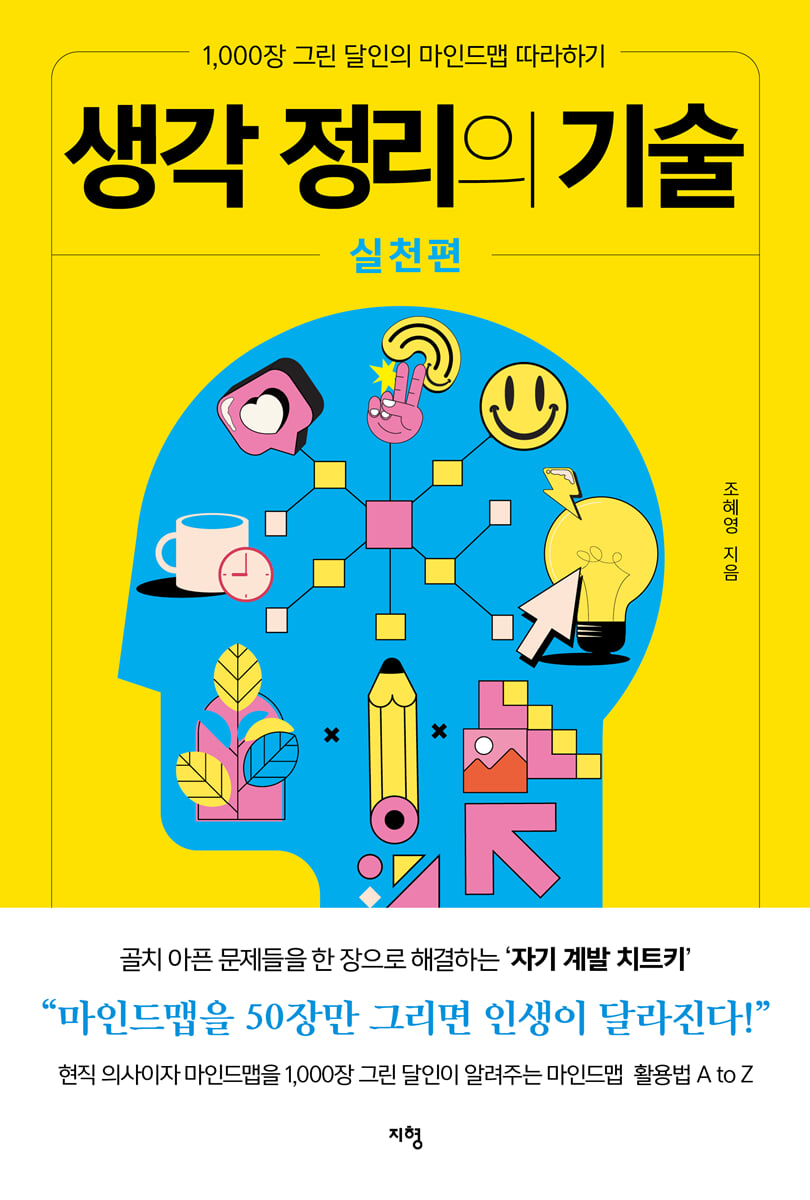
The Art of Organizing Thoughts: Practical Edition
 |
Description
Book Introduction
A bestseller with cumulative sales of 350,000 copies since its publication in 2007.
The sequel to "The Art of Organizing Thoughts" is finally out!
A sequel worthy of the fame of 『The Art of Organizing Thoughts』, the original mind map boom in Korea, has finally been published.
In the meantime, I tried writing by domestic mind map experts(?) and reviewed countless foreign mind map related books, but I couldn't find a suitable book.
It was because of the principle that I would not publish a book unless it was an outstanding book that surpassed my previous work.
Is there a mind map book that can be completed in one volume, like a one-page mind map? Now, I confidently recommend a book written by a master who has drawn 1,000 mind maps.
This is a perfect guide for mind mapping beginners and those who have given up on mind mapping because it is difficult, to open the path to becoming a successful mind mapper.
This book covers the entire process of mind mapping, from preparing materials to drawing methods, for those who are just starting out with mind mapping.
It also provides tips on how to overcome initial difficulties, such as drawing images or choosing central keywords, how to use mind maps in daily life, and how to reread and interpret mind maps.
Additionally, the author explains, with examples, how to reduce trial and error by correcting mistakes frequently made by beginners in his current lectures, including mistakes he made when first drawing a mind map.
This one book is enough.
I am confident that this will serve as a practical textbook on mind mapping for everyone.
Homo Faber (instrumental man) in the AI era uses mind maps.
By learning systematic and expansive thinking through a tool called a mind map, you will be able to develop a high level of thinking skills even without a mind map.
It helps you understand yourself and the world more deeply, organizes your life to be more efficient at work, and leads to improved learning and creative thinking.
From mind maps for self-reflection to mind maps for reading, journaling, travel, and even work, if you consistently draw mind maps by referring to the masters' mind maps, you will be able to develop your own unique method.
The sequel to "The Art of Organizing Thoughts" is finally out!
A sequel worthy of the fame of 『The Art of Organizing Thoughts』, the original mind map boom in Korea, has finally been published.
In the meantime, I tried writing by domestic mind map experts(?) and reviewed countless foreign mind map related books, but I couldn't find a suitable book.
It was because of the principle that I would not publish a book unless it was an outstanding book that surpassed my previous work.
Is there a mind map book that can be completed in one volume, like a one-page mind map? Now, I confidently recommend a book written by a master who has drawn 1,000 mind maps.
This is a perfect guide for mind mapping beginners and those who have given up on mind mapping because it is difficult, to open the path to becoming a successful mind mapper.
This book covers the entire process of mind mapping, from preparing materials to drawing methods, for those who are just starting out with mind mapping.
It also provides tips on how to overcome initial difficulties, such as drawing images or choosing central keywords, how to use mind maps in daily life, and how to reread and interpret mind maps.
Additionally, the author explains, with examples, how to reduce trial and error by correcting mistakes frequently made by beginners in his current lectures, including mistakes he made when first drawing a mind map.
This one book is enough.
I am confident that this will serve as a practical textbook on mind mapping for everyone.
Homo Faber (instrumental man) in the AI era uses mind maps.
By learning systematic and expansive thinking through a tool called a mind map, you will be able to develop a high level of thinking skills even without a mind map.
It helps you understand yourself and the world more deeply, organizes your life to be more efficient at work, and leads to improved learning and creative thinking.
From mind maps for self-reflection to mind maps for reading, journaling, travel, and even work, if you consistently draw mind maps by referring to the masters' mind maps, you will be able to develop your own unique method.
- You can preview some of the book's contents.
Preview
index
Author's Note
Part 1: Drawing a Mind Map
1.
Changing lives
My life begins with organizing my thoughts/mind maps, a tool for recording thoughts/mapping, a way to accumulate knowledge/the trajectory of change and growth
2.
Mind map preparation materials
Getting Started with Mind Mapping/Analog Materials/Digital Materials
3.
Mind Map Components
Image/Branch/Keyword/Color/Radial
Part 2 Various Mind Maps
1.
flow of thought
2.
Associative mind map
3.
Diary Mind Map
4.
Emotion Mind Map
5.
Travel Mind Map
6.
Reading Mind Map
Reading for drawing mind maps/field-specific reading mind maps/essays, novels, picture books/knowledge books, self-help books/multiple volumes, multiple mind maps
7.
Lecture Mind Map
Preparing to Draw a Mind Map / Using Lectures and Video Content / Short Videos and Mind Map Practice
8.
Writing Mind Map
Reading a book and writing/Watching a movie and writing/Composing a plan and writing
9.
Other mind maps (presentations, exhibitions, meetings)
Part 3: Becoming a Mind Mapper
1.
Mind Map for Self-Healing
Mind maps that start with me/mind maps that get to know me/mind maps that organize my life/mind maps that calm my anxiety/mind maps that make work worthwhile
2.
Mind Mapper in Practice
Mind Mapping Tips / Common Mistakes / Tools for Persistence / Hand-Drawn Digital Mind Maps / Who Are Mind Maps for? / Storage and Utilization / Mind Maps in the AI Era / Questions and Answers / Collection of Mind Mapping Case Studies
Epilogue
References
Part 1: Drawing a Mind Map
1.
Changing lives
My life begins with organizing my thoughts/mind maps, a tool for recording thoughts/mapping, a way to accumulate knowledge/the trajectory of change and growth
2.
Mind map preparation materials
Getting Started with Mind Mapping/Analog Materials/Digital Materials
3.
Mind Map Components
Image/Branch/Keyword/Color/Radial
Part 2 Various Mind Maps
1.
flow of thought
2.
Associative mind map
3.
Diary Mind Map
4.
Emotion Mind Map
5.
Travel Mind Map
6.
Reading Mind Map
Reading for drawing mind maps/field-specific reading mind maps/essays, novels, picture books/knowledge books, self-help books/multiple volumes, multiple mind maps
7.
Lecture Mind Map
Preparing to Draw a Mind Map / Using Lectures and Video Content / Short Videos and Mind Map Practice
8.
Writing Mind Map
Reading a book and writing/Watching a movie and writing/Composing a plan and writing
9.
Other mind maps (presentations, exhibitions, meetings)
Part 3: Becoming a Mind Mapper
1.
Mind Map for Self-Healing
Mind maps that start with me/mind maps that get to know me/mind maps that organize my life/mind maps that calm my anxiety/mind maps that make work worthwhile
2.
Mind Mapper in Practice
Mind Mapping Tips / Common Mistakes / Tools for Persistence / Hand-Drawn Digital Mind Maps / Who Are Mind Maps for? / Storage and Utilization / Mind Maps in the AI Era / Questions and Answers / Collection of Mind Mapping Case Studies
Epilogue
References
Detailed image

Into the book
A mind map is 'writing down keywords of what you want to remember and what you want to expand on and then unfolding them.'
There is no fragment of thought that is not drawn in a mind map.
Mind mapping is my way of thinking.
It's fun to see the shape of thoughts that expand out from keywords, and it's satisfying to see the result filled like a picture after completing the mind map.
No matter how complex the content, if you draw a central image and write down the theme, your thoughts will naturally be structured within it.
Through that process, I can see with my own eyes that I am growing.
--- p.18
I recommend drawing analogically until you are completely comfortable with mind mapping.
It is recommended to draw at least 50 pages analogically to get used to mind mapping itself.
Digital mind maps should be as simple and accessible as drawing with a pen on paper.
If you keep repeating it, you will be able to use various functions naturally, and in the process, you will develop your own tastes.
--- p.42
It is also important to use images and colors together.
A good mind map goes beyond recording information and tries to convey more with images and colors.
Images activate our creative brains, helping us think creatively and strengthening our memories at the same time.
By adding images that match each item and using colors that match those images, your mind map becomes a single, integrated visual resource rather than a simple list of information.
--- p.64
The good thing about mind maps is that you don't have to stop at just the keywords you start drawing, but you can continue to expand them in a larger radial pattern.
It's like a tree growing and continuing to put out new branches.
Continuing to expand your thinking is key to creative thinking and idea expansion.
Mind maps can express as much as space allows, and even allow for thoughts that go beyond that.
Even after drawing, when I look at it again next time, my thoughts extend further from the tip of the branch.
--- p.66
Depending on the type of mind map, the way of thinking also changes.
Mind mapping for organizing lectures begins with organizing information into categories.
On the other hand, mind maps for organizing thoughts are sufficient in that you simply expand your thoughts based on the words that come to mind.
Although the two types seem opposite, they are not completely separate.
As mentioned earlier, creative keywords and recall keywords can be used in lecture mind maps for recall purposes, and knowledge for recall can be organized in thought organization mind maps for visualizing thoughts that arise.
--- p.71
You may be wondering, 'What if I write the central keyword incorrectly?'
But the most important thing in a mind map is 'I am doing well.
The answer is 'there is no correct answer'.
Mind maps can be expanded at any time.
You can always add new ideas as they come to you.
--- p.74
Every time I read a book, I draw a mind map.
To draw a mind map, I extract important keywords while reading a book and connect the content to my thoughts.
In this process, my thoughts about the book become richer, and the book lives on in me for a long time, creating more thoughts.
The information I gain from books like this becomes an important fuel for my growth.
This is why I value reading mind maps.
--- p.91
When reading a difficult book, you should abandon the idea of summarizing everything and drawing a perfect mind map.
Mind maps are 'how I remember this book'.
You can organize what you understand and your thoughts about it into keywords, and then draw a mind map of what you want to keep (〈Non-literature 4〉).
The most important thing at this time is to ‘believe in yourself.’
There is no right answer to the keyword.
There is only my choice.
While it's important to understand what the book is saying, when reading a difficult book, it's better to focus on what you understand.
--- p.114
Watching short videos and practicing is also a good way to get better at drawing mind maps.
You can become more and more proficient by watching short videos of about 5 to 10 minutes, extracting keywords, and drawing mind maps.
It's difficult to read a book every day and draw a mind map, but it's not that difficult to watch a short video and draw a mind map.
These exercises help us better organize information and structure our thoughts.
--- pp.144-145
The amount of keywords in a mind map varies depending on the topic or amount of information.
You can divide it into several pages or summarize it all on one page.
How evenly the mind map is spread across the paper is a matter of technique.
As you work as a mind mapper, you will come across topics that you want to organize into a mind map, even if the content is small.
Basically, mind maps are expressed as 'drawing' rather than 'writing'.
If possible, it is necessary to draw it without making it awkward while using the space widely to achieve overall harmony.
--- p.193
Mind maps are a tool to expand and organize my thoughts, and the purpose of drawing mind maps is always for myself.
However, many people think that the answer is in the mind map.
I believe that when you draw a mind map, everyone should be able to understand and interpret it together.
This is a misunderstanding of the essence of mind mapping.
If there is a right answer to a mind map, there must be an objective structure that everyone can draw on the same map.
However, our thoughts are so personal, and mind maps are meant to unfold them, so they are bound to be different for each individual.
So, basically, there is no right answer in mind maps.
There is only one way to expand your thinking.
There is no fragment of thought that is not drawn in a mind map.
Mind mapping is my way of thinking.
It's fun to see the shape of thoughts that expand out from keywords, and it's satisfying to see the result filled like a picture after completing the mind map.
No matter how complex the content, if you draw a central image and write down the theme, your thoughts will naturally be structured within it.
Through that process, I can see with my own eyes that I am growing.
--- p.18
I recommend drawing analogically until you are completely comfortable with mind mapping.
It is recommended to draw at least 50 pages analogically to get used to mind mapping itself.
Digital mind maps should be as simple and accessible as drawing with a pen on paper.
If you keep repeating it, you will be able to use various functions naturally, and in the process, you will develop your own tastes.
--- p.42
It is also important to use images and colors together.
A good mind map goes beyond recording information and tries to convey more with images and colors.
Images activate our creative brains, helping us think creatively and strengthening our memories at the same time.
By adding images that match each item and using colors that match those images, your mind map becomes a single, integrated visual resource rather than a simple list of information.
--- p.64
The good thing about mind maps is that you don't have to stop at just the keywords you start drawing, but you can continue to expand them in a larger radial pattern.
It's like a tree growing and continuing to put out new branches.
Continuing to expand your thinking is key to creative thinking and idea expansion.
Mind maps can express as much as space allows, and even allow for thoughts that go beyond that.
Even after drawing, when I look at it again next time, my thoughts extend further from the tip of the branch.
--- p.66
Depending on the type of mind map, the way of thinking also changes.
Mind mapping for organizing lectures begins with organizing information into categories.
On the other hand, mind maps for organizing thoughts are sufficient in that you simply expand your thoughts based on the words that come to mind.
Although the two types seem opposite, they are not completely separate.
As mentioned earlier, creative keywords and recall keywords can be used in lecture mind maps for recall purposes, and knowledge for recall can be organized in thought organization mind maps for visualizing thoughts that arise.
--- p.71
You may be wondering, 'What if I write the central keyword incorrectly?'
But the most important thing in a mind map is 'I am doing well.
The answer is 'there is no correct answer'.
Mind maps can be expanded at any time.
You can always add new ideas as they come to you.
--- p.74
Every time I read a book, I draw a mind map.
To draw a mind map, I extract important keywords while reading a book and connect the content to my thoughts.
In this process, my thoughts about the book become richer, and the book lives on in me for a long time, creating more thoughts.
The information I gain from books like this becomes an important fuel for my growth.
This is why I value reading mind maps.
--- p.91
When reading a difficult book, you should abandon the idea of summarizing everything and drawing a perfect mind map.
Mind maps are 'how I remember this book'.
You can organize what you understand and your thoughts about it into keywords, and then draw a mind map of what you want to keep (〈Non-literature 4〉).
The most important thing at this time is to ‘believe in yourself.’
There is no right answer to the keyword.
There is only my choice.
While it's important to understand what the book is saying, when reading a difficult book, it's better to focus on what you understand.
--- p.114
Watching short videos and practicing is also a good way to get better at drawing mind maps.
You can become more and more proficient by watching short videos of about 5 to 10 minutes, extracting keywords, and drawing mind maps.
It's difficult to read a book every day and draw a mind map, but it's not that difficult to watch a short video and draw a mind map.
These exercises help us better organize information and structure our thoughts.
--- pp.144-145
The amount of keywords in a mind map varies depending on the topic or amount of information.
You can divide it into several pages or summarize it all on one page.
How evenly the mind map is spread across the paper is a matter of technique.
As you work as a mind mapper, you will come across topics that you want to organize into a mind map, even if the content is small.
Basically, mind maps are expressed as 'drawing' rather than 'writing'.
If possible, it is necessary to draw it without making it awkward while using the space widely to achieve overall harmony.
--- p.193
Mind maps are a tool to expand and organize my thoughts, and the purpose of drawing mind maps is always for myself.
However, many people think that the answer is in the mind map.
I believe that when you draw a mind map, everyone should be able to understand and interpret it together.
This is a misunderstanding of the essence of mind mapping.
If there is a right answer to a mind map, there must be an objective structure that everyone can draw on the same map.
However, our thoughts are so personal, and mind maps are meant to unfold them, so they are bound to be different for each individual.
So, basically, there is no right answer in mind maps.
There is only one way to expand your thinking.
--- p.212
Publisher's Review
Self-Development Cheat Code: Solving Your Troublesome Problems in One Page
“Draw just 50 mind maps and your life will change!”
A practicing physician and mind map expert with 1,000 mind maps demonstrates mind map usage for beginners.
A friendly helper for 'Marin' and 'Mapoja'
(Marin refers to a beginner in mind mapping, and Mapoja refers to a person who started mind mapping but gave up.)
▶ As expected, the national rule is to use the equipment quickly.
When drawing a mind map, you need tools.
This book solves the problems that arise during the preparatory stage of drawing a mind map.
Mind maps can be drawn analogously by hand or digitally using a tablet, and the author explains in detail what is needed for both methods.
When drawing by hand, you will need a pen to write keywords, a marker or colored pencil to draw images or color branches, and paper or a notebook to store them in.
This book shows you what to consider when choosing each tool, and even names each pen the author chose, with photos.
When drawing digitally, you need to use an application, and the type of app varies depending on the type of tablet (iPad, Galaxy Tab).
We provide detailed information on each app that is good for drawing mind maps, including how to use it and basic settings.
▶ The master's know-how, generously revealed!
A mind map can be said to be an image of text.
But expressing thoughts through drawings requires another skill.
Many people hesitate from the beginning of mind mapping because they encounter the difficulty of drawing pictures.
So, the author meticulously teaches how to solve things that beginners find difficult, such as specific methods for finding and drawing images needed for mind maps, how to draw branches that expand radially, what the central and detailed keywords that go up the branches are, how to use recall keywords and creative keywords, and how to color mind maps to make them more attractive and effective and increase concentration.
The author recommends drawing at least 50 mind maps by hand until you become comfortable with them.
If you are a marine who doesn't know what to draw, tracing is also a good method.
Let's get familiar with mind maps by drawing along with the author's mind map.
▶ Mind maps are a self-development cheat key.
Mind maps are not only used for work and study, such as planning tasks, writing reports, making presentations, generating ideas, and preparing for meetings.
Using mind maps in your daily life not only serves as a tool for visualizing your thoughts clearly and providing new inspiration, but also allows you to experience how your thoughts expand and change as you draw them.
The author shows mind maps of various fields that he himself drew and encourages readers by suggesting points to follow when drawing.
You can see various mind maps, such as a diary mind map to remember special days, a travel mind map to plan a trip and create memories, a reading mind map to help you grow, a lecture mind map that leads to change rather than just listening to a lecture, a video mind map to organize knowledge and thoughts in a flood of videos, and a mind map to leave a review after watching a movie or visiting an art gallery.
Anyone can start mind mapping right away by selecting only the necessary parts from the table of contents of this book and following along.
▶ The power of detail
The reading mind map, which will be used most frequently when learning and utilizing mind maps, devotes a lot of space to kindly informing you of the materials to prepare, reading methods for each field, and even the process.
It explains things in surprising detail, such as how to use flags (post-its), how to take notes, and how to use the margins or end pages of books.
It also shows various ways to use it with real examples, such as how to draw mind maps according to the genre of the book, such as essays, novels, picture books, knowledge books, and self-help books; how to draw mind maps for thick brick books and difficult books that you have read but not understood; how to draw one book as multiple mind maps; and conversely, how to draw multiple books as one mind map.
Reading mind maps are a way to remember the books I read in my own way.
Let's put the thoughts and interpretations I gained from the book into a reading mind map.
▶ Escape from 'Mapoja' by just blindly following along
The flower of the master mind map is the self-healing mind map.
The author candidly shows how he used mind maps as a tool for self-reflection, the foundation of self-development.
The author honestly shares the process of growing himself through mind mapping, starting with himself, getting to know himself, organizing his life, alleviating anxiety, and ultimately making his current work worthwhile.
As you follow the author's self-healing process, your perspective will naturally broaden and your life will gain more depth.
Let's listen to the author.
“What changes me is my actions, and those actions come from my thoughts.
“Mind mapping is an important tool for organizing and developing my thoughts.”
▶ Further detailed explanation is omitted.
As a 'practical guide', this book contains specific content that will be of practical help to Marin, and it is also friendly to those unfamiliar with mind maps.
It understands the difficulties faced by marines, presents practical solutions, explains how to utilize mind maps in daily life, answers questions to reduce trial and error, and provides various case studies to answer all your questions about mind maps.
It also provides all the necessary tips, such as how to overcome mannerism, the importance of numbering, giving your mind map your own meaning (color, direction, etc.), how to save the mind maps you have accumulated, how to reread and interpret the mind maps you have drawn in the past, and how to reduce mistakes.
“Draw just 50 mind maps and your life will change!”
A practicing physician and mind map expert with 1,000 mind maps demonstrates mind map usage for beginners.
A friendly helper for 'Marin' and 'Mapoja'
(Marin refers to a beginner in mind mapping, and Mapoja refers to a person who started mind mapping but gave up.)
▶ As expected, the national rule is to use the equipment quickly.
When drawing a mind map, you need tools.
This book solves the problems that arise during the preparatory stage of drawing a mind map.
Mind maps can be drawn analogously by hand or digitally using a tablet, and the author explains in detail what is needed for both methods.
When drawing by hand, you will need a pen to write keywords, a marker or colored pencil to draw images or color branches, and paper or a notebook to store them in.
This book shows you what to consider when choosing each tool, and even names each pen the author chose, with photos.
When drawing digitally, you need to use an application, and the type of app varies depending on the type of tablet (iPad, Galaxy Tab).
We provide detailed information on each app that is good for drawing mind maps, including how to use it and basic settings.
▶ The master's know-how, generously revealed!
A mind map can be said to be an image of text.
But expressing thoughts through drawings requires another skill.
Many people hesitate from the beginning of mind mapping because they encounter the difficulty of drawing pictures.
So, the author meticulously teaches how to solve things that beginners find difficult, such as specific methods for finding and drawing images needed for mind maps, how to draw branches that expand radially, what the central and detailed keywords that go up the branches are, how to use recall keywords and creative keywords, and how to color mind maps to make them more attractive and effective and increase concentration.
The author recommends drawing at least 50 mind maps by hand until you become comfortable with them.
If you are a marine who doesn't know what to draw, tracing is also a good method.
Let's get familiar with mind maps by drawing along with the author's mind map.
▶ Mind maps are a self-development cheat key.
Mind maps are not only used for work and study, such as planning tasks, writing reports, making presentations, generating ideas, and preparing for meetings.
Using mind maps in your daily life not only serves as a tool for visualizing your thoughts clearly and providing new inspiration, but also allows you to experience how your thoughts expand and change as you draw them.
The author shows mind maps of various fields that he himself drew and encourages readers by suggesting points to follow when drawing.
You can see various mind maps, such as a diary mind map to remember special days, a travel mind map to plan a trip and create memories, a reading mind map to help you grow, a lecture mind map that leads to change rather than just listening to a lecture, a video mind map to organize knowledge and thoughts in a flood of videos, and a mind map to leave a review after watching a movie or visiting an art gallery.
Anyone can start mind mapping right away by selecting only the necessary parts from the table of contents of this book and following along.
▶ The power of detail
The reading mind map, which will be used most frequently when learning and utilizing mind maps, devotes a lot of space to kindly informing you of the materials to prepare, reading methods for each field, and even the process.
It explains things in surprising detail, such as how to use flags (post-its), how to take notes, and how to use the margins or end pages of books.
It also shows various ways to use it with real examples, such as how to draw mind maps according to the genre of the book, such as essays, novels, picture books, knowledge books, and self-help books; how to draw mind maps for thick brick books and difficult books that you have read but not understood; how to draw one book as multiple mind maps; and conversely, how to draw multiple books as one mind map.
Reading mind maps are a way to remember the books I read in my own way.
Let's put the thoughts and interpretations I gained from the book into a reading mind map.
▶ Escape from 'Mapoja' by just blindly following along
The flower of the master mind map is the self-healing mind map.
The author candidly shows how he used mind maps as a tool for self-reflection, the foundation of self-development.
The author honestly shares the process of growing himself through mind mapping, starting with himself, getting to know himself, organizing his life, alleviating anxiety, and ultimately making his current work worthwhile.
As you follow the author's self-healing process, your perspective will naturally broaden and your life will gain more depth.
Let's listen to the author.
“What changes me is my actions, and those actions come from my thoughts.
“Mind mapping is an important tool for organizing and developing my thoughts.”
▶ Further detailed explanation is omitted.
As a 'practical guide', this book contains specific content that will be of practical help to Marin, and it is also friendly to those unfamiliar with mind maps.
It understands the difficulties faced by marines, presents practical solutions, explains how to utilize mind maps in daily life, answers questions to reduce trial and error, and provides various case studies to answer all your questions about mind maps.
It also provides all the necessary tips, such as how to overcome mannerism, the importance of numbering, giving your mind map your own meaning (color, direction, etc.), how to save the mind maps you have accumulated, how to reread and interpret the mind maps you have drawn in the past, and how to reduce mistakes.
GOODS SPECIFICS
- Date of issue: February 25, 2025
- Page count, weight, size: 248 pages | 442g | 152*225*16mm
- ISBN13: 9788993111477
- ISBN10: 8993111472
You may also like
카테고리
korean


korean

![GQ KOREA Mark (Monthly): December [2025]](http://librairie.coreenne.fr/cdn/shop/files/8ef265dbbfbf186523ed75ba7319009d.jpg?v=1765340328&width=3840)


