

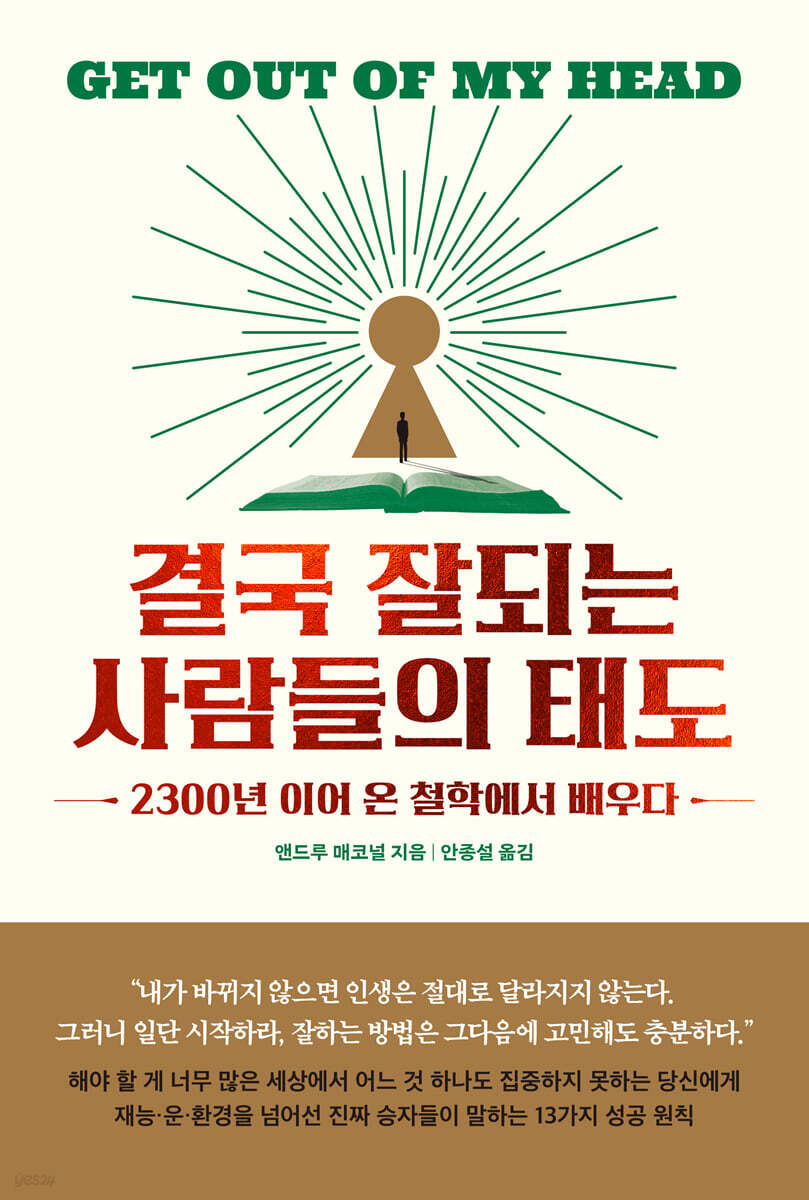
The attitude of people who eventually succeed
 |
Description
Book Introduction
“If I don’t change, life will never change.
So, just get started, and you can worry about how to do it well later.”
In a world with so many things to do, to you who can't focus on anything
13 Success Laws from True Winners: Beyond Talent, Luck, and Circumstances
A book that summarizes the 13 attitudes of people who ultimately succeed, discovered in Stoic philosophy that has been passed down for over 2,300 years.
Some say that ultimately, successful people are not born with extraordinary talent or from wealthy backgrounds, but simply have a different attitude toward problems.
Andrew McConnell, an entrepreneur and bestselling author, graduated from Harvard University and worked in various positions as a lawyer and consultant at leading companies such as Merrill Lynch and McKinsey. He then founded Lented, a company that has been listed on the Inc. 500 list for two consecutive years.
Why does he, whose impressive resume suggests a path to success based solely on natural talent and skill, cite attitude as the most crucial factor in success and happiness? Contrary to appearances, he has, in fact, endured countless crises and conflicts.
The company I started by giving up a high salary is on the verge of bankruptcy. I've lost precious time with my family and suffered burnout because I was struggling with menial tasks. I've also missed the opportunity for change by blaming the company and my colleagues for my problems.
But at some point, he realizes that there are people who face similar difficulties without being too discouraged and quietly focus on their work, and that they are the ones who lead successful businesses and live lives without regrets.
Ultimately, successful people aren't those who have a lot, are lucky, or boast about how right they are.
They were people who could quietly focus on what they could do in any situation and bring about great change.
This is consistent with the teachings of Stoic philosophy, which began 2,300 years ago.
Stoic philosophy emphasizes that there are things in the world that can be controlled and things that cannot, and that by distinguishing between these and focusing solely on what can be controlled, you can live the life you want.
And the only thing you can control is yourself.
So now it's time to get off the treadmill of blaming circumstances, blaming others, regretting the past, and fearing the future.
If I don't change, my life will never change.
In this book, Andrew McConnell writes frankly and honestly about the various crises he faced and the process of overcoming them while holding various roles as an office worker, CEO, husband, and father.
It also describes the wisdom of Stoic philosophy, which serves as a compass in times of crisis, in an easy-to-understand and fun way.
Adam Grant, a professor of organizational psychology at Wharton School, praised this book, which condenses not only his personal experiences but also the attitudes of 22 entrepreneurs, scholars, athletes, explorers, and other “modern-day Stoics” who have reached the top of their fields, saying, “This book explains in a way that makes the wisdom of Stoic philosophy useful in an easy-to-understand way,” and readers gave it rave reviews, saying, “It’s revolutionary,” and “I became a much better person after reading this book.”
So, just get started, and you can worry about how to do it well later.”
In a world with so many things to do, to you who can't focus on anything
13 Success Laws from True Winners: Beyond Talent, Luck, and Circumstances
A book that summarizes the 13 attitudes of people who ultimately succeed, discovered in Stoic philosophy that has been passed down for over 2,300 years.
Some say that ultimately, successful people are not born with extraordinary talent or from wealthy backgrounds, but simply have a different attitude toward problems.
Andrew McConnell, an entrepreneur and bestselling author, graduated from Harvard University and worked in various positions as a lawyer and consultant at leading companies such as Merrill Lynch and McKinsey. He then founded Lented, a company that has been listed on the Inc. 500 list for two consecutive years.
Why does he, whose impressive resume suggests a path to success based solely on natural talent and skill, cite attitude as the most crucial factor in success and happiness? Contrary to appearances, he has, in fact, endured countless crises and conflicts.
The company I started by giving up a high salary is on the verge of bankruptcy. I've lost precious time with my family and suffered burnout because I was struggling with menial tasks. I've also missed the opportunity for change by blaming the company and my colleagues for my problems.
But at some point, he realizes that there are people who face similar difficulties without being too discouraged and quietly focus on their work, and that they are the ones who lead successful businesses and live lives without regrets.
Ultimately, successful people aren't those who have a lot, are lucky, or boast about how right they are.
They were people who could quietly focus on what they could do in any situation and bring about great change.
This is consistent with the teachings of Stoic philosophy, which began 2,300 years ago.
Stoic philosophy emphasizes that there are things in the world that can be controlled and things that cannot, and that by distinguishing between these and focusing solely on what can be controlled, you can live the life you want.
And the only thing you can control is yourself.
So now it's time to get off the treadmill of blaming circumstances, blaming others, regretting the past, and fearing the future.
If I don't change, my life will never change.
In this book, Andrew McConnell writes frankly and honestly about the various crises he faced and the process of overcoming them while holding various roles as an office worker, CEO, husband, and father.
It also describes the wisdom of Stoic philosophy, which serves as a compass in times of crisis, in an easy-to-understand and fun way.
Adam Grant, a professor of organizational psychology at Wharton School, praised this book, which condenses not only his personal experiences but also the attitudes of 22 entrepreneurs, scholars, athletes, explorers, and other “modern-day Stoics” who have reached the top of their fields, saying, “This book explains in a way that makes the wisdom of Stoic philosophy useful in an easy-to-understand way,” and readers gave it rave reviews, saying, “It’s revolutionary,” and “I became a much better person after reading this book.”
- You can preview some of the book's contents.
Preview
index
Translator's Note - The problem wasn't others, it was me.
PROLOGUE - The Philosophy of Attitude Worth More Than $50 Million
Beginning the book - My encounter with Stoic philosophy completely changed my attitude toward life.
PART 1.
If I don't change, life will never change.
: The thoughts of people who are ultimately successful
CHAPTER 1.
Why leave your worth to others' judgments?
If you don't believe in your own worth, you'll be swayed by others' low evaluations.
Why I Need to Carefully Consider My Value
The psychology of people who take on trivial tasks
Living a worthwhile life means spending your time on worthwhile things.
The Wise Time Management of Successful People 1
The Wise Time Management of Successful People 2
CHAPTER 2.
You can't change the situation, but you can choose your attitude toward it.
“Do what you have to do, or don’t even think about it!”
You can't change the situation, but you can choose your attitude toward it.
The Amazing Secrets of Success from the Man Who Built a Global Company
First, distinguish between what can be changed and what cannot be changed.
How to Push Your Limits to Achieve Peak Performance
CHAPTER 3.
Truly wise people find solutions in the criticism of others.
Characteristics of People Who Win in Arguments and Fail in Business
The tremendous change driven by the courage to admit that you might be wrong
Criticism is the best feedback when you listen to it without emotion.
5 Tips for People Who Still Fear Criticism
PART 2.
Learning from 2,300 years of philosophy
: The attitude of people who eventually succeed
CHAPTER 4.
One thing I realized just before my life was ruined
What on earth was I so afraid of?
If you assume the worst, the answer appears.
Why Navy SEALs Train Hard Every Day
If you want to have a strong, unwavering mentality
A 3-Step Framework to Achieve Your Goals in Any Situation
CHAPTER 5.
Turning crises into opportunities and becoming stronger
No matter how hard you live, a crisis can come.
Are you an internal or external control person?
A crisis is not the obstacle itself, but rather our reaction to it.
Advice from a man who suffered a terrible accident and became a top explorer.
Take a deep breath and take just one step.
Lifeline Practice: Turning Crisis into Opportunity
CHAPTER 6.
Don't suffer twice over what happened in the past.
We suffer more often in our imagination than in reality.
Do you remember what you were worried about a month ago?
The One Principle That Built a $50 Billion Company
How to avoid ruining your day with useless regrets and anxiety
CHAPTER 7.
Remember that in life, there are no unconditionally bad or unconditionally good things.
What a rookie CEO learned from experiencing such injustice
In life, there are no unconditionally bad or unconditionally good things.
A grateful person eventually gets everything.
“I am the luckiest person in the world.”
How to Use Gratitude Most Effectively
CHAPTER 8.
I would rather be a person with a good attitude than someone who risks his life for the result.
A wise person calculates results differently from effort.
Amateurs obsessed with results vs.
A professional who values the process
Despite this, the reason he lives his life to the fullest
How to break free from a life of joy and sorrow over results
PART 3.
Just start, and you can worry about how to do it well later.
: The skill of selection and concentration of those who ultimately succeed
CHAPTER 9.
I don't blame anyone, it just changes me.
The Hard Truths of Life I Learned at McKinsey
Why life remains the same even after changing jobs or meeting new people.
The first thing you have to give up to get what you want
If I don't change, life will never change.
CHAPTER 10.
The perfect time never comes, the time is now.
The world's most successful man changed 'later' to 'today'
What People Who Have Regrets at the End of Their Lives Have in Common
A very simple way to avoid missing opportunities: “Just give it a try.”
Procrastination is the biggest waste of life.
CHAPTER 11.
Don't try to do everything well, just focus on what really matters.
The paradox that the more you have, the less happy you become
Why Smart People Don't Multitask
There are only one or two things that are truly important.
Innovation is saying no to a thousand less important things.
How to focus your time and energy on what matters most
CHAPTER 12.
Just start, and you can worry about how to do it well later.
Worrying more doesn't lead to better results.
"Just right" is enough, not perfect.
Once you start doing it, creativity and excellence will come out.
A surefire way to deal with your inner, persistent perfectionist.
CHAPTER 13.
If you don't want to regret it in a year
Why no one came up with ideas during the meeting
Even if it's difficult, take the right path. In hindsight, it turns out that it's the easiest and fastest path.
The surprising secret to being selected as a top 500 company for two consecutive years
It's time to get up and take action.
If you don't want to regret it in a year
Concluding the Book - A Good Attitude Creates a Quality Life
EPILOGUE - Cheering you on to live a life without regrets
PROLOGUE - The Philosophy of Attitude Worth More Than $50 Million
Beginning the book - My encounter with Stoic philosophy completely changed my attitude toward life.
PART 1.
If I don't change, life will never change.
: The thoughts of people who are ultimately successful
CHAPTER 1.
Why leave your worth to others' judgments?
If you don't believe in your own worth, you'll be swayed by others' low evaluations.
Why I Need to Carefully Consider My Value
The psychology of people who take on trivial tasks
Living a worthwhile life means spending your time on worthwhile things.
The Wise Time Management of Successful People 1
The Wise Time Management of Successful People 2
CHAPTER 2.
You can't change the situation, but you can choose your attitude toward it.
“Do what you have to do, or don’t even think about it!”
You can't change the situation, but you can choose your attitude toward it.
The Amazing Secrets of Success from the Man Who Built a Global Company
First, distinguish between what can be changed and what cannot be changed.
How to Push Your Limits to Achieve Peak Performance
CHAPTER 3.
Truly wise people find solutions in the criticism of others.
Characteristics of People Who Win in Arguments and Fail in Business
The tremendous change driven by the courage to admit that you might be wrong
Criticism is the best feedback when you listen to it without emotion.
5 Tips for People Who Still Fear Criticism
PART 2.
Learning from 2,300 years of philosophy
: The attitude of people who eventually succeed
CHAPTER 4.
One thing I realized just before my life was ruined
What on earth was I so afraid of?
If you assume the worst, the answer appears.
Why Navy SEALs Train Hard Every Day
If you want to have a strong, unwavering mentality
A 3-Step Framework to Achieve Your Goals in Any Situation
CHAPTER 5.
Turning crises into opportunities and becoming stronger
No matter how hard you live, a crisis can come.
Are you an internal or external control person?
A crisis is not the obstacle itself, but rather our reaction to it.
Advice from a man who suffered a terrible accident and became a top explorer.
Take a deep breath and take just one step.
Lifeline Practice: Turning Crisis into Opportunity
CHAPTER 6.
Don't suffer twice over what happened in the past.
We suffer more often in our imagination than in reality.
Do you remember what you were worried about a month ago?
The One Principle That Built a $50 Billion Company
How to avoid ruining your day with useless regrets and anxiety
CHAPTER 7.
Remember that in life, there are no unconditionally bad or unconditionally good things.
What a rookie CEO learned from experiencing such injustice
In life, there are no unconditionally bad or unconditionally good things.
A grateful person eventually gets everything.
“I am the luckiest person in the world.”
How to Use Gratitude Most Effectively
CHAPTER 8.
I would rather be a person with a good attitude than someone who risks his life for the result.
A wise person calculates results differently from effort.
Amateurs obsessed with results vs.
A professional who values the process
Despite this, the reason he lives his life to the fullest
How to break free from a life of joy and sorrow over results
PART 3.
Just start, and you can worry about how to do it well later.
: The skill of selection and concentration of those who ultimately succeed
CHAPTER 9.
I don't blame anyone, it just changes me.
The Hard Truths of Life I Learned at McKinsey
Why life remains the same even after changing jobs or meeting new people.
The first thing you have to give up to get what you want
If I don't change, life will never change.
CHAPTER 10.
The perfect time never comes, the time is now.
The world's most successful man changed 'later' to 'today'
What People Who Have Regrets at the End of Their Lives Have in Common
A very simple way to avoid missing opportunities: “Just give it a try.”
Procrastination is the biggest waste of life.
CHAPTER 11.
Don't try to do everything well, just focus on what really matters.
The paradox that the more you have, the less happy you become
Why Smart People Don't Multitask
There are only one or two things that are truly important.
Innovation is saying no to a thousand less important things.
How to focus your time and energy on what matters most
CHAPTER 12.
Just start, and you can worry about how to do it well later.
Worrying more doesn't lead to better results.
"Just right" is enough, not perfect.
Once you start doing it, creativity and excellence will come out.
A surefire way to deal with your inner, persistent perfectionist.
CHAPTER 13.
If you don't want to regret it in a year
Why no one came up with ideas during the meeting
Even if it's difficult, take the right path. In hindsight, it turns out that it's the easiest and fastest path.
The surprising secret to being selected as a top 500 company for two consecutive years
It's time to get up and take action.
If you don't want to regret it in a year
Concluding the Book - A Good Attitude Creates a Quality Life
EPILOGUE - Cheering you on to live a life without regrets
Detailed image

Into the book
Weekends spent missing family time while struggling with unimportant tasks, nights spent worrying about things that never happened, exhausting negotiations and events to show that I was running a successful business, pointless arguments to prove my point…
You may have been tormented by the thought of working 24 hours a day, but how much of that work was truly important and core?
As I looked back at each one, the real problem became clear.
The person who treated my assets the cheapest was none other than myself.
--- From "Starting the Book"
My father nodded as if he understood, then paused for a moment before speaking.
“Don’t do that.
“Don’t ever do that again.”
“What?” I asked back.
“Do what you have to do, or don’t even think about it if you’re not going to do it.
What I'm saying is, don't waste your time worrying about things you shouldn't be doing! That's the worst thing you can do.
Rather than constantly thinking about it and not being able to forget it for even a moment, it's better to get things done.
You're going to do it anyway.
Because it's always been like that.
So when you play, just have fun without thinking about anything.”
--- From "You can't change the situation, but you can choose your attitude toward it"
“When someone criticizes you, first assume that the criticism is correct.
Preparing countermeasures and solutions comes next.
Otherwise, we'll just waste time arguing about what's right.
There is truth in every criticism, even if it is only a grain of sand.
“If you don’t get caught up in arguments that lead to no conclusion, you can quickly find a solution by finding out the little bits of truth.”
--- From "A truly wise person finds solutions in the criticism of others"
According to Adler, the situation itself is not something to be judged as good or bad.
We just attach various labels to the situation.
Shakespeare also said it through Hamlet.
“There is no good or bad.
“It’s just the thinking that makes it so.”
--- From "Don't suffer twice over what happened in the past"
The Stoic philosophers recognized early on that the final outcome is beyond our control.
So what is under our control? The process.
What we do and how we do it is entirely up to our own efforts, with the best results expected.
So the Stoic philosophers advised that we should make every effort to achieve our goals, but let go of our attachment to the results.
--- From "I will be a person with a good attitude rather than someone who risks his life for the result"
“The problem is that people who leave McKinsey because the workload is too much, the hours are too long, or they can’t stop thinking about work when they get home, they don’t change no matter where they go.
The problem isn't with the company, it's with everything else.
The problem is 'them'.
It is no one else but themselves who makes them work that way.
“Just changing where you work doesn’t change how you work.”
The painful truth was that I was too quick to blame someone else, something else.
The problem wasn't the company, it was the way I worked.
As long as I didn't control myself like that, it didn't matter where my paycheck came from.
I would have made my life a sea of suffering by constantly blaming the company and making excuses for this and that.
--- From "I don't blame anything, it just changes me"
Honestly, I don't know how much time I have left in this life.
If you postpone your dreams by saying 'later,' those dreams may never come true.
And I dare say that everyone reading this has at least one thing they've been putting off until the "right time" comes.
Proposing to a loved one, becoming a parent, starting a business, selling everything you own and traveling the world…
Think of all the things you've put off doing that would definitely add value to your life because it wasn't the right time.
The 'right time' never comes.
There is only one time.
It's only right now.
--- From "The perfect time never comes, the time is now"
The world is too complex to be satisfied with just one right answer.
Rather than trying to find the perfect answer, your goal should be to synthesize the information you have to find the best possible answer, and then work to make that "good answer" the "best answer."
When starting a company or creating a product, the initial idea is rarely the right one.
The key is how to put that idea into action and how to persevere and not give up when difficulties arise.
--- From "Just start, and you can worry about how to do it well later"
If you want to do a good job, if you want to achieve something, just start doing it.
As you do it, you will see paths you never thought of, and as the results accumulate, the quality will change.
Creativity and excellence emerge from the process, not from the beginning.
So, even if it's sloppy and not that great, just start and see.
You can think about how to do it well later.
--- From "Just start, and you can worry about how to do it well later"
If there is an easy shortcut next to the difficult right path, isn't it the same for companies and people that they want to go there?
But there are those who oppose this idea.
They say that even if it seems difficult and hard, taking the right path turns out to be the fastest and easiest path in the long run.
Whether you're a CEO running a company or an individual leading a life, having the conviction and will to put your resolutions into action, not just words, means you have a solid roadmap.
And the person with the map moves forward steadily without much wandering or turning back.
Ultimately, they achieve their goals faster and easier.
You may have been tormented by the thought of working 24 hours a day, but how much of that work was truly important and core?
As I looked back at each one, the real problem became clear.
The person who treated my assets the cheapest was none other than myself.
--- From "Starting the Book"
My father nodded as if he understood, then paused for a moment before speaking.
“Don’t do that.
“Don’t ever do that again.”
“What?” I asked back.
“Do what you have to do, or don’t even think about it if you’re not going to do it.
What I'm saying is, don't waste your time worrying about things you shouldn't be doing! That's the worst thing you can do.
Rather than constantly thinking about it and not being able to forget it for even a moment, it's better to get things done.
You're going to do it anyway.
Because it's always been like that.
So when you play, just have fun without thinking about anything.”
--- From "You can't change the situation, but you can choose your attitude toward it"
“When someone criticizes you, first assume that the criticism is correct.
Preparing countermeasures and solutions comes next.
Otherwise, we'll just waste time arguing about what's right.
There is truth in every criticism, even if it is only a grain of sand.
“If you don’t get caught up in arguments that lead to no conclusion, you can quickly find a solution by finding out the little bits of truth.”
--- From "A truly wise person finds solutions in the criticism of others"
According to Adler, the situation itself is not something to be judged as good or bad.
We just attach various labels to the situation.
Shakespeare also said it through Hamlet.
“There is no good or bad.
“It’s just the thinking that makes it so.”
--- From "Don't suffer twice over what happened in the past"
The Stoic philosophers recognized early on that the final outcome is beyond our control.
So what is under our control? The process.
What we do and how we do it is entirely up to our own efforts, with the best results expected.
So the Stoic philosophers advised that we should make every effort to achieve our goals, but let go of our attachment to the results.
--- From "I will be a person with a good attitude rather than someone who risks his life for the result"
“The problem is that people who leave McKinsey because the workload is too much, the hours are too long, or they can’t stop thinking about work when they get home, they don’t change no matter where they go.
The problem isn't with the company, it's with everything else.
The problem is 'them'.
It is no one else but themselves who makes them work that way.
“Just changing where you work doesn’t change how you work.”
The painful truth was that I was too quick to blame someone else, something else.
The problem wasn't the company, it was the way I worked.
As long as I didn't control myself like that, it didn't matter where my paycheck came from.
I would have made my life a sea of suffering by constantly blaming the company and making excuses for this and that.
--- From "I don't blame anything, it just changes me"
Honestly, I don't know how much time I have left in this life.
If you postpone your dreams by saying 'later,' those dreams may never come true.
And I dare say that everyone reading this has at least one thing they've been putting off until the "right time" comes.
Proposing to a loved one, becoming a parent, starting a business, selling everything you own and traveling the world…
Think of all the things you've put off doing that would definitely add value to your life because it wasn't the right time.
The 'right time' never comes.
There is only one time.
It's only right now.
--- From "The perfect time never comes, the time is now"
The world is too complex to be satisfied with just one right answer.
Rather than trying to find the perfect answer, your goal should be to synthesize the information you have to find the best possible answer, and then work to make that "good answer" the "best answer."
When starting a company or creating a product, the initial idea is rarely the right one.
The key is how to put that idea into action and how to persevere and not give up when difficulties arise.
--- From "Just start, and you can worry about how to do it well later"
If you want to do a good job, if you want to achieve something, just start doing it.
As you do it, you will see paths you never thought of, and as the results accumulate, the quality will change.
Creativity and excellence emerge from the process, not from the beginning.
So, even if it's sloppy and not that great, just start and see.
You can think about how to do it well later.
--- From "Just start, and you can worry about how to do it well later"
If there is an easy shortcut next to the difficult right path, isn't it the same for companies and people that they want to go there?
But there are those who oppose this idea.
They say that even if it seems difficult and hard, taking the right path turns out to be the fastest and easiest path in the long run.
Whether you're a CEO running a company or an individual leading a life, having the conviction and will to put your resolutions into action, not just words, means you have a solid roadmap.
And the person with the map moves forward steadily without much wandering or turning back.
Ultimately, they achieve their goals faster and easier.
--- From "If you don't want to regret it in a year"
Publisher's Review
“The problem wasn’t the company or anyone else, it was me.”
The most powerful law of growth, derived from Stoic philosophy, which has been handed down as the bible of attitude.
As we live, there are times when we learn life lessons in an unexpected way, as if we were hit hard on the back of the head.
The teaching is so cold that we run away from such words, ignore them, or even explode with anger at the innocent person.
But if you suppress your mental resistance and reflect on it carefully, your life will change 180 degrees from then on.
Andrew McConnell learned that lesson early in his career, working at the global consulting firm McKinsey.
At that time, he worked all night, took a short nap, and then went to work at dawn, repeating this every day.
He wasn't the only one who devoted all his time and energy to work.
Any McKinsey employee working for a company that charges high consulting fees felt they had to prove their worth every single day.
Eventually, McConnell, whose physical and mental health had reached its limit, went to a senior colleague who had been with the company for a long time and confided his concerns.
He spoke frankly about the fatigue, frustration, and embarrassment that weighed on him, as well as his concerns about changing jobs.
But the senior who had been listening quietly gave him an insight that he would never forget.
“The people who work here are the ones who never think that this is enough.
It's about people who always work longer, harder, and harder.
The problem is that people who leave McKinsey because of the workload, the long hours, or the inability to stop thinking about work when they get home are the same no matter where they go.
The problem isn't McKinsey.
It's the same everywhere else.
The problem is 'them'.
The people who make them work that way are none other than themselves.
“Changing where you work doesn’t change how you work.”
Since that day, McConnell has shifted his focus on the issue.
In the end, the problem wasn't the company or anyone else.
Unless I changed the way I worked, it was clear that the same problems would repeat themselves wherever I went.
What's worse is that while you blame the environment and others, you become less and less likely to change yourself.
If you stop blaming yourself and focus on what you can change, wouldn't you be more likely to live the life you truly want?
And McConnell later learned that Stoic philosophy, which began 2,300 years ago, had long preached similar teachings.
“You can’t change the situation, but you can choose your attitude toward it.”
The attitude of those who ultimately succeed, learned from 2,300 years of philosophy.
Stoic philosophy, which began with Zeno of Citium around 300 BC, reached its peak in the 1st century AD and has been passed down to modern times through the books of Seneca, Epictetus, and Marcus Aurelius.
The reason Stoic philosophy has survived and been loved for so long is because it is an ideology that focuses on changing life, not a philosophy for logic.
Stoic philosophy focused on the question of how to sustain life in the face of unexpected misfortune.
And to do that, the first skill that needs to be refined is the attitude of distinguishing between what is controllable and what is uncontrollable.
Epictetus concisely explains the core of Stoic philosophy.
“Some things we can control, and some things we can’t.
Only after you have mastered these fundamental principles and learned how to distinguish between what you can control and what you cannot, can you achieve inner peace and outer effectiveness.”
According to Stoic philosophy, there is only one thing humans can control: themselves.
Everything else - unexpected good and bad luck, the past or the future, the minds of others, the outcome of events - is beyond our control.
If you can distinguish this properly, you can escape the cycle of regret, worry, blaming others and circumstances, and false expectations and disappointment.
This means that you can achieve inner peace.
Some people find the Stoic perspective too bleak, tying everything outside of oneself to a realm beyond one's control.
However, as we saw in McConnell's case, true change is impossible without changing ourselves. When we stop blaming the environment and start changing what we can, step by step, the waves of change it creates will exceed expectations.
Stoic philosophy calls a life focused on controllable things the "master's attitude."
And in this book, McConnell describes the owner's attitude as follows:
“A person who loves himself does not waste his life carelessly.
Let go of useless worries and wasteful arguments, and focus on what you can and must do.
They do not needlessly compare themselves to others, and they believe in and protect their own worth.
So rather than trying to show off, I try to focus on building my substance.
By distinguishing between criticism of your work and criticism of yourself, you are not greatly shaken by criticism and use it in a productive way.
Also, in any situation, I don't stay in despair for too long, but find something to do and do it.
In short, they are the bosses of their own lives.
He is the decision maker.
They do not blame others or circumstances when they face difficulties.
No excuses or justifications.
Instead, focus on what you can do.”
“Do what you have to do, or don’t even think about it!”
By focusing on what you can do without blaming the situation, you eventually reach the top.
The Art of Selection and Focus: Discovered from 22 Modern-Day Stoic Philosophers
Thanks to the teachings of Stoic philosophy, Andrew McConnell has been able to steadily move on to success without being discouraged by the unexpected hardships of life.
When the company he had founded by giving up a high salary was on the verge of bankruptcy and he couldn't even pay his employees' salaries, and he couldn't sleep for days, he thought of Seneca's words, "He who foresees misfortune even once will not be affected when it actually strikes," and assumed the worst-case scenario.
But when I realized that even if the company went bankrupt, it wouldn't be as big of a deal as I had hoped, my worries and fears subsided and my thoughts and judgments became clearer.
Thanks to this, we were able to establish a solid foundation for our business by exiting loss-making business divisions and attracting new investments.
When he found himself in a situation where he had to work 24 hours a day, contrary to his expectations that starting a business would lead to the life of an owner, he remembered the words of Epictetus.
“The person who knows you best is yourself.
In other words, you have to be able to evaluate how much you are worth and, more importantly, how much you should sell yourself for.” Once he acknowledged that he was the one who was wasting his most precious resource, time, on trivial things, he was able to re-prioritize his life, and as a result, he not only lived a much more relaxed and happier life than before, but also achieved a better performance, enough to be named to the Inc. 500 list twice.
This is not the only Stoic teaching that saved him from danger.
He wanted to let readers know that they were not alone in their struggles, so he wrote this book by honestly describing his own mistakes and presenting the wisdom of Stoic philosophy that helped him correct them in easy, accessible language.
He also condensed and included in this book the attitudes of 22 CEOs, scholars, athletes, explorers, and other people he has met who have become the best in their fields.
Serial entrepreneur Ed Baker, who doubled Facebook's user base and grew Uber by 3,600 percent by focusing on what he could control; Kat Cole, who rose from a part-time restaurant worker to a vice president in five years by quickly changing what could be changed rather than responding to criticism with arguments; Colin O'Brady, who was burned so badly that he would never walk again but turned the crisis into an opportunity to become a world-record-breaking explorer; Tom Gonzer, who grew DocuSign into a publicly traded company with a market capitalization of nearly $50 billion by focusing solely on solving the problem at hand rather than giving in to the endless challenges; Simon Tam, a musician who didn't wait for the perfect solution to emerge but just started and gave it his all to create the best results...
The stories of modern-day Stoics show that their success did not come from extraordinary talent, luck, or circumstances.
They didn't leave their success to others, circumstances, or luck, nor did they wait for the perfect time and conditions.
Once they started, they got into it and gradually improved.
The real reason they ultimately succeeded despite the overwhelming adversities of life was because of this focus and execution.
“If I don’t change, life will never change.
So, just get started, and you can worry about how to do it well later.”
To you who doesn't want to regret it in a year
McConnell has joined the ranks of successful entrepreneurs whom new CEOs turn to for advice.
But while he recounts his experiences in detail, he warns us never to use them as an example.
Because success is an original result of the accumulation of actions such as challenging, making mistakes, and correcting them.
There is no perfect answer from the beginning. We must synthesize the information we have to find the best possible 'answer' and strive to make that good answer the 'best answer.'
Even Mark Zuckerberg and Jeff Bezos, the leading entrepreneurs of our time, had rather clumsy beginnings.
They just tried it once, quickly discovered the problem, fixed it, and improved it over and over again.
So don't worry too much, don't hesitate, just get started.
As you do it, you will see paths you never thought of, and as the results accumulate, the quality will change.
Creativity and excellence emerge from the process, not from the beginning.
So, even if it's sloppy and not that great, you have to start first.
You can think about how to do it well later.
This book, which provides specific suggestions on how to increase execution and concentration based on Stoic philosophy, has received praise from readers such as "revolutionary" and "I became a much better person after reading this book," and has been listed on the bestseller lists of the LA Times, Wall Street Journal, and Publisher's Weekly.
Anyone who repeats the same resolutions and fails every year, who thinks about them but never puts them into action, who feels burned out by the overwhelming workload, or who wants to focus on what really matters will find help in this book.
Now is the time for change.
The most powerful law of growth, derived from Stoic philosophy, which has been handed down as the bible of attitude.
As we live, there are times when we learn life lessons in an unexpected way, as if we were hit hard on the back of the head.
The teaching is so cold that we run away from such words, ignore them, or even explode with anger at the innocent person.
But if you suppress your mental resistance and reflect on it carefully, your life will change 180 degrees from then on.
Andrew McConnell learned that lesson early in his career, working at the global consulting firm McKinsey.
At that time, he worked all night, took a short nap, and then went to work at dawn, repeating this every day.
He wasn't the only one who devoted all his time and energy to work.
Any McKinsey employee working for a company that charges high consulting fees felt they had to prove their worth every single day.
Eventually, McConnell, whose physical and mental health had reached its limit, went to a senior colleague who had been with the company for a long time and confided his concerns.
He spoke frankly about the fatigue, frustration, and embarrassment that weighed on him, as well as his concerns about changing jobs.
But the senior who had been listening quietly gave him an insight that he would never forget.
“The people who work here are the ones who never think that this is enough.
It's about people who always work longer, harder, and harder.
The problem is that people who leave McKinsey because of the workload, the long hours, or the inability to stop thinking about work when they get home are the same no matter where they go.
The problem isn't McKinsey.
It's the same everywhere else.
The problem is 'them'.
The people who make them work that way are none other than themselves.
“Changing where you work doesn’t change how you work.”
Since that day, McConnell has shifted his focus on the issue.
In the end, the problem wasn't the company or anyone else.
Unless I changed the way I worked, it was clear that the same problems would repeat themselves wherever I went.
What's worse is that while you blame the environment and others, you become less and less likely to change yourself.
If you stop blaming yourself and focus on what you can change, wouldn't you be more likely to live the life you truly want?
And McConnell later learned that Stoic philosophy, which began 2,300 years ago, had long preached similar teachings.
“You can’t change the situation, but you can choose your attitude toward it.”
The attitude of those who ultimately succeed, learned from 2,300 years of philosophy.
Stoic philosophy, which began with Zeno of Citium around 300 BC, reached its peak in the 1st century AD and has been passed down to modern times through the books of Seneca, Epictetus, and Marcus Aurelius.
The reason Stoic philosophy has survived and been loved for so long is because it is an ideology that focuses on changing life, not a philosophy for logic.
Stoic philosophy focused on the question of how to sustain life in the face of unexpected misfortune.
And to do that, the first skill that needs to be refined is the attitude of distinguishing between what is controllable and what is uncontrollable.
Epictetus concisely explains the core of Stoic philosophy.
“Some things we can control, and some things we can’t.
Only after you have mastered these fundamental principles and learned how to distinguish between what you can control and what you cannot, can you achieve inner peace and outer effectiveness.”
According to Stoic philosophy, there is only one thing humans can control: themselves.
Everything else - unexpected good and bad luck, the past or the future, the minds of others, the outcome of events - is beyond our control.
If you can distinguish this properly, you can escape the cycle of regret, worry, blaming others and circumstances, and false expectations and disappointment.
This means that you can achieve inner peace.
Some people find the Stoic perspective too bleak, tying everything outside of oneself to a realm beyond one's control.
However, as we saw in McConnell's case, true change is impossible without changing ourselves. When we stop blaming the environment and start changing what we can, step by step, the waves of change it creates will exceed expectations.
Stoic philosophy calls a life focused on controllable things the "master's attitude."
And in this book, McConnell describes the owner's attitude as follows:
“A person who loves himself does not waste his life carelessly.
Let go of useless worries and wasteful arguments, and focus on what you can and must do.
They do not needlessly compare themselves to others, and they believe in and protect their own worth.
So rather than trying to show off, I try to focus on building my substance.
By distinguishing between criticism of your work and criticism of yourself, you are not greatly shaken by criticism and use it in a productive way.
Also, in any situation, I don't stay in despair for too long, but find something to do and do it.
In short, they are the bosses of their own lives.
He is the decision maker.
They do not blame others or circumstances when they face difficulties.
No excuses or justifications.
Instead, focus on what you can do.”
“Do what you have to do, or don’t even think about it!”
By focusing on what you can do without blaming the situation, you eventually reach the top.
The Art of Selection and Focus: Discovered from 22 Modern-Day Stoic Philosophers
Thanks to the teachings of Stoic philosophy, Andrew McConnell has been able to steadily move on to success without being discouraged by the unexpected hardships of life.
When the company he had founded by giving up a high salary was on the verge of bankruptcy and he couldn't even pay his employees' salaries, and he couldn't sleep for days, he thought of Seneca's words, "He who foresees misfortune even once will not be affected when it actually strikes," and assumed the worst-case scenario.
But when I realized that even if the company went bankrupt, it wouldn't be as big of a deal as I had hoped, my worries and fears subsided and my thoughts and judgments became clearer.
Thanks to this, we were able to establish a solid foundation for our business by exiting loss-making business divisions and attracting new investments.
When he found himself in a situation where he had to work 24 hours a day, contrary to his expectations that starting a business would lead to the life of an owner, he remembered the words of Epictetus.
“The person who knows you best is yourself.
In other words, you have to be able to evaluate how much you are worth and, more importantly, how much you should sell yourself for.” Once he acknowledged that he was the one who was wasting his most precious resource, time, on trivial things, he was able to re-prioritize his life, and as a result, he not only lived a much more relaxed and happier life than before, but also achieved a better performance, enough to be named to the Inc. 500 list twice.
This is not the only Stoic teaching that saved him from danger.
He wanted to let readers know that they were not alone in their struggles, so he wrote this book by honestly describing his own mistakes and presenting the wisdom of Stoic philosophy that helped him correct them in easy, accessible language.
He also condensed and included in this book the attitudes of 22 CEOs, scholars, athletes, explorers, and other people he has met who have become the best in their fields.
Serial entrepreneur Ed Baker, who doubled Facebook's user base and grew Uber by 3,600 percent by focusing on what he could control; Kat Cole, who rose from a part-time restaurant worker to a vice president in five years by quickly changing what could be changed rather than responding to criticism with arguments; Colin O'Brady, who was burned so badly that he would never walk again but turned the crisis into an opportunity to become a world-record-breaking explorer; Tom Gonzer, who grew DocuSign into a publicly traded company with a market capitalization of nearly $50 billion by focusing solely on solving the problem at hand rather than giving in to the endless challenges; Simon Tam, a musician who didn't wait for the perfect solution to emerge but just started and gave it his all to create the best results...
The stories of modern-day Stoics show that their success did not come from extraordinary talent, luck, or circumstances.
They didn't leave their success to others, circumstances, or luck, nor did they wait for the perfect time and conditions.
Once they started, they got into it and gradually improved.
The real reason they ultimately succeeded despite the overwhelming adversities of life was because of this focus and execution.
“If I don’t change, life will never change.
So, just get started, and you can worry about how to do it well later.”
To you who doesn't want to regret it in a year
McConnell has joined the ranks of successful entrepreneurs whom new CEOs turn to for advice.
But while he recounts his experiences in detail, he warns us never to use them as an example.
Because success is an original result of the accumulation of actions such as challenging, making mistakes, and correcting them.
There is no perfect answer from the beginning. We must synthesize the information we have to find the best possible 'answer' and strive to make that good answer the 'best answer.'
Even Mark Zuckerberg and Jeff Bezos, the leading entrepreneurs of our time, had rather clumsy beginnings.
They just tried it once, quickly discovered the problem, fixed it, and improved it over and over again.
So don't worry too much, don't hesitate, just get started.
As you do it, you will see paths you never thought of, and as the results accumulate, the quality will change.
Creativity and excellence emerge from the process, not from the beginning.
So, even if it's sloppy and not that great, you have to start first.
You can think about how to do it well later.
This book, which provides specific suggestions on how to increase execution and concentration based on Stoic philosophy, has received praise from readers such as "revolutionary" and "I became a much better person after reading this book," and has been listed on the bestseller lists of the LA Times, Wall Street Journal, and Publisher's Weekly.
Anyone who repeats the same resolutions and fails every year, who thinks about them but never puts them into action, who feels burned out by the overwhelming workload, or who wants to focus on what really matters will find help in this book.
Now is the time for change.
GOODS SPECIFICS
- Date of issue: January 3, 2025
- Page count, weight, size: 280 pages | 145*215*20mm
- ISBN13: 9791190538749
- ISBN10: 1190538741
You may also like
카테고리
korean


korean

![GQ KOREA Mark (Monthly): December [2025]](http://librairie.coreenne.fr/cdn/shop/files/8ef265dbbfbf186523ed75ba7319009d.jpg?v=1765340328&width=3840)


