

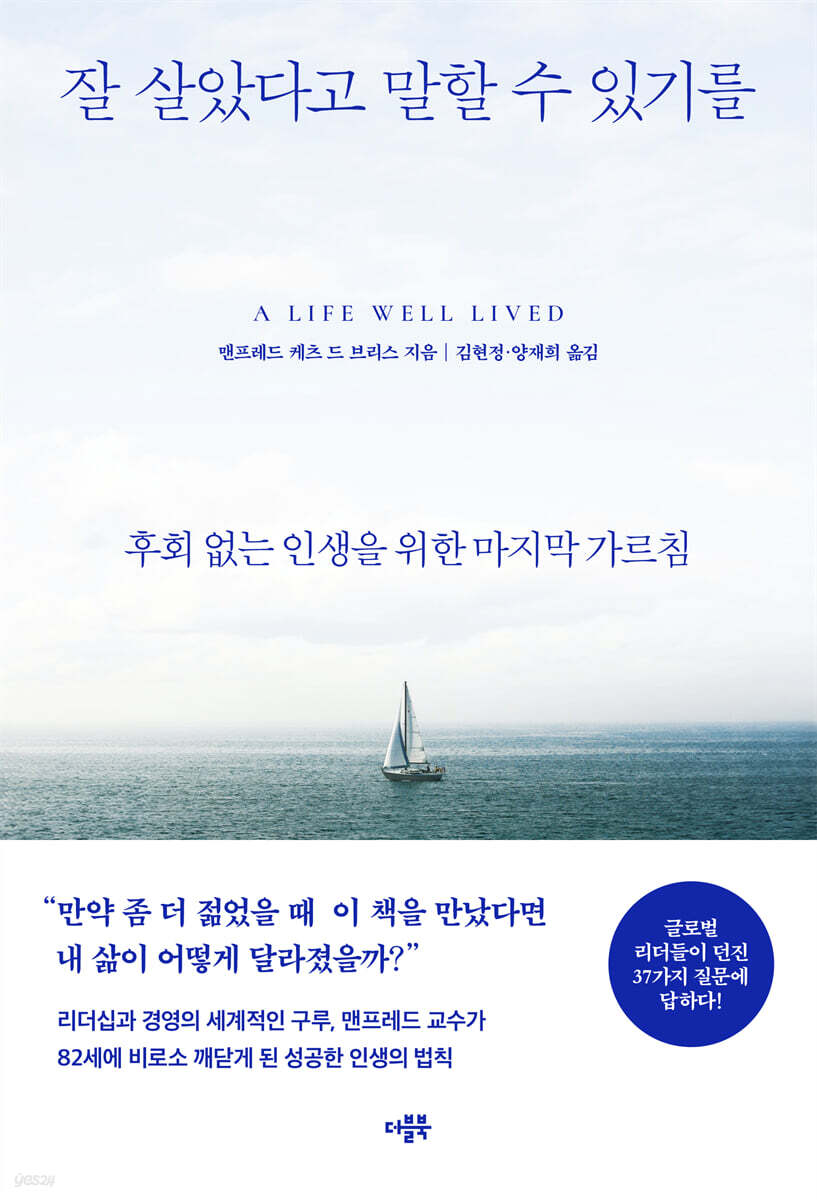
I hope I can say I lived well
 |
Description
Book Introduction
How can I live a life that I can say I have lived well? Manfred Ketz de Vries is a psychoanalyst, executive coach, consultant, management trainer, researcher, and author of numerous books. The author realized that no matter what role he played, the countless questions he received from people ultimately led back to the fundamental question: "How can I live a life without regrets?" "I Hope I Can Say I Lived Well" differs from the author's previous books. The point is that you can find answers to 37 of life's most curious questions as if you were reading a novel. The book begins with a traveler getting lost in Siberia. The traveler then meets the 'kabouter'. Kabuto is a mysterious being that all Dutch people know, and the author presents Kabuto as a wise man. From the beginning, the book tells stories to travelers and poses riddles and difficult questions, providing them with an opportunity to ask themselves and reflect on life and values. The author introduced a method in which his two 'selves' engage in a dialogue using the Socratic method of questioning and answering. The first self is an ordinary traveler lost in the Siberian forests, and the second self is Kabubu, a reflective avatar who helps the traveler. By observing this process, readers will gain the insights needed to live a life without regrets. |
- You can preview some of the book's contents.
Preview
index
introduction
Can you say you lived well?
First day
1.
If you feel lost
2.
How to open your heart
3.
imperfect logical thinking
4.
Listening and waiting for your turn to speak
5.
When you have to choose between falling and jumping
6.
Bad things are bound to happen
7.
Kindness is met with gratitude, complaints are met with dignity.
Second day
8.
The power of promises
9.
What is good enough?
10.
A virtuous person does not show off his virtue.
11.
Causes of stress, fatigue, anxiety, and depression
12.
About my selfishness
13.
What to do now for your mental health
14.
How to identify arrogant people
15.
How to spot a lie
16.
All About Backbiting
17.
If you want to find a real solution to the problem
18.
Positive self-fulfilling prophecies create better outcomes.
Fourth day
19.
Aren't you caught up in meaningless rituals?
20.
Managing anger well gives you energy.
21.
The basic principle of relationships: compromise
22.
How to cope with illness, anger, depression, and anxiety
23.
Dreams are an opportunity to gain insight into what you miss while awake.
24.
Connect with your inner self through fantasy
25.
The conviction that everything I do has a purpose
26.
Paradoxical intervention and strategic psychotherapy
27.
The most powerful weapon hidden by competent leaders
Fifth day
28.
Moments when you need encouragement
29.
To judge someone properly
30.
About sexual desire
31.
We are too often dragged around
32.
How to take proper care of myself
33.
An essential attitude in the workplace
34.
What to do if life feels listless right now
35.
Things Parents Can Do for Their Children
36.
The power to overcome dark times
37.
A person who can say that he lived well in his last moments
Can you say you lived well?
First day
1.
If you feel lost
2.
How to open your heart
3.
imperfect logical thinking
4.
Listening and waiting for your turn to speak
5.
When you have to choose between falling and jumping
6.
Bad things are bound to happen
7.
Kindness is met with gratitude, complaints are met with dignity.
Second day
8.
The power of promises
9.
What is good enough?
10.
A virtuous person does not show off his virtue.
11.
Causes of stress, fatigue, anxiety, and depression
12.
About my selfishness
13.
What to do now for your mental health
14.
How to identify arrogant people
15.
How to spot a lie
16.
All About Backbiting
17.
If you want to find a real solution to the problem
18.
Positive self-fulfilling prophecies create better outcomes.
Fourth day
19.
Aren't you caught up in meaningless rituals?
20.
Managing anger well gives you energy.
21.
The basic principle of relationships: compromise
22.
How to cope with illness, anger, depression, and anxiety
23.
Dreams are an opportunity to gain insight into what you miss while awake.
24.
Connect with your inner self through fantasy
25.
The conviction that everything I do has a purpose
26.
Paradoxical intervention and strategic psychotherapy
27.
The most powerful weapon hidden by competent leaders
Fifth day
28.
Moments when you need encouragement
29.
To judge someone properly
30.
About sexual desire
31.
We are too often dragged around
32.
How to take proper care of myself
33.
An essential attitude in the workplace
34.
What to do if life feels listless right now
35.
Things Parents Can Do for Their Children
36.
The power to overcome dark times
37.
A person who can say that he lived well in his last moments
Detailed image
Into the book
“It’s hard to learn anything if you believe you already know everything.”
Preconceptions and biases prevent us from noticing what is truly important.
It also makes it difficult to distinguish between truth and lies.
Simply put, you must first learn to open your heart before you open your mouth.
To learn something new, you have to forget what you've learned before.
“When you open your mind to new possibilities, you will probably be amazed at what you see.”
--- p.44
I suddenly wondered how often I had lived as a prisoner of my own concepts, reasoning, language, and logic.
How often have I focused on evaluations or judgments? It's not me who limits possibilities, but rather how I perceive myself.
--- p.54
As I've lived, I've come to believe that communication is essential to creating a stable relationship.
Lack of communication breeds anxiety, misunderstanding, distrust, and suspicion.
The way you communicate determines the quality of your life.
This is true not only in communicating with others, but also in communicating with oneself.
If you can communicate well with yourself, you are more likely to make wiser decisions.
--- p.59
As we live, there are times when we have to choose between 'falling' and 'jumping'.
When I jump, I have some control, but when I fall, I have no choice.
That is, consciousness can be overwhelmed by the power of the unconscious.
Topics that we try to ignore or hide eventually rear their heads.
Ignoring or hiding something is just a temporary way out, but it will eventually reveal itself.
--- p.69
To reach a higher level of self-awareness and self-understanding, you need to examine the scripts that play out in your inner theater to see if they contain lines that evoke negative emotions like, "I'm not good enough," "I'm not smart enough," "I can't do it," "I always mess up," and "This is too much for me."
--- p.73
“Of course, being an authentic person doesn’t mean you have to be perfect.
Don't try to be perfect.
If you pursue perfection, disaster will follow.
You have to accept that you are good enough, that is, you are still in an unfinished state.
We should see it as a process of change and growth.
“An authentic person is willing to say, ‘I was wrong,’ or ‘I don’t know.’”
--- p.102
Don't be distracted by the easy tasks right in front of you, but focus on the truly important tasks, even if they are difficult.
If you want to find a real solution to a problem, that is, if you want to find the best solution, you have to start where the answer is hidden.
If you only search under the streetlights, you will eventually get lost.
If you want to broaden your horizons of knowledge and ability with an open mind, you must be aware of and avoid the negative consequences of the "streetlight effect."
Never overlook what's hidden in the shadows.
--- p.173
“A positive attitude is beneficial for mental health.
So please, as often as possible, think optimistically and positively about yourself.
It's a good idea to start by carefully choosing the words you use on a daily basis.
For example, you should avoid using definitive expressions such as 'never,' 'always,' 'I can't,' or 'I don't want to.'
Surround yourself with people who believe in you and support you.
It's a good idea to distance yourself from people who have a negative influence on you.
--- p.184
“Anger is a universal emotion that everyone experiences.
It's one of the human conditions.
Everyone experiences extreme anger at least once in their life.
Anger is an emotion that makes you aware of the problems you are experiencing or the suffering you are harboring inside.
It motivates us to make changes, achieve our goals, and push us forward.”
--- p.201
“People who exhibit neurotic reactions often lack the coping skills to regulate their emotions and behaviors, making them unable to respond effectively to difficult situations.
They tend to get irritated easily, have difficulty tolerating frustration, overreact to stress, and exaggerate minor problems.
You may be easily hurt or offended, often anxious, and constantly worried.
And they are prone to self-doubt, excessive guilt or shame, and emotionally swayed.
Sometimes you may be overly self-conscious or self-critical.
--- p.223
I learned many valuable lessons from the conversations I had with Kabuto.
His insight allowed me to take a serious look at my life.
It felt like I had been given another chance to start life anew.
I also wondered how my life would have been different if I had met Kaboo when I was younger.
But now is the time to get away from all thoughts.
My mind's wanderings had to stop at this point, and I had to focus on the rugged terrain that was unfolding before my eyes.
Preconceptions and biases prevent us from noticing what is truly important.
It also makes it difficult to distinguish between truth and lies.
Simply put, you must first learn to open your heart before you open your mouth.
To learn something new, you have to forget what you've learned before.
“When you open your mind to new possibilities, you will probably be amazed at what you see.”
--- p.44
I suddenly wondered how often I had lived as a prisoner of my own concepts, reasoning, language, and logic.
How often have I focused on evaluations or judgments? It's not me who limits possibilities, but rather how I perceive myself.
--- p.54
As I've lived, I've come to believe that communication is essential to creating a stable relationship.
Lack of communication breeds anxiety, misunderstanding, distrust, and suspicion.
The way you communicate determines the quality of your life.
This is true not only in communicating with others, but also in communicating with oneself.
If you can communicate well with yourself, you are more likely to make wiser decisions.
--- p.59
As we live, there are times when we have to choose between 'falling' and 'jumping'.
When I jump, I have some control, but when I fall, I have no choice.
That is, consciousness can be overwhelmed by the power of the unconscious.
Topics that we try to ignore or hide eventually rear their heads.
Ignoring or hiding something is just a temporary way out, but it will eventually reveal itself.
--- p.69
To reach a higher level of self-awareness and self-understanding, you need to examine the scripts that play out in your inner theater to see if they contain lines that evoke negative emotions like, "I'm not good enough," "I'm not smart enough," "I can't do it," "I always mess up," and "This is too much for me."
--- p.73
“Of course, being an authentic person doesn’t mean you have to be perfect.
Don't try to be perfect.
If you pursue perfection, disaster will follow.
You have to accept that you are good enough, that is, you are still in an unfinished state.
We should see it as a process of change and growth.
“An authentic person is willing to say, ‘I was wrong,’ or ‘I don’t know.’”
--- p.102
Don't be distracted by the easy tasks right in front of you, but focus on the truly important tasks, even if they are difficult.
If you want to find a real solution to a problem, that is, if you want to find the best solution, you have to start where the answer is hidden.
If you only search under the streetlights, you will eventually get lost.
If you want to broaden your horizons of knowledge and ability with an open mind, you must be aware of and avoid the negative consequences of the "streetlight effect."
Never overlook what's hidden in the shadows.
--- p.173
“A positive attitude is beneficial for mental health.
So please, as often as possible, think optimistically and positively about yourself.
It's a good idea to start by carefully choosing the words you use on a daily basis.
For example, you should avoid using definitive expressions such as 'never,' 'always,' 'I can't,' or 'I don't want to.'
Surround yourself with people who believe in you and support you.
It's a good idea to distance yourself from people who have a negative influence on you.
--- p.184
“Anger is a universal emotion that everyone experiences.
It's one of the human conditions.
Everyone experiences extreme anger at least once in their life.
Anger is an emotion that makes you aware of the problems you are experiencing or the suffering you are harboring inside.
It motivates us to make changes, achieve our goals, and push us forward.”
--- p.201
“People who exhibit neurotic reactions often lack the coping skills to regulate their emotions and behaviors, making them unable to respond effectively to difficult situations.
They tend to get irritated easily, have difficulty tolerating frustration, overreact to stress, and exaggerate minor problems.
You may be easily hurt or offended, often anxious, and constantly worried.
And they are prone to self-doubt, excessive guilt or shame, and emotionally swayed.
Sometimes you may be overly self-conscious or self-critical.
--- p.223
I learned many valuable lessons from the conversations I had with Kabuto.
His insight allowed me to take a serious look at my life.
It felt like I had been given another chance to start life anew.
I also wondered how my life would have been different if I had met Kaboo when I was younger.
But now is the time to get away from all thoughts.
My mind's wanderings had to stop at this point, and I had to focus on the rugged terrain that was unfolding before my eyes.
--- p.347
Publisher's Review
“If I had come across this book when I was younger,
How would my life have been different?
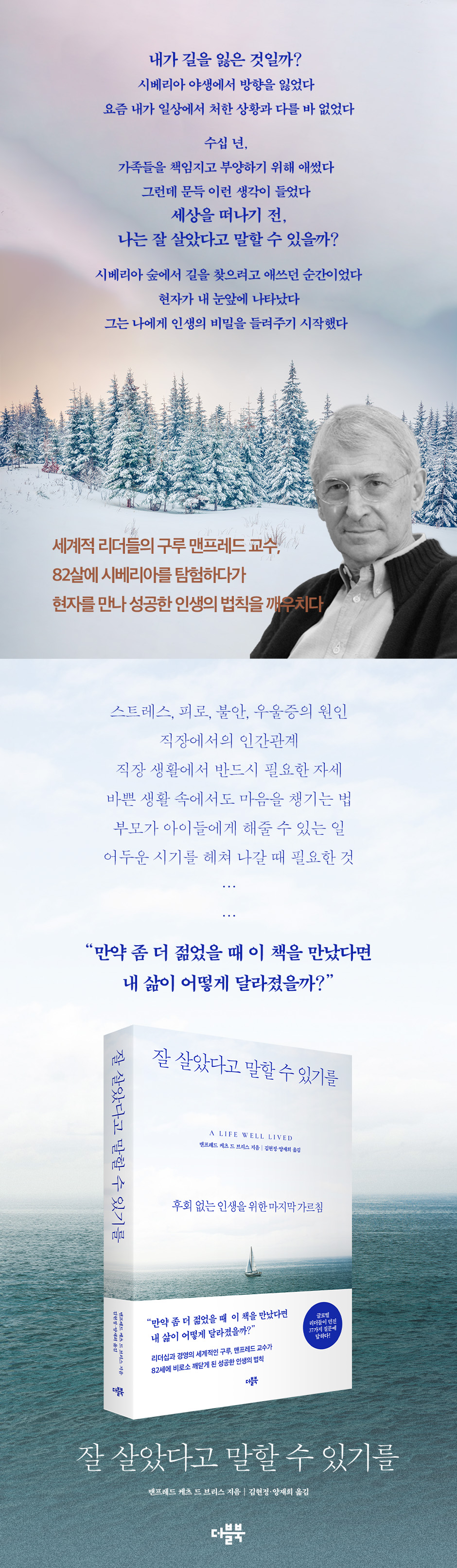
The author is a psychoanalyst, executive coach, management education expert, and researcher, and is considered a guru for leaders.
Every time the author gives a lecture, he receives numerous questions.
These are the questions asked by CEOs, executives, and leaders of global companies.
Those questions were closely related to unusual experiences or fundamental life problems that we all experience at least once in our lives.
The author realized that all these questions ultimately boil down to one fundamental question: "How can I live a life without regrets?"
The author wrote this book to answer that question.
The author believed that nothing was more effective in answering that question than a 'story'.
Because life itself is a collection of stories, and humans create memories and gain enlightenment through stories.
Through stories, humans understand seemingly insurmountable difficulties and make sense of puzzling dilemmas.
This is what makes this book different from the author's previous books.
"I hope I can say I lived well" is composed of a conversation between a traveler (the naive me) wandering through Siberia and Kabu (the reflective me).
In this book, 'Innocent Me' is set up as lost (in many ways) in the Siberian wilds, and from the beginning, he tells the traveler several stories, introducing one by one the important themes in human life.
In this book, the author tells stories on various topics necessary to answer the question of what it means to live a life without regrets.
It emphasized the importance of harmony between oneself and others, the need to build close relationships, and the challenge of taking on tasks beyond one's capabilities.
Living a meaningful life means realizing what keeps you alive, understanding your capabilities, and knowing how to make the right choices.
The author also highlighted the importance of commitment to one's career, family and friends, philosophy and ideology, and community.
The author says, “I hope that through this book, readers will be able to understand the important values of life more clearly.”
By observing the conversation between the traveler and the car, it helps them reflect on the difficulties they have faced in the past, present, or will face in the future.
'I' and 'the wise man', through the Socratic method of questioning
Answering the question of what a life without regrets is!
Living a busy life, I feel lost and explore the wilds of Siberia to find time to reflect on myself.
As you wander through the Siberian wilderness without any signs, a wise man named Kaboo appears.
'I' spends five days with Kabu, and as I listen to his stories about what is most necessary in life, I grow little by little.
In fact, when everything is going well, it often feels like each day is flowing smoothly, full of meaning and vitality.
But when things seem to be going wrong, it's time to pause and reflect on ourselves, asking ourselves if we're truly living the life we want. This book is filled with helpful content that will help you pause and reflect.
From 'I' and 'Ka', we exchange stories through the Socratic method of questioning and answering.
This method, used by the Greek philosopher Socrates, is a dialogue method that helps teachers and students explore each other's beliefs, values, and hypotheses through conversation without set answers.
Socrates constantly asked questions to encourage his students to think critically and develop their own perspectives.
From the beginning, he tells me old stories and fables.
'I' reflect to find the hidden meaning in the story.
For example, from the beginning, Kabu tells this story.
There were two geese and a turtle living in a small pond.
As the pond grew smaller due to the lack of rain, the geese decided to leave for a better place to live.
The goose suggested to the turtle that they go together.
However, I had to keep my mouth shut while we were going together.
The geese held a branch in their beaks and asked the turtle to put his mouth in the middle of the branch.
As the turtle bit the branch, the geese flew into the sky.
But when the children saw this and laughed at it, the turtle retorted, “You’re the ones who are funny!” and at the same time, he lost his grip on the branch and fell from the sky to his death.
When I hear this story, I think about the times when I should be careful with my words.
I've come to realize that speaking too much can hinder effective communication and prevent listening.
Also, as I reflect on the great difference between listening and waiting my turn to speak, I am reminded that patience is the cornerstone of wisdom.
From the beginning, through stories, the teaching was to speak less and listen more.
Kabuto and 'I' exchange 37 stories like this over the course of five days.
The conversation with Kabuto covers a variety of topics necessary to answer the question of what it means to live a life without regrets.
On life's journey
A book to read when you feel lost
From then on, he watched me leave, showing me the way back to civilization.
How should I say goodbye to this special being who, in just five days, had come to know me better than I knew myself? What kind of greeting would be appropriate? I walked a few steps and turned around, but Kabubu had already vanished.
_Page 346
The 'I' who appears in this book is an ordinary father living in modern society.
I work to support my family and try to find some time for myself, but even that isn't easy.
Because I lose track of even my time alone while thinking about work and family.
No matter how old you get, human relationships are difficult, and in work life, difficult days come in different forms every day.
I've just been working hard, but it feels like people are gossiping about me here and there, and even though I've gained some material freedom, the quality of my life seems to have declined.
In fact, if you look back on your life, you may be filled with regrets or despair over a life that did not live up to your expectations.
However, Kabu, who appears as a wise man, says that there are ways to overcome these emotions, and he imparts that wisdom through 'questions' and 'stories'.
The lost traveler in the book, 'I', speaks.
“The conversation I had with Kabuto had a profound impact on me.
It allowed me to look at life from a different angle.
From the beginning, it was clear that a worthwhile life is one in which new challenges continue to arise.
“I thought again about how lucky I was to meet him.”
I recommend this book to anyone who feels lost for a moment.
If you suffer from stress, fatigue, sleeplessness due to anxiety, or struggle with interpersonal relationships, you can find the cause in this book.
This book also provides solutions to problems that may prevent you from achieving results.
This book is a profound and clear answer to questions posed to world leaders by an 82-year-old scholar.
How would my life have been different?
The author is a psychoanalyst, executive coach, management education expert, and researcher, and is considered a guru for leaders.
Every time the author gives a lecture, he receives numerous questions.
These are the questions asked by CEOs, executives, and leaders of global companies.
Those questions were closely related to unusual experiences or fundamental life problems that we all experience at least once in our lives.
The author realized that all these questions ultimately boil down to one fundamental question: "How can I live a life without regrets?"
The author wrote this book to answer that question.
The author believed that nothing was more effective in answering that question than a 'story'.
Because life itself is a collection of stories, and humans create memories and gain enlightenment through stories.
Through stories, humans understand seemingly insurmountable difficulties and make sense of puzzling dilemmas.
This is what makes this book different from the author's previous books.
"I hope I can say I lived well" is composed of a conversation between a traveler (the naive me) wandering through Siberia and Kabu (the reflective me).
In this book, 'Innocent Me' is set up as lost (in many ways) in the Siberian wilds, and from the beginning, he tells the traveler several stories, introducing one by one the important themes in human life.
In this book, the author tells stories on various topics necessary to answer the question of what it means to live a life without regrets.
It emphasized the importance of harmony between oneself and others, the need to build close relationships, and the challenge of taking on tasks beyond one's capabilities.
Living a meaningful life means realizing what keeps you alive, understanding your capabilities, and knowing how to make the right choices.
The author also highlighted the importance of commitment to one's career, family and friends, philosophy and ideology, and community.
The author says, “I hope that through this book, readers will be able to understand the important values of life more clearly.”
By observing the conversation between the traveler and the car, it helps them reflect on the difficulties they have faced in the past, present, or will face in the future.
'I' and 'the wise man', through the Socratic method of questioning
Answering the question of what a life without regrets is!
Living a busy life, I feel lost and explore the wilds of Siberia to find time to reflect on myself.
As you wander through the Siberian wilderness without any signs, a wise man named Kaboo appears.
'I' spends five days with Kabu, and as I listen to his stories about what is most necessary in life, I grow little by little.
In fact, when everything is going well, it often feels like each day is flowing smoothly, full of meaning and vitality.
But when things seem to be going wrong, it's time to pause and reflect on ourselves, asking ourselves if we're truly living the life we want. This book is filled with helpful content that will help you pause and reflect.
From 'I' and 'Ka', we exchange stories through the Socratic method of questioning and answering.
This method, used by the Greek philosopher Socrates, is a dialogue method that helps teachers and students explore each other's beliefs, values, and hypotheses through conversation without set answers.
Socrates constantly asked questions to encourage his students to think critically and develop their own perspectives.
From the beginning, he tells me old stories and fables.
'I' reflect to find the hidden meaning in the story.
For example, from the beginning, Kabu tells this story.
There were two geese and a turtle living in a small pond.
As the pond grew smaller due to the lack of rain, the geese decided to leave for a better place to live.
The goose suggested to the turtle that they go together.
However, I had to keep my mouth shut while we were going together.
The geese held a branch in their beaks and asked the turtle to put his mouth in the middle of the branch.
As the turtle bit the branch, the geese flew into the sky.
But when the children saw this and laughed at it, the turtle retorted, “You’re the ones who are funny!” and at the same time, he lost his grip on the branch and fell from the sky to his death.
When I hear this story, I think about the times when I should be careful with my words.
I've come to realize that speaking too much can hinder effective communication and prevent listening.
Also, as I reflect on the great difference between listening and waiting my turn to speak, I am reminded that patience is the cornerstone of wisdom.
From the beginning, through stories, the teaching was to speak less and listen more.
Kabuto and 'I' exchange 37 stories like this over the course of five days.
The conversation with Kabuto covers a variety of topics necessary to answer the question of what it means to live a life without regrets.
On life's journey
A book to read when you feel lost
From then on, he watched me leave, showing me the way back to civilization.
How should I say goodbye to this special being who, in just five days, had come to know me better than I knew myself? What kind of greeting would be appropriate? I walked a few steps and turned around, but Kabubu had already vanished.
_Page 346
The 'I' who appears in this book is an ordinary father living in modern society.
I work to support my family and try to find some time for myself, but even that isn't easy.
Because I lose track of even my time alone while thinking about work and family.
No matter how old you get, human relationships are difficult, and in work life, difficult days come in different forms every day.
I've just been working hard, but it feels like people are gossiping about me here and there, and even though I've gained some material freedom, the quality of my life seems to have declined.
In fact, if you look back on your life, you may be filled with regrets or despair over a life that did not live up to your expectations.
However, Kabu, who appears as a wise man, says that there are ways to overcome these emotions, and he imparts that wisdom through 'questions' and 'stories'.
The lost traveler in the book, 'I', speaks.
“The conversation I had with Kabuto had a profound impact on me.
It allowed me to look at life from a different angle.
From the beginning, it was clear that a worthwhile life is one in which new challenges continue to arise.
“I thought again about how lucky I was to meet him.”
I recommend this book to anyone who feels lost for a moment.
If you suffer from stress, fatigue, sleeplessness due to anxiety, or struggle with interpersonal relationships, you can find the cause in this book.
This book also provides solutions to problems that may prevent you from achieving results.
This book is a profound and clear answer to questions posed to world leaders by an 82-year-old scholar.
GOODS SPECIFICS
- Date of issue: December 10, 2024
- Page count, weight, size: 352 pages | 472g | 143*210*22mm
- ISBN13: 9791193153482
You may also like
카테고리
korean


korean

![ELLE 엘르 스페셜 에디션 A형 : 12월 [2025]](http://librairie.coreenne.fr/cdn/shop/files/b8e27a3de6c9538896439686c6b0e8fb.jpg?v=1766436872&width=3840)


