

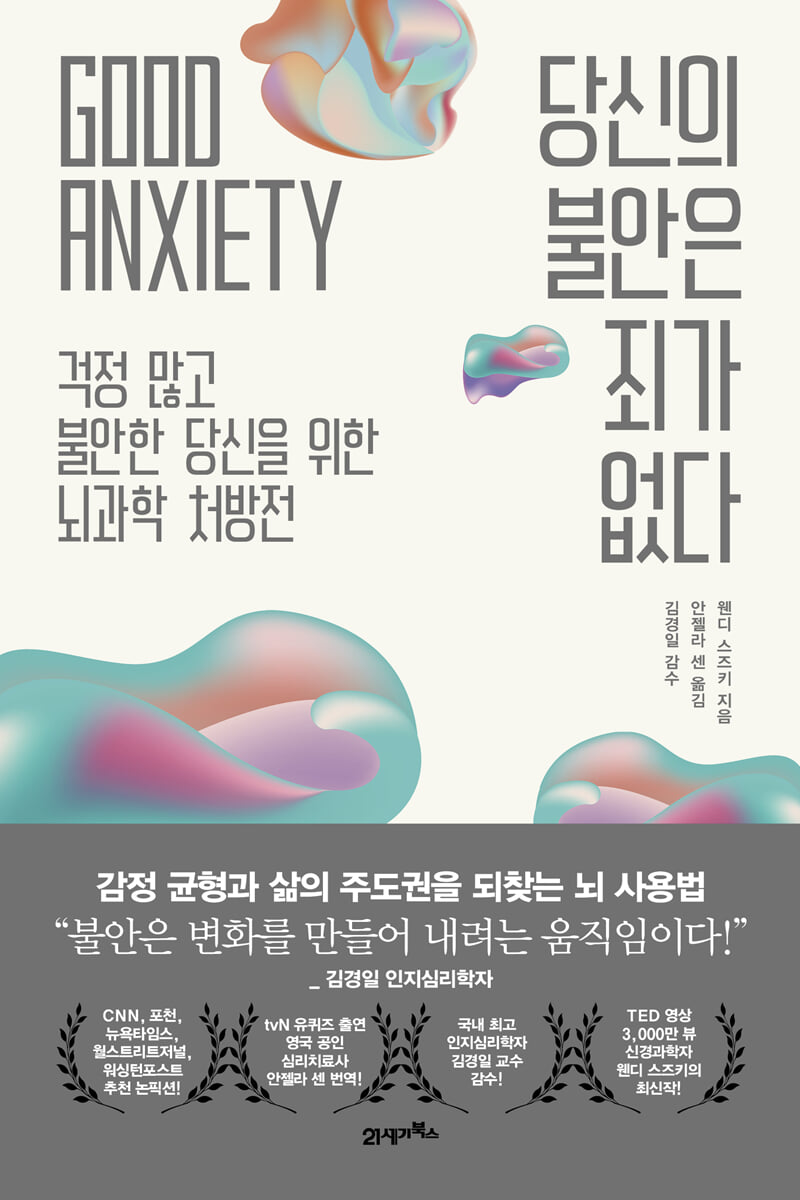
Your anxiety is innocent
 |
Description
Book Introduction
★ Nonfiction recommended by CNN, Fortune, The New York Times, The Wall Street Journal, and The Washington Post! ★ Translated by Angela Sen, a British licensed psychotherapist who appeared on tvN's "You Quiz on the Block"! ★ Highly recommended by cognitive psychologist Professor Kim Kyung-il! ★ TED video with 30 million views: The latest work by neuroscientist Wendy Suzuki! In this age of anxiety, is anxiety really such a bad thing? World-renowned neuroscientist Wendy Suzuki says that anxiety can help us grow once more! A book that helps us see anxiety as a 'positive' driving force in life, rather than a 'negative' thing that interferes with life, has been published by 21st Century Books. In her latest book, "Your Anxiety is Not Guilty," world-renowned neuroscientist Wendy Suzuki completely dispels misconceptions about anxiety through her own experience with anxiety and neuroscientific evidence. It literally allows you to 'rediscover' anxiety. We live in an age of anxiety. From global pandemics to economic collapses to everyday stresses, our lives are filled with reasons to feel anxious. Moreover, news and social media constantly bombard us with content 24/7, fanning anxiety. Hundreds of millions of people around the world suffer from mild anxiety. It is said that 90% of the world's population feels anxious in their daily lives and is affected by it. These everyday anxieties remain unresolved and hinder our will to live actively. The author argues that anxiety is an unavoidable part of life, and that none of us are immune to it. So, is anxiety inevitable? The author argues that viewing anxiety from a perspective other than "mind" can transform your life. It is through the ‘brain’. The author presents specific ways to deal with anxiety, including how to become a better person through the six gifts anxiety gives, and how to use anxiety effectively to protect yourself, along with a case study of how he changed his relationship with anxiety from the perspective of the 'brain'. |
- You can preview some of the book's contents.
Preview
index
A Review | How You Deal with Anxiety Determines Your Happiness
Translator's Note | Anxiety is a Signal from Your Heart
Prologue | Why I, a Neuroscientist, Focused on Anxiety
Self-Assessment Test 1 | How Anxious Am I?
Watch Part 1: Anxiety Again
Chapter 1: Rediscovering Anxiety
Anxiety is just a reaction created by the brain.
What the primitive brain does in our heads
The road to bad anxiety
Is it everyday anxiety or an anxiety disorder?
To avoid being ruled by anxiety
Chapter 2: Bad Anxiety and Good Anxiety
The brain changes: the hope of neuroplasticity
Why Negative Emotions Last Longer
Four Ways to Manage Anxiety
Chapter 3: Anxiety is Not a Sin
What we do when we're anxious
Two ways to deal with emotions
If bad anxiety is driving you
Part 2: Six Gifts of Anxiety Revealed by Brain Science
Chapter 4 The Gift of Anxiety 1.
resilience
The moment when resilience grows
Stress is essential for resilience
Does your stress response change your brain structure?
Preventing future anxiety with present anxiety
Characteristics of People with Strong Resilience
Overcoming the pain of loss through anxiety
Chapter 5 The Gift of Anxiety 2.
immersive experience
The 10,000-hour rule is nonsense
My abilities are nurtured by anxiety.
Good anxiety created by stimulation
If you don't want anxiety to become a hindrance,
Now is the time to show off your skills with anxiety
Dopanmin's Pangpang, a small tip for immersion
Take advantage of the tension and challenge yourself!
Chapter 6 The Gift of Anxiety 3.
Activist Mindset
Who sets your limits?
A new mindset gained thanks to anxiety
Attitude changes behavior
Imagine the worst-case scenario
Acknowledge and believe in your own changes
Don't press the mute button on your own problems.
Failure is an opportunity to learn
Anxiety is a sweet tip about my situation.
Chapter 7 The Gift of Anxiety 4.
concentration
Good anxiety that improves concentration
Executive functions that regulate anxiety
Multitasking destroys attention.
Hormones are the problem?
Meditation to heal scattered attention
The Impact of Just 10 Minutes of Exercise on Anxiety
Tetris helps
How to Use a Worry List
Good anxiety leads to productivity.
Chapter 8 The Gift of Anxiety 5.
Sociality
True bonds are a defense against bad anxiety.
How the Social Brain Works
The love hormone that blocks anxiety
The power of empathy and compassion learned through good anxiety
The courage that comes from interest
Anyone can transform anxiety into compassion.
Chapter 9 The Gift of Anxiety 6.
creativity
Anxiety is the fuel of creativity
The power of creativity as a source of change and healing
Creative traits are optional
Creativity is the product of an effort to process emotions.
The Three Neural Networks Where Creativity Happens
Two Types of Creative Thinking
The moment when anxiety turns into inspiration
Pain is a pathway to creativity
Part 3: Building a Different Relationship with Anxiety
Chapter 10: Becoming Friends with Anxiety
Anxiety is a good friend
Self-Assessment Test 2 | How do you feel when you're anxious?
Self-Diagnosis Test 3 | What Triggers Your Anxiety?
Find your own way to calm your mind
Allow yourself to feel uncomfortable
Chapter 11: Turning Anxiety to Your Advantage
What are your strategies for regulating your emotions?
How to Use Tools to Manage Anxiety
Chapter 12: How to Use Anxiety to Protect Myself
Five Ways to Build Resilience
Creating small moments of immersion
Accelerate with an Activist Mindset
How to Change Negative Self-Talk
Focus your brain on the present moment
Creativity comes with practice.
Developing Social Muscles
Epilogue | Anxiety Can Be a Strength, Not a Curse
Acknowledgements
References
Translator's Note | Anxiety is a Signal from Your Heart
Prologue | Why I, a Neuroscientist, Focused on Anxiety
Self-Assessment Test 1 | How Anxious Am I?
Watch Part 1: Anxiety Again
Chapter 1: Rediscovering Anxiety
Anxiety is just a reaction created by the brain.
What the primitive brain does in our heads
The road to bad anxiety
Is it everyday anxiety or an anxiety disorder?
To avoid being ruled by anxiety
Chapter 2: Bad Anxiety and Good Anxiety
The brain changes: the hope of neuroplasticity
Why Negative Emotions Last Longer
Four Ways to Manage Anxiety
Chapter 3: Anxiety is Not a Sin
What we do when we're anxious
Two ways to deal with emotions
If bad anxiety is driving you
Part 2: Six Gifts of Anxiety Revealed by Brain Science
Chapter 4 The Gift of Anxiety 1.
resilience
The moment when resilience grows
Stress is essential for resilience
Does your stress response change your brain structure?
Preventing future anxiety with present anxiety
Characteristics of People with Strong Resilience
Overcoming the pain of loss through anxiety
Chapter 5 The Gift of Anxiety 2.
immersive experience
The 10,000-hour rule is nonsense
My abilities are nurtured by anxiety.
Good anxiety created by stimulation
If you don't want anxiety to become a hindrance,
Now is the time to show off your skills with anxiety
Dopanmin's Pangpang, a small tip for immersion
Take advantage of the tension and challenge yourself!
Chapter 6 The Gift of Anxiety 3.
Activist Mindset
Who sets your limits?
A new mindset gained thanks to anxiety
Attitude changes behavior
Imagine the worst-case scenario
Acknowledge and believe in your own changes
Don't press the mute button on your own problems.
Failure is an opportunity to learn
Anxiety is a sweet tip about my situation.
Chapter 7 The Gift of Anxiety 4.
concentration
Good anxiety that improves concentration
Executive functions that regulate anxiety
Multitasking destroys attention.
Hormones are the problem?
Meditation to heal scattered attention
The Impact of Just 10 Minutes of Exercise on Anxiety
Tetris helps
How to Use a Worry List
Good anxiety leads to productivity.
Chapter 8 The Gift of Anxiety 5.
Sociality
True bonds are a defense against bad anxiety.
How the Social Brain Works
The love hormone that blocks anxiety
The power of empathy and compassion learned through good anxiety
The courage that comes from interest
Anyone can transform anxiety into compassion.
Chapter 9 The Gift of Anxiety 6.
creativity
Anxiety is the fuel of creativity
The power of creativity as a source of change and healing
Creative traits are optional
Creativity is the product of an effort to process emotions.
The Three Neural Networks Where Creativity Happens
Two Types of Creative Thinking
The moment when anxiety turns into inspiration
Pain is a pathway to creativity
Part 3: Building a Different Relationship with Anxiety
Chapter 10: Becoming Friends with Anxiety
Anxiety is a good friend
Self-Assessment Test 2 | How do you feel when you're anxious?
Self-Diagnosis Test 3 | What Triggers Your Anxiety?
Find your own way to calm your mind
Allow yourself to feel uncomfortable
Chapter 11: Turning Anxiety to Your Advantage
What are your strategies for regulating your emotions?
How to Use Tools to Manage Anxiety
Chapter 12: How to Use Anxiety to Protect Myself
Five Ways to Build Resilience
Creating small moments of immersion
Accelerate with an Activist Mindset
How to Change Negative Self-Talk
Focus your brain on the present moment
Creativity comes with practice.
Developing Social Muscles
Epilogue | Anxiety Can Be a Strength, Not a Curse
Acknowledgements
References
Detailed image

Into the book
Although it may be called by different names, anxiety is a physical and psychological response to stress.
The problem is that our bodies can't tell whether the stress is caused by a real situation or by an imagination or hypothesis we've created in our heads.
But understanding the neurobiological aspects of anxiety and how your brain and body actually react can help you regulate and manage these emotions.
Then, it is possible to positively increase the energy of anxiety.
--- From "Chapter 1: Rediscovering Anxiety"
Essentially, anxiety may begin as a signal that draws attention to avoid danger, but it doesn't necessarily cause discomfort or distraction or disrupt the well-being and balance we naturally strive for.
We can use our cognitive abilities to reinterpret situations as challenges rather than as dangers, allowing us to overcome challenges and use them as opportunities for new learning.
We have several options for managing our anxiety (or emotions) and, if possible, our responses themselves, as well as for paying attention to emotional cues.
Our brains are truly amazing!
--- From "Chapter 2: Bad Anxiety and Good Anxiety"
It is important to be aware of how we react to stress and anxiety.
If you find yourself using more than two or three negative coping strategies, this could be an indicator that you are experiencing severe anxiety.
On the other hand, using positive coping strategies indicates that you have a tolerance for stress and flexibility with your emotions.
--- From "Chapter 3: Anxiety is Not a Sin"
The good news here is that while we can't completely avoid the big and small stressors we face in life, we can build resilience.
We build resilience by learning to think flexibly and accepting that our very existence is not defined by failure.
You can also build resilience by pursuing things that bring you joy or pleasure, from food to sports to sex.
Yes, that's right.
Having fun helps build resilience!
--- From "Chapter 4: The Gift of Anxiety"
I closely observed my reactions to new stimuli and tracked the results.
I generated and collected my own data in real time.
What I witnessed was an undeniable change.
Yes, that's right.
I was able to lose weight.
Yes, that's right.
My body felt more energetic and positive.
Yes, that's right.
I was able to concentrate more calmly.
I started sleeping better, taking breaks, and not working all the time.
But the most important change I experienced then was a fundamental shift in my emotional state and attitude towards life.
--- From "Chapter 6: The Gift of Anxiety"
Empathy is great, but there's something even more amazing than that.
It's compassion.
In a sense, compassion is one of anxiety's simplest superpowers.
Having compassion for someone who personally causes you anxiety actually reduces anxiety in both yourself and others.
--- From "Chapter 8: The Gift of Anxiety"
We can use pain to create new, useful, and life-changing things.
It's up to us.
But the process itself is ultimately cathartic, taking us beyond ourselves and contributing to the world.
The problem is that our bodies can't tell whether the stress is caused by a real situation or by an imagination or hypothesis we've created in our heads.
But understanding the neurobiological aspects of anxiety and how your brain and body actually react can help you regulate and manage these emotions.
Then, it is possible to positively increase the energy of anxiety.
--- From "Chapter 1: Rediscovering Anxiety"
Essentially, anxiety may begin as a signal that draws attention to avoid danger, but it doesn't necessarily cause discomfort or distraction or disrupt the well-being and balance we naturally strive for.
We can use our cognitive abilities to reinterpret situations as challenges rather than as dangers, allowing us to overcome challenges and use them as opportunities for new learning.
We have several options for managing our anxiety (or emotions) and, if possible, our responses themselves, as well as for paying attention to emotional cues.
Our brains are truly amazing!
--- From "Chapter 2: Bad Anxiety and Good Anxiety"
It is important to be aware of how we react to stress and anxiety.
If you find yourself using more than two or three negative coping strategies, this could be an indicator that you are experiencing severe anxiety.
On the other hand, using positive coping strategies indicates that you have a tolerance for stress and flexibility with your emotions.
--- From "Chapter 3: Anxiety is Not a Sin"
The good news here is that while we can't completely avoid the big and small stressors we face in life, we can build resilience.
We build resilience by learning to think flexibly and accepting that our very existence is not defined by failure.
You can also build resilience by pursuing things that bring you joy or pleasure, from food to sports to sex.
Yes, that's right.
Having fun helps build resilience!
--- From "Chapter 4: The Gift of Anxiety"
I closely observed my reactions to new stimuli and tracked the results.
I generated and collected my own data in real time.
What I witnessed was an undeniable change.
Yes, that's right.
I was able to lose weight.
Yes, that's right.
My body felt more energetic and positive.
Yes, that's right.
I was able to concentrate more calmly.
I started sleeping better, taking breaks, and not working all the time.
But the most important change I experienced then was a fundamental shift in my emotional state and attitude towards life.
--- From "Chapter 6: The Gift of Anxiety"
Empathy is great, but there's something even more amazing than that.
It's compassion.
In a sense, compassion is one of anxiety's simplest superpowers.
Having compassion for someone who personally causes you anxiety actually reduces anxiety in both yourself and others.
--- From "Chapter 8: The Gift of Anxiety"
We can use pain to create new, useful, and life-changing things.
It's up to us.
But the process itself is ultimately cathartic, taking us beyond ourselves and contributing to the world.
--- From "Chapter 9: The Gift of Anxiety"
Publisher's Review
Anyone can turn bad anxiety into good anxiety!
Top Neuroscientists Share Tips for Managing Anxiety You Can Try Right Now
Until now, we have viewed anxiety largely negatively.
And I thought anxiety was uncontrollable because it was such a negative and uncomfortable emotion.
But Wendy Suzuki, the author of this book, says that if we understand the neurobiological processes behind anxiety more objectively and accurately, we can look at anxiety in a different light.
Of course, it is fundamentally not easy to take control of the reaction patterns that we unconsciously think, feel, and act in.
However, our brains are capable of sufficient change because they have the ability to adapt to their surroundings.
In this book, readers will learn how to cope with and manage anxiety, worry, and all kinds of uncomfortable emotions, how to endure everyday challenges by moving toward a point of balance called homeostasis, and how to actively use neurobiological knowledge to form new neural pathways and change patterns of thought, emotion, and behavior to transform their lives.
You'll also measure your level of anxiety through a simple "self-diagnosis test" in the introduction and the latter half, and by identifying specific triggers that trigger your anxiety, you'll discover your own way to calm your mind.
By practicing these specific activities one by one, you will be able to live a strong and happy life through your own way of using anxiety.
Knowing how your brain works can help you manage anxiety.
Bad Anxiety vs. Good Anxiety, Take Control of Your Anxiety!
When the author was in his forties, he was experiencing what is commonly called a midlife crisis and was deeply dissatisfied with his life.
That's when I decided to use myself as a neuroscientist.
And through therapeutic interventions for the body and mind, such as exercise, balanced nutrition, and meditation, I have personally experienced hope in life by actually changing my brain.
After changing her lifestyle, the author experienced remarkable improvements in her mental health and well-being, as well as notable improvements in her productivity, memory, and concentration.
Research has shown that when anxiety is addressed with positive responses like exercise, a healthy diet, or meditation, the brain-body system undergoes a process of adjustment, rebalancing the neural circuits associated with anxiety and leading to positive emotional changes.
The author argues that anxiety is not inherently bad because it has led her to change her lifestyle through the signals it gives her.
The author further states that if we learn to understand our emotions, thoughts, and behaviors, we can transform bad anxiety, which causes negative emotions like nervousness and fear, into good anxiety, which creates positive mindsets like courage and inspiration.
In other words, anxiety depends on how we interpret and manage external stressors.
And the fact that anxiety changes based on how we respond means that we can take control of it.
In this way, the author explains, in an easy-to-understand scientific way, how the brain, and thus the body and mind, work due to anxiety.
Only when we truly understand anxiety can we stop fighting it.
Anxiety is not a curse, it's a strength!
Six Gifts of Anxiety That Will Give You a Positive Mindset
The author goes further to say that anxiety can be transformed into important information that benefits us.
We have the inner power to determine and change not only ourselves but also how we interact with others, our thoughts, feelings, and actions.
By using strategies to modulate the neural circuits of anxiety, you can take the first step toward awakening your brain and body on a deeper, more meaningful level and take control of your anxiety.
Anxiety then becomes a powerful tool that moves our brain and body, influencing many areas of our lives.
Among them, the author presents six gifts that anxiety gives.
Anxiety builds resilience, which allows us to adapt and recover from trials, and motivates us, enabling us to engage.
Anxiety also helps us develop an "activist mindset," which allows us to face problems and overcome them to grow, and it improves our "concentration" and "social skills," which enhances our work abilities and fosters "creativity."
In this way, anxiety will guide us from a mediocre life to a more fulfilling life with higher goals, and from an ordinary life to an extraordinary life.
A Neuroscientist's Prescription for Anxiety
A book I would like to gift to everyone who lives with anxiety!
This book is divided into three parts.
Part 1 defines anxiety and explains that it is an inevitable emotion designed for survival.
And he explains that our brains have the neuroplasticity to reappraise anxiety, which allows us to change how we think about it.
Through a shift in thinking, we will establish different positive and negative coping strategies for anxiety, and examine the results resulting from the differences in each strategy through case studies.
Part 2 focuses on leveraging the six gifts anxiety gives you to your advantage in life.
Specifically, anxiety fosters resilience to recover from hardship, concentration to immerse oneself in work, an activist mindset to face and actively deal with anxiety, social skills through empathy and compassion, and fuels creativity.
In Part 3, we'll take a simple self-assessment test to help you recognize your current anxiety and determine if you're ready to deal with uncomfortable feelings.
And it offers concrete, practical ways to use anxiety to transform your life.
For those of us trying to navigate a world where worries are bound to increase, Dr. Suzuki offers a welcome roadmap.
- The Wall Street Journal
This book includes self-assessment tests and strategies to help people assess their anxiety and even become friends with it.
A powerful reminder that people can change their reactions to inevitable anxiety and stress! - The Washington Post
Top Neuroscientists Share Tips for Managing Anxiety You Can Try Right Now
Until now, we have viewed anxiety largely negatively.
And I thought anxiety was uncontrollable because it was such a negative and uncomfortable emotion.
But Wendy Suzuki, the author of this book, says that if we understand the neurobiological processes behind anxiety more objectively and accurately, we can look at anxiety in a different light.
Of course, it is fundamentally not easy to take control of the reaction patterns that we unconsciously think, feel, and act in.
However, our brains are capable of sufficient change because they have the ability to adapt to their surroundings.
In this book, readers will learn how to cope with and manage anxiety, worry, and all kinds of uncomfortable emotions, how to endure everyday challenges by moving toward a point of balance called homeostasis, and how to actively use neurobiological knowledge to form new neural pathways and change patterns of thought, emotion, and behavior to transform their lives.
You'll also measure your level of anxiety through a simple "self-diagnosis test" in the introduction and the latter half, and by identifying specific triggers that trigger your anxiety, you'll discover your own way to calm your mind.
By practicing these specific activities one by one, you will be able to live a strong and happy life through your own way of using anxiety.
Knowing how your brain works can help you manage anxiety.
Bad Anxiety vs. Good Anxiety, Take Control of Your Anxiety!
When the author was in his forties, he was experiencing what is commonly called a midlife crisis and was deeply dissatisfied with his life.
That's when I decided to use myself as a neuroscientist.
And through therapeutic interventions for the body and mind, such as exercise, balanced nutrition, and meditation, I have personally experienced hope in life by actually changing my brain.
After changing her lifestyle, the author experienced remarkable improvements in her mental health and well-being, as well as notable improvements in her productivity, memory, and concentration.
Research has shown that when anxiety is addressed with positive responses like exercise, a healthy diet, or meditation, the brain-body system undergoes a process of adjustment, rebalancing the neural circuits associated with anxiety and leading to positive emotional changes.
The author argues that anxiety is not inherently bad because it has led her to change her lifestyle through the signals it gives her.
The author further states that if we learn to understand our emotions, thoughts, and behaviors, we can transform bad anxiety, which causes negative emotions like nervousness and fear, into good anxiety, which creates positive mindsets like courage and inspiration.
In other words, anxiety depends on how we interpret and manage external stressors.
And the fact that anxiety changes based on how we respond means that we can take control of it.
In this way, the author explains, in an easy-to-understand scientific way, how the brain, and thus the body and mind, work due to anxiety.
Only when we truly understand anxiety can we stop fighting it.
Anxiety is not a curse, it's a strength!
Six Gifts of Anxiety That Will Give You a Positive Mindset
The author goes further to say that anxiety can be transformed into important information that benefits us.
We have the inner power to determine and change not only ourselves but also how we interact with others, our thoughts, feelings, and actions.
By using strategies to modulate the neural circuits of anxiety, you can take the first step toward awakening your brain and body on a deeper, more meaningful level and take control of your anxiety.
Anxiety then becomes a powerful tool that moves our brain and body, influencing many areas of our lives.
Among them, the author presents six gifts that anxiety gives.
Anxiety builds resilience, which allows us to adapt and recover from trials, and motivates us, enabling us to engage.
Anxiety also helps us develop an "activist mindset," which allows us to face problems and overcome them to grow, and it improves our "concentration" and "social skills," which enhances our work abilities and fosters "creativity."
In this way, anxiety will guide us from a mediocre life to a more fulfilling life with higher goals, and from an ordinary life to an extraordinary life.
A Neuroscientist's Prescription for Anxiety
A book I would like to gift to everyone who lives with anxiety!
This book is divided into three parts.
Part 1 defines anxiety and explains that it is an inevitable emotion designed for survival.
And he explains that our brains have the neuroplasticity to reappraise anxiety, which allows us to change how we think about it.
Through a shift in thinking, we will establish different positive and negative coping strategies for anxiety, and examine the results resulting from the differences in each strategy through case studies.
Part 2 focuses on leveraging the six gifts anxiety gives you to your advantage in life.
Specifically, anxiety fosters resilience to recover from hardship, concentration to immerse oneself in work, an activist mindset to face and actively deal with anxiety, social skills through empathy and compassion, and fuels creativity.
In Part 3, we'll take a simple self-assessment test to help you recognize your current anxiety and determine if you're ready to deal with uncomfortable feelings.
And it offers concrete, practical ways to use anxiety to transform your life.
For those of us trying to navigate a world where worries are bound to increase, Dr. Suzuki offers a welcome roadmap.
- The Wall Street Journal
This book includes self-assessment tests and strategies to help people assess their anxiety and even become friends with it.
A powerful reminder that people can change their reactions to inevitable anxiety and stress! - The Washington Post
GOODS SPECIFICS
- Date of issue: July 17, 2024
- Page count, weight, size: 340 pages | 460g | 140*210*22mm
- ISBN13: 9791171176670
- ISBN10: 1171176678
You may also like
카테고리
korean


korean

![GQ KOREA Mark (Monthly): December [2025]](http://librairie.coreenne.fr/cdn/shop/files/8ef265dbbfbf186523ed75ba7319009d.jpg?v=1765340328&width=3840)


