

1st grade spelling
 |
Description
Book Introduction
New release from the best-selling 〈1st Grade Series〉!
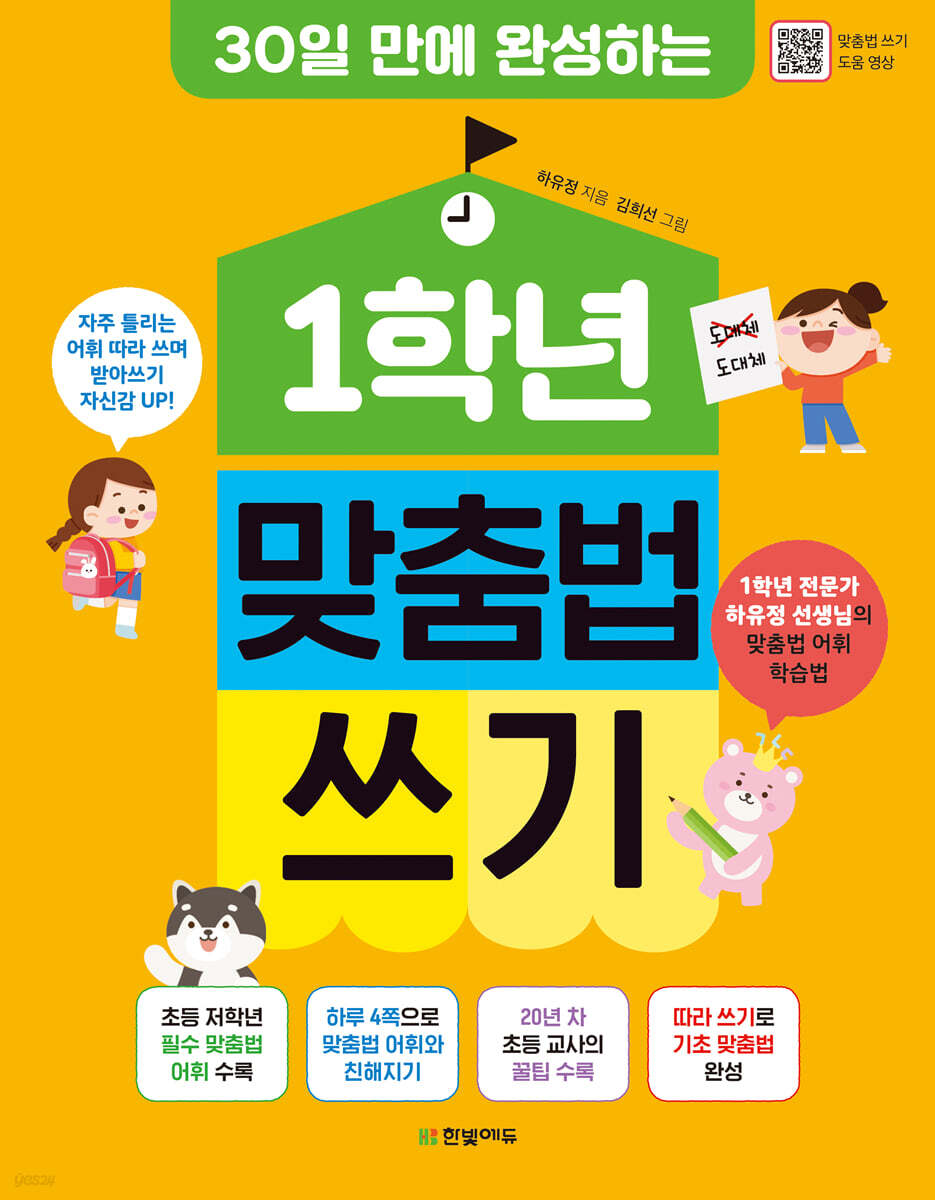
Spelling, Vocabulary, and Writing Learning Methods Suggested by First-Year Specialist Teacher Ha Yu-jeong
The first grade and lower grades of elementary school are an important time to build basic Korean language skills.
The thing that children who learn Hangul at this age have the most difficulty with is ‘spelling.’
Words that are difficult to distinguish and confusing based on sound alone are not learned automatically, so if they are learned incorrectly, it is not easy to correct them.
So how can we ensure correct spelling without making mistakes? This new book in the "First Grade Series," "First Grade Spelling," is designed to help first graders familiarize themselves with essential spelling vocabulary with a variety of meanings by visualizing and practicing spelling.
Repeatedly copying and writing is a much more effective way to learn than simply looking at it.
By following the essential spelling vocabulary for 30 days, children will naturally become familiar with spelling and develop solid Korean language skills.
Spelling, Vocabulary, and Writing Learning Methods Suggested by First-Year Specialist Teacher Ha Yu-jeong
The first grade and lower grades of elementary school are an important time to build basic Korean language skills.
The thing that children who learn Hangul at this age have the most difficulty with is ‘spelling.’
Words that are difficult to distinguish and confusing based on sound alone are not learned automatically, so if they are learned incorrectly, it is not easy to correct them.
So how can we ensure correct spelling without making mistakes? This new book in the "First Grade Series," "First Grade Spelling," is designed to help first graders familiarize themselves with essential spelling vocabulary with a variety of meanings by visualizing and practicing spelling.
Repeatedly copying and writing is a much more effective way to learn than simply looking at it.
By following the essential spelling vocabulary for 30 days, children will naturally become familiar with spelling and develop solid Korean language skills.
- You can preview some of the book's contents.
Preview
index
[Vocabularies that sound similar but have different meanings]
Day 1: New VS Seda|Time VS Tteoda
Day 2: Baeda vs. Veda | Maeda vs. Meda
Day 3: Pickle vs. Bark | Build vs. Bark
Day 4: Order vs. Cool | Up vs. Down
Day 5: To be buried VS to be buried | Must VS to be sure
Day 6: Cider vs. Stacking | Pick Up vs. Pick Up
Day 7: Right vs. Take on | Hurt vs. Close
Day 8: Reveal VS Take Out | Bring VS Same
Day 9: To put VS to stick | To leave VS to tie
Day 10: Tear vs. Crush | Offer vs. Support
⊙Review activity
[Confusing words with different sounds and meanings]
Day 11: Guess VS Guess | Lose VS Forget
Day 12: Teach vs. Point Out | Different vs. Wrong
Day 13: Barada VS Barada | Thick VS Thick
Day 14: Break VS Breaking | Wet VS Pushing
Day 15: Small VS Less | Better VS More
Day 16: Chasing vs. Chasing | Reflecting vs. Reflecting
Day 17: Earn vs. Earn | Stop by vs. Stop by
Day 18: Increase VS Increase|Mix VS Rot
Day 19 Shell VS Peel|- Jang-i VS - Jang-i
⊙Review activity
[Words that sound the same but have different meanings]
Day 20: Bae | Kim
Day 21 Night|Snow
Day 22: Apples|Words
Day 23, Friday | Air
Day 24: Punishment|Tea
Day 25: Tada|Tada
⊙Review activity
[Easy to misspell words]
Day 26: Stew (○) VS Stew (X) | Baby (○) VS Baby (X)
Shop (○) VS Store (X)|Pillow (○) VS Pillow (X)
Day 27 Black (○) VS Black (X) | How many days (○) VS How many days (X)
Multiply (○) VS Multiply (X)|Cut (○) VS Cut (X)
Day 28 Tteokbokki (○) VS Tteokbokki (X)|Quantity (○) VS Quantity (X)
Wide (○) VS Wide (X)|Sun (○) VS Sun (X)
Day 29 Role (○) VS Role (X)|Washing Dishes (○) VS Washing Dishes (X)
What the heck (○) VS What the heck (X)|Eye booger (○) VS Eye booger (X)
Day 30 Upside Down (○) VS Upside Down (X)|Rest Area (○) VS Rest Area (X)
Ice (○) VS Ice (X)|Flower Bud (○) VS Flower Bud (X)
⊙Review activity
Ding dong daeng! Correct answer
Day 1: New VS Seda|Time VS Tteoda
Day 2: Baeda vs. Veda | Maeda vs. Meda
Day 3: Pickle vs. Bark | Build vs. Bark
Day 4: Order vs. Cool | Up vs. Down
Day 5: To be buried VS to be buried | Must VS to be sure
Day 6: Cider vs. Stacking | Pick Up vs. Pick Up
Day 7: Right vs. Take on | Hurt vs. Close
Day 8: Reveal VS Take Out | Bring VS Same
Day 9: To put VS to stick | To leave VS to tie
Day 10: Tear vs. Crush | Offer vs. Support
⊙Review activity
[Confusing words with different sounds and meanings]
Day 11: Guess VS Guess | Lose VS Forget
Day 12: Teach vs. Point Out | Different vs. Wrong
Day 13: Barada VS Barada | Thick VS Thick
Day 14: Break VS Breaking | Wet VS Pushing
Day 15: Small VS Less | Better VS More
Day 16: Chasing vs. Chasing | Reflecting vs. Reflecting
Day 17: Earn vs. Earn | Stop by vs. Stop by
Day 18: Increase VS Increase|Mix VS Rot
Day 19 Shell VS Peel|- Jang-i VS - Jang-i
⊙Review activity
[Words that sound the same but have different meanings]
Day 20: Bae | Kim
Day 21 Night|Snow
Day 22: Apples|Words
Day 23, Friday | Air
Day 24: Punishment|Tea
Day 25: Tada|Tada
⊙Review activity
[Easy to misspell words]
Day 26: Stew (○) VS Stew (X) | Baby (○) VS Baby (X)
Shop (○) VS Store (X)|Pillow (○) VS Pillow (X)
Day 27 Black (○) VS Black (X) | How many days (○) VS How many days (X)
Multiply (○) VS Multiply (X)|Cut (○) VS Cut (X)
Day 28 Tteokbokki (○) VS Tteokbokki (X)|Quantity (○) VS Quantity (X)
Wide (○) VS Wide (X)|Sun (○) VS Sun (X)
Day 29 Role (○) VS Role (X)|Washing Dishes (○) VS Washing Dishes (X)
What the heck (○) VS What the heck (X)|Eye booger (○) VS Eye booger (X)
Day 30 Upside Down (○) VS Upside Down (X)|Rest Area (○) VS Rest Area (X)
Ice (○) VS Ice (X)|Flower Bud (○) VS Flower Bud (X)
⊙Review activity
Ding dong daeng! Correct answer
Detailed image

Publisher's Review
Complete basic spelling by following along, 4 pages a day for 30 days!
Perfect preparation for dictation, including 108 essential spelling vocabulary words.
In the "1st Grade Series", "1st Grade Dictation" focuses on the 'sound' of words and builds the foundation for dictation through 5 units, including basic vowels and consonants, representative final consonants, complex vowels, secondary final consonants, and dictation of textbook sentences.
If you have understood the basic spelling principles through this course, in "First Grade Spelling Writing," you will intensively study 108 confusing spelling words in four types: words that sound similar but have different meanings, words that are confusing but have different sounds and meanings, words that sound the same but have different meanings, and words that are easy to get wrong.
By learning various types of writing, such as writing vocabulary while thinking about the meaning, writing vocabulary in short sentences, writing vocabulary/sentences with different meanings in a sentence, connecting words/sentences with pictures, and writing short sentences yourself, you will be able to naturally learn confusing vocabulary and complete basic spelling through writing.
20 years of experience as an elementary school teacher
Includes tips for learning spelling and vocabulary!
Spelling vocabulary is often confusing even if you fully understand the principles of spelling.
So we need a way to remember and not forget.
《1st Grade Spelling》 is filled with spelling and vocabulary learning tips taught in a friendly and fun way by an elementary school teacher with 20 years of experience.
Helps children understand and remember words more easily with clever explanations that review vocabulary classification and spelling principles.
For example, in the case of pillow(O) VS pillow(X), 'pillow' is a word derived from 'beda'.
Remember '베다' which means 'to lean against and lie down!', '두죽다 VS 도죽다' are 'Thick = appearance (object), Thick = mind (belief, trust)', '절이다 VS 저리다' are 'If it is connected to food, write '절이다', and if it is connected to the body, write '저리다'. (If we pickle our bodies, we will be in big trouble!)'.
In this way, you can learn confusing spelling and vocabulary in a fun and effective way through the teacher's tips.
《1st Grade Hangul》-《1st Grade Dictation》-《1st Grade Spelling》
Complete the basics of first-grade Korean! Boost your Korean confidence!
The three Korean language textbooks in the "1st Grade Series" that systematically lay the foundation for learning Korean language in the first grade of elementary school, "1st Grade Hangul Teaching" - "1st Grade Dictation" - "1st Grade Spelling Writing" are structured to help students gradually learn reading, writing, and spelling, which are the core of the 1st grade Korean language curriculum.
If you follow along step by step with each book, from “First Grade Hangul Teaki” that lays the foundation for learning Hangul by learning vowels, consonants, and final consonants, to “First Grade Dictation” that focuses on sounds and develops first dictation skills centered on words and sentences that frequently appear in first grade textbooks, to “First Grade Spelling Writing” that learns confusing vocabulary by writing it out with abundant example sentences, you will find yourself completing basic Korean language skills before you know it.
If you want to build your child's confidence in the Korean language, I highly recommend these three perfectly structured books!
Perfect preparation for dictation, including 108 essential spelling vocabulary words.
In the "1st Grade Series", "1st Grade Dictation" focuses on the 'sound' of words and builds the foundation for dictation through 5 units, including basic vowels and consonants, representative final consonants, complex vowels, secondary final consonants, and dictation of textbook sentences.
If you have understood the basic spelling principles through this course, in "First Grade Spelling Writing," you will intensively study 108 confusing spelling words in four types: words that sound similar but have different meanings, words that are confusing but have different sounds and meanings, words that sound the same but have different meanings, and words that are easy to get wrong.
By learning various types of writing, such as writing vocabulary while thinking about the meaning, writing vocabulary in short sentences, writing vocabulary/sentences with different meanings in a sentence, connecting words/sentences with pictures, and writing short sentences yourself, you will be able to naturally learn confusing vocabulary and complete basic spelling through writing.
20 years of experience as an elementary school teacher
Includes tips for learning spelling and vocabulary!
Spelling vocabulary is often confusing even if you fully understand the principles of spelling.
So we need a way to remember and not forget.
《1st Grade Spelling》 is filled with spelling and vocabulary learning tips taught in a friendly and fun way by an elementary school teacher with 20 years of experience.
Helps children understand and remember words more easily with clever explanations that review vocabulary classification and spelling principles.
For example, in the case of pillow(O) VS pillow(X), 'pillow' is a word derived from 'beda'.
Remember '베다' which means 'to lean against and lie down!', '두죽다 VS 도죽다' are 'Thick = appearance (object), Thick = mind (belief, trust)', '절이다 VS 저리다' are 'If it is connected to food, write '절이다', and if it is connected to the body, write '저리다'. (If we pickle our bodies, we will be in big trouble!)'.
In this way, you can learn confusing spelling and vocabulary in a fun and effective way through the teacher's tips.
《1st Grade Hangul》-《1st Grade Dictation》-《1st Grade Spelling》
Complete the basics of first-grade Korean! Boost your Korean confidence!
The three Korean language textbooks in the "1st Grade Series" that systematically lay the foundation for learning Korean language in the first grade of elementary school, "1st Grade Hangul Teaching" - "1st Grade Dictation" - "1st Grade Spelling Writing" are structured to help students gradually learn reading, writing, and spelling, which are the core of the 1st grade Korean language curriculum.
If you follow along step by step with each book, from “First Grade Hangul Teaki” that lays the foundation for learning Hangul by learning vowels, consonants, and final consonants, to “First Grade Dictation” that focuses on sounds and develops first dictation skills centered on words and sentences that frequently appear in first grade textbooks, to “First Grade Spelling Writing” that learns confusing vocabulary by writing it out with abundant example sentences, you will find yourself completing basic Korean language skills before you know it.
If you want to build your child's confidence in the Korean language, I highly recommend these three perfectly structured books!
GOODS SPECIFICS
- Date of issue: March 31, 2025
- Page count, weight, size: 144 pages | 850g | 230*295*11mm
- ISBN13: 9791169213554
- ISBN10: 1169213553
- KC Certification: Certification Type: Conformity Confirmation
You may also like
카테고리
korean


korean

![GQ KOREA Mark (Monthly): December [2025]](http://librairie.coreenne.fr/cdn/shop/files/8ef265dbbfbf186523ed75ba7319009d.jpg?v=1765340328&width=3840)


