

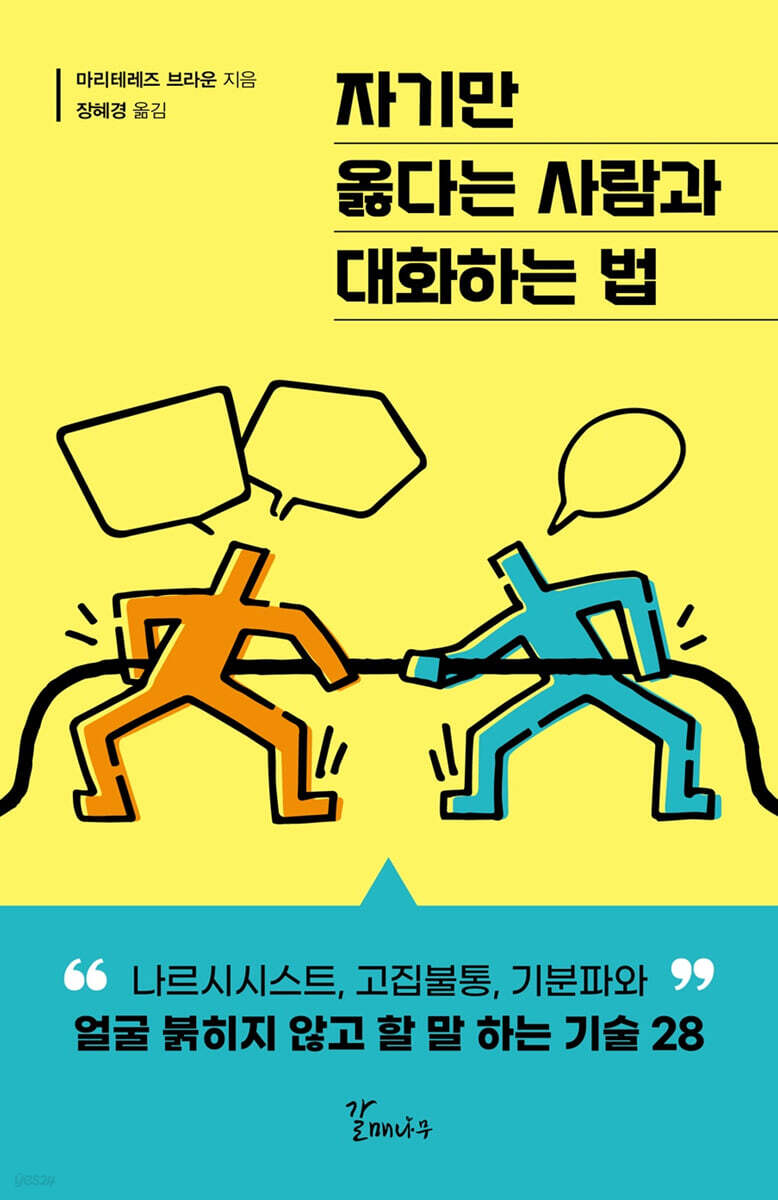
How to Talk to Someone Who Thinks They're Right
 |
Description
Book Introduction
When talking to someone you don't understand
What to say and what not to say
Even in an unfavorable conversation, you need a single word to take the initiative!
**** “A book that condenses the knowledge of understanding others, arguing delicately, and building self-confidence.” _Cori***
**** "I've read countless books on public speaking, but this one is different! It's a wonderful blend of conversational skills and psychology, and it gave me the courage to argue, even though I was afraid of it." _y***
Why does a normally pleasant conversation quickly devolve into an argument? Why won't that person give in, even when their argument is clearly wrong? Narcissists, stubborn people, moody people... How can you possibly converse with people you simply can't communicate with without feeling embarrassed?
When we talk to someone who has a conflicting opinion on a crucial point, we tend to jump to conclusions.
They demonize the other side, take sides by highlighting differences, and sometimes try to lecture the other by claiming moral superiority.
It is at this point that the conflict ignites.
Because the goal of dialogue is transformed from respect and cooperation to victory or defeat and submission.
The author, who has been active as a communication and negotiation trainer for a long time, says that he began writing this book while contemplating a positive conversation culture that "seeks common solutions together," and calls it a "cooperative" conversation technique.
In these days when it's so important to silence others, even by using harsh language, and to distinguish right from wrong, subduing the other person seems like the only quick solution, but in reality, that's not the case.
Rather, conversations based on understanding the other person's psychology are more effective in changing people's thoughts.
In fact, the author confesses that, while listening to clients' cases and experimenting with the techniques in this book himself, he has come to realize that even the most stubborn people will listen if you try to engage in a respectful conversation.
Therefore, this book aims to introduce a conversational method that increases one's influence while respecting the values of others who have different opinions from one's own, and a wise conversational method that courageously refutes flawed logic while also turning the conversation in a positive direction.
"How can we open the closed ears of those who are so tightly shut? If you've ever wondered, open this book.
If you follow the communication skills presented by the author, you will find clear answers.
Plus, you get one thing that's most important:
What we were missing.
“It is the art of winning people’s hearts.”
_Heeren Choi · YouTuber of "Heeren Choi" and author of "I Have Something to Say"
Without backing down, without losing your dignity
Smart Conversation Skills 28
The five chapters of this book proceed in the order of the conversations.
From how to resolve conflicts in everyday conversations to how to respond to rude comments that attack you, you can choose and read the book that best suits your situation and circumstances.
The techniques in this book don't require a ton of time or headaches.
The experiences of the author himself and those he met vividly portray the conversational culture of modern society, enough for anyone to read and relate to.
Here, we'll introduce various research results, psychological theories, and how communication works. Follow along step by step and apply the techniques that work for you.
For those who have long avoided argument because they dislike conflict, I hope this book will give them the courage not to give up on difficult conversations too quickly, and the wisdom to utilize the gaps between attack and retreat to lead a rational dialogue.
What to say and what not to say
Even in an unfavorable conversation, you need a single word to take the initiative!
**** “A book that condenses the knowledge of understanding others, arguing delicately, and building self-confidence.” _Cori***
**** "I've read countless books on public speaking, but this one is different! It's a wonderful blend of conversational skills and psychology, and it gave me the courage to argue, even though I was afraid of it." _y***
Why does a normally pleasant conversation quickly devolve into an argument? Why won't that person give in, even when their argument is clearly wrong? Narcissists, stubborn people, moody people... How can you possibly converse with people you simply can't communicate with without feeling embarrassed?
When we talk to someone who has a conflicting opinion on a crucial point, we tend to jump to conclusions.
They demonize the other side, take sides by highlighting differences, and sometimes try to lecture the other by claiming moral superiority.
It is at this point that the conflict ignites.
Because the goal of dialogue is transformed from respect and cooperation to victory or defeat and submission.
The author, who has been active as a communication and negotiation trainer for a long time, says that he began writing this book while contemplating a positive conversation culture that "seeks common solutions together," and calls it a "cooperative" conversation technique.
In these days when it's so important to silence others, even by using harsh language, and to distinguish right from wrong, subduing the other person seems like the only quick solution, but in reality, that's not the case.
Rather, conversations based on understanding the other person's psychology are more effective in changing people's thoughts.
In fact, the author confesses that, while listening to clients' cases and experimenting with the techniques in this book himself, he has come to realize that even the most stubborn people will listen if you try to engage in a respectful conversation.
Therefore, this book aims to introduce a conversational method that increases one's influence while respecting the values of others who have different opinions from one's own, and a wise conversational method that courageously refutes flawed logic while also turning the conversation in a positive direction.
"How can we open the closed ears of those who are so tightly shut? If you've ever wondered, open this book.
If you follow the communication skills presented by the author, you will find clear answers.
Plus, you get one thing that's most important:
What we were missing.
“It is the art of winning people’s hearts.”
_Heeren Choi · YouTuber of "Heeren Choi" and author of "I Have Something to Say"
Without backing down, without losing your dignity
Smart Conversation Skills 28
The five chapters of this book proceed in the order of the conversations.
From how to resolve conflicts in everyday conversations to how to respond to rude comments that attack you, you can choose and read the book that best suits your situation and circumstances.
The techniques in this book don't require a ton of time or headaches.
The experiences of the author himself and those he met vividly portray the conversational culture of modern society, enough for anyone to read and relate to.
Here, we'll introduce various research results, psychological theories, and how communication works. Follow along step by step and apply the techniques that work for you.
For those who have long avoided argument because they dislike conflict, I hope this book will give them the courage not to give up on difficult conversations too quickly, and the wisdom to utilize the gaps between attack and retreat to lead a rational dialogue.
- You can preview some of the book's contents.
Preview
index
I don't argue, but I win arguments.
Chapter 1: There's a reason conversations escalate into arguments.
The conversation begins when you let go of the idea of trying to persuade.
1.
A word that makes the other person realize their own weakness
: Ask specific questions
2.
Don't start a discussion before you know the real intention.
: Digging into the 'real' reasons for the insistence
3.
How do you deal with someone who gets angry first?
: When feelings are acknowledged, they subside.
4.
People only hear what they want to believe.
: The art of 'controlled conversation' that allows for understanding without misunderstanding.
5.
A question that changes a person who doesn't know his own mistakes
: 'How do you think I feel?' doesn't work.
? Assistive technology that is good to know 1.
Sometimes flexible, sometimes strong
: The courage to fight a 'friendly confrontation'
Chapter 2: The Psychological Game of Taking the Lead Even in Unfavorable Conversations
Warm-up: Don't Say "You're Bad and I'm Right"
6.
How to Inspire Trust When Persuading Your Superiors
: Sometimes I put the words of authority before my own.
7.
First, win the other person's favor, without being obvious.
: 'Positive filter' technology that sends the message that you are on the same side
8.
Why should we focus on the word that comes before “but” rather than after it?
: 'Positive reinforcement' techniques that take the lead in conversation
9.
What to say when persuading someone with a firm opinion
: “Actually, I thought so too…….”
10.
The magic of “Because that’s exactly why”
: If I use the counterargument well, it will be to my advantage.
11.
How to exploit the psychology of not wanting to disappoint expectations
: The 'altercasting' technique to get what you want
12.
All humans have a tendency to avoid contradictions.
: Attack the contradiction between claims and actions.
? Assistive technology 2 that is good to know.
Control your emotions that interfere with conversation.
: Escape from 'Amygdala Hijacking'
Chapter 3: Smart Conversation Skills That Avoid Getting Engaged in Wasteful Arguments
Warm-up: I Could Be Wrong: Moving Beyond Moral Rationalization
13.
Stubborn people are not as stupid as you think.
: Overcoming the Wall of Values with 'Touch Turn Talk'
14.
Things to keep in mind when rephrasing your words into the other person's language
: 'Language Value Framing' technology
15.
“I am in the same position, but my method is a little different.”
: 'Content Value Framing' technology
? 3 Assistive Technologies You Should Know
Concrete alternatives for managing emotions
How to Stay Calm While Talking to a Stubborn Person
Chapter 4: The Minor Reasons Why My Rebuttal Didn't Work
Warm-up: Evidence that sounds credible, not evidence that is credible
16.
People have different points of attraction depending on their desires.
: Who will you approach with what logic?
17.
The sooner you respond to a counterargument, the better.
: The 'pre-bend method' technique of turning weaknesses into strengths
18.
Speak in the following order: topic, logic, and conclusion.
: TAC technology that makes people follow their own taste
19.
How to make your position sound like a compromise
: The 'extreme centrist' technique of packaging my argument as the most reasonable
20.
Experiences and emotions are more powerful than facts.
: The effect is greater when you include an emotional story in your experience.
21.
The message should be simple and repeated.
: Just because something has a lot of evidence doesn't mean it's good.
? 4 Assistive Technologies You Should Know
Nonverbal expressions that give strength to words
: Voice, body language, facial expressions, word choice
Chapter 5: How to remain unshaken by rude, ignorant, and sarcastic remarks
Warm-up: How to Have a Cooperative Conversation with Someone Who Try to Manipulate You
22.
The art of responding to overly harsh remarks with a laugh
: 'Excessive agreement' echoes the other person's words.
23.
If you are shaken by the thought that the accusation might be true,
: A technique for people who hate conflict to accept it with confidence
24.
How to Respond When Someone Points Out Your Speech, Not Your Topic
: When the point is blurred, respond with context.
25.
“It seems like you have some strange trauma…….”
: How to Stop Someone from Gaining Dominance with Personal Attacks
26.
Advice for those who don't want to be bad people
: How to Stick to Your Decisions Without Being Emotionally Blackmailed
27.
What to do when something feels off and you feel pressured
: To avoid being caught up in the other person's value frame
28.
A simple and quick way to defeat “it’s always been that way”
: Comparison destroys errors in a few words.
? 5 Assistive Technologies You Should Know.
Special Problems of Online Communication
: The less you can see the face, the more delicate it is
Appendix: How One Black Musician Changed the Hearts of Hundreds of Racists
Don't give up quickly even if you meet someone who has different ideas from you.
Americas
Chapter 1: There's a reason conversations escalate into arguments.
The conversation begins when you let go of the idea of trying to persuade.
1.
A word that makes the other person realize their own weakness
: Ask specific questions
2.
Don't start a discussion before you know the real intention.
: Digging into the 'real' reasons for the insistence
3.
How do you deal with someone who gets angry first?
: When feelings are acknowledged, they subside.
4.
People only hear what they want to believe.
: The art of 'controlled conversation' that allows for understanding without misunderstanding.
5.
A question that changes a person who doesn't know his own mistakes
: 'How do you think I feel?' doesn't work.
? Assistive technology that is good to know 1.
Sometimes flexible, sometimes strong
: The courage to fight a 'friendly confrontation'
Chapter 2: The Psychological Game of Taking the Lead Even in Unfavorable Conversations
Warm-up: Don't Say "You're Bad and I'm Right"
6.
How to Inspire Trust When Persuading Your Superiors
: Sometimes I put the words of authority before my own.
7.
First, win the other person's favor, without being obvious.
: 'Positive filter' technology that sends the message that you are on the same side
8.
Why should we focus on the word that comes before “but” rather than after it?
: 'Positive reinforcement' techniques that take the lead in conversation
9.
What to say when persuading someone with a firm opinion
: “Actually, I thought so too…….”
10.
The magic of “Because that’s exactly why”
: If I use the counterargument well, it will be to my advantage.
11.
How to exploit the psychology of not wanting to disappoint expectations
: The 'altercasting' technique to get what you want
12.
All humans have a tendency to avoid contradictions.
: Attack the contradiction between claims and actions.
? Assistive technology 2 that is good to know.
Control your emotions that interfere with conversation.
: Escape from 'Amygdala Hijacking'
Chapter 3: Smart Conversation Skills That Avoid Getting Engaged in Wasteful Arguments
Warm-up: I Could Be Wrong: Moving Beyond Moral Rationalization
13.
Stubborn people are not as stupid as you think.
: Overcoming the Wall of Values with 'Touch Turn Talk'
14.
Things to keep in mind when rephrasing your words into the other person's language
: 'Language Value Framing' technology
15.
“I am in the same position, but my method is a little different.”
: 'Content Value Framing' technology
? 3 Assistive Technologies You Should Know
Concrete alternatives for managing emotions
How to Stay Calm While Talking to a Stubborn Person
Chapter 4: The Minor Reasons Why My Rebuttal Didn't Work
Warm-up: Evidence that sounds credible, not evidence that is credible
16.
People have different points of attraction depending on their desires.
: Who will you approach with what logic?
17.
The sooner you respond to a counterargument, the better.
: The 'pre-bend method' technique of turning weaknesses into strengths
18.
Speak in the following order: topic, logic, and conclusion.
: TAC technology that makes people follow their own taste
19.
How to make your position sound like a compromise
: The 'extreme centrist' technique of packaging my argument as the most reasonable
20.
Experiences and emotions are more powerful than facts.
: The effect is greater when you include an emotional story in your experience.
21.
The message should be simple and repeated.
: Just because something has a lot of evidence doesn't mean it's good.
? 4 Assistive Technologies You Should Know
Nonverbal expressions that give strength to words
: Voice, body language, facial expressions, word choice
Chapter 5: How to remain unshaken by rude, ignorant, and sarcastic remarks
Warm-up: How to Have a Cooperative Conversation with Someone Who Try to Manipulate You
22.
The art of responding to overly harsh remarks with a laugh
: 'Excessive agreement' echoes the other person's words.
23.
If you are shaken by the thought that the accusation might be true,
: A technique for people who hate conflict to accept it with confidence
24.
How to Respond When Someone Points Out Your Speech, Not Your Topic
: When the point is blurred, respond with context.
25.
“It seems like you have some strange trauma…….”
: How to Stop Someone from Gaining Dominance with Personal Attacks
26.
Advice for those who don't want to be bad people
: How to Stick to Your Decisions Without Being Emotionally Blackmailed
27.
What to do when something feels off and you feel pressured
: To avoid being caught up in the other person's value frame
28.
A simple and quick way to defeat “it’s always been that way”
: Comparison destroys errors in a few words.
? 5 Assistive Technologies You Should Know.
Special Problems of Online Communication
: The less you can see the face, the more delicate it is
Appendix: How One Black Musician Changed the Hearts of Hundreds of Racists
Don't give up quickly even if you meet someone who has different ideas from you.
Americas
Detailed image

Into the book
In this way, we want to be right rather than acknowledge the legitimacy of others.
So, the probability of persuading the other person is highest when you respond to them at as many points as possible and cleverly incorporate their content into your logic.
It's about building a bridge between two positions that seem absolutely irreconcilable.
--- p.13, from “Introduction: I don’t argue, but I win arguments”
In one experiment, participants with extreme political leanings were asked to describe their party's policies in as much detail as possible.
Most of them failed to explain, and their political stance softened somewhat afterward.
However, when we asked these people about their personal motivations and asked them to list reasons why they supported that party, the same effect did not occur.
Because ignorance went undetected.
Even if I asked for a mechanical explanation of something I believed I knew, I would realize the flaws in my own knowledge.
Let's use this principle in discussions too.
Ask specific questions about your partner's ideas and find out how they came to that conclusion.
--- p.28, from “Technique 1: A single word that makes the opponent realize his or her own weakness”
Sometimes we need 'acceptance'.
It requires the ability to approach others with affection, respect them and their position, and, if necessary, to completely put aside your own position.
Sometimes, 'facing it' is necessary.
You need to be able to reject or point out shameless behavior, and you need to be able to clearly state your position and tell the other person, “You’re wrong.”
--- p.54, from “Good-to-Know Assistive Technology 1: Sometimes Flexible, Sometimes Strong”
It's a typical "yes, but" discussion focused on the differences.
Linguist and negotiation consultant Dr. Hartwig Eckert points out that most persuasion focuses on the difference, the counterargument that follows the “but.”
Doing so not only directs attention to the counterargument, but also forces you to keep chasing it, handing the initiative in the negotiation over to the other party.
Therefore, Eckert recommends breaking this pattern by paying attention to where the other person has already agreed, or at least acknowledged, what point they are agreeing to.
By repeating the points the other person has agreed to and emphasizing them with further questions, you can regain control.
--- p.78, from 「Technique 8: Why should we focus on the word that comes before “but” rather than after it?」
But we are not helpless against our emotions and reflexive reactions.
Even if you can't control your emotions, you can control your impulsive behavior and regulate your emotions by taking the initiative and stabilizing your amygdala.
Viktor Emil Frankl, a neurologist and psychiatrist who survived Nazi concentration camps and is considered the founder of logotherapy, questioned whether humans have mental freedom or whether, in certain situations, there is simply no other way.
Ultimately, he concluded that humans can choose how to think, and that much depends on decisions rather than automatic reactions.
--- p.107, from “Useful Assistive Technology 2: Control Emotions That Interfere with Conversation”
To reach a solution, you need to consider what values the other person truly values.
As with all disputes, the issue in this case isn't the outward appearance of the situation, namely the clothes.
Rather, the values hidden behind the clothes are more important.
In other words, the core of the problem is the value of ‘following the rules’ of the director.
Values are identity.
Therefore, trying to persuade someone is like directly attacking the core of their personality.
The only chance to solve the problem is to acknowledge the other person's values and integrate them into your own logic.
First, you need to find out the values hidden in the other person's words.
--- p.128, from “Technique 13: Stubborn People Are Not as Stupid as You Think”
If you are stuck in the mold of your own values, it is difficult to persuade others.
For example, if you ask conservatives to be tolerant of minorities and use words they dislike, such as “victim,” “sense of privilege,” “sexism,” and “problem,” you will naturally face a backlash.
To conservative recipients, words like 'practical', 'civilized', 'cultured', and 'rational' are perceived much more positively.
Words that align with conservative values, such as history and culture, generally get through well.
--- p.139, from “Technique 14: Things to be careful of when speaking in the other person’s language”
At worst, we are quick to label our opponents.
Narcissist, old fart, feminist… … Labels strip the other person of their humanity, making it easier to unleash the flames of anger toward them.
This is called the 'dehumanization of everyday life' and is very common in debates.
However, if we do not see others as human beings, we lose empathy and respect, and we abandon the moral thinking that pursues social coexistence.
--- pp.149-150, from “Assistive Technology to Know 3: Specific Alternatives for Managing Emotions”
I once fell for that technique too.
When I went to the store to buy a laptop, the salesperson recommended a new model, listing all sorts of figures and data, but I kept hesitating.
In this case, additional information is of little help.
Because for me, there wasn't much difference between the models there.
Then the salesman said.
“I also use this laptop, and I use it to edit YouTube videos.
“It’s so good that I don’t plan on changing it even if a new model comes out.” I decided on that laptop.
--- p.191, from “Technology 20: Experience and emotion are more powerful than facts”
When someone says, “That’s not a problem,” reveal the hidden meaning behind their words.
“If you don’t think the problem is a big deal, you won’t find a solution.
What's important now is... " Responding like this allows the discussion to return to the original topic without straying into unimportant side issues like who can say what, and what is and is not permissible to say.
--- p.225, from 「Technology 25: “It seems like you have a strange trauma…….”」
If your boss threatens you by saying, “I am your boss, and if you respect and support me, you should not refuse any work I give you,” you should acknowledge the relationship but refuse to take a position.
“Of course I respect you.
However, I cannot give you any further instructions because my workload is too heavy right now.” When your spouse says, “How can you say something like that when you love me?”, emphasize your love but reject his position.
“I love you, I love you so much.
But just because I love you doesn't mean I can't say what I think."
--- p.234, from “Technique 26: Advice for Those Who Don’t Want to Become Bad People”
So, let's not give up too quickly just because we have different opinions.
You can continue the conversation even if you don't like the other person's behavior.
Even if you can't convince the other person right now, let them know that you have several valid reasons for your position.
Sometimes persuasion is about sowing seeds of doubt.
Fruits don't ripen overnight.
It takes time for a seed to grow and bear fruit.
So, the probability of persuading the other person is highest when you respond to them at as many points as possible and cleverly incorporate their content into your logic.
It's about building a bridge between two positions that seem absolutely irreconcilable.
--- p.13, from “Introduction: I don’t argue, but I win arguments”
In one experiment, participants with extreme political leanings were asked to describe their party's policies in as much detail as possible.
Most of them failed to explain, and their political stance softened somewhat afterward.
However, when we asked these people about their personal motivations and asked them to list reasons why they supported that party, the same effect did not occur.
Because ignorance went undetected.
Even if I asked for a mechanical explanation of something I believed I knew, I would realize the flaws in my own knowledge.
Let's use this principle in discussions too.
Ask specific questions about your partner's ideas and find out how they came to that conclusion.
--- p.28, from “Technique 1: A single word that makes the opponent realize his or her own weakness”
Sometimes we need 'acceptance'.
It requires the ability to approach others with affection, respect them and their position, and, if necessary, to completely put aside your own position.
Sometimes, 'facing it' is necessary.
You need to be able to reject or point out shameless behavior, and you need to be able to clearly state your position and tell the other person, “You’re wrong.”
--- p.54, from “Good-to-Know Assistive Technology 1: Sometimes Flexible, Sometimes Strong”
It's a typical "yes, but" discussion focused on the differences.
Linguist and negotiation consultant Dr. Hartwig Eckert points out that most persuasion focuses on the difference, the counterargument that follows the “but.”
Doing so not only directs attention to the counterargument, but also forces you to keep chasing it, handing the initiative in the negotiation over to the other party.
Therefore, Eckert recommends breaking this pattern by paying attention to where the other person has already agreed, or at least acknowledged, what point they are agreeing to.
By repeating the points the other person has agreed to and emphasizing them with further questions, you can regain control.
--- p.78, from 「Technique 8: Why should we focus on the word that comes before “but” rather than after it?」
But we are not helpless against our emotions and reflexive reactions.
Even if you can't control your emotions, you can control your impulsive behavior and regulate your emotions by taking the initiative and stabilizing your amygdala.
Viktor Emil Frankl, a neurologist and psychiatrist who survived Nazi concentration camps and is considered the founder of logotherapy, questioned whether humans have mental freedom or whether, in certain situations, there is simply no other way.
Ultimately, he concluded that humans can choose how to think, and that much depends on decisions rather than automatic reactions.
--- p.107, from “Useful Assistive Technology 2: Control Emotions That Interfere with Conversation”
To reach a solution, you need to consider what values the other person truly values.
As with all disputes, the issue in this case isn't the outward appearance of the situation, namely the clothes.
Rather, the values hidden behind the clothes are more important.
In other words, the core of the problem is the value of ‘following the rules’ of the director.
Values are identity.
Therefore, trying to persuade someone is like directly attacking the core of their personality.
The only chance to solve the problem is to acknowledge the other person's values and integrate them into your own logic.
First, you need to find out the values hidden in the other person's words.
--- p.128, from “Technique 13: Stubborn People Are Not as Stupid as You Think”
If you are stuck in the mold of your own values, it is difficult to persuade others.
For example, if you ask conservatives to be tolerant of minorities and use words they dislike, such as “victim,” “sense of privilege,” “sexism,” and “problem,” you will naturally face a backlash.
To conservative recipients, words like 'practical', 'civilized', 'cultured', and 'rational' are perceived much more positively.
Words that align with conservative values, such as history and culture, generally get through well.
--- p.139, from “Technique 14: Things to be careful of when speaking in the other person’s language”
At worst, we are quick to label our opponents.
Narcissist, old fart, feminist… … Labels strip the other person of their humanity, making it easier to unleash the flames of anger toward them.
This is called the 'dehumanization of everyday life' and is very common in debates.
However, if we do not see others as human beings, we lose empathy and respect, and we abandon the moral thinking that pursues social coexistence.
--- pp.149-150, from “Assistive Technology to Know 3: Specific Alternatives for Managing Emotions”
I once fell for that technique too.
When I went to the store to buy a laptop, the salesperson recommended a new model, listing all sorts of figures and data, but I kept hesitating.
In this case, additional information is of little help.
Because for me, there wasn't much difference between the models there.
Then the salesman said.
“I also use this laptop, and I use it to edit YouTube videos.
“It’s so good that I don’t plan on changing it even if a new model comes out.” I decided on that laptop.
--- p.191, from “Technology 20: Experience and emotion are more powerful than facts”
When someone says, “That’s not a problem,” reveal the hidden meaning behind their words.
“If you don’t think the problem is a big deal, you won’t find a solution.
What's important now is... " Responding like this allows the discussion to return to the original topic without straying into unimportant side issues like who can say what, and what is and is not permissible to say.
--- p.225, from 「Technology 25: “It seems like you have a strange trauma…….”」
If your boss threatens you by saying, “I am your boss, and if you respect and support me, you should not refuse any work I give you,” you should acknowledge the relationship but refuse to take a position.
“Of course I respect you.
However, I cannot give you any further instructions because my workload is too heavy right now.” When your spouse says, “How can you say something like that when you love me?”, emphasize your love but reject his position.
“I love you, I love you so much.
But just because I love you doesn't mean I can't say what I think."
--- p.234, from “Technique 26: Advice for Those Who Don’t Want to Become Bad People”
So, let's not give up too quickly just because we have different opinions.
You can continue the conversation even if you don't like the other person's behavior.
Even if you can't convince the other person right now, let them know that you have several valid reasons for your position.
Sometimes persuasion is about sowing seeds of doubt.
Fruits don't ripen overnight.
It takes time for a seed to grow and bear fruit.
--- p.256, from “5 Assistive Technologies to Know: Special Issues in Online Communication”
Publisher's Review
Without backing down, without losing your dignity
Smart Conversation Skills 28
The five chapters of this book proceed in the order of the conversations.
From how to resolve conflicts in everyday conversations to how to respond to rude comments that attack you, you can choose and read the book that best suits your situation and circumstances.
The techniques in this book don't require a ton of time or headaches.
The experiences of the author himself and those he met vividly portray the conversational culture of modern society, enough for anyone to read and relate to.
Here, we'll introduce various research results, psychological theories, and how communication works. Follow along step by step and apply the techniques that work for you.
For those who have long avoided argument because they dislike conflict, I hope this book will give them the courage not to give up on difficult conversations too quickly, and the wisdom to utilize the gaps between attack and retreat to lead a rational dialogue.
A psychological game to win over someone with different opinions
"Win their favor first, without being obvious."
People trust the words of people who are part of the same group more.
This kind of 'group bias' sometimes fuels hostility, as if everyone who is not on my side is my enemy.
However, if you want to persuade the other person, you should not take sides, but rather emphasize a sense of belonging by narrowing the distance to 'us'.
The more I feel like I can never be on the same side as that person, the more I feel this way.
“No connection, no persuasion.” Chapter 2 of the book focuses on this very point.
This guide covers a variety of techniques, from how to quietly win over someone and get them to listen to your opinions to how to rekindle a conversation that seems to be stalling.
Let's look at technique 8.
It is a 'positive reinforcement' technique that takes the initiative in a conversation by capturing the positive aspects of the other person's negative comments and repeating them.
Rather than focusing on the 'negation' that leads to "but" to persuade, try focusing on the 'acknowledgment' that comes before it.
Rather than responding to a counterargument, repeat the word “but” and ask a deeper question, and the other person will automatically reflect on the positive aspects.
For example, if you had the option to add a few words to a negative interview, what would you say? "Can you tell me why I was rejected?" Questions like this are completely unhelpful, as they remind the other person of the reasons why they rejected you.
But if you ask, “Why did you give me the opportunity to interview?”, the other person will remind you of the things he or she liked about you, even without you having to say them.
Smart conversation skills that avoid getting caught up in wasteful arguments
Advice for People Who Hate Conflict and Avoid Arguments
For some reason, there are people who I find unpleasant when I talk to them.
I feel like we're not communicating and the conversation is going in circles.
Why? Because the conversation is often based on differences in values.
Imagine having a conversation with someone who disagrees with you on issues like migrant workers, gender discrimination, or political progressives and conservatives.
Arguments with this type of person are often emotional and draining.
Values make people stubborn.
However, the author says that it is possible to have a full conversation with these people and find a solution in a positive direction.
But that is, unless you equate values with people.
Attacking values is like attacking personality.
Therefore, in times like these, a more delicate conversation is required.
We must intentionally guide the other person so that he or she can follow our logic without resistance, while fully respecting his or her values.
‘Language value framing’ and ‘content value framing’ introduced in Skills 14 and 15 of Chapter 3 are good examples.
When trying to persuade conservatives to be tolerant of minorities, using language they dislike, like “privilege,” “victim,” and “problem,” will inevitably provoke a backlash.
Even if you say the same thing, if you replace it with words that align with their values, such as 'practical', 'civilized', and 'rational', you can create room for persuasion.
‘Content value framing’ is no different.
If language value framing is a technique for using the other person's language, content value framing is a technique for opening the other person's mind by letting them know that we share the same values even though our positions are different.
At this time, the conversation follows this format.
“I am in the same position.
“But the length is a bit different, so I think another method is more effective.”
A minor reason why my rebuttal didn't work
“Who will you approach with what logic?”
If Chapter 3 explored how to use your values to turn a destructive conversation to your advantage, Chapter 4 goes a step further, examining specifically how to effectively respond to objections and reframe your position to make it sound as reasonable as possible.
There are six methods in total.
Each person has different desires and different points of attraction depending on the desire, so the 'tailored logic' technique suggests approaching with logic that suits each characteristic; the 'preemptive argument' technique where I snatch up the objection before it even comes out of my mouth and strike first; the TAC technique where I make even the most self-righteous person agree with my position by speaking in the order of topic (T), logic (A), and conclusion (C); the 'extreme middle ground' technique where I exploit the psychology of liking the middle ground to package my argument as if it were the middle ground between extremes; the 'emotional position' technique where I actively utilize the power of experience and emotion rather than objective facts; and the 'broken record' technique where I simply and repeatedly state the core message by targeting the 'illusory truth effect' where people believe frequently encountered information to be more true.
As you can see here, understanding the psychology behind the words is important in persuading people.
Ultimately, whoever knows better how communication works has the advantage.
In Chapter 4, we'll explore nonverbal cues like voice, posture, facial expressions, and word choice that add power to your words. Let's combine the two to make your words even more believable.
How to remain unshaken by rude, ignorant, or sarcastic remarks
“What to say when something feels off and oppressive.”
There are people who remain unmoved no matter what conversation techniques you use.
They always insist that they are right, and they sometimes present their beliefs as if they were objective evidence, or they even openly criticize you.
In times like these, a more powerful 'assertion mode' is needed than the previous technique.
Chapter 5 explores how to have conversations that resist and cooperate with those who try to manipulate you.
‘Psychologization’ is a typical method of manipulating others.
Blame others for not agreeing with what you say.
“Look into your own heart.
A representative example is “I wonder if you have any trauma.”
Or there is a way to link values and needs.
“If you respect and support your boss, you shouldn’t refuse to accept tasks from above.” When we hear things like this, we quickly comply with the other person’s demands for fear of losing our positive role.
How can I resist such comments and still get what I want? During a meeting, someone from another department says this about your opinion:
“We work in different departments, so what do you know about it?” This is a personal attack targeting you as a person, not the topic.
In this case, let's apply skill 25 'Stop by Kkabal'.
It is a technique of briefly summarizing the other person's conversation style, then stopping the conversation and returning to the original topic.
“You might be thinking that this is my personal opinion, but that’s not the case.
“Because it is an opinion that came from the department level… … .” The moment you notice the other person’s strategy and mention that fact, psychological manipulation loses its effect.
Moreover, it is more beneficial in that it allows you to strengthen your self-confidence and not be swayed by the other person's criticism by thinking, "That person might be right."
The case of Daryl Davis, an African-American musician, included in the appendix demonstrates the extent to which a positive dialogue culture can have an impact, so I highly recommend reading it.
This section, which analyzes how the book's techniques were actually applied in the process of persuading hundreds of racists, is a very helpful reference for readers to use as a practical exercise.
Furthermore, as we follow his journey of willingly engaging with extremists and changing their minds solely through dialogue, we will gain the courage and realization that there is no one we cannot persuade, as long as we don't give up.
Smart Conversation Skills 28
The five chapters of this book proceed in the order of the conversations.
From how to resolve conflicts in everyday conversations to how to respond to rude comments that attack you, you can choose and read the book that best suits your situation and circumstances.
The techniques in this book don't require a ton of time or headaches.
The experiences of the author himself and those he met vividly portray the conversational culture of modern society, enough for anyone to read and relate to.
Here, we'll introduce various research results, psychological theories, and how communication works. Follow along step by step and apply the techniques that work for you.
For those who have long avoided argument because they dislike conflict, I hope this book will give them the courage not to give up on difficult conversations too quickly, and the wisdom to utilize the gaps between attack and retreat to lead a rational dialogue.
A psychological game to win over someone with different opinions
"Win their favor first, without being obvious."
People trust the words of people who are part of the same group more.
This kind of 'group bias' sometimes fuels hostility, as if everyone who is not on my side is my enemy.
However, if you want to persuade the other person, you should not take sides, but rather emphasize a sense of belonging by narrowing the distance to 'us'.
The more I feel like I can never be on the same side as that person, the more I feel this way.
“No connection, no persuasion.” Chapter 2 of the book focuses on this very point.
This guide covers a variety of techniques, from how to quietly win over someone and get them to listen to your opinions to how to rekindle a conversation that seems to be stalling.
Let's look at technique 8.
It is a 'positive reinforcement' technique that takes the initiative in a conversation by capturing the positive aspects of the other person's negative comments and repeating them.
Rather than focusing on the 'negation' that leads to "but" to persuade, try focusing on the 'acknowledgment' that comes before it.
Rather than responding to a counterargument, repeat the word “but” and ask a deeper question, and the other person will automatically reflect on the positive aspects.
For example, if you had the option to add a few words to a negative interview, what would you say? "Can you tell me why I was rejected?" Questions like this are completely unhelpful, as they remind the other person of the reasons why they rejected you.
But if you ask, “Why did you give me the opportunity to interview?”, the other person will remind you of the things he or she liked about you, even without you having to say them.
Smart conversation skills that avoid getting caught up in wasteful arguments
Advice for People Who Hate Conflict and Avoid Arguments
For some reason, there are people who I find unpleasant when I talk to them.
I feel like we're not communicating and the conversation is going in circles.
Why? Because the conversation is often based on differences in values.
Imagine having a conversation with someone who disagrees with you on issues like migrant workers, gender discrimination, or political progressives and conservatives.
Arguments with this type of person are often emotional and draining.
Values make people stubborn.
However, the author says that it is possible to have a full conversation with these people and find a solution in a positive direction.
But that is, unless you equate values with people.
Attacking values is like attacking personality.
Therefore, in times like these, a more delicate conversation is required.
We must intentionally guide the other person so that he or she can follow our logic without resistance, while fully respecting his or her values.
‘Language value framing’ and ‘content value framing’ introduced in Skills 14 and 15 of Chapter 3 are good examples.
When trying to persuade conservatives to be tolerant of minorities, using language they dislike, like “privilege,” “victim,” and “problem,” will inevitably provoke a backlash.
Even if you say the same thing, if you replace it with words that align with their values, such as 'practical', 'civilized', and 'rational', you can create room for persuasion.
‘Content value framing’ is no different.
If language value framing is a technique for using the other person's language, content value framing is a technique for opening the other person's mind by letting them know that we share the same values even though our positions are different.
At this time, the conversation follows this format.
“I am in the same position.
“But the length is a bit different, so I think another method is more effective.”
A minor reason why my rebuttal didn't work
“Who will you approach with what logic?”
If Chapter 3 explored how to use your values to turn a destructive conversation to your advantage, Chapter 4 goes a step further, examining specifically how to effectively respond to objections and reframe your position to make it sound as reasonable as possible.
There are six methods in total.
Each person has different desires and different points of attraction depending on the desire, so the 'tailored logic' technique suggests approaching with logic that suits each characteristic; the 'preemptive argument' technique where I snatch up the objection before it even comes out of my mouth and strike first; the TAC technique where I make even the most self-righteous person agree with my position by speaking in the order of topic (T), logic (A), and conclusion (C); the 'extreme middle ground' technique where I exploit the psychology of liking the middle ground to package my argument as if it were the middle ground between extremes; the 'emotional position' technique where I actively utilize the power of experience and emotion rather than objective facts; and the 'broken record' technique where I simply and repeatedly state the core message by targeting the 'illusory truth effect' where people believe frequently encountered information to be more true.
As you can see here, understanding the psychology behind the words is important in persuading people.
Ultimately, whoever knows better how communication works has the advantage.
In Chapter 4, we'll explore nonverbal cues like voice, posture, facial expressions, and word choice that add power to your words. Let's combine the two to make your words even more believable.
How to remain unshaken by rude, ignorant, or sarcastic remarks
“What to say when something feels off and oppressive.”
There are people who remain unmoved no matter what conversation techniques you use.
They always insist that they are right, and they sometimes present their beliefs as if they were objective evidence, or they even openly criticize you.
In times like these, a more powerful 'assertion mode' is needed than the previous technique.
Chapter 5 explores how to have conversations that resist and cooperate with those who try to manipulate you.
‘Psychologization’ is a typical method of manipulating others.
Blame others for not agreeing with what you say.
“Look into your own heart.
A representative example is “I wonder if you have any trauma.”
Or there is a way to link values and needs.
“If you respect and support your boss, you shouldn’t refuse to accept tasks from above.” When we hear things like this, we quickly comply with the other person’s demands for fear of losing our positive role.
How can I resist such comments and still get what I want? During a meeting, someone from another department says this about your opinion:
“We work in different departments, so what do you know about it?” This is a personal attack targeting you as a person, not the topic.
In this case, let's apply skill 25 'Stop by Kkabal'.
It is a technique of briefly summarizing the other person's conversation style, then stopping the conversation and returning to the original topic.
“You might be thinking that this is my personal opinion, but that’s not the case.
“Because it is an opinion that came from the department level… … .” The moment you notice the other person’s strategy and mention that fact, psychological manipulation loses its effect.
Moreover, it is more beneficial in that it allows you to strengthen your self-confidence and not be swayed by the other person's criticism by thinking, "That person might be right."
The case of Daryl Davis, an African-American musician, included in the appendix demonstrates the extent to which a positive dialogue culture can have an impact, so I highly recommend reading it.
This section, which analyzes how the book's techniques were actually applied in the process of persuading hundreds of racists, is a very helpful reference for readers to use as a practical exercise.
Furthermore, as we follow his journey of willingly engaging with extremists and changing their minds solely through dialogue, we will gain the courage and realization that there is no one we cannot persuade, as long as we don't give up.
A psychological game to win over someone with different opinions
"Win their favor first, without being obvious."
People trust the words of people who are part of the same group more.
This kind of 'group bias' sometimes fuels hostility, as if everyone who is not on my side is my enemy.
However, if you want to persuade the other person, you should not take sides, but rather emphasize a sense of belonging by narrowing the distance to 'us'.
The more I feel like I can never be on the same side as that person, the more I feel this way.
“No connection, no persuasion.” Chapter 2 of the book focuses on this very point.
This guide covers a variety of techniques, from how to quietly win over someone and get them to listen to your opinions to how to rekindle a conversation that seems to be stalling.
Let's look at technique 8.
It is a 'positive reinforcement' technique that takes the initiative in a conversation by capturing the positive aspects of the other person's negative comments and repeating them.
Rather than focusing on the 'negation' that leads to "but" to persuade, try focusing on the 'acknowledgment' that comes before it.
Rather than responding to a counterargument, repeat the word “but” and ask a deeper question, and the other person will automatically reflect on the positive aspects.
For example, if you had the option to add a few words to a negative interview, what would you say? "Can you tell me why I was rejected?" Questions like this are completely unhelpful, as they remind the other person of the reasons why they rejected you.
But if you ask, “Why did you give me the opportunity to interview?”, the other person will remind you of the things he or she liked about you, even without you having to say them.
Smart conversation skills that avoid getting caught up in wasteful arguments
Advice for People Who Hate Conflict and Avoid Arguments
For some reason, there are people who I find unpleasant when I talk to them.
I feel like we're not communicating and the conversation is going in circles.
Why? Because the conversation is often based on differences in values.
Imagine having a conversation with someone who disagrees with you on issues like migrant workers, gender discrimination, or political progressives and conservatives.
Arguments with this type of person are often emotional and draining.
Values make people stubborn.
However, the author says that it is possible to have a full conversation with these people and find a solution in a positive direction.
But that is, unless you equate values with people.
Attacking values is like attacking personality.
Therefore, in times like these, a more delicate conversation is required.
We must intentionally guide the other person so that he or she can follow our logic without resistance, while fully respecting his or her values.
‘Language value framing’ and ‘content value framing’ introduced in Skills 14 and 15 of Chapter 3 are good examples.
When trying to persuade conservatives to be tolerant of minorities, using language they dislike, like “privilege,” “victim,” and “problem,” will inevitably provoke a backlash.
Even if you say the same thing, if you replace it with words that align with their values, such as 'practical', 'civilized', and 'rational', you can create room for persuasion.
‘Content value framing’ is no different.
If language value framing is a technique for using the other person's language, content value framing is a technique for opening the other person's mind by letting them know that we share the same values even though our positions are different.
At this time, the conversation follows this format.
“I am in the same position.
“But the length is a bit different, so I think another method is more effective.”
A minor reason why my rebuttal didn't work
“Who will you approach with what logic?”
If Chapter 3 explored how to use your values to turn a destructive conversation to your advantage, Chapter 4 goes a step further, examining specifically how to effectively respond to objections and reframe your position to make it sound as reasonable as possible.
There are six methods in total.
Each person has different desires and different points of attraction depending on the desire, so the 'tailored logic' technique suggests approaching with logic that suits each characteristic; the 'preemptive argument' technique where I snatch up the objection before it even comes out of my mouth and strike first; the TAC technique where I make even the most self-righteous person agree with my position by speaking in the order of topic (T), logic (A), and conclusion (C); the 'extreme middle ground' technique where I exploit the psychology of liking the middle ground to package my argument as if it were the middle ground between extremes; the 'emotional position' technique where I actively utilize the power of experience and emotion rather than objective facts; and the 'broken record' technique where I simply and repeatedly state the core message by targeting the 'illusory truth effect' where people believe frequently encountered information to be more true.
As you can see here, understanding the psychology behind the words is important in persuading people.
Ultimately, whoever knows better how communication works has the advantage.
In Chapter 4, we will look at nonverbal expressions that add power to words, such as voice, posture, facial expressions, and word choice. Let's combine the two to make our words more trustworthy.
How to remain unshaken by rude, ignorant, or sarcastic remarks
“What to say when something feels off and oppressive.”
There are people who remain unmoved no matter what conversation techniques you use.
They always insist that they are right, and they sometimes present their beliefs as if they were objective evidence, or they even openly criticize you.
In times like these, a more powerful 'assertion mode' is needed than the previous technique.
Chapter 5 explores how to have conversations that resist and cooperate with those who try to manipulate you.
‘Psychologization’ is a typical method of manipulating others.
Blame others for not agreeing with what you say.
“Look into your own heart.
A representative example is “I wonder if you have any trauma.”
Or there is a way to link values and needs.
“If you respect and support your boss, you shouldn’t refuse to accept tasks from above.” When we hear things like this, we quickly comply with the other person’s demands for fear of losing our positive role.
How can I resist such comments and still get what I want? During a meeting, someone from another department says this about your opinion:
“We work in different departments, so what do you know about it?” This is a personal attack targeting you as a person, not the topic.
In this case, let's apply skill 25 'Stop by Kkabal'.
It is a technique of briefly summarizing the other person's conversation style, then stopping the conversation and returning to the original topic.
“You might be thinking that this is my personal opinion, but that’s not the case.
“Because it is an opinion that came from the department level… … .” The moment you notice the other person’s strategy and mention that fact, psychological manipulation loses its effect.
Moreover, it is more beneficial in that it allows you to strengthen your self-confidence and not be swayed by the other person's criticism by thinking, "That person might be right."
The case of Daryl Davis, an African-American musician, included in the appendix demonstrates the extent to which a positive dialogue culture can have an impact, so I highly recommend reading it.
This section, which analyzes how the book's techniques were actually applied in the process of persuading hundreds of racists, is a very helpful reference for readers to use as a practical exercise.
Furthermore, as we follow his journey of willingly engaging with extremists and changing their minds solely through dialogue, we will gain the courage and realization that there is no one we cannot persuade, as long as we don't give up.
A psychological game to win over someone with different opinions
"Win their favor first, without being obvious."
People trust the words of people who are part of the same group more.
This kind of 'group bias' sometimes fuels hostility, as if everyone who is not on my side is my enemy.
However, if you want to persuade the other person, you should not take sides, but rather emphasize a sense of belonging by narrowing the distance to 'us'.
The more I feel like I can never be on the same side as that person, the more I feel this way.
“No connection, no persuasion.” Chapter 2 of the book focuses on this very point.
This guide covers a variety of techniques, from how to quietly win over someone and get them to listen to your opinions to how to rekindle a conversation that seems to be stalling.
Let's look at technique 8.
It is a 'positive reinforcement' technique that takes the initiative in a conversation by capturing the positive aspects of the other person's negative comments and repeating them.
Rather than focusing on the 'negation' that leads to "but" to persuade, try focusing on the 'acknowledgment' that comes before it.
Rather than responding to a counterargument, repeat the word “but” and ask a deeper question, and the other person will automatically reflect on the positive aspects.
For example, if you had the option to add a few words to a negative interview, what would you say? "Can you tell me why I was rejected?" Questions like this are completely unhelpful, as they remind the other person of the reasons why they rejected you.
But if you ask, “Why did you give me the opportunity to interview?”, the other person will remind you of the things he or she liked about you, even without you having to say them.
Smart conversation skills that avoid getting caught up in wasteful arguments
Advice for People Who Hate Conflict and Avoid Arguments
For some reason, there are people who I find unpleasant when I talk to them.
I feel like we're not communicating and the conversation is going in circles.
Why? Because the conversation is often based on differences in values.
Imagine having a conversation with someone who disagrees with you on issues like migrant workers, gender discrimination, or political progressives and conservatives.
Arguments with this type of person are often emotional and draining.
Values make people stubborn.
However, the author says that it is possible to have a full conversation with these people and find a solution in a positive direction.
But that is, unless you equate values with people.
Attacking values is like attacking personality.
Therefore, in times like these, a more delicate conversation is required.
We must intentionally guide the other person so that he or she can follow our logic without resistance, while fully respecting his or her values.
‘Language value framing’ and ‘content value framing’ introduced in Skills 14 and 15 of Chapter 3 are good examples.
When trying to persuade conservatives to be tolerant of minorities, using language they dislike, like “privilege,” “victim,” and “problem,” will inevitably provoke a backlash.
Even if you say the same thing, if you replace it with words that align with their values, such as 'practical', 'civilized', and 'rational', you can create room for persuasion.
‘Content value framing’ is no different.
If language value framing is a technique for using the other person's language, content value framing is a technique for opening the other person's mind by letting them know that we share the same values even though our positions are different.
At this time, the conversation follows this format.
“I am in the same position.
“But the length is a bit different, so I think another method is more effective.”
A minor reason why my rebuttal didn't work
“Who will you approach with what logic?”
If Chapter 3 explored how to use your values to turn a destructive conversation to your advantage, Chapter 4 goes a step further, examining specifically how to effectively respond to objections and reframe your position to make it sound as reasonable as possible.
There are six methods in total.
Each person has different desires and different points of attraction depending on the desire, so the 'tailored logic' technique suggests approaching with logic that suits each characteristic; the 'preemptive argument' technique where I snatch up the objection before it even comes out of my mouth and strike first; the TAC technique where I make even the most self-righteous person agree with my position by speaking in the order of topic (T), logic (A), and conclusion (C); the 'extreme middle ground' technique where I exploit the psychology of liking the middle ground to package my argument as if it were the middle ground between extremes; the 'emotional position' technique where I actively utilize the power of experience and emotion rather than objective facts; and the 'broken record' technique where I simply and repeatedly state the core message by targeting the 'illusory truth effect' where people believe frequently encountered information to be more true.
As you can see here, understanding the psychology behind the words is important in persuading people.
Ultimately, whoever knows better how communication works has the advantage.
In Chapter 4, we will look at nonverbal expressions that add power to words, such as voice, posture, facial expressions, and word choice. Let's combine the two to make our words more trustworthy.
How to remain unshaken by rude, ignorant, or sarcastic remarks
“What to say when something feels off and oppressive.”
There are people who remain unmoved no matter what conversation techniques you use.
They always insist that they are right, and they sometimes present their beliefs as if they were objective evidence, or they even openly criticize you.
In times like these, a more powerful 'assertion mode' is needed than the previous technique.
Chapter 5 explores how to have conversations that are both cooperative and resistant to those who try to manipulate you.
‘Psychologization’ is a typical method of manipulating others.
Blame others for not agreeing with what you say.
“Look into your own heart.
A representative example is “I wonder if you have any trauma.”
Or there is a way to link values and needs.
“If you respect and support your boss, you shouldn’t refuse to accept tasks from above.” When we hear things like this, we quickly comply with the other person’s demands for fear of losing our positive role.
How can I resist such comments and still get what I want? During a meeting, someone from another department says this about your opinion:
“We work in different departments, so what do you know about it?” This is a personal attack targeting you as a person, not the topic.
In this case, let's apply skill 25 'Stop by Kkabal'.
It is a technique of briefly summarizing the other person's conversation style, then stopping the conversation and returning to the original topic.
“You might be thinking that this is my personal opinion, but that’s not the case.
“Because it is an opinion that came from the department level… … .” The moment you notice the other person’s strategy and mention that fact, psychological manipulation loses its effect.
Moreover, it is more beneficial in that it allows you to strengthen your self-confidence and not be swayed by the other person's criticism by thinking, "That person might be right."
The case of Daryl Davis, an African-American musician, included in the appendix demonstrates the extent to which a positive dialogue culture can have an impact, so I highly recommend reading it.
This section, which analyzes how the book's techniques were actually applied in the process of persuading hundreds of racists, is a very helpful reference for readers to use as a practical exercise.
Furthermore, as we follow his journey of willingly engaging with extremists and changing their minds solely through dialogue, we will gain the courage and realization that there is no one we cannot persuade, as long as we don't give up.
"Win their favor first, without being obvious."
People trust the words of people who are part of the same group more.
This kind of 'group bias' sometimes fuels hostility, as if everyone who is not on my side is my enemy.
However, if you want to persuade the other person, you should not take sides, but rather emphasize a sense of belonging by narrowing the distance to 'us'.
The more I feel like I can never be on the same side as that person, the more I feel this way.
“No connection, no persuasion.” Chapter 2 of the book focuses on this very point.
This guide covers a variety of techniques, from how to quietly win over someone and get them to listen to your opinions to how to rekindle a conversation that seems to be stalling.
Let's look at technique 8.
It is a 'positive reinforcement' technique that takes the initiative in a conversation by capturing the positive aspects of the other person's negative comments and repeating them.
Rather than focusing on the 'negation' that leads to "but" to persuade, try focusing on the 'acknowledgment' that comes before it.
Rather than responding to a counterargument, repeat the word “but” and ask a deeper question, and the other person will automatically reflect on the positive aspects.
For example, if you had the option to add a few words to a negative interview, what would you say? "Can you tell me why I was rejected?" Questions like this are completely unhelpful, as they remind the other person of the reasons why they rejected you.
But if you ask, “Why did you give me the opportunity to interview?”, the other person will remind you of the things he or she liked about you, even without you having to say them.
Smart conversation skills that avoid getting caught up in wasteful arguments
Advice for People Who Hate Conflict and Avoid Arguments
For some reason, there are people who I find unpleasant when I talk to them.
I feel like we're not communicating and the conversation is going in circles.
Why? Because the conversation is often based on differences in values.
Imagine having a conversation with someone who disagrees with you on issues like migrant workers, gender discrimination, or political progressives and conservatives.
Arguments with this type of person are often emotional and draining.
Values make people stubborn.
However, the author says that it is possible to have a full conversation with these people and find a solution in a positive direction.
But that is, unless you equate values with people.
Attacking values is like attacking personality.
Therefore, in times like these, a more delicate conversation is required.
We must intentionally guide the other person so that he or she can follow our logic without resistance, while fully respecting his or her values.
‘Language value framing’ and ‘content value framing’ introduced in Skills 14 and 15 of Chapter 3 are good examples.
When trying to persuade conservatives to be tolerant of minorities, using language they dislike, like “privilege,” “victim,” and “problem,” will inevitably provoke a backlash.
Even if you say the same thing, if you replace it with words that align with their values, such as 'practical', 'civilized', and 'rational', you can create room for persuasion.
‘Content value framing’ is no different.
If language value framing is a technique for using the other person's language, content value framing is a technique for opening the other person's mind by letting them know that we share the same values even though our positions are different.
At this time, the conversation follows this format.
“I am in the same position.
“But the length is a bit different, so I think another method is more effective.”
A minor reason why my rebuttal didn't work
“Who will you approach with what logic?”
If Chapter 3 explored how to use your values to turn a destructive conversation to your advantage, Chapter 4 goes a step further, examining specifically how to effectively respond to objections and reframe your position to make it sound as reasonable as possible.
There are six methods in total.
Each person has different desires and different points of attraction depending on the desire, so the 'tailored logic' technique suggests approaching with logic that suits each characteristic; the 'preemptive argument' technique where I snatch up the objection before it even comes out of my mouth and strike first; the TAC technique where I make even the most self-righteous person agree with my position by speaking in the order of topic (T), logic (A), and conclusion (C); the 'extreme middle ground' technique where I exploit the psychology of liking the middle ground to package my argument as if it were the middle ground between extremes; the 'emotional position' technique where I actively utilize the power of experience and emotion rather than objective facts; and the 'broken record' technique where I simply and repeatedly state the core message by targeting the 'illusory truth effect' where people believe frequently encountered information to be more true.
As you can see here, understanding the psychology behind the words is important in persuading people.
Ultimately, whoever knows better how communication works has the advantage.
In Chapter 4, we will look at nonverbal expressions that add power to words, such as voice, posture, facial expressions, and word choice. Let's combine the two to make our words more trustworthy.
How to remain unshaken by rude, ignorant, or sarcastic remarks
“What to say when something feels off and oppressive.”
There are people who remain unmoved no matter what conversation techniques you use.
They always insist that they are right, and they sometimes present their beliefs as if they were objective evidence, or they even openly criticize you.
In times like these, a more powerful 'assertion mode' is needed than the previous technique.
Chapter 5 explores how to have conversations that resist and cooperate with those who try to manipulate you.
‘Psychologization’ is a typical method of manipulating others.
Blame others for not agreeing with what you say.
“Look into your own heart.
A representative example is “I wonder if you have any trauma.”
Or there is a way to link values and needs.
“If you respect and support your boss, you shouldn’t refuse to accept tasks from above.” When we hear things like this, we quickly comply with the other person’s demands for fear of losing our positive role.
How can I resist such comments and still get what I want? During a meeting, someone from another department says this about your opinion:
“We work in different departments, so what do you know about it?” This is a personal attack targeting you as a person, not the topic.
In this case, let's apply skill 25 'Stop by Kkabal'.
It is a technique of briefly summarizing the other person's conversation style, then stopping the conversation and returning to the original topic.
“You might be thinking that this is my personal opinion, but that’s not the case.
“Because it is an opinion that came from the department level… … .” The moment you notice the other person’s strategy and mention that fact, psychological manipulation loses its effect.
Moreover, it is more beneficial in that it allows you to strengthen your self-confidence and not be swayed by the other person's criticism by thinking, "That person might be right."
The case of Daryl Davis, an African-American musician, included in the appendix demonstrates the extent to which a positive dialogue culture can have an impact, so I highly recommend reading it.
This section, which analyzes how the book's techniques were actually applied in the process of persuading hundreds of racists, is a very helpful reference for readers to use as a practical exercise.
Furthermore, as we follow his journey of willingly engaging with extremists and changing their minds solely through dialogue, we will gain the courage and realization that there is no one we cannot persuade, as long as we don't give up.
A psychological game to win over someone with different opinions
"Win their favor first, without being obvious."
People trust the words of people who are part of the same group more.
This kind of 'group bias' sometimes fuels hostility, as if everyone who is not on my side is my enemy.
However, if you want to persuade the other person, you should not take sides, but rather emphasize a sense of belonging by narrowing the distance to 'us'.
The more I feel like I can never be on the same side as that person, the more I feel this way.
“No connection, no persuasion.” Chapter 2 of the book focuses on this very point.
This guide covers a variety of techniques, from how to quietly win over someone and get them to listen to your opinions to how to rekindle a conversation that seems to be stalling.
Let's look at technique 8.
It is a 'positive reinforcement' technique that takes the initiative in a conversation by capturing the positive aspects of the other person's negative comments and repeating them.
Rather than focusing on the 'negation' that leads to "but" to persuade, try focusing on the 'acknowledgment' that comes before it.
Rather than responding to a counterargument, repeat the word “but” and ask a deeper question, and the other person will automatically reflect on the positive aspects.
For example, if you had the option to add a few words to a negative interview, what would you say? "Can you tell me why I was rejected?" Questions like this are completely unhelpful, as they remind the other person of the reasons why they rejected you.
But if you ask, “Why did you give me the opportunity to interview?”, the other person will remind you of the things he or she liked about you, even without you having to say them.
Smart conversation skills that avoid getting caught up in wasteful arguments
Advice for People Who Hate Conflict and Avoid Arguments
For some reason, there are people who I find unpleasant when I talk to them.
I feel like we're not communicating and the conversation is going in circles.
Why? Because the conversation is often based on differences in values.
Imagine having a conversation with someone who disagrees with you on issues like migrant workers, gender discrimination, or political progressives and conservatives.
Arguments with this type of person are often emotional and draining.
Values make people stubborn.
However, the author says that it is possible to have a full conversation with these people and find a solution in a positive direction.
But that is, unless you equate values with people.
Attacking values is like attacking personality.
Therefore, in times like these, a more delicate conversation is required.
We must intentionally guide the other person so that he or she can follow our logic without resistance, while fully respecting his or her values.
‘Language value framing’ and ‘content value framing’ introduced in Skills 14 and 15 of Chapter 3 are good examples.
When trying to persuade conservatives to be tolerant of minorities, using language they dislike, like “privilege,” “victim,” and “problem,” will inevitably provoke a backlash.
Even if you say the same thing, if you replace it with words that align with their values, such as 'practical', 'civilized', and 'rational', you can create room for persuasion.
‘Content value framing’ is no different.
If language value framing is a technique for using the other person's language, content value framing is a technique for opening the other person's mind by letting them know that we share the same values even though our positions are different.
At this time, the conversation follows this format.
“I am in the same position.
“But the length is a bit different, so I think another method is more effective.”
A minor reason why my rebuttal didn't work
“Who will you approach with what logic?”
If Chapter 3 explored how to use your values to turn a destructive conversation to your advantage, Chapter 4 goes a step further, examining specifically how to effectively respond to objections and reframe your position to make it sound as reasonable as possible.
There are six methods in total.
Each person has different desires and different points of attraction depending on the desire, so the 'tailored logic' technique suggests approaching with logic that suits each characteristic; the 'preemptive argument' technique where I snatch up the objection before it even comes out of my mouth and strike first; the TAC technique where I make even the most self-righteous person agree with my position by speaking in the order of topic (T), logic (A), and conclusion (C); the 'extreme middle ground' technique where I exploit the psychology of liking the middle ground to package my argument as if it were the middle ground between extremes; the 'emotional position' technique where I actively utilize the power of experience and emotion rather than objective facts; and the 'broken record' technique where I simply and repeatedly state the core message by targeting the 'illusory truth effect' where people believe frequently encountered information to be more true.
As you can see here, understanding the psychology behind the words is important in persuading people.
Ultimately, whoever knows better how communication works has the advantage.
In Chapter 4, we will look at nonverbal expressions that add power to words, such as voice, posture, facial expressions, and word choice. Let's combine the two to make our words more trustworthy.
How to remain unshaken by rude, ignorant, or sarcastic remarks
“What to say when something feels off and oppressive.”
There are people who remain unmoved no matter what conversation techniques you use.
They always insist that they are right, and they sometimes present their beliefs as if they were objective evidence, or they even openly criticize you.
In times like these, a more powerful 'assertion mode' is needed than the previous technique.
Chapter 5 explores how to have conversations that are both cooperative and resistant to those who try to manipulate you.
‘Psychologization’ is a typical method of manipulating others.
Blame others for not agreeing with what you say.
“Look into your own heart.
A representative example is “I wonder if you have any trauma.”
Or there is a way to link values and needs.
“If you respect and support your boss, you shouldn’t refuse to accept tasks from above.” When we hear things like this, we quickly comply with the other person’s demands for fear of losing our positive role.
How can I resist such comments and still get what I want? During a meeting, someone from another department says this about your opinion:
“We work in different departments, so what do you know about it?” This is a personal attack targeting you as a person, not the topic.
In this case, let's apply skill 25 'Stop by Kkabal'.
It is a technique of briefly summarizing the other person's conversation style, then stopping the conversation and returning to the original topic.
“You might be thinking that this is my personal opinion, but that’s not the case.
“Because it is an opinion that came from the department level… … .” The moment you notice the other person’s strategy and mention that fact, psychological manipulation loses its effect.
Moreover, it is more beneficial in that it allows you to strengthen your self-confidence and not be swayed by the other person's criticism by thinking, "That person might be right."
The case of Daryl Davis, an African-American musician, included in the appendix demonstrates the extent to which a positive dialogue culture can have an impact, so I highly recommend reading it.
This section, which analyzes how the book's techniques were actually applied in the process of persuading hundreds of racists, is a very helpful reference for readers to use as a practical exercise.
Furthermore, as we follow his journey of willingly engaging with extremists and changing their minds solely through dialogue, we will gain the courage and realization that there is no one we cannot persuade, as long as we don't give up.
GOODS SPECIFICS
- Date of issue: July 8, 2024
- Page count, weight, size: 288 pages | 356g | 133*205*19mm
- ISBN13: 9791191842692
- ISBN10: 119184269X
You may also like
카테고리
korean


korean

![GQ KOREA Mark (Monthly): December [2025]](http://librairie.coreenne.fr/cdn/shop/files/8ef265dbbfbf186523ed75ba7319009d.jpg?v=1765340328&width=3840)


