

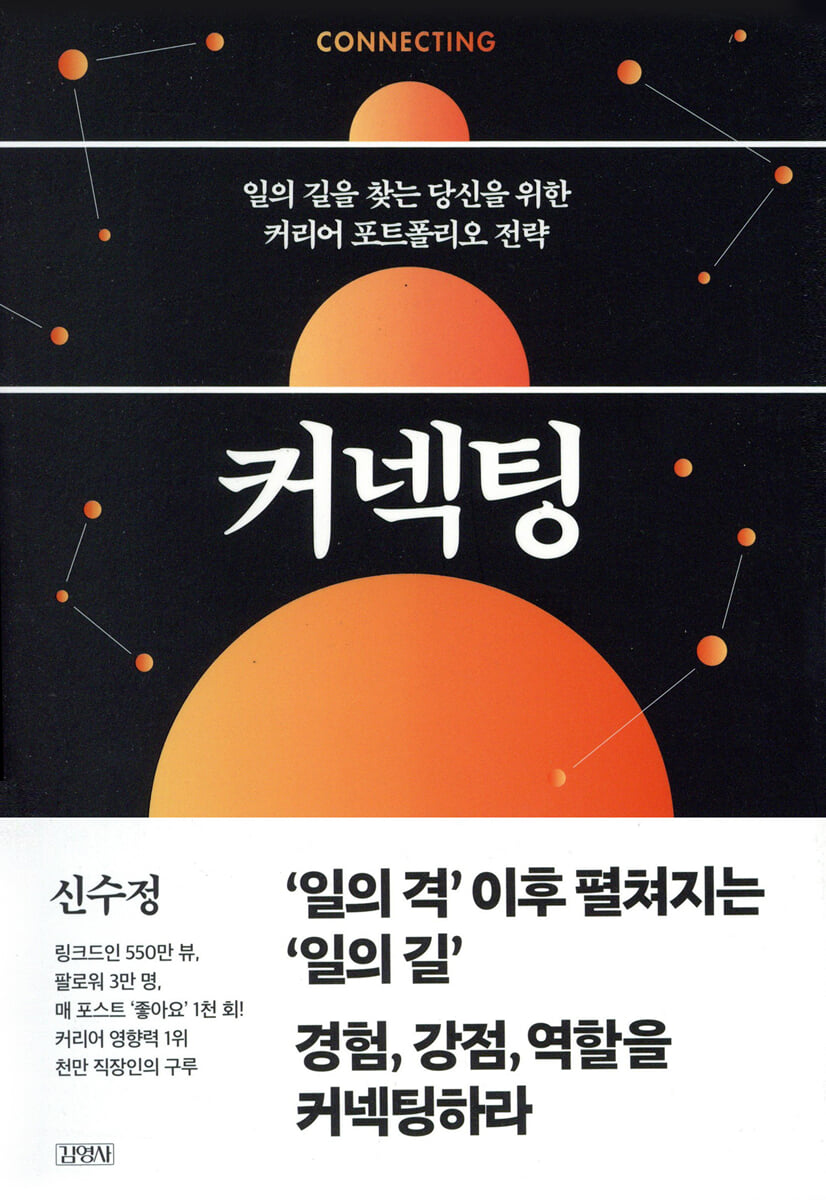
Connecting
 |
Description
Book Introduction
Shin Su-jeong's Career Textbook, Mentor to 10 Million Office Workers
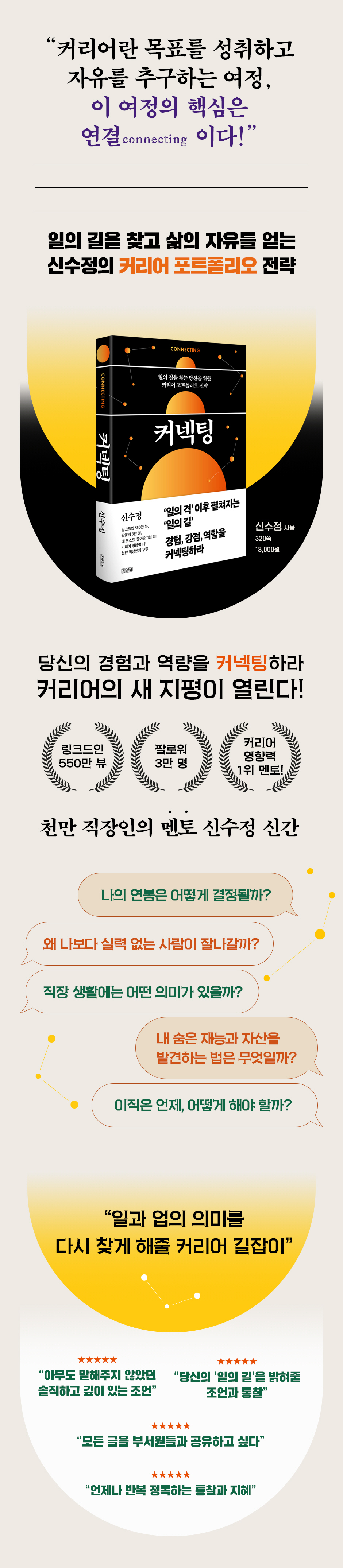
Career portfolio strategy to find your path in work and achieve freedom in life
Shin Su-jeong, a mentor to tens of millions of office workers who shares her experiences, wisdom, and insights about work and life on social media such as Facebook and LinkedIn, has published a new book titled "Connecting."
We propose a "career portfolio strategy" that focuses on career planning, implementation, and management in a rapidly changing workplace environment and circumstances.
A career portfolio is a strategy that involves spreading one's diverse experiences and capabilities across various areas of work and life, and flexibly connecting and combining them according to the situation and needs.
It is also in line with the concept of connecting the dots that Steve Jobs talked about.
Since 2013, author Shin Su-jeong has been publishing insights on social media about "how to do a good job" and "how to enrich your work and life."
Posts on Facebook, LinkedIn, and other platforms often receive thousands of likes and hundreds of comments.
While my previous work, "The Class of Work," a collection of serialized articles, discussed how people and organizations grow through work, this new book, "Connecting," offers career management and specific implementation methods that can be immediately applied in practice, as well as the mindset and attitude that strengthens your career.
It provides guidelines on how to discover and develop your talents, expand your career and demonstrate your accomplishments, practical strategies for starting a business or changing jobs, how to turn a hobby into a career, how to create career opportunities through networking, and how to create and utilize a career portfolio.
This book can be used by everyone, from students contemplating career choices, freshmen just starting out in their careers, those preparing to start a business or change jobs, team leaders and leaders managing and operating large and small organizations, and even executives nearing retirement.
In an era where "how quickly you learn and how flexibly you can respond" is becoming more important than "how much you know," I recommend "Connecting," which will guide you in career planning and execution.
Career portfolio strategy to find your path in work and achieve freedom in life
Shin Su-jeong, a mentor to tens of millions of office workers who shares her experiences, wisdom, and insights about work and life on social media such as Facebook and LinkedIn, has published a new book titled "Connecting."
We propose a "career portfolio strategy" that focuses on career planning, implementation, and management in a rapidly changing workplace environment and circumstances.
A career portfolio is a strategy that involves spreading one's diverse experiences and capabilities across various areas of work and life, and flexibly connecting and combining them according to the situation and needs.
It is also in line with the concept of connecting the dots that Steve Jobs talked about.
Since 2013, author Shin Su-jeong has been publishing insights on social media about "how to do a good job" and "how to enrich your work and life."
Posts on Facebook, LinkedIn, and other platforms often receive thousands of likes and hundreds of comments.
While my previous work, "The Class of Work," a collection of serialized articles, discussed how people and organizations grow through work, this new book, "Connecting," offers career management and specific implementation methods that can be immediately applied in practice, as well as the mindset and attitude that strengthens your career.
It provides guidelines on how to discover and develop your talents, expand your career and demonstrate your accomplishments, practical strategies for starting a business or changing jobs, how to turn a hobby into a career, how to create career opportunities through networking, and how to create and utilize a career portfolio.
This book can be used by everyone, from students contemplating career choices, freshmen just starting out in their careers, those preparing to start a business or change jobs, team leaders and leaders managing and operating large and small organizations, and even executives nearing retirement.
In an era where "how quickly you learn and how flexibly you can respond" is becoming more important than "how much you know," I recommend "Connecting," which will guide you in career planning and execution.
- You can preview some of the book's contents.
Preview
index
Part 1: Understanding Careers
[Career Reality] 1.
Things don't go as planned│2.
How are salaries determined?: Industry and industry perspectives│3.
How is salary determined?: A job perspective│4.
How is salary determined?: From the perspective of competency and expertise│5.
Another strategy to maximize your income
[Career Mechanism] 6.
What is the meaning of work life?│7.
Does work have to be fun?│8.
What perspective should I have on my work life?│9.
Mindset needed in a changing era│10.
From ‘Career Path’ to ‘Career Portfolio’│11.
How should I build my career?│12.
What is the most important advice?│13.
Career and the Matthew Effect│14.
In the first 10 years of your career│15.
Skills have little to do with years of experience│16.
Career Survival Secrets for Introverts and Those with Lack of Networking│17.
As a player and pro, not a walker│18.
Boundless Capabilities│19. Talents in the AI Era│20.
Life is long and retirement is early│21.
A career is a journey to achieve a mission and pursue freedom.
Part 2: Career Portfolio Strategy
[Career Planning and Design] 1.
Designing Your Career with a Career Portfolio│2. STEP 1.
Setting Purpose and Values│3. STEP 2.
Organizing Experience Blocks│4. STEP 3.
Identifying Strengths and Competencies │ 5. STEP 4.
Organizing Role Blocks│6. STEP 5.
Planning and Strategy │7.
Considerations When Developing a Career Strategy
[Career Exploration and Expansion] 8.
How to Discover Your Talent│9.
What are your hidden assets?│10.
How to View Your Weaknesses: Three Perspectives on Turning Weaknesses into Strengths│11.
Recommended job blocks for a competitive career│12.
Don't dig just one well│13.
Competitiveness lies in trying even seemingly useless things│14.
What You Can Learn from Big Companies│15.
Is heading into the bare ground just a waste?│16.
Differences between entrepreneurs and employees of large corporations│17.
The 10×10 Rule to Overcome Your Limits│18.
Build a weak solidarity│19.
Promotion Strategy│20.
Increase the chances that someone will find you│21.
The Art of Choosing a Career│22.
Don't Ignore the Power of Culture When Moving Careers│23.
What should you consider when moving from a large corporation to a global company or startup?│24.
Be mindful of these points when changing jobs│25.
Build your personal brand within the organization│26.
Advice for Women's Careers│27.
Include leadership in your career portfolio.
Part 3: Competencies and Attitudes that Strengthen Your Career Portfolio
Foundational competencies and attitudes for a career portfolio
[Based Competencies] 1.
Start with the results│2.
Approximate calculation ability│3.
Easy to write, easy to speak│4.
Developing Presentation Skills│5.
Conclusion first│6.
Start with the easy things│7.
Work with priorities
[Definition and expression of performance] 8.
What is performance?│9.
Performance Communication
[Learning and Practice] 10.
From input to output│11.
The Diseconomies of Time Shortening│12.
To relax, you need time to strengthen.│13.
Take on a slightly more difficult task│14.
You don't have to be twice as good as others to be twice as successful.
[Attitude] 15.
Can 'recent experience' help your career?│16.
Why do people who are less skilled than me do better than me?│17.
Anxiety Brings Growth│18.
Lack of passion and perseverance can be a blessing│19.
If you are sincere in small things, there is a high chance that luck will come to you│20.
There is a need to give up│21.
How to see your own blind spots?: The smarter and more successful you are, the more you need someone│22.
Does feedback necessarily help improve performance?│23.
Burnout Prevention│24.
Leisure is also a skill│25.
Look probabilistically, not decisively: The Dunning-Kruger effect
[Career Reality] 1.
Things don't go as planned│2.
How are salaries determined?: Industry and industry perspectives│3.
How is salary determined?: A job perspective│4.
How is salary determined?: From the perspective of competency and expertise│5.
Another strategy to maximize your income
[Career Mechanism] 6.
What is the meaning of work life?│7.
Does work have to be fun?│8.
What perspective should I have on my work life?│9.
Mindset needed in a changing era│10.
From ‘Career Path’ to ‘Career Portfolio’│11.
How should I build my career?│12.
What is the most important advice?│13.
Career and the Matthew Effect│14.
In the first 10 years of your career│15.
Skills have little to do with years of experience│16.
Career Survival Secrets for Introverts and Those with Lack of Networking│17.
As a player and pro, not a walker│18.
Boundless Capabilities│19. Talents in the AI Era│20.
Life is long and retirement is early│21.
A career is a journey to achieve a mission and pursue freedom.
Part 2: Career Portfolio Strategy
[Career Planning and Design] 1.
Designing Your Career with a Career Portfolio│2. STEP 1.
Setting Purpose and Values│3. STEP 2.
Organizing Experience Blocks│4. STEP 3.
Identifying Strengths and Competencies │ 5. STEP 4.
Organizing Role Blocks│6. STEP 5.
Planning and Strategy │7.
Considerations When Developing a Career Strategy
[Career Exploration and Expansion] 8.
How to Discover Your Talent│9.
What are your hidden assets?│10.
How to View Your Weaknesses: Three Perspectives on Turning Weaknesses into Strengths│11.
Recommended job blocks for a competitive career│12.
Don't dig just one well│13.
Competitiveness lies in trying even seemingly useless things│14.
What You Can Learn from Big Companies│15.
Is heading into the bare ground just a waste?│16.
Differences between entrepreneurs and employees of large corporations│17.
The 10×10 Rule to Overcome Your Limits│18.
Build a weak solidarity│19.
Promotion Strategy│20.
Increase the chances that someone will find you│21.
The Art of Choosing a Career│22.
Don't Ignore the Power of Culture When Moving Careers│23.
What should you consider when moving from a large corporation to a global company or startup?│24.
Be mindful of these points when changing jobs│25.
Build your personal brand within the organization│26.
Advice for Women's Careers│27.
Include leadership in your career portfolio.
Part 3: Competencies and Attitudes that Strengthen Your Career Portfolio
Foundational competencies and attitudes for a career portfolio
[Based Competencies] 1.
Start with the results│2.
Approximate calculation ability│3.
Easy to write, easy to speak│4.
Developing Presentation Skills│5.
Conclusion first│6.
Start with the easy things│7.
Work with priorities
[Definition and expression of performance] 8.
What is performance?│9.
Performance Communication
[Learning and Practice] 10.
From input to output│11.
The Diseconomies of Time Shortening│12.
To relax, you need time to strengthen.│13.
Take on a slightly more difficult task│14.
You don't have to be twice as good as others to be twice as successful.
[Attitude] 15.
Can 'recent experience' help your career?│16.
Why do people who are less skilled than me do better than me?│17.
Anxiety Brings Growth│18.
Lack of passion and perseverance can be a blessing│19.
If you are sincere in small things, there is a high chance that luck will come to you│20.
There is a need to give up│21.
How to see your own blind spots?: The smarter and more successful you are, the more you need someone│22.
Does feedback necessarily help improve performance?│23.
Burnout Prevention│24.
Leisure is also a skill│25.
Look probabilistically, not decisively: The Dunning-Kruger effect
Detailed image
Into the book
I would like to define career like this.
“A career is a journey to achieve a mission and pursue freedom.” One of the key elements of this journey is ‘connecting.’
This journey isn't all fun and games.
There are slopes, rocks, and piles of shit.
There will be worries, pain, and sorrow.
But the beauty of life is that all these things are interconnected.
That not a single experience is unnecessary or useless.
I hope readers will grow, build successful careers, and achieve high incomes through the wisdom and insights in this book.
But above all, I want to achieve what I want and enjoy freedom in my career journey.
--- p.13
When considering salary, here are some things to consider:
Are my industry and its structure capable of paying high salaries? What is the industry outlook? Is the structure ripe for higher salaries? Is it ripe for lower salaries? Is it destined to remain the same?
--- p.24
We must now acknowledge that age and ability are not proportional.
No professional gets paid more because they are older.
In traditional industrial structures, age and ability were almost proportional.
A little more experience meant more ability.
So, people without experience always had to be in a position to learn.
Of course, these characteristics persist in any job even now.
However, the degree of proportionality is decreasing compared to the past.
Especially in this era of rapid technological development, younger people can acquire skills and improve their capabilities more quickly than those with more experience.
--- p.62
If possible, choose a company with a good management infrastructure for your first or early-stage job.
And if possible, choose a fast-growing company, department, or job for your next career step.
Of course, it would be best if your first job is in a fast-growing company with good infrastructure.
--- p.83
There's no need to conclude that the experience of heading into bare ground is bad.
Of course, it is much more efficient to build something on top of a well-established system.
Learning, practicing, and finding mentors are essential, but sometimes it's also necessary to create something on your own before learning it.
There is a risk of repeating other people's mistakes, but you can also create from scratch without prejudice and develop your thinking skills.
--- p.186
Many self-help books tell you to know yourself first and then decide what you really want.
But unfortunately, it's hard to know who I am, what I'm good at, and what I want.
What's the way? Try a variety of actions.
Instead of worrying, try different things, meet different people, and discover your own potential.
In doing so, you must find a context and area where you can demonstrate your passion and achieve results.
“A career is a journey to achieve a mission and pursue freedom.” One of the key elements of this journey is ‘connecting.’
This journey isn't all fun and games.
There are slopes, rocks, and piles of shit.
There will be worries, pain, and sorrow.
But the beauty of life is that all these things are interconnected.
That not a single experience is unnecessary or useless.
I hope readers will grow, build successful careers, and achieve high incomes through the wisdom and insights in this book.
But above all, I want to achieve what I want and enjoy freedom in my career journey.
--- p.13
When considering salary, here are some things to consider:
Are my industry and its structure capable of paying high salaries? What is the industry outlook? Is the structure ripe for higher salaries? Is it ripe for lower salaries? Is it destined to remain the same?
--- p.24
We must now acknowledge that age and ability are not proportional.
No professional gets paid more because they are older.
In traditional industrial structures, age and ability were almost proportional.
A little more experience meant more ability.
So, people without experience always had to be in a position to learn.
Of course, these characteristics persist in any job even now.
However, the degree of proportionality is decreasing compared to the past.
Especially in this era of rapid technological development, younger people can acquire skills and improve their capabilities more quickly than those with more experience.
--- p.62
If possible, choose a company with a good management infrastructure for your first or early-stage job.
And if possible, choose a fast-growing company, department, or job for your next career step.
Of course, it would be best if your first job is in a fast-growing company with good infrastructure.
--- p.83
There's no need to conclude that the experience of heading into bare ground is bad.
Of course, it is much more efficient to build something on top of a well-established system.
Learning, practicing, and finding mentors are essential, but sometimes it's also necessary to create something on your own before learning it.
There is a risk of repeating other people's mistakes, but you can also create from scratch without prejudice and develop your thinking skills.
--- p.186
Many self-help books tell you to know yourself first and then decide what you really want.
But unfortunately, it's hard to know who I am, what I'm good at, and what I want.
What's the way? Try a variety of actions.
Instead of worrying, try different things, meet different people, and discover your own potential.
In doing so, you must find a context and area where you can demonstrate your passion and achieve results.
--- p.295
Publisher's Review
A new work by Shin Su-jeong, the mentor of 10 million office workers!
This book will be the North Star on your career journey to find your path and achieve freedom in life!
Connect with your 'career portfolio'!
Enthusiastic cheers from readers who read it first!
★ Insights and wisdom that I always read over and over again! ★ I want to share all the articles with my team members.
★ Honest and in-depth advice that breaks down prejudices that no one tells you about while living in society.
★ A writing that becomes flesh and blood for working people! ★ The path to becoming a professional is difficult.
Respect to all professionals around the world! ★ A career guide that rediscovers the meaning of work and vocation!
The lifespan of companies is getting shorter, while the lifespan of humans is getting longer.
It is difficult to sustain yourself for a lifetime with the skills you acquire at the beginning of your career.
No one can avoid the frequent job changes that professional soccer players experience.
We live in an era where we must even compete with AI.
From teenagers and freshmen contemplating their career paths, to experienced workers, executives, and retirees, the concerns of tens of millions of workers are all the same.
How should I build my career?
To this end, a new book, "Connecting," by Shin Su-jeong (Vice President of KT), a mentor to tens of millions of office workers, has been published, offering cool-headed solutions and realistic advice.
This book proposes a shift from a linear, single-track "career path" to a "career portfolio."
In the world from now on, 'how much do you know?' won't matter.
What's more important is how quickly you can learn? Can you connect and combine your experiences and capabilities? How flexibly can you respond to change?
This is the career portfolio strategy.
The methodology is 'connecting', which involves developing and unfolding one's diverse experiences and capabilities, and flexibly connecting and combining them whenever career needs arise.
The author, Shin Su-jeong, is a manager, connector, and borderless person.
I have gained experience and insight by working in various workplaces of various sizes and types, including startups, ventures, mid-sized companies, global companies, and large corporations.
His writings about his work and life on social media spread his influence by word of mouth, earning him the title of "Facebook Sage" and "Leadership Guru."
His previous works, "The Rise of Work" and "Time of Insight," became bestsellers immediately after publication, and readers continued to seek his positive influence and his cool-headed insights and practical solutions.
This "Connecting" has been a hot topic on Facebook and LinkedIn, receiving a warm response and sympathy for its honest and in-depth advice that no one has ever offered, as well as for suggesting new perspectives and directions for careers.
"Connecting" can be utilized by everyone, from students contemplating career choices, fresh graduates just starting out in their careers, those preparing to start a business or change jobs, team leaders and leaders managing and operating organizations large and small, to executives nearing retirement.
In an era where "how quickly you learn and how flexibly you can respond" is becoming more important than "how much you know," this book will serve as a North Star illuminating the career journey of those who are constantly changing, growing, and working.
“How should I plan my career?”
Shin Soo-jung's suggested career path: "Career Portfolio Strategy"
“How should I plan my career?”
This is a question that Shin Su-jeong, a mentor to tens of millions of office workers, often receives.
For professionals struggling to navigate their careers in an uncertain and rapidly changing world, Shin Soo-jung offers a career portfolio strategy.
In her new book, Connecting, Shin Soo-jung says, “Career experiences (of course) don’t go as expected.”
It often happens that you fail to get promoted, your boss who harasses you becomes more successful, the organization you work for suddenly disbands, or you have to change jobs urgently due to family circumstances, just as you thought your company life would be fun and last forever.
The author's career was like that too.
At the recommendation of an acquaintance, I was lucky enough to start my first job at a global IT company. However, I changed jobs six times while pursuing my doctorate, going through acquisitions, starting my own business, and changing jobs.
Thanks to his diverse career experience, the author has held positions ranging from a three-person venture to a mid-sized company managing over 800 people, and even a leadership role overseeing a multi-trillion-won business with thousands of employees.
Exposure to different types of systems and cultures gave me insight into how to navigate my career journey.
"Connecting" is a career textbook that embodies the insights and wisdom Shin Su-jeong has accumulated.
What insights does Shin Soo-jung offer in a world of recurring variables and coincidences? Does the fact that careers don't always go as predicted mean goals and plans are no longer necessary? The author argues that such times demand even more clear and systematic career management.
Even if your plans go awry due to unexpected events, if you have a well-organized planning process, you will be able to deal with any situation with ease.
The process of making a plan is more important than the plan itself.
Let's set our intentions and make plans.
But there's no need to be disappointed if things don't go as planned.
Let's experiment with different possibilities with curiosity, optimism, perseverance, flexibility, and risk-taking, and give back to those around us and meet many people.
If you do this, there is a high possibility that a coincidence or an unexpected benefactor will guide you.
You can adjust your plans accordingly.
(Page 21)
The author proposes a 'career portfolio strategy' as a tool to help set, plan, and execute career goals.
A career portfolio is a flexible way to organize and reorganize the experiences, strengths, capabilities, and roles you have accumulated so far or will accumulate in the future.
A career portfolio helps you understand what you're good at and what you enjoy, and it allows you to clearly outline your future goals, roles, and the conditions needed to achieve them.
It's a powerful toolbox that will help you plan your career and execute it.
"Connecting" first examines various career situations where the theory and case studies of career portfolio strategy can be applied.
This is advice from 'career guru' Shin Su-jeong on concerns that all professionals may experience.
1) What if you are a young adult who is just starting or about to start a career?
See 'How is your salary determined?' and 'The first 10 years of your career.'
Salary (income) is an important factor influencing career choice, job change, and career advancement.
However, many people often think that their salary is determined solely by their abilities and efforts.
This book explains that annual salary is influenced not only by ability but also by three more crucial factors: 'structural limitations of the industry,' 'specificity of the job,' and 'individual expertise and capabilities.'
The author suggests that career choices or job changes be made based on these three factors.
Aren't there other criteria for choosing a career besides salary? In response to a third-year employee's concern, "Is where and how much you earn the most important indicator of success?" the author advises, "For the first ten years of your career, prioritize an environment that fosters skill development over position or salary."
Because early career salaries don't make you rich.
If possible, it would be best to choose a place with a well-established management infrastructure and where you can learn a lot from your seniors.
If that's not the case, you should learn as much as you can from your current situation or get training from outside.
The way to do this is to develop expertise and then change jobs.
After about 10 years of this type of training, it becomes easier to choose a career based on your own goals, values, and tendencies.
Only those who have accumulated inner strength can make flexible choices.
2) What if you are a team member or team leader who is concerned about relationships within the organization?
See 'What does work life mean?'
The author argues that in the workplace, in addition to economic income, the needs for 'relationships, recognition, respect, and self-actualization' must be met.
If you think you have to work to earn money, you've given up on the rest of the benefits from the start.
At work, you can experience learning and growth, teamwork, the power of leading and encouraging, and making an impact and contributing to the world.
In these things, people find the meaning of life.
Of course, there are plenty of jobs that have different environments and the meaning of life that you seek.
Boring routines, mismatched coworkers and bosses are common.
Therefore, the author says that we must gain the strength to choose a job that will allow us to cultivate the expertise mentioned above and find meaning in life.
3) What if you are finishing your career?
'Life gets longer and retirement gets faster' is helpful.
In the past, when life was not long, it was common to spend time at home after retirement.
However, in these days called the 100-year era, the retirement age is also getting lower.
After retirement, some people work in other jobs or teach.
Or you can start a business or give lectures.
However, the author says it is important to plan ahead before leaving office.
It is necessary to build a solid economic foundation without wasting the professional skills you have accumulated during your active service.
It is said that people who are active even after retirement are not people who are stuck in their 'job' but who have created a 'vocation'.
In this way, even if the position or title disappears, it is possible to stand on one's own.
4) What if I am looking for a new opportunity through a job change or starting a business?
You can see 'Career Choice Skills' and 'Things to Keep in Mind When Changing Jobs'.
An individual's performance is achieved not only through his or her own abilities, but also through a combination of colleagues, superiors, and company systems.
When moving to a new environment, whether it's a job change or starting a business, you need to clearly understand what you're losing and what you're gaining.
So the author urges that there must be a reason for changing jobs.
You may consider changing jobs for reasons such as interpersonal relationships, salary, or culture.
Also, if possible, you should change jobs or start a business during a boom period, and you should not take a break after quitting your job and then look for a new job.
Looking for a job without any affiliation lowers your self-worth.
When you're worried, it's good to keep two things in mind.
First, clarify your selection criteria and set priorities.
If you are drawn to something but can't make a decision right away, you need to figure out what will change and what won't after you change jobs or start a business.
What's important here is making the right decision to choose, rather than the choice itself.
If the pros and cons are evenly balanced, you should stop worrying, flip a coin, and try to make the right decision.
Design and Implement a Career Portfolio Strategy
Block, connect, and reassemble
A career portfolio strategy is an effective and concrete tool that can be immediately applied to career management.
By preparing and managing your career portfolio in advance, you can respond flexibly and safely to situations that may arise tomorrow, such as resignation, job changes, or career changes.
A career portfolio strategy isn't just about trying things out.
Divide your strengths, capabilities, roles, and experiences into units or blocks, and arrange and recombine them to create various scenarios.
"Connecting" includes design, application, and real-world examples to help you immediately implement a career portfolio strategy.
This book proposes a career portfolio strategy divided into five steps.
1) Setting career goals and values
The first step in creating a career portfolio is to establish your desired career goals and values.
Goals could include 'making a lot of money and living comfortably', 'becoming an executive and exercising influence', or 'retiring early and living freely'.
If you have decided on a destination called your career goal, your values will become the compass that will help you get there.
Values can be external or material, such as wealth, popularity, status, and influence, or personal, such as learning, achievement, and security.
Sometimes relationships with family, friends, and community are given priority.
Career goals and values influence your attitude and behavior when pursuing or choosing a new career, and when working on your current job.
2) Organizing experience blocks
Every experience you have in life becomes a valuable career asset.
Experience blocks include schoolwork, certifications, work achievements, jobs, hobbies or group activities, and even travel or wandering.
There is no need to decide whether the experience is useful or not.
Even if something seems odd now, it can later lead to experiences that open up unexpected career options.
Steve Jobs's study of design and his trip to India also had a significant impact on Apple's success, connecting the dots.
3) Identifying strengths and competency blocks
Based on the experience blocks, you can draw out what you are good at, that is, your strengths and capabilities.
Strengths include overall personality, attitude, and character, while competencies refer to the abilities and skills required from a job perspective.
List the areas in which you excel academically, areas in which you have achieved success at work, and your expertise and business skills.
Strengths and capabilities should focus on discovering what is hidden, strengthening what has already been discovered, and developing what will be needed in the future.
This area includes academic aptitude, judgment, optimism, enthusiasm, learning ability, problem-solving skills, communication or presentation skills, and even networking skills.
4) Organizing role blocks
Draw on the roles you have played in your career experience.
It includes what duties and roles you held in informal or formal settings.
There are roles within the company organization, such as team member, team leader, and manager, and there are also positions in other groups, such as professor, writer, and community leader.
Furthermore, I will also organize the roles I would like to take on in the future.
Important criteria to consider here are how competitive I am in the role, how much I earn from the role, and how much fun and motivation I find in the role.
Through this evaluation, we create blocks of past, present, and future roles.
5) Planning and strategizing
The final step in building a career portfolio is to establish your "to-be" goals and strategies.
Let's gather together the career blocks we've organized so far and think about what makes them different and how we can utilize them.
Review your current career portfolio, envision the portfolio you want to have, and derive strategies and key tasks to achieve it.
For example, if you are a 3rd year employee, the past 3 years of work become an experience block.
Curiosity, passion, and learning ability become strength blocks, and communication skills become competency blocks.
Role blocks might be marketer, blogger, or writer.
Based on this, set short-term or long-term 'to-be' goals.
You can also become a leader in an organization or publish a book to build your own brand.
Alternatively, simply increasing profits by 30% or more could be the goal.
If we summarize it this way, the strategy becomes clear.
There are ways to move to an organization that can provide a raise or leadership position.
Or, taking a class to help you publish a book can also be a strategy.
In this way, a career portfolio helps you clarify your goals and objectives, differentiate yourself by combining and connecting your building blocks, and develop realistic strategies and plans.
“Why do people who are less capable than me do better than me?”
The skills and attitudes needed to build a successful career
"Connecting" also suggests "basic competencies" and "attitudes" that differentiate you from others in executing your career portfolio.
People working in the same company or organization do not pursue the same career paths because they each have different basic capabilities and attitudes.
Basic competencies are the so-called 'how to do a good job' that provide a solid foundation for doing work at the workplace.
This book focuses on the ability to plan the present by calculating backwards from results, the ability to make rough calculations, the ability to summarize, the ability to speak and write simply, and the ability to set priorities and work.
Attitude is as important as ability.
Even if you have excellent work skills and abilities, if you lack attitude, you will not last long.
Attitude doesn't create short-term results, but it does create value over time.
This book suggests confidence, sincerity, attitude toward failure and giving up, and leisure.
It may seem obvious, but the author reminds us that attitude always makes a difference.
This book will be the North Star on your career journey to find your path and achieve freedom in life!
Connect with your 'career portfolio'!
Enthusiastic cheers from readers who read it first!
★ Insights and wisdom that I always read over and over again! ★ I want to share all the articles with my team members.
★ Honest and in-depth advice that breaks down prejudices that no one tells you about while living in society.
★ A writing that becomes flesh and blood for working people! ★ The path to becoming a professional is difficult.
Respect to all professionals around the world! ★ A career guide that rediscovers the meaning of work and vocation!
The lifespan of companies is getting shorter, while the lifespan of humans is getting longer.
It is difficult to sustain yourself for a lifetime with the skills you acquire at the beginning of your career.
No one can avoid the frequent job changes that professional soccer players experience.
We live in an era where we must even compete with AI.
From teenagers and freshmen contemplating their career paths, to experienced workers, executives, and retirees, the concerns of tens of millions of workers are all the same.
How should I build my career?
To this end, a new book, "Connecting," by Shin Su-jeong (Vice President of KT), a mentor to tens of millions of office workers, has been published, offering cool-headed solutions and realistic advice.
This book proposes a shift from a linear, single-track "career path" to a "career portfolio."
In the world from now on, 'how much do you know?' won't matter.
What's more important is how quickly you can learn? Can you connect and combine your experiences and capabilities? How flexibly can you respond to change?
This is the career portfolio strategy.
The methodology is 'connecting', which involves developing and unfolding one's diverse experiences and capabilities, and flexibly connecting and combining them whenever career needs arise.
The author, Shin Su-jeong, is a manager, connector, and borderless person.
I have gained experience and insight by working in various workplaces of various sizes and types, including startups, ventures, mid-sized companies, global companies, and large corporations.
His writings about his work and life on social media spread his influence by word of mouth, earning him the title of "Facebook Sage" and "Leadership Guru."
His previous works, "The Rise of Work" and "Time of Insight," became bestsellers immediately after publication, and readers continued to seek his positive influence and his cool-headed insights and practical solutions.
This "Connecting" has been a hot topic on Facebook and LinkedIn, receiving a warm response and sympathy for its honest and in-depth advice that no one has ever offered, as well as for suggesting new perspectives and directions for careers.
"Connecting" can be utilized by everyone, from students contemplating career choices, fresh graduates just starting out in their careers, those preparing to start a business or change jobs, team leaders and leaders managing and operating organizations large and small, to executives nearing retirement.
In an era where "how quickly you learn and how flexibly you can respond" is becoming more important than "how much you know," this book will serve as a North Star illuminating the career journey of those who are constantly changing, growing, and working.
“How should I plan my career?”
Shin Soo-jung's suggested career path: "Career Portfolio Strategy"
“How should I plan my career?”
This is a question that Shin Su-jeong, a mentor to tens of millions of office workers, often receives.
For professionals struggling to navigate their careers in an uncertain and rapidly changing world, Shin Soo-jung offers a career portfolio strategy.
In her new book, Connecting, Shin Soo-jung says, “Career experiences (of course) don’t go as expected.”
It often happens that you fail to get promoted, your boss who harasses you becomes more successful, the organization you work for suddenly disbands, or you have to change jobs urgently due to family circumstances, just as you thought your company life would be fun and last forever.
The author's career was like that too.
At the recommendation of an acquaintance, I was lucky enough to start my first job at a global IT company. However, I changed jobs six times while pursuing my doctorate, going through acquisitions, starting my own business, and changing jobs.
Thanks to his diverse career experience, the author has held positions ranging from a three-person venture to a mid-sized company managing over 800 people, and even a leadership role overseeing a multi-trillion-won business with thousands of employees.
Exposure to different types of systems and cultures gave me insight into how to navigate my career journey.
"Connecting" is a career textbook that embodies the insights and wisdom Shin Su-jeong has accumulated.
What insights does Shin Soo-jung offer in a world of recurring variables and coincidences? Does the fact that careers don't always go as predicted mean goals and plans are no longer necessary? The author argues that such times demand even more clear and systematic career management.
Even if your plans go awry due to unexpected events, if you have a well-organized planning process, you will be able to deal with any situation with ease.
The process of making a plan is more important than the plan itself.
Let's set our intentions and make plans.
But there's no need to be disappointed if things don't go as planned.
Let's experiment with different possibilities with curiosity, optimism, perseverance, flexibility, and risk-taking, and give back to those around us and meet many people.
If you do this, there is a high possibility that a coincidence or an unexpected benefactor will guide you.
You can adjust your plans accordingly.
(Page 21)
The author proposes a 'career portfolio strategy' as a tool to help set, plan, and execute career goals.
A career portfolio is a flexible way to organize and reorganize the experiences, strengths, capabilities, and roles you have accumulated so far or will accumulate in the future.
A career portfolio helps you understand what you're good at and what you enjoy, and it allows you to clearly outline your future goals, roles, and the conditions needed to achieve them.
It's a powerful toolbox that will help you plan your career and execute it.
"Connecting" first examines various career situations where the theory and case studies of career portfolio strategy can be applied.
This is advice from 'career guru' Shin Su-jeong on concerns that all professionals may experience.
1) What if you are a young adult who is just starting or about to start a career?
See 'How is your salary determined?' and 'The first 10 years of your career.'
Salary (income) is an important factor influencing career choice, job change, and career advancement.
However, many people often think that their salary is determined solely by their abilities and efforts.
This book explains that annual salary is influenced not only by ability but also by three more crucial factors: 'structural limitations of the industry,' 'specificity of the job,' and 'individual expertise and capabilities.'
The author suggests that career choices or job changes be made based on these three factors.
Aren't there other criteria for choosing a career besides salary? In response to a third-year employee's concern, "Is where and how much you earn the most important indicator of success?" the author advises, "For the first ten years of your career, prioritize an environment that fosters skill development over position or salary."
Because early career salaries don't make you rich.
If possible, it would be best to choose a place with a well-established management infrastructure and where you can learn a lot from your seniors.
If that's not the case, you should learn as much as you can from your current situation or get training from outside.
The way to do this is to develop expertise and then change jobs.
After about 10 years of this type of training, it becomes easier to choose a career based on your own goals, values, and tendencies.
Only those who have accumulated inner strength can make flexible choices.
2) What if you are a team member or team leader who is concerned about relationships within the organization?
See 'What does work life mean?'
The author argues that in the workplace, in addition to economic income, the needs for 'relationships, recognition, respect, and self-actualization' must be met.
If you think you have to work to earn money, you've given up on the rest of the benefits from the start.
At work, you can experience learning and growth, teamwork, the power of leading and encouraging, and making an impact and contributing to the world.
In these things, people find the meaning of life.
Of course, there are plenty of jobs that have different environments and the meaning of life that you seek.
Boring routines, mismatched coworkers and bosses are common.
Therefore, the author says that we must gain the strength to choose a job that will allow us to cultivate the expertise mentioned above and find meaning in life.
3) What if you are finishing your career?
'Life gets longer and retirement gets faster' is helpful.
In the past, when life was not long, it was common to spend time at home after retirement.
However, in these days called the 100-year era, the retirement age is also getting lower.
After retirement, some people work in other jobs or teach.
Or you can start a business or give lectures.
However, the author says it is important to plan ahead before leaving office.
It is necessary to build a solid economic foundation without wasting the professional skills you have accumulated during your active service.
It is said that people who are active even after retirement are not people who are stuck in their 'job' but who have created a 'vocation'.
In this way, even if the position or title disappears, it is possible to stand on one's own.
4) What if I am looking for a new opportunity through a job change or starting a business?
You can see 'Career Choice Skills' and 'Things to Keep in Mind When Changing Jobs'.
An individual's performance is achieved not only through his or her own abilities, but also through a combination of colleagues, superiors, and company systems.
When moving to a new environment, whether it's a job change or starting a business, you need to clearly understand what you're losing and what you're gaining.
So the author urges that there must be a reason for changing jobs.
You may consider changing jobs for reasons such as interpersonal relationships, salary, or culture.
Also, if possible, you should change jobs or start a business during a boom period, and you should not take a break after quitting your job and then look for a new job.
Looking for a job without any affiliation lowers your self-worth.
When you're worried, it's good to keep two things in mind.
First, clarify your selection criteria and set priorities.
If you are drawn to something but can't make a decision right away, you need to figure out what will change and what won't after you change jobs or start a business.
What's important here is making the right decision to choose, rather than the choice itself.
If the pros and cons are evenly balanced, you should stop worrying, flip a coin, and try to make the right decision.
Design and Implement a Career Portfolio Strategy
Block, connect, and reassemble
A career portfolio strategy is an effective and concrete tool that can be immediately applied to career management.
By preparing and managing your career portfolio in advance, you can respond flexibly and safely to situations that may arise tomorrow, such as resignation, job changes, or career changes.
A career portfolio strategy isn't just about trying things out.
Divide your strengths, capabilities, roles, and experiences into units or blocks, and arrange and recombine them to create various scenarios.
"Connecting" includes design, application, and real-world examples to help you immediately implement a career portfolio strategy.
This book proposes a career portfolio strategy divided into five steps.
1) Setting career goals and values
The first step in creating a career portfolio is to establish your desired career goals and values.
Goals could include 'making a lot of money and living comfortably', 'becoming an executive and exercising influence', or 'retiring early and living freely'.
If you have decided on a destination called your career goal, your values will become the compass that will help you get there.
Values can be external or material, such as wealth, popularity, status, and influence, or personal, such as learning, achievement, and security.
Sometimes relationships with family, friends, and community are given priority.
Career goals and values influence your attitude and behavior when pursuing or choosing a new career, and when working on your current job.
2) Organizing experience blocks
Every experience you have in life becomes a valuable career asset.
Experience blocks include schoolwork, certifications, work achievements, jobs, hobbies or group activities, and even travel or wandering.
There is no need to decide whether the experience is useful or not.
Even if something seems odd now, it can later lead to experiences that open up unexpected career options.
Steve Jobs's study of design and his trip to India also had a significant impact on Apple's success, connecting the dots.
3) Identifying strengths and competency blocks
Based on the experience blocks, you can draw out what you are good at, that is, your strengths and capabilities.
Strengths include overall personality, attitude, and character, while competencies refer to the abilities and skills required from a job perspective.
List the areas in which you excel academically, areas in which you have achieved success at work, and your expertise and business skills.
Strengths and capabilities should focus on discovering what is hidden, strengthening what has already been discovered, and developing what will be needed in the future.
This area includes academic aptitude, judgment, optimism, enthusiasm, learning ability, problem-solving skills, communication or presentation skills, and even networking skills.
4) Organizing role blocks
Draw on the roles you have played in your career experience.
It includes what duties and roles you held in informal or formal settings.
There are roles within the company organization, such as team member, team leader, and manager, and there are also positions in other groups, such as professor, writer, and community leader.
Furthermore, I will also organize the roles I would like to take on in the future.
Important criteria to consider here are how competitive I am in the role, how much I earn from the role, and how much fun and motivation I find in the role.
Through this evaluation, we create blocks of past, present, and future roles.
5) Planning and strategizing
The final step in building a career portfolio is to establish your "to-be" goals and strategies.
Let's gather together the career blocks we've organized so far and think about what makes them different and how we can utilize them.
Review your current career portfolio, envision the portfolio you want to have, and derive strategies and key tasks to achieve it.
For example, if you are a 3rd year employee, the past 3 years of work become an experience block.
Curiosity, passion, and learning ability become strength blocks, and communication skills become competency blocks.
Role blocks might be marketer, blogger, or writer.
Based on this, set short-term or long-term 'to-be' goals.
You can also become a leader in an organization or publish a book to build your own brand.
Alternatively, simply increasing profits by 30% or more could be the goal.
If we summarize it this way, the strategy becomes clear.
There are ways to move to an organization that can provide a raise or leadership position.
Or, taking a class to help you publish a book can also be a strategy.
In this way, a career portfolio helps you clarify your goals and objectives, differentiate yourself by combining and connecting your building blocks, and develop realistic strategies and plans.
“Why do people who are less capable than me do better than me?”
The skills and attitudes needed to build a successful career
"Connecting" also suggests "basic competencies" and "attitudes" that differentiate you from others in executing your career portfolio.
People working in the same company or organization do not pursue the same career paths because they each have different basic capabilities and attitudes.
Basic competencies are the so-called 'how to do a good job' that provide a solid foundation for doing work at the workplace.
This book focuses on the ability to plan the present by calculating backwards from results, the ability to make rough calculations, the ability to summarize, the ability to speak and write simply, and the ability to set priorities and work.
Attitude is as important as ability.
Even if you have excellent work skills and abilities, if you lack attitude, you will not last long.
Attitude doesn't create short-term results, but it does create value over time.
This book suggests confidence, sincerity, attitude toward failure and giving up, and leisure.
It may seem obvious, but the author reminds us that attitude always makes a difference.
GOODS SPECIFICS
- Date of issue: February 19, 2024
- Page count, weight, size: 320 pages | 414g | 140*205*25mm
- ISBN13: 9788934965145
You may also like
카테고리
korean


korean

![GQ KOREA Mark (Monthly): December [2025]](http://librairie.coreenne.fr/cdn/shop/files/8ef265dbbfbf186523ed75ba7319009d.jpg?v=1765340328&width=3840)


