

The Secret of Pain
 |
Description
Book Introduction
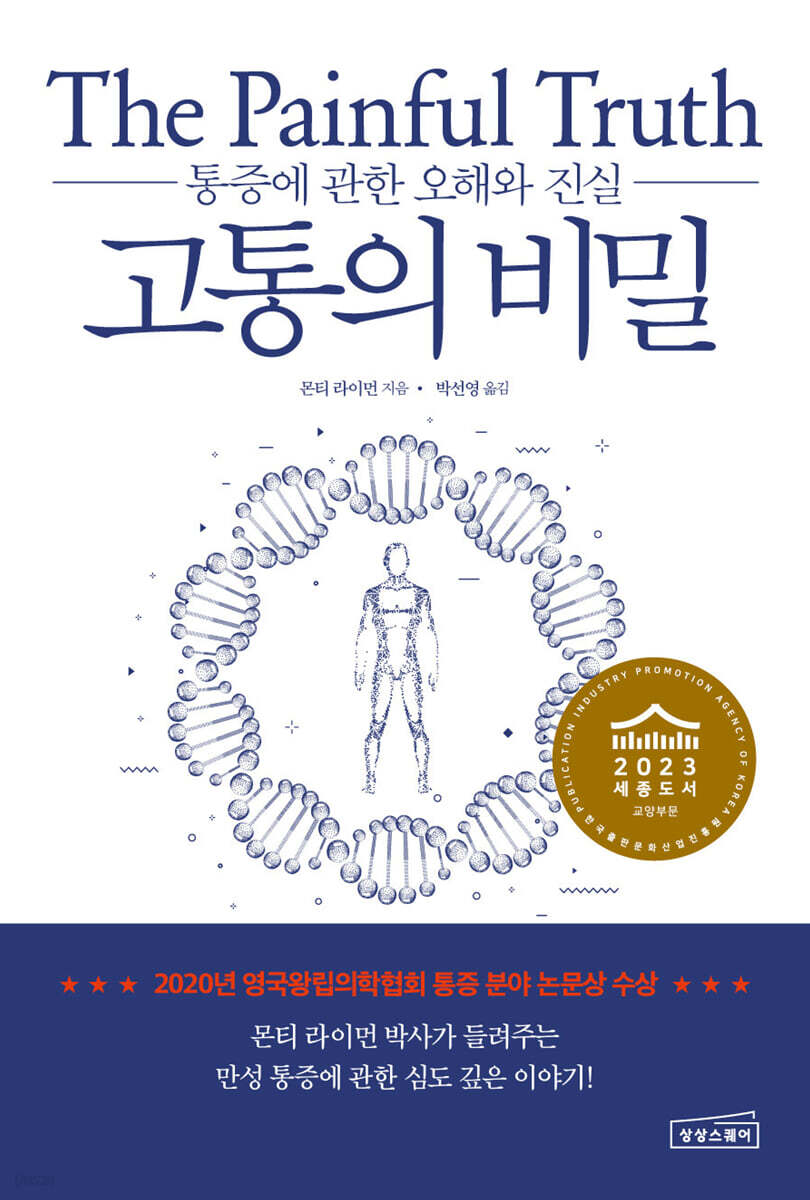
2020 Royal Society of Medicine Pain Research Award An in-depth look at chronic pain from Dr. Monty Lyman! Today we are experiencing a golden age of pain science. Our understanding of pain has changed dramatically in recent years. It is no exaggeration to say that everything we knew about pain was wrong. As Dr. Monty Lyman says, the price of misunderstanding pain is too high. This book explores the mysteries of pain, from phantom pain to chronic pain, through a variety of case studies demonstrating the extremes of pain and cutting-edge neuroscience research. Dr. Lyman not only offers hope for relief from excruciating pain, but ultimately offers profound insights into what it means to be human. |
- You can preview some of the book's contents.
Preview
index
Introduction
prolog
Chapter 1: What is the nature of pain?
_The defense system that protects my body
Chapter 2: Is a Pain-Free Life a Blessing?
_Stories of people who can't feel pain
Chapter 3: New Topics in Pain Science
Pain relief using distraction and imagination
Chapter 4: Does the Placebo Effect Really Exist?
_The effect of expectation and prediction
Chapter 5: What Does Pain Mean?
_Emotional factors of pain
Chapter 6: Pain Can Be Enjoyable
The Duality of Pain and Pleasure
Chapter 7: Why Pain Is So Contagious
_The meaning of pain as understood by neural resonance
Chapter 8: Pay Attention to Social Pain
_Heartache
Chapter 9: The Relationship Between Race, Culture, Belief, and Pain
_A message of acceptance and hope
Chapter 10: Plagues in Modern Society
Modern life that worsens chronic pain
Chapter 11: Why the Pain Doesn't Go Away
_The Secret of Pain Revealed by Neuroplasticity
Chapter 12: In Search of New Hope
A Revolution in Pain Management
Acknowledgements
Glossary
References
Search
prolog
Chapter 1: What is the nature of pain?
_The defense system that protects my body
Chapter 2: Is a Pain-Free Life a Blessing?
_Stories of people who can't feel pain
Chapter 3: New Topics in Pain Science
Pain relief using distraction and imagination
Chapter 4: Does the Placebo Effect Really Exist?
_The effect of expectation and prediction
Chapter 5: What Does Pain Mean?
_Emotional factors of pain
Chapter 6: Pain Can Be Enjoyable
The Duality of Pain and Pleasure
Chapter 7: Why Pain Is So Contagious
_The meaning of pain as understood by neural resonance
Chapter 8: Pay Attention to Social Pain
_Heartache
Chapter 9: The Relationship Between Race, Culture, Belief, and Pain
_A message of acceptance and hope
Chapter 10: Plagues in Modern Society
Modern life that worsens chronic pain
Chapter 11: Why the Pain Doesn't Go Away
_The Secret of Pain Revealed by Neuroplasticity
Chapter 12: In Search of New Hope
A Revolution in Pain Management
Acknowledgements
Glossary
References
Search
Detailed image
.jpg)
Into the book
The statement that “pain is a protective response from our body” is not a definition of pain, but an absolute truth about pain.
This is the truth, as told by the countless studies and interviews in this book, and explains why pain is so strange and capricious, and why it often persists even after a wound has healed.
We will never understand this aspect of pain if we remain confined to the idea that pain is a direct measure of damage.
Understanding that pain is a protective response and does not necessarily provide accurate information about tissue damage is the first step to healing your body and mind.
--- p.34, from “Chapter 1 ‘What is the nature of pain?’”
You can think of pain as an overly loyal companion dog or an overreacting police officer.
In any case, it is important to know that pain can occur even without physical damage.
Chronic pain, especially persistent pain, is often caused by the brain's overprotection.
The most effective treatments for chronic pain are evidence-based treatments.
In other words, it is a method of reducing evidence that threatens the brain and continuing to provide reassuring evidence.
Denying your current state and 'fighting' the pain does not work.
Methods that attempt to eliminate problems that are thought to be present in the body's tissues are also rarely effective.
Well, that's the way the treatment is intended to work anyway.
Modern medicine likes to talk about fighting disease.
Unless the body is under attack from an external infectious agent like the coronavirus or a malfunctioning cell like a cancer cell, pain is a response to help us, so the expression "fighting pain" is not appropriate.
Pain is our bodyguard and guardian angel.
He is a dear friend and doctor.
Even when life is difficult due to pain, knowing that pain is always there to protect our bodies is the first step to living with chronic pain, and even reducing or eliminating it.
--- p.44~45, from “Chapter 1 ‘What is the nature of pain?’”
The brain's expectations and predictions have a profound impact on our perception of pain.
This is something that is difficult to understand with the mind-body dualism that is the basis of Western medicine.
It will take some time to know whether open-label placebos really work.
However, there are many ways to reduce pain and improve quality of life through the 'expectation effect'.
First, creating a positive treatment environment, such as the physical environment of the treatment room or the doctor's attitude, should be a mandatory requirement rather than an additional service.
Additionally, those in a position to care for patients should strive to create an environment that fosters trust, avoids language that unnecessarily causes anxiety, reinforces positive associations, and instills realistic and positive reassurances.
Utilizing the expectancy effect is not about giving a placebo or recommending a treatment that works solely on the placebo effect, but rather about building confidence in the cure and reducing anxiety based on accurate information.
Above all, it humanizes the practice of medicine, allowing both those receiving treatment and those providing it to focus on hope and recovery.
--- p.118, from Chapter 4, “Does the Placebo Effect Really Exist?”
A brain region called the anterior cingulate cortex is responsible for blending emotional and sensory input to create a single, integrated experience.
If we look at it from the perspective of a baker, it can be likened to a master baker at the highest level.
This boomerang-shaped area is located between the limbic system, which is involved in 'emotions', and the prefrontal cortex, which is involved in 'cognitive' functions. Knowing this anatomical structure is important to understanding the role of the anterior cingulate cortex.
The anterior cingulate cortex monitors the flow of sensory information from the body to the brain, such as the danger signals felt by your toes when your foot hits a doorframe.
The anterior cingulate cortex is constantly monitoring our bodies for any danger or damage, but it goes beyond detecting pain to play a higher role in understanding the meaning of pain.
In other words, the anterior cingulate cortex sits atop a sort of ivory tower called the prefrontal cortex, seeking the "meaning" of pain rather than wasting energy figuring out trivial details like where danger signals are coming from.
So when we feel emotions like alienation, anxiety, or depression, we integrate physical, emotional, and social factors to interpret the meaning of the pain.
The anterior cingulate cortex is involved in making us feel real hurt and pain when someone hurts our feelings.
So it's activated not only when we feel physical pain, but also when we feel the pain of being abandoned.
--- p.125, from “Chapter 5 ‘What is the meaning of pain?’”
If people living with chronic pain can develop control and coping skills regarding their pain, they can reduce the intensity and discomfort of the pain itself.
The best way is to know exactly what the pain is.
You have to be able to tell what is real pain and what is not.
And we have to learn how to cope with pain.
--- p.132, from Chapter 5, “What is the meaning of pain?”
The most important thing when helping people who are in pain is to recognize that pain is highly contagious.
Understanding that pain is contagious is the starting point for helping those suffering from pain and the first step toward understanding how to turn empathy into practical action.
--- p.180, from Chapter 7, “Why is pain so contagious?”
For many people, singing, dancing, exercise, and religious activities provide better pain relief than drugs because they allow them to form positive, regular connections with others.
However, it is not necessary to interact with many people to have a pain-relieving effect.
When it comes to managing chronic pain, simple friendships can be more powerful than morphine.
Additionally, Robin Dunbar's research team at Oxford University discovered that people with a wider range of interpersonal relationships have higher pain thresholds.
Active social interactions help relieve pain by binding endorphins to opioid receptors.
These results also demonstrate that social isolation, depression, and chronic pain are closely related.
Meaningful interactions don't just reduce pain.
Building good relationships is beneficial to all aspects of your mental and physical health.
--- p.188, from “Chapter 8 ‘Pay Attention to Social Pain’”
Pain is a response to protect our body.
That's the truth about pain.
What we can do on a personal and societal level is to reduce stress and increase stability.
--- p.236, from “Chapter 10 ‘Plagues of Modern Society’”
The more pain you anticipate, the more pain your brain generates, and the more pain you generate, the more pain you anticipate.
As this process is repeated, the effect of the self-fulfilling prophecy becomes more and more amplified.
Humans are prone to confirmation bias and are more interested in information that supports their beliefs.
Moreover, the human brain has a strong pessimistic tendency when it comes to survival issues.
It's easy to feel pain, but once you feel it, it doesn't go away easily.
That's why we often don't realize that our wounds are healing and our bodies are getting better.
--- p.243, from “Chapter 11 ‘Why the Pain Doesn’t Go Away’”
Ultimately, because pain manifests differently from person to person, the approach to treatment should also vary from person to person.
Pain wants to protect the whole human being.
Therefore, to reduce pain and make the brain feel at ease, we need to address all aspects of the human experience.
Sean C., a pain specialist at Stanford University.
Mackey put it this way:
“Chronic pain is not just a physical problem, nor is it just a brain problem.
Anything can be a problem.
So we need to look at the whole thing.
“We must reclaim our entire lives.”
This is the truth, as told by the countless studies and interviews in this book, and explains why pain is so strange and capricious, and why it often persists even after a wound has healed.
We will never understand this aspect of pain if we remain confined to the idea that pain is a direct measure of damage.
Understanding that pain is a protective response and does not necessarily provide accurate information about tissue damage is the first step to healing your body and mind.
--- p.34, from “Chapter 1 ‘What is the nature of pain?’”
You can think of pain as an overly loyal companion dog or an overreacting police officer.
In any case, it is important to know that pain can occur even without physical damage.
Chronic pain, especially persistent pain, is often caused by the brain's overprotection.
The most effective treatments for chronic pain are evidence-based treatments.
In other words, it is a method of reducing evidence that threatens the brain and continuing to provide reassuring evidence.
Denying your current state and 'fighting' the pain does not work.
Methods that attempt to eliminate problems that are thought to be present in the body's tissues are also rarely effective.
Well, that's the way the treatment is intended to work anyway.
Modern medicine likes to talk about fighting disease.
Unless the body is under attack from an external infectious agent like the coronavirus or a malfunctioning cell like a cancer cell, pain is a response to help us, so the expression "fighting pain" is not appropriate.
Pain is our bodyguard and guardian angel.
He is a dear friend and doctor.
Even when life is difficult due to pain, knowing that pain is always there to protect our bodies is the first step to living with chronic pain, and even reducing or eliminating it.
--- p.44~45, from “Chapter 1 ‘What is the nature of pain?’”
The brain's expectations and predictions have a profound impact on our perception of pain.
This is something that is difficult to understand with the mind-body dualism that is the basis of Western medicine.
It will take some time to know whether open-label placebos really work.
However, there are many ways to reduce pain and improve quality of life through the 'expectation effect'.
First, creating a positive treatment environment, such as the physical environment of the treatment room or the doctor's attitude, should be a mandatory requirement rather than an additional service.
Additionally, those in a position to care for patients should strive to create an environment that fosters trust, avoids language that unnecessarily causes anxiety, reinforces positive associations, and instills realistic and positive reassurances.
Utilizing the expectancy effect is not about giving a placebo or recommending a treatment that works solely on the placebo effect, but rather about building confidence in the cure and reducing anxiety based on accurate information.
Above all, it humanizes the practice of medicine, allowing both those receiving treatment and those providing it to focus on hope and recovery.
--- p.118, from Chapter 4, “Does the Placebo Effect Really Exist?”
A brain region called the anterior cingulate cortex is responsible for blending emotional and sensory input to create a single, integrated experience.
If we look at it from the perspective of a baker, it can be likened to a master baker at the highest level.
This boomerang-shaped area is located between the limbic system, which is involved in 'emotions', and the prefrontal cortex, which is involved in 'cognitive' functions. Knowing this anatomical structure is important to understanding the role of the anterior cingulate cortex.
The anterior cingulate cortex monitors the flow of sensory information from the body to the brain, such as the danger signals felt by your toes when your foot hits a doorframe.
The anterior cingulate cortex is constantly monitoring our bodies for any danger or damage, but it goes beyond detecting pain to play a higher role in understanding the meaning of pain.
In other words, the anterior cingulate cortex sits atop a sort of ivory tower called the prefrontal cortex, seeking the "meaning" of pain rather than wasting energy figuring out trivial details like where danger signals are coming from.
So when we feel emotions like alienation, anxiety, or depression, we integrate physical, emotional, and social factors to interpret the meaning of the pain.
The anterior cingulate cortex is involved in making us feel real hurt and pain when someone hurts our feelings.
So it's activated not only when we feel physical pain, but also when we feel the pain of being abandoned.
--- p.125, from “Chapter 5 ‘What is the meaning of pain?’”
If people living with chronic pain can develop control and coping skills regarding their pain, they can reduce the intensity and discomfort of the pain itself.
The best way is to know exactly what the pain is.
You have to be able to tell what is real pain and what is not.
And we have to learn how to cope with pain.
--- p.132, from Chapter 5, “What is the meaning of pain?”
The most important thing when helping people who are in pain is to recognize that pain is highly contagious.
Understanding that pain is contagious is the starting point for helping those suffering from pain and the first step toward understanding how to turn empathy into practical action.
--- p.180, from Chapter 7, “Why is pain so contagious?”
For many people, singing, dancing, exercise, and religious activities provide better pain relief than drugs because they allow them to form positive, regular connections with others.
However, it is not necessary to interact with many people to have a pain-relieving effect.
When it comes to managing chronic pain, simple friendships can be more powerful than morphine.
Additionally, Robin Dunbar's research team at Oxford University discovered that people with a wider range of interpersonal relationships have higher pain thresholds.
Active social interactions help relieve pain by binding endorphins to opioid receptors.
These results also demonstrate that social isolation, depression, and chronic pain are closely related.
Meaningful interactions don't just reduce pain.
Building good relationships is beneficial to all aspects of your mental and physical health.
--- p.188, from “Chapter 8 ‘Pay Attention to Social Pain’”
Pain is a response to protect our body.
That's the truth about pain.
What we can do on a personal and societal level is to reduce stress and increase stability.
--- p.236, from “Chapter 10 ‘Plagues of Modern Society’”
The more pain you anticipate, the more pain your brain generates, and the more pain you generate, the more pain you anticipate.
As this process is repeated, the effect of the self-fulfilling prophecy becomes more and more amplified.
Humans are prone to confirmation bias and are more interested in information that supports their beliefs.
Moreover, the human brain has a strong pessimistic tendency when it comes to survival issues.
It's easy to feel pain, but once you feel it, it doesn't go away easily.
That's why we often don't realize that our wounds are healing and our bodies are getting better.
--- p.243, from “Chapter 11 ‘Why the Pain Doesn’t Go Away’”
Ultimately, because pain manifests differently from person to person, the approach to treatment should also vary from person to person.
Pain wants to protect the whole human being.
Therefore, to reduce pain and make the brain feel at ease, we need to address all aspects of the human experience.
Sean C., a pain specialist at Stanford University.
Mackey put it this way:
“Chronic pain is not just a physical problem, nor is it just a brain problem.
Anything can be a problem.
So we need to look at the whole thing.
“We must reclaim our entire lives.”
--- p.282, from “Chapter 12 ‘In Search of New Hope’”
Publisher's Review
Understanding pain is important to overcoming it.
"The Secret of Pain" examines the essence of pain.
It expands our perception of pain.
What is pain? Is pain really all bad? Misconceptions about pain can have the unintended consequence of lowering your quality of life and harming your health.
Pain is a signal generated by the brain to protect our body, but if we ignore it, we can worsen our health by continuously exposing ourselves to dangerous situations.
Dr. Monty Lyman, winner of the 2020 Royal Society of Physicians Award for Distinguished Service in Pain, has written a book titled "The Painful Truth: The new science of why we hurt and how we can heal." Through a variety of case studies showing the extremes of pain and cutting-edge neuroscience research using cutting-edge technology, the book uncovers the secrets of numerous pains, from phantom pain to chronic pain.
The saying, “Pain is our body’s protective response” is an absolute truth about pain.
Pain does not provide accurate information about tissue damage, and most pain is a decision made by the brain, outside of our conscious control, to notify the conscious mind that we are in danger.
That is, pain is not 'perceived' by the brain; the brain 'creates' pain.
Because our brains are powerful enough to manipulate the experience of pain through beliefs and expectations.
The placebo we are all familiar with can also be said to be a response of the brain to the 'context' in which the treatment is delivered, and the placebo effect reminds us that pain is a product of the brain's judgment of the situation without us being aware of it.
Dr. Lyman takes a particularly in-depth approach to chronic pain, preaching that treatments that focus on the individual's underlying issues rather than on finding a specific cause of the pain are more effective.
Chronic pain can be treated by considering both psychological and social factors, and an understanding of how to change the course of pain is necessary.
The more you fall into the vicious cycle of pain, the more deeply the pain becomes imprinted on your brain circuits. Therefore, it is important to break out of the vicious cycle of pain by making lifestyle changes, such as reducing stress, exercising regularly, getting enough sleep, and socializing.
Written for those who suffer from pain, those who care for them, or anyone who wants to learn more about this fascinating phenomenon, this book argues that we don't have to succumb to pain or waste our lives fighting it.
"The Secret of Pain" examines the essence of pain.
It expands our perception of pain.
What is pain? Is pain really all bad? Misconceptions about pain can have the unintended consequence of lowering your quality of life and harming your health.
Pain is a signal generated by the brain to protect our body, but if we ignore it, we can worsen our health by continuously exposing ourselves to dangerous situations.
Dr. Monty Lyman, winner of the 2020 Royal Society of Physicians Award for Distinguished Service in Pain, has written a book titled "The Painful Truth: The new science of why we hurt and how we can heal." Through a variety of case studies showing the extremes of pain and cutting-edge neuroscience research using cutting-edge technology, the book uncovers the secrets of numerous pains, from phantom pain to chronic pain.
The saying, “Pain is our body’s protective response” is an absolute truth about pain.
Pain does not provide accurate information about tissue damage, and most pain is a decision made by the brain, outside of our conscious control, to notify the conscious mind that we are in danger.
That is, pain is not 'perceived' by the brain; the brain 'creates' pain.
Because our brains are powerful enough to manipulate the experience of pain through beliefs and expectations.
The placebo we are all familiar with can also be said to be a response of the brain to the 'context' in which the treatment is delivered, and the placebo effect reminds us that pain is a product of the brain's judgment of the situation without us being aware of it.
Dr. Lyman takes a particularly in-depth approach to chronic pain, preaching that treatments that focus on the individual's underlying issues rather than on finding a specific cause of the pain are more effective.
Chronic pain can be treated by considering both psychological and social factors, and an understanding of how to change the course of pain is necessary.
The more you fall into the vicious cycle of pain, the more deeply the pain becomes imprinted on your brain circuits. Therefore, it is important to break out of the vicious cycle of pain by making lifestyle changes, such as reducing stress, exercising regularly, getting enough sleep, and socializing.
Written for those who suffer from pain, those who care for them, or anyone who wants to learn more about this fascinating phenomenon, this book argues that we don't have to succumb to pain or waste our lives fighting it.
GOODS SPECIFICS
- Publication date: November 9, 2022
- Page count, weight, size: 352 pages | 524g | 152*225*18mm
- ISBN13: 9791192389059
- ISBN10: 1192389050
You may also like
카테고리
korean


korean

![GQ KOREA Mark (Monthly): December [2025]](http://librairie.coreenne.fr/cdn/shop/files/8ef265dbbfbf186523ed75ba7319009d.jpg?v=1765340328&width=3840)


