

Don't let anyone into your room.
 |
Description
Book Introduction
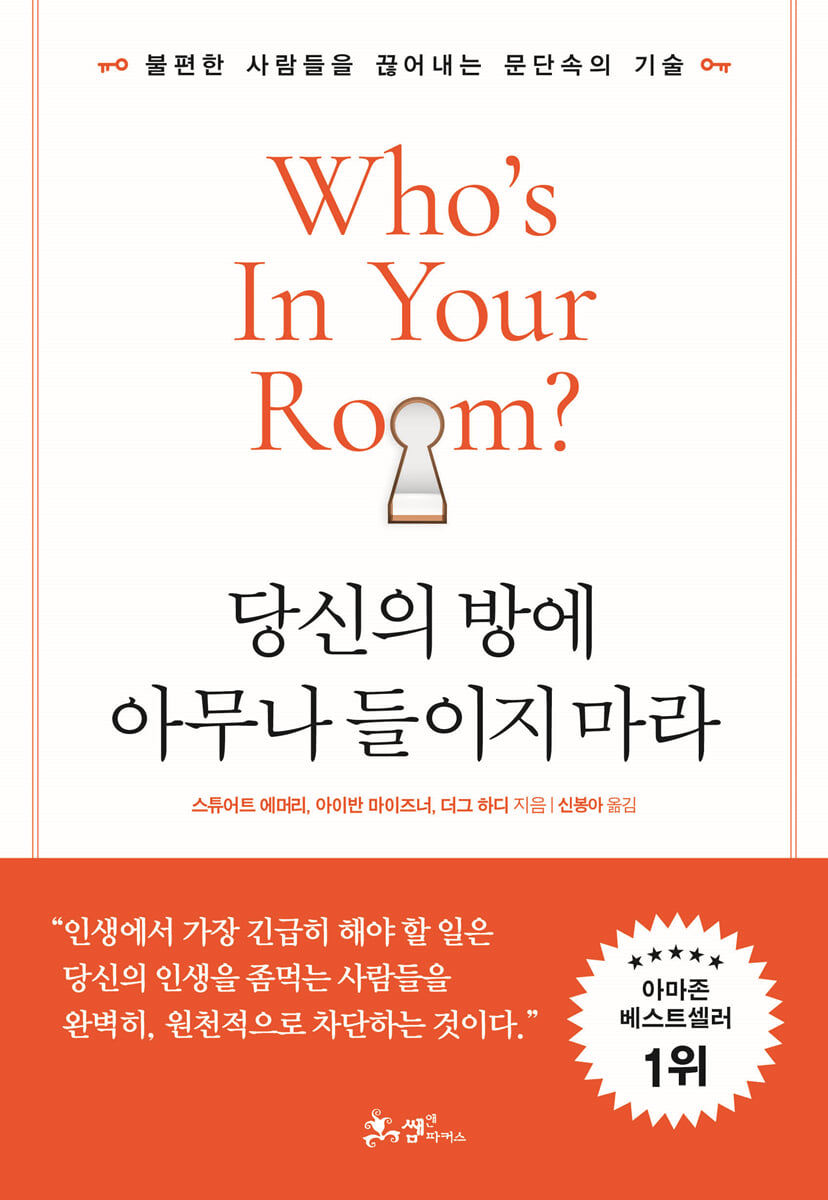
“Never forget, the people around you make your life.” Cut off people who make my life unpleasant and uncomfortable The art of human relations: surrounding yourself with valuable people * The protagonist of the reverse myth that rose to #1 on Amazon Bestseller list through word of mouth alone! * Highly recommended by Jack Canfield, author of Chicken Soup for the Soul! * Includes the 10 commandments of 'Room Rules' to manage the room of my heart! Imagine living in one room your entire life. Everyone you have ever met lives in that room with you. There is only one door in the room, and once you enter, you can never leave. If this assumption were true, would we really let just anyone into our rooms? Would we, with a heavy heart, let someone in who we'd obviously regret getting close to? Would we simply watch selfish, complaining people create a commotion in our rooms? If we were all forced to live together in one room, we'd be more selective about who would enter before allowing them in. We will establish criteria for selecting the people we allow in, and manage those who do so to ensure they do not cause problems. This book compares all of one's interpersonal relationships to a single 'room' and guides one to properly care for this room. From specific solutions like "doorkeepers," "janitors," and "room rules" to the correct way to refuse to protect your own territory, this guide to door locks enriches your relationships and life through practical and systematic techniques. |
- You can preview some of the book's contents.
Preview
index
|Introduction| Do you become like the person next to you?
Chapter 1 Imagine everyone living in one room.
They Never Leave · Human Relationships Are Not Constant · People Who Resonate with Me, Those Who Don't · Opening Your Eyes to Your Inner Reality · Training to Visualize a Room
Chapter 2 The Most Important People in the Room
A janitor, someone who guards the entrance. · There needs to be rules about who is allowed in. · A caretaker, someone who cleans the room. · Using janitors and caretakers.
Chapter 3: People in My Room
Who is near and who is far away? · A list of residents is needed. · Morning and evening visualization exercises.
Chapter 4 Dealmakers and Dealbreakers
Dealbreakers who teach the value of opposing concepts · Dealmakers who practice their values · Training to create a list of values · People who demonstrate my core values
Chapter 5: Your Values Shape Your Life
Explore relationships in today's to-do list · People who share your values · Understanding values through life items · Whose room are you in? · You can even put yourself on a shelf.
Chapter 6: Various tools for managing rooms
How to store in a box · Distinguishing between the engine and the anchor · Gently ignoring and sending it away · Creating the space you need
Chapter 7: Liberation and Fulfillment Through Rejection
Setting Boundaries Through Rejection · Focusing on Yourself, Not Others · The Front Line for Rejection · How to Say "No" Wisely · Don't Give Your Power to Others
Chapter 8: Understanding the Joys and Pitfalls of the Room
Finding Joy in Your Room · The Line Between Joy and Traps · Avoiding Traps That Threaten Your Room · A Remedy for Loving but Difficult Relationships · Warning Signs That Alert You to Traps · A Timeline of Joy and Traps
Chapter 9: When Bad Things Happen in a Good Room
Start with your family · Your room needs cleaning too · Sometimes adversity is your teacher · Those who cause the most harm
Chapter 10: Living in Flames, Not Wax
Living in the Flames · Happiness and Fulfillment Are Different · Seek Harmony, Not Balance · The Power to Change Your Room and Your Life · Take a Second Look at Your Room
Chapter 1 Imagine everyone living in one room.
They Never Leave · Human Relationships Are Not Constant · People Who Resonate with Me, Those Who Don't · Opening Your Eyes to Your Inner Reality · Training to Visualize a Room
Chapter 2 The Most Important People in the Room
A janitor, someone who guards the entrance. · There needs to be rules about who is allowed in. · A caretaker, someone who cleans the room. · Using janitors and caretakers.
Chapter 3: People in My Room
Who is near and who is far away? · A list of residents is needed. · Morning and evening visualization exercises.
Chapter 4 Dealmakers and Dealbreakers
Dealbreakers who teach the value of opposing concepts · Dealmakers who practice their values · Training to create a list of values · People who demonstrate my core values
Chapter 5: Your Values Shape Your Life
Explore relationships in today's to-do list · People who share your values · Understanding values through life items · Whose room are you in? · You can even put yourself on a shelf.
Chapter 6: Various tools for managing rooms
How to store in a box · Distinguishing between the engine and the anchor · Gently ignoring and sending it away · Creating the space you need
Chapter 7: Liberation and Fulfillment Through Rejection
Setting Boundaries Through Rejection · Focusing on Yourself, Not Others · The Front Line for Rejection · How to Say "No" Wisely · Don't Give Your Power to Others
Chapter 8: Understanding the Joys and Pitfalls of the Room
Finding Joy in Your Room · The Line Between Joy and Traps · Avoiding Traps That Threaten Your Room · A Remedy for Loving but Difficult Relationships · Warning Signs That Alert You to Traps · A Timeline of Joy and Traps
Chapter 9: When Bad Things Happen in a Good Room
Start with your family · Your room needs cleaning too · Sometimes adversity is your teacher · Those who cause the most harm
Chapter 10: Living in Flames, Not Wax
Living in the Flames · Happiness and Fulfillment Are Different · Seek Harmony, Not Balance · The Power to Change Your Room and Your Life · Take a Second Look at Your Room
Detailed image

Into the book
“Who’s in your room?” This question is one way to gain a clear and honest understanding of all the relationships in your life.
The question itself is simple (or perhaps because it is simple), but it holds infinite possibilities that can be applied to the details of everyone's life, including yours.
By consciously choosing which people occupy your psychological space and where each of them is located, you gain the power to create the life you want.
--- p.7, from “Introduction”
There is one rule to this door.
This door is one-way.
It may be an entrance, but it cannot be an exit.
That is, everyone comes in and no one goes out.
Those who enter through this door and the luggage they bring can never leave.
forever.
They and their luggage will remain in your room for the rest of your life.
The reason this concept is important is because who is in the room determines the quality of your life.
--- p.16, from “Chapter 1 Imagine Everyone Living in One Room”
The doorman is the person who allows people into your room (remember, once you're in, you can never come out).
And the manager is the person who gives instructions and controls the people who have already entered the room.
That means you have control over who can be near you or far away, who can move around the room freely and who must stay in one place.
The roles of the janitor and the caretaker are simple, but if you do them right, they will become your best friends.
--- p.38~39, from “Chapter 2: The Most Important People in the Room”
There are many people in your room.
Before we start sorting through those people, let's first check what your room looks like right now.
Who's right next to you, and who's farther away? Who catches your eye the most? There might be loud, disturbing events happening in your room.
Conversely, it can be quiet and even a little boring.
Who are the most striking people in your room? Who are the people who entered without you even knowing when, only to wake up and find themselves screaming right in front of you? Why did you let them into your room in the first place?
--- p.62, from “Chapter 3: People in My Room”
People struggle with making lists of their values, but they know who their "dealbreakers" are.
For example, people who only take and do not give, people who suck your energy, those are deal breakers.
They are still in your room because you brought them in a long time ago, but the distance between you and them does not need to be close.
This step is an important part of assessing your worth.
Everyone needs a list of dealbreakers.
This includes values, behaviors, traits, personalities, projects, etc. that you can never tolerate.
--- p.82~83, from “Chapter 4 Dealmakers and Dealbreakers”
Remember, it's much less painful to keep someone out of your life in the first place than to kill someone who's already in it.
Think about a situation in your life where what you thought was a great opportunity actually ended up bringing someone into the room who didn't align with your values.
It's easy to realize that you've wasted your time, energy, and money on those fake opportunities.
--- p.113, from “Chapter 5: Your Values Create Your Life”
By now you've probably noticed that there are quite a few people you'd like to banish from the room.
These are dealbreakers, people you would have been better off not letting into the room in the first place.
If I could, I would kick them out with my feet, but that's impossible since they're already inside the room.
Ivan's mother gave her son some tips on how to solve this problem.
“We can’t kick anyone out, but we can box them up and put them on the shelf.”
--- p.128~129, from “Chapter 6: Various Tools for Managing Rooms”
I would like to make one important suggestion.
Let's try not to feel guilty about saying no.
We want to say "yes" to others' demands as much as possible, but sometimes the cost is too high.
In this case, you should accept the decision to reject with a relaxed mind and recognize that you are now firmly guarding the visit.
Say 'no', accept that you made the right choice for yourself, and move on.
--- p.167, from “Chapter 7 Liberation and Fulfillment through Rejection”
I would be lying if I said there wasn't someone I loved but also wanted to throw on a high shelf out of reach.
These troublemakers are usually family members or long-time friends whom we love and cannot completely banish from our lives.
We want to keep them in the room, but only in very small doses.
How wonderful it would be if we could only encounter these difficult people very rarely!
--- p.191, from “Chapter 8: Understanding the Joys and Pitfalls of the Room”
The thought, 'Who is in your room?' allows you space for fulfillment.
The reason we've discussed the toxic people in the room in detail earlier is because we need to start by clearing out those who take up too much space.
When you let go of bad relationships, you have more time and attention to devote to good ones.
When you have clear standards about who you let into a room, when you let them in, and why, you can become closer to those who need and love you.
That includes yourself.
Remember, you are the curator of that room.
The question itself is simple (or perhaps because it is simple), but it holds infinite possibilities that can be applied to the details of everyone's life, including yours.
By consciously choosing which people occupy your psychological space and where each of them is located, you gain the power to create the life you want.
--- p.7, from “Introduction”
There is one rule to this door.
This door is one-way.
It may be an entrance, but it cannot be an exit.
That is, everyone comes in and no one goes out.
Those who enter through this door and the luggage they bring can never leave.
forever.
They and their luggage will remain in your room for the rest of your life.
The reason this concept is important is because who is in the room determines the quality of your life.
--- p.16, from “Chapter 1 Imagine Everyone Living in One Room”
The doorman is the person who allows people into your room (remember, once you're in, you can never come out).
And the manager is the person who gives instructions and controls the people who have already entered the room.
That means you have control over who can be near you or far away, who can move around the room freely and who must stay in one place.
The roles of the janitor and the caretaker are simple, but if you do them right, they will become your best friends.
--- p.38~39, from “Chapter 2: The Most Important People in the Room”
There are many people in your room.
Before we start sorting through those people, let's first check what your room looks like right now.
Who's right next to you, and who's farther away? Who catches your eye the most? There might be loud, disturbing events happening in your room.
Conversely, it can be quiet and even a little boring.
Who are the most striking people in your room? Who are the people who entered without you even knowing when, only to wake up and find themselves screaming right in front of you? Why did you let them into your room in the first place?
--- p.62, from “Chapter 3: People in My Room”
People struggle with making lists of their values, but they know who their "dealbreakers" are.
For example, people who only take and do not give, people who suck your energy, those are deal breakers.
They are still in your room because you brought them in a long time ago, but the distance between you and them does not need to be close.
This step is an important part of assessing your worth.
Everyone needs a list of dealbreakers.
This includes values, behaviors, traits, personalities, projects, etc. that you can never tolerate.
--- p.82~83, from “Chapter 4 Dealmakers and Dealbreakers”
Remember, it's much less painful to keep someone out of your life in the first place than to kill someone who's already in it.
Think about a situation in your life where what you thought was a great opportunity actually ended up bringing someone into the room who didn't align with your values.
It's easy to realize that you've wasted your time, energy, and money on those fake opportunities.
--- p.113, from “Chapter 5: Your Values Create Your Life”
By now you've probably noticed that there are quite a few people you'd like to banish from the room.
These are dealbreakers, people you would have been better off not letting into the room in the first place.
If I could, I would kick them out with my feet, but that's impossible since they're already inside the room.
Ivan's mother gave her son some tips on how to solve this problem.
“We can’t kick anyone out, but we can box them up and put them on the shelf.”
--- p.128~129, from “Chapter 6: Various Tools for Managing Rooms”
I would like to make one important suggestion.
Let's try not to feel guilty about saying no.
We want to say "yes" to others' demands as much as possible, but sometimes the cost is too high.
In this case, you should accept the decision to reject with a relaxed mind and recognize that you are now firmly guarding the visit.
Say 'no', accept that you made the right choice for yourself, and move on.
--- p.167, from “Chapter 7 Liberation and Fulfillment through Rejection”
I would be lying if I said there wasn't someone I loved but also wanted to throw on a high shelf out of reach.
These troublemakers are usually family members or long-time friends whom we love and cannot completely banish from our lives.
We want to keep them in the room, but only in very small doses.
How wonderful it would be if we could only encounter these difficult people very rarely!
--- p.191, from “Chapter 8: Understanding the Joys and Pitfalls of the Room”
The thought, 'Who is in your room?' allows you space for fulfillment.
The reason we've discussed the toxic people in the room in detail earlier is because we need to start by clearing out those who take up too much space.
When you let go of bad relationships, you have more time and attention to devote to good ones.
When you have clear standards about who you let into a room, when you let them in, and why, you can become closer to those who need and love you.
That includes yourself.
Remember, you are the curator of that room.
--- p.246, from “Chapter 10: Living in Flames, Not Wax”
Publisher's Review
“Who is in your room right now?”
A brilliant question that will change your perspective on human relationships.
There is probably no problem that has plagued so many people for so long, transcending time and generations, as much as human relationships.
Today, people live in a vast society and form diverse relationships.
Like it or not.
That's where the problem lies.
We often end up suffering after being forced into relationships because we can't refuse people we don't particularly like.
And then they ponder how to break free from this troublesome relationship. Ivan Meisner, the world's leading authority on business networking and dubbed "the father of modern networking" by CNN, says, "A wise person isn't one who is good at breaking up uncomfortable relationships, but one who never starts one in the first place."
If we could make the right decision in advance about whether or not we should be in a relationship with someone, we could avoid the pain and waste of energy that would arise later.
This book, which rose to the number one spot on Amazon's US bestseller list solely through word of mouth after its publication, offers a new solution to human relationships with the simple yet insightful question, "Who's in your room?"
The concept starts from the unique and shocking assumption that everyone you've ever met in your life lives together in one room.
This concept is metaphorical, but in some ways it touches the truth.
Research in the field of neuroscience shows that the way we think, act, and live is influenced, knowingly or unknowingly, by countless people we have known and interacted with, from the past to the present.
The closer someone is to me, the greater the influence.
Ultimately, the people around me are what make me who I am and what makes my life.
Human relationships are like the strings of a piano. When you are with good people, people you feel comfortable with and get along with, resonance occurs, but when you are with untrustworthy people, people who make you feel uncomfortable and unpleasant, dissonance occurs.
So, if I take a good look at the people in my room, the people I have relationships with, I can see how my relationships with them affect my life.
If you feel like your life is in disarray, there's a good chance some weird people are hanging out with you.
So who should we let into the room, and what should we do with those already in the room?
“Every relationship needs a gatekeeper!”
How to Use the Door of the Heart to Block Uninvited Guests in Your Life
Once you enter the room called human relationships, you can never leave and are together forever.
Therefore, you must carefully decide who you let into your room and where they will stay once they are there to lead your life the way you want.
This book provides a solution to this problem through the concepts of 'gatekeeper' and 'caretaker'.
A doorkeeper is a person who locks doors.
That is, it plays a role in allowing or rejecting someone when they try to enter the room.
A manager is literally a person who manages a room.
For the sake of my peace and stability in my mind and daily life, I send noisy and troublesome people to a corner of the room where they cannot be seen, and sometimes I even put them in a bag and lock them.
The roles of the gatekeeper and the caretaker may seem simple, but they are important devices for properly managing human relationships.
Each person can embody their own image of a gatekeeper and caretaker as effectively as possible, thereby pursuing the values and relationships they value.
This book presents several tools, including interesting and effective methods called gatekeepers and janitors.
This allows us to lock down the door to prevent anyone from entering the room, and control and manage those who do enter.
The core techniques taught in this book will help you fundamentally correct your perception of human relationships, thereby bringing the center of gravity in your relationships back to yourself.
- How to set up a 'gatekeeper' in the room of my heart to check the entrance of those who try to enter.
- How to have a 'caretaker' in the room of my heart to organize and discipline the people who come in.
- How to define relationships in a way that is meaningful to me, not to the other person or the situation.
- How to detect and control the influence of people around you on your thoughts, feelings, and actions.
- How to distinguish between those who can enter my room and those who cannot
- How to decide where people will stay in my room, close to me or far away from me
- How to deal with difficult people, etc.
“Your room is your life!”
A must-read for a life filled with fulfillment and satisfaction.
The ultimate reason why your room is important is because your room is your life.
We live in relationships, influenced by them, sometimes becoming like them and sometimes repulsed by them.
Human relationships are a microcosm of life, and our world is ultimately determined by the people in it.
They say you can get to know a person by looking at the three friends he or she often hangs out with.
If I can't refuse and am dragged around by people who break the values I hold dear, at some point, the very thing I hate may become my own reflection.
When you recognize that fact, the relationship becomes even more important and weighty.
We must be able to see who knocks on our door and predict and prevent the kind of relationship we will have with that person in the future.
That doesn't mean we all have to have the ability to divine the future or read faces.
What we need is the discernment and rules to clearly define our own standards and values for the kind of life we want to live and the kind of person we want to be, and to only allow those who meet those standards into our lives.
If you understand the concept of a room and manage it properly, this book will give you a new perspective on how to relate to people in the future, and ultimately, you will be able to find the path to a better life.
That life is a life filled with the joy of having good people around you, and a life filled with the satisfaction of having a positive influence on one another.
Remember, you are the master of your room.
A brilliant question that will change your perspective on human relationships.
There is probably no problem that has plagued so many people for so long, transcending time and generations, as much as human relationships.
Today, people live in a vast society and form diverse relationships.
Like it or not.
That's where the problem lies.
We often end up suffering after being forced into relationships because we can't refuse people we don't particularly like.
And then they ponder how to break free from this troublesome relationship. Ivan Meisner, the world's leading authority on business networking and dubbed "the father of modern networking" by CNN, says, "A wise person isn't one who is good at breaking up uncomfortable relationships, but one who never starts one in the first place."
If we could make the right decision in advance about whether or not we should be in a relationship with someone, we could avoid the pain and waste of energy that would arise later.
This book, which rose to the number one spot on Amazon's US bestseller list solely through word of mouth after its publication, offers a new solution to human relationships with the simple yet insightful question, "Who's in your room?"
The concept starts from the unique and shocking assumption that everyone you've ever met in your life lives together in one room.
This concept is metaphorical, but in some ways it touches the truth.
Research in the field of neuroscience shows that the way we think, act, and live is influenced, knowingly or unknowingly, by countless people we have known and interacted with, from the past to the present.
The closer someone is to me, the greater the influence.
Ultimately, the people around me are what make me who I am and what makes my life.
Human relationships are like the strings of a piano. When you are with good people, people you feel comfortable with and get along with, resonance occurs, but when you are with untrustworthy people, people who make you feel uncomfortable and unpleasant, dissonance occurs.
So, if I take a good look at the people in my room, the people I have relationships with, I can see how my relationships with them affect my life.
If you feel like your life is in disarray, there's a good chance some weird people are hanging out with you.
So who should we let into the room, and what should we do with those already in the room?
“Every relationship needs a gatekeeper!”
How to Use the Door of the Heart to Block Uninvited Guests in Your Life
Once you enter the room called human relationships, you can never leave and are together forever.
Therefore, you must carefully decide who you let into your room and where they will stay once they are there to lead your life the way you want.
This book provides a solution to this problem through the concepts of 'gatekeeper' and 'caretaker'.
A doorkeeper is a person who locks doors.
That is, it plays a role in allowing or rejecting someone when they try to enter the room.
A manager is literally a person who manages a room.
For the sake of my peace and stability in my mind and daily life, I send noisy and troublesome people to a corner of the room where they cannot be seen, and sometimes I even put them in a bag and lock them.
The roles of the gatekeeper and the caretaker may seem simple, but they are important devices for properly managing human relationships.
Each person can embody their own image of a gatekeeper and caretaker as effectively as possible, thereby pursuing the values and relationships they value.
This book presents several tools, including interesting and effective methods called gatekeepers and janitors.
This allows us to lock down the door to prevent anyone from entering the room, and control and manage those who do enter.
The core techniques taught in this book will help you fundamentally correct your perception of human relationships, thereby bringing the center of gravity in your relationships back to yourself.
- How to set up a 'gatekeeper' in the room of my heart to check the entrance of those who try to enter.
- How to have a 'caretaker' in the room of my heart to organize and discipline the people who come in.
- How to define relationships in a way that is meaningful to me, not to the other person or the situation.
- How to detect and control the influence of people around you on your thoughts, feelings, and actions.
- How to distinguish between those who can enter my room and those who cannot
- How to decide where people will stay in my room, close to me or far away from me
- How to deal with difficult people, etc.
“Your room is your life!”
A must-read for a life filled with fulfillment and satisfaction.
The ultimate reason why your room is important is because your room is your life.
We live in relationships, influenced by them, sometimes becoming like them and sometimes repulsed by them.
Human relationships are a microcosm of life, and our world is ultimately determined by the people in it.
They say you can get to know a person by looking at the three friends he or she often hangs out with.
If I can't refuse and am dragged around by people who break the values I hold dear, at some point, the very thing I hate may become my own reflection.
When you recognize that fact, the relationship becomes even more important and weighty.
We must be able to see who knocks on our door and predict and prevent the kind of relationship we will have with that person in the future.
That doesn't mean we all have to have the ability to divine the future or read faces.
What we need is the discernment and rules to clearly define our own standards and values for the kind of life we want to live and the kind of person we want to be, and to only allow those who meet those standards into our lives.
If you understand the concept of a room and manage it properly, this book will give you a new perspective on how to relate to people in the future, and ultimately, you will be able to find the path to a better life.
That life is a life filled with the joy of having good people around you, and a life filled with the satisfaction of having a positive influence on one another.
Remember, you are the master of your room.
GOODS SPECIFICS
- Date of issue: October 25, 2023
- Page count, weight, size: 248 pages | 398g | 145*210*15mm
- ISBN13: 9791165348304
- ISBN10: 1165348306
You may also like
카테고리
korean


korean

![ELLE 엘르 스페셜 에디션 A형 : 12월 [2025]](http://librairie.coreenne.fr/cdn/shop/files/b8e27a3de6c9538896439686c6b0e8fb.jpg?v=1766436872&width=3840)


