

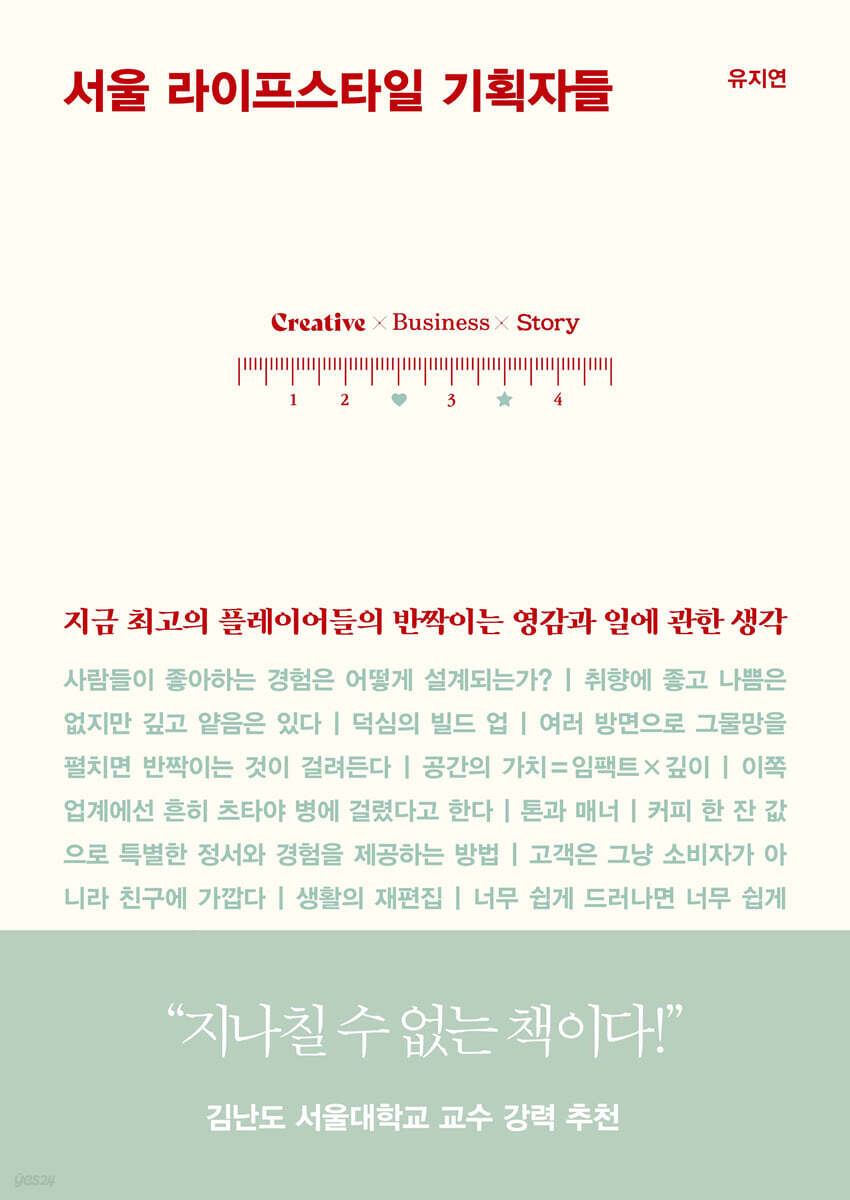
Seoul Lifestyle Planners
 |
Description
Book Introduction
How are experiences designed that people love?
Sparkling inspiration and work-related thoughts from today's top players
"A book you can't pass up!" - Highly recommended by Professor Kim Nan-do of Seoul National University
There are planners that capitalists who want to capture the millennial generation look for first.
These are the best players who have put their personal interests and tastes on the stage of 'business'.
Planners aren't selling a single product or service; they're the ones who ask, "What do you think of this lifestyle?"
It contains the sparkling inspirations and thoughts on work of wonderful creators who are redefining the sensibility of Seoul, such as Point of View, Yeonnam Market, Project Rent, Farmers Market Marche@, Onion, Cosociety, Million Archive, and Bomarket.
It teaches the fundamentals of lifestyle business and branding strategies to creative workers such as marketers, individual creators, brand managers, and editors who need to find their way through what people like.
“This is a book you can’t pass up!” said Professor Kim Nan-do of Seoul National University, strongly recommending it.
Sparkling inspiration and work-related thoughts from today's top players
"A book you can't pass up!" - Highly recommended by Professor Kim Nan-do of Seoul National University
There are planners that capitalists who want to capture the millennial generation look for first.
These are the best players who have put their personal interests and tastes on the stage of 'business'.
Planners aren't selling a single product or service; they're the ones who ask, "What do you think of this lifestyle?"
It contains the sparkling inspirations and thoughts on work of wonderful creators who are redefining the sensibility of Seoul, such as Point of View, Yeonnam Market, Project Rent, Farmers Market Marche@, Onion, Cosociety, Million Archive, and Bomarket.
It teaches the fundamentals of lifestyle business and branding strategies to creative workers such as marketers, individual creators, brand managers, and editors who need to find their way through what people like.
“This is a book you can’t pass up!” said Professor Kim Nan-do of Seoul National University, strongly recommending it.
- You can preview some of the book's contents.
Preview
index
Introduction
The Complex Taste of Analog: The Future of Offline Retail
How to Turn Your Taste into a Business
Atelier Ecriture Kim Jae-won
Branding a Neighborhood
Urban Play Hong Joo-seok
Build up of virtue
Project Rent Choi Won-seok
What you feel as soon as you enter the 'space'
Fabricators Kim Seong-jo & Kim Dong-gyu
Barcodes are no fun!
Farmers Market Marche @ Lee Bo-eun
Discover the standards you want to support
Kim Min-cheol of Seoul Social Standard
Creative, Business, and Storytelling
Kosai Society's Lee Min-soo & Wi Tae-yang
Building a house outside the house
Lee Jun-hyung, Urban Empathy Cooperative Architects Office
How far can I edit?
Jeon Myeong-hee, a certified real estate agent at Byeoljip Real Estate Agency
Into the things I like
Lemon Seoul Kim Bo-ra & Yoon Jong-hoo
From the huge archive called ‘the past’
Hohodang Yang Jeong-eun
What young planners can do in rural areas
Market Rage Heaven Anrian
Beyond the sparkling, fading things
Chapter One Kim Ga-eon & Gu Byeong-jun
So, all of this is the power of planning
Million Archive Jeong Eun-sol
To suggest a direction that fits with life
Bomarket Yoo Bora
Reviews
Photo source
The Complex Taste of Analog: The Future of Offline Retail
How to Turn Your Taste into a Business
Atelier Ecriture Kim Jae-won
Branding a Neighborhood
Urban Play Hong Joo-seok
Build up of virtue
Project Rent Choi Won-seok
What you feel as soon as you enter the 'space'
Fabricators Kim Seong-jo & Kim Dong-gyu
Barcodes are no fun!
Farmers Market Marche @ Lee Bo-eun
Discover the standards you want to support
Kim Min-cheol of Seoul Social Standard
Creative, Business, and Storytelling
Kosai Society's Lee Min-soo & Wi Tae-yang
Building a house outside the house
Lee Jun-hyung, Urban Empathy Cooperative Architects Office
How far can I edit?
Jeon Myeong-hee, a certified real estate agent at Byeoljip Real Estate Agency
Into the things I like
Lemon Seoul Kim Bo-ra & Yoon Jong-hoo
From the huge archive called ‘the past’
Hohodang Yang Jeong-eun
What young planners can do in rural areas
Market Rage Heaven Anrian
Beyond the sparkling, fading things
Chapter One Kim Ga-eon & Gu Byeong-jun
So, all of this is the power of planning
Million Archive Jeong Eun-sol
To suggest a direction that fits with life
Bomarket Yoo Bora
Reviews
Photo source
Detailed image
.jpg)
Into the book
Purpose is the most important thing.
The first thing to think about is, 'Why should I create this space?'
Then, a blueprint is drawn up in text format.
Start by searching using countless different search terms.
It's very persistent.
Repeat the process of adding words from the most developed countries in that field, as well as English, Japanese, German, and French, to find good results.
If you spread your net in various directions, something shiny will be caught. In the case of LCDC Seoul, we started by considering, "Where should we begin when writing about the brand and space?"
Then I thought, what if I tried to apply the structure of unfolding a story to space?
A complex cultural space is a multi-layered, overlapping space.
So I came up with the keyword, story within a story.
When creating the master plan for the project, the most important premise was decided upon.
And short stories and novels, framed compositions, omnibus compositions, serial and parallel compositions, etc. were expressed by substituting them into space.
The café on the first floor has a small space within the space, and on the third floor, several spaces are connected in parallel.
The 4th floor bar, as the name suggests, is where untold stories are told.
I don't think there is any good or bad taste.
But it can be shallow or deep.
When you develop a deep interest in a field, it becomes worth paying attention to, regardless of whether it is good or bad.
To develop a deep taste, experience is important, but learning is even more important.
And rather, it seems like we can't find our true tastes in the midst of the flood of images and information.
There are so many cool images on your phone, but it's like they're not yours.
---From "How to Design Your Taste into a Business" by Atelier Ecriture Kim Jae-won
A common overlooked aspect when planning commercial spaces is consistency.
I learned that maintaining a space is more difficult than creating something new and diverse.
The effort to maintain a commercial space like a market actually involves more hidden aspects, such as inventory management, than what is visible.
True skill comes from consistency.
When planning or managing a Bomarket, I'm sometimes asked about my tastes, and honestly, I'm a little embarrassed.
Since your main job is a designer, I wonder if the space reflects your taste.
A designer's job is to understand consumers, find out what they want, and find satisfaction in that.
I think it's an artist's job to want people to follow what he likes.
Commercial space planners need an objective perspective rather than personal taste.
This means that decisions should be made from the consumer's perspective, not the planner's.
The first thing to think about is, 'Why should I create this space?'
Then, a blueprint is drawn up in text format.
Start by searching using countless different search terms.
It's very persistent.
Repeat the process of adding words from the most developed countries in that field, as well as English, Japanese, German, and French, to find good results.
If you spread your net in various directions, something shiny will be caught. In the case of LCDC Seoul, we started by considering, "Where should we begin when writing about the brand and space?"
Then I thought, what if I tried to apply the structure of unfolding a story to space?
A complex cultural space is a multi-layered, overlapping space.
So I came up with the keyword, story within a story.
When creating the master plan for the project, the most important premise was decided upon.
And short stories and novels, framed compositions, omnibus compositions, serial and parallel compositions, etc. were expressed by substituting them into space.
The café on the first floor has a small space within the space, and on the third floor, several spaces are connected in parallel.
The 4th floor bar, as the name suggests, is where untold stories are told.
I don't think there is any good or bad taste.
But it can be shallow or deep.
When you develop a deep interest in a field, it becomes worth paying attention to, regardless of whether it is good or bad.
To develop a deep taste, experience is important, but learning is even more important.
And rather, it seems like we can't find our true tastes in the midst of the flood of images and information.
There are so many cool images on your phone, but it's like they're not yours.
---From "How to Design Your Taste into a Business" by Atelier Ecriture Kim Jae-won
A common overlooked aspect when planning commercial spaces is consistency.
I learned that maintaining a space is more difficult than creating something new and diverse.
The effort to maintain a commercial space like a market actually involves more hidden aspects, such as inventory management, than what is visible.
True skill comes from consistency.
When planning or managing a Bomarket, I'm sometimes asked about my tastes, and honestly, I'm a little embarrassed.
Since your main job is a designer, I wonder if the space reflects your taste.
A designer's job is to understand consumers, find out what they want, and find satisfaction in that.
I think it's an artist's job to want people to follow what he likes.
Commercial space planners need an objective perspective rather than personal taste.
This means that decisions should be made from the consumer's perspective, not the planner's.
---From "Bomaket Yoo Bo-ra, 'Suggesting a direction for life'"
Publisher's Review
How are experiences designed that people love?
Sparkling inspiration and work-related thoughts from the best players
There are planners that capitalists who want to capture the millennial generation look for first.
These are the best players who have put their personal interests and tastes on the stage of 'business'.
They don't sell a single product or service; they ask, "How about this lifestyle?"
For example, in the case of coffee, it is not simply about opening and running a coffee shop, but creating a world within it.
It captures the exceptional vision, sparkling inspiration, and work ethic of these amazing creators.
We teach the fundamentals of lifestyle business and sustainable branding strategies to creative workers who need to find their way through what people love.
Point of View, Yeonnam Market, Project Rent, Cheongun Mine, Farmers Market Marche@,
Onion, Cosociety, Huam Kitchen, Byeoljip, Lemon Seoul, Market Lazy Heaven,
Hohodang, Chapter One, Million Archive, Bomarket
You can meet the leaders of planning who made Seongsu-dong and Yeonhui-Yeonnam-dong what they are today, artist groups who line up with customers wherever they open their doors, local branding experts who provide special emotions and experiences, offline content providers who have cultivated a mecca for pop-ups, individuals who collaborate to last longer and more steadily, creative groups who share inspiration while seeking the survival of creative workers, planners of commercial spaces who have achieved success with small capital by closely following the lives of consumers, and architects who uncover marginalized desires and propose standards.
The Secret to Powerful Content That Captivates Millennials
The Fundamentals of a Lifestyle Business and Sustainable Branding Strategies
It teaches the fundamentals of lifestyle business and sustainable branding strategies not only to startups, solo creators, entrepreneurs, and brand managers at large corporations, but also to marketers, editors, designers, and directors who need to find their way through what people love.
Highly recommended by Professor Kim Nan-do of Seoul National University
“This is a book you can’t pass up!”
Professor Kim Nan-do of Seoul National University, a leading trend analyst in Korea, explains, “The vivid secrets of how personal tastes become businesses and are expanded and reproduced as another culture unfold like a panorama.
The sparkling stories of planners who are changing Seoul's cultural map today.
“If you’re looking for inspiration for your lifestyle business, this is a book you can’t miss,” he highly recommends.
Sparkling inspiration and work-related thoughts from the best players
There are planners that capitalists who want to capture the millennial generation look for first.
These are the best players who have put their personal interests and tastes on the stage of 'business'.
They don't sell a single product or service; they ask, "How about this lifestyle?"
For example, in the case of coffee, it is not simply about opening and running a coffee shop, but creating a world within it.
It captures the exceptional vision, sparkling inspiration, and work ethic of these amazing creators.
We teach the fundamentals of lifestyle business and sustainable branding strategies to creative workers who need to find their way through what people love.
Point of View, Yeonnam Market, Project Rent, Cheongun Mine, Farmers Market Marche@,
Onion, Cosociety, Huam Kitchen, Byeoljip, Lemon Seoul, Market Lazy Heaven,
Hohodang, Chapter One, Million Archive, Bomarket
You can meet the leaders of planning who made Seongsu-dong and Yeonhui-Yeonnam-dong what they are today, artist groups who line up with customers wherever they open their doors, local branding experts who provide special emotions and experiences, offline content providers who have cultivated a mecca for pop-ups, individuals who collaborate to last longer and more steadily, creative groups who share inspiration while seeking the survival of creative workers, planners of commercial spaces who have achieved success with small capital by closely following the lives of consumers, and architects who uncover marginalized desires and propose standards.
The Secret to Powerful Content That Captivates Millennials
The Fundamentals of a Lifestyle Business and Sustainable Branding Strategies
It teaches the fundamentals of lifestyle business and sustainable branding strategies not only to startups, solo creators, entrepreneurs, and brand managers at large corporations, but also to marketers, editors, designers, and directors who need to find their way through what people love.
Highly recommended by Professor Kim Nan-do of Seoul National University
“This is a book you can’t pass up!”
Professor Kim Nan-do of Seoul National University, a leading trend analyst in Korea, explains, “The vivid secrets of how personal tastes become businesses and are expanded and reproduced as another culture unfold like a panorama.
The sparkling stories of planners who are changing Seoul's cultural map today.
“If you’re looking for inspiration for your lifestyle business, this is a book you can’t miss,” he highly recommends.
GOODS SPECIFICS
- Date of issue: June 2, 2023
- Page count, weight, size: 376 pages | 366g | 125*175*25mm
- ISBN13: 9791197879425
- ISBN10: 1197879420
You may also like
카테고리
korean


korean

![GQ KOREA Mark (Monthly): December [2025]](http://librairie.coreenne.fr/cdn/shop/files/8ef265dbbfbf186523ed75ba7319009d.jpg?v=1765340328&width=3840)


