

Practice turning off your mind
 |
Description
Book Introduction
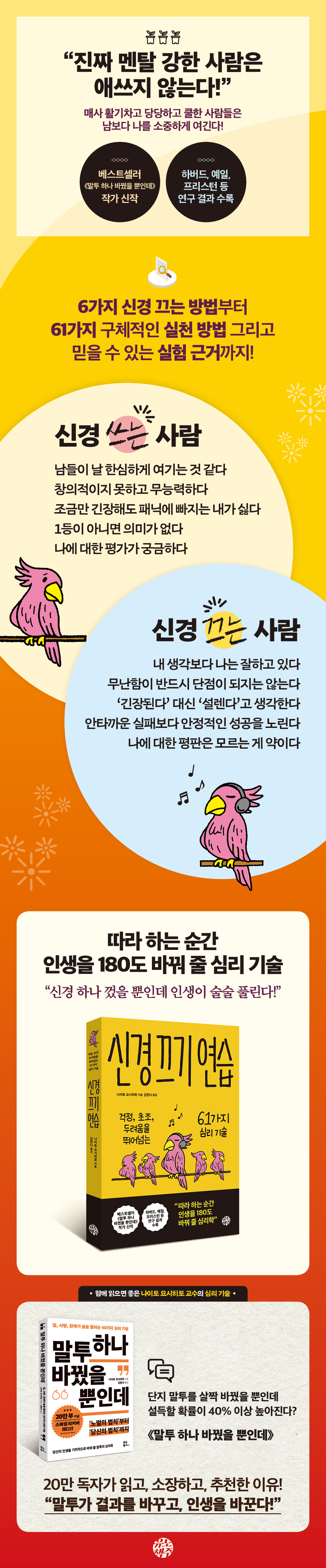
The moment you follow, your life changes. Psychology that will change you 180 degrees! “Why do I feel intimidated when someone sees me?” “Why do I always make so many mistakes?” “Why can’t I be creative?” The problem is that we live our lives worrying too much about other people's opinions and evaluations. This gaze causes stress and suffering, and makes me blush and lower my head in embarrassment. But did you know that others don't care about you? Would you believe that simply clenching your fist can boost your motivation? What about the fact that listening to songs with heartwarming lyrics can make you a better person? Japanese bestselling author and psychologist Yoshihito Naito says that if we just let go of our worries and let go of our energy for a little while, we won't feel a single trace of worry, anxiety, or fear. No matter how important consideration and effort is in social life, being too concerned about others can actually harm your own health. Therefore, it is okay to value yourself first and the other person second. Lynn Alden of the University of British Columbia videotaped presenters and had them evaluate the presentations themselves and those around them. At this time, the presenter, who thought he was not good at expressing his opinion, evaluated himself as “extremely pathetic, my hands and voice are shaking.” However, the evaluations of those around me who saw the video were 180 degrees different. "This person seems to be assertive, fluent, and unconcerned," he said! We judge ourselves harshly, failing to consider the possibility that we might be doing better than we think. This is why we must let go of the prejudice and delusion that others will think poorly of us and stop obsessing over it. People who blush easily are thought to be able to lower others' guard easily, and people who are often anxious are said to be 'thrilled' instead. To get rid of negative thoughts that are bothering me, I just have to stare at a small dot, and when I can't relax, washing my hands helps. How about it? Isn't it easy? All of these actions are backed by credible psychological research! If you follow and practice the 61 psychological techniques in "The Turn Off Your Mind," your prejudices will disappear and your life will change completely. I really hope you have the experience of feeling relieved and thinking, “What? I don’t have to worry about it so much.” |
- You can preview some of the book's contents.
Preview
index
Prologue Don't try too hard
Chapter 1: “Why Do We Care About Others?”
Mindfulness Exercise 1: Recognizing Bias
01 Nobody cares about me?│Spotlight Effect
02 Why Do I Think I'm Ugly? │ Positive Guessing
03 Why You Don't Have to Worry About Your Thoughts Being Expunged│The Illusion of Transparency
04 Instead of worrying, act confidently│The effect of confidence
05 This is better than a blank expression│The effect of laughter
06 Why You Don't Need to Be Embarrassed by Blushing │ The Law of Shame
07 Why do people with good speaking skills have bad reputations? │ The Law of Assertiveness
08 Why Ordinary Opinions Are Praised│The Effect of Being Safe
09 It Doesn't Have to Be a Deep Relationship│The Laws of Dating
10 Ways to Be Happy Talking to Strangers│The Laws of Human Relationships
11 Reasons You Shouldn't Envy Popular People│The Law of Popularity
Column 1: There are so many things to worry about.
Chapter 2 · “How can I avoid being noticed?”
Mindfulness Exercise 2: Shifting Your Mind
12 Reasons Why You Should Give Yourself the Easiest Tasks │ The Law of Accumulation
13 The Most Effective Method for When You're Stressed│The Tire Effect
14 Don't Expect Anything from the Start│The Law of Expectations
15 Ways to Deal with Unpleasant People│The Effects of Cynicism
16. Never Have Big Dreams│Thinking Flexiblely
17 Reasons Why You Don't Need to Befriend People You Don't Like│Social Allergens
18 Show an embarrassed face│The effect of an honest expression
19 Reasons Why You Can Feel Good About Lend Your Stuff│The Law of Sharing
20 Change Something Else Instead of the Unchangeable Past│Reevaluation Method
Column 2: The reason your body is heavy is because your mind is heavy.
Chapter 3: “How can I make a good impression?”
Mindfulness Exercise 3: Take Action
21. There is a different posture that boosts motivation. The effect of clenching a fist.
22 Why Other People's Perspectives Help | The Show-Off Effect
23 It's Better to Not Have Enough Time to Think│The Law of Free Time
24 Rather Be Hated│The Effect of the Imbalance Between Good and Evil
25 Why We Punish Ourselves│The Dobby Effect
26 There's No Need to Be First Place│The Rule of Third Place
27 Why Even Experts Make Mistakes│The Law of Burden
28 Why Do Pessimistic Thoughts Keep Coming to Me?│The Benefits of Deep Sleep
29 How to Create a Body Type That's Difficult to Worry About│The Effects of Dietary Fiber
30. The Energy Needed to Regulate Emotions│The Reasons for Irritability
Column 3: Living the Weekends the Same as Weekdays
Chapter 4: “How can I protect myself?”
Letting Go Exercise 4: Letting Go of Anxiety
31 Why You Can't Solve All Your Problems Alone│Expert Strategies
32 Why Do Complaints Keep Growing? │The Law of Psychological Contagion
33 Why Complaining Makes Money Run Away│The Laws of the Rich
34 When in trouble, use this strategy│The Law of Smiles
35 The Easiest Way to Boost Your Motivation│The Bright Voice Effect
36 Psychological Strategies to Give You the Courage to Say No│Power Pose
37 Why Giving Up Quickly Benefits You│The Congruence Effect
38 Why Do Opinions Differ About the Same Facts?│The Law of Belief
39 It's Very Easy to Become a Good Person│The Infectious Effect of Warm Words
40 Don't Study Economics! │The Law of the Cost of Human Relationships
Column 4 Are you annoyed by the temperature?
Chapter 5: “How can I avoid regrets?”
Letting Go Exercise 5: Letting Go of the Little Things
41 Stop Dot-Seeing Now│The Law of Bad Words
42 Why Do I Keep Seeking Evaluation of Myself? │Ego Surfing
43 Reasons Why You Should Think of Doing What You Have to Do│The Law of Strictness
44 Once you decide, don't change it. Decision│The immutable law
How to Free Yourself from Negative Thoughts in 45 Minutes│The Focus Effect
46 The Easiest Way to Change Your Mood│The Effect of Washing Your Hands
47 Reasons Why It's Better Not to Reflect│The Law of Guilt
48 The Simplest Way to Change the Atmosphere│The Law of Angles
49 Acknowledge Your Discrimination │ The Halo Effect
50 Reasons Why Face-to-Face Meetings Are Effective│The Effects of Meetings
Column 5: The Psychological Impact of Dieting
Chapter 6: “How Do I Take Control of My Life?”
Letting Go Exercise 6: Strengthening Your Mind
51 Don't Try to Be Liked│The Social Tuning Effect
52 Sometimes It's Better to Be Fooled│Truth Bias
53 Why Low Self-Esteem Leads to Higher Evaluations│The Law of Self-Esteem
54 The Minimum Conditions for a Satisfactory Life│The Law of Comparison
55 Sometimes Comparison Is Better│The Law of Growth
56 Reasons Why You Can Let Go of the Desire to Get Along with Everyone│The Effects of Social Distancing
57 Why Coolness Is Necessary in Relationships│The Sunk Cost Effect
58 Why do we say that what we believe comes true? │The Placebo Effect
59 The Easiest Way to Feel Happiest│The Law of Favorites
60 Reasons Why People Are Cold to Others│The Law of Kindness
61 Knowing Just One Thing Can Make Even a Weak Heart Stronger│The Effect of Autosuggestion
Column 6: The Grass is Not as Green as You Think
Epilogue: In any situation, I am a better person than I thought.
References
Chapter 1: “Why Do We Care About Others?”
Mindfulness Exercise 1: Recognizing Bias
01 Nobody cares about me?│Spotlight Effect
02 Why Do I Think I'm Ugly? │ Positive Guessing
03 Why You Don't Have to Worry About Your Thoughts Being Expunged│The Illusion of Transparency
04 Instead of worrying, act confidently│The effect of confidence
05 This is better than a blank expression│The effect of laughter
06 Why You Don't Need to Be Embarrassed by Blushing │ The Law of Shame
07 Why do people with good speaking skills have bad reputations? │ The Law of Assertiveness
08 Why Ordinary Opinions Are Praised│The Effect of Being Safe
09 It Doesn't Have to Be a Deep Relationship│The Laws of Dating
10 Ways to Be Happy Talking to Strangers│The Laws of Human Relationships
11 Reasons You Shouldn't Envy Popular People│The Law of Popularity
Column 1: There are so many things to worry about.
Chapter 2 · “How can I avoid being noticed?”
Mindfulness Exercise 2: Shifting Your Mind
12 Reasons Why You Should Give Yourself the Easiest Tasks │ The Law of Accumulation
13 The Most Effective Method for When You're Stressed│The Tire Effect
14 Don't Expect Anything from the Start│The Law of Expectations
15 Ways to Deal with Unpleasant People│The Effects of Cynicism
16. Never Have Big Dreams│Thinking Flexiblely
17 Reasons Why You Don't Need to Befriend People You Don't Like│Social Allergens
18 Show an embarrassed face│The effect of an honest expression
19 Reasons Why You Can Feel Good About Lend Your Stuff│The Law of Sharing
20 Change Something Else Instead of the Unchangeable Past│Reevaluation Method
Column 2: The reason your body is heavy is because your mind is heavy.
Chapter 3: “How can I make a good impression?”
Mindfulness Exercise 3: Take Action
21. There is a different posture that boosts motivation. The effect of clenching a fist.
22 Why Other People's Perspectives Help | The Show-Off Effect
23 It's Better to Not Have Enough Time to Think│The Law of Free Time
24 Rather Be Hated│The Effect of the Imbalance Between Good and Evil
25 Why We Punish Ourselves│The Dobby Effect
26 There's No Need to Be First Place│The Rule of Third Place
27 Why Even Experts Make Mistakes│The Law of Burden
28 Why Do Pessimistic Thoughts Keep Coming to Me?│The Benefits of Deep Sleep
29 How to Create a Body Type That's Difficult to Worry About│The Effects of Dietary Fiber
30. The Energy Needed to Regulate Emotions│The Reasons for Irritability
Column 3: Living the Weekends the Same as Weekdays
Chapter 4: “How can I protect myself?”
Letting Go Exercise 4: Letting Go of Anxiety
31 Why You Can't Solve All Your Problems Alone│Expert Strategies
32 Why Do Complaints Keep Growing? │The Law of Psychological Contagion
33 Why Complaining Makes Money Run Away│The Laws of the Rich
34 When in trouble, use this strategy│The Law of Smiles
35 The Easiest Way to Boost Your Motivation│The Bright Voice Effect
36 Psychological Strategies to Give You the Courage to Say No│Power Pose
37 Why Giving Up Quickly Benefits You│The Congruence Effect
38 Why Do Opinions Differ About the Same Facts?│The Law of Belief
39 It's Very Easy to Become a Good Person│The Infectious Effect of Warm Words
40 Don't Study Economics! │The Law of the Cost of Human Relationships
Column 4 Are you annoyed by the temperature?
Chapter 5: “How can I avoid regrets?”
Letting Go Exercise 5: Letting Go of the Little Things
41 Stop Dot-Seeing Now│The Law of Bad Words
42 Why Do I Keep Seeking Evaluation of Myself? │Ego Surfing
43 Reasons Why You Should Think of Doing What You Have to Do│The Law of Strictness
44 Once you decide, don't change it. Decision│The immutable law
How to Free Yourself from Negative Thoughts in 45 Minutes│The Focus Effect
46 The Easiest Way to Change Your Mood│The Effect of Washing Your Hands
47 Reasons Why It's Better Not to Reflect│The Law of Guilt
48 The Simplest Way to Change the Atmosphere│The Law of Angles
49 Acknowledge Your Discrimination │ The Halo Effect
50 Reasons Why Face-to-Face Meetings Are Effective│The Effects of Meetings
Column 5: The Psychological Impact of Dieting
Chapter 6: “How Do I Take Control of My Life?”
Letting Go Exercise 6: Strengthening Your Mind
51 Don't Try to Be Liked│The Social Tuning Effect
52 Sometimes It's Better to Be Fooled│Truth Bias
53 Why Low Self-Esteem Leads to Higher Evaluations│The Law of Self-Esteem
54 The Minimum Conditions for a Satisfactory Life│The Law of Comparison
55 Sometimes Comparison Is Better│The Law of Growth
56 Reasons Why You Can Let Go of the Desire to Get Along with Everyone│The Effects of Social Distancing
57 Why Coolness Is Necessary in Relationships│The Sunk Cost Effect
58 Why do we say that what we believe comes true? │The Placebo Effect
59 The Easiest Way to Feel Happiest│The Law of Favorites
60 Reasons Why People Are Cold to Others│The Law of Kindness
61 Knowing Just One Thing Can Make Even a Weak Heart Stronger│The Effect of Autosuggestion
Column 6: The Grass is Not as Green as You Think
Epilogue: In any situation, I am a better person than I thought.
References
Detailed image
Into the book
We are wary when we meet strangers.
Because I don't know if this person is someone who will harm me or if he is dangerous.
But if they blush, feel embarrassed, or hesitate, I let my guard down and think, 'Oh, this person won't harm me.'
Shy people are well-received because they allow the other person to be at ease and not be unnecessarily nervous.
---From "The Law of Shame"
Alison W. Brooks of Harvard Business School
Brooks had 113 college students sing in a karaoke room equipped with a scoring function.
Some people may enjoy singing in front of others, but most people feel embarrassed and extremely nervous about singing in front of strangers.
And it feels even more so when you are given a score.
At this time, Allison Brooks set three conditions.
The first group was conditioned to tell themselves to “calm down” before singing, and the second group was conditioned to tell themselves “I feel excited for some reason!”
The third group was asked not to engage in any behavior that would make them talk to themselves, as this was the comparison condition.
So what were the results of this experiment? Trying to calm yourself down by telling yourself to calm down actually made you nervous and less able to sing well.
---From "The Tyre Effect"
According to research by Andrew MacGregor Cameron of Johns Hopkins University in the United States, a whopping 13,054 new people registered on the first day alone.
For reference, before Facebook launched this service, the average number of new users registered per day was 616.
You can see how effective it is to advertise on Facebook that you are an organ donor (the number of new registrations remained high for 12 days afterward).
Why has the number of new registrants skyrocketed? Could it be because telling others you're a potential organ donor feels somehow cool, or because it proves to them that you're a good person?
---From "Show Effect"
No matter how well-liked your actions have been up until now, there are many cases where you end up being hated over trivial things.
For example, a celebrity who has been treated well as a popular celebrity can suddenly become hated for something trivial, such as cheating or making strange remarks on TV.
Or, it is very common for a minor slip of the tongue to cause a loss of trust built up until then and a sharp drop in popularity.
In fact, this has nothing to do with how well-liked you have been so far.
When you are hated by others, you receive great hatred in an instant.
---From "The Effect of the Imbalance of Good and Evil"
Stewart McCann of Cape Breton University in Canada conducted a study on the relationship between whether a tweet was positive or negative and a person's socioeconomic status (wealth or not).
This is a very large-scale study, as it analyzed the Twitter content of 140,000 people.
His research found that the more negative the content, the lower the social and economic status.
In short, this means that people who only gossip, complain, and whine cannot become rich.
---From "The Laws of the Rich"
Jennifer S. Beer of the University of Texas, USA
Beer took photographs of the experimental participants and then showed the photographs to a panel of 10 judges (five men and five women) and provided feedback on the results.
That feedback was a trick.
She had prepared it in advance, telling some people, “You are hated by six out of ten people,” and telling others, “No one hates you.”
And when we asked people to rate their own personality, we found that people whose self-esteem was hurt rated their own personality negatively.
Because I don't know if this person is someone who will harm me or if he is dangerous.
But if they blush, feel embarrassed, or hesitate, I let my guard down and think, 'Oh, this person won't harm me.'
Shy people are well-received because they allow the other person to be at ease and not be unnecessarily nervous.
---From "The Law of Shame"
Alison W. Brooks of Harvard Business School
Brooks had 113 college students sing in a karaoke room equipped with a scoring function.
Some people may enjoy singing in front of others, but most people feel embarrassed and extremely nervous about singing in front of strangers.
And it feels even more so when you are given a score.
At this time, Allison Brooks set three conditions.
The first group was conditioned to tell themselves to “calm down” before singing, and the second group was conditioned to tell themselves “I feel excited for some reason!”
The third group was asked not to engage in any behavior that would make them talk to themselves, as this was the comparison condition.
So what were the results of this experiment? Trying to calm yourself down by telling yourself to calm down actually made you nervous and less able to sing well.
---From "The Tyre Effect"
According to research by Andrew MacGregor Cameron of Johns Hopkins University in the United States, a whopping 13,054 new people registered on the first day alone.
For reference, before Facebook launched this service, the average number of new users registered per day was 616.
You can see how effective it is to advertise on Facebook that you are an organ donor (the number of new registrations remained high for 12 days afterward).
Why has the number of new registrants skyrocketed? Could it be because telling others you're a potential organ donor feels somehow cool, or because it proves to them that you're a good person?
---From "Show Effect"
No matter how well-liked your actions have been up until now, there are many cases where you end up being hated over trivial things.
For example, a celebrity who has been treated well as a popular celebrity can suddenly become hated for something trivial, such as cheating or making strange remarks on TV.
Or, it is very common for a minor slip of the tongue to cause a loss of trust built up until then and a sharp drop in popularity.
In fact, this has nothing to do with how well-liked you have been so far.
When you are hated by others, you receive great hatred in an instant.
---From "The Effect of the Imbalance of Good and Evil"
Stewart McCann of Cape Breton University in Canada conducted a study on the relationship between whether a tweet was positive or negative and a person's socioeconomic status (wealth or not).
This is a very large-scale study, as it analyzed the Twitter content of 140,000 people.
His research found that the more negative the content, the lower the social and economic status.
In short, this means that people who only gossip, complain, and whine cannot become rich.
---From "The Laws of the Rich"
Jennifer S. Beer of the University of Texas, USA
Beer took photographs of the experimental participants and then showed the photographs to a panel of 10 judges (five men and five women) and provided feedback on the results.
That feedback was a trick.
She had prepared it in advance, telling some people, “You are hated by six out of ten people,” and telling others, “No one hates you.”
And when we asked people to rate their own personality, we found that people whose self-esteem was hurt rated their own personality negatively.
---From "Ego Surfing"
Publisher's Review
“Only two out of ten people look at me.”
Everyone has had this experience at least once.
I left the house, but no matter how much I think about it, the clothes I'm wearing today feel a bit outdated.
It seems like everyone passing by is looking at me for my strange clothes, and laughing at me inside.
I can't even lift my head and walk, and my face feels hotter and redder.
Thomas Gilovich of Cornell University in the United States asked his students to wear extremely embarrassing T-shirts with large pictures of unknown musicians printed on them and walk around the campus.
Gilovich asked the returning students how many people they thought had looked at them, and about 47% guessed that too many people had looked at them.
However, according to a survey conducted by a collaborator who secretly followed the students, only 24% of people noticed the extremely embarrassing T-shirt.
According to Yoshihito Naito, a psychologist and author of the best-selling book "Just Change Your Tone of Speech," we are overly concerned and nervous about what other people think.
The author introduces 61 mind-blowing psychological techniques, saying, “It’s okay to be a little self-centered.”
Since these are all easy to put into practice, I'm sure you'll feel lighter and say, "Let's think a little more at ease!"
● Are you worried that people will think you are incompetent because you are not creative?
Jennifer Mueller of the University of San Diego in the United States formed several groups and had participants discuss the topic, "What can airlines do to become more profitable?"
Before the discussion, half of the participants were asked to come up with as creative an idea as possible, while the rest were asked to come up with unoriginal ideas.
And when the discussion was over, they were asked to evaluate each other.
So what were the results? Surprisingly, the more creative the ideas, the worse the evaluations! They were even judged to have a marked lack of leadership qualities!
This shows us that being mediocre isn't necessarily a disadvantage, and that we don't have to force ourselves to be creative.
If you keep worrying because you think you are ordinary, then you are worrying for nothing.
● What if you feel anxious because you didn’t do well from the beginning?
Ruth Edelman of American University conducted an experiment in which she gave weekly assignments to 52 people diagnosed with social phobia to see if their symptoms could be improved.
The assignments were very easy, such as, "Let's walk through a crowded place this week" or "Let's say hello to five people passing by."
Six months later, Edelman gathered them together and had them give a speech in front of others.
But then something very surprising happened.
People who suffered from social phobia began to speak in front of others.
The more properly a person performs a task, the less anxious he or she becomes when standing in front of others.
To relieve our impatience, let's give ourselves a very small task.
Wouldn't it be better to start with something like 'I look into my eyes in the mirror'?
● What if you are always afraid because your mentality is as fragile as tofu?
Vladimir Rykov of Moscow State University in Russia had his students self-hypnotize themselves by saying, “I am the genius violinist Fritz Kreisler from Vienna!” and then had them play their instruments and have experts grade them.
He also had them solve math problems after making a self-hypnosis that they were the famous French mathematician Henri Poincaré.
What were the results? They were quite surprising.
It was found that both performance evaluations and math problem scores of students who played the violin improved.
Should we just consider it as autosuggestion, or should we still believe in the power of autosuggestion?
Whenever you feel mentally unstable, think of a very good and strong person you ideally think of and try to give yourself a hint by saying, “I am ○○!”
The more you believe that it will work, the more it becomes a dream to have a strong mentality.
“6 Ways to Practice Not Giving a F*ck!”
In Chapter 1, we explore why we care about others and whether others actually care about us as much.
We introduce the fact that it is a prejudice to belittle ourselves by saying that we are ugly, and the reason why we do not have to force ourselves to show our abilities.
Chapter 2 teaches you how to change your thinking and stop caring about what others think.
There is no way to instantly become bold enough to be liked by others or to make people like you who hate you.
Instead, if you change your standards of thinking in the direction the author suggests, you will soon be reborn as someone who does not care about what others think.
Chapter 3 introduces how to make a good impression by taking action.
It also explains the benefits of clenching your fist when you're nervous and anxious about getting a bad evaluation from others, and why you don't necessarily have to be number one.
If you follow along one by one, you will soon hear people say that you are a good person without having to worry about it.
Chapter 4 talks about how to let go of anxiety and protect myself.
We'll give you some good reasons why it's good to reduce your complaints, and some super-simple ways to find the courage to say no.
As you reflect on how to protect your feelings, attitude, and heart, you will soon find yourself no longer afraid of getting hurt.
Chapter 5 teaches you how to avoid regrets by letting go of the little things.
No matter how uncertain the future may be, we present the scientific reasons why you should stop looking at your fortune right now, as well as the simplest way to change your mood and atmosphere.
If you practice these easy methods one by one, you will soon find yourself free of prejudice.
Finally, Chapter 6 talks about how to strengthen your mind and take control of your life.
It teaches you when to compare and when not to, and shows you the easiest way to live a happy life.
Finally, as you reflect on these things, you will find yourself standing tall and unwavering.
Everyone has had this experience at least once.
I left the house, but no matter how much I think about it, the clothes I'm wearing today feel a bit outdated.
It seems like everyone passing by is looking at me for my strange clothes, and laughing at me inside.
I can't even lift my head and walk, and my face feels hotter and redder.
Thomas Gilovich of Cornell University in the United States asked his students to wear extremely embarrassing T-shirts with large pictures of unknown musicians printed on them and walk around the campus.
Gilovich asked the returning students how many people they thought had looked at them, and about 47% guessed that too many people had looked at them.
However, according to a survey conducted by a collaborator who secretly followed the students, only 24% of people noticed the extremely embarrassing T-shirt.
According to Yoshihito Naito, a psychologist and author of the best-selling book "Just Change Your Tone of Speech," we are overly concerned and nervous about what other people think.
The author introduces 61 mind-blowing psychological techniques, saying, “It’s okay to be a little self-centered.”
Since these are all easy to put into practice, I'm sure you'll feel lighter and say, "Let's think a little more at ease!"
● Are you worried that people will think you are incompetent because you are not creative?
Jennifer Mueller of the University of San Diego in the United States formed several groups and had participants discuss the topic, "What can airlines do to become more profitable?"
Before the discussion, half of the participants were asked to come up with as creative an idea as possible, while the rest were asked to come up with unoriginal ideas.
And when the discussion was over, they were asked to evaluate each other.
So what were the results? Surprisingly, the more creative the ideas, the worse the evaluations! They were even judged to have a marked lack of leadership qualities!
This shows us that being mediocre isn't necessarily a disadvantage, and that we don't have to force ourselves to be creative.
If you keep worrying because you think you are ordinary, then you are worrying for nothing.
● What if you feel anxious because you didn’t do well from the beginning?
Ruth Edelman of American University conducted an experiment in which she gave weekly assignments to 52 people diagnosed with social phobia to see if their symptoms could be improved.
The assignments were very easy, such as, "Let's walk through a crowded place this week" or "Let's say hello to five people passing by."
Six months later, Edelman gathered them together and had them give a speech in front of others.
But then something very surprising happened.
People who suffered from social phobia began to speak in front of others.
The more properly a person performs a task, the less anxious he or she becomes when standing in front of others.
To relieve our impatience, let's give ourselves a very small task.
Wouldn't it be better to start with something like 'I look into my eyes in the mirror'?
● What if you are always afraid because your mentality is as fragile as tofu?
Vladimir Rykov of Moscow State University in Russia had his students self-hypnotize themselves by saying, “I am the genius violinist Fritz Kreisler from Vienna!” and then had them play their instruments and have experts grade them.
He also had them solve math problems after making a self-hypnosis that they were the famous French mathematician Henri Poincaré.
What were the results? They were quite surprising.
It was found that both performance evaluations and math problem scores of students who played the violin improved.
Should we just consider it as autosuggestion, or should we still believe in the power of autosuggestion?
Whenever you feel mentally unstable, think of a very good and strong person you ideally think of and try to give yourself a hint by saying, “I am ○○!”
The more you believe that it will work, the more it becomes a dream to have a strong mentality.
“6 Ways to Practice Not Giving a F*ck!”
In Chapter 1, we explore why we care about others and whether others actually care about us as much.
We introduce the fact that it is a prejudice to belittle ourselves by saying that we are ugly, and the reason why we do not have to force ourselves to show our abilities.
Chapter 2 teaches you how to change your thinking and stop caring about what others think.
There is no way to instantly become bold enough to be liked by others or to make people like you who hate you.
Instead, if you change your standards of thinking in the direction the author suggests, you will soon be reborn as someone who does not care about what others think.
Chapter 3 introduces how to make a good impression by taking action.
It also explains the benefits of clenching your fist when you're nervous and anxious about getting a bad evaluation from others, and why you don't necessarily have to be number one.
If you follow along one by one, you will soon hear people say that you are a good person without having to worry about it.
Chapter 4 talks about how to let go of anxiety and protect myself.
We'll give you some good reasons why it's good to reduce your complaints, and some super-simple ways to find the courage to say no.
As you reflect on how to protect your feelings, attitude, and heart, you will soon find yourself no longer afraid of getting hurt.
Chapter 5 teaches you how to avoid regrets by letting go of the little things.
No matter how uncertain the future may be, we present the scientific reasons why you should stop looking at your fortune right now, as well as the simplest way to change your mood and atmosphere.
If you practice these easy methods one by one, you will soon find yourself free of prejudice.
Finally, Chapter 6 talks about how to strengthen your mind and take control of your life.
It teaches you when to compare and when not to, and shows you the easiest way to live a happy life.
Finally, as you reflect on these things, you will find yourself standing tall and unwavering.
GOODS SPECIFICS
- Date of issue: January 2, 2023
- Page count, weight, size: 248 pages | 352g | 142*210*16mm
- ISBN13: 9791192300405
- ISBN10: 1192300408
You may also like
카테고리
korean


korean

![ELLE 엘르 스페셜 에디션 A형 : 12월 [2025]](http://librairie.coreenne.fr/cdn/shop/files/b8e27a3de6c9538896439686c6b0e8fb.jpg?v=1766436872&width=3840)


