

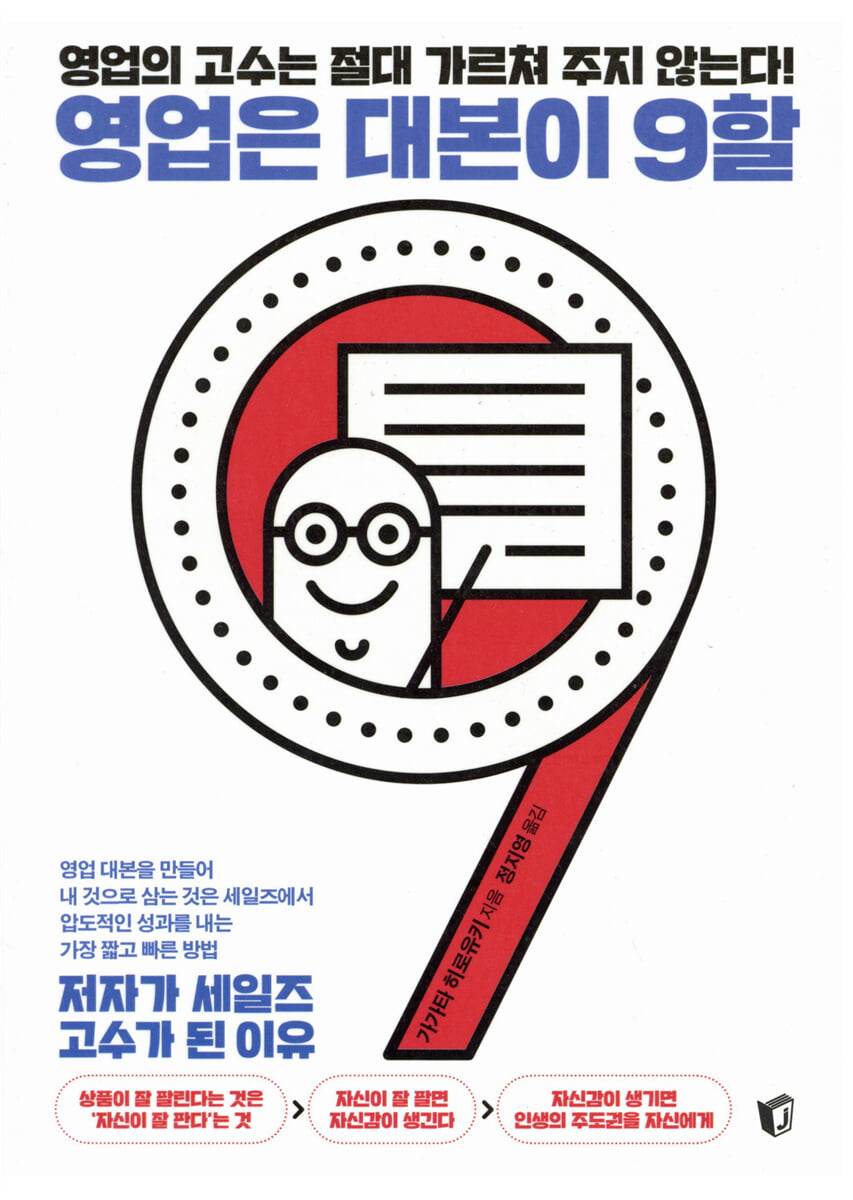
Sales is 90% scripted
 |
Description
Book Introduction
A completed sales script becomes your best sales weapon.
So now let's make the best weapon together.
What this book conveys is the core of sales, the knowledge of writing and refining sales scripts, which the author, a sales training expert, teaches in his script sales seminars.
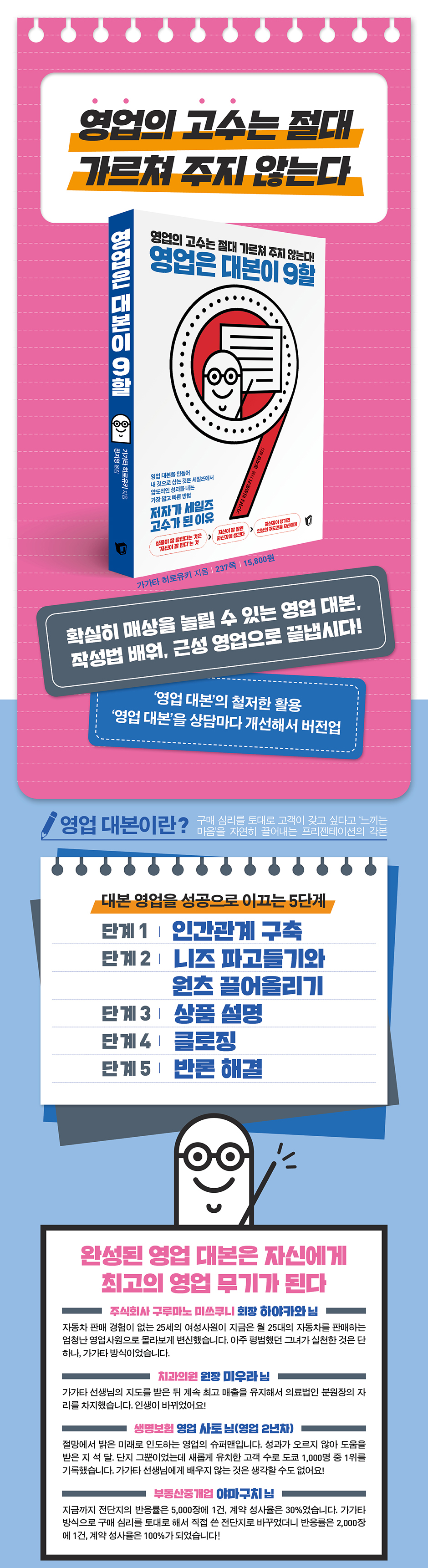
A sales script is a presentation (consultation) script that naturally draws out the customer's "feeling" that they want something based on their purchasing psychology.
If you have the highly reproducible know-how to easily elicit customers' desires of "I want to have it" and "I want to buy it," you can close contracts with up to 8 out of 10 potential customers.
For example, let me tell you a story about when I trained a 23-year-old part-time worker to become a sales king with a monthly income of 100 million yen in just a few months.
He was 23 years old when he joined the company.
After graduating from high school, I worked part-time at a family restaurant and had no social experience.
At first, the author thought, 'It won't be easy to educate this kind of guy,' and honestly, he was depressed.
However, he was very naive as he had no sales experience.
He desperately memorized the given sales script over and over again without missing a single word.
He repeated the author's teachings more honestly than anyone else and put them into practice thoroughly.
As I found out later, his parents were bankrupt and he needed to pay for his younger sister's education, so he had a reason to earn money.
People with poor sales experience or who are not pure often give up halfway through because they do not follow the sales script and their sales performance is poor.
But he followed along purely once.
And in the blink of an eye, he achieved success and became a salesperson who sold 100 million yen a month.
First of all, the key to victory was that I followed the sales script strictly, kept to the basics, and quickly improved the sales script by reflecting on each consultation.
Here's the secret to his becoming a sales king:
Thorough use of the 'sales script'
Upgrading the 'Sales Script' by improving it for each consultation
This is the secret to how a 23-year-old part-time worker with no social experience was able to sell over 100 million yen per month within just a few months of joining the company.
If you master script sales, anyone can easily increase their contract closing rate.
So why does having a sales script help anyone achieve results? First, because it allows the salesperson to fully prepare for the consultation, allowing them to always lead the consultation (presentation).
Moreover, since the sales script has been refined through past successes and failures, it is more likely to be successful.
Consultations without a sales script are prone to repeating the same mistakes because they can't be improved upon even if they fail.
And above all, by incorporating the author's essence of 'digging into needs' into your sales script, you can achieve an overwhelming increase in the contract closing rate.
'Needs exploration' is the core of sales that most sales professionals are mastering (without even realizing it).
This content will be introduced in the main text.
In other words, while reading this book, you will learn how to create a sales script, and at the same time, you will be able to absorb the core sales techniques that sales experts are practicing without even realizing it.
So now let's make the best weapon together.
What this book conveys is the core of sales, the knowledge of writing and refining sales scripts, which the author, a sales training expert, teaches in his script sales seminars.
A sales script is a presentation (consultation) script that naturally draws out the customer's "feeling" that they want something based on their purchasing psychology.
If you have the highly reproducible know-how to easily elicit customers' desires of "I want to have it" and "I want to buy it," you can close contracts with up to 8 out of 10 potential customers.
For example, let me tell you a story about when I trained a 23-year-old part-time worker to become a sales king with a monthly income of 100 million yen in just a few months.
He was 23 years old when he joined the company.
After graduating from high school, I worked part-time at a family restaurant and had no social experience.
At first, the author thought, 'It won't be easy to educate this kind of guy,' and honestly, he was depressed.
However, he was very naive as he had no sales experience.
He desperately memorized the given sales script over and over again without missing a single word.
He repeated the author's teachings more honestly than anyone else and put them into practice thoroughly.
As I found out later, his parents were bankrupt and he needed to pay for his younger sister's education, so he had a reason to earn money.
People with poor sales experience or who are not pure often give up halfway through because they do not follow the sales script and their sales performance is poor.
But he followed along purely once.
And in the blink of an eye, he achieved success and became a salesperson who sold 100 million yen a month.
First of all, the key to victory was that I followed the sales script strictly, kept to the basics, and quickly improved the sales script by reflecting on each consultation.
Here's the secret to his becoming a sales king:
Thorough use of the 'sales script'
Upgrading the 'Sales Script' by improving it for each consultation
This is the secret to how a 23-year-old part-time worker with no social experience was able to sell over 100 million yen per month within just a few months of joining the company.
If you master script sales, anyone can easily increase their contract closing rate.
So why does having a sales script help anyone achieve results? First, because it allows the salesperson to fully prepare for the consultation, allowing them to always lead the consultation (presentation).
Moreover, since the sales script has been refined through past successes and failures, it is more likely to be successful.
Consultations without a sales script are prone to repeating the same mistakes because they can't be improved upon even if they fail.
And above all, by incorporating the author's essence of 'digging into needs' into your sales script, you can achieve an overwhelming increase in the contract closing rate.
'Needs exploration' is the core of sales that most sales professionals are mastering (without even realizing it).
This content will be introduced in the main text.
In other words, while reading this book, you will learn how to create a sales script, and at the same time, you will be able to absorb the core sales techniques that sales experts are practicing without even realizing it.
index
Preface──I spent 2.5 million yen on purchasing the company's products with my own money.
Why I Became a Sales Expert
[Voice of Script Sales Recommendation]
letter
Why, no matter how much time passes
Is it not selling?
What are your sales concerns?
You can't sell with just 'spirit, guts, and feeling'
As your sales performance improves, you can take control of your life.
How I became interested in 'script sales'
Even sales experts are unknowingly practicing "needs-digging."
[Introduction Summary]
Chapter 1
Leading script sales to success
Step 5
Up to 80% of potential customers will close a deal if you refine your sales script.
Five Steps to an 80% Closing Rate
Step 1: Building Relationships
Step 2: Digging into Needs and Evoking Wants
Step 3: Product Description
Step 4: Closing
Step 5: Resolving Objections (Handling Objections)
[Chapter 1 Summary]
Chapter 2
Create your own sales script
Three Points to Consider When Writing a Sales Script
Let's write our own sales script.
Good sales scripts, bad sales scripts
[Chapter 2 Summary]
Chapter 3
Script Sales Stage 1
Building human relationships
What is relationship building?
Aiming for a doctor-patient relationship
Questions that will make you an instant expert
A Simple Way to Build Deep Trust
There are three stages to rapport.
The unmistakable 'chat power'
Laport Technique 1: Mirroring
Rapport Technique 2: Pacing
Rapport Technique 3: Backtracking
If you care about your customers, technology is meaningless.
Praise your partner's belief level on a 'neurological level'
Focus on your customers' "secret windows" and "unknown windows."
Three Goals for Building Relationships
[Chapter 3 Summary]
Chapter 4
Script Sales Stage 2
Digging into Needs and Elevating Wants
The difference between needs and wants
'Needs products' and 'want products' have different sales methods.
Seven Principles of Needs Digging
Understand the customer's situation in detail
Ask questions that encourage 'need recognition'
Ask questions that 'dig into needs'
Asking about 'Determination and Confirmation of Needs'
How far do we have to go before we can say we've 'digged into a need'?
Here's how to raise your wants
'Test Closing' to Understand
How can I make an immediate decision?
[Chapter 4 Summary]
Chapter 5
Script Sales Stage 3
Product Description
Product descriptions are perfect if they are "FABEC official."
FEATURE and ADVANTAGE
BENEFIT
EXPLANATION and CONFIRMATION
Specific examples of product descriptions
[Chapter 5 Summary]
Chapter 6
Script Sales Stage 4
Closing
How do top salespeople feel about being rejected?
Five Steps to Choosing a Closing
Specific examples of closing options
Things to keep in mind when choosing a closing
Closing Technique Application 1: Action Closing
Closing Technique Application Part 2: "Considering Closing - Positive Suggestion"
[Chapter 6 Summary]
Chapter 7
Step 5 of Script Sales
'Resolving objections'
Resolution of objections must be anticipated.
Step 1: Clearly state the situation under review (rebuttal) through questions.
Step 2: Resolving Objections: Develop a listening attitude by empathizing with and praising the objection.
Step 3: Propose
Step 4: Resolving Objections: "Describe the benefits (and provide clear reasons) that warrant the customer's acceptance of the proposal."
[Chapter 7 Summary]
Conclusion──
Why I Became a Sales Expert
[Voice of Script Sales Recommendation]
letter
Why, no matter how much time passes
Is it not selling?
What are your sales concerns?
You can't sell with just 'spirit, guts, and feeling'
As your sales performance improves, you can take control of your life.
How I became interested in 'script sales'
Even sales experts are unknowingly practicing "needs-digging."
[Introduction Summary]
Chapter 1
Leading script sales to success
Step 5
Up to 80% of potential customers will close a deal if you refine your sales script.
Five Steps to an 80% Closing Rate
Step 1: Building Relationships
Step 2: Digging into Needs and Evoking Wants
Step 3: Product Description
Step 4: Closing
Step 5: Resolving Objections (Handling Objections)
[Chapter 1 Summary]
Chapter 2
Create your own sales script
Three Points to Consider When Writing a Sales Script
Let's write our own sales script.
Good sales scripts, bad sales scripts
[Chapter 2 Summary]
Chapter 3
Script Sales Stage 1
Building human relationships
What is relationship building?
Aiming for a doctor-patient relationship
Questions that will make you an instant expert
A Simple Way to Build Deep Trust
There are three stages to rapport.
The unmistakable 'chat power'
Laport Technique 1: Mirroring
Rapport Technique 2: Pacing
Rapport Technique 3: Backtracking
If you care about your customers, technology is meaningless.
Praise your partner's belief level on a 'neurological level'
Focus on your customers' "secret windows" and "unknown windows."
Three Goals for Building Relationships
[Chapter 3 Summary]
Chapter 4
Script Sales Stage 2
Digging into Needs and Elevating Wants
The difference between needs and wants
'Needs products' and 'want products' have different sales methods.
Seven Principles of Needs Digging
Understand the customer's situation in detail
Ask questions that encourage 'need recognition'
Ask questions that 'dig into needs'
Asking about 'Determination and Confirmation of Needs'
How far do we have to go before we can say we've 'digged into a need'?
Here's how to raise your wants
'Test Closing' to Understand
How can I make an immediate decision?
[Chapter 4 Summary]
Chapter 5
Script Sales Stage 3
Product Description
Product descriptions are perfect if they are "FABEC official."
FEATURE and ADVANTAGE
BENEFIT
EXPLANATION and CONFIRMATION
Specific examples of product descriptions
[Chapter 5 Summary]
Chapter 6
Script Sales Stage 4
Closing
How do top salespeople feel about being rejected?
Five Steps to Choosing a Closing
Specific examples of closing options
Things to keep in mind when choosing a closing
Closing Technique Application 1: Action Closing
Closing Technique Application Part 2: "Considering Closing - Positive Suggestion"
[Chapter 6 Summary]
Chapter 7
Step 5 of Script Sales
'Resolving objections'
Resolution of objections must be anticipated.
Step 1: Clearly state the situation under review (rebuttal) through questions.
Step 2: Resolving Objections: Develop a listening attitude by empathizing with and praising the objection.
Step 3: Propose
Step 4: Resolving Objections: "Describe the benefits (and provide clear reasons) that warrant the customer's acceptance of the proposal."
[Chapter 7 Summary]
Conclusion──
Detailed image
Into the book
If you have sales skills, it feels like you can close about 8 people.
Conversely, a 100% contract success rate is impossible.
If you read sales books or attend seminars, you'll often find people saying things like, "I have a 99% closing rate." Either they're doing something strange (cheating) or their prospects are being unreasonably low-standard.
If your contract success rate is around 80%, I would consider that a fair figure.
I've seen many of my sales consulting clients become incredibly happy when their closing rate goes from 20% to 40%, or from 20% to 60%.
Simply because sales increased.
Obviously, if your contract closing rate doubles, your sales will also double.
So, let's first set a target contract completion rate.
For example, if you have 4 out of 10 deals now, with a 40% success rate and a 4 million yen contract amount, you can set your own goals, such as, “I want a 60% success rate and a 6 million yen contract amount by the end of the month.”
--- p.49
The salesperson of the past showed a sales style that emphasized 'closing' or 'resolving objections (handling objections)'.
But still, the contract was established.
However, with the revision of the 'Commercial Transactions Act', consumer protection has been accelerated, such as allowing for the cancellation of contracts entered into through strong pressure without penalty.
Additionally, with the spread of the Internet and social media, it has become easier for negative rumors like “that company is a black company” to spread, making it difficult to provide strong consultations that prioritize closing or resolving objections (handling objections).
So, in current counseling, building ‘human relationships’ has become more important.
--- p.54
There are good sales scripts and bad sales scripts.
So what makes a good sales script?
〔Format〕
?The table of contents and page numbers are included, making it easy to read.
?The objectives of each stage are clearly stated.
?There are at most five customer patterns.
First, I wrote a script for a typical customer.
? It is written in a specific conversational format, not just as a topic, so it is easy for beginners to understand.
〔Contents〕
?The intent, background, and purpose of the conversation are described, so it can be applied.
?Veterans can also use it
?It's at a level that even a newbie can understand.
?It was created with specific customers in mind.
?You can look back when you're in a slump
It is organized like this.
Conversely, a script that fails to grasp this point can be said to be a bad sales script.
For reference, a sample sales script is included on the next page.
First of all, I've simplified the content considerably to make it easier to understand, so please use it as a reference when creating your script.
Additionally, the "needs-digging" approach, which is central to the following sample, is effective and has a high impact, so if you don't read this book in order and understand its true intentions, you might end up feeling unfavorable, thinking, "Isn't this just trying to incite customers?"
However, if you master this part, you will know what is best for your customers and will have an absolute effect of increasing your contract closing rate.
--- pp.68~69
Typically, salespeople may have a negative image of being pushy and trying to sell something, or on the contrary, being servile and trying to sell something by any means necessary.
A good salesperson doesn't push the sales pitch too hard or be overly grovelly.
The ideal relationship between a top salesperson and a potential customer is, to put it simply, like the relationship between a doctor and his patient.
For example, if you go to the hospital with a fever, and the doctor doesn't even examine you and instead arrogantly says, "It's just a cold," and prescribes medicine, what would you do? You wouldn't trust that doctor.
You will feel like, 'I want to receive more friendly treatment.'
On the other hand, even if the doctor is very humble and says, “I’m really sorry, but I would be happy if you could take this medicine, even if it’s just a little bit better.”
--- p.84
Why don't many people engage in "needs exploration"? It's because without established relationships, they're simply rude.
“I don’t want to hear that from you! You’re so rude!” the other person will get angry.
For example, let's say you have a friend who has been with you for decades.
A true friend will tell you things that are difficult to say.
Otherwise, you can't call them friends.
When you build a relationship with someone who is like a friend you've known for decades, they'll be happy to tell you things that are difficult for ordinary people to say.
Therefore, before 'digging into needs', the first step is to build human relationships.
--- p.150
Here, it seemed like the customer was not digging into the needs because he said, “Even if the layoffs continue, we can just hire again.”
So I started to dig deeper into the issue, wondering if it might be making my position worse.
Please note that in actual consultations, there are cases where asking questions to customers does not lead to ‘digging into their needs.’
This is when the customer does not have the answer to the question.
At that time, let's use third-person speech, saying, "There are people who find themselves in difficult situations like this, so I'm talking to them to prevent that from happening."
For example, consider a conversation where a life insurance salesperson uses the third-person narrative to convey the necessity of insurance by "digging into needs."
It feels like this.
This is a story about a family with a husband, a young child, and a wife who just started a business.
My husband suddenly passed away one day.
My husband didn't have life insurance.
The wife worked hard for the child.
However, after paying off the debts my husband left behind, the survivor's pension (65,000 yen) and the money I earned from my part-time job were not enough.
When my child was in the 6th grade of elementary school, there was a school trip.
Since we were desperate to pay for school meals, it was impossible for my wife to pay for the school trip.
During the three days of the school trip, the child was left alone in the classroom studying on his own.
On the last night of the school trip, the wife apologized to the child through tears.
"Sorry.
Because my mom couldn't even send me on a school trip.
Sorry."
--- pp.160~161
If a client hears, “We’ll look into it,” at the end of the closing, they’ll be completely demoralized.
If you don't prepare for this, you will end up losing the contract by just saying, "Then please reply later."
What should we do in such cases? Try the following magic formula.
Let's try.
There are four steps to resolving an objection.
Step 1: Clarify the situation in which you are reviewing (refuting) through questions.
When you hear, “I’ll look into it,” ask, “What do you think you’ll look into?”
Be clear about what you want to review.
Conversely, a 100% contract success rate is impossible.
If you read sales books or attend seminars, you'll often find people saying things like, "I have a 99% closing rate." Either they're doing something strange (cheating) or their prospects are being unreasonably low-standard.
If your contract success rate is around 80%, I would consider that a fair figure.
I've seen many of my sales consulting clients become incredibly happy when their closing rate goes from 20% to 40%, or from 20% to 60%.
Simply because sales increased.
Obviously, if your contract closing rate doubles, your sales will also double.
So, let's first set a target contract completion rate.
For example, if you have 4 out of 10 deals now, with a 40% success rate and a 4 million yen contract amount, you can set your own goals, such as, “I want a 60% success rate and a 6 million yen contract amount by the end of the month.”
--- p.49
The salesperson of the past showed a sales style that emphasized 'closing' or 'resolving objections (handling objections)'.
But still, the contract was established.
However, with the revision of the 'Commercial Transactions Act', consumer protection has been accelerated, such as allowing for the cancellation of contracts entered into through strong pressure without penalty.
Additionally, with the spread of the Internet and social media, it has become easier for negative rumors like “that company is a black company” to spread, making it difficult to provide strong consultations that prioritize closing or resolving objections (handling objections).
So, in current counseling, building ‘human relationships’ has become more important.
--- p.54
There are good sales scripts and bad sales scripts.
So what makes a good sales script?
〔Format〕
?The table of contents and page numbers are included, making it easy to read.
?The objectives of each stage are clearly stated.
?There are at most five customer patterns.
First, I wrote a script for a typical customer.
? It is written in a specific conversational format, not just as a topic, so it is easy for beginners to understand.
〔Contents〕
?The intent, background, and purpose of the conversation are described, so it can be applied.
?Veterans can also use it
?It's at a level that even a newbie can understand.
?It was created with specific customers in mind.
?You can look back when you're in a slump
It is organized like this.
Conversely, a script that fails to grasp this point can be said to be a bad sales script.
For reference, a sample sales script is included on the next page.
First of all, I've simplified the content considerably to make it easier to understand, so please use it as a reference when creating your script.
Additionally, the "needs-digging" approach, which is central to the following sample, is effective and has a high impact, so if you don't read this book in order and understand its true intentions, you might end up feeling unfavorable, thinking, "Isn't this just trying to incite customers?"
However, if you master this part, you will know what is best for your customers and will have an absolute effect of increasing your contract closing rate.
--- pp.68~69
Typically, salespeople may have a negative image of being pushy and trying to sell something, or on the contrary, being servile and trying to sell something by any means necessary.
A good salesperson doesn't push the sales pitch too hard or be overly grovelly.
The ideal relationship between a top salesperson and a potential customer is, to put it simply, like the relationship between a doctor and his patient.
For example, if you go to the hospital with a fever, and the doctor doesn't even examine you and instead arrogantly says, "It's just a cold," and prescribes medicine, what would you do? You wouldn't trust that doctor.
You will feel like, 'I want to receive more friendly treatment.'
On the other hand, even if the doctor is very humble and says, “I’m really sorry, but I would be happy if you could take this medicine, even if it’s just a little bit better.”
--- p.84
Why don't many people engage in "needs exploration"? It's because without established relationships, they're simply rude.
“I don’t want to hear that from you! You’re so rude!” the other person will get angry.
For example, let's say you have a friend who has been with you for decades.
A true friend will tell you things that are difficult to say.
Otherwise, you can't call them friends.
When you build a relationship with someone who is like a friend you've known for decades, they'll be happy to tell you things that are difficult for ordinary people to say.
Therefore, before 'digging into needs', the first step is to build human relationships.
--- p.150
Here, it seemed like the customer was not digging into the needs because he said, “Even if the layoffs continue, we can just hire again.”
So I started to dig deeper into the issue, wondering if it might be making my position worse.
Please note that in actual consultations, there are cases where asking questions to customers does not lead to ‘digging into their needs.’
This is when the customer does not have the answer to the question.
At that time, let's use third-person speech, saying, "There are people who find themselves in difficult situations like this, so I'm talking to them to prevent that from happening."
For example, consider a conversation where a life insurance salesperson uses the third-person narrative to convey the necessity of insurance by "digging into needs."
It feels like this.
This is a story about a family with a husband, a young child, and a wife who just started a business.
My husband suddenly passed away one day.
My husband didn't have life insurance.
The wife worked hard for the child.
However, after paying off the debts my husband left behind, the survivor's pension (65,000 yen) and the money I earned from my part-time job were not enough.
When my child was in the 6th grade of elementary school, there was a school trip.
Since we were desperate to pay for school meals, it was impossible for my wife to pay for the school trip.
During the three days of the school trip, the child was left alone in the classroom studying on his own.
On the last night of the school trip, the wife apologized to the child through tears.
"Sorry.
Because my mom couldn't even send me on a school trip.
Sorry."
--- pp.160~161
If a client hears, “We’ll look into it,” at the end of the closing, they’ll be completely demoralized.
If you don't prepare for this, you will end up losing the contract by just saying, "Then please reply later."
What should we do in such cases? Try the following magic formula.
Let's try.
There are four steps to resolving an objection.
Step 1: Clarify the situation in which you are reviewing (refuting) through questions.
When you hear, “I’ll look into it,” ask, “What do you think you’ll look into?”
Be clear about what you want to review.
--- p.214
Publisher's Review
When sales performance goes up
You can take control of your own life.
Since it was the world's largest self-development company, I expected that they would provide proper sales training, so I joined the company.
But in reality, I couldn't learn any logical sales skills because my boss, who seemed to be a former athlete, only gave me abstract sermons like, "Sales is all about people!"
“You need to have a keen sense to understand your customers’ feelings.
There was also illogical and ineffective advice such as, “So, be conscious of the soles of your feet when you walk!”
As a result, I had no sales for a month or two, and was sold out by my boss.
Then one day, I felt something strange in my throat.
I was eating lunch and my throat felt like it was burning.
I told my colleague, “Isn’t that esophageal cancer? Your late mother has the same symptoms.”
“Anyway, go to the hospital quickly!” he said.
I had an endoscopy with a trembling heart, and it turned out that it wasn't cancer, but reflux esophagitis.
It seemed like it was because I was addicted to alcohol due to stress.
I was so desperate that I took out a loan to buy a product that my company was selling for 2.5 million yen with my own money.
Of course, there were no sales results after that.
I haven't sold anything for three months, so I thought, 'It's too late.'
With the thought of 'let's quit' in mind, I put my resignation letter in my suit pocket and waited for the right moment to tell my boss.
At that time, I had the opportunity to win the heart of the company's top salesperson by chance and learn about his special sales techniques.
I accompanied him on his sales trips, recorded the conversations, listened to them over and over again, and wrote them down in text to try to systematize his sales.
Surprisingly, he had acquired a special theory that was little known in Japan and was conducting business based on that theory.
I listened to and analyzed the recorded sales conversation of that person over 100 times to understand his techniques.
And once I started using that special sales theory, I was able to achieve excellent sales results one after another.
The important things in communication are:
Who is talking?
What are you talking about?
How do you talk?
However, improving humanity or human power, which corresponds to 'who is speaking?', takes time.
From a purchasing psychology perspective, the sales script (what you say) and the conversation style with prospects (how you say it) are two things anyone can improve.
I'm doing it without even knowing it
Digging into needs
“I’ve never learned a systematic sales method before.” Many people around me say this.
Especially, the more a person is called a sales expert, the more he or she tends not to teach others.
Why is that? Do the top salespeople around us not teach us anything? A little thought reveals that top salespeople achieved their position because they were more ambitious than anyone else in their competition with other salespeople.
So, there is no intention to ‘teach someone’ in the first place.
Even if we give in and say that a top salesperson thinks, "Let's teach them," there are many cases where they cannot teach them because they have been doing things by feeling up to now.
When someone is making sales, the company asks them to choose one path: “Will you dedicate yourself to sales as a professional?” or “Will you become a manager?”
However, even managers who are directly involved in the field find it easier to 'increase sales themselves' than to 'train others', and 'if they are generating sales themselves, they can show their presence', so they cannot resist the temptation to increase sales themselves rather than training their subordinates.
I started out as a private academy instructor during my college years, and have since built my career as an education specialist, working as a college entrance exam prep academy instructor, vocational school instructor, and business seminar trainer.
And always keep the following in mind:
“Why am I doing well?” “How can I help my subordinates do well?” That’s how I was able to provide effective guidance repeatedly.
The secret to sales, in a word, is to dig into needs rather than close.
I provide sales training and sales consulting across the country.
For example, when I was doing sales training at a sales company with 50 years of history, a top salesperson said this.
"I was doing it (needs digging) without even knowing it! We were doing it right." Top salespeople are secretly doing "needs digging" (without even knowing it).
It just hasn't spread widely in the world.
Through this book, you can experience the secret method (digging into needs) that sales experts are using in secret.
I'm in 'script sales'
How I opened my eyes
Personally, I had good sales performance, but I was unable to improve the performance of my subordinates.
As any salesperson who smokes knows, they usually relieve stress by smoking a cigarette every hour.
One day while I was working, I saw my reflection in the smoking room window and it felt strange.
He looked so skinny because of the stress.
I lost more than 10kg.
I suddenly got scared.
(I don't smoke now.) When I got back to the office, my boss was berating my subordinates.
“In sales, performance is your character!” “You’re a salary thief!” “Don’t come into the company until you make a sale.” For subordinates who couldn’t make a sale, he would tape their phones to their hands and make them stand for hours, making them keep making calls.
The subordinates were already under tremendous stress.
If I didn't relieve my subordinates' stress, I felt like they would run away (resign) in the blink of an eye.
In other departments, the company had employees suffering from mental illnesses such as panic disorder, depression, and Meniere's disease (an inner ear disease that causes dizziness and hearing loss).
Every day after work, I would go out to the bar with them and drink until I was drunk.
My monthly salary of 1.2 to 1.3 million yen was completely spent on alcohol.
Then one day, the tips of my fingers started to tingle.
Since I wear contact lenses, I didn't worry about it, thinking, 'Did the contact lens solution seep in?'
But then my skin started to fade.
Extreme stress caused him to develop vitiligo (the same condition as Michael Jackson).
Even now, the joints on my fingertips are discolored.
'It's not hard anymore.
I want to die…' It was the first time I felt like I understood the feelings of someone who was committing suicide.
When you think about death, you usually think, 'It must hurt.'
You might think, 'I'm scared.'
But when I really want to commit suicide, the thought that dying would be 'more comfortable' than now comes to mind.
When I was so desperate that I thought, 'If I jumped on the train, it would be easier,' I came across a psychology book in a bookstore.
At the time, the unknown teacher was the one who taught 'living psychology' that was actually producing results in clinical practice.
In other words, he was a 'real' expert.
I went to the teacher's office with the intention of grabbing at straws.
And he desperately learned, absorbed, and practiced that theory, and succeeded in training his subordinates.
“Mr. Kagata is my teacher!” Many of my former subordinates still say this today.
That's when I realized, 'Sales training is truly my calling.'
Afterwards, he received a good evaluation for his team's performance and was put in charge of a new business, successfully achieving annual sales of 100 million yen in his first year.
My sales training content is two-fold.
Writing a Sales Script - What to Say?
Conversational Skills for Delivering to Customers -〉How to Say It?
I started my career in sales in 2000 and have experience training subordinates as a sales manager at numerous companies.
What I can say for sure is this:
They say that '90% of sales is script'.
You can take control of your own life.
Since it was the world's largest self-development company, I expected that they would provide proper sales training, so I joined the company.
But in reality, I couldn't learn any logical sales skills because my boss, who seemed to be a former athlete, only gave me abstract sermons like, "Sales is all about people!"
“You need to have a keen sense to understand your customers’ feelings.
There was also illogical and ineffective advice such as, “So, be conscious of the soles of your feet when you walk!”
As a result, I had no sales for a month or two, and was sold out by my boss.
Then one day, I felt something strange in my throat.
I was eating lunch and my throat felt like it was burning.
I told my colleague, “Isn’t that esophageal cancer? Your late mother has the same symptoms.”
“Anyway, go to the hospital quickly!” he said.
I had an endoscopy with a trembling heart, and it turned out that it wasn't cancer, but reflux esophagitis.
It seemed like it was because I was addicted to alcohol due to stress.
I was so desperate that I took out a loan to buy a product that my company was selling for 2.5 million yen with my own money.
Of course, there were no sales results after that.
I haven't sold anything for three months, so I thought, 'It's too late.'
With the thought of 'let's quit' in mind, I put my resignation letter in my suit pocket and waited for the right moment to tell my boss.
At that time, I had the opportunity to win the heart of the company's top salesperson by chance and learn about his special sales techniques.
I accompanied him on his sales trips, recorded the conversations, listened to them over and over again, and wrote them down in text to try to systematize his sales.
Surprisingly, he had acquired a special theory that was little known in Japan and was conducting business based on that theory.
I listened to and analyzed the recorded sales conversation of that person over 100 times to understand his techniques.
And once I started using that special sales theory, I was able to achieve excellent sales results one after another.
The important things in communication are:
Who is talking?
What are you talking about?
How do you talk?
However, improving humanity or human power, which corresponds to 'who is speaking?', takes time.
From a purchasing psychology perspective, the sales script (what you say) and the conversation style with prospects (how you say it) are two things anyone can improve.
I'm doing it without even knowing it
Digging into needs
“I’ve never learned a systematic sales method before.” Many people around me say this.
Especially, the more a person is called a sales expert, the more he or she tends not to teach others.
Why is that? Do the top salespeople around us not teach us anything? A little thought reveals that top salespeople achieved their position because they were more ambitious than anyone else in their competition with other salespeople.
So, there is no intention to ‘teach someone’ in the first place.
Even if we give in and say that a top salesperson thinks, "Let's teach them," there are many cases where they cannot teach them because they have been doing things by feeling up to now.
When someone is making sales, the company asks them to choose one path: “Will you dedicate yourself to sales as a professional?” or “Will you become a manager?”
However, even managers who are directly involved in the field find it easier to 'increase sales themselves' than to 'train others', and 'if they are generating sales themselves, they can show their presence', so they cannot resist the temptation to increase sales themselves rather than training their subordinates.
I started out as a private academy instructor during my college years, and have since built my career as an education specialist, working as a college entrance exam prep academy instructor, vocational school instructor, and business seminar trainer.
And always keep the following in mind:
“Why am I doing well?” “How can I help my subordinates do well?” That’s how I was able to provide effective guidance repeatedly.
The secret to sales, in a word, is to dig into needs rather than close.
I provide sales training and sales consulting across the country.
For example, when I was doing sales training at a sales company with 50 years of history, a top salesperson said this.
"I was doing it (needs digging) without even knowing it! We were doing it right." Top salespeople are secretly doing "needs digging" (without even knowing it).
It just hasn't spread widely in the world.
Through this book, you can experience the secret method (digging into needs) that sales experts are using in secret.
I'm in 'script sales'
How I opened my eyes
Personally, I had good sales performance, but I was unable to improve the performance of my subordinates.
As any salesperson who smokes knows, they usually relieve stress by smoking a cigarette every hour.
One day while I was working, I saw my reflection in the smoking room window and it felt strange.
He looked so skinny because of the stress.
I lost more than 10kg.
I suddenly got scared.
(I don't smoke now.) When I got back to the office, my boss was berating my subordinates.
“In sales, performance is your character!” “You’re a salary thief!” “Don’t come into the company until you make a sale.” For subordinates who couldn’t make a sale, he would tape their phones to their hands and make them stand for hours, making them keep making calls.
The subordinates were already under tremendous stress.
If I didn't relieve my subordinates' stress, I felt like they would run away (resign) in the blink of an eye.
In other departments, the company had employees suffering from mental illnesses such as panic disorder, depression, and Meniere's disease (an inner ear disease that causes dizziness and hearing loss).
Every day after work, I would go out to the bar with them and drink until I was drunk.
My monthly salary of 1.2 to 1.3 million yen was completely spent on alcohol.
Then one day, the tips of my fingers started to tingle.
Since I wear contact lenses, I didn't worry about it, thinking, 'Did the contact lens solution seep in?'
But then my skin started to fade.
Extreme stress caused him to develop vitiligo (the same condition as Michael Jackson).
Even now, the joints on my fingertips are discolored.
'It's not hard anymore.
I want to die…' It was the first time I felt like I understood the feelings of someone who was committing suicide.
When you think about death, you usually think, 'It must hurt.'
You might think, 'I'm scared.'
But when I really want to commit suicide, the thought that dying would be 'more comfortable' than now comes to mind.
When I was so desperate that I thought, 'If I jumped on the train, it would be easier,' I came across a psychology book in a bookstore.
At the time, the unknown teacher was the one who taught 'living psychology' that was actually producing results in clinical practice.
In other words, he was a 'real' expert.
I went to the teacher's office with the intention of grabbing at straws.
And he desperately learned, absorbed, and practiced that theory, and succeeded in training his subordinates.
“Mr. Kagata is my teacher!” Many of my former subordinates still say this today.
That's when I realized, 'Sales training is truly my calling.'
Afterwards, he received a good evaluation for his team's performance and was put in charge of a new business, successfully achieving annual sales of 100 million yen in his first year.
My sales training content is two-fold.
Writing a Sales Script - What to Say?
Conversational Skills for Delivering to Customers -〉How to Say It?
I started my career in sales in 2000 and have experience training subordinates as a sales manager at numerous companies.
What I can say for sure is this:
They say that '90% of sales is script'.
GOODS SPECIFICS
- Publication date: December 15, 2020
- Pages, weight, size: 237 pages | 408g | 148*210*20mm
- ISBN13: 9788965022954
- ISBN10: 8965022959
You may also like
카테고리
korean


korean

![GQ KOREA Mark (Monthly): December [2025]](http://librairie.coreenne.fr/cdn/shop/files/8ef265dbbfbf186523ed75ba7319009d.jpg?v=1765340328&width=3840)


