

AI's Strongest Class
 |
Description
Book Introduction
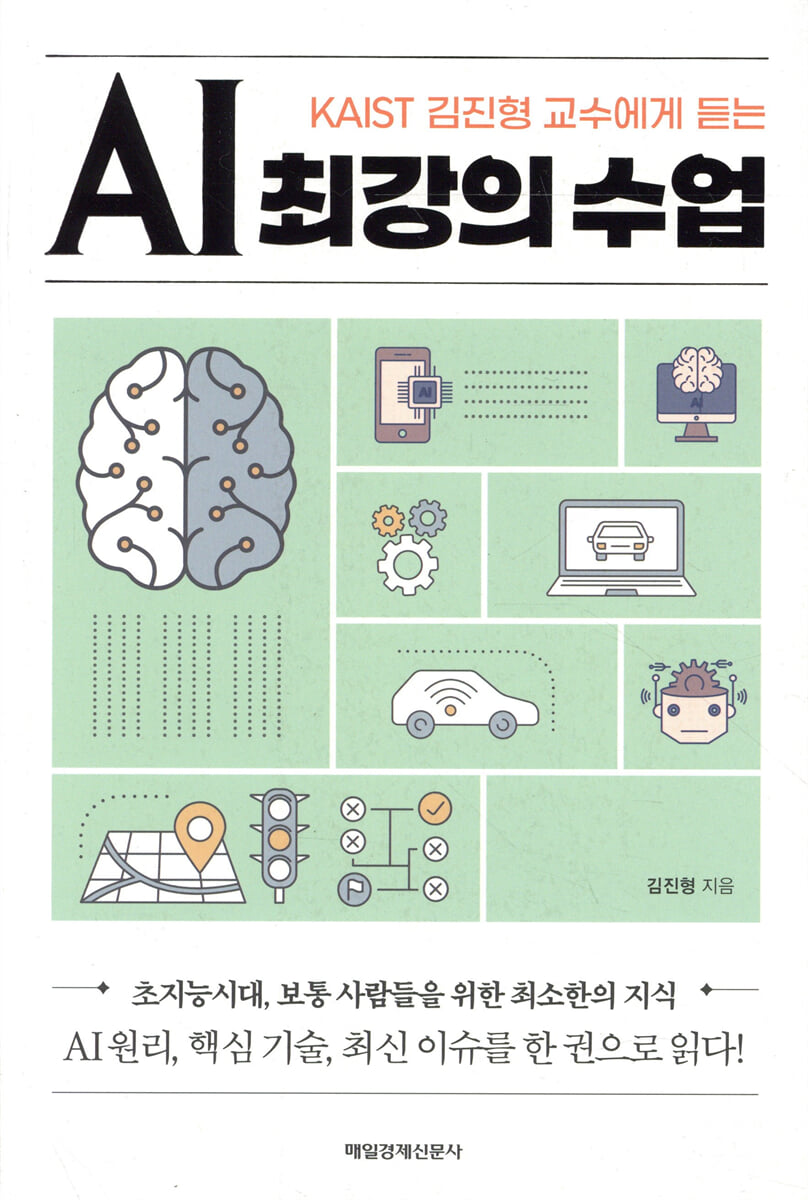
How AI is Changing Our Lives and Our World AI is driving innovation, improving productivity, and solving complex problems across a wide range of industries. McKinsey estimates that the ripple effect of artificial intelligence on the global economy will increase global GDP by 1.2% annually, adding $13 trillion to global GDP annually by 2030. But what are the changes we will face immediately, rather than these macro-level stories? And what preparations should I make? Jobs will disappear and new ones will be created, and education will change accordingly. Furthermore, our lives will also change positively. You can receive legal and tax advice more easily and in more detail. Medical change is close to revolution. People who have lost both legs will be able to walk freely, and they will be able to predict their illnesses and take proactive measures to prevent them. This book captures all of this. It explores the macroscopic world and the direct impact of AI on our lives, and suggests a direction for its future. |
- You can preview some of the book's contents.
Preview
index
Part 01 How Artificial Intelligence is Changing Our Lives and Our World
A Powerful Destroyer: Artificial Intelligence / What is Artificial Intelligence? / Can Artificial Intelligence Have Emotions and Will? / Is Artificial Intelligence Always Ethical? / Is Artificial Intelligence Beyond Humanity Possible? 68
Part 02 Technology for AI Smarter Than Humans
Human-like vs. pursuit of rationality / History of challenges in artificial intelligence / Problem-solving techniques to achieve goals / Artificial intelligence that utilizes human knowledge / Self-learning machine learning / The human brain's operating mechanism, artificial neural networks / The emergence of deep learning that is good at learning / Computer vision that sees and understands like humans / People and machines, conversing naturally / Transfer learning that utilizes what has been learned / Some limitations of deep learning / The best artificial intelligence has not been invented yet
Part 03 Whoever controls AI controls the future.
The Source of Global Economic Growth / Disappearing, Creating, and Transforming Jobs / Civic Education in the Age of Artificial Intelligence / Let's Train Artificial Intelligence Experts / Democratization of Artificial Intelligence Technology / Competition for Artificial Intelligence Leading to Political Ideology / Negative Effects of Artificial Intelligence / Transhumanism that Transcends Humanity / Artificial Intelligence Broadly Benefiting the World
Appendix AI Basics Word Explanation
A Powerful Destroyer: Artificial Intelligence / What is Artificial Intelligence? / Can Artificial Intelligence Have Emotions and Will? / Is Artificial Intelligence Always Ethical? / Is Artificial Intelligence Beyond Humanity Possible? 68
Part 02 Technology for AI Smarter Than Humans
Human-like vs. pursuit of rationality / History of challenges in artificial intelligence / Problem-solving techniques to achieve goals / Artificial intelligence that utilizes human knowledge / Self-learning machine learning / The human brain's operating mechanism, artificial neural networks / The emergence of deep learning that is good at learning / Computer vision that sees and understands like humans / People and machines, conversing naturally / Transfer learning that utilizes what has been learned / Some limitations of deep learning / The best artificial intelligence has not been invented yet
Part 03 Whoever controls AI controls the future.
The Source of Global Economic Growth / Disappearing, Creating, and Transforming Jobs / Civic Education in the Age of Artificial Intelligence / Let's Train Artificial Intelligence Experts / Democratization of Artificial Intelligence Technology / Competition for Artificial Intelligence Leading to Political Ideology / Negative Effects of Artificial Intelligence / Transhumanism that Transcends Humanity / Artificial Intelligence Broadly Benefiting the World
Appendix AI Basics Word Explanation
Detailed image
Into the book
“Artificial intelligence is also playing a significant role in the medical field.
A machine that automatically diagnoses diabetic retinopathy, which previously required a two-hour examination by an ophthalmologist with 20 years of experience, has received FDA approval and is now in the field.
This disease can lead to blindness, and more than 400 million people worldwide are at risk, but in developing countries, there is a shortage of trained ophthalmologists, so many people do not receive timely treatment.
The diagnostic system analyzes images of the patient's eye to 'instantly' determine whether retinopathy is present.
Diagnosing diseases that required considerable expertise has become possible with the same effort as stepping on a scale.
In early 2020, a study reported that artificial intelligence was superior to well-trained radiologists in analyzing radiological images to detect breast cancer.
The work that doctors used to do is gradually being replaced by artificial intelligence.
Artificial intelligence researchers predict that 80% of doctors' work will be automated within 10 years.”
“Let’s look at the role of artificial intelligence in agriculture.
Spraying herbicides and fertilizers on large farms is a labor-intensive and painful task.
However, we cannot indiscriminately spray herbicides and fertilizers on weeds and crops.
Weeds need to be sprayed with herbicide, and crops need to be sprayed with fertilizer.
Artificial intelligence has automated this task.
Artificial intelligence 'reports' and sprays.
The artificial intelligence accurately recognized each weed and crop by learning from a database of weeds and crops.
“It is said that the introduction of this type of artificial intelligence has reduced the use of environmentally harmful herbicides by 90%.”
“The field of art cannot avoid artificial intelligence either.
Artificial intelligence creates works of art.
A work of art must be original.
However, even if it is original, if it stands out too much and causes rejection, it cannot be considered a good work of art.
Artificial intelligence also adopts this strategy.
By studying numerous works, you learn the patterns of the works, and by making slight changes to them, you create new works.
If you give a landscape photo to an AI that has learned Van Gogh's painting style and ask it to transform it into Van Gogh's style, it will create it in an instant.
“One of the works created this way, a French-style portrait, was sold for 500 million won at an auction in New York.”
“When given a topic, AI can create a story related to it, and the content is plausible.
OpenAI, a company founded with private investment to research and publicize general artificial intelligence, has developed an AI program called GPT-3. GPT-3 can generate plausible sentences following a given sentence.
It is said that it learned from a massive sentence of 45 terabytes.
As a result, he surprised many people by demonstrating his ability to write beautiful essays.
“If you throw me a verse from Shakespeare, I’ll take it and write a poem in his style.”
“Deepfake, a publicly available technology, can replace the face of a video subject with the face of a person of your choice.
This technology was used to create a video of President Obama making an outrageous statement.
Also, a fake video of House Speaker Pelosi, a political opponent of Trump, talking nonsense after drinking was created and circulated on social media.
A domestic company even created a fake video of President Moon Jae-in saying, "AI is important."
“A lifelike two-dimensional avatar leads the conversation with natural body movements.
These avatars are sometimes called digital humans.
Avatars use conversational and visual features to engage customers in personalized interactions.
Grow into a unique avatar by accumulating experience and learning new knowledge.
Avatars with specific knowledge are also leased to companies to be used for customer service, etc.
I think the most successful digital human right now is Amelia.
Amelia, who has been hired by several global companies, works 24 hours a day, 365 days a year without eating or sleeping, receiving a monthly salary of only $1,800.
He handles twelve tasks, including call center work and accounting, and is fluent in 20 languages, including English and French.
She also has the ability to memorize reports that are hundreds of pages long in just a few minutes, which is said to be a source of high satisfaction for the companies that employ her.”
The ethical issues facing self-driving cars when faced with dilemmas are complex. MIT is conducting the Moral Machine project to study the ethical operation of self-driving cars.
This project investigates the public's ethical perceptions about the actions that autonomous vehicles should take in emergencies.
Let's look at one example used in this project.
A self-driving car carrying three passengers encounters an unavoidable obstacle.
There are only two choices.
This is the case when the driver suddenly turns the steering wheel and kills three innocent people crossing the street to protect the passengers, or collides with an obstacle and injures three passengers.
Which case is more ethical? Most people would say the latter.
Passengers are simply trying to get around quickly and end up in an accident, but why should innocent people crossing the street be killed? The latter is clearly more ethical, but will such a product be accepted in the market? Consumers, being selfish, will avoid purchasing such vehicles.
What if there was only one person crossing the street? Wouldn't it be more ethical from a utilitarian perspective to sacrifice one person to save three? What if the three people crossing the street were running a red light? What if the passengers were boys and the other people crossing were elderly? The possibilities are endless.
In all these situations, one wonders whether it is possible to algorithmically predict the ethical behavior of autonomous vehicles.”
“If we connect the capabilities of powerful artificial intelligence with the human brain, humans will become omnipotent.
It may sound like a dream from a science fiction movie, but the reality of this technology is gradually getting closer.
In his book, The Singularity is Near, futurist Ray Kurzweil predicts that a "hybrid brain" combining humans and artificial intelligence will become a reality after 2030.
The technology that aims to connect computers and the brain is called BCI.
This effort aims to enhance human capabilities by directly connecting the human brain and a computer, interpreting and utilizing neural signals in real time, or inputting and modifying external information. BCI technology enables direct communication between the brain and computers.
Therefore, it can process large amounts of information faster than reading with your eyes or writing with your hands.
Also, if the brain is connected to just one computer, all the information and knowledge in the world can be used.
With the help of artificial intelligence spread across the world, we will also have powerful judgment abilities.
“It is to become an omnipotent person.”
A machine that automatically diagnoses diabetic retinopathy, which previously required a two-hour examination by an ophthalmologist with 20 years of experience, has received FDA approval and is now in the field.
This disease can lead to blindness, and more than 400 million people worldwide are at risk, but in developing countries, there is a shortage of trained ophthalmologists, so many people do not receive timely treatment.
The diagnostic system analyzes images of the patient's eye to 'instantly' determine whether retinopathy is present.
Diagnosing diseases that required considerable expertise has become possible with the same effort as stepping on a scale.
In early 2020, a study reported that artificial intelligence was superior to well-trained radiologists in analyzing radiological images to detect breast cancer.
The work that doctors used to do is gradually being replaced by artificial intelligence.
Artificial intelligence researchers predict that 80% of doctors' work will be automated within 10 years.”
“Let’s look at the role of artificial intelligence in agriculture.
Spraying herbicides and fertilizers on large farms is a labor-intensive and painful task.
However, we cannot indiscriminately spray herbicides and fertilizers on weeds and crops.
Weeds need to be sprayed with herbicide, and crops need to be sprayed with fertilizer.
Artificial intelligence has automated this task.
Artificial intelligence 'reports' and sprays.
The artificial intelligence accurately recognized each weed and crop by learning from a database of weeds and crops.
“It is said that the introduction of this type of artificial intelligence has reduced the use of environmentally harmful herbicides by 90%.”
“The field of art cannot avoid artificial intelligence either.
Artificial intelligence creates works of art.
A work of art must be original.
However, even if it is original, if it stands out too much and causes rejection, it cannot be considered a good work of art.
Artificial intelligence also adopts this strategy.
By studying numerous works, you learn the patterns of the works, and by making slight changes to them, you create new works.
If you give a landscape photo to an AI that has learned Van Gogh's painting style and ask it to transform it into Van Gogh's style, it will create it in an instant.
“One of the works created this way, a French-style portrait, was sold for 500 million won at an auction in New York.”
“When given a topic, AI can create a story related to it, and the content is plausible.
OpenAI, a company founded with private investment to research and publicize general artificial intelligence, has developed an AI program called GPT-3. GPT-3 can generate plausible sentences following a given sentence.
It is said that it learned from a massive sentence of 45 terabytes.
As a result, he surprised many people by demonstrating his ability to write beautiful essays.
“If you throw me a verse from Shakespeare, I’ll take it and write a poem in his style.”
“Deepfake, a publicly available technology, can replace the face of a video subject with the face of a person of your choice.
This technology was used to create a video of President Obama making an outrageous statement.
Also, a fake video of House Speaker Pelosi, a political opponent of Trump, talking nonsense after drinking was created and circulated on social media.
A domestic company even created a fake video of President Moon Jae-in saying, "AI is important."
“A lifelike two-dimensional avatar leads the conversation with natural body movements.
These avatars are sometimes called digital humans.
Avatars use conversational and visual features to engage customers in personalized interactions.
Grow into a unique avatar by accumulating experience and learning new knowledge.
Avatars with specific knowledge are also leased to companies to be used for customer service, etc.
I think the most successful digital human right now is Amelia.
Amelia, who has been hired by several global companies, works 24 hours a day, 365 days a year without eating or sleeping, receiving a monthly salary of only $1,800.
He handles twelve tasks, including call center work and accounting, and is fluent in 20 languages, including English and French.
She also has the ability to memorize reports that are hundreds of pages long in just a few minutes, which is said to be a source of high satisfaction for the companies that employ her.”
The ethical issues facing self-driving cars when faced with dilemmas are complex. MIT is conducting the Moral Machine project to study the ethical operation of self-driving cars.
This project investigates the public's ethical perceptions about the actions that autonomous vehicles should take in emergencies.
Let's look at one example used in this project.
A self-driving car carrying three passengers encounters an unavoidable obstacle.
There are only two choices.
This is the case when the driver suddenly turns the steering wheel and kills three innocent people crossing the street to protect the passengers, or collides with an obstacle and injures three passengers.
Which case is more ethical? Most people would say the latter.
Passengers are simply trying to get around quickly and end up in an accident, but why should innocent people crossing the street be killed? The latter is clearly more ethical, but will such a product be accepted in the market? Consumers, being selfish, will avoid purchasing such vehicles.
What if there was only one person crossing the street? Wouldn't it be more ethical from a utilitarian perspective to sacrifice one person to save three? What if the three people crossing the street were running a red light? What if the passengers were boys and the other people crossing were elderly? The possibilities are endless.
In all these situations, one wonders whether it is possible to algorithmically predict the ethical behavior of autonomous vehicles.”
“If we connect the capabilities of powerful artificial intelligence with the human brain, humans will become omnipotent.
It may sound like a dream from a science fiction movie, but the reality of this technology is gradually getting closer.
In his book, The Singularity is Near, futurist Ray Kurzweil predicts that a "hybrid brain" combining humans and artificial intelligence will become a reality after 2030.
The technology that aims to connect computers and the brain is called BCI.
This effort aims to enhance human capabilities by directly connecting the human brain and a computer, interpreting and utilizing neural signals in real time, or inputting and modifying external information. BCI technology enables direct communication between the brain and computers.
Therefore, it can process large amounts of information faster than reading with your eyes or writing with your hands.
Also, if the brain is connected to just one computer, all the information and knowledge in the world can be used.
With the help of artificial intelligence spread across the world, we will also have powerful judgment abilities.
“It is to become an omnipotent person.”
--- From the text
Publisher's Review
"AI dreams of machines smarter than humans."
What makes such a revolutionary change possible?
One step ahead! Forget all the AI-related books you've read so far.
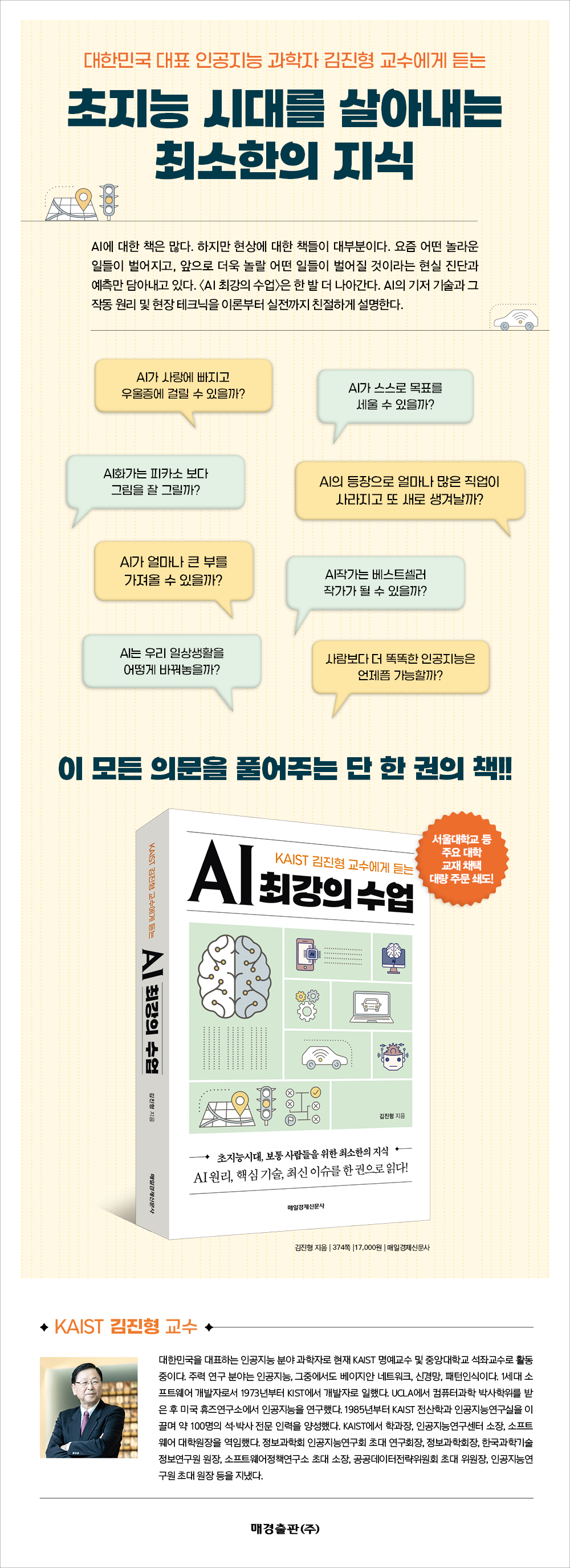
Read the basic principles, core technologies, implementation methods, and latest issues in one book!
There are many books about AI.
But most of the books are about phenomena.
It only contains a diagnosis of reality and predictions about what surprising things are happening these days and what even more surprising things will happen in the future.
"AI's Strongest Class" goes one step further.
We will explain in detail the underlying technology that operates these phenomena and how that technology is achieved, starting from the principles.
That is, we are not simply showing a machine writing and saying that it is amazing.
It explains how certain technologies are developed to make machines work, how technologies are implemented, and how machines present writing to us.
When you dissect AI like this, the emotions that were previously surprising begin to change.
Ultimately, it is something created by humans, so it is possible to predict where AI has its limitations and where it can be further developed.
Machine learning, deep learning, GPT-3, deepfakes, vision systems, chatbots, parallel reality…
Everything you need to know about AI!
What is the essence of artificial intelligence, and what are the capabilities and limitations of this technology?
While it's fascinating to see what future AI technologies might enable, knowing what we can do with current technology offers economic benefits.
So we need to know exactly what AI technology we currently have.
You shouldn't be too overconfident and greedy.
Machine Learning & Deep Learning
By studying numerous works, you learn the patterns of the works, and by making slight changes to them, you create new works of art.
If you give a landscape photo to an AI that has learned Van Gogh's painting style, it will instantly transform it into a painting in Van Gogh's style.
Composing, performing, writing poetry, novels, choreography, etc. are also possible.
Vision System
An unmanned store has opened.
Consumers just go into the store, take what they want, and leave.
The calculation is done automatically by finding the user's registered account.
It also recognizes when you change your mind about an item and then return it.
Generative Adversarial Networks (GANs)
It is used to generate new data similar to training data.
For example, after learning many cat pictures, it can generate new cat pictures.
Create new photos with realistic properties that look real.
Using this technology, we can also predict what a person will look like 10 or 20 years from now based on their current appearance.
GPT-3
If you give me a topic, I will write an essay related to it.
Beyond creativity, imitation is also possible.
If you give them a verse from Shakespeare, they will learn it and write a poem in his style.
Replace the faces of the actors in deepfake videos with your desired faces.
This technology was used to create fake videos of US President Obama making strange remarks and US House Speaker Pelosi talking nonsense after drinking, which were circulated on social media.
Parallel reality
Several people look at the same point at the same time.
But not everyone sees the same information.
Each customer sees only the information they want.
These customized bulletin boards are being installed at airports.
Chatbot
When a user asks a question, it is basic to search the Internet and answer, and it also serves as a chatting companion to pass the time.
It connects to your schedule so that you can perform planned tasks at the desired time, and like a personal assistant, it remembers and reminds you of what you need to do.
What makes such a revolutionary change possible?
One step ahead! Forget all the AI-related books you've read so far.
Read the basic principles, core technologies, implementation methods, and latest issues in one book!
There are many books about AI.
But most of the books are about phenomena.
It only contains a diagnosis of reality and predictions about what surprising things are happening these days and what even more surprising things will happen in the future.
"AI's Strongest Class" goes one step further.
We will explain in detail the underlying technology that operates these phenomena and how that technology is achieved, starting from the principles.
That is, we are not simply showing a machine writing and saying that it is amazing.
It explains how certain technologies are developed to make machines work, how technologies are implemented, and how machines present writing to us.
When you dissect AI like this, the emotions that were previously surprising begin to change.
Ultimately, it is something created by humans, so it is possible to predict where AI has its limitations and where it can be further developed.
Machine learning, deep learning, GPT-3, deepfakes, vision systems, chatbots, parallel reality…
Everything you need to know about AI!
What is the essence of artificial intelligence, and what are the capabilities and limitations of this technology?
While it's fascinating to see what future AI technologies might enable, knowing what we can do with current technology offers economic benefits.
So we need to know exactly what AI technology we currently have.
You shouldn't be too overconfident and greedy.
Machine Learning & Deep Learning
By studying numerous works, you learn the patterns of the works, and by making slight changes to them, you create new works of art.
If you give a landscape photo to an AI that has learned Van Gogh's painting style, it will instantly transform it into a painting in Van Gogh's style.
Composing, performing, writing poetry, novels, choreography, etc. are also possible.
Vision System
An unmanned store has opened.
Consumers just go into the store, take what they want, and leave.
The calculation is done automatically by finding the user's registered account.
It also recognizes when you change your mind about an item and then return it.
Generative Adversarial Networks (GANs)
It is used to generate new data similar to training data.
For example, after learning many cat pictures, it can generate new cat pictures.
Create new photos with realistic properties that look real.
Using this technology, we can also predict what a person will look like 10 or 20 years from now based on their current appearance.
GPT-3
If you give me a topic, I will write an essay related to it.
Beyond creativity, imitation is also possible.
If you give them a verse from Shakespeare, they will learn it and write a poem in his style.
Replace the faces of the actors in deepfake videos with your desired faces.
This technology was used to create fake videos of US President Obama making strange remarks and US House Speaker Pelosi talking nonsense after drinking, which were circulated on social media.
Parallel reality
Several people look at the same point at the same time.
But not everyone sees the same information.
Each customer sees only the information they want.
These customized bulletin boards are being installed at airports.
Chatbot
When a user asks a question, it is basic to search the Internet and answer, and it also serves as a chatting companion to pass the time.
It connects to your schedule so that you can perform planned tasks at the desired time, and like a personal assistant, it remembers and reminds you of what you need to do.
GOODS SPECIFICS
- Publication date: November 20, 2020
- Page count, weight, size: 374 pages | 676g | 152*225*30mm
- ISBN13: 9791164841905
- ISBN10: 1164841904
You may also like
카테고리
korean


korean

![ELLE 엘르 스페셜 에디션 A형 : 12월 [2025]](http://librairie.coreenne.fr/cdn/shop/files/b8e27a3de6c9538896439686c6b0e8fb.jpg?v=1766436872&width=3840)


