

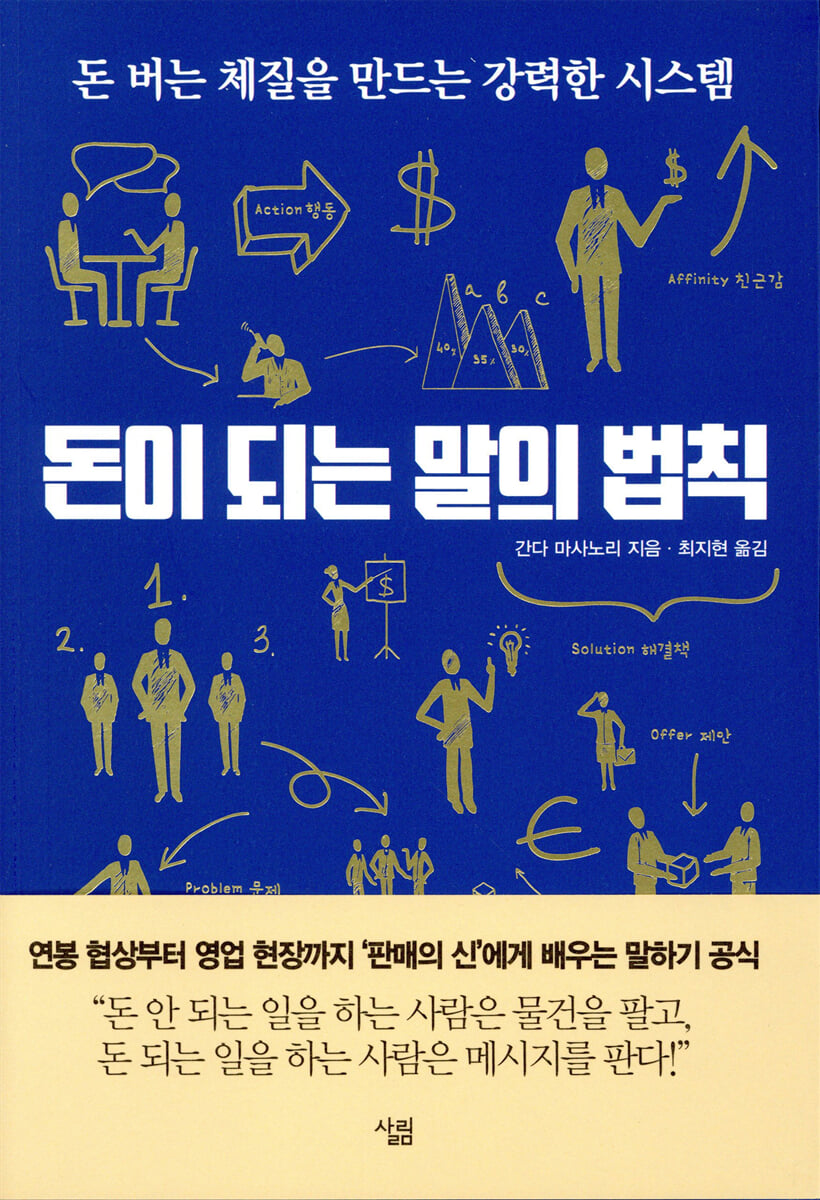
The Law of Money Talk
 |
Description
Book Introduction
“You can become rich just by changing the way you speak.”
From salary negotiations to sales pitches, learn speaking skills from the "God of Sales."
Japan's top marketer and entrepreneurship mentor who has trained 20,000 CEOs has summarized the "skills of selling things and making money" into rules.
The days when only salespeople and salespeople sell things are over.
Nowadays, anyone can survive only if they make money and dedicate themselves to 'selling' things.
Part 1 of this book poses five questions to readers on how to sell products and services to customers in real-world situations, and provides step-by-step coaching to help them develop a "money-making constitution."
Additionally, the 41 speaking formulas listed in Part 2 of this book, divided into three stages, are based on the 'New PASONA' formula, which the author has acquired and updated over the past 20 years, and is now revealing for the first time, guiding you on the path to becoming rich in a systematic and scientific manner.
Throughout the book, it brainwashes you into what makes money and what doesn't, reducing the common mistakes you make in the process of making money.
From salary negotiations to sales pitches, learn speaking skills from the "God of Sales."
Japan's top marketer and entrepreneurship mentor who has trained 20,000 CEOs has summarized the "skills of selling things and making money" into rules.
The days when only salespeople and salespeople sell things are over.
Nowadays, anyone can survive only if they make money and dedicate themselves to 'selling' things.
Part 1 of this book poses five questions to readers on how to sell products and services to customers in real-world situations, and provides step-by-step coaching to help them develop a "money-making constitution."
Additionally, the 41 speaking formulas listed in Part 2 of this book, divided into three stages, are based on the 'New PASONA' formula, which the author has acquired and updated over the past 20 years, and is now revealing for the first time, guiding you on the path to becoming rich in a systematic and scientific manner.
Throughout the book, it brainwashes you into what makes money and what doesn't, reducing the common mistakes you make in the process of making money.
- You can preview some of the book's contents.
Preview
index
Starting Out_You Can Make Money Just by Changing the Way You Speak
Part 1: Theory of Building a Money-Making Constitution
Chapter 1: Five Questions to Identify Money-Winning Words
What are the characteristics of the product you are trying to sell?
Who are the consumers who want this product?
Is the company that made the product trustworthy?
Are you gaining customer empathy?
What evidence can reassure customers?
Chapter 2: How to Create a Flow of Money-Making Words
What is the 'New PASONA Law'?
Implementing the 'New PASONA Law'
3 Ways to Create a Message That Sells
The mechanism by which messages are transmitted
Part 2: A System for Building a Money-Making Constitution
Chapter 3: The Power of Making Money
The Law of the Growth Curve: When Sales Fall, It's an Opportunity
The Law of Change and Courage: Results Speak for Yourself
The Law of Product Standardization: Upgrade Your Success Experience
The Two Mountains Rule: Find the Customer Within Your Customers
The Law of Customer Listening: Secure Profits Over Budget
The Law of Breaking Through a Million: Focus on Variables
The Law of Dream Utilization: A Desperate Question Finds an Answer
Aladdin and the Magic Lamp: What Does the Future Need?
The Law of Approval: Start Small
Momotaro's Law: Change your words depending on the person you're talking to.
The 80% Rule: Focus on Profit
The Law of Experiential Value: Give Experiences, Not Products
The Law of the Six: Business Models Are Built in Crisis
The Law of Shared Growth: Succeed Together with Your Customers
The Law of Constructive Abandonment: Don't Compromise with Reality
The Law of Group Rope Jumping: Build Small Successes
Chapter 4: How to Create a Money-Winning Message
The Law of Copywriting: Emotion Can Be Conveyed in a Single Line
The Law of Headshots: Images are Powerful
The Law of the Slide: Write copy that makes people curious about the next sentence.
The Law of Pain Resolution: Tell Your Customers What They Want to Hear
The Law of the Wounded Healer: Harness Adversity
The Law of Countdown: Consider Your Customer's Context
The Law of Unexpected Competitors: Build Unexpected Enemies
One Rule of Life: Challenges Come Before Money
The Law of Irresistible Expressions: List the Effects of Buying
The Law of First Offering: Show the Best First
The Law of Effective Evidence: Reveal Your Customers
The Law of Bold Guarantees: Don't Be Afraid of Refunds
The Simple Law of Exchange: Make Buying Simple
The Invisible Law of Consideration: Put Your Heart into Your Packaging
The Law of Bundling: Sell More to Satisfy More
The Law of Consumer Success: Selling Isn't the End
Chapter 5… From Temple to President, From Merchant to Business
The Law of Strategic Proposals: Showcase What You Do Best
The Law of Trust Design: Invest in Intangible Value
The Law of Loss Acceptance: Connect Profits to Social Contribution
The Law of Firm Refusal: Express a Sense of Mission
The Law of Simple Rules: Codes of Conduct Make a Company
The Law of Oil and Water: There's No Innovation Without Management
The Law of Customer Reviews: The Future is Created by Customers
The Law of Life and Career: Fun Makes Money
The Law of Money Talk: Do things for others.
Appendix_[Won't Make Money] vs.
[Money-Making Ideas] Checklist
Part 1: Theory of Building a Money-Making Constitution
Chapter 1: Five Questions to Identify Money-Winning Words
What are the characteristics of the product you are trying to sell?
Who are the consumers who want this product?
Is the company that made the product trustworthy?
Are you gaining customer empathy?
What evidence can reassure customers?
Chapter 2: How to Create a Flow of Money-Making Words
What is the 'New PASONA Law'?
Implementing the 'New PASONA Law'
3 Ways to Create a Message That Sells
The mechanism by which messages are transmitted
Part 2: A System for Building a Money-Making Constitution
Chapter 3: The Power of Making Money
The Law of the Growth Curve: When Sales Fall, It's an Opportunity
The Law of Change and Courage: Results Speak for Yourself
The Law of Product Standardization: Upgrade Your Success Experience
The Two Mountains Rule: Find the Customer Within Your Customers
The Law of Customer Listening: Secure Profits Over Budget
The Law of Breaking Through a Million: Focus on Variables
The Law of Dream Utilization: A Desperate Question Finds an Answer
Aladdin and the Magic Lamp: What Does the Future Need?
The Law of Approval: Start Small
Momotaro's Law: Change your words depending on the person you're talking to.
The 80% Rule: Focus on Profit
The Law of Experiential Value: Give Experiences, Not Products
The Law of the Six: Business Models Are Built in Crisis
The Law of Shared Growth: Succeed Together with Your Customers
The Law of Constructive Abandonment: Don't Compromise with Reality
The Law of Group Rope Jumping: Build Small Successes
Chapter 4: How to Create a Money-Winning Message
The Law of Copywriting: Emotion Can Be Conveyed in a Single Line
The Law of Headshots: Images are Powerful
The Law of the Slide: Write copy that makes people curious about the next sentence.
The Law of Pain Resolution: Tell Your Customers What They Want to Hear
The Law of the Wounded Healer: Harness Adversity
The Law of Countdown: Consider Your Customer's Context
The Law of Unexpected Competitors: Build Unexpected Enemies
One Rule of Life: Challenges Come Before Money
The Law of Irresistible Expressions: List the Effects of Buying
The Law of First Offering: Show the Best First
The Law of Effective Evidence: Reveal Your Customers
The Law of Bold Guarantees: Don't Be Afraid of Refunds
The Simple Law of Exchange: Make Buying Simple
The Invisible Law of Consideration: Put Your Heart into Your Packaging
The Law of Bundling: Sell More to Satisfy More
The Law of Consumer Success: Selling Isn't the End
Chapter 5… From Temple to President, From Merchant to Business
The Law of Strategic Proposals: Showcase What You Do Best
The Law of Trust Design: Invest in Intangible Value
The Law of Loss Acceptance: Connect Profits to Social Contribution
The Law of Firm Refusal: Express a Sense of Mission
The Law of Simple Rules: Codes of Conduct Make a Company
The Law of Oil and Water: There's No Innovation Without Management
The Law of Customer Reviews: The Future is Created by Customers
The Law of Life and Career: Fun Makes Money
The Law of Money Talk: Do things for others.
Appendix_[Won't Make Money] vs.
[Money-Making Ideas] Checklist
Into the book
Selling things is not something you have to do just to make a living.
Selling is the best way to discover and express your talents, and as a result, it leads directly to income.
--- p.5
When it comes to increasing sales, it's more important to know who to say what to say, and in what order to say it, than how to say it.
--- p.20
What exactly is your product? Could you explain two of its features in 20 seconds, so they can intuitively grasp it? The reason it needs to be 20 seconds is because, like TV commercials, people can only listen for 15 seconds, or at most 20 seconds, to understand a single fact.
At the same time, let us point out two characteristics.
Why two? Because one characteristic is too vague for consumers to conjure up an image.
--- p.27
A truly good thing will eventually become widely known, even if it takes a long time.
But why are so many products not selling in reality? The reason becomes clear when you ask, "Please show me some good products."
There are many times when I am shocked when I see the products that companies put out.
A ‘good product’ is good from the seller’s perspective, but from the buyer’s perspective, it is often a ‘product that is lacking in some way.’
However, the reason why the seller is so convinced that it is a 'good product' is because he has not made any effort to sell it.
--- p.77
First, look at the customer list.
While it's nice to see an analysis report organized in Excel or PowerPoint, I recommend looking at a list with customer names and addresses.
Each customer has their own data
Because it feels vivid that he is a human being with a face, not a person.
Which area has the most people, whether they live in apartments or houses, whether there are many young people or older people, what products they bought and what products they didn't buy, and what products they bought after what products they bought based on their purchasing history, etc.
You can get this amazing information by just looking at your customer list for 20 minutes.
--- p.100
Tell the president (Momotaro) your purpose (Why).
Managers won't move unless they know why they need to implement this idea.
Tell the practitioner (dog) the specific details (What).
Let's talk about practical things like specific tasks and schedules.
Tell the manager (monkey) how to do it.
The nature of the work being done, the size of the budget, etc. are the information that managers want to know.
And to the unifier (pheasant) he speaks of the person (Who).
We talk about who will take on what role, how to allocate personnel, etc.
--- p.115
If six people respond to your call, you've started a worthwhile project.
Because, according to the company founders, the number of customers in the early days when the company was founded was around 6.
okay
These six people could become key partners for the company in the future.
By building deep relationships with these six people and securing demand, we can easily increase the number of people from 6 to 60, and then from those 60 to 6,000 in one fell swoop.
--- p.124
When a client asks me for advice on sales copy, I first ask, "What pain point can your product solve?"
The other party may be confused, but if the answer is not clear, it is safe to assume that no one will pay for that company's products.
--- p.146
If you start technically doing tie-ins, customers will just leave.
It is important to have the concept of 'up serve' rather than 'up sale'.
Sub means 'service' and 'up serve' means serving customers more.
Just by changing the word 'sale' to 'sub', you can suggest products that are suitable for your customers.
--- p.180
People who do unprofitable work are happy or sad only by looking at the number of stars in customer reviews.
Meanwhile, people in the money business ask, "How were the customer reviews this month?" and then gather all the people involved in the company to devise a corporate strategy.
The best way to sustainably grow your business is to focus on simple metrics without fooling your customers.
Selling is the best way to discover and express your talents, and as a result, it leads directly to income.
--- p.5
When it comes to increasing sales, it's more important to know who to say what to say, and in what order to say it, than how to say it.
--- p.20
What exactly is your product? Could you explain two of its features in 20 seconds, so they can intuitively grasp it? The reason it needs to be 20 seconds is because, like TV commercials, people can only listen for 15 seconds, or at most 20 seconds, to understand a single fact.
At the same time, let us point out two characteristics.
Why two? Because one characteristic is too vague for consumers to conjure up an image.
--- p.27
A truly good thing will eventually become widely known, even if it takes a long time.
But why are so many products not selling in reality? The reason becomes clear when you ask, "Please show me some good products."
There are many times when I am shocked when I see the products that companies put out.
A ‘good product’ is good from the seller’s perspective, but from the buyer’s perspective, it is often a ‘product that is lacking in some way.’
However, the reason why the seller is so convinced that it is a 'good product' is because he has not made any effort to sell it.
--- p.77
First, look at the customer list.
While it's nice to see an analysis report organized in Excel or PowerPoint, I recommend looking at a list with customer names and addresses.
Each customer has their own data
Because it feels vivid that he is a human being with a face, not a person.
Which area has the most people, whether they live in apartments or houses, whether there are many young people or older people, what products they bought and what products they didn't buy, and what products they bought after what products they bought based on their purchasing history, etc.
You can get this amazing information by just looking at your customer list for 20 minutes.
--- p.100
Tell the president (Momotaro) your purpose (Why).
Managers won't move unless they know why they need to implement this idea.
Tell the practitioner (dog) the specific details (What).
Let's talk about practical things like specific tasks and schedules.
Tell the manager (monkey) how to do it.
The nature of the work being done, the size of the budget, etc. are the information that managers want to know.
And to the unifier (pheasant) he speaks of the person (Who).
We talk about who will take on what role, how to allocate personnel, etc.
--- p.115
If six people respond to your call, you've started a worthwhile project.
Because, according to the company founders, the number of customers in the early days when the company was founded was around 6.
okay
These six people could become key partners for the company in the future.
By building deep relationships with these six people and securing demand, we can easily increase the number of people from 6 to 60, and then from those 60 to 6,000 in one fell swoop.
--- p.124
When a client asks me for advice on sales copy, I first ask, "What pain point can your product solve?"
The other party may be confused, but if the answer is not clear, it is safe to assume that no one will pay for that company's products.
--- p.146
If you start technically doing tie-ins, customers will just leave.
It is important to have the concept of 'up serve' rather than 'up sale'.
Sub means 'service' and 'up serve' means serving customers more.
Just by changing the word 'sale' to 'sub', you can suggest products that are suitable for your customers.
--- p.180
People who do unprofitable work are happy or sad only by looking at the number of stars in customer reviews.
Meanwhile, people in the money business ask, "How were the customer reviews this month?" and then gather all the people involved in the company to devise a corporate strategy.
The best way to sustainably grow your business is to focus on simple metrics without fooling your customers.
--- p.207
Publisher's Review
“Are you doing something that makes money now?”
Five questions and 41 formulas that have helped 20,000 startups succeed over the past 20 years.
There was a time when income was determined by the company you worked for, your position, education, and age.
If you work diligently as society dictates, you will naturally earn money.
But look around now.
A 30-year-old who made hundreds of millions of won in profit through real estate investment as a side job, a successful startup CEO in his 20s who passed the GED exam, a 40-year-old housewife who created her own SNS channel and earns hundreds of millions of won in annual salary…
There are countless ordinary people living as rich people.
This book says that everyone has the power to make money.
However, 'making money' is the result of the communication ability that connects the values I have with the other person, and this ability is expressed in the way I use words.
And to develop this ability, the author has compiled in this book the know-how he has accumulated from helping 20,000 people start their own businesses and his field experience from working as a marketer for over 20 years.
The 'Law of Money Talk' is not as complicated as you might think.
By revising the marketing plan I wrote today, the email I send to my customers, and the report I use to persuade my boss based on these five questions that create a profitable statement, such as “What are the characteristics of the product you are trying to sell?” and “Who is the consumer who wants this product?”, I will be able to create a “profitable statement.”
And furthermore, it gives those working on the front lines of sales the power to persuade customers.
This book connects the value I provide with the needs of my customers through five questions in Part 1, and helps readers embody the 'Laws of Money-Making Words' in real life through 41 rules in Part 2, so they can learn how to speak to become rich and actually become rich.
“There is a pattern to making money.”
The Law of Money-Making Words Revealed for the First Time by a Top Marketer
Author Masanori Kanda, who claims that “what you say and in what order is more important than what kind of rhetoric you use,” reveals for the first time in this book the “New PASONA” law as the most powerful secret weapon that can help you immediately learn the “law of money-making words.”
This is the 'Pasona Law' developed based on the author's field experience.
If the existing rule was to show 'the problem the customer is having', 'reveal' the problem in more detail, then state the product or service you are trying to sell as a 'solution', 'limit' the items to emphasize the necessity, and finally suggest a method of 'action' (such as purchasing or inquiring about the product or service), the New Pathona rule focuses more on 'friendliness' with the customer rather than 'arousing' the customer, and emphasizes the importance of 'suggestion'.
He was providing advice on editing advertising copy and service content in response to clients' requests, such as, "How can I create a message that sells a product (service)?" He realized that there was a certain pattern to 'words that make money' and proposed the 'New Parsona Law', which resulted in an explosive response.
Sales started to increase with just a ‘formula made from patterns’.
At first, create your messages according to these rules, and then, as you become more comfortable with them, try rearranging them to use more appropriate and powerful "money talk" to suit the situation.
Just by changing the way you speak a little, you can dramatically increase consumer response and make yourself rich.
“People who do things that don’t make money sell things,
“People who make money sell messages.”
“Is this a profitable business?” Have you ever heard this question from your boss, business partner, or customer?
In the unpredictable and rapidly changing business jungle, even if you're not a CEO or a salesperson, you'll face this question every moment, at every moment of choice and decision.
Of course, the 'sell skills' discussed in this book may not be the perfect answer.
However, speaking secrets that can be used right away starting tomorrow morning, such as ‘Say the purpose to the CEO first, and say the content to the workers first’, ‘Listing more than 7 purchase effects is effective’, and ‘Use a face photo in banner ads’, or the secrets of business management, such as ‘You can create a business model with just 6 customers’, and ‘The point of a project is to start small without getting approval’, will constantly stimulate you and make you take action when you are unknowingly focusing on things that don’t make money and missing out on things that make money.
Are you still ignoring sales as a job for the sales department, focusing solely on tasks that will help you navigate immediate crises? If you have great ideas but fail to put them into action, sacrificing results? If you're so busy dealing with the day-to-day tasks that you can't create profitable projects, then this book is for you.
Five questions and 41 formulas that have helped 20,000 startups succeed over the past 20 years.
There was a time when income was determined by the company you worked for, your position, education, and age.
If you work diligently as society dictates, you will naturally earn money.
But look around now.
A 30-year-old who made hundreds of millions of won in profit through real estate investment as a side job, a successful startup CEO in his 20s who passed the GED exam, a 40-year-old housewife who created her own SNS channel and earns hundreds of millions of won in annual salary…
There are countless ordinary people living as rich people.
This book says that everyone has the power to make money.
However, 'making money' is the result of the communication ability that connects the values I have with the other person, and this ability is expressed in the way I use words.
And to develop this ability, the author has compiled in this book the know-how he has accumulated from helping 20,000 people start their own businesses and his field experience from working as a marketer for over 20 years.
The 'Law of Money Talk' is not as complicated as you might think.
By revising the marketing plan I wrote today, the email I send to my customers, and the report I use to persuade my boss based on these five questions that create a profitable statement, such as “What are the characteristics of the product you are trying to sell?” and “Who is the consumer who wants this product?”, I will be able to create a “profitable statement.”
And furthermore, it gives those working on the front lines of sales the power to persuade customers.
This book connects the value I provide with the needs of my customers through five questions in Part 1, and helps readers embody the 'Laws of Money-Making Words' in real life through 41 rules in Part 2, so they can learn how to speak to become rich and actually become rich.
“There is a pattern to making money.”
The Law of Money-Making Words Revealed for the First Time by a Top Marketer
Author Masanori Kanda, who claims that “what you say and in what order is more important than what kind of rhetoric you use,” reveals for the first time in this book the “New PASONA” law as the most powerful secret weapon that can help you immediately learn the “law of money-making words.”
This is the 'Pasona Law' developed based on the author's field experience.
If the existing rule was to show 'the problem the customer is having', 'reveal' the problem in more detail, then state the product or service you are trying to sell as a 'solution', 'limit' the items to emphasize the necessity, and finally suggest a method of 'action' (such as purchasing or inquiring about the product or service), the New Pathona rule focuses more on 'friendliness' with the customer rather than 'arousing' the customer, and emphasizes the importance of 'suggestion'.
He was providing advice on editing advertising copy and service content in response to clients' requests, such as, "How can I create a message that sells a product (service)?" He realized that there was a certain pattern to 'words that make money' and proposed the 'New Parsona Law', which resulted in an explosive response.
Sales started to increase with just a ‘formula made from patterns’.
At first, create your messages according to these rules, and then, as you become more comfortable with them, try rearranging them to use more appropriate and powerful "money talk" to suit the situation.
Just by changing the way you speak a little, you can dramatically increase consumer response and make yourself rich.
“People who do things that don’t make money sell things,
“People who make money sell messages.”
“Is this a profitable business?” Have you ever heard this question from your boss, business partner, or customer?
In the unpredictable and rapidly changing business jungle, even if you're not a CEO or a salesperson, you'll face this question every moment, at every moment of choice and decision.
Of course, the 'sell skills' discussed in this book may not be the perfect answer.
However, speaking secrets that can be used right away starting tomorrow morning, such as ‘Say the purpose to the CEO first, and say the content to the workers first’, ‘Listing more than 7 purchase effects is effective’, and ‘Use a face photo in banner ads’, or the secrets of business management, such as ‘You can create a business model with just 6 customers’, and ‘The point of a project is to start small without getting approval’, will constantly stimulate you and make you take action when you are unknowingly focusing on things that don’t make money and missing out on things that make money.
Are you still ignoring sales as a job for the sales department, focusing solely on tasks that will help you navigate immediate crises? If you have great ideas but fail to put them into action, sacrificing results? If you're so busy dealing with the day-to-day tasks that you can't create profitable projects, then this book is for you.
GOODS SPECIFICS
- Date of publication: December 14, 2016
- Page count, weight, size: 224 pages | 386g | 150*218*13mm
- ISBN13: 9788952235435
- ISBN10: 8952235436
You may also like
카테고리
korean


korean

![ELLE 엘르 스페셜 에디션 A형 : 12월 [2025]](http://librairie.coreenne.fr/cdn/shop/files/b8e27a3de6c9538896439686c6b0e8fb.jpg?v=1766436872&width=3840)


