

Slow walk
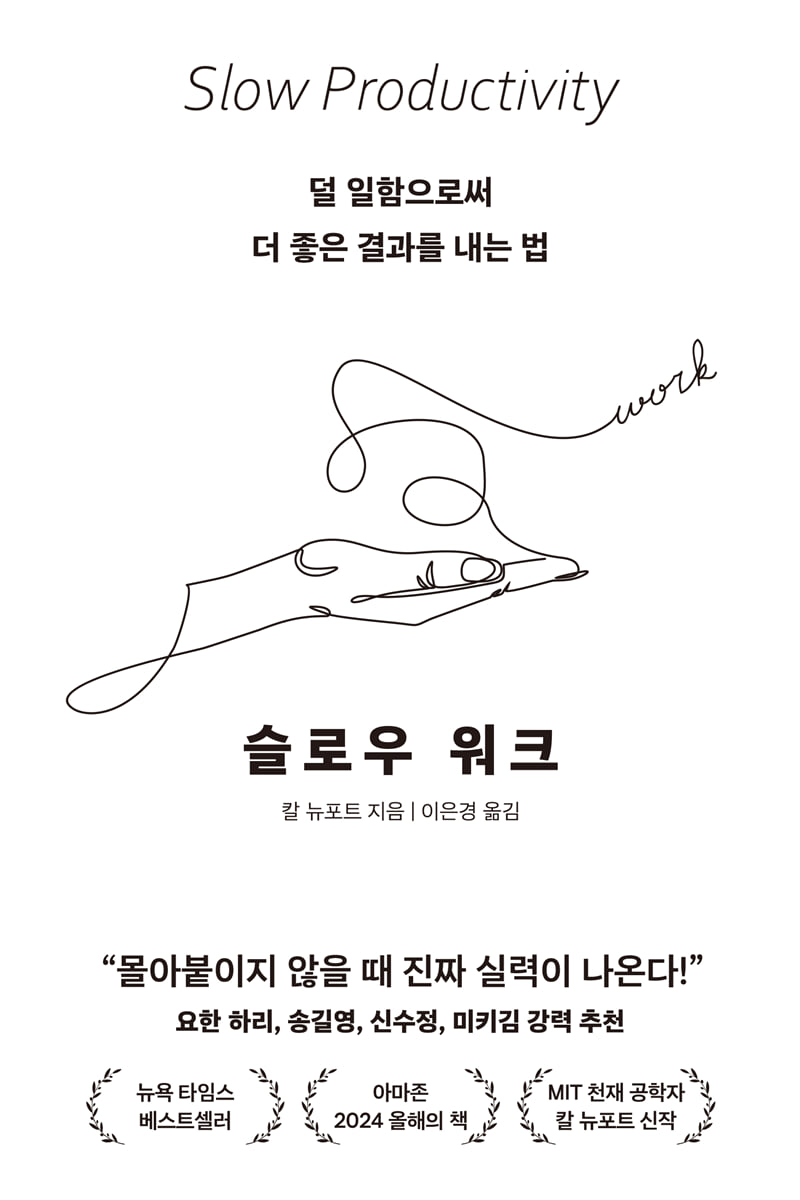 |
Description
Book Introduction
*** Highly recommended by Yohan Hari, Song Gil-young, Shin Su-jeong, and Mickey Kim
*** New York Times bestseller
*** Amazon's 2024 Book of the Year
*** A new book by MIT genius engineer Cal Newport
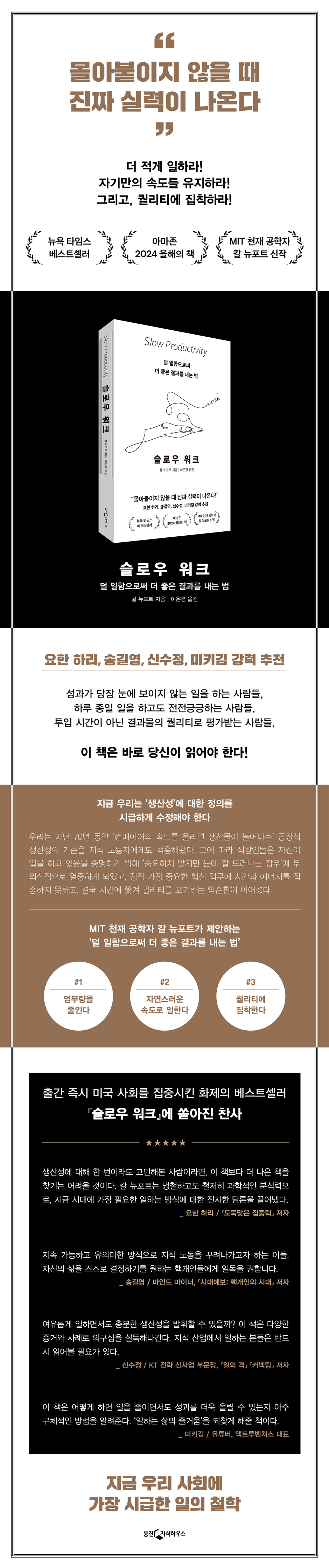
"True skill comes out when you don't push yourself."
Work less! Keep your own pace! And, obsess over quality!
In 1967, New Yorker reporter John McPhee wrote about his story-writing process.
He said he spent about eight months researching one article, then spent the next two weeks sitting at a picnic table, meeting sources and organizing the story, writing only 500 words a day.
If a reporter were working like this today, he would be fired immediately, but surprisingly, this reporter won the Pulitzer Prize in 1999 and has written a whopping 29 books, two of which were finalists for the National Book Award.
In the introduction to his new book, Slow Walk, Cal Newport, a brilliant engineer from MIT and renowned journalist, introduces John McPhee and argues that our society urgently needs to revise its definition of 'productivity.'
For the past 70 years, we have applied the factory-style productivity standard of "increasing the speed of the conveyor belt increases output" to knowledge workers.
Due to the nature of knowledge work, where the products are not immediately visible, today's workers unconsciously become absorbed in "unimportant but visible chores" to prove that they are working, thereby preventing them from focusing their time and energy on the most important core tasks.
This led to a vicious cycle of sacrificing the quality of important work in order to 'look like you're working hard.'
Cal Newport strongly argues that knowledge work requires standards of 'productivity' appropriate to it, and proposes 'slow productivity' as a solution.
He doesn't just advocate a new work philosophy; he backs it up with rigorous scientific evidence, and he packs this book with practical work techniques that can actually help you reduce your workload and maintain your own pace.
Based on in-depth research into the working practices of a diverse range of knowledge workers, from the examples of traditional scholars like Galileo and Isaac Newton to artists like Jane Austen and Georgia O'Keeffe and the creators of the hit drama series CSI, this book presents three core principles of "slow productivity."
Only when you reduce your workload and work at your own pace can the quality of your work improve.
This book is a new work philosophy that is most needed in our time, breaking free from overload and pursuing meaningful achievement.
*** New York Times bestseller
*** Amazon's 2024 Book of the Year
*** A new book by MIT genius engineer Cal Newport
"True skill comes out when you don't push yourself."
Work less! Keep your own pace! And, obsess over quality!
In 1967, New Yorker reporter John McPhee wrote about his story-writing process.
He said he spent about eight months researching one article, then spent the next two weeks sitting at a picnic table, meeting sources and organizing the story, writing only 500 words a day.
If a reporter were working like this today, he would be fired immediately, but surprisingly, this reporter won the Pulitzer Prize in 1999 and has written a whopping 29 books, two of which were finalists for the National Book Award.
In the introduction to his new book, Slow Walk, Cal Newport, a brilliant engineer from MIT and renowned journalist, introduces John McPhee and argues that our society urgently needs to revise its definition of 'productivity.'
For the past 70 years, we have applied the factory-style productivity standard of "increasing the speed of the conveyor belt increases output" to knowledge workers.
Due to the nature of knowledge work, where the products are not immediately visible, today's workers unconsciously become absorbed in "unimportant but visible chores" to prove that they are working, thereby preventing them from focusing their time and energy on the most important core tasks.
This led to a vicious cycle of sacrificing the quality of important work in order to 'look like you're working hard.'
Cal Newport strongly argues that knowledge work requires standards of 'productivity' appropriate to it, and proposes 'slow productivity' as a solution.
He doesn't just advocate a new work philosophy; he backs it up with rigorous scientific evidence, and he packs this book with practical work techniques that can actually help you reduce your workload and maintain your own pace.
Based on in-depth research into the working practices of a diverse range of knowledge workers, from the examples of traditional scholars like Galileo and Isaac Newton to artists like Jane Austen and Georgia O'Keeffe and the creators of the hit drama series CSI, this book presents three core principles of "slow productivity."
Only when you reduce your workload and work at your own pace can the quality of your work improve.
This book is a new work philosophy that is most needed in our time, breaking free from overload and pursuing meaningful achievement.
- You can preview some of the book's contents.
Preview
index
Introduction
PART 01 Basis
CHAPTER 1 The Rise and Fall of Pseudo-Productivity
What does 'productivity' mean?
Why are we so exhausted?
Is there a better approach?
CHAPTER 2 Slow Productivity
Slow Revolution
In search of a better alternative
new philosophy
PART 02 PRINCIPLES
CHAPTER 3 REDUCING YOUR WORKLOAD
The first principle of slow productivity
Why should knowledge workers reduce their workload?
Key Challenge: Limiting Critical Work
Limit missions
Limiting projects
Limit your daily goal
Key Challenge: Limiting Minor Tasks
Let's set up an autopilot schedule.
Let's synchronize
Let other people do more work
Avoid task generators
Let's spend money
What should parents do if they can't reduce their childcare and housework?
Key Challenge: Pulling Instead of Pushing
Full System Simulation Phase 1: Hold and Proceed
Full System Simulation Step 2: Application Process
Full System Simulation Step 3: Organizing the List
CHAPTER 4 Working at a Natural Pace
The second principle of slow productivity
Why should knowledge workers regain their natural pace?
Let's take our time
Let's make a five-year plan
Let's double the project schedule
Let's simplify our daily schedule
Forgive yourself
Embrace seasonality
Let's plan a slow season
Let's reduce the annual working period
Let's practice 'small seasonality'
People who have to work fast and frantically
Let's work like poets
Let's connect space and work
I prefer strange to cool
Consciousness must attract attention
CHAPTER 5 Obsessed with Quality
The Third Principle of Slow Productivity
Why should knowledge workers be obsessed with quality?
Let's hone our tastes
Become a movie buff
Let's start a gathering with like-minded people.
Let's buy a high-quality notebook
Is perfectionism a problem?
Bet on yourself
Let's write after the kids go to bed
Let's cut salaries
Let's announce the schedule
Let's attract investors
conclusion
Acknowledgements
Americas
PART 01 Basis
CHAPTER 1 The Rise and Fall of Pseudo-Productivity
What does 'productivity' mean?
Why are we so exhausted?
Is there a better approach?
CHAPTER 2 Slow Productivity
Slow Revolution
In search of a better alternative
new philosophy
PART 02 PRINCIPLES
CHAPTER 3 REDUCING YOUR WORKLOAD
The first principle of slow productivity
Why should knowledge workers reduce their workload?
Key Challenge: Limiting Critical Work
Limit missions
Limiting projects
Limit your daily goal
Key Challenge: Limiting Minor Tasks
Let's set up an autopilot schedule.
Let's synchronize
Let other people do more work
Avoid task generators
Let's spend money
What should parents do if they can't reduce their childcare and housework?
Key Challenge: Pulling Instead of Pushing
Full System Simulation Phase 1: Hold and Proceed
Full System Simulation Step 2: Application Process
Full System Simulation Step 3: Organizing the List
CHAPTER 4 Working at a Natural Pace
The second principle of slow productivity
Why should knowledge workers regain their natural pace?
Let's take our time
Let's make a five-year plan
Let's double the project schedule
Let's simplify our daily schedule
Forgive yourself
Embrace seasonality
Let's plan a slow season
Let's reduce the annual working period
Let's practice 'small seasonality'
People who have to work fast and frantically
Let's work like poets
Let's connect space and work
I prefer strange to cool
Consciousness must attract attention
CHAPTER 5 Obsessed with Quality
The Third Principle of Slow Productivity
Why should knowledge workers be obsessed with quality?
Let's hone our tastes
Become a movie buff
Let's start a gathering with like-minded people.
Let's buy a high-quality notebook
Is perfectionism a problem?
Bet on yourself
Let's write after the kids go to bed
Let's cut salaries
Let's announce the schedule
Let's attract investors
conclusion
Acknowledgements
Americas
Detailed image
Into the book
Just as John McPhee waited at an outdoor table for the insight he needed to compose an article to strike, Zyker's efforts demonstrate the definition of meaningful and worthwhile work that doesn't require a hectic pace.
The magic of what might be called a "slow" pace compared to the seemingly endless demands of similar productivity driven by the adoption of cutting-edge technology becomes evident over a long period of time.
--- p.43, 「CHAPTER 1.
From “The Rise and Fall of Pseudo-Productivity”
While moves to maintain remote work or reduce working hours help mitigate some of the worst side effects of pseudo-productivity, they rarely address the underlying problem.
This is tantamount to responding to the rampant fast food culture by demanding that McDonald's increase the nutritional value of its menu.
While this approach may help mitigate some of the health impacts of fast food, it doesn't challenge the culture that encourages us to rush through our meals in the first place.
A more sustainable way to address the burnout syndrome facing knowledge workers is to offer attractive alternatives.
To do so, we need to go beyond simply trying to limit pseudo-productivity and propose a completely new vision of what productivity means.
--- p.54, 「CHAPTER 2.
From "Slow Productivity"
Had Jane Austen not made the momentous decision in 1809 to turn the productive conditions in her favor, the world would probably never have known just how talented she was.
Austin's family, who had been plagued by complex problems for several years, decided to withdraw from the social circles of Chawton, providing a welcome respite that had a significant impact on Austin's work.
Escaped from the world and living in a small country house, suddenly and miraculously free from both housework and social responsibilities, Austin found herself with a real, meaningful space to think and write creatively for the first time in over a decade.
It was here, working at her modest writing desk by the window overlooking the street, that Austen finally finished the manuscripts of Sense and Sensibility and Pride and Prejudice and began Mansfield Park and Emma.
--- pp.71-72, 「CHAPTER 3.
From "Reducing Workload"
How do knowledge workers determine when to decline the constant barrage of requests? In modern office environments, knowledge workers tend to adjust their stress levels based on initial baselines.
Declining a Zoom meeting invitation carries a social capital cost, as it can cause minor inconvenience to your colleagues and signal that you're uncooperative or lazy.
However, if your workload is too much and you are very stressed, you may be able to afford this cost.
To justify the distress caused to the other person by refusing, the distress you personally feel must be that great.
The problem with applying a stress-based heuristic like this is that we rarely turn down incoming work until we realize that our workload has already reached an unsustainable limit.
--- pp.83-84, 「CHAPTER 3.
From "Reducing Workload"
In general, strategies that require others to do more work are effective in suppressing tasks.
For example, the "reverse task list" is a more appealing version of the method I proposed in the New Yorker article.
First, create a list of open tasks that correspond to each major task category you handle in your workplace.
When you ask someone to take on a minor task, instruct them to add it directly to their list of related shared tasks.
For example, instruct them to write in a shared document or create a new card on a Trello shared board.
First of all, it is important to make it clear that you must enter 'all' the information required to complete the task.
Using a reverse task list requires the requester to invest more time in specifying exactly what is expected of the requestee, which simplifies the process of fulfilling the request.
--- p.118, 「CHAPTER 3.
From "Reducing Workload"
Over short periods of time, like a few days or weeks, the efforts of historically significant thinkers like Copernicus and Newton can seem haphazard and lazy.
But over the long term, their efforts seem to have borne undeniable fruit.
In today's work environment, we are biased towards evaluating efforts in the short term.
As I pointed out in Part 1 of this book, as knowledge work emerged as a major economic sector in the 20th century, we responded to the shock of all this newness by applying the rushed productivity concept characteristic of industrial sectors.
To the great scientists of the past, the hasty nature of modern man would seem to be a madman and a source of trouble.
They were interested in the achievements they made over a lifetime, not just a specific short period of time.
Without a boss watching them or customers demanding their emails be answered, they didn't feel pressured to be as busy as possible every day.
Rather, I was able to spend a long time on the project and adjust my work pace to a more leisurely pace depending on the situation.
--- pp.146-147, 「CHAPTER 4.
From "Working at a natural pace"
In fact, humans are not very good at estimating the time required to perform cognitive tasks.
We have an innate, natural understanding of the time required to do visible tasks, such as making a hatchet or gathering edible plants.
But when you're planning something that you can't feel directly with your body, you end up guessing more than you realize, and estimating how long it'll take based on a best-case scenario.
Perhaps he enjoys the thrill of planning and imagining extremely ambitious schedules.
"Wow, if I could write four chapters this fall, I'd be ahead of schedule!" It feels good in the moment, but after that, you spend your days in confusion and disappointment.
You can counter this instinct to drift into unfounded optimism by adopting a relaxed approach of doubling your initial estimated schedule.
As a result, you can complete your plans at a more leisurely pace.
--- pp.168-169, 「CHAPTER 4.
From "Working at a natural pace"
In the context of knowledge work, perhaps the most famous example of a slow pace being sacrificed for high quality is Steve Jobs' triumphant return to Apple.
When Jobs took over as interim CEO in 1997, Apple's quarterly sales were down 30 percent.
Jobs believed that Apple's problems were related to its octopus-like expansion of its product line.
Jobs started asking his executives a simple question: “What model do you tell your friends to buy?”
When management couldn't come up with a clear answer, Jobs decided to simplify the product line to just four computers: business desktops and laptops, and consumer desktops and laptops.
This eliminates the confusion about which Apple device is right for you.
“Choosing what not to do is as important as deciding what to do,” Jobs explained.
The magic of what might be called a "slow" pace compared to the seemingly endless demands of similar productivity driven by the adoption of cutting-edge technology becomes evident over a long period of time.
--- p.43, 「CHAPTER 1.
From “The Rise and Fall of Pseudo-Productivity”
While moves to maintain remote work or reduce working hours help mitigate some of the worst side effects of pseudo-productivity, they rarely address the underlying problem.
This is tantamount to responding to the rampant fast food culture by demanding that McDonald's increase the nutritional value of its menu.
While this approach may help mitigate some of the health impacts of fast food, it doesn't challenge the culture that encourages us to rush through our meals in the first place.
A more sustainable way to address the burnout syndrome facing knowledge workers is to offer attractive alternatives.
To do so, we need to go beyond simply trying to limit pseudo-productivity and propose a completely new vision of what productivity means.
--- p.54, 「CHAPTER 2.
From "Slow Productivity"
Had Jane Austen not made the momentous decision in 1809 to turn the productive conditions in her favor, the world would probably never have known just how talented she was.
Austin's family, who had been plagued by complex problems for several years, decided to withdraw from the social circles of Chawton, providing a welcome respite that had a significant impact on Austin's work.
Escaped from the world and living in a small country house, suddenly and miraculously free from both housework and social responsibilities, Austin found herself with a real, meaningful space to think and write creatively for the first time in over a decade.
It was here, working at her modest writing desk by the window overlooking the street, that Austen finally finished the manuscripts of Sense and Sensibility and Pride and Prejudice and began Mansfield Park and Emma.
--- pp.71-72, 「CHAPTER 3.
From "Reducing Workload"
How do knowledge workers determine when to decline the constant barrage of requests? In modern office environments, knowledge workers tend to adjust their stress levels based on initial baselines.
Declining a Zoom meeting invitation carries a social capital cost, as it can cause minor inconvenience to your colleagues and signal that you're uncooperative or lazy.
However, if your workload is too much and you are very stressed, you may be able to afford this cost.
To justify the distress caused to the other person by refusing, the distress you personally feel must be that great.
The problem with applying a stress-based heuristic like this is that we rarely turn down incoming work until we realize that our workload has already reached an unsustainable limit.
--- pp.83-84, 「CHAPTER 3.
From "Reducing Workload"
In general, strategies that require others to do more work are effective in suppressing tasks.
For example, the "reverse task list" is a more appealing version of the method I proposed in the New Yorker article.
First, create a list of open tasks that correspond to each major task category you handle in your workplace.
When you ask someone to take on a minor task, instruct them to add it directly to their list of related shared tasks.
For example, instruct them to write in a shared document or create a new card on a Trello shared board.
First of all, it is important to make it clear that you must enter 'all' the information required to complete the task.
Using a reverse task list requires the requester to invest more time in specifying exactly what is expected of the requestee, which simplifies the process of fulfilling the request.
--- p.118, 「CHAPTER 3.
From "Reducing Workload"
Over short periods of time, like a few days or weeks, the efforts of historically significant thinkers like Copernicus and Newton can seem haphazard and lazy.
But over the long term, their efforts seem to have borne undeniable fruit.
In today's work environment, we are biased towards evaluating efforts in the short term.
As I pointed out in Part 1 of this book, as knowledge work emerged as a major economic sector in the 20th century, we responded to the shock of all this newness by applying the rushed productivity concept characteristic of industrial sectors.
To the great scientists of the past, the hasty nature of modern man would seem to be a madman and a source of trouble.
They were interested in the achievements they made over a lifetime, not just a specific short period of time.
Without a boss watching them or customers demanding their emails be answered, they didn't feel pressured to be as busy as possible every day.
Rather, I was able to spend a long time on the project and adjust my work pace to a more leisurely pace depending on the situation.
--- pp.146-147, 「CHAPTER 4.
From "Working at a natural pace"
In fact, humans are not very good at estimating the time required to perform cognitive tasks.
We have an innate, natural understanding of the time required to do visible tasks, such as making a hatchet or gathering edible plants.
But when you're planning something that you can't feel directly with your body, you end up guessing more than you realize, and estimating how long it'll take based on a best-case scenario.
Perhaps he enjoys the thrill of planning and imagining extremely ambitious schedules.
"Wow, if I could write four chapters this fall, I'd be ahead of schedule!" It feels good in the moment, but after that, you spend your days in confusion and disappointment.
You can counter this instinct to drift into unfounded optimism by adopting a relaxed approach of doubling your initial estimated schedule.
As a result, you can complete your plans at a more leisurely pace.
--- pp.168-169, 「CHAPTER 4.
From "Working at a natural pace"
In the context of knowledge work, perhaps the most famous example of a slow pace being sacrificed for high quality is Steve Jobs' triumphant return to Apple.
When Jobs took over as interim CEO in 1997, Apple's quarterly sales were down 30 percent.
Jobs believed that Apple's problems were related to its octopus-like expansion of its product line.
Jobs started asking his executives a simple question: “What model do you tell your friends to buy?”
When management couldn't come up with a clear answer, Jobs decided to simplify the product line to just four computers: business desktops and laptops, and consumer desktops and laptops.
This eliminates the confusion about which Apple device is right for you.
“Choosing what not to do is as important as deciding what to do,” Jobs explained.
--- pp.223-224, 「CHAPTER 5.
From “Obsessed with Quality”
From “Obsessed with Quality”
Publisher's Review
*** Highly recommended by Yohan Hari, Song Gil-young, Shin Su-jeong, and Mickey Kim
*** New York Times bestseller
*** Amazon's 2024 Book of the Year
*** A new book by MIT genius engineer Cal Newport
"True skill comes out when you don't push yourself."
The philosophy of the most urgent task in our society today
In 1967, New Yorker reporter John McPhee revealed his writing process.
He spent about eight months researching one article, then wrote only 500 words a day for two weeks (about the length of one A4 page).
The rest of the time, I mostly sat at a picnic table, chatting with sources or organizing stories.
If a reporter were working like this today, he'd be fired in an instant, but surprisingly, this reporter won the Pulitzer Prize in 1999 and has written a whopping 29 books, two of which were finalists for the National Book Award.
In the introduction to his new book, Slow Walk, Cal Newport, a brilliant engineer from MIT and renowned journalist, introduces John McPhee and argues that our society urgently needs to revise its definition of 'productivity.'
For the past 70 years, we have applied the factory-style productivity standard of "increasing the speed of the conveyor belt increases output" to knowledge workers.
The knowledge industry is not structured like agriculture or manufacturing, where simply increasing working hours leads to more money, yet we work without much discussion about it, resulting in the tragedy of countless workers suffering from burnout.
Cal Newport argues that knowledge work requires standards of productivity commensurate with its nature, and proposes "slow productivity" as a solution.
He doesn't just advocate a new work philosophy; he backs it up with rigorous scientific evidence, and he packs this book with practical techniques that can actually improve performance by reducing workload.
“The less work you do, the better your performance!”
How to Get Better Results by Working Less
‘Knowledge labor’ refers to “economic activities that transform knowledge into products with market value.”
In other words, knowledge workers are people who must turn the knowledge in their heads into ‘money-making’ results.
This applies to most office workers, including marketers, planners, accountants, computer programmers, and designers.
The author points out that because of the nature of knowledge work, where the products are not immediately visible, today's workers unconsciously become absorbed in "unimportant but visible chores" to prove that they are working.
For example, I spend more time and energy than I think on side tasks that are far removed from my core work but give me the feeling of working hard, such as responding to emails and work messengers that come in at any given time, attending regular meetings, and writing non-urgent reports.
By doing so, you lose the ability to focus your energy on the most important core tasks, and eventually, you end up sacrificing quality in the face of time pressure.
The author says that the vicious cycle of working a hectic day, worrying about not being able to finish work after work, and working overtime to solve this problem, leading to burnout, stems from this very 'misunderstanding of productivity.'
Cal Newport draws important insights into "slow productivity" from the work processes of those who freely adjusted their work methods without being constrained by factory-style productivity standards.
From the examples of scientists like Galileo and Newton to artists like Paul McCartney and Quentin Tarantino, and JRR, author of The Lord of the Rings
Based on in-depth research on the working styles of various knowledge workers, from novelists such as Tolkien to Ian Fleming, who wrote the James Bond series, the book presents three core principles of 'slow productivity.'
Only when you reduce your workload and work at your own pace can the quality of your work improve.
Work less! Keep your own pace!
And, obsess over quality!
This book consists of two parts.
Part 1 provides substantial evidence that the problems facing today's knowledge workers—such as burnout, the "quiet quit" culture, and the conflict over shorter working hours—are due to a lack of a clear definition of "productivity."
And as an alternative, it makes a compelling case that it is now time to shift from 'fast' to 'slow'.
Scientific calculations have proven that reducing workload and working at a pace that allows you to focus most effectively actually improves the quality of your results and increases your productivity.
Part 2 covers each of the three principles of 'slow productivity' in detail.
We'll explore how we can apply three principles to maintain a sustainable work life without burning ourselves out.
In particular, Chapter 3 of Part 2, 'Reduce Workload' and Chapter 4, 'Work at a Natural Pace', introduce practical 'slow work' techniques that anyone can apply to their work, regardless of occupation.
It is full of ideas for reducing additional tasks based on core tasks.
It also offers a variety of strategies for slowing down your own workload without burdening your colleagues.
Chapter 5, "Obsessed with Quality," demonstrates through a variety of real-world examples how a work attitude that prioritizes quality over immediate, quick results can have a positive impact on both the company and its employees in the long term.
Especially, the story that you can find surprising inspiration in your main job by broadening your horizons and exploring interests unrelated to your profession will be a great motivation for your work and life in general.
People who want to enjoy the 'joy of work' without exhausting themselves,
This book is something you must read.
In 1995, it was not the employees who sat in the office for long hours that saved CBS, an American broadcasting station that was suffering from a deficit and had the lowest viewership ratings for years, but a single drama that persistently pushed forward an idea that had repeatedly failed over the course of five years and became successful.
The behind-the-scenes production of that drama perfectly illustrates the three core principles of 'Slow Walk', and that drama was none other than the huge hit 'CSI: Crime Investigation'.
In a society where being busy is considered a virtue, the harder you work, the more likely you are to suffer from burnout.
If you feel like you've reached the breaking point of burnout, I highly recommend reading this book.
"Slow Work" is a new work philosophy that is most needed in our time, one that allows us to escape from overload and pursue meaningful achievements.
*** New York Times bestseller
*** Amazon's 2024 Book of the Year
*** A new book by MIT genius engineer Cal Newport
"True skill comes out when you don't push yourself."
The philosophy of the most urgent task in our society today
In 1967, New Yorker reporter John McPhee revealed his writing process.
He spent about eight months researching one article, then wrote only 500 words a day for two weeks (about the length of one A4 page).
The rest of the time, I mostly sat at a picnic table, chatting with sources or organizing stories.
If a reporter were working like this today, he'd be fired in an instant, but surprisingly, this reporter won the Pulitzer Prize in 1999 and has written a whopping 29 books, two of which were finalists for the National Book Award.
In the introduction to his new book, Slow Walk, Cal Newport, a brilliant engineer from MIT and renowned journalist, introduces John McPhee and argues that our society urgently needs to revise its definition of 'productivity.'
For the past 70 years, we have applied the factory-style productivity standard of "increasing the speed of the conveyor belt increases output" to knowledge workers.
The knowledge industry is not structured like agriculture or manufacturing, where simply increasing working hours leads to more money, yet we work without much discussion about it, resulting in the tragedy of countless workers suffering from burnout.
Cal Newport argues that knowledge work requires standards of productivity commensurate with its nature, and proposes "slow productivity" as a solution.
He doesn't just advocate a new work philosophy; he backs it up with rigorous scientific evidence, and he packs this book with practical techniques that can actually improve performance by reducing workload.
“The less work you do, the better your performance!”
How to Get Better Results by Working Less
‘Knowledge labor’ refers to “economic activities that transform knowledge into products with market value.”
In other words, knowledge workers are people who must turn the knowledge in their heads into ‘money-making’ results.
This applies to most office workers, including marketers, planners, accountants, computer programmers, and designers.
The author points out that because of the nature of knowledge work, where the products are not immediately visible, today's workers unconsciously become absorbed in "unimportant but visible chores" to prove that they are working.
For example, I spend more time and energy than I think on side tasks that are far removed from my core work but give me the feeling of working hard, such as responding to emails and work messengers that come in at any given time, attending regular meetings, and writing non-urgent reports.
By doing so, you lose the ability to focus your energy on the most important core tasks, and eventually, you end up sacrificing quality in the face of time pressure.
The author says that the vicious cycle of working a hectic day, worrying about not being able to finish work after work, and working overtime to solve this problem, leading to burnout, stems from this very 'misunderstanding of productivity.'
Cal Newport draws important insights into "slow productivity" from the work processes of those who freely adjusted their work methods without being constrained by factory-style productivity standards.
From the examples of scientists like Galileo and Newton to artists like Paul McCartney and Quentin Tarantino, and JRR, author of The Lord of the Rings
Based on in-depth research on the working styles of various knowledge workers, from novelists such as Tolkien to Ian Fleming, who wrote the James Bond series, the book presents three core principles of 'slow productivity.'
Only when you reduce your workload and work at your own pace can the quality of your work improve.
Work less! Keep your own pace!
And, obsess over quality!
This book consists of two parts.
Part 1 provides substantial evidence that the problems facing today's knowledge workers—such as burnout, the "quiet quit" culture, and the conflict over shorter working hours—are due to a lack of a clear definition of "productivity."
And as an alternative, it makes a compelling case that it is now time to shift from 'fast' to 'slow'.
Scientific calculations have proven that reducing workload and working at a pace that allows you to focus most effectively actually improves the quality of your results and increases your productivity.
Part 2 covers each of the three principles of 'slow productivity' in detail.
We'll explore how we can apply three principles to maintain a sustainable work life without burning ourselves out.
In particular, Chapter 3 of Part 2, 'Reduce Workload' and Chapter 4, 'Work at a Natural Pace', introduce practical 'slow work' techniques that anyone can apply to their work, regardless of occupation.
It is full of ideas for reducing additional tasks based on core tasks.
It also offers a variety of strategies for slowing down your own workload without burdening your colleagues.
Chapter 5, "Obsessed with Quality," demonstrates through a variety of real-world examples how a work attitude that prioritizes quality over immediate, quick results can have a positive impact on both the company and its employees in the long term.
Especially, the story that you can find surprising inspiration in your main job by broadening your horizons and exploring interests unrelated to your profession will be a great motivation for your work and life in general.
People who want to enjoy the 'joy of work' without exhausting themselves,
This book is something you must read.
In 1995, it was not the employees who sat in the office for long hours that saved CBS, an American broadcasting station that was suffering from a deficit and had the lowest viewership ratings for years, but a single drama that persistently pushed forward an idea that had repeatedly failed over the course of five years and became successful.
The behind-the-scenes production of that drama perfectly illustrates the three core principles of 'Slow Walk', and that drama was none other than the huge hit 'CSI: Crime Investigation'.
In a society where being busy is considered a virtue, the harder you work, the more likely you are to suffer from burnout.
If you feel like you've reached the breaking point of burnout, I highly recommend reading this book.
"Slow Work" is a new work philosophy that is most needed in our time, one that allows us to escape from overload and pursue meaningful achievements.
GOODS SPECIFICS
- Date of issue: September 23, 2024
- Page count, weight, size: 284 pages | 380g | 140*210*18mm
- ISBN13: 9788901288444
- ISBN10: 8901288443
You may also like
카테고리
korean


korean

![GQ KOREA Mark (Monthly): December [2025]](http://librairie.coreenne.fr/cdn/shop/files/8ef265dbbfbf186523ed75ba7319009d.jpg?v=1765340328&width=3840)


