

Talking to dogs in their language
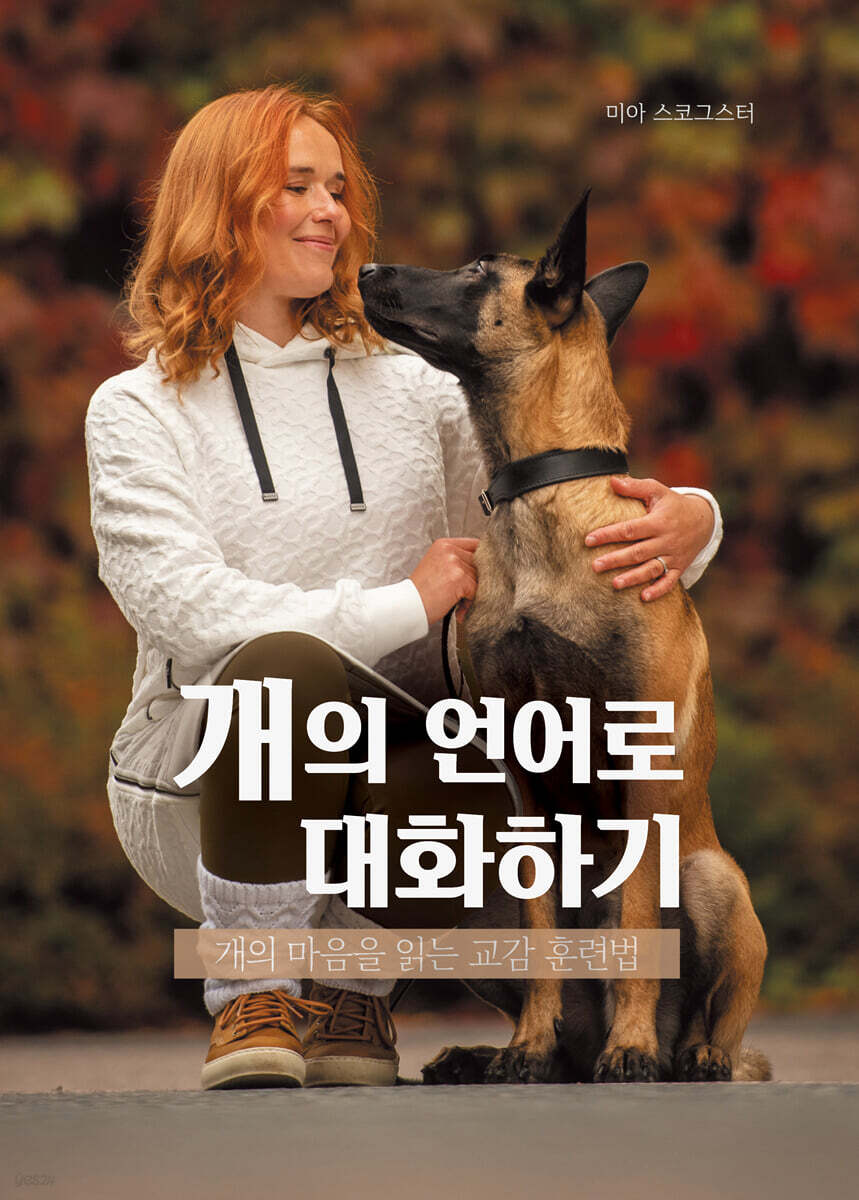 |
Description
Book Introduction
“Every dog deserves a life of inspiration and companionship with a guardian who understands their language.”
- Mia Skogster
Two-time IGP World Champion
Mentor to trainers around the world
A New Paradigm in Relationship-Centered Training: Role Immersion Training
『Let's Speak Dog』 is the Korean version of 『Let's Speak Dog』, a compilation of 25 years of field experience and insight from two-time IGP World Champion Mia Skogster.
The author's training philosophy, which views dogs not as beings that learn to perform given tasks through repeated mechanical reinforcement and punishment, but as partners whose emotions and spontaneity must be respected, has been a great inspiration to trainers around the world.
The author's proposed "Role Immersion Training" method helps build an effective bond with your dog through emotional exchange before teaching it any skills.
The guardian reads the dog's emotions through the dog's body language and uses his voice and body language appropriately for the purpose, leading the dog to choose the appropriate behavior for the situation while maintaining the ideal emotional state.
This book introduces reward design using six voices of praise and their variations, organic movement flow composition using the insertion of pauses, and training methods according to the temperament and personality of the dog, with specific and abundant examples.
This book will serve as a practical guide for aspiring trainers, handlers preparing for IGP and other dog sports, pet owners who live with working dogs, and pet owners who want to move beyond command-obedience training to a more 'communion'-based approach.
If you can read your dog's emotions, motivate and empower him appropriately, and make him follow you with joy, training becomes a 'conversation' in itself.
Don't hesitate to learn the language of dogs.
Your dog deserves a life of inspiration and companionship with a guardian who understands their language.
- Mia Skogster
Two-time IGP World Champion
Mentor to trainers around the world
A New Paradigm in Relationship-Centered Training: Role Immersion Training
『Let's Speak Dog』 is the Korean version of 『Let's Speak Dog』, a compilation of 25 years of field experience and insight from two-time IGP World Champion Mia Skogster.
The author's training philosophy, which views dogs not as beings that learn to perform given tasks through repeated mechanical reinforcement and punishment, but as partners whose emotions and spontaneity must be respected, has been a great inspiration to trainers around the world.
The author's proposed "Role Immersion Training" method helps build an effective bond with your dog through emotional exchange before teaching it any skills.
The guardian reads the dog's emotions through the dog's body language and uses his voice and body language appropriately for the purpose, leading the dog to choose the appropriate behavior for the situation while maintaining the ideal emotional state.
This book introduces reward design using six voices of praise and their variations, organic movement flow composition using the insertion of pauses, and training methods according to the temperament and personality of the dog, with specific and abundant examples.
This book will serve as a practical guide for aspiring trainers, handlers preparing for IGP and other dog sports, pet owners who live with working dogs, and pet owners who want to move beyond command-obedience training to a more 'communion'-based approach.
If you can read your dog's emotions, motivate and empower him appropriately, and make him follow you with joy, training becomes a 'conversation' in itself.
Don't hesitate to learn the language of dogs.
Your dog deserves a life of inspiration and companionship with a guardian who understands their language.
- You can preview some of the book's contents.
Preview
index
Entering 13
1.
17. Conversing in a Dog's Language Through Role Immersion
2.
Mia's Story 31
3.
Helge - The Dog Who Changed My Life 47
4.
Six Different Voices of Praise 63
5.
Reward Play - Laying the Foundation for Immersion 89
6.
Connecting Through Play 107
7.
Behavior control training is fun 137
8.
The flow of movement makes the master 169
9.
Reading Your Dog's Body Language 187
10.
Communicating Accurately Through Gestures 195
11.
Lessons Learned with Lettuce in Germany 213
12.
Creating the Optimal Emotional State 223
13.
Inspired Training Method 253
14.
In summary 269
1.
17. Conversing in a Dog's Language Through Role Immersion
2.
Mia's Story 31
3.
Helge - The Dog Who Changed My Life 47
4.
Six Different Voices of Praise 63
5.
Reward Play - Laying the Foundation for Immersion 89
6.
Connecting Through Play 107
7.
Behavior control training is fun 137
8.
The flow of movement makes the master 169
9.
Reading Your Dog's Body Language 187
10.
Communicating Accurately Through Gestures 195
11.
Lessons Learned with Lettuce in Germany 213
12.
Creating the Optimal Emotional State 223
13.
Inspired Training Method 253
14.
In summary 269
Detailed image

Into the book
Many trainers still adhere to the instrumental (or operant) conditioning theory.
Instrumental conditioning theory was developed by psychologist B.
Widely known through F. Skinner, it claims that the behavior of animals or people can be corrected through reinforcement such as rewards or punishments.
Desired behaviors are reinforced through rewards, and unwanted behaviors are weakened through punishment.
The strength of this theory is its simplicity and clarity.
And this strength also acts as the biggest weakness.
Rewards and punishments cannot explain all types of learning.
Learning and behavior are much more complex than the mechanistic diagrams presented by instrumental conditioning theory.
--- 「1.
From “Talking in Dog Language through Role Immersion”
After a year of intensive training, we participated in our first search dog test.
Jackie took first place, scoring 99 points in the obedience subject.
The guy was very motivated, showed great focus, and maintained perfect eye contact with me throughout the task.
It was a huge change compared to early fall just a year ago.
After a little over a month, he qualified for the highest level of competition, and Jackie achieved the highest grade, Class 3, in the search subject of the Finnish Working Dog Trials.
At this time, he also received very high scores in the obedience subject.
Later, Jackie became champion in the obedience subject of the working dog training test, receiving a perfect score, and won a bronze medal at the Finnish Championships.
--- 「2.
From "Mia's Story"
About a hundred people rushed out to see whose dog had escaped from the car.
I stayed in the classroom and drank water.
I figured it didn't concern me since my dog was safely staying in a hotel room across the street anyway.
But then someone ran into the classroom and shouted.
“Mia, are you a dog?” As soon as I heard that, I ran out, and the dog sitting calmly among the people on the bus was indeed Helge.
--- 「3.
Helge - From "The Dog That Changed My Life"
Praise not only motivates dogs to perform the desired behavior, it also evokes specific emotions.
The emotions that are reinforced vary depending on my intonation.
In some situations, it's good to get your dog excited and feel proud of himself, while in others, you need to bring out a calm and relaxed state.
… (omitted) … When I train, I systematically use six different tones of praise and their variations.
The six voices of praise that will be introduced below will be called cute, high-spirited, flirting, admiration, driving instructor, and witch.
We named them so that you can easily recall the mood of each compliment and the emotion it is trying to convey, even if there is no dog in front of you.
--- 「4.
From “Six Different Voices of Praise”
Very few dogs are sufficiently rewarded with praise alone.
So, no matter what you're teaching in any situation, you should always provide a reward, either food, a toy, or both.
Food rewards can be used as soon as your puppy is 2 to 4 months old.
Toy rewards can be used after the dog has enjoyed playing and learned the rules of play.
Each dog has different play preferences.
Some dogs love balls more than anything in the world, while others have no interest at all.
Always choose rewards that suit your dog's personality.
--- 「5.
From “Reward Play - Laying the Foundation for Immersion”
For dogs who love toys, play is an important factor in determining their happiness in life.
Play itself can be enjoyable for dogs and can even satisfy specific needs.
In fact, many dogs enjoy chasing and attacking bouncy 'prey'.
When praise is added at the right time, this simple act becomes a meaningful experience, and the dog feels like he is sharing a wonderful moment with his guardian.
--- 「6.
From “Communicating through Play”
Many guardians teach impulse control with just one word, like “stop,” and use it in many situations, such as putting down an object or ignoring a passing dog.
I teach several words that each mean 'giving up'.
This is because by doing so, you can experience a variety of emotions by using different voices of praise for each directive.
Each directive is followed by a voice of praise to reinforce the desired emotional state.
For example, my dogs learn that when they hear the word “wait,” they stop and become calm, and are rewarded.
On the other hand, when you hear your name or the word “look,” you get excited and engaged in the idea that you will be doing something together.
--- 「7.
From "Behavior Control Training is Fun"
When the handler stops, the dog stops.
If the handler clearly performs a certain action, the dog can follow that action.
By inserting pauses to organically structure the flow of movement, your dog will be able to better absorb the information being given and have more time to focus on the instructions and movements that follow.
By giving your dog a clear understanding of when to wait and when to release the wait, he will gain confidence and motivation, giving him the strength to focus and complete successive tasks without reward.
The dog also learns through this process that a quiet, still handler is not a strange or scary presence, but rather an interesting and enjoyable presence.
--- 「8.
From “The flow of movement makes the master”
In other dogs, a stiff body posture and low tail wagging like a flag may indicate feelings of anxiety or intimidation.
But Nora is just very focused on training.
Nora's gaze, ears, mouth shape, and breathing all signal that she is enjoying this situation.
Breathing is normal, eyes and ears are wide open, and the animal is focused on its caregiver.
This interpretation is also supported by the observation that Nora showed motivation before starting the task and excitedly returned to her caregiver after receiving the reward.
--- 「9.
From "Reading My Dog's Body Language"
A dog's state of arousal can be flexibly adjusted by using pauses, waiting, and various movements.
It is a way of controlling the speed of movement by moving quickly at times, slowly at other times, stopping suddenly, or turning the body at unexpected times.
When rewarding, you can build excitement and then stop and calm down again.
This will give your puppy a chance to rest and build up his strength for the next training session.
… (omitted) … If your dog is sensitive, it is best to keep your hand close to the body as much as possible when moving.
When rewarding, you can show that you are not trying to threaten the dog by turning slightly instead of looking straight at the dog.
When encouraging a dog, you should primarily use your feet and refrain from using your hands.
--- 「10.
From “Communicating accurately through gestures”
When I returned to Finland from Germany, I experienced a kind of culture shock.
The luxurious facilities and harmonious atmosphere of the Hoiving Club disappeared like a mirage.
During my first winter back home, I trained my obedience subjects mostly alone in the snow-covered fields, and in the spring I trained my tracking subjects in a corner of a city park.
Although the environment was completely different, I continued training Letiwa, especially focusing on tracking and obedience.
--- 「11.
From "Lessons Learned with Lettuce in Germany"
When a dog enters a state of flow, it no longer seeks out anything.
I know exactly what needs to be done and I am ready to do my best at whatever task is given to me.
Because you trust your abilities and are confident, details do not interfere with your ability to complete tasks.
During a game, dogs are always faced with unexpected obstacles and difficulties, and they must be able to use these difficulties as a springboard to move forward.
Dogs who confidently perform tasks in an appropriate emotional state are more motivated by the handler's tension, lack of reward, long waiting times, unfamiliar sounds, and other dogs around them.
--- 「12.
From “Creating the Optimal Emotional State”
When I was young, I felt invincible.
It was an incredibly lucky moment to have a lucky guy named Helge while preparing for my first IGP.
Training with Helge wasn't always smooth, but he was generous and forgiving of my mistakes.
After Helge, I met Leti, who was just as talented as Helge.
Of course, there was a subtle adjustment process that everyone goes through, even for Lettu.
But Lettuce was never a difficult dog to handle.
After that, the dog that made me think about everything from the beginning, Inspiris, appeared.
Instrumental conditioning theory was developed by psychologist B.
Widely known through F. Skinner, it claims that the behavior of animals or people can be corrected through reinforcement such as rewards or punishments.
Desired behaviors are reinforced through rewards, and unwanted behaviors are weakened through punishment.
The strength of this theory is its simplicity and clarity.
And this strength also acts as the biggest weakness.
Rewards and punishments cannot explain all types of learning.
Learning and behavior are much more complex than the mechanistic diagrams presented by instrumental conditioning theory.
--- 「1.
From “Talking in Dog Language through Role Immersion”
After a year of intensive training, we participated in our first search dog test.
Jackie took first place, scoring 99 points in the obedience subject.
The guy was very motivated, showed great focus, and maintained perfect eye contact with me throughout the task.
It was a huge change compared to early fall just a year ago.
After a little over a month, he qualified for the highest level of competition, and Jackie achieved the highest grade, Class 3, in the search subject of the Finnish Working Dog Trials.
At this time, he also received very high scores in the obedience subject.
Later, Jackie became champion in the obedience subject of the working dog training test, receiving a perfect score, and won a bronze medal at the Finnish Championships.
--- 「2.
From "Mia's Story"
About a hundred people rushed out to see whose dog had escaped from the car.
I stayed in the classroom and drank water.
I figured it didn't concern me since my dog was safely staying in a hotel room across the street anyway.
But then someone ran into the classroom and shouted.
“Mia, are you a dog?” As soon as I heard that, I ran out, and the dog sitting calmly among the people on the bus was indeed Helge.
--- 「3.
Helge - From "The Dog That Changed My Life"
Praise not only motivates dogs to perform the desired behavior, it also evokes specific emotions.
The emotions that are reinforced vary depending on my intonation.
In some situations, it's good to get your dog excited and feel proud of himself, while in others, you need to bring out a calm and relaxed state.
… (omitted) … When I train, I systematically use six different tones of praise and their variations.
The six voices of praise that will be introduced below will be called cute, high-spirited, flirting, admiration, driving instructor, and witch.
We named them so that you can easily recall the mood of each compliment and the emotion it is trying to convey, even if there is no dog in front of you.
--- 「4.
From “Six Different Voices of Praise”
Very few dogs are sufficiently rewarded with praise alone.
So, no matter what you're teaching in any situation, you should always provide a reward, either food, a toy, or both.
Food rewards can be used as soon as your puppy is 2 to 4 months old.
Toy rewards can be used after the dog has enjoyed playing and learned the rules of play.
Each dog has different play preferences.
Some dogs love balls more than anything in the world, while others have no interest at all.
Always choose rewards that suit your dog's personality.
--- 「5.
From “Reward Play - Laying the Foundation for Immersion”
For dogs who love toys, play is an important factor in determining their happiness in life.
Play itself can be enjoyable for dogs and can even satisfy specific needs.
In fact, many dogs enjoy chasing and attacking bouncy 'prey'.
When praise is added at the right time, this simple act becomes a meaningful experience, and the dog feels like he is sharing a wonderful moment with his guardian.
--- 「6.
From “Communicating through Play”
Many guardians teach impulse control with just one word, like “stop,” and use it in many situations, such as putting down an object or ignoring a passing dog.
I teach several words that each mean 'giving up'.
This is because by doing so, you can experience a variety of emotions by using different voices of praise for each directive.
Each directive is followed by a voice of praise to reinforce the desired emotional state.
For example, my dogs learn that when they hear the word “wait,” they stop and become calm, and are rewarded.
On the other hand, when you hear your name or the word “look,” you get excited and engaged in the idea that you will be doing something together.
--- 「7.
From "Behavior Control Training is Fun"
When the handler stops, the dog stops.
If the handler clearly performs a certain action, the dog can follow that action.
By inserting pauses to organically structure the flow of movement, your dog will be able to better absorb the information being given and have more time to focus on the instructions and movements that follow.
By giving your dog a clear understanding of when to wait and when to release the wait, he will gain confidence and motivation, giving him the strength to focus and complete successive tasks without reward.
The dog also learns through this process that a quiet, still handler is not a strange or scary presence, but rather an interesting and enjoyable presence.
--- 「8.
From “The flow of movement makes the master”
In other dogs, a stiff body posture and low tail wagging like a flag may indicate feelings of anxiety or intimidation.
But Nora is just very focused on training.
Nora's gaze, ears, mouth shape, and breathing all signal that she is enjoying this situation.
Breathing is normal, eyes and ears are wide open, and the animal is focused on its caregiver.
This interpretation is also supported by the observation that Nora showed motivation before starting the task and excitedly returned to her caregiver after receiving the reward.
--- 「9.
From "Reading My Dog's Body Language"
A dog's state of arousal can be flexibly adjusted by using pauses, waiting, and various movements.
It is a way of controlling the speed of movement by moving quickly at times, slowly at other times, stopping suddenly, or turning the body at unexpected times.
When rewarding, you can build excitement and then stop and calm down again.
This will give your puppy a chance to rest and build up his strength for the next training session.
… (omitted) … If your dog is sensitive, it is best to keep your hand close to the body as much as possible when moving.
When rewarding, you can show that you are not trying to threaten the dog by turning slightly instead of looking straight at the dog.
When encouraging a dog, you should primarily use your feet and refrain from using your hands.
--- 「10.
From “Communicating accurately through gestures”
When I returned to Finland from Germany, I experienced a kind of culture shock.
The luxurious facilities and harmonious atmosphere of the Hoiving Club disappeared like a mirage.
During my first winter back home, I trained my obedience subjects mostly alone in the snow-covered fields, and in the spring I trained my tracking subjects in a corner of a city park.
Although the environment was completely different, I continued training Letiwa, especially focusing on tracking and obedience.
--- 「11.
From "Lessons Learned with Lettuce in Germany"
When a dog enters a state of flow, it no longer seeks out anything.
I know exactly what needs to be done and I am ready to do my best at whatever task is given to me.
Because you trust your abilities and are confident, details do not interfere with your ability to complete tasks.
During a game, dogs are always faced with unexpected obstacles and difficulties, and they must be able to use these difficulties as a springboard to move forward.
Dogs who confidently perform tasks in an appropriate emotional state are more motivated by the handler's tension, lack of reward, long waiting times, unfamiliar sounds, and other dogs around them.
--- 「12.
From “Creating the Optimal Emotional State”
When I was young, I felt invincible.
It was an incredibly lucky moment to have a lucky guy named Helge while preparing for my first IGP.
Training with Helge wasn't always smooth, but he was generous and forgiving of my mistakes.
After Helge, I met Leti, who was just as talented as Helge.
Of course, there was a subtle adjustment process that everyone goes through, even for Lettu.
But Lettuce was never a difficult dog to handle.
After that, the dog that made me think about everything from the beginning, Inspiris, appeared.
--- 「13.
From the "Training Method Completed by Inspiris"
From the "Training Method Completed by Inspiris"
Publisher's Review
[Author's Note]
To our Korean readers,
I am very pleased and honored to be able to meet you in the Korean version of 『Talking to Dogs』.
It gives me great joy to know that dog lovers around the world are connecting with their dogs and developing a deeper connection and trust.
This book was born from a long-time love for dogs and the belief that emotional communication, rather than mechanical training, can create a deeper and more meaningful relationship between humans and dogs.
Dogs don't learn just by repetition and reward.
Dogs learn through their connections with humans, through their imitation of us, and most importantly, through the emotions we transmit to them.
In this book, I introduce the 'Role Immersion Training Method' that I have been researching and developing for a long time.
This training method suggests that you position yourself as a calm and confident guide, leading your dog to read your emotions and act accordingly, rather than simply following directions.
You'll learn how to use body language more clearly, how to use your voice as an effective tool, and how to tailor your approach to your dog's personality.
Whether your dog is brave, shy, sensitive, or expressive, this book will help you be the teacher he needs.
Thank you for bringing this book into your life.
May you and your dog experience moments filled with clarity, deep connection, success, and joy.
With gratitude and support,
Mia Skogster
To our Korean readers,
I am very pleased and honored to be able to meet you in the Korean version of 『Talking to Dogs』.
It gives me great joy to know that dog lovers around the world are connecting with their dogs and developing a deeper connection and trust.
This book was born from a long-time love for dogs and the belief that emotional communication, rather than mechanical training, can create a deeper and more meaningful relationship between humans and dogs.
Dogs don't learn just by repetition and reward.
Dogs learn through their connections with humans, through their imitation of us, and most importantly, through the emotions we transmit to them.
In this book, I introduce the 'Role Immersion Training Method' that I have been researching and developing for a long time.
This training method suggests that you position yourself as a calm and confident guide, leading your dog to read your emotions and act accordingly, rather than simply following directions.
You'll learn how to use body language more clearly, how to use your voice as an effective tool, and how to tailor your approach to your dog's personality.
Whether your dog is brave, shy, sensitive, or expressive, this book will help you be the teacher he needs.
Thank you for bringing this book into your life.
May you and your dog experience moments filled with clarity, deep connection, success, and joy.
With gratitude and support,
Mia Skogster
GOODS SPECIFICS
- Date of issue: September 17, 2025
- Page count, weight, size: 280 pages | 880g | 190*265*18mm
- ISBN13: 9791199279636
- ISBN10: 1199279633
You may also like
카테고리
korean


korean

![GQ KOREA Mark (Monthly): December [2025]](http://librairie.coreenne.fr/cdn/shop/files/8ef265dbbfbf186523ed75ba7319009d.jpg?v=1765340328&width=3840)


