

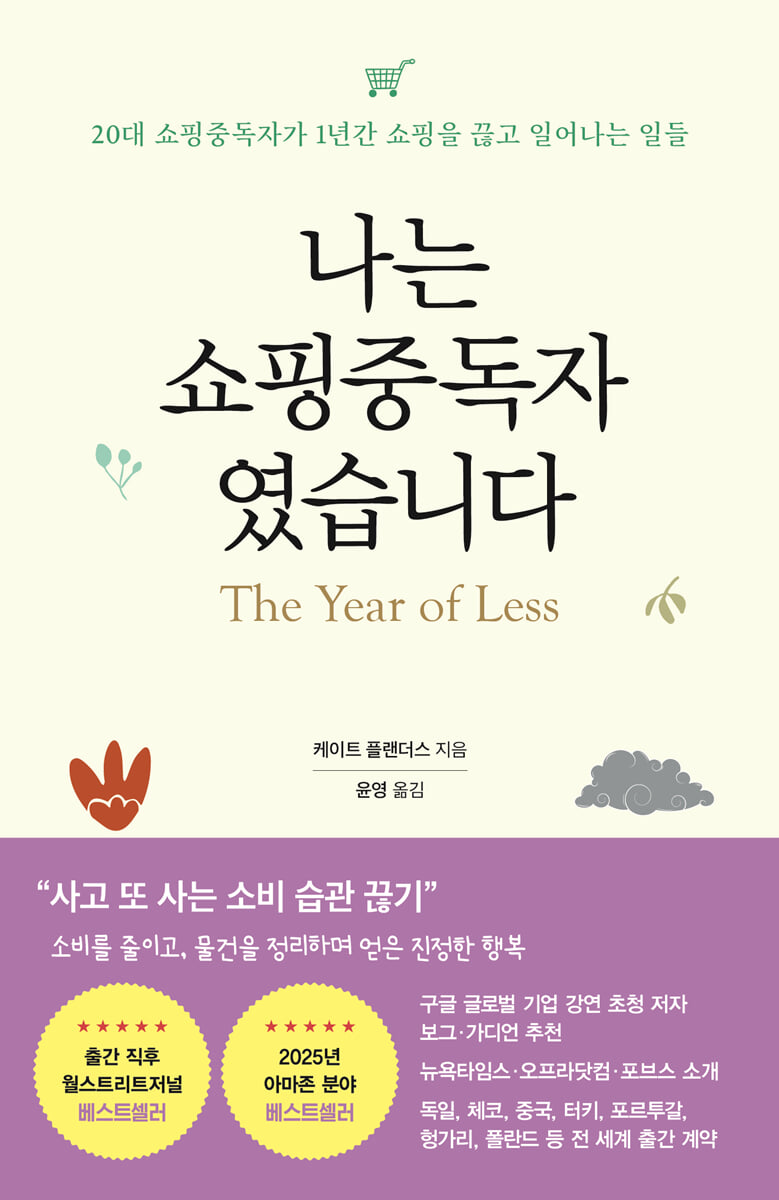
I was a shopaholic
 |
Description
Book Introduction
A shopaholic in his 20s with 40 million won in credit card debt
A one-year shopping ban declared, what's next?
★★★★★ Wall Street Journal Bestseller
★★★★★ Amazon Category Bestseller
“The Amazing Things That Happened When I Quit Shopping for a Year!”
Invited author of Google Global Corporate Lecture
Recommended by Vogue and The Guardian, featured in The New York Times, Oprah, The Guardian, and Forbes
Publishing contracts worldwide, including Germany, Czech Republic, China, Türkiye, Portugal, Hungary, and Poland
I dream that shopping will make me a better person, that buying things will enrich my life, but even after shopping, the emptiness in my heart doesn't completely fill, and I keep shopping again.
Before you know it, your credit card bill has ballooned to a surprising level, and your salary is being spent on credit card bills.
The resolution to save money is fleeting, but once again we are trapped in the cycle of consumption, and there is no way to break the vicious cycle that repeats itself like a habit.
Kate Flanders, who had been spending money and time lavishly on shopping and drinking since her 20s and was shocked to find herself with 40 million won in credit card debt, decided to abstain from shopping for a year on her 29th birthday.
And after declaring a shopping ban on her blog, she vividly documented the process.
This book, "I Was a Shopaholic," which collected these stories, provided a turning point for change for people struggling with the same problem.
This book, which teaches how to break the vicious cycle of unrestrained spending and credit card debt, and live simply and properly by getting rid of unnecessary things, received sympathy and praise from readers and became a 'Wall Street Journal Bestseller' immediately after its publication in 2018. It has been very popular and has been an 'Amazon Category Bestseller' every year as a book that provides motivation in times when 'a new life' and 'a change of habits' are needed.
The author reveals the process of how, after a year of giving up indiscriminate shopping and saying goodbye to unnecessary things in life, she changed both her appearance and her inner self, as well as her interpersonal relationships and her values and philosophy on life.
Let's embark on a journey to correct our wrong consumption habits and eliminate unnecessary things from our lives through this book, which contains the author's special story, which was also featured in a Google global corporate lecture.
A one-year shopping ban declared, what's next?
★★★★★ Wall Street Journal Bestseller
★★★★★ Amazon Category Bestseller
“The Amazing Things That Happened When I Quit Shopping for a Year!”
Invited author of Google Global Corporate Lecture
Recommended by Vogue and The Guardian, featured in The New York Times, Oprah, The Guardian, and Forbes
Publishing contracts worldwide, including Germany, Czech Republic, China, Türkiye, Portugal, Hungary, and Poland
I dream that shopping will make me a better person, that buying things will enrich my life, but even after shopping, the emptiness in my heart doesn't completely fill, and I keep shopping again.
Before you know it, your credit card bill has ballooned to a surprising level, and your salary is being spent on credit card bills.
The resolution to save money is fleeting, but once again we are trapped in the cycle of consumption, and there is no way to break the vicious cycle that repeats itself like a habit.
Kate Flanders, who had been spending money and time lavishly on shopping and drinking since her 20s and was shocked to find herself with 40 million won in credit card debt, decided to abstain from shopping for a year on her 29th birthday.
And after declaring a shopping ban on her blog, she vividly documented the process.
This book, "I Was a Shopaholic," which collected these stories, provided a turning point for change for people struggling with the same problem.
This book, which teaches how to break the vicious cycle of unrestrained spending and credit card debt, and live simply and properly by getting rid of unnecessary things, received sympathy and praise from readers and became a 'Wall Street Journal Bestseller' immediately after its publication in 2018. It has been very popular and has been an 'Amazon Category Bestseller' every year as a book that provides motivation in times when 'a new life' and 'a change of habits' are needed.
The author reveals the process of how, after a year of giving up indiscriminate shopping and saying goodbye to unnecessary things in life, she changed both her appearance and her inner self, as well as her interpersonal relationships and her values and philosophy on life.
Let's embark on a journey to correct our wrong consumption habits and eliminate unnecessary things from our lives through this book, which contains the author's special story, which was also featured in a Google global corporate lecture.
- You can preview some of the book's contents.
Preview
index
Recommendation
Introduction: I decided to abstain from shopping for the next year.
(PART 01) July: Getting a handle on the situation
(PART 02) August: Changing Basic Lifestyle Habits
(PART 03) September: Say goodbye to shopping and the mood-boosting pleasures
(PART 04) October: Growing Up and Moving Away
(PART 05) November: Losing Consciousness and Regaining It
(PART 06) December: Creating New Traditions
(PART 07) January: Rewriting the Rules
(PART 08) February: Letting Go of the Future
(PART 09) March: Cheer Up
(PART 10) April: Planning Your Escape
(PART 11) MAY: Finding Myself in a Different Place
(PART 12) JUNE: PACKING AND MOVING
Epilogue: Learning to Live Instead of Buying
A Guide to Living Less Instead of Shopping
References
Community
Reading Group Guide
Acknowledgements
Introduction: I decided to abstain from shopping for the next year.
(PART 01) July: Getting a handle on the situation
(PART 02) August: Changing Basic Lifestyle Habits
(PART 03) September: Say goodbye to shopping and the mood-boosting pleasures
(PART 04) October: Growing Up and Moving Away
(PART 05) November: Losing Consciousness and Regaining It
(PART 06) December: Creating New Traditions
(PART 07) January: Rewriting the Rules
(PART 08) February: Letting Go of the Future
(PART 09) March: Cheer Up
(PART 10) April: Planning Your Escape
(PART 11) MAY: Finding Myself in a Different Place
(PART 12) JUNE: PACKING AND MOVING
Epilogue: Learning to Live Instead of Buying
A Guide to Living Less Instead of Shopping
References
Community
Reading Group Guide
Acknowledgements
Detailed image

Publisher's Review
I learned this after quitting my shopping addiction.
Ruined my life
Unnecessary things
A living experiment that shows that more stuff is not the answer.
A fascinating story we can all learn from
-Vogue
“I should just cut up my cards or something!” We’ve all had that experience of checking our credit card bills this month, regretting our past selves for spending without proper control, and then blaming the poor credit card.
The bitter regret is fleeting, and like a spinning top, I use my credit card again and again, and after the credit card bill is deducted from my salary, I just sigh at the sight of my emptied bank account.
If you want to break free from the cycle of recurring credit card debt but can't, how can you change your ingrained spending habits?
Kate, the author of this book, "I Was a Shopaholic," ran up a whopping 40 million won in credit card debt in her 20s. She decided she couldn't live like that any longer and declared a one-year shopping ban.
Kate's resolution, which started with a shopping ban, led to 'cleaning out unused items', and further, 'breaking bad drinking habits', 'stopping overeating and managing her diet', 'turning off the TV' that she habitually had on, 'reestablishing human relationships' with family, friends, and lovers that she had been overly dependent on, and even reflecting on 'herself', the subject of all these situations, making her look back on her deep inner self and her entire life.
“A year of shopping bans was a challenge for me.
That time completely turned my life upside down.
And then, he saved me.”
Kate announced her one-year shopping ban challenge on her blog, and her unique and courageous experiment sparked public interest and excitement.
The extreme method that the author unconsciously chose was actually 'the will to live properly.'
During this time, Kate has a remarkable experience that reveals her life.
A year's worth of blog entries, along with incidents that were sometimes too gruesome to share, were compiled into a book, which Vogue praised as "a living experiment, a fascinating story we can all learn from."
The No Shopping Challenge is
Not only my bank account
Saved my life too
What are the things I am addicted to and obsessed with without even knowing it?
When you need a reset on shopping, alcohol, food, TV, social media, work, and relationships
After Katie stopped shopping so unnecessarily, everything around her began to look drastically different.
In the past, he lived by accumulating things he bought with credit cards, believing that life was all about items: fashion items needed to be a laid-back and cool person, intellectual items needed to look professional, and household items that would eventually come in handy if he had them.
Of course, it felt good to go shopping and buy new things.
I feel like I have become the ideal person I want to be, and I also feel hopeful that my life will become more satisfying.
But that feeling didn't last long, shopping didn't make me a better person, and the satisfaction I got from things often quickly became tiresome.
The author realized this through a shopping ban.
That the happiness we can get from things and consumption is not real, and that it is an 'addiction' that we have become too accustomed to.
Some people might be watching Katie's story and thinking, 'I'm not a shopaholic.'
But if you feel like your monthly credit card bills are a bit too much, or if you feel like you don't have enough money to save each month (leaving aside high prices, low wages, various taxes, and living expenses), there's something wrong with your spending habits.
The author says that after declaring her shopping ban, in addition to those who supported her, there were also those who considered her an unusual and peculiar person.
When the topic of fashion or trends came up during a conversation, they would exclude the person by saying, “Oh, Katie, you don’t go shopping, do you?”
Katie suddenly realized something during her conversation with them.
“It’s clear that we all need to save more, so why are we encouraging each other to spend money?”
We spend money to live more freely, but in the end we are not free from money.
The author asks herself if shopping and spending are really the answer, and that question extends to everything surrounding her and her life.
The author feels that she was obsessed and addicted to all of these things, just like shopping, on a daily basis: the alcohol she drank at parties out of habit, the food she ate when stressed, the books she didn't read, the clothes she didn't wear, the various items she didn't use, the TV she left on out of emptiness, the work life that caused her burnout, the boyfriend who only hurt her, and even the friends who showed off to each other and had a negative influence on her.
And just like you quit shopping, start practicing letting go of things you've been holding on to for no reason.
Lastly, he even let go of his feelings for his family, which he had considered greater and more precious than himself.
What I'm holding on to,
What I have to let go of,
The kind of life I want
A life reset that started with a shopping ban
Finding balance in life and living as your true self
When Katie first started the no-shopping challenge, she thought of it as a challenge about 'spending and money.'
I never thought that extreme consumption control measures would become a turning point that would completely change my life.
But the author must have felt it in his heart.
That if you don't do it now, it might get harder, and that this is your last chance.
His experiment was not a show-off challenge, but an adventure to find his true self.
After a year of challenges and successes, the realization I gained was simple.
“That was enough.
What I had was enough.
“I had enough.”
The original title of this book, “The Year of Less,” which introduces the reckless but courageous challenge of Katie, a shopaholic in her 20s, can be translated as “the year of letting go.”
The author confesses this at the end of the book:
“More” can never be the answer.
“As you know, the answer is always less.” The author reveals that by taking on the challenge, he stopped living mindlessly and started questioning his decisions.
Then he realizes that the life he wanted was not a successful life in the big city, and that what he really loved was people and experiences, not things.
So I got rid of 70% of my stuff, paid off all my debt, and started living on 51% of my income, saving 31%, and traveling with 18%.
Katie tells us through her own experience that when we want to consume something, it is because we feel a 'lack' in our hearts, and that this can never be solved with 'money'.
With this book, let's discover the bad habits in our daily lives that we didn't even realize were 'addictive' and find an opportunity to reset our lives without falling into the vicious cycle of consuming more and needing more.
Ruined my life
Unnecessary things
A living experiment that shows that more stuff is not the answer.
A fascinating story we can all learn from
-Vogue
“I should just cut up my cards or something!” We’ve all had that experience of checking our credit card bills this month, regretting our past selves for spending without proper control, and then blaming the poor credit card.
The bitter regret is fleeting, and like a spinning top, I use my credit card again and again, and after the credit card bill is deducted from my salary, I just sigh at the sight of my emptied bank account.
If you want to break free from the cycle of recurring credit card debt but can't, how can you change your ingrained spending habits?
Kate, the author of this book, "I Was a Shopaholic," ran up a whopping 40 million won in credit card debt in her 20s. She decided she couldn't live like that any longer and declared a one-year shopping ban.
Kate's resolution, which started with a shopping ban, led to 'cleaning out unused items', and further, 'breaking bad drinking habits', 'stopping overeating and managing her diet', 'turning off the TV' that she habitually had on, 'reestablishing human relationships' with family, friends, and lovers that she had been overly dependent on, and even reflecting on 'herself', the subject of all these situations, making her look back on her deep inner self and her entire life.
“A year of shopping bans was a challenge for me.
That time completely turned my life upside down.
And then, he saved me.”
Kate announced her one-year shopping ban challenge on her blog, and her unique and courageous experiment sparked public interest and excitement.
The extreme method that the author unconsciously chose was actually 'the will to live properly.'
During this time, Kate has a remarkable experience that reveals her life.
A year's worth of blog entries, along with incidents that were sometimes too gruesome to share, were compiled into a book, which Vogue praised as "a living experiment, a fascinating story we can all learn from."
The No Shopping Challenge is
Not only my bank account
Saved my life too
What are the things I am addicted to and obsessed with without even knowing it?
When you need a reset on shopping, alcohol, food, TV, social media, work, and relationships
After Katie stopped shopping so unnecessarily, everything around her began to look drastically different.
In the past, he lived by accumulating things he bought with credit cards, believing that life was all about items: fashion items needed to be a laid-back and cool person, intellectual items needed to look professional, and household items that would eventually come in handy if he had them.
Of course, it felt good to go shopping and buy new things.
I feel like I have become the ideal person I want to be, and I also feel hopeful that my life will become more satisfying.
But that feeling didn't last long, shopping didn't make me a better person, and the satisfaction I got from things often quickly became tiresome.
The author realized this through a shopping ban.
That the happiness we can get from things and consumption is not real, and that it is an 'addiction' that we have become too accustomed to.
Some people might be watching Katie's story and thinking, 'I'm not a shopaholic.'
But if you feel like your monthly credit card bills are a bit too much, or if you feel like you don't have enough money to save each month (leaving aside high prices, low wages, various taxes, and living expenses), there's something wrong with your spending habits.
The author says that after declaring her shopping ban, in addition to those who supported her, there were also those who considered her an unusual and peculiar person.
When the topic of fashion or trends came up during a conversation, they would exclude the person by saying, “Oh, Katie, you don’t go shopping, do you?”
Katie suddenly realized something during her conversation with them.
“It’s clear that we all need to save more, so why are we encouraging each other to spend money?”
We spend money to live more freely, but in the end we are not free from money.
The author asks herself if shopping and spending are really the answer, and that question extends to everything surrounding her and her life.
The author feels that she was obsessed and addicted to all of these things, just like shopping, on a daily basis: the alcohol she drank at parties out of habit, the food she ate when stressed, the books she didn't read, the clothes she didn't wear, the various items she didn't use, the TV she left on out of emptiness, the work life that caused her burnout, the boyfriend who only hurt her, and even the friends who showed off to each other and had a negative influence on her.
And just like you quit shopping, start practicing letting go of things you've been holding on to for no reason.
Lastly, he even let go of his feelings for his family, which he had considered greater and more precious than himself.
What I'm holding on to,
What I have to let go of,
The kind of life I want
A life reset that started with a shopping ban
Finding balance in life and living as your true self
When Katie first started the no-shopping challenge, she thought of it as a challenge about 'spending and money.'
I never thought that extreme consumption control measures would become a turning point that would completely change my life.
But the author must have felt it in his heart.
That if you don't do it now, it might get harder, and that this is your last chance.
His experiment was not a show-off challenge, but an adventure to find his true self.
After a year of challenges and successes, the realization I gained was simple.
“That was enough.
What I had was enough.
“I had enough.”
The original title of this book, “The Year of Less,” which introduces the reckless but courageous challenge of Katie, a shopaholic in her 20s, can be translated as “the year of letting go.”
The author confesses this at the end of the book:
“More” can never be the answer.
“As you know, the answer is always less.” The author reveals that by taking on the challenge, he stopped living mindlessly and started questioning his decisions.
Then he realizes that the life he wanted was not a successful life in the big city, and that what he really loved was people and experiences, not things.
So I got rid of 70% of my stuff, paid off all my debt, and started living on 51% of my income, saving 31%, and traveling with 18%.
Katie tells us through her own experience that when we want to consume something, it is because we feel a 'lack' in our hearts, and that this can never be solved with 'money'.
With this book, let's discover the bad habits in our daily lives that we didn't even realize were 'addictive' and find an opportunity to reset our lives without falling into the vicious cycle of consuming more and needing more.
GOODS SPECIFICS
- Date of issue: July 29, 2025
- Page count, weight, size: 340 pages | 130*200*30mm
- ISBN13: 9791161505442
- ISBN10: 116150544X
You may also like
카테고리
korean


korean

![ELLE 엘르 스페셜 에디션 A형 : 12월 [2025]](http://librairie.coreenne.fr/cdn/shop/files/b8e27a3de6c9538896439686c6b0e8fb.jpg?v=1766436872&width=3840)


