

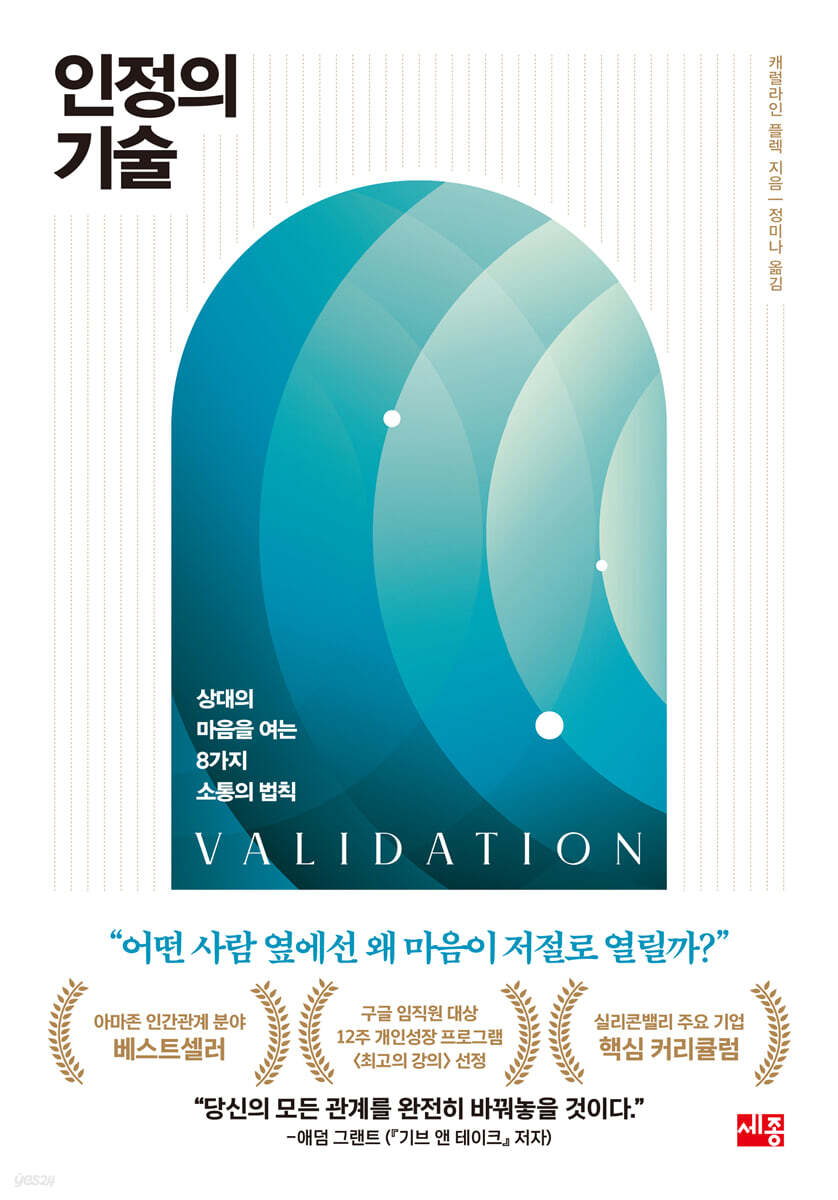
The Art of Recognition
 |
Description
Book Introduction
“It will completely change all your relationships!”
Adam Grant (author of Give and Take)
The magical word that can change your relationship: 'Acceptance'
8 Empathy Formulas You Can Learn and Use Right Away
★Amazon Bestseller in Human Relationships
★Selected as the [Best Course] for the 12-Week Personal Growth Program for Google Employees
"Why do I feel comfortable around some people and always feel nervous around others?" There's a technique that's often taught first and foremost in countless therapy sessions, parenting workshops, and corporate training.
This technology, which was adopted by Silicon Valley's top companies, brought about changes that exceeded management's expectations and was proven in real-life cases where it saved the life of a client at risk of suicide.
The reason why conflicts are frequent and relationships are uncomfortable is, surprisingly, because of one thing: the lack of 'recognition'.
Simply accepting the other person's feelings as they are will reduce conflict, deepen trust, and make the relationship much more comfortable.
True understanding naturally opens the other person's heart and makes them listen to what you have to say.
Verbal rewards like recognition and empathy generate far more powerful intrinsic motivation than awards or monetary rewards.
In organizations in particular, this 'technology of recognition' has been shown to increase work engagement by more than three times.
"The Art of Validation" is a practical guide that explains the principles of "validation," which work like magic in human relationships, based on insights from psychology and behavioral science.
The author's clinical experience at Stanford and Duke universities, as well as proven case studies from Silicon Valley corporate training, have earned him a high level of expertise and credibility, enough to be selected as a "Best Course" by Google's 12-Week Personal Growth Program.
It covers in depth not only how to read the other person's emotions and build trust, but also the process of 'self-acceptance', which is to affirm and accept oneself.
The author introduces eight simple yet powerful practical techniques for unblocking the flow of relationships while simultaneously accepting others' words and feelings.
Reflecting the realities of Korean society, it presents concrete and practical solutions that can be applied immediately to conflict situations encountered in everyday life, such as at home, at work, and during childcare.
Adam Grant (author of Give and Take)
The magical word that can change your relationship: 'Acceptance'
8 Empathy Formulas You Can Learn and Use Right Away
★Amazon Bestseller in Human Relationships
★Selected as the [Best Course] for the 12-Week Personal Growth Program for Google Employees
"Why do I feel comfortable around some people and always feel nervous around others?" There's a technique that's often taught first and foremost in countless therapy sessions, parenting workshops, and corporate training.
This technology, which was adopted by Silicon Valley's top companies, brought about changes that exceeded management's expectations and was proven in real-life cases where it saved the life of a client at risk of suicide.
The reason why conflicts are frequent and relationships are uncomfortable is, surprisingly, because of one thing: the lack of 'recognition'.
Simply accepting the other person's feelings as they are will reduce conflict, deepen trust, and make the relationship much more comfortable.
True understanding naturally opens the other person's heart and makes them listen to what you have to say.
Verbal rewards like recognition and empathy generate far more powerful intrinsic motivation than awards or monetary rewards.
In organizations in particular, this 'technology of recognition' has been shown to increase work engagement by more than three times.
"The Art of Validation" is a practical guide that explains the principles of "validation," which work like magic in human relationships, based on insights from psychology and behavioral science.
The author's clinical experience at Stanford and Duke universities, as well as proven case studies from Silicon Valley corporate training, have earned him a high level of expertise and credibility, enough to be selected as a "Best Course" by Google's 12-Week Personal Growth Program.
It covers in depth not only how to read the other person's emotions and build trust, but also the process of 'self-acceptance', which is to affirm and accept oneself.
The author introduces eight simple yet powerful practical techniques for unblocking the flow of relationships while simultaneously accepting others' words and feelings.
Reflecting the realities of Korean society, it presents concrete and practical solutions that can be applied immediately to conflict situations encountered in everyday life, such as at home, at work, and during childcare.
- You can preview some of the book's contents.
Preview
index
Introduction | Knowing You: The Art of Empathy and Recognition that Transforms Relationships
Part 1.
Acknowledging Makes a Difference: A Core Principle of Relationships
Chapter 1.
"Yeah, you're right"? The law of relationships that changes in a single word.
Chapter 2.
The Power of Acceptance: The Magical Art of Saving Relationships
Chapter 3.
Eyes that see the invisible
Chapter 4.
Don't Waste Your Pain: How to Transform Hurt into Growth
Part 2.
8 Recognition Skills That Will Transform Your Relationships
Chapter 5.
The Ladder of Recognition: 8 Steps to Authentic Communication
Chapter 6.
① Pay attention - The miracle of 'listening power'
Chapter 7.
② Following - The art of imitation that connects relationships
Chapter 8.
③ Understanding the Context - How to Read Beyond Visible Behavior
Chapter 9.
④ Try to change your perspective - “Anyone would have done the same in that situation.”
Chapter 10.
⑤ Mind Reading - The ability to perceive the other person's inner thoughts
Chapter 11.
⑥ Show action - A way to convey a message stronger than words.
Chapter 12.
⑦ Sharing Emotions - How to Connect More Deeply
Chapter 13.
⑧ Show sincerity - the highest level of empathy
Part 3.
The real change that recognition brings
Chapter 14.
The most powerful way to change behavior
Chapter 15.
The Art of Acceptance that Opens a Child's Heart
Chapter 16.
The art of protecting love
Chapter 17.
The leader who recognizes wins
Chapter 18.
Self-Awareness Skills to Boost Resilience
Conclusion | I Have the Right to Be on My Own Side
Acknowledgements
Appendix | Ladder of Recognition: A Practical Guide
main
Part 1.
Acknowledging Makes a Difference: A Core Principle of Relationships
Chapter 1.
"Yeah, you're right"? The law of relationships that changes in a single word.
Chapter 2.
The Power of Acceptance: The Magical Art of Saving Relationships
Chapter 3.
Eyes that see the invisible
Chapter 4.
Don't Waste Your Pain: How to Transform Hurt into Growth
Part 2.
8 Recognition Skills That Will Transform Your Relationships
Chapter 5.
The Ladder of Recognition: 8 Steps to Authentic Communication
Chapter 6.
① Pay attention - The miracle of 'listening power'
Chapter 7.
② Following - The art of imitation that connects relationships
Chapter 8.
③ Understanding the Context - How to Read Beyond Visible Behavior
Chapter 9.
④ Try to change your perspective - “Anyone would have done the same in that situation.”
Chapter 10.
⑤ Mind Reading - The ability to perceive the other person's inner thoughts
Chapter 11.
⑥ Show action - A way to convey a message stronger than words.
Chapter 12.
⑦ Sharing Emotions - How to Connect More Deeply
Chapter 13.
⑧ Show sincerity - the highest level of empathy
Part 3.
The real change that recognition brings
Chapter 14.
The most powerful way to change behavior
Chapter 15.
The Art of Acceptance that Opens a Child's Heart
Chapter 16.
The art of protecting love
Chapter 17.
The leader who recognizes wins
Chapter 18.
Self-Awareness Skills to Boost Resilience
Conclusion | I Have the Right to Be on My Own Side
Acknowledgements
Appendix | Ladder of Recognition: A Practical Guide
main
Detailed image

Into the book
Learning the art of recognition felt like finding a puzzle piece I didn't even know I had lost.
It's as if I've found the key to the whole picture.
Soon after learning this skill, I realized that the sensitivity that had plagued me my entire life could actually be a force that saved others.
The 'magic' that I had been pursuing my entire life was actually a simple technique that anyone could learn.
The more I practiced this, the more proficient I became, and the more deeply I was able to connect with myself and others.
As time passed, my perspective on emotions and the distance between myself and them changed.
My sensitivity, which I had always wanted to hide, blossomed into a special talent that soothed the hearts of others through this technique.
---From the "Introductory Note"
About ten years after learning this skill, I made it my life's calling to share this valuable skill with more people.
In the process, I've seen people use this technology to revive broken marriages, rebuild relationships between parents and children, and even save lives (I'll tell you about some of these later).
Now, I teach this technique first and foremost, whether it's in psychotherapy, parenting workshops, or corporate training.
When I was asked to lead a 12-week course on interpersonal skills for 100 employees at one of Silicon Valley's top five companies, I devoted a full third of my time to this technical training.
The course's success far exceeded management's expectations, and the most common request I received after the lecture was for a book to be written solely on this technology.
---From the "Introductory Note"
Human experience is made up of emotions, thoughts, and actions.
The important thing is that we don't have to acknowledge every aspect of a person's experience.
We tend to be more drawn to the negative aspects or things we don't understand about others.
This is due to human 'negative bias'.
But true recognition begins by moving beyond such biases and finding a 'piece of truth' within the other person's experience.
The piece doesn't have to be very large.
All you have to do is find the link that will allow you to understand why that person thought that way, why he felt that way, and why he acted that way.
If you're having trouble finding even that piece, think about it this way:
“If that person thinks that way, is that behavior understandable?” If someone believes that radiation has spread in their city, collecting evidence to protest to the government is a perfectly understandable response.
---From "Chapter 3: Eyes that See the Invisible"
When Matt Sakaguchi moved to a new team at Google, he wanted to avoid the interpersonal problems he had experienced on his previous team.
As a performance-oriented Googler, he consulted with experts to create a healthy team culture.
The experts he found were Google's "Project Aristotle Team," an internal organization that studies the core characteristics of high-performing teams.
Having analyzed hundreds of teams and possessing vast amounts of data, they advised Sakaguchi to first assess the team's current state.
They distributed the questionnaire they provided to their team members, and they probably secretly found it annoying, thinking it was just another questionnaire.
Sakaguchi believed his team had strong teamwork, but the survey results were different from his expectations.
So, true to his performance-oriented leadership, he decided to spend the entire day outside the office discussing the results with his team.
He relieved the tension in a unique way.
It was suggested that each person express their life journey through a drawing.
As the first presenter, instead of sharing a typical success story, he opened up about his stage 4 cancer diagnosis and his struggles with the disease.
He shared that he had been working at Google for the past five years and had been receiving treatment, and that he had recently discovered abnormalities in his liver and was concerned that a relapse was possible.
Sakaguchi's confession goes beyond a simple personal narrative, reminding us that everyone lives their own lives outside of work.
In the presentations that followed, instead of the flashy images posted on social media, real stories containing the patterns of each person's life were told through pictures.
He realized that the team's superficial performance alone could not be used to understand the real problem, and he believed that the same would be true on an individual level.
His prediction was correct.
He created a psychological space where his team members could express themselves freely and honestly, and in the process, their understanding of each other deepened.
In a later interview, Sakaguchi said:
“I created this space because I wanted to see if hearing someone’s honest story would lead people to see them as a complete person, not just a colleague.
In fact, after that, we came to understand each other as human beings beyond our work relationship.
Through these in-depth conversations, we were able to naturally discuss ways to improve teamwork.
After about a month, the team's communication style changed, and it ended up being the best team I've ever had at Google.”
---From "Chapter 17: The Leader Who Recognizes Wins"
Self-understanding protects us from the negative emotions that naturally arise when the world assumes your feelings are “wrong.”
An example is the loss of identity experienced during the 72 hours following cancer treatment.
At this time, I feel as if I have left my body and am observing myself.
As Matt can attest, even I, a psychologist, have a hard time accurately describing this sensation.
If I had to describe it, I would say it's a mixture of anxious agitation and a sense of self-dissociation.
At times like this, cats are no longer cute, comedy becomes annoying, and everything feels boring.
Rather than becoming depressed or indifferent, I just become numb.
The only proof that I am me is that I am aware that I am not my usual self.
Nowhere in the chemotherapy side effect guide my oncologist gave me did it say anything about kittens suddenly becoming less cute.
When talking about this loss of identity, the medical staff quickly changed the subject, saying, “This is the first time I’ve heard of it.”
In other words, it was no different from saying, “That’s not normal.”
If I didn't have self-understanding, I would have doubted myself.
"Is it the chemotherapy? Or is there something wrong with me?" But I understood the validity of my feelings, and I trusted my experience more than others.
Thanks to this, I was able to avoid falling into the swamp of self-denial.
In the past, I might have thought my reaction was excessive, or I might have simply accepted society's view of women's medical symptoms as trivial.
But now I know I have the right to tell you exactly what I'm going through.
If I can feel this way and not be lonely in it, then others can too.
So self-understanding is important.
As mentioned in Chapter 18, self-understanding improves self-esteem, self-compassion, and your relationship with yourself.
As relationships deepen, trust grows.
The point I want to emphasize is that as we understand ourselves better, we can more easily trust our judgments and experiences, and thus be able to accept the opinions of others without confusion or negativity.
It's as if I've found the key to the whole picture.
Soon after learning this skill, I realized that the sensitivity that had plagued me my entire life could actually be a force that saved others.
The 'magic' that I had been pursuing my entire life was actually a simple technique that anyone could learn.
The more I practiced this, the more proficient I became, and the more deeply I was able to connect with myself and others.
As time passed, my perspective on emotions and the distance between myself and them changed.
My sensitivity, which I had always wanted to hide, blossomed into a special talent that soothed the hearts of others through this technique.
---From the "Introductory Note"
About ten years after learning this skill, I made it my life's calling to share this valuable skill with more people.
In the process, I've seen people use this technology to revive broken marriages, rebuild relationships between parents and children, and even save lives (I'll tell you about some of these later).
Now, I teach this technique first and foremost, whether it's in psychotherapy, parenting workshops, or corporate training.
When I was asked to lead a 12-week course on interpersonal skills for 100 employees at one of Silicon Valley's top five companies, I devoted a full third of my time to this technical training.
The course's success far exceeded management's expectations, and the most common request I received after the lecture was for a book to be written solely on this technology.
---From the "Introductory Note"
Human experience is made up of emotions, thoughts, and actions.
The important thing is that we don't have to acknowledge every aspect of a person's experience.
We tend to be more drawn to the negative aspects or things we don't understand about others.
This is due to human 'negative bias'.
But true recognition begins by moving beyond such biases and finding a 'piece of truth' within the other person's experience.
The piece doesn't have to be very large.
All you have to do is find the link that will allow you to understand why that person thought that way, why he felt that way, and why he acted that way.
If you're having trouble finding even that piece, think about it this way:
“If that person thinks that way, is that behavior understandable?” If someone believes that radiation has spread in their city, collecting evidence to protest to the government is a perfectly understandable response.
---From "Chapter 3: Eyes that See the Invisible"
When Matt Sakaguchi moved to a new team at Google, he wanted to avoid the interpersonal problems he had experienced on his previous team.
As a performance-oriented Googler, he consulted with experts to create a healthy team culture.
The experts he found were Google's "Project Aristotle Team," an internal organization that studies the core characteristics of high-performing teams.
Having analyzed hundreds of teams and possessing vast amounts of data, they advised Sakaguchi to first assess the team's current state.
They distributed the questionnaire they provided to their team members, and they probably secretly found it annoying, thinking it was just another questionnaire.
Sakaguchi believed his team had strong teamwork, but the survey results were different from his expectations.
So, true to his performance-oriented leadership, he decided to spend the entire day outside the office discussing the results with his team.
He relieved the tension in a unique way.
It was suggested that each person express their life journey through a drawing.
As the first presenter, instead of sharing a typical success story, he opened up about his stage 4 cancer diagnosis and his struggles with the disease.
He shared that he had been working at Google for the past five years and had been receiving treatment, and that he had recently discovered abnormalities in his liver and was concerned that a relapse was possible.
Sakaguchi's confession goes beyond a simple personal narrative, reminding us that everyone lives their own lives outside of work.
In the presentations that followed, instead of the flashy images posted on social media, real stories containing the patterns of each person's life were told through pictures.
He realized that the team's superficial performance alone could not be used to understand the real problem, and he believed that the same would be true on an individual level.
His prediction was correct.
He created a psychological space where his team members could express themselves freely and honestly, and in the process, their understanding of each other deepened.
In a later interview, Sakaguchi said:
“I created this space because I wanted to see if hearing someone’s honest story would lead people to see them as a complete person, not just a colleague.
In fact, after that, we came to understand each other as human beings beyond our work relationship.
Through these in-depth conversations, we were able to naturally discuss ways to improve teamwork.
After about a month, the team's communication style changed, and it ended up being the best team I've ever had at Google.”
---From "Chapter 17: The Leader Who Recognizes Wins"
Self-understanding protects us from the negative emotions that naturally arise when the world assumes your feelings are “wrong.”
An example is the loss of identity experienced during the 72 hours following cancer treatment.
At this time, I feel as if I have left my body and am observing myself.
As Matt can attest, even I, a psychologist, have a hard time accurately describing this sensation.
If I had to describe it, I would say it's a mixture of anxious agitation and a sense of self-dissociation.
At times like this, cats are no longer cute, comedy becomes annoying, and everything feels boring.
Rather than becoming depressed or indifferent, I just become numb.
The only proof that I am me is that I am aware that I am not my usual self.
Nowhere in the chemotherapy side effect guide my oncologist gave me did it say anything about kittens suddenly becoming less cute.
When talking about this loss of identity, the medical staff quickly changed the subject, saying, “This is the first time I’ve heard of it.”
In other words, it was no different from saying, “That’s not normal.”
If I didn't have self-understanding, I would have doubted myself.
"Is it the chemotherapy? Or is there something wrong with me?" But I understood the validity of my feelings, and I trusted my experience more than others.
Thanks to this, I was able to avoid falling into the swamp of self-denial.
In the past, I might have thought my reaction was excessive, or I might have simply accepted society's view of women's medical symptoms as trivial.
But now I know I have the right to tell you exactly what I'm going through.
If I can feel this way and not be lonely in it, then others can too.
So self-understanding is important.
As mentioned in Chapter 18, self-understanding improves self-esteem, self-compassion, and your relationship with yourself.
As relationships deepen, trust grows.
The point I want to emphasize is that as we understand ourselves better, we can more easily trust our judgments and experiences, and thus be able to accept the opinions of others without confusion or negativity.
---From the “Conclusion”
Publisher's Review
All relationships begin with 'acknowledgement'
A key communication skill that has caught the attention of psychology and Silicon Valley.
In modern society, human relationships are becoming increasingly complex.
At work, the stress of collaboration and communication, at home, the feeling of not being understood, parents can easily lose the thread of their relationships amidst repeated conflicts with their children.
"The Art of Validation" cuts through all conflicts in relationships, including work, home, and parenting, with a single principle: validation.
The 'recognition' this book speaks of is not simple empathy or agreement.
It is an attitude of non-judgmental acceptance that accepts the other person's feelings and reactions as "that could be the case" without judging or interpreting them.
In fact, it is a core skill that is taught first in almost all fields that deal with human relations, such as psychotherapy, parenting workshops, and organizational leadership training.
The author shares his experience of a client on the brink of suicide finding a turning point in his life with a single word: "acknowledgement."
Leading Silicon Valley companies, including Google, have also incorporated this technology into their leadership and team communication training, and have observed quantifiable changes in trust and engagement among team members.
These examples demonstrate that recognition is not just a personal capacity for empathy; it is a practical tool for driving change in relationships.
In particular, this book goes beyond simply explaining the principles of recognition in an abstract manner, but concretizes them into eight practical strategies that can be applied in various realities, such as the workplace, couples, and parent-child relationships.
We guide you through how to reduce tension in conversations and build trust by observing emotions as they are, without judging or trying to correct them.
"The Art of Acceptance" offers practical solutions for those seeking to reduce conflict, restore relationships, and reconnect with lost connections.
For readers who want to understand how trust is formed, this book will be the most practical guide, combining psychological principles with practical methods.
A single word can change teamwork.
It's not about techniques, it's about changing your attitude toward emotions.
Most problems in the workplace start with people, not with work.
Friction with people, rather than performance, is often the primary reason for leaving a company, and when teamwork breaks down, the productivity of the entire organization also suffers.
Reflecting this reality, "The Art of Recognition" presents specific methods for building psychological safety and forming sustainable trust.
The 'recognition' the book talks about is not simply listening or positive feedback.
It is an attitude of accepting the other person's feelings as they are and conveying that they are valid.
This process is particularly powerful in organizations where conflicts of opinion occur frequently during meetings or communication between departments is blocked.
For example, when internal conflict within the team escalated after a product failure, one startup CTO accepted his subordinates' anger and disappointment, and from that day on, the team regained a sense of security.
Rather than trying to change the feelings, a single word like “I guess that could have happened” changed the atmosphere of the organization.
According to organizational behavior research, teams that feel psychologically safe are significantly more innovative and problem-solving capable than those that don't.
This book emphasizes that this 'sense of safety' comes from an 'attitude of recognition.'
A change in attitude, not just a communication technique.
"The Art of Recognition" guides you through practical strategies to reduce workplace conflict and restore teamwork through this transformation.
If you're in a workplace where people are more difficult than the work, this book offers a clue to rebuilding your relationships.
What's harder than love is acceptance.
Emotional Skills to Restore a Marital Breakdown
The closer the relationship, the more easily feelings are hurt and misread.
"The Art of Recognition" finds the root cause of recurring conflicts in marital relationships in "non-recognition of emotions."
Many couples invalidate each other's feelings by saying things like, "That's not right," or "Why do you always think that way?", deepening the wounds.
This book explains how such interactions can erode relationships and suggests "acknowledging emotions" as a key skill for restoring them.
In fact, one husband who had been watching his wife struggle with illness for a long time offered no advice or even tried to control the situation.
He just quietly listened to his wife's feelings and stayed by her side with just one word: "It must be so hard."
He confesses that those times were actually the greatest comfort to his wife.
We often try to 'fix' things to help our loved ones, but what's really needed is an attitude of acceptance of the feelings as they are.
The first thing that is dealt with in couples counseling is this ‘acknowledgment.’
This technique is not a temporary emotional regulation tool, but a foundational tool for relationship restoration.
If your relationship is worn down by recurring conflict, this book will show you how to build "emotional bridges" that can reconnect even when the gaps seem irreparable.
Accept the other person's feelings as they are.
At that moment, the relationship is reconnected.
We can communicate without having to scold each other
Parents' attitudes that open their children's hearts
If you have recurring conflicts with your child, the first thing to check is not your 'tone of speech' but your 'reaction to emotions'.
Many parents are embarrassed by their child's emotional expressions or ignore them, responding with, "Why are you making such a fuss over something so trivial?"
This can instill in the child the perception that “my feelings are wrong.”
"The Art of Recognition" proposes a shift from viewing children's emotions as "objects of control" to "starting points of understanding."
In fact, like the case of the mother who said to her child who was having trouble adjusting to kindergarten, “I know you might feel unfamiliar and scared in a new environment,” instead of “Why are you crying?”, an attitude of accepting the emotions themselves greatly reduced the child’s anxiety.
Just having your feelings acknowledged makes your child feel safe and allows them to reveal their hidden feelings.
This book specifically explains how to create an environment where children can honestly express their emotions, based on the principle of acknowledging their emotions but guiding their behavior separately.
"The Art of Recognition" fosters a "relationship-centered parenting" perspective that seeks to understand and coordinate children's emotions together, rather than controlling their behavior.
How to connect with your child's heart without emotional outbursts? This book will serve as the most practical guide for parents seeking that turning point.
A key communication skill that has caught the attention of psychology and Silicon Valley.
In modern society, human relationships are becoming increasingly complex.
At work, the stress of collaboration and communication, at home, the feeling of not being understood, parents can easily lose the thread of their relationships amidst repeated conflicts with their children.
"The Art of Validation" cuts through all conflicts in relationships, including work, home, and parenting, with a single principle: validation.
The 'recognition' this book speaks of is not simple empathy or agreement.
It is an attitude of non-judgmental acceptance that accepts the other person's feelings and reactions as "that could be the case" without judging or interpreting them.
In fact, it is a core skill that is taught first in almost all fields that deal with human relations, such as psychotherapy, parenting workshops, and organizational leadership training.
The author shares his experience of a client on the brink of suicide finding a turning point in his life with a single word: "acknowledgement."
Leading Silicon Valley companies, including Google, have also incorporated this technology into their leadership and team communication training, and have observed quantifiable changes in trust and engagement among team members.
These examples demonstrate that recognition is not just a personal capacity for empathy; it is a practical tool for driving change in relationships.
In particular, this book goes beyond simply explaining the principles of recognition in an abstract manner, but concretizes them into eight practical strategies that can be applied in various realities, such as the workplace, couples, and parent-child relationships.
We guide you through how to reduce tension in conversations and build trust by observing emotions as they are, without judging or trying to correct them.
"The Art of Acceptance" offers practical solutions for those seeking to reduce conflict, restore relationships, and reconnect with lost connections.
For readers who want to understand how trust is formed, this book will be the most practical guide, combining psychological principles with practical methods.
A single word can change teamwork.
It's not about techniques, it's about changing your attitude toward emotions.
Most problems in the workplace start with people, not with work.
Friction with people, rather than performance, is often the primary reason for leaving a company, and when teamwork breaks down, the productivity of the entire organization also suffers.
Reflecting this reality, "The Art of Recognition" presents specific methods for building psychological safety and forming sustainable trust.
The 'recognition' the book talks about is not simply listening or positive feedback.
It is an attitude of accepting the other person's feelings as they are and conveying that they are valid.
This process is particularly powerful in organizations where conflicts of opinion occur frequently during meetings or communication between departments is blocked.
For example, when internal conflict within the team escalated after a product failure, one startup CTO accepted his subordinates' anger and disappointment, and from that day on, the team regained a sense of security.
Rather than trying to change the feelings, a single word like “I guess that could have happened” changed the atmosphere of the organization.
According to organizational behavior research, teams that feel psychologically safe are significantly more innovative and problem-solving capable than those that don't.
This book emphasizes that this 'sense of safety' comes from an 'attitude of recognition.'
A change in attitude, not just a communication technique.
"The Art of Recognition" guides you through practical strategies to reduce workplace conflict and restore teamwork through this transformation.
If you're in a workplace where people are more difficult than the work, this book offers a clue to rebuilding your relationships.
What's harder than love is acceptance.
Emotional Skills to Restore a Marital Breakdown
The closer the relationship, the more easily feelings are hurt and misread.
"The Art of Recognition" finds the root cause of recurring conflicts in marital relationships in "non-recognition of emotions."
Many couples invalidate each other's feelings by saying things like, "That's not right," or "Why do you always think that way?", deepening the wounds.
This book explains how such interactions can erode relationships and suggests "acknowledging emotions" as a key skill for restoring them.
In fact, one husband who had been watching his wife struggle with illness for a long time offered no advice or even tried to control the situation.
He just quietly listened to his wife's feelings and stayed by her side with just one word: "It must be so hard."
He confesses that those times were actually the greatest comfort to his wife.
We often try to 'fix' things to help our loved ones, but what's really needed is an attitude of acceptance of the feelings as they are.
The first thing that is dealt with in couples counseling is this ‘acknowledgment.’
This technique is not a temporary emotional regulation tool, but a foundational tool for relationship restoration.
If your relationship is worn down by recurring conflict, this book will show you how to build "emotional bridges" that can reconnect even when the gaps seem irreparable.
Accept the other person's feelings as they are.
At that moment, the relationship is reconnected.
We can communicate without having to scold each other
Parents' attitudes that open their children's hearts
If you have recurring conflicts with your child, the first thing to check is not your 'tone of speech' but your 'reaction to emotions'.
Many parents are embarrassed by their child's emotional expressions or ignore them, responding with, "Why are you making such a fuss over something so trivial?"
This can instill in the child the perception that “my feelings are wrong.”
"The Art of Recognition" proposes a shift from viewing children's emotions as "objects of control" to "starting points of understanding."
In fact, like the case of the mother who said to her child who was having trouble adjusting to kindergarten, “I know you might feel unfamiliar and scared in a new environment,” instead of “Why are you crying?”, an attitude of accepting the emotions themselves greatly reduced the child’s anxiety.
Just having your feelings acknowledged makes your child feel safe and allows them to reveal their hidden feelings.
This book specifically explains how to create an environment where children can honestly express their emotions, based on the principle of acknowledging their emotions but guiding their behavior separately.
"The Art of Recognition" fosters a "relationship-centered parenting" perspective that seeks to understand and coordinate children's emotions together, rather than controlling their behavior.
How to connect with your child's heart without emotional outbursts? This book will serve as the most practical guide for parents seeking that turning point.
GOODS SPECIFICS
- Date of issue: June 30, 2025
- Page count, weight, size: 384 pages | 548g | 150*215*25mm
- ISBN13: 9788984078758
- ISBN10: 8984078751
You may also like
카테고리
korean


korean

![ELLE 엘르 스페셜 에디션 A형 : 12월 [2025]](http://librairie.coreenne.fr/cdn/shop/files/b8e27a3de6c9538896439686c6b0e8fb.jpg?v=1766436872&width=3840)


