

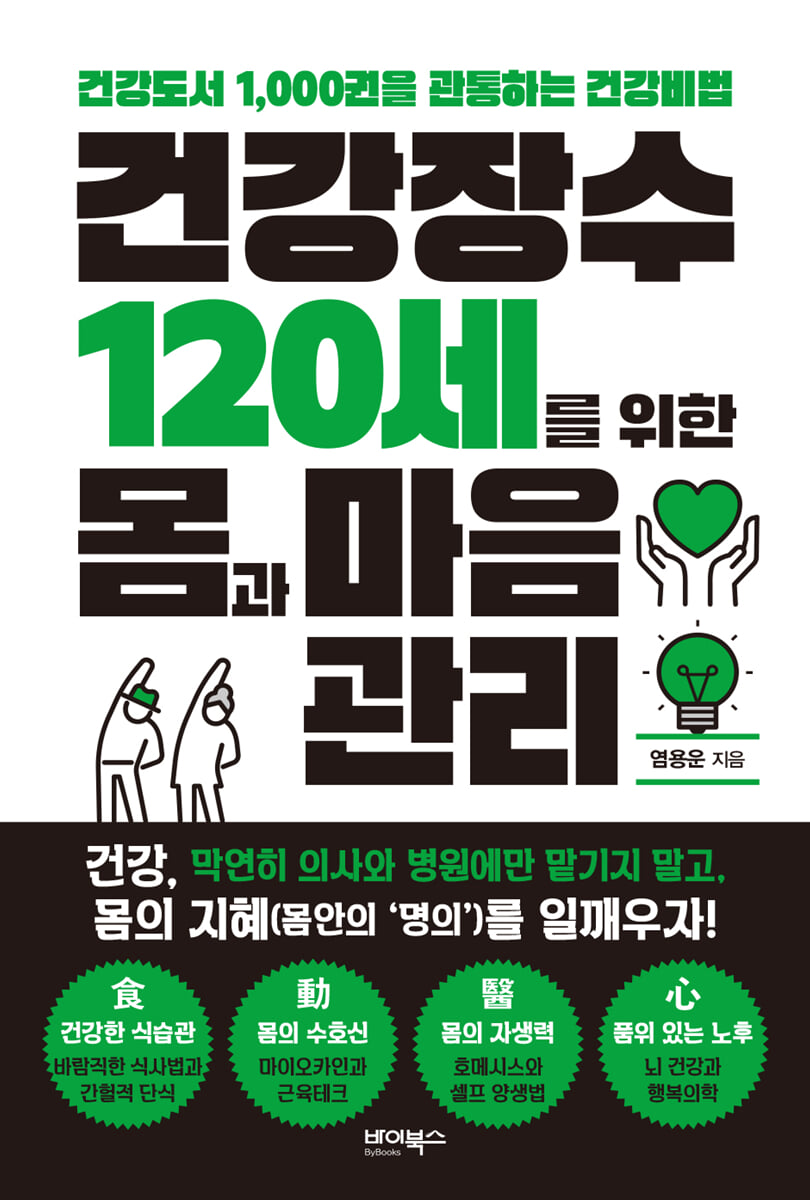
Body and Mind Care for a Healthy Longevity of 120
 |
Description
Book Introduction
Health secrets that permeate 1,000 health books.
There is a reason why author Yong-un Yeom, who has held important positions at leading domestic and international companies, is currently preparing for the completion and opening of a specialized healing hospital for chronic diseases such as cancer, diabetes, hypertension, hyperlipidemia, and autoimmune diseases.
After witnessing the absurd death of my parents due to incorrect hospital treatment and reading over 1,000 domestic and international health-related literature, I realized something and wrote "Body and Mind Management for a Healthy Longevity of 120" to inform people of ways to take care of their own health and become independent.
If you exercise regularly, improve your eating habits, and take care of your own health, you will be amazed by your body's amazing self-healing power and mysterious wisdom.
Let us remember once again that the foundation of disease treatment lies not in complex and difficult surgeries, synthetic chemical drugs, or miracle cures, but in the simple clarity of the three major elements of health management: food, lifestyle habits, and exercise.
There is a reason why author Yong-un Yeom, who has held important positions at leading domestic and international companies, is currently preparing for the completion and opening of a specialized healing hospital for chronic diseases such as cancer, diabetes, hypertension, hyperlipidemia, and autoimmune diseases.
After witnessing the absurd death of my parents due to incorrect hospital treatment and reading over 1,000 domestic and international health-related literature, I realized something and wrote "Body and Mind Management for a Healthy Longevity of 120" to inform people of ways to take care of their own health and become independent.
If you exercise regularly, improve your eating habits, and take care of your own health, you will be amazed by your body's amazing self-healing power and mysterious wisdom.
Let us remember once again that the foundation of disease treatment lies not in complex and difficult surgeries, synthetic chemical drugs, or miracle cures, but in the simple clarity of the three major elements of health management: food, lifestyle habits, and exercise.
- You can preview some of the book's contents.
Preview
index
Before reading the book
Preface _ Insights from Reading 1,000 Health-Related Books
1.
Aging and longevity
What is aging?
Common Signs of Aging | The Root Causes of Aging | Inflammation Accelerates Aging | Obesity, the Root Cause of Chronic Inflammation
What is longevity?
The average human lifespan is 120-125 years | The number of people living past 100 is increasing | Three dimensions of longevity research
Representative long-lived people
Emperor Qianlong | The Rise of Super Agers | Where Are We Now?
Lessons from the Elderly
Blue Zone Diet and Lifestyle Habits | The Blessed Centenarians
Outlook for the next 10 to 20 years
In the age of digital medicine, longevity science is advancing at a dazzling pace. | Longevity genes, regenerative medicine, and synthetic biology. | Artificial intelligence (AI): How far will evolution take us? | The next few decades and the challenges we face.
The key to healthy longevity
What is Health? | Accelerated vs. Delayed Aging | The Key to Healthy Longevity | The Duality of Key Health Factors | Hormesis: Boosting the Body's Self-Regenerating Power
2.
Body Care - Theory
Taking care of your body with food
[Food & Nutrition] Fuel Nutrients and Nutrients That Break Down Fuel | How to Eat | Blood Sugar and Blood Sugar Spikes | The Scary Blood Sugar Spikes | Problems Caused by Blood Sugar Spikes | How to Reduce Blood Sugar Spikes
[News/Fasting] Calorie restriction, 'forced change of feathers' | Fasting opens up a new dimension to the body | An era without hunger | A life of freedom | Intermittent fasting | Intermittent fasting methods | Meals provide both nutrition and fatigue | Morning is the time for elimination | Concerns about morning fasting | Skipping breakfast makes you feel lighter | The 5 commandments of hunger
Take care of your body with exercise
[Exercise] Health lies in 'good blood + smooth circulation' | The root of all illness, lack of exercise and weak lower body | The surprising effects of exercise | It's never too late to exercise, and it's even more effective in old age | Walking, the beginning of all exercise | Don't just walk, do strength training too | Aerobic is breathing, and anaerobic is holding your breath?
[Muscle] Muscle is the Key to a Healthy Longevity | Sarcopenia, the Root of Age-Related Diseases | Another Muscle Problem, Muscle Fat | Slowing Aging with Muscle Exercise | Muscle Structure and Role | Well-Developed Muscles Prevent Disease - Muscle Tech | Fatness vs. Fitness | Mitochondria, the Cellular Energy Powerhouse | Enough Mitochondria | Myokines, the Muscle's All-Powerful Hormones | Desirable Exercise Intensity | Maintaining Healthy Bones | Don't Fall
Taking care of your body through medicine
[Western vs. Eastern Medicine] The Differences Between Western and Eastern Medicine | Core Concepts of Eastern Medicine: Qi (氣) and Healing | Koreans' Illnesses Are Different from Westerners'
[The Limitations of Modern Western Medicine] The Reality of 3-Minute Consultations | The Truth and Lies of Hospital Diagnoses | Why Going to the Hospital Doesn't Satisfy You | Overdiagnosis and Overtreatment | Things to Keep in Mind to Avoid Being Treated by Doctors | Overprescription | More than Four Types of Medications Cross the Line of Medicine | Surgery and Hospitalization in the Elderly
6 major lifestyle diseases
Modern Western Medicine and Chronic Disease | Chronic disease stems from imbalances within the body.
[Diabetes] The problem isn't blood sugar, it's insulin resistance | Diseases caused by diet and lack of exercise, solved with diet and exercise | Treatment options available to diabetics | Koreans are more susceptible to diabetes than Westerners.
[High Blood Pressure] Causes of High Blood Pressure | Blood Pressure Medication and Your Body's Reaction | Effective Ways to Lower Blood Pressure | Are the Standards the Same for Seniors?
[Hyperlipidemia] Misconceptions about cholesterol and recent changes | Side effects of cholesterol medications | Cholesterol: A problem whether it's high or low | Dealing with hyperlipidemia | 2.32 million Koreans suffer from high blood pressure, hyperlipidemia, and diabetes simultaneously.
[Cancer/Prostate] Let's Think Differently About Cancer | Cancer is Not a "Bad Thing," but a Desperate Struggle for Survival | The Pros and Cons of Early Screening and Treatment | The Three Standard Treatments and Their Effects on the Human Body | Doctors' Own Cancer Treatments | The Three Standard Treatments vs. Natural Remedies | Prostate Health | Dr. Andrew Weil's Reflections on Cancer
[Gut Health & Constipation] 3 Important Roles of the Gut | Microbiome and Gut Microbes | What Do Gut Microbes Do? | Coexistence with Bacteria for Health | Constipation | Do Laxatives Really Need to Be Taken? | Constipation in the Elderly and Supportive Therapies | Quick Fix for Constipation | Mornings are for Excretion Time; Let's Relieve Constipation by Skipping Breakfast
[Periodontal Disease and Oral Aging] Periodontal Disease: The Beginning of All Diseases | Periodontal Disease and Dental Care | Aspiration Pneumonia and Oral Aging
The mystery of the human body, the wisdom of the body
What is life? | The mysterious inner power, self-healing, immunity, and hormesis | Even exercise, which is considered good for your health, is stressful | The principle of yin and yang, and the inner power | How hormesis works you need to know | Excess is as bad as excess, moderation, and hormesis
3.
Self-directed body management
Taking care of your body with food
Do you need to eat healthy to live to 100? | Eating healthy food in the elderly is linked to malnutrition and aging. | Do our bodies like health supplements? | Eat natural foods instead of vitamin supplements.
Take care of your body with exercise
In the age of centenarians, let's focus on the inherent mobility capabilities.
Taking care of your body through medicine
Self-healing power is what cures illness | Disc disease is mostly muscle pain | There are no disc patients in Africa | Health checkups create patients | Medical care that makes you dependent on medication
Self-directed health management
Why climb the 'medical conveyor belt'? | 80% of illnesses can be cured by self-healing power | Why you lose out when you visit a doctor without thinking | The principle of having a cold head and warm feet and stomach (頭睾寒足腹熱) that revives the body and mind | What is disease and what is health?
Health Independence/Self-Test
Health Checkups Made Practical | Now, Let's Pursue Health Independence | 3 Self-Tests
Major health methods of oriental medicine
What is Yangsaeng (養生)? | Yangsaeng and Qi | Jeonggi (正氣) and Sagi (邪氣) | Gochibeop (叩齒法) | Hoejinbeop (廻津法) | Anal exercise, Jeganggong (提肛功) | Acupuncture, acupuncture and moxibustion | Acupressure, massage, and massage | Meridians, acupoints, and the flow of Qi | Smooth circulation of Qi, the shortcut to health
Acupressure and meridians/acupoints
The Effects of Acupressure | Authentic Acupressure | Self-Acupressure | The Six Internal Organs and the 14 Meridians | 28 Key Acupressure Points | Useful Acupressure Point Locations - Video Commentary | Applications by Major Symptom (Examples) | Nail Stimulation Therapy | Acupuncture Self-Acupuncture: Home Acupuncture
4.
Key Controversial Issues
Why the Debate Continues
Why Health Claims Are So Diverse | Why We're So Easy to Fall for Misinformation | Harmful or Beneficial? It's All About Quantity | Getting the Right Information About Health | The Various Controversies, and the Four Core Controversies
[Minerals] What are Minerals? | Inorganic vs. Organic Minerals | Our bodies can only utilize organic minerals | Minerals in salt | Minerals in water
[Salt] Salt and the Human Body | Salt and High Blood Pressure | Salt and High Blood Pressure: A Shifting Paradigm | How Salt Became a "Bad Guy" | The Body's Wisdom and Dynamic Balance | Is a Low-Salt Diet Really Good for Your Health? | Is Natural Salt Really Salt? | Salt, the Root of Minerals
[Water] When is the best time to drink water? | How much water should you drink? | Excessive water intake is as harmful as overeating. | Eight glasses (2 liters) of water a day? | Water intake guidelines for Koreans - Korean Nutrition Society
[Sunlight] The Function of Sunlight | Sunlight is a Vital Substance in Our Bodies | Misconceptions About Sunlight | The UV Dilemma: Should We Avoid It or Get It? | The Right Amount of UVB for Our Bodies | Understanding Sunscreen | Let's Get the Right Amount of Sunlight
Wise judgment and choice
The never-ending debate... what's truly healthy?
5.
Mind management
Mind management
Mindfulness begins with body care | How to cope with stress | 'Happiness Meditation': An easy way to start meditation | How not to become old | Invest in aging gracefully | People die not from cancer, but from worry and pain | Actor Shin Sung-il suddenly passed away | Novelist Bok Geo-il is actively working
Brain health and dementia prevention
Dementia, a major obstacle to a healthy long life | Misconceptions about dementia | Hearing loss, the biggest risk factor | Type 3 diabetes, a dementia more feared than cancer | Prolonged sitting and lying habits promote dementia | The dementia-preventing effects of naps and music | Lifestyle habits that extend brain health and longevity | Favorite foods are good for the brain, too.
Happiness Medicine
We too easily visit the hospital frequently | Medical knowledge you need to know | The U-curve and the right dosage | 'Barbell': Towards a balance between body and brain | Two ways to adapt to a changing world | There is no absolute health management method.
6.
Healthy up to 120
Suggestion
Successful Aging... | Youth and Aging: The More You Rest, the Older You Get | The Process of Reaching a Healthy 120 | Can Humans Live to 120?
Action Agenda
Food, movement, medicine, and mind
3 Major Body Care Tips - Practice
[Eating Well] Aligning with the Three Cycles of Intake, Assimilation, and Expulsion | Simple and Effective Intermittent Fasting | Intermittent Fasting Methods and Benefits | Lowering Blood Sugar Spikes | Salt, Water, and Sunlight
[Movement] Regular exercise is essential for those in their 40s and 50s | Muscles need to be protected for those in their 60s and 70s | Muscle training, how and how much to do | Tips for strengthening exercise | Excessive exercise can be counterproductive | Exercise on an empty stomach, and eat an hour after exercise | Exercising in the evening is not good | Examples of post-workout | Exercise while being aware of the target muscles, and sometimes exercise in reverse | How much should I walk? 7,000 to 8,800 steps a day | Walking 10,000 steps may not be good for your feet...
[Medicine, Treatment, and Healing] In an aging society, health is also self-care | Focus on unhealthy factors that threaten independence | Healthy breathing, deep, long, thin, and balanced | Raising body temperature by 1°C, and reducing head, nose, feet, and abdomen heat | Gochi method, rounding method, air purification, and self-acupressure
Mind Management - Practice
From Hospital-centered to Life-centered | Fighting Ageism | The Language of Longevity | Living with or without Subjective Age, and Names | Don't 'Waste Emotions'; Move Your Body When You're Feeling Weary | Happier People Live Longer | Loneliness in Old Age: Passive Loneliness Is Isolation, Active Loneliness Is Self-Reliance | The Joy of Solitude
Dignity and Ikigai
Maintain dignity, humor, and humility | Conversational masters, speak slowly | Standing on the subway... | Hide your old age first | 90% of the reasons you dislike someone are because of their smell | The meaning of life and a healthy long life | Ikigai, the meaning of life | The praise of gray hair | Birds don't look back as they fly
Conclusion: The more you know, the healthier you are, and the more you practice, the longer you live.
Acknowledgements
Topic classification and references
Preface _ Insights from Reading 1,000 Health-Related Books
1.
Aging and longevity
What is aging?
Common Signs of Aging | The Root Causes of Aging | Inflammation Accelerates Aging | Obesity, the Root Cause of Chronic Inflammation
What is longevity?
The average human lifespan is 120-125 years | The number of people living past 100 is increasing | Three dimensions of longevity research
Representative long-lived people
Emperor Qianlong | The Rise of Super Agers | Where Are We Now?
Lessons from the Elderly
Blue Zone Diet and Lifestyle Habits | The Blessed Centenarians
Outlook for the next 10 to 20 years
In the age of digital medicine, longevity science is advancing at a dazzling pace. | Longevity genes, regenerative medicine, and synthetic biology. | Artificial intelligence (AI): How far will evolution take us? | The next few decades and the challenges we face.
The key to healthy longevity
What is Health? | Accelerated vs. Delayed Aging | The Key to Healthy Longevity | The Duality of Key Health Factors | Hormesis: Boosting the Body's Self-Regenerating Power
2.
Body Care - Theory
Taking care of your body with food
[Food & Nutrition] Fuel Nutrients and Nutrients That Break Down Fuel | How to Eat | Blood Sugar and Blood Sugar Spikes | The Scary Blood Sugar Spikes | Problems Caused by Blood Sugar Spikes | How to Reduce Blood Sugar Spikes
[News/Fasting] Calorie restriction, 'forced change of feathers' | Fasting opens up a new dimension to the body | An era without hunger | A life of freedom | Intermittent fasting | Intermittent fasting methods | Meals provide both nutrition and fatigue | Morning is the time for elimination | Concerns about morning fasting | Skipping breakfast makes you feel lighter | The 5 commandments of hunger
Take care of your body with exercise
[Exercise] Health lies in 'good blood + smooth circulation' | The root of all illness, lack of exercise and weak lower body | The surprising effects of exercise | It's never too late to exercise, and it's even more effective in old age | Walking, the beginning of all exercise | Don't just walk, do strength training too | Aerobic is breathing, and anaerobic is holding your breath?
[Muscle] Muscle is the Key to a Healthy Longevity | Sarcopenia, the Root of Age-Related Diseases | Another Muscle Problem, Muscle Fat | Slowing Aging with Muscle Exercise | Muscle Structure and Role | Well-Developed Muscles Prevent Disease - Muscle Tech | Fatness vs. Fitness | Mitochondria, the Cellular Energy Powerhouse | Enough Mitochondria | Myokines, the Muscle's All-Powerful Hormones | Desirable Exercise Intensity | Maintaining Healthy Bones | Don't Fall
Taking care of your body through medicine
[Western vs. Eastern Medicine] The Differences Between Western and Eastern Medicine | Core Concepts of Eastern Medicine: Qi (氣) and Healing | Koreans' Illnesses Are Different from Westerners'
[The Limitations of Modern Western Medicine] The Reality of 3-Minute Consultations | The Truth and Lies of Hospital Diagnoses | Why Going to the Hospital Doesn't Satisfy You | Overdiagnosis and Overtreatment | Things to Keep in Mind to Avoid Being Treated by Doctors | Overprescription | More than Four Types of Medications Cross the Line of Medicine | Surgery and Hospitalization in the Elderly
6 major lifestyle diseases
Modern Western Medicine and Chronic Disease | Chronic disease stems from imbalances within the body.
[Diabetes] The problem isn't blood sugar, it's insulin resistance | Diseases caused by diet and lack of exercise, solved with diet and exercise | Treatment options available to diabetics | Koreans are more susceptible to diabetes than Westerners.
[High Blood Pressure] Causes of High Blood Pressure | Blood Pressure Medication and Your Body's Reaction | Effective Ways to Lower Blood Pressure | Are the Standards the Same for Seniors?
[Hyperlipidemia] Misconceptions about cholesterol and recent changes | Side effects of cholesterol medications | Cholesterol: A problem whether it's high or low | Dealing with hyperlipidemia | 2.32 million Koreans suffer from high blood pressure, hyperlipidemia, and diabetes simultaneously.
[Cancer/Prostate] Let's Think Differently About Cancer | Cancer is Not a "Bad Thing," but a Desperate Struggle for Survival | The Pros and Cons of Early Screening and Treatment | The Three Standard Treatments and Their Effects on the Human Body | Doctors' Own Cancer Treatments | The Three Standard Treatments vs. Natural Remedies | Prostate Health | Dr. Andrew Weil's Reflections on Cancer
[Gut Health & Constipation] 3 Important Roles of the Gut | Microbiome and Gut Microbes | What Do Gut Microbes Do? | Coexistence with Bacteria for Health | Constipation | Do Laxatives Really Need to Be Taken? | Constipation in the Elderly and Supportive Therapies | Quick Fix for Constipation | Mornings are for Excretion Time; Let's Relieve Constipation by Skipping Breakfast
[Periodontal Disease and Oral Aging] Periodontal Disease: The Beginning of All Diseases | Periodontal Disease and Dental Care | Aspiration Pneumonia and Oral Aging
The mystery of the human body, the wisdom of the body
What is life? | The mysterious inner power, self-healing, immunity, and hormesis | Even exercise, which is considered good for your health, is stressful | The principle of yin and yang, and the inner power | How hormesis works you need to know | Excess is as bad as excess, moderation, and hormesis
3.
Self-directed body management
Taking care of your body with food
Do you need to eat healthy to live to 100? | Eating healthy food in the elderly is linked to malnutrition and aging. | Do our bodies like health supplements? | Eat natural foods instead of vitamin supplements.
Take care of your body with exercise
In the age of centenarians, let's focus on the inherent mobility capabilities.
Taking care of your body through medicine
Self-healing power is what cures illness | Disc disease is mostly muscle pain | There are no disc patients in Africa | Health checkups create patients | Medical care that makes you dependent on medication
Self-directed health management
Why climb the 'medical conveyor belt'? | 80% of illnesses can be cured by self-healing power | Why you lose out when you visit a doctor without thinking | The principle of having a cold head and warm feet and stomach (頭睾寒足腹熱) that revives the body and mind | What is disease and what is health?
Health Independence/Self-Test
Health Checkups Made Practical | Now, Let's Pursue Health Independence | 3 Self-Tests
Major health methods of oriental medicine
What is Yangsaeng (養生)? | Yangsaeng and Qi | Jeonggi (正氣) and Sagi (邪氣) | Gochibeop (叩齒法) | Hoejinbeop (廻津法) | Anal exercise, Jeganggong (提肛功) | Acupuncture, acupuncture and moxibustion | Acupressure, massage, and massage | Meridians, acupoints, and the flow of Qi | Smooth circulation of Qi, the shortcut to health
Acupressure and meridians/acupoints
The Effects of Acupressure | Authentic Acupressure | Self-Acupressure | The Six Internal Organs and the 14 Meridians | 28 Key Acupressure Points | Useful Acupressure Point Locations - Video Commentary | Applications by Major Symptom (Examples) | Nail Stimulation Therapy | Acupuncture Self-Acupuncture: Home Acupuncture
4.
Key Controversial Issues
Why the Debate Continues
Why Health Claims Are So Diverse | Why We're So Easy to Fall for Misinformation | Harmful or Beneficial? It's All About Quantity | Getting the Right Information About Health | The Various Controversies, and the Four Core Controversies
[Minerals] What are Minerals? | Inorganic vs. Organic Minerals | Our bodies can only utilize organic minerals | Minerals in salt | Minerals in water
[Salt] Salt and the Human Body | Salt and High Blood Pressure | Salt and High Blood Pressure: A Shifting Paradigm | How Salt Became a "Bad Guy" | The Body's Wisdom and Dynamic Balance | Is a Low-Salt Diet Really Good for Your Health? | Is Natural Salt Really Salt? | Salt, the Root of Minerals
[Water] When is the best time to drink water? | How much water should you drink? | Excessive water intake is as harmful as overeating. | Eight glasses (2 liters) of water a day? | Water intake guidelines for Koreans - Korean Nutrition Society
[Sunlight] The Function of Sunlight | Sunlight is a Vital Substance in Our Bodies | Misconceptions About Sunlight | The UV Dilemma: Should We Avoid It or Get It? | The Right Amount of UVB for Our Bodies | Understanding Sunscreen | Let's Get the Right Amount of Sunlight
Wise judgment and choice
The never-ending debate... what's truly healthy?
5.
Mind management
Mind management
Mindfulness begins with body care | How to cope with stress | 'Happiness Meditation': An easy way to start meditation | How not to become old | Invest in aging gracefully | People die not from cancer, but from worry and pain | Actor Shin Sung-il suddenly passed away | Novelist Bok Geo-il is actively working
Brain health and dementia prevention
Dementia, a major obstacle to a healthy long life | Misconceptions about dementia | Hearing loss, the biggest risk factor | Type 3 diabetes, a dementia more feared than cancer | Prolonged sitting and lying habits promote dementia | The dementia-preventing effects of naps and music | Lifestyle habits that extend brain health and longevity | Favorite foods are good for the brain, too.
Happiness Medicine
We too easily visit the hospital frequently | Medical knowledge you need to know | The U-curve and the right dosage | 'Barbell': Towards a balance between body and brain | Two ways to adapt to a changing world | There is no absolute health management method.
6.
Healthy up to 120
Suggestion
Successful Aging... | Youth and Aging: The More You Rest, the Older You Get | The Process of Reaching a Healthy 120 | Can Humans Live to 120?
Action Agenda
Food, movement, medicine, and mind
3 Major Body Care Tips - Practice
[Eating Well] Aligning with the Three Cycles of Intake, Assimilation, and Expulsion | Simple and Effective Intermittent Fasting | Intermittent Fasting Methods and Benefits | Lowering Blood Sugar Spikes | Salt, Water, and Sunlight
[Movement] Regular exercise is essential for those in their 40s and 50s | Muscles need to be protected for those in their 60s and 70s | Muscle training, how and how much to do | Tips for strengthening exercise | Excessive exercise can be counterproductive | Exercise on an empty stomach, and eat an hour after exercise | Exercising in the evening is not good | Examples of post-workout | Exercise while being aware of the target muscles, and sometimes exercise in reverse | How much should I walk? 7,000 to 8,800 steps a day | Walking 10,000 steps may not be good for your feet...
[Medicine, Treatment, and Healing] In an aging society, health is also self-care | Focus on unhealthy factors that threaten independence | Healthy breathing, deep, long, thin, and balanced | Raising body temperature by 1°C, and reducing head, nose, feet, and abdomen heat | Gochi method, rounding method, air purification, and self-acupressure
Mind Management - Practice
From Hospital-centered to Life-centered | Fighting Ageism | The Language of Longevity | Living with or without Subjective Age, and Names | Don't 'Waste Emotions'; Move Your Body When You're Feeling Weary | Happier People Live Longer | Loneliness in Old Age: Passive Loneliness Is Isolation, Active Loneliness Is Self-Reliance | The Joy of Solitude
Dignity and Ikigai
Maintain dignity, humor, and humility | Conversational masters, speak slowly | Standing on the subway... | Hide your old age first | 90% of the reasons you dislike someone are because of their smell | The meaning of life and a healthy long life | Ikigai, the meaning of life | The praise of gray hair | Birds don't look back as they fly
Conclusion: The more you know, the healthier you are, and the more you practice, the longer you live.
Acknowledgements
Topic classification and references
Detailed image
Into the book
“The pain that doesn’t destroy me makes me stronger.”
This is a famous quote from German philosopher Friedrich Nietzsche that expresses the mechanism of human resilience.
Pain that doesn't destroy us has a powerful rejuvenating effect on our bodies.
The best examples are ‘exercise’ and ‘fasting’.
It is a well-known fact that exercise is good for your health.
But exercise itself is painful for the body.
We exercise and fast, comforting ourselves with the saying, 'No Pain, No Gain.'
The most valid hypothesis regarding the 'cycle of pain and recovery' is 'hormesis', which will be explained below.
- The restorative power that lies dormant within the body is awakened by pain.
- Moderate amounts of toxins or stimuli have a beneficial effect and are called hormesis.
- Exercise, stress, and other factors activate hormesis.
- On the other hand, excessive exercise and stress can make you tired and old.
- When humans face a threat to their survival, hormesis is activated.
- Pain and recovery trigger and activate the rejuvenation system.
- On the other hand, when danger and pain disappear, muscle, bone and organ functions decline and the body ages.
- For anti-aging, it is necessary to gradually increase the appropriate amount of pain.
- The lives of the world's longest-lived people are a cycle of pain and recovery.
--- pp.70-71
The most important and basic life force that allows us to survive is something we are born with.
If we do not interfere with the natural flow of our body by harsh artificial means, the life force within us will revive itself.
What fundamentally saves me is not a special method or theory, but the ‘self-reliance’ within me.
The strength and precision of our body's inherent self-healing power is beyond the reach of any medical or medicinal remedy.
Protecting, nurturing, and utilizing our inherent vitality is what we call "self-medication," which will become increasingly important and welcome in the super-aging society that is upon us.
'Let's create a healthy body' means not just making indicators like blood pressure or body fat levels 'normal', but rather creating a state where we can live our daily lives with energy.
If you're healthy and happy, you probably don't need to worry too much about numbers.
Health is about changing the bad habits you've been practicing without even realizing it, so you don't go back to the lifestyle that caused you to lose your health.
However, there is absolutely no need to act with a heavy heart and asceticism. A journey of a thousand miles begins with a single step.
Things you can do right away include keeping your body warm, walking as much as possible, standing instead of sitting, and eating carbohydrates last.
The path to health is to shift your focus from an unhealthy life to a healthy life.
But doing it consistently is never easy.
--- pp.264-265
Meditation experts emphasize ‘no thoughts, no images.’
It means a state of having no emotions or thoughts.
But how many people can realistically achieve the master's "no thoughts, no thoughts" approach? Instead of clinging to the "no thoughts, no thoughts" approach from the outset, I recommend the easy, "happy imagination."
Let's lightly imagine happy moments in the past or dreams coming true in the future.
Then, naturally, yang energy begins to accumulate through meditation.
When you meditate with positive thoughts and pleasant imagination, yang energy enters your whole body.
Let your breathing be natural and don't consciously try to do it this way or that way.
It is also a good idea to listen to soft meditative music that calms your emotions.
Positive thoughts attract positive energy.
If you close your eyes and imagine happiness, yang energy will accumulate in the lower abdomen.
As your practice deepens, at some point you will forget your body, let go of your thoughts and emotions, and naturally enter a state of no thoughts and no feelings.
It is not something that can be entered into with a conscious desire to be mindless.
Meditation is not something remote and exclusive to special people.
Rather than being bound by the theoretical and archaic 'no thoughts, no images', I recommend that you first begin with 'happiness meditation' in a calm and comfortable manner, thinking of pleasant thoughts and positive imaginations.
This is a famous quote from German philosopher Friedrich Nietzsche that expresses the mechanism of human resilience.
Pain that doesn't destroy us has a powerful rejuvenating effect on our bodies.
The best examples are ‘exercise’ and ‘fasting’.
It is a well-known fact that exercise is good for your health.
But exercise itself is painful for the body.
We exercise and fast, comforting ourselves with the saying, 'No Pain, No Gain.'
The most valid hypothesis regarding the 'cycle of pain and recovery' is 'hormesis', which will be explained below.
- The restorative power that lies dormant within the body is awakened by pain.
- Moderate amounts of toxins or stimuli have a beneficial effect and are called hormesis.
- Exercise, stress, and other factors activate hormesis.
- On the other hand, excessive exercise and stress can make you tired and old.
- When humans face a threat to their survival, hormesis is activated.
- Pain and recovery trigger and activate the rejuvenation system.
- On the other hand, when danger and pain disappear, muscle, bone and organ functions decline and the body ages.
- For anti-aging, it is necessary to gradually increase the appropriate amount of pain.
- The lives of the world's longest-lived people are a cycle of pain and recovery.
--- pp.70-71
The most important and basic life force that allows us to survive is something we are born with.
If we do not interfere with the natural flow of our body by harsh artificial means, the life force within us will revive itself.
What fundamentally saves me is not a special method or theory, but the ‘self-reliance’ within me.
The strength and precision of our body's inherent self-healing power is beyond the reach of any medical or medicinal remedy.
Protecting, nurturing, and utilizing our inherent vitality is what we call "self-medication," which will become increasingly important and welcome in the super-aging society that is upon us.
'Let's create a healthy body' means not just making indicators like blood pressure or body fat levels 'normal', but rather creating a state where we can live our daily lives with energy.
If you're healthy and happy, you probably don't need to worry too much about numbers.
Health is about changing the bad habits you've been practicing without even realizing it, so you don't go back to the lifestyle that caused you to lose your health.
However, there is absolutely no need to act with a heavy heart and asceticism. A journey of a thousand miles begins with a single step.
Things you can do right away include keeping your body warm, walking as much as possible, standing instead of sitting, and eating carbohydrates last.
The path to health is to shift your focus from an unhealthy life to a healthy life.
But doing it consistently is never easy.
--- pp.264-265
Meditation experts emphasize ‘no thoughts, no images.’
It means a state of having no emotions or thoughts.
But how many people can realistically achieve the master's "no thoughts, no thoughts" approach? Instead of clinging to the "no thoughts, no thoughts" approach from the outset, I recommend the easy, "happy imagination."
Let's lightly imagine happy moments in the past or dreams coming true in the future.
Then, naturally, yang energy begins to accumulate through meditation.
When you meditate with positive thoughts and pleasant imagination, yang energy enters your whole body.
Let your breathing be natural and don't consciously try to do it this way or that way.
It is also a good idea to listen to soft meditative music that calms your emotions.
Positive thoughts attract positive energy.
If you close your eyes and imagine happiness, yang energy will accumulate in the lower abdomen.
As your practice deepens, at some point you will forget your body, let go of your thoughts and emotions, and naturally enter a state of no thoughts and no feelings.
It is not something that can be entered into with a conscious desire to be mindless.
Meditation is not something remote and exclusive to special people.
Rather than being bound by the theoretical and archaic 'no thoughts, no images', I recommend that you first begin with 'happiness meditation' in a calm and comfortable manner, thinking of pleasant thoughts and positive imaginations.
--- p.361
Publisher's Review
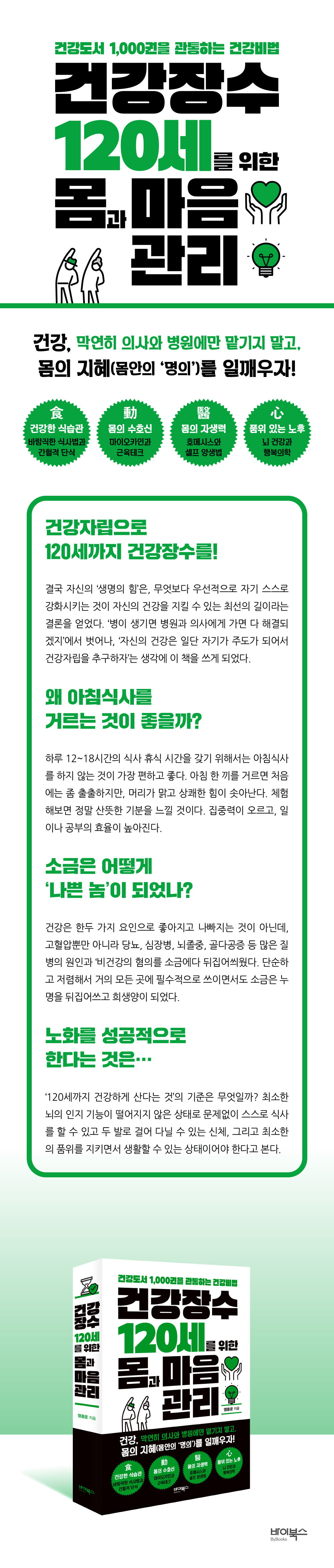
Live a long and healthy life until you are 120 years old through healthy independence!
“In the end, I came to the conclusion that strengthening one’s own ‘life force’ above all else is the best way to protect one’s health.
“I wrote this book with the idea that, rather than thinking, ‘If I get sick, I can just go to the hospital and see a doctor, and everything will be resolved,’ I should take charge of my own health and pursue self-reliance in health.”
There is a reason why author Yong-un Yeom, who has held important positions at leading domestic and international companies, is currently preparing for the completion and opening of a specialized healing hospital for chronic diseases such as cancer, diabetes, hypertension, hyperlipidemia, and autoimmune diseases.
After witnessing the absurd death of my parents due to incorrect hospital treatment and reading over 1,000 domestic and international health-related literature, I realized something and wrote “Body and Mind Management for a Healthy Longevity of 120” to inform people of ways to take care of their own health and become independent.
This book tells modern people who are more concerned about their health than anyone else but do not know how to maintain their health the secret to living a long and healthy life until the age of 120.
Most of the chronic diseases and lifestyle-related diseases that modern people suffer from are not easily cured with medication or surgery.
Let's not just leave our health to doctors and hospitals, but awaken the wisdom of our body, the 'medical doctor' within us!
Why is it a good idea to skip breakfast?
“To ensure you have 12 to 18 hours of mealtime rest per day, it is best and most convenient to skip breakfast.
If you skip breakfast, you may feel a little sluggish at first, but your head will clear and you will feel refreshed and energized.
If you try it, you will feel really refreshed.
“Concentration increases, and work and study efficiency increases.”
Intermittent fasting, which is popular these days, is not starvation.
It's a healthy eating habit that simply extends the time between meals, giving your body time to clean itself.
To ensure you have 12 to 18 hours of mealtime rest per day, it is best and most convenient to skip breakfast.
Also, in the morning, our body's nerves below the 9th thoracic vertebra are actively moving for excretion, but if we eat breakfast, they cannot function properly.
The fasting method that is 'actually sustainable' will be the one that suits you best.
It is difficult to fast continuously for a whole day or for several days.
However, simply skipping breakfast seems to be enough willpower for most people to not eat for a certain amount of time each day.
Dining should be enjoyable, and when it comes to food and environmental hazards, it's much easier to live by the principle of "eliminating the worst" rather than "doing the best."
How did salt become a 'bad guy'?
“Health is not something that gets better or worse with just one or two factors, but it is the cause of many diseases such as high blood pressure, diabetes, heart disease, stroke, and osteoporosis, and the accusation of ‘unhealthiness’ has been put to shame.
“Salt, despite being simple, cheap, and essential in almost every application, has been given a bad name and made a scapegoat.”
Our body regulates the balance of water and salt to maintain this pressure appropriately, and sets the optimal blood pressure for our body at any given time according to our needs.
If it's too salty, you'll drink water, and if there's too much salt, you'll get it out through urine, feces, or sweat.
The body is a self-regulating and self-balancing organism.
We need to move beyond the dichotomy of thinking that there are good and bad foods for the body.
The problem is quantity.
There is no such thing as absolutely good or bad food.
It's just a matter of whether you eat more or less, whether you need more or less.
There is no expert who can tell us what to eat and how much to eat. Each of us has our own standards and needs.
Aging successfully means…
"What defines 'living healthily to 120'? At the very least, I believe it should be a state where one can feed themselves without difficulty, walk on two feet, and maintain a minimum level of dignity, with no cognitive decline."
To reach a healthy age of 120, you must pass through several hurdles.
The first thing to pay attention to in middle age is ‘chronic diseases and lifestyle-related diseases.’
Once you pass this gate, another gate is 'fracture injury' in the elderly.
Another one is the gateway called 'dementia' that awaits us in old age.
There are various conditions for successful aging, but three representative ones can be mentioned.
First, you must be physically healthy.
Second, mental cognitive function must be well maintained without decline.
Third, it is important to participate in social activities based on smooth interpersonal relationships.
If you exercise regularly, improve your eating habits, and take care of your own health, you will be amazed by your body's amazing self-healing power and mysterious wisdom.
Through “Body and Mind Management for a Healthy Longevity of 120,” let us once again remember that the foundation of disease treatment lies not in complex and difficult surgeries, synthetic chemical drugs, or miracle drugs, but in the simple clarity of the three major elements of health management: food, lifestyle habits, and exercise.
“In the end, I came to the conclusion that strengthening one’s own ‘life force’ above all else is the best way to protect one’s health.
“I wrote this book with the idea that, rather than thinking, ‘If I get sick, I can just go to the hospital and see a doctor, and everything will be resolved,’ I should take charge of my own health and pursue self-reliance in health.”
There is a reason why author Yong-un Yeom, who has held important positions at leading domestic and international companies, is currently preparing for the completion and opening of a specialized healing hospital for chronic diseases such as cancer, diabetes, hypertension, hyperlipidemia, and autoimmune diseases.
After witnessing the absurd death of my parents due to incorrect hospital treatment and reading over 1,000 domestic and international health-related literature, I realized something and wrote “Body and Mind Management for a Healthy Longevity of 120” to inform people of ways to take care of their own health and become independent.
This book tells modern people who are more concerned about their health than anyone else but do not know how to maintain their health the secret to living a long and healthy life until the age of 120.
Most of the chronic diseases and lifestyle-related diseases that modern people suffer from are not easily cured with medication or surgery.
Let's not just leave our health to doctors and hospitals, but awaken the wisdom of our body, the 'medical doctor' within us!
Why is it a good idea to skip breakfast?
“To ensure you have 12 to 18 hours of mealtime rest per day, it is best and most convenient to skip breakfast.
If you skip breakfast, you may feel a little sluggish at first, but your head will clear and you will feel refreshed and energized.
If you try it, you will feel really refreshed.
“Concentration increases, and work and study efficiency increases.”
Intermittent fasting, which is popular these days, is not starvation.
It's a healthy eating habit that simply extends the time between meals, giving your body time to clean itself.
To ensure you have 12 to 18 hours of mealtime rest per day, it is best and most convenient to skip breakfast.
Also, in the morning, our body's nerves below the 9th thoracic vertebra are actively moving for excretion, but if we eat breakfast, they cannot function properly.
The fasting method that is 'actually sustainable' will be the one that suits you best.
It is difficult to fast continuously for a whole day or for several days.
However, simply skipping breakfast seems to be enough willpower for most people to not eat for a certain amount of time each day.
Dining should be enjoyable, and when it comes to food and environmental hazards, it's much easier to live by the principle of "eliminating the worst" rather than "doing the best."
How did salt become a 'bad guy'?
“Health is not something that gets better or worse with just one or two factors, but it is the cause of many diseases such as high blood pressure, diabetes, heart disease, stroke, and osteoporosis, and the accusation of ‘unhealthiness’ has been put to shame.
“Salt, despite being simple, cheap, and essential in almost every application, has been given a bad name and made a scapegoat.”
Our body regulates the balance of water and salt to maintain this pressure appropriately, and sets the optimal blood pressure for our body at any given time according to our needs.
If it's too salty, you'll drink water, and if there's too much salt, you'll get it out through urine, feces, or sweat.
The body is a self-regulating and self-balancing organism.
We need to move beyond the dichotomy of thinking that there are good and bad foods for the body.
The problem is quantity.
There is no such thing as absolutely good or bad food.
It's just a matter of whether you eat more or less, whether you need more or less.
There is no expert who can tell us what to eat and how much to eat. Each of us has our own standards and needs.
Aging successfully means…
"What defines 'living healthily to 120'? At the very least, I believe it should be a state where one can feed themselves without difficulty, walk on two feet, and maintain a minimum level of dignity, with no cognitive decline."
To reach a healthy age of 120, you must pass through several hurdles.
The first thing to pay attention to in middle age is ‘chronic diseases and lifestyle-related diseases.’
Once you pass this gate, another gate is 'fracture injury' in the elderly.
Another one is the gateway called 'dementia' that awaits us in old age.
There are various conditions for successful aging, but three representative ones can be mentioned.
First, you must be physically healthy.
Second, mental cognitive function must be well maintained without decline.
Third, it is important to participate in social activities based on smooth interpersonal relationships.
If you exercise regularly, improve your eating habits, and take care of your own health, you will be amazed by your body's amazing self-healing power and mysterious wisdom.
Through “Body and Mind Management for a Healthy Longevity of 120,” let us once again remember that the foundation of disease treatment lies not in complex and difficult surgeries, synthetic chemical drugs, or miracle drugs, but in the simple clarity of the three major elements of health management: food, lifestyle habits, and exercise.
GOODS SPECIFICS
- Date of issue: May 10, 2025
- Page count, weight, size: 464 pages | 690g | 152*225*27mm
- ISBN13: 9791158773908
- ISBN10: 1158773900
You may also like
카테고리
korean


korean

![GQ KOREA Mark (Monthly): December [2025]](http://librairie.coreenne.fr/cdn/shop/files/8ef265dbbfbf186523ed75ba7319009d.jpg?v=1765340328&width=3840)


