

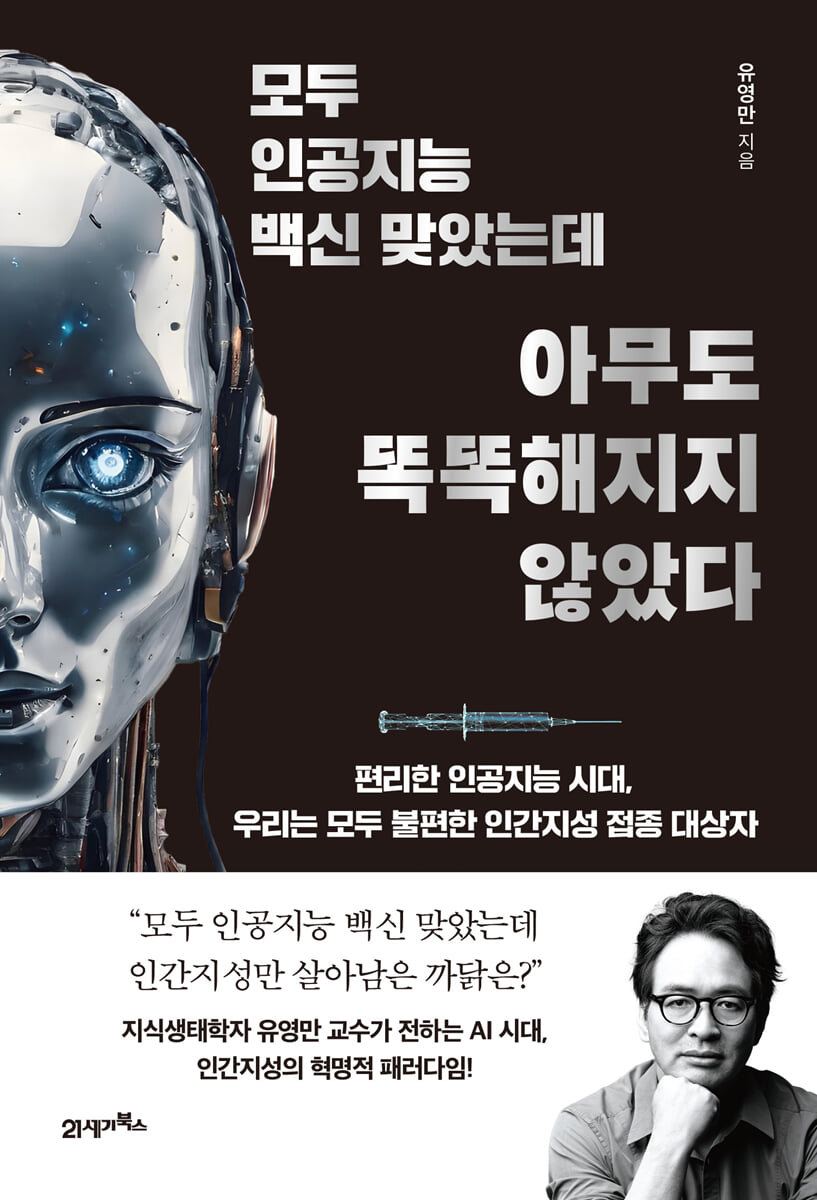
Everyone got the AI vaccine, but no one got smarter.
 |
Description
Book Introduction
The 'Life Lessons' series, a time to add wisdom to your life.
“Don’t chase the answers, ask questions.
That is the power that only humans possess.
All the essential knowledge you need for life is gathered together! The 31st book in the "Life Lectures" series, a fascinating knowledge experience presented by Korea's leading professors, has been published.
The Life Lectures series, which transcribes the lectures of the best professors in various fields from universities across the country, including history, philosophy, science, medicine, and art, into books, provides readers with useful knowledge to live today and insight to look forward to tomorrow.
It is a knowledge and culture brand that allows you to encounter the best knowledge content in everyday life through not only books but also online lectures, YouTube, and podcasts.
In "Everyone Got the AI Vaccine, But No One Got Smarter," Professor Yoo Young-man examines what unique human abilities and values will transcend the age of AI.
The more we admire the quick answers provided by convenient artificial intelligence, the more our human problem-solving awareness disappears, and we become dependent on artificial intelligence, living lives that are nothing more than copies of artificial intelligence.
Problem solvers who don't just seek answers but ask questions and raise issues can open new horizons for human intelligence beyond the age of artificial intelligence.
This book contains the secrets of 'inconvenient human intelligence' that goes beyond 'convenient artificial intelligence'.
“Don’t chase the answers, ask questions.
That is the power that only humans possess.
All the essential knowledge you need for life is gathered together! The 31st book in the "Life Lectures" series, a fascinating knowledge experience presented by Korea's leading professors, has been published.
The Life Lectures series, which transcribes the lectures of the best professors in various fields from universities across the country, including history, philosophy, science, medicine, and art, into books, provides readers with useful knowledge to live today and insight to look forward to tomorrow.
It is a knowledge and culture brand that allows you to encounter the best knowledge content in everyday life through not only books but also online lectures, YouTube, and podcasts.
In "Everyone Got the AI Vaccine, But No One Got Smarter," Professor Yoo Young-man examines what unique human abilities and values will transcend the age of AI.
The more we admire the quick answers provided by convenient artificial intelligence, the more our human problem-solving awareness disappears, and we become dependent on artificial intelligence, living lives that are nothing more than copies of artificial intelligence.
Problem solvers who don't just seek answers but ask questions and raise issues can open new horizons for human intelligence beyond the age of artificial intelligence.
This book contains the secrets of 'inconvenient human intelligence' that goes beyond 'convenient artificial intelligence'.
- You can preview some of the book's contents.
Preview
index
Prologue: Why do we hesitate in the face of unhesitating artificial intelligence?
Part 1: Convenient AI Leads to Inconvenient, Biased Truths
01 Why can't artificial intelligence surpass human intelligence?
02 Human learning from the edge to the realm of excellence, encountering pride.
03. Thinking human intelligence beats unthinking artificial intelligence.
04 Human intelligence does not 'generate' but 'becomes'.
Part 2: Unconventional questions open unexpected doors.
01 Four types of human intelligence that surpass artificial intelligence
02 When you love, questions pour in and a revolution begins.
03 An unprecedented question opens an unfamiliar gateway.
04 While you are asking questions, it is while
05 Questions are a catalyst for rethinking the nature of work.
Part 3: Empathy and imagination are essential for success.
01 True thought is the courage to put both hands on your heart and reflect.
02 A sense of the world comes before a worldview.
03 Imagination is more important than knowledge.
04 Innovation begins when we love the pain of others.
Part 4: Lead with wisdom, not knowledge.
01 Wisdom sprouts when you ask questions.
02 Failure Experiences Create Method Development Experts
03 The Trap of Success Experiences: Hubris
04 Before you know it with your head, you feel it with your heart!
05 Practical wisdom is born from dilemmas.
If you flip the 5th part of 'grades', it becomes 'aptitude'.
01 (4) Cycle of meditation: observation, reflection, insight, reflection
02 What is the difference between occupations ending in "won" and "ga"?
03 If you change your color, you will be different.
04 Overcoming adversity revives your career.
05 Don't be better than others, do better than before.
06 What is the only secret to parents becoming parents?
07 All creation is a creative plagiarism of previous works.
Epilogue Certainty corrupts.
The question is preservatives
Part 1: Convenient AI Leads to Inconvenient, Biased Truths
01 Why can't artificial intelligence surpass human intelligence?
02 Human learning from the edge to the realm of excellence, encountering pride.
03. Thinking human intelligence beats unthinking artificial intelligence.
04 Human intelligence does not 'generate' but 'becomes'.
Part 2: Unconventional questions open unexpected doors.
01 Four types of human intelligence that surpass artificial intelligence
02 When you love, questions pour in and a revolution begins.
03 An unprecedented question opens an unfamiliar gateway.
04 While you are asking questions, it is while
05 Questions are a catalyst for rethinking the nature of work.
Part 3: Empathy and imagination are essential for success.
01 True thought is the courage to put both hands on your heart and reflect.
02 A sense of the world comes before a worldview.
03 Imagination is more important than knowledge.
04 Innovation begins when we love the pain of others.
Part 4: Lead with wisdom, not knowledge.
01 Wisdom sprouts when you ask questions.
02 Failure Experiences Create Method Development Experts
03 The Trap of Success Experiences: Hubris
04 Before you know it with your head, you feel it with your heart!
05 Practical wisdom is born from dilemmas.
If you flip the 5th part of 'grades', it becomes 'aptitude'.
01 (4) Cycle of meditation: observation, reflection, insight, reflection
02 What is the difference between occupations ending in "won" and "ga"?
03 If you change your color, you will be different.
04 Overcoming adversity revives your career.
05 Don't be better than others, do better than before.
06 What is the only secret to parents becoming parents?
07 All creation is a creative plagiarism of previous works.
Epilogue Certainty corrupts.
The question is preservatives
Detailed image
.jpg)
Into the book
A person who finds answers through artificial intelligence or an artificial intelligence that finds the answers a person wants or is impatient and restless
I feel anxious just the same.
People and information skip from here to there or just skim through the path, fidgeting as if possessed or frantically chased by something.
Since there is no time to hesitate, there is no time to think about its meaning, and there is no time to leisurely leave traces of thoughts.
Information becomes meaningful only when we find meaning in it, and information becomes more meaningful only when it has meaning.
The heavier the gravity of that meaning, the deeper we can dig into it, soaring above the horizontally floating pile of information, seeking vertical depth.
--- pp.10-11
As artificial intelligence technology advances day by day, it is acting as a threat to human creativity.
There are even cautious predictions that there will come a day when artificial intelligence will produce works more creative than humans.
In fact, many people believe that artificial intelligence's creative abilities have already surpassed those of humans.
The possibility that artificial intelligence will surpass human intelligence has been proven through various examples.
However, no case has yet been discovered that surpasses human intelligence.
Because artificial intelligence is possible, but artificial intelligence is not.
To understand this point, we must understand the difference between intelligence and intellect.
--- p.31
Artificial intelligence cannot understand context.
One of the unique abilities that humans possess is contextual thinking.
Even while speaking to the audience or the other person, keep an eye on them to determine whether what you are saying is resonating.
When you throw a joke, figure out whether the other person is taking it as a joke or seriously, and if you feel that they are taking the joke seriously, contrary to your expectations, then immediately stop the joke.
Because it could easily lead to fatal problems.
Contextual reasoning is a core communication skill.
This is because communication is a process of observing how the other person perceives the sender's intention and meaning and changing the meaning or type of the message I want to convey based on that reaction.
Contextual reasoning is, in a word, the ability to make comprehensive judgments about a situation.
The other person interpreted the meaning of what he said differently than intended.
If you interpret it, you can quickly determine the reason and then change your strategy, such as changing the meaning from the original intention or explaining it with a more specific example.
That kind of adaptability is contextual thinking.
Artificial intelligence lacks the ability to judge unexpected situations and respond to situations that change in an instant.
It could be said that he is immature in handling unscripted scenarios.
--- pp.35-36
Questions are the driving force behind a revolution in thinking and the triggers of association that connect unrelated things by fostering accidental encounters.
Questions are a stimulus that negates the obvious and a starting point for reflection that makes us re-examine the direction of our lives.
Questions are a wake-up call that makes us realize what we don't know.
Simply asking a question can provide a revolutionary impetus that makes us fundamentally reconsider not only our way of thinking but also our way of living.
--- p.122
Aristotle's practical wisdom is the ability to judge morally by considering how to act most correctly in a given situation in light of the true purpose of the matter, rather than judging all matters according to precedent or custom just because there is precedent or custom.
In a word, practical wisdom is the ability to make correct judgments about a situation in light of the true purpose of the work.
Artificial intelligence does not have this kind of practical wisdom.
Artificial intelligence can quickly unravel complex tangled threads in situations where the right answer is determined by black-and-white logic.
However, in gray areas and dilemma situations, it is easy to make judgments about ambiguous and uncertain issues where there is no set answer.
Can't get off.
--- p.188
The gap between artificial intelligence and humans is gradually narrowing.
Artificial intelligence also produces countless questions through algorithms.
But there is no artificial intelligence to question.
A self-reflection question is a question that allows you to evaluate and judge whether the question you asked is appropriate for the situation.
Artificial intelligence cannot be questioned.
It only produces probabilistically according to algorithms and patterns.
Questioning, that is, questioning to judge the qualitative properties, validity, and appropriateness of one's own questions, is a uniquely human ability.
I feel anxious just the same.
People and information skip from here to there or just skim through the path, fidgeting as if possessed or frantically chased by something.
Since there is no time to hesitate, there is no time to think about its meaning, and there is no time to leisurely leave traces of thoughts.
Information becomes meaningful only when we find meaning in it, and information becomes more meaningful only when it has meaning.
The heavier the gravity of that meaning, the deeper we can dig into it, soaring above the horizontally floating pile of information, seeking vertical depth.
--- pp.10-11
As artificial intelligence technology advances day by day, it is acting as a threat to human creativity.
There are even cautious predictions that there will come a day when artificial intelligence will produce works more creative than humans.
In fact, many people believe that artificial intelligence's creative abilities have already surpassed those of humans.
The possibility that artificial intelligence will surpass human intelligence has been proven through various examples.
However, no case has yet been discovered that surpasses human intelligence.
Because artificial intelligence is possible, but artificial intelligence is not.
To understand this point, we must understand the difference between intelligence and intellect.
--- p.31
Artificial intelligence cannot understand context.
One of the unique abilities that humans possess is contextual thinking.
Even while speaking to the audience or the other person, keep an eye on them to determine whether what you are saying is resonating.
When you throw a joke, figure out whether the other person is taking it as a joke or seriously, and if you feel that they are taking the joke seriously, contrary to your expectations, then immediately stop the joke.
Because it could easily lead to fatal problems.
Contextual reasoning is a core communication skill.
This is because communication is a process of observing how the other person perceives the sender's intention and meaning and changing the meaning or type of the message I want to convey based on that reaction.
Contextual reasoning is, in a word, the ability to make comprehensive judgments about a situation.
The other person interpreted the meaning of what he said differently than intended.
If you interpret it, you can quickly determine the reason and then change your strategy, such as changing the meaning from the original intention or explaining it with a more specific example.
That kind of adaptability is contextual thinking.
Artificial intelligence lacks the ability to judge unexpected situations and respond to situations that change in an instant.
It could be said that he is immature in handling unscripted scenarios.
--- pp.35-36
Questions are the driving force behind a revolution in thinking and the triggers of association that connect unrelated things by fostering accidental encounters.
Questions are a stimulus that negates the obvious and a starting point for reflection that makes us re-examine the direction of our lives.
Questions are a wake-up call that makes us realize what we don't know.
Simply asking a question can provide a revolutionary impetus that makes us fundamentally reconsider not only our way of thinking but also our way of living.
--- p.122
Aristotle's practical wisdom is the ability to judge morally by considering how to act most correctly in a given situation in light of the true purpose of the matter, rather than judging all matters according to precedent or custom just because there is precedent or custom.
In a word, practical wisdom is the ability to make correct judgments about a situation in light of the true purpose of the work.
Artificial intelligence does not have this kind of practical wisdom.
Artificial intelligence can quickly unravel complex tangled threads in situations where the right answer is determined by black-and-white logic.
However, in gray areas and dilemma situations, it is easy to make judgments about ambiguous and uncertain issues where there is no set answer.
Can't get off.
--- p.188
The gap between artificial intelligence and humans is gradually narrowing.
Artificial intelligence also produces countless questions through algorithms.
But there is no artificial intelligence to question.
A self-reflection question is a question that allows you to evaluate and judge whether the question you asked is appropriate for the situation.
Artificial intelligence cannot be questioned.
It only produces probabilistically according to algorithms and patterns.
Questioning, that is, questioning to judge the qualitative properties, validity, and appropriateness of one's own questions, is a uniquely human ability.
--- p.209
Publisher's Review
"Will we become accustomed to convenience, or will we remain thinking humans?"
Beyond convenient artificial intelligence to inconvenient human intelligence
The development of artificial intelligence (AI) is revolutionizing our lives.
However, Professor Yoo Young-man warns that we are becoming increasingly passive beings amid the benefits brought by 'convenient' artificial intelligence.
We are losing our ability to reason as we simply accept the answers provided by AI, and we are ultimately at risk of becoming mere copies of ourselves.
He argues that to overcome this, we must cultivate an 'uncomfortable' human intelligence.
In other words, the goal we should truly pursue is not a quick and efficient answer, but the wisdom we gain through realization, experience, and suffering.
This process is like climbing Mount Everest.
Reaching the summit by helicopter is a completely different experience than struggling to climb on your own.
The latter brings true growth and enlightenment.
Likewise, humans must explore, challenge, and generate new perspectives on their own, rather than relying on easy and quick solutions provided by AI.
“Admiration comes from the head, but emotion comes from the heart.”
Discovering the Depth of Thought: What AI Can't Replace
His message, "Create emotion, not admiration," resonates deeply. While AI-generated sentences are logical and sophisticated, they lack the original story, imbued with human experience and emotion.
We need to unleash the unique creativity of humans that AI cannot replace.
This requires the effort to endure discomfort and deepen one's thinking.
The author says that if you take the convenient path, you will be left with narrow-minded thinking, and if you take the uncomfortable path, you will be left with abundant wisdom.
The author also emphasizes that we must live a life of constant questioning, contemplation, and physical encounters so as not to lose our human intelligence even amidst the convenience brought about by artificial intelligence.
This book suggests a path for us, living in the AI era, to remain not mere consumers of technology, but active individuals with creative thinking. What choices should we make in the advent of the AI era? To answer the question this book poses, we must once again cultivate the power of thought.
Beyond convenient artificial intelligence to inconvenient human intelligence
The development of artificial intelligence (AI) is revolutionizing our lives.
However, Professor Yoo Young-man warns that we are becoming increasingly passive beings amid the benefits brought by 'convenient' artificial intelligence.
We are losing our ability to reason as we simply accept the answers provided by AI, and we are ultimately at risk of becoming mere copies of ourselves.
He argues that to overcome this, we must cultivate an 'uncomfortable' human intelligence.
In other words, the goal we should truly pursue is not a quick and efficient answer, but the wisdom we gain through realization, experience, and suffering.
This process is like climbing Mount Everest.
Reaching the summit by helicopter is a completely different experience than struggling to climb on your own.
The latter brings true growth and enlightenment.
Likewise, humans must explore, challenge, and generate new perspectives on their own, rather than relying on easy and quick solutions provided by AI.
“Admiration comes from the head, but emotion comes from the heart.”
Discovering the Depth of Thought: What AI Can't Replace
His message, "Create emotion, not admiration," resonates deeply. While AI-generated sentences are logical and sophisticated, they lack the original story, imbued with human experience and emotion.
We need to unleash the unique creativity of humans that AI cannot replace.
This requires the effort to endure discomfort and deepen one's thinking.
The author says that if you take the convenient path, you will be left with narrow-minded thinking, and if you take the uncomfortable path, you will be left with abundant wisdom.
The author also emphasizes that we must live a life of constant questioning, contemplation, and physical encounters so as not to lose our human intelligence even amidst the convenience brought about by artificial intelligence.
This book suggests a path for us, living in the AI era, to remain not mere consumers of technology, but active individuals with creative thinking. What choices should we make in the advent of the AI era? To answer the question this book poses, we must once again cultivate the power of thought.
GOODS SPECIFICS
- Date of issue: March 28, 2025
- Page count, weight, size: 256 pages | 128*188*20mm
- ISBN13: 9791173571695
- ISBN10: 1173571698
You may also like
카테고리
korean


korean

![GQ KOREA Mark (Monthly): December [2025]](http://librairie.coreenne.fr/cdn/shop/files/8ef265dbbfbf186523ed75ba7319009d.jpg?v=1765340328&width=3840)


