

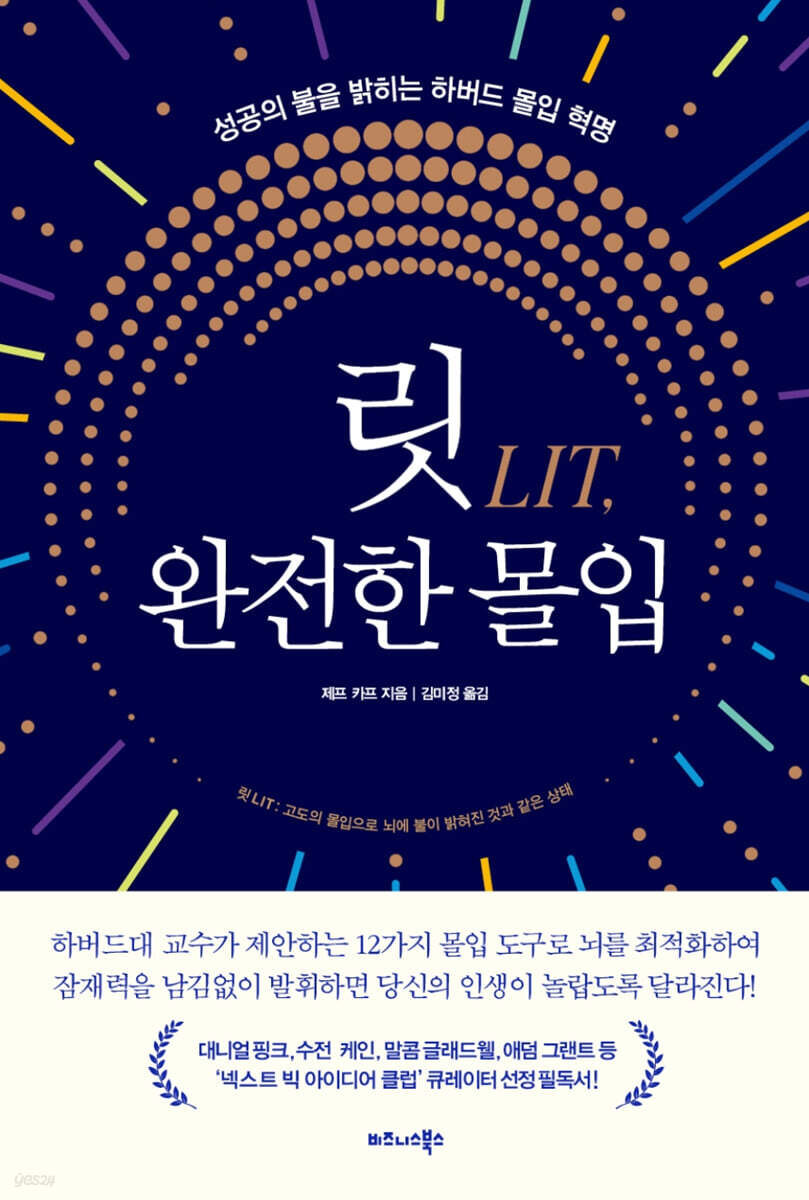
LIT, complete immersion
 |
Description
Book Introduction
Daniel Pink, Susan Cain, Malcolm Gladwell, Adam Grant, etc.
A must-read book selected by the curators of the 'Next Big Idea Club'!
12 Immersion Tools to Increase Brain Efficiency by 200%
The Harvard Brain Remodeling Project that will transform your distracted self!
In an age of constant distraction, the author, a professor at Harvard Medical School and a professor of biomedical engineering at MIT, shares his secrets for achieving optimal immersion even in extremely distracting environments! The author, who struggled academically as a child, almost to the point of expulsion, discovered the secret to immersion through years of persistent effort.
He developed 12 easy-to-implement, foolproof immersion tools that activate the brain the way you want, and he named them LIT (Life Ignition Tools).
'Rit' refers to a state of high immersion, as if a light is turned on in the brain.
When in a lit state, neurons are activated and the brain lights up as if it were on fire when viewed on an fMRI.
At this time, we not only develop the mental muscles that allow us to focus and focus at our peak, but also connect with our deepest intuition and become more sensitive to and able to utilize all the possibilities around us.
Furthermore, we can continue the flow of energy that allows us to continuously learn, grow, and create.
The author personally interviewed world-renowned figures such as Nobel Prize winners, memory champions, and Olympic medalists, and incorporated their secrets to success into 12 Lit immersion tools.
By embodying the spirit of LEET by following successful examples in various fields, you will soon find yourself focusing on important goals and unleashing greater potential.
If you want to cut through the noise of the world and focus on what matters most, if you want to be a successful and disruptive innovator in every field, make Lit your tool for success.
A must-read book selected by the curators of the 'Next Big Idea Club'!
12 Immersion Tools to Increase Brain Efficiency by 200%
The Harvard Brain Remodeling Project that will transform your distracted self!
In an age of constant distraction, the author, a professor at Harvard Medical School and a professor of biomedical engineering at MIT, shares his secrets for achieving optimal immersion even in extremely distracting environments! The author, who struggled academically as a child, almost to the point of expulsion, discovered the secret to immersion through years of persistent effort.
He developed 12 easy-to-implement, foolproof immersion tools that activate the brain the way you want, and he named them LIT (Life Ignition Tools).
'Rit' refers to a state of high immersion, as if a light is turned on in the brain.
When in a lit state, neurons are activated and the brain lights up as if it were on fire when viewed on an fMRI.
At this time, we not only develop the mental muscles that allow us to focus and focus at our peak, but also connect with our deepest intuition and become more sensitive to and able to utilize all the possibilities around us.
Furthermore, we can continue the flow of energy that allows us to continuously learn, grow, and create.
The author personally interviewed world-renowned figures such as Nobel Prize winners, memory champions, and Olympic medalists, and incorporated their secrets to success into 12 Lit immersion tools.
By embodying the spirit of LEET by following successful examples in various fields, you will soon find yourself focusing on important goals and unleashing greater potential.
If you want to cut through the noise of the world and focus on what matters most, if you want to be a successful and disruptive innovator in every field, make Lit your tool for success.
- You can preview some of the book's contents.
Preview
index
Introduction: The Power of Lit to Unleash Your Evolutionary Potential
Let's get the ball rolling!: Lowering Activation Energy
1.
Switching: What's holding me back?
Embrace the Boundary or Build Bridges? | Adam Rippon: Dreams as Inspiration | How Am I Thinking? | James Doty: Compassion Transforming the Roots of Resistance | Susan Hockfield: Responding to the Call to Service | The Importance of Conscious Rhythm | A Life That Sparks Energy from the Heart
Practice Guidelines_Time to Use Your Imagination
2.
Finding Meaning in Questions: Turning Caution into Curiosity and Deeper Inquiry
Now is the time to question my thought process | An inward-turning exploration | The curiosity that fuels exploration and discovery | A bridge from question to action | Bigger questions for a bigger life | Stopping the autopilot of tendencies and boundaries
Practice Guidelines: Cultivating a Questioning Mind
3.
Finding the Clue in a Troublesome Problem: How to Figure Out What I Want
Challenges that Drive Action | Start Anywhere: Purpose Creates Passion, and Passion Fosters Purpose and Joy | Know Yourself | Kick Off the Shoes That Don't Fit | The Common Need for Action
Practice Guidelines: Finding Action in Frustration
4.
Becoming an Active Opportunist: How to Uncover Ideas, Insights, and Inspiration from Everywhere
Philip Sharp: Talking to People Who Know Different Things | Reaching Outward for Your Brain | The Chemist and His Comics | Linda Stone: Increasing Your Potential for Luck | Stephen Wilkes: Inspiration from Time Travel | The Secret to Boosting Your Superpowers | Contagious Altruism: Lit for the Public Good
Practical Guidelines: Be an active opportunist who seeks, exchanges, and synthesizes ideas.
5.
Stimulating My Brain: Attention Is My Superpower
So many distractions, one more to add? | White noise or a playlist? | Pushing the boundaries of perception | Nudges that guide me | Resist the pull, push forward | Pilates, podcasts, and new exercises | The punch of motivation | Partnerships and parenting: A powerful stimulus
Practice Guidelines: Stimulating Your Brain in Everyday Life
6.
Fascination with Movement: A Key to Evolutionary Success
Nature prepares us for good | The first obstacle, inertia: Overcoming it with small actions | Finding the method that works for me: Tips for experimenting | The fact that humans are also a force of nature | Endurance is its own reward | Choosing a conscious rhythm
Action Guidelines_Move More!
7.
Falling in Love with Practice: The Joy of a 'Healthy' Brain
Nelson Dellis: Clarity in a Crisis | Chris Hadfield: Practicing for the Unpredictable | Joan Dick: Practice for a Stronger Brain | Breaking It Down: Practice More Frequently and Shorter | The Joy of Patience
Practice Guidelines: Celebrate all your goals and accomplishments as they come.
8.
Doing It Newly and Differently: How to Inspire Surprise and Serendipity
Going against the cognitive element | Changing perspectives with 'making it strange' | Making the most of chance encounters
Action Guidelines: Stepping Out of Your Comfort Zone and Into Your Lit Zone
9.
Focusing Beyond Failure: The Courage to Gather Energy and Take New Actions
Robert Langer: Don't Be Drowning in Failure | Failure Bias: The Obstacles to Proper Failure Management | Successfully Proving That Something Doesn't Work | Aim for Constructive Failure | There's No Place to Hide | Praise Yourself for the Long Road You've Come
Practice Guidelines: Turning Failure into Creativity
10.
Demonstrating Humanity: The Virtue of Humility
May-Britt Moser: Win-Win Situations | Dave Kuchen, the Elder: Science Meets Spirituality | The Lean Twist: Transforming Assumptions and Possibilities | The Awe and Humility of Lit | Robert Langer: My Father's Legacy as a Touchstone | Bringing It Home
Practice Guidelines: Practicing Humility for Authentic Communication
11.
Hitting the 'Pause' Button: Why You Should Take Time to Stay and Observe
Borrowing the Wisdom of Winter | A Fascinating Experiment on Temporariness | Burnout: The New Normal? | When Your Mind Wants to Wander, Open the Door Wide! | Secrets of the Sleeping Brain | Meditation Experiment | Silence vs.
Stimulation | An unexpected, powerful pause | Something that makes me happy
Practice Guidelines_Practice pressing the 'Stop' button
12.
Embracing Nature: How to Rejuvenate Your Roots
Something New Always Exists | Dave Kutzen: One Vision, One Quest | David Suzuki: Finding Your Place in the Web of Life | Pandora Thomas: Permaculture: Legacy and Blueprint | Inspiration from Nature vs.
Exploiting Nature: How Do I Relate to It? | Nature's Secrets Hidden in Plain Sight | Clear Solutions to Difficult Problems
Practice Guide_Become a Problem Solver
13.
Lighting the World: Creating a Bold and Loving Culture
Reginald Shuford: Start Close, Don't Do It Alone | The Power of One to Flip the Switch | Reclaiming and Revitalizing Community | Unprecedented Times, Technology, and Opportunity | James Doty: Compassion, the Human Common Denominator | Harnessing Spiritual Resources | Bishop Marianne Bird: A Reflective and Examining Life | Dinner Table Wisdom for a Lit World | Illuminating the World: Stay Close, and Your Passion Will Find Purpose
Practice Guide_Rekindling the Spark: Questions About the RIT Tool
Conclusion: The answer lies in the question.
Let's get the ball rolling!: Lowering Activation Energy
1.
Switching: What's holding me back?
Embrace the Boundary or Build Bridges? | Adam Rippon: Dreams as Inspiration | How Am I Thinking? | James Doty: Compassion Transforming the Roots of Resistance | Susan Hockfield: Responding to the Call to Service | The Importance of Conscious Rhythm | A Life That Sparks Energy from the Heart
Practice Guidelines_Time to Use Your Imagination
2.
Finding Meaning in Questions: Turning Caution into Curiosity and Deeper Inquiry
Now is the time to question my thought process | An inward-turning exploration | The curiosity that fuels exploration and discovery | A bridge from question to action | Bigger questions for a bigger life | Stopping the autopilot of tendencies and boundaries
Practice Guidelines: Cultivating a Questioning Mind
3.
Finding the Clue in a Troublesome Problem: How to Figure Out What I Want
Challenges that Drive Action | Start Anywhere: Purpose Creates Passion, and Passion Fosters Purpose and Joy | Know Yourself | Kick Off the Shoes That Don't Fit | The Common Need for Action
Practice Guidelines: Finding Action in Frustration
4.
Becoming an Active Opportunist: How to Uncover Ideas, Insights, and Inspiration from Everywhere
Philip Sharp: Talking to People Who Know Different Things | Reaching Outward for Your Brain | The Chemist and His Comics | Linda Stone: Increasing Your Potential for Luck | Stephen Wilkes: Inspiration from Time Travel | The Secret to Boosting Your Superpowers | Contagious Altruism: Lit for the Public Good
Practical Guidelines: Be an active opportunist who seeks, exchanges, and synthesizes ideas.
5.
Stimulating My Brain: Attention Is My Superpower
So many distractions, one more to add? | White noise or a playlist? | Pushing the boundaries of perception | Nudges that guide me | Resist the pull, push forward | Pilates, podcasts, and new exercises | The punch of motivation | Partnerships and parenting: A powerful stimulus
Practice Guidelines: Stimulating Your Brain in Everyday Life
6.
Fascination with Movement: A Key to Evolutionary Success
Nature prepares us for good | The first obstacle, inertia: Overcoming it with small actions | Finding the method that works for me: Tips for experimenting | The fact that humans are also a force of nature | Endurance is its own reward | Choosing a conscious rhythm
Action Guidelines_Move More!
7.
Falling in Love with Practice: The Joy of a 'Healthy' Brain
Nelson Dellis: Clarity in a Crisis | Chris Hadfield: Practicing for the Unpredictable | Joan Dick: Practice for a Stronger Brain | Breaking It Down: Practice More Frequently and Shorter | The Joy of Patience
Practice Guidelines: Celebrate all your goals and accomplishments as they come.
8.
Doing It Newly and Differently: How to Inspire Surprise and Serendipity
Going against the cognitive element | Changing perspectives with 'making it strange' | Making the most of chance encounters
Action Guidelines: Stepping Out of Your Comfort Zone and Into Your Lit Zone
9.
Focusing Beyond Failure: The Courage to Gather Energy and Take New Actions
Robert Langer: Don't Be Drowning in Failure | Failure Bias: The Obstacles to Proper Failure Management | Successfully Proving That Something Doesn't Work | Aim for Constructive Failure | There's No Place to Hide | Praise Yourself for the Long Road You've Come
Practice Guidelines: Turning Failure into Creativity
10.
Demonstrating Humanity: The Virtue of Humility
May-Britt Moser: Win-Win Situations | Dave Kuchen, the Elder: Science Meets Spirituality | The Lean Twist: Transforming Assumptions and Possibilities | The Awe and Humility of Lit | Robert Langer: My Father's Legacy as a Touchstone | Bringing It Home
Practice Guidelines: Practicing Humility for Authentic Communication
11.
Hitting the 'Pause' Button: Why You Should Take Time to Stay and Observe
Borrowing the Wisdom of Winter | A Fascinating Experiment on Temporariness | Burnout: The New Normal? | When Your Mind Wants to Wander, Open the Door Wide! | Secrets of the Sleeping Brain | Meditation Experiment | Silence vs.
Stimulation | An unexpected, powerful pause | Something that makes me happy
Practice Guidelines_Practice pressing the 'Stop' button
12.
Embracing Nature: How to Rejuvenate Your Roots
Something New Always Exists | Dave Kutzen: One Vision, One Quest | David Suzuki: Finding Your Place in the Web of Life | Pandora Thomas: Permaculture: Legacy and Blueprint | Inspiration from Nature vs.
Exploiting Nature: How Do I Relate to It? | Nature's Secrets Hidden in Plain Sight | Clear Solutions to Difficult Problems
Practice Guide_Become a Problem Solver
13.
Lighting the World: Creating a Bold and Loving Culture
Reginald Shuford: Start Close, Don't Do It Alone | The Power of One to Flip the Switch | Reclaiming and Revitalizing Community | Unprecedented Times, Technology, and Opportunity | James Doty: Compassion, the Human Common Denominator | Harnessing Spiritual Resources | Bishop Marianne Bird: A Reflective and Examining Life | Dinner Table Wisdom for a Lit World | Illuminating the World: Stay Close, and Your Passion Will Find Purpose
Practice Guide_Rekindling the Spark: Questions About the RIT Tool
Conclusion: The answer lies in the question.
Detailed image

Into the book
'Lit' provides a good description of what it looks like for scientists who study immersive states.
When you become immersed in something, neurons in your brain (and gut) become activated.
This increases blood flow in the brain, which neuroscientists can detect using functional magnetic resonance imaging (fMRI).
When viewed on a monitor, this oxygenated blood brightens yellow-orange areas of the brain that would otherwise appear gray.
Emerging science shows that neural activation is linked not only to specific cognitive activities or emotions like fear or anger, but also to feelings of love, wonder, happiness, pleasure, and "peak states" or flow.
--- From the "Preface"
The instructors I met in after-school classes asked me a series of questions and asked me about my reasoning process.
“So, what did you think about that?” This intriguing and simple question made me go inward and look into my own thought process.
After being taught to examine my thought processes at an early age, I developed a knack for recognizing myself and my subjects when my thoughts became sloppy or clogged from overthinking.
As I practiced, when I felt overwhelmed and frustrated, I was able to use this mental switch to curiously examine why I was feeling overwhelmed and stuck, to examine my thoughts, and then figure out how to cope and move forward.
--- From "Chapter 1 Switch Change"
When we feel curious, our brain's pleasure, reward, and memory centers all light up, and as a result, our brains pursue deeper learning, discovery, and social connection.
Whether the quest is driven by interest or deprivation, neural circuits respond to the information and perceive it as an intrinsic reward.
Even when the information itself has no practical value or is predicted to disappoint or lead to negative outcomes, the "lure of curiosity" continues to drive us to explore more! This is why scrolling online is so addictive, and why misinformation is so persistent and difficult to ignore.
--- From "Chapter 2: Finding Meaning in Questions"
A recent study of over 50,000 people on social interaction and happiness found that people who interacted with a wide range of people were happier than those with narrow social circles.
The researchers made their announcement based on public data from government and public health agencies and previous studies.
“More than the total amount of social interaction and activities people engage in, the diversity of relationships represented in their social portfolios is a unique predictor of both interpersonal well-being and individual well-being over time.” The more conversations people had across relationship categories, the greater their satisfaction, and this finding held true across large samples from multiple countries.
--- From Chapter 4: Becoming an Active Opportunist
Beyond the metabolic markers of exercise and fitness, movement is intertwined with our social and emotional development and lifelong health and well-being.
Have you ever been moved by something? If so, you've felt the emotional energy that shifts your state of mind in one direction or another.
Let's consider how meditation can transform chaotic energy into calm, and actually affect the brain waves that correspond to each of these states.
--- From Chapter 6, “Fascinated by Movement”
Practice not only helps you learn or master a skill, it also has a revitalizing effect.
When repetition and challenge promote neuroplasticity, new and deeper neural pathways develop in the brain.
These pathways weave together and energize a network of connections that influence our mood, cognition, memory, motivation, and attention.
--- From "Chapter 7: Falling in Love with Practice"
The brain responds to stimuli by creating new neural pathways that not only foster abilities associated with motor and skill mastery, but also foster creativity.
A 2022 study examined visual artists and scientists who demonstrated unusual creativity (also known as Big-C) and a "smart control group."
Researchers have found that creativity, linked to Big-C in the brain, is more associated with "random" systems than with systems that operate "efficiently" across the entire network.
“Although more random connections are less efficient most of the time, this system encourages brain activity to ‘take the road less traveled’ and make novel connections.”
When you become immersed in something, neurons in your brain (and gut) become activated.
This increases blood flow in the brain, which neuroscientists can detect using functional magnetic resonance imaging (fMRI).
When viewed on a monitor, this oxygenated blood brightens yellow-orange areas of the brain that would otherwise appear gray.
Emerging science shows that neural activation is linked not only to specific cognitive activities or emotions like fear or anger, but also to feelings of love, wonder, happiness, pleasure, and "peak states" or flow.
--- From the "Preface"
The instructors I met in after-school classes asked me a series of questions and asked me about my reasoning process.
“So, what did you think about that?” This intriguing and simple question made me go inward and look into my own thought process.
After being taught to examine my thought processes at an early age, I developed a knack for recognizing myself and my subjects when my thoughts became sloppy or clogged from overthinking.
As I practiced, when I felt overwhelmed and frustrated, I was able to use this mental switch to curiously examine why I was feeling overwhelmed and stuck, to examine my thoughts, and then figure out how to cope and move forward.
--- From "Chapter 1 Switch Change"
When we feel curious, our brain's pleasure, reward, and memory centers all light up, and as a result, our brains pursue deeper learning, discovery, and social connection.
Whether the quest is driven by interest or deprivation, neural circuits respond to the information and perceive it as an intrinsic reward.
Even when the information itself has no practical value or is predicted to disappoint or lead to negative outcomes, the "lure of curiosity" continues to drive us to explore more! This is why scrolling online is so addictive, and why misinformation is so persistent and difficult to ignore.
--- From "Chapter 2: Finding Meaning in Questions"
A recent study of over 50,000 people on social interaction and happiness found that people who interacted with a wide range of people were happier than those with narrow social circles.
The researchers made their announcement based on public data from government and public health agencies and previous studies.
“More than the total amount of social interaction and activities people engage in, the diversity of relationships represented in their social portfolios is a unique predictor of both interpersonal well-being and individual well-being over time.” The more conversations people had across relationship categories, the greater their satisfaction, and this finding held true across large samples from multiple countries.
--- From Chapter 4: Becoming an Active Opportunist
Beyond the metabolic markers of exercise and fitness, movement is intertwined with our social and emotional development and lifelong health and well-being.
Have you ever been moved by something? If so, you've felt the emotional energy that shifts your state of mind in one direction or another.
Let's consider how meditation can transform chaotic energy into calm, and actually affect the brain waves that correspond to each of these states.
--- From Chapter 6, “Fascinated by Movement”
Practice not only helps you learn or master a skill, it also has a revitalizing effect.
When repetition and challenge promote neuroplasticity, new and deeper neural pathways develop in the brain.
These pathways weave together and energize a network of connections that influence our mood, cognition, memory, motivation, and attention.
--- From "Chapter 7: Falling in Love with Practice"
The brain responds to stimuli by creating new neural pathways that not only foster abilities associated with motor and skill mastery, but also foster creativity.
A 2022 study examined visual artists and scientists who demonstrated unusual creativity (also known as Big-C) and a "smart control group."
Researchers have found that creativity, linked to Big-C in the brain, is more associated with "random" systems than with systems that operate "efficiently" across the entire network.
“Although more random connections are less efficient most of the time, this system encourages brain activity to ‘take the road less traveled’ and make novel connections.”
--- From Chapter 8, “Doing It Newly and Differently”
Publisher's Review
A student who has difficulty learning and has given up in the classroom
Created by a Harvard professor who holds over 100 patents
The miracle immersion tool, LIT!
"A book that will boost your brain energy and unleash your explosive potential!" - The Next Big Idea Club
In an age where distractions and distractions have become a daily occurrence, immersion, which boosts brain power through strong focus, has become a crucial skill.
There are many ways to meditate and focus in a quiet environment, but how can we protect ourselves from temptations and distractions and achieve deep immersion in complex environments? The author, a Harvard Medical School professor and biotechnology innovator with over 100 patents, struggled with ADHD and learning disabilities as a child, even facing expulsion from school. However, through his innate curiosity and unconventional thinking, he discovered the secret to self-focus.
And he developed the immersion method he discovered into 12 tools and developed the 'LIT (Life Ignition Tools)' tool.
'Rit' refers to a state in which the brain is activated and produces high energy due to high immersion.
When our brains reach a state of enlightenment, awe, or excitement, their neurons become activated and light up, as seen in functional magnetic resonance imaging (fMRI).
By utilizing Lit, we can ignite our brains in this way! The author argues that tapping into our innate curiosity and questioning is the source of creativity, connection, and the power to live a purposeful life. He unravels the keys to evolutionary success learned from nature through 12 "Lit Tools."
By utilizing the Lit tools presented in this book, anyone can adjust the direction of their life based on a high degree of immersion and creativity, and demonstrate their abilities to the highest level.
12 Characteristics of Successful People Through Immersion!
In this book, the author also shares insights gleaned from direct interviews with some of the world's most accomplished individuals.
Through countless conversations with Nobel Prize winners, a five-time U.S. Memory Champion, an Olympic medalist, a visionary photographer, a social justice activist, and a neurosurgeon who founded a center for compassion, I uncovered their secrets to immersive success, and I share insights from a diverse range of professors, inventors, entrepreneurs, CEOs, and researchers.
The 12 characteristics the author derived from these are as follows:
1.
Use your imagination.
Unbound by conventional patterns, we seek new ways of thinking and possibilities.
2.
Ask a question.
Intentionally ask questions and cultivate curiosity about everything.
3.
Welcome obstacles.
Find clues to self-improvement from things that cause you frustration.
4.
He is an active opportunist.
Dig deep into your own field while also expanding into other areas.
5.
Do attention training.
Knowing how to use attention that is deliberately trained rather than innate.
6.
Enjoy the movement.
We welcome all movement, not just exercise.
7.
I love practicing.
Not only do they advocate practice, they are obsessed with it.
8.
Pursuing newness and difference.
‘Making things unfamiliar’ and ‘challenging new things’ are their daily routine.
9.
It fails constructively.
Reframe and reflect on failure from the perspective of success.
10.
Be humble.
Learn from those around you and communicate honestly.
11.
There is a 'stop'.
Take a short break to recover and enjoy solitude and silence.
12.
Embrace nature.
Approach nature and learn ancient wisdom from it.
Beat the distractions of everyday life and distractions
The secret to achieving solid results!
By utilizing the 12 flow tools presented in this book, anyone can take control of their life with energy, attention, creativity, motivation, and influence.
Learning how to reach the Lit state will give you the ultimate in regenerative energy, and this method is easily accessible to anyone, anywhere, at any time.
If you want to cut through the noise of the world and focus on what matters most, if you want to be successful and disruptive in every field, make Lit your tool for success.
Created by a Harvard professor who holds over 100 patents
The miracle immersion tool, LIT!
"A book that will boost your brain energy and unleash your explosive potential!" - The Next Big Idea Club
In an age where distractions and distractions have become a daily occurrence, immersion, which boosts brain power through strong focus, has become a crucial skill.
There are many ways to meditate and focus in a quiet environment, but how can we protect ourselves from temptations and distractions and achieve deep immersion in complex environments? The author, a Harvard Medical School professor and biotechnology innovator with over 100 patents, struggled with ADHD and learning disabilities as a child, even facing expulsion from school. However, through his innate curiosity and unconventional thinking, he discovered the secret to self-focus.
And he developed the immersion method he discovered into 12 tools and developed the 'LIT (Life Ignition Tools)' tool.
'Rit' refers to a state in which the brain is activated and produces high energy due to high immersion.
When our brains reach a state of enlightenment, awe, or excitement, their neurons become activated and light up, as seen in functional magnetic resonance imaging (fMRI).
By utilizing Lit, we can ignite our brains in this way! The author argues that tapping into our innate curiosity and questioning is the source of creativity, connection, and the power to live a purposeful life. He unravels the keys to evolutionary success learned from nature through 12 "Lit Tools."
By utilizing the Lit tools presented in this book, anyone can adjust the direction of their life based on a high degree of immersion and creativity, and demonstrate their abilities to the highest level.
12 Characteristics of Successful People Through Immersion!
In this book, the author also shares insights gleaned from direct interviews with some of the world's most accomplished individuals.
Through countless conversations with Nobel Prize winners, a five-time U.S. Memory Champion, an Olympic medalist, a visionary photographer, a social justice activist, and a neurosurgeon who founded a center for compassion, I uncovered their secrets to immersive success, and I share insights from a diverse range of professors, inventors, entrepreneurs, CEOs, and researchers.
The 12 characteristics the author derived from these are as follows:
1.
Use your imagination.
Unbound by conventional patterns, we seek new ways of thinking and possibilities.
2.
Ask a question.
Intentionally ask questions and cultivate curiosity about everything.
3.
Welcome obstacles.
Find clues to self-improvement from things that cause you frustration.
4.
He is an active opportunist.
Dig deep into your own field while also expanding into other areas.
5.
Do attention training.
Knowing how to use attention that is deliberately trained rather than innate.
6.
Enjoy the movement.
We welcome all movement, not just exercise.
7.
I love practicing.
Not only do they advocate practice, they are obsessed with it.
8.
Pursuing newness and difference.
‘Making things unfamiliar’ and ‘challenging new things’ are their daily routine.
9.
It fails constructively.
Reframe and reflect on failure from the perspective of success.
10.
Be humble.
Learn from those around you and communicate honestly.
11.
There is a 'stop'.
Take a short break to recover and enjoy solitude and silence.
12.
Embrace nature.
Approach nature and learn ancient wisdom from it.
Beat the distractions of everyday life and distractions
The secret to achieving solid results!
By utilizing the 12 flow tools presented in this book, anyone can take control of their life with energy, attention, creativity, motivation, and influence.
Learning how to reach the Lit state will give you the ultimate in regenerative energy, and this method is easily accessible to anyone, anywhere, at any time.
If you want to cut through the noise of the world and focus on what matters most, if you want to be successful and disruptive in every field, make Lit your tool for success.
GOODS SPECIFICS
- Date of issue: March 18, 2025
- Page count, weight, size: 464 pages | 670g | 152*225*23mm
- ISBN13: 9791162544150
- ISBN10: 1162544155
You may also like
카테고리
korean


korean

![GQ KOREA Mark (Monthly): December [2025]](http://librairie.coreenne.fr/cdn/shop/files/8ef265dbbfbf186523ed75ba7319009d.jpg?v=1765340328&width=3840)


