

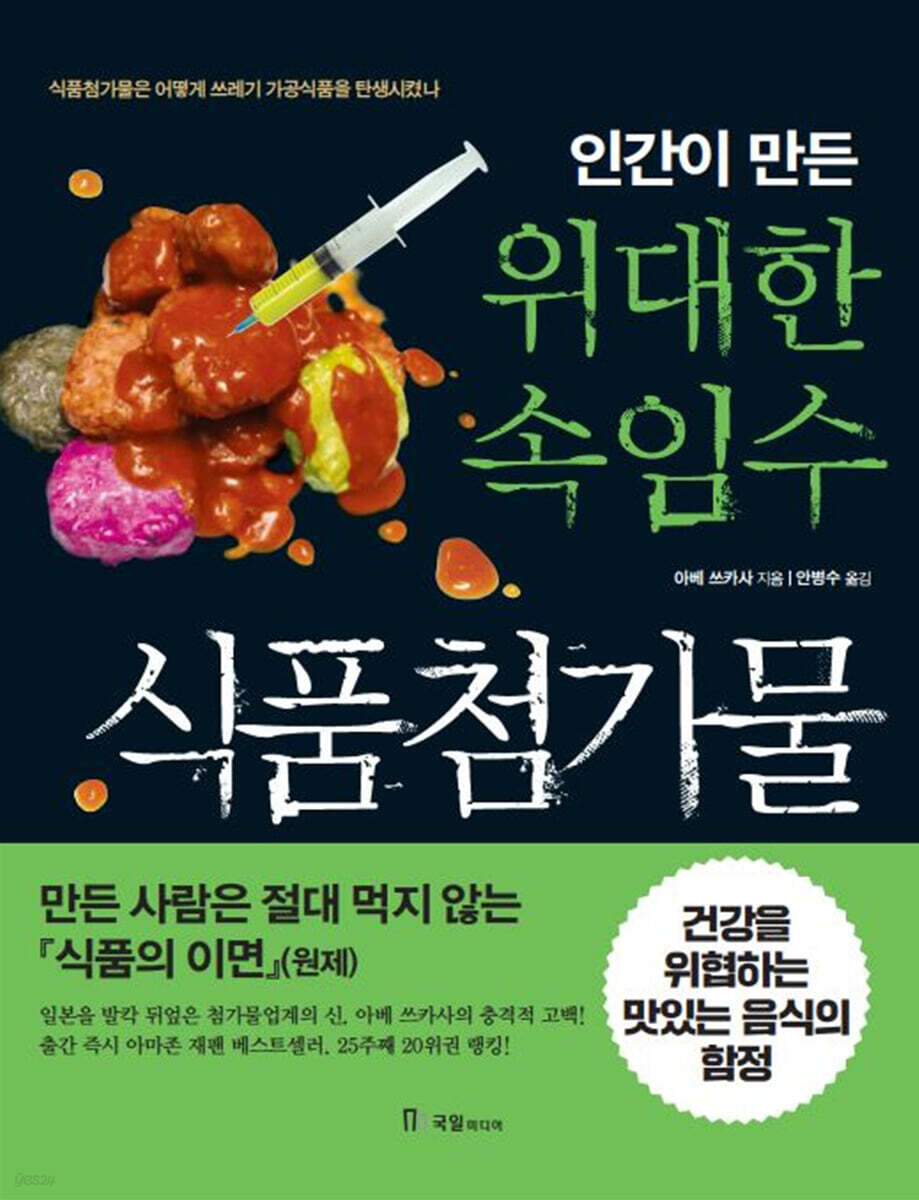
Food additives: the greatest human-made deception
 |
Description
Book Introduction
Food additives in processed foods are silent killers.
Tsukasa Abe, a living witness to the Japanese additive industry, reveals in detail the true nature and manufacturing process of food additives, the main ingredients that create the flavor of sweets and processed foods, in his book, “Food Additives: The Great Deception Created by Mankind.”
Food additives are silent killers that numb the tongues of my children and family and slowly take away their health.
This book delves into the reality of the main ingredients and food additives that create the flavor of snacks and processed foods, as well as the shocking manufacturing process, which was introduced on KBS 2TV's "Tracking 60 Minutes" in 2006 and caused a huge stir.
This newly revised book highlights the seriousness of the dangers of processed foods and veiled food additives, the distorted taste buds of children, and suggests ways in which our eating habits should change.
Tsukasa Abe, a living witness to the Japanese additive industry, reveals in detail the true nature and manufacturing process of food additives, the main ingredients that create the flavor of sweets and processed foods, in his book, “Food Additives: The Great Deception Created by Mankind.”
Food additives are silent killers that numb the tongues of my children and family and slowly take away their health.
This book delves into the reality of the main ingredients and food additives that create the flavor of snacks and processed foods, as well as the shocking manufacturing process, which was introduced on KBS 2TV's "Tracking 60 Minutes" in 2006 and caused a huge stir.
This newly revised book highlights the seriousness of the dangers of processed foods and veiled food additives, the distorted taste buds of children, and suggests ways in which our eating habits should change.
index
preface
prolog
Chapter 1: Processed foods with indiscriminate use of food additives
Three Musketeers Foods
100 kilograms of pork equals 130 kilograms of ham
Did you choose Pudding Ham today?
A small question is the key to solving the problem
The story behind pickled foods becoming bland
A lump of additives disguised as plums
Beneficiaries of low-salt products are:
Grandma's Danmuji's Ordeal
Low-grade pollack roe transformed into top-quality product in an instant.
Myeongranjeot is a treasure trove of chemicals.
If you eat more than 20 additives at once,
Uncolored pollack roe
Chapter 2: The Taste of a Kitchen Stained with Fake
Why is soy sauce on sale so cheap?
The bare face of imitation soy sauce
The difference between 1,000 yen and 198 yen
Pure rice mirin and mirin-flavored seasoning
The ingredients of Cheongju (clear liquor) are
Cheongju with added alcohol
One pure rice wine is worth ten cheongjus.
Don't be fooled by the price
There is a trick to salt too
The taste of the manipulated sea
Salt information must be disclosed
There are fakes of vinegar and sugar too.
The collapsing food culture of modern people
Children's tastes are being distorted
Chapter 3: The Veiled World of Additives
The identity of coffee creamer
Water, oil, and chemicals reincarnated as creamer
Blind spots in display criteria, batch display
The secret behind chemical seasoning labels
A blind, blind, blind-blind, mass-labeling system
Another blind spot exemption
The food industry must also disclose information.
Chapter 4: Food Additives I Ate Today
The unavoidable reality of overconsumption
A day in the life of single office worker N
Dozens of additives enter our mouths every day.
Is the housewife's diet okay?
A housewife is more serious than a bachelor
Chapter 5: Children's Distorted Sense of Taste
The Secret of Ramen Soup
The substances that make up taste are all in one container
The reason why chemical seasoning use continues to increase
Even natural broth contains chemical seasonings
Identity of protein hydrolysate
The Magician of Flavor, Protein Hydrolyzate
Are protein hydrolysates safe?
The story of children's taste buds being distorted
Is this really a natural taste?
Protein hydrolysate is the number one target for children's caution.
Wizard's Drink
High-fructose corn syrup, a popular sugar for children
Fatal to health
A mother and children who are touched
Chapter 6: For the Future of Diet
The additive issue needs to be reconsidered
Benefits of Additives
Are food additives the axis of evil?
You don't need to be an additive doctor.
Food additives are something you don't find in your kitchen.
Understanding the notation
Five suggestions for the era of additive omnipotence
I need to rethink what's in the kitchen too.
A nation stands strong only when its diet stands strong.
Children who do not know the nobility of food
There is life in nature in food.
The price of neglecting food
Parents should often show their children how to cook.
Dietary education should be viewed in the long term
Involving people in cooking is also a good way to educate them about food habits.
The distorted sense of taste returns
Dads should also be active in housework.
Another necessary moral standard
There are definitely consumers who understand
Additive-free shouldn't be an excuse
Consumers also have responsibility
Meaning of 3 out of 4
Small actions add up to big changes
Epilogue
prolog
Chapter 1: Processed foods with indiscriminate use of food additives
Three Musketeers Foods
100 kilograms of pork equals 130 kilograms of ham
Did you choose Pudding Ham today?
A small question is the key to solving the problem
The story behind pickled foods becoming bland
A lump of additives disguised as plums
Beneficiaries of low-salt products are:
Grandma's Danmuji's Ordeal
Low-grade pollack roe transformed into top-quality product in an instant.
Myeongranjeot is a treasure trove of chemicals.
If you eat more than 20 additives at once,
Uncolored pollack roe
Chapter 2: The Taste of a Kitchen Stained with Fake
Why is soy sauce on sale so cheap?
The bare face of imitation soy sauce
The difference between 1,000 yen and 198 yen
Pure rice mirin and mirin-flavored seasoning
The ingredients of Cheongju (clear liquor) are
Cheongju with added alcohol
One pure rice wine is worth ten cheongjus.
Don't be fooled by the price
There is a trick to salt too
The taste of the manipulated sea
Salt information must be disclosed
There are fakes of vinegar and sugar too.
The collapsing food culture of modern people
Children's tastes are being distorted
Chapter 3: The Veiled World of Additives
The identity of coffee creamer
Water, oil, and chemicals reincarnated as creamer
Blind spots in display criteria, batch display
The secret behind chemical seasoning labels
A blind, blind, blind-blind, mass-labeling system
Another blind spot exemption
The food industry must also disclose information.
Chapter 4: Food Additives I Ate Today
The unavoidable reality of overconsumption
A day in the life of single office worker N
Dozens of additives enter our mouths every day.
Is the housewife's diet okay?
A housewife is more serious than a bachelor
Chapter 5: Children's Distorted Sense of Taste
The Secret of Ramen Soup
The substances that make up taste are all in one container
The reason why chemical seasoning use continues to increase
Even natural broth contains chemical seasonings
Identity of protein hydrolysate
The Magician of Flavor, Protein Hydrolyzate
Are protein hydrolysates safe?
The story of children's taste buds being distorted
Is this really a natural taste?
Protein hydrolysate is the number one target for children's caution.
Wizard's Drink
High-fructose corn syrup, a popular sugar for children
Fatal to health
A mother and children who are touched
Chapter 6: For the Future of Diet
The additive issue needs to be reconsidered
Benefits of Additives
Are food additives the axis of evil?
You don't need to be an additive doctor.
Food additives are something you don't find in your kitchen.
Understanding the notation
Five suggestions for the era of additive omnipotence
I need to rethink what's in the kitchen too.
A nation stands strong only when its diet stands strong.
Children who do not know the nobility of food
There is life in nature in food.
The price of neglecting food
Parents should often show their children how to cook.
Dietary education should be viewed in the long term
Involving people in cooking is also a good way to educate them about food habits.
The distorted sense of taste returns
Dads should also be active in housework.
Another necessary moral standard
There are definitely consumers who understand
Additive-free shouldn't be an excuse
Consumers also have responsibility
Meaning of 3 out of 4
Small actions add up to big changes
Epilogue
Into the book
The meatballs I developed cost less than 100 yen per pack.
It's a groundbreaking price.
The cost would be only 20 to 30 yen.
The secret, of course, lies in the additives.
This product was a huge hit as soon as it was released.
Sales were so strong that the CEO of the business partner was always talking about it, and I even heard that he was able to build a building by making one good product.
It may not taste like meat, but once the magical power of the additives kicks in, it transforms into a wonderful meatball.
My kids eat it because they like it.
Eating it means eating the sodium polyphosphate, glycerin fatty acid ester, calcium phosphate, red 3, red 102, sorbic acid, caramel color, etc. that are contained within it.
To think such things would enter the mouths of my most precious, one-of-a-kind clones! I felt goosebumps run down my spine, as if my blood was flowing backwards.
--- From the "Prologue"
How many supplements does Mr. N consume each day? Even if we exclude duplicates, the total would easily exceed 60.
The convenience store that Mr. N frequently uses literally provides a lot of convenience to our eating habits.
We have a wide variety of foods that can easily satisfy your hunger, and the prices are not too expensive.
Large grocery stores such as supermarkets and marts are not much different in that respect.
But behind that cheapness and convenience, there are additives that are indiscriminately abused.
--- From "Food Additives I Ate Today"
Why is jelly used in ham?
Why is soy protein in hamburgers?
The purpose is to increase quantity and lower unit price.
Because it only sells if it's cheap.
○○○ sauce, △△△ broth, etc. are not much different.
Its convenience may be the secret to its popularity, but its biggest appeal is its affordability.
Most consumers don't care how the food they buy is made or what ingredients are in it.
It is no exaggeration to say that I don't look at the notation at all.
Ultimately, consumers are also supporters of food additives.
It's a groundbreaking price.
The cost would be only 20 to 30 yen.
The secret, of course, lies in the additives.
This product was a huge hit as soon as it was released.
Sales were so strong that the CEO of the business partner was always talking about it, and I even heard that he was able to build a building by making one good product.
It may not taste like meat, but once the magical power of the additives kicks in, it transforms into a wonderful meatball.
My kids eat it because they like it.
Eating it means eating the sodium polyphosphate, glycerin fatty acid ester, calcium phosphate, red 3, red 102, sorbic acid, caramel color, etc. that are contained within it.
To think such things would enter the mouths of my most precious, one-of-a-kind clones! I felt goosebumps run down my spine, as if my blood was flowing backwards.
--- From the "Prologue"
How many supplements does Mr. N consume each day? Even if we exclude duplicates, the total would easily exceed 60.
The convenience store that Mr. N frequently uses literally provides a lot of convenience to our eating habits.
We have a wide variety of foods that can easily satisfy your hunger, and the prices are not too expensive.
Large grocery stores such as supermarkets and marts are not much different in that respect.
But behind that cheapness and convenience, there are additives that are indiscriminately abused.
--- From "Food Additives I Ate Today"
Why is jelly used in ham?
Why is soy protein in hamburgers?
The purpose is to increase quantity and lower unit price.
Because it only sells if it's cheap.
○○○ sauce, △△△ broth, etc. are not much different.
Its convenience may be the secret to its popularity, but its biggest appeal is its affordability.
Most consumers don't care how the food they buy is made or what ingredients are in it.
It is no exaggeration to say that I don't look at the notation at all.
Ultimately, consumers are also supporters of food additives.
--- From "For the Future of Eating"
Publisher's Review
Why I Can Never Let My Daughter Eat Food I Make
There is no one who does not know how harmful food additives are.
Everyone knows we shouldn't eat it, but like people who don't know anything, our hands are reaching for processed foods full of food additives.
Why is that? Because our mouths and tongues are already addicted to it.
So, if we avoid fast food and processed foods and instead eat homemade food, is it safe? Even ingredients that give our food its flavor—soy sauce, gochujang, doenjang, salt—cannot escape the trap of food additives.
Do you think the commercially available soybean paste used for soybean paste stew is made solely from soybeans and yeast? If you think it's made traditionally using only fermented soybeans and salt, you're mistaken.
Food additives are also included in soybean paste and red pepper paste without exception.
So, there is no way that soybean paste stew made with it can be safe.
Needless to say, processed foods such as fish cakes, crab meat, and ham, as well as triangle kimbap and sandwiches sold at convenience stores, are at an even more serious level.
The more delicious it is, the more food additives it contains, which is correct.
The longer the distribution period, the more food additives are added, which is correct.
If you think that the simpler the cooking, the more food additives it contains, then you are right.
If you think that the cheaper it is, the more food additives it contains, then you are correct.
The author tells an anecdote about how, when he was developing meatballs, his daughter tried to eat them, but he scolded her and told her not to.
It's terrifying to think that there are foods that you would never eat if you knew about them, and that the person who made them would never eat them.
This book reveals how the food we eat is made, the hidden side of food, and its harmful effects. It also introduces essential methods to protect our health amidst the threat of food additives.
There is no one who does not know how harmful food additives are.
Everyone knows we shouldn't eat it, but like people who don't know anything, our hands are reaching for processed foods full of food additives.
Why is that? Because our mouths and tongues are already addicted to it.
So, if we avoid fast food and processed foods and instead eat homemade food, is it safe? Even ingredients that give our food its flavor—soy sauce, gochujang, doenjang, salt—cannot escape the trap of food additives.
Do you think the commercially available soybean paste used for soybean paste stew is made solely from soybeans and yeast? If you think it's made traditionally using only fermented soybeans and salt, you're mistaken.
Food additives are also included in soybean paste and red pepper paste without exception.
So, there is no way that soybean paste stew made with it can be safe.
Needless to say, processed foods such as fish cakes, crab meat, and ham, as well as triangle kimbap and sandwiches sold at convenience stores, are at an even more serious level.
The more delicious it is, the more food additives it contains, which is correct.
The longer the distribution period, the more food additives are added, which is correct.
If you think that the simpler the cooking, the more food additives it contains, then you are right.
If you think that the cheaper it is, the more food additives it contains, then you are correct.
The author tells an anecdote about how, when he was developing meatballs, his daughter tried to eat them, but he scolded her and told her not to.
It's terrifying to think that there are foods that you would never eat if you knew about them, and that the person who made them would never eat them.
This book reveals how the food we eat is made, the hidden side of food, and its harmful effects. It also introduces essential methods to protect our health amidst the threat of food additives.
GOODS SPECIFICS
- Date of issue: January 20, 2025
- Page count, weight, size: 216 pages | 172*215*20mm
- ISBN13: 9788974259266
- ISBN10: 8974259265
You may also like
카테고리
korean


korean

![GQ KOREA Mark (Monthly): December [2025]](http://librairie.coreenne.fr/cdn/shop/files/8ef265dbbfbf186523ed75ba7319009d.jpg?v=1765340328&width=3840)


