

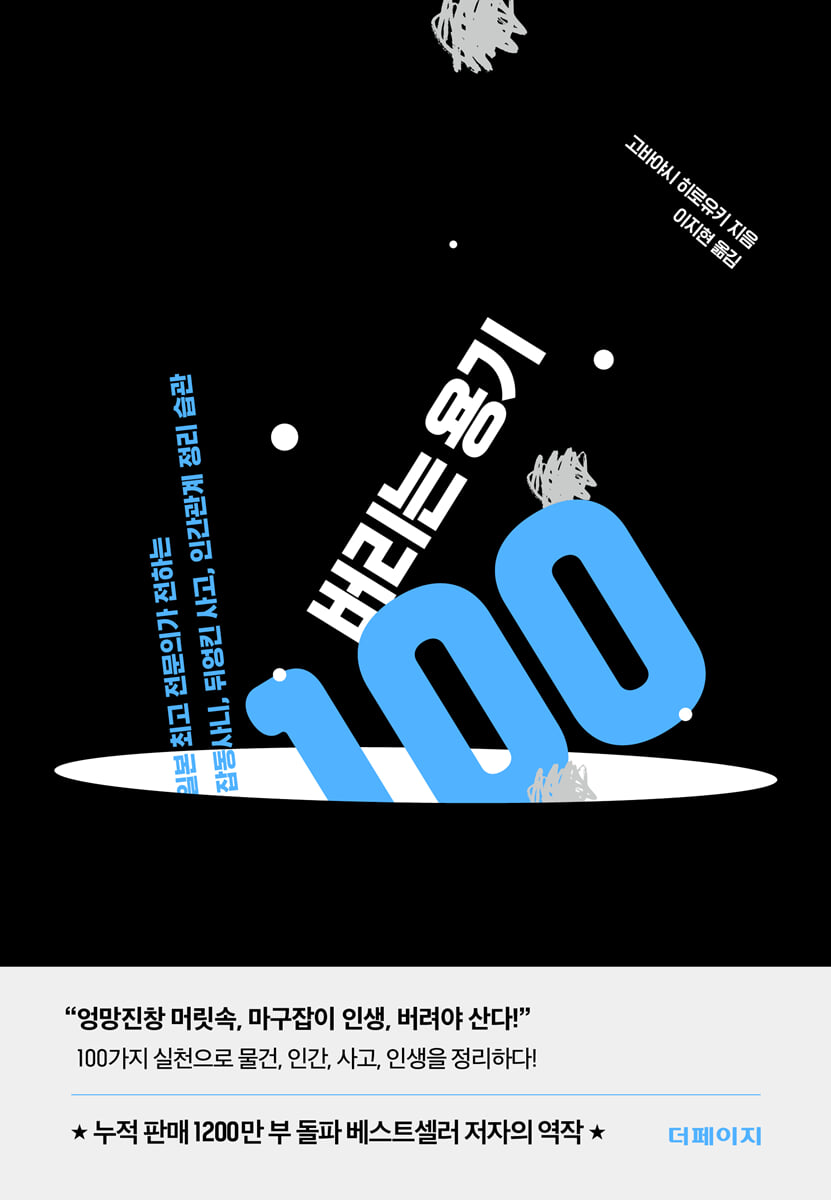
100 containers to throw away
 |
Description
Book Introduction
“Are you stressed out by unnecessary human relationships?”
“Are you always running around looking for something?”
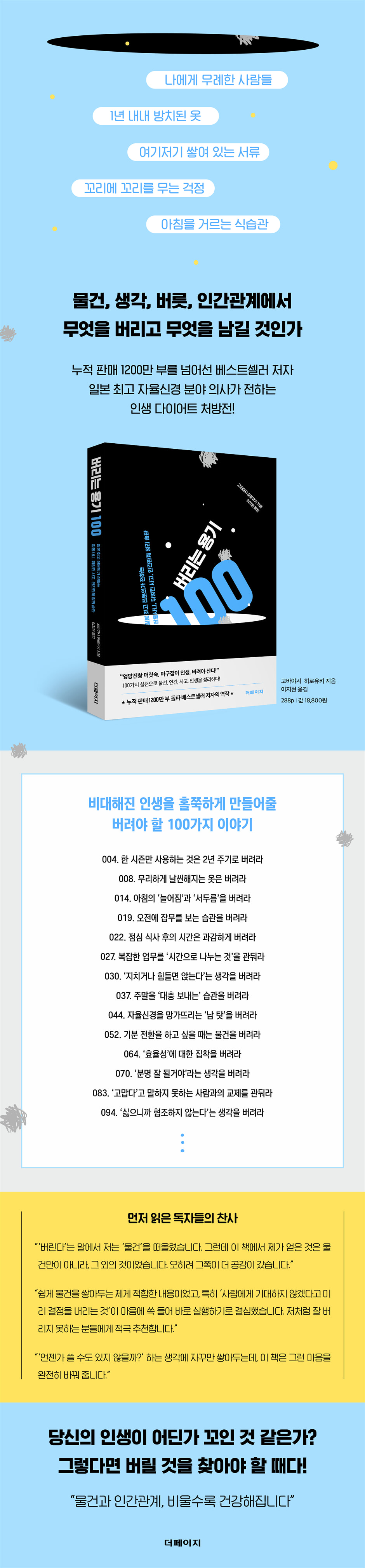
A leading Japanese autonomic nervous system specialist shares tips on "letting go" for life and health.
We live in an overflowing world of objects and information every day, and we feel that our lives are becoming cluttered with unnecessary things.
If you repeatedly feel like your day-to-day life is not going well, whether you're struggling to find what you need or stressed out by complicated relationships, the cause may be a lack of "courage to let go."
If we do not organize the accumulated items and relationships that have accumulated without our knowledge and instead just let them pile up, the balance of the autonomic nervous system that controls our body will be disrupted and our physical condition will rapidly deteriorate.
This book is not just a simple organizing book.
It teaches you how to boldly remove the 'clutter' that has accumulated in every aspect of your life, from things to habits, mindsets, and even relationships.
As a result, you will have an amazing experience where your body and mind will feel lighter and you will see the answers to life.
Hiroyuki Kobayashi, an authority on autonomic nervous system research, presents a scientific approach to solving stress and confusion in this book.
Chapter 1 teaches us how to break away from the 'tyrants of things' that rule the room.
Clothes left in the closet all year, piles of paperwork, and even small items that just take up space in the name of memories.
If you organize boldly, you can gain much more freedom than you think.
Chapter 2 focuses on lifestyle habits.
You arrive at work drenched in sweat, or sleep in late, obsessed with your smartphone, and face an exhausting day.
This kind of habit is the main culprit that destroys the autonomic nervous system.
From simple actions like "not taking the elevator" to saying goodbye to social media, experience firsthand how small changes can make your day easier.
Chapter 3 deals with stereotypes and mindsets.
Ideas like "I need to rest on the weekends" or "I need to think about my next schedule" can be traps that tire you out.
By learning to "empty your mind" through this chapter, you will gain the freedom to make better choices instead of worrying and hesitating.
Chapter 4 shifts the focus to the dining table.
Are you aware that poor eating habits like rushed lunches, excessive dieting, and excessive use of health supplements are tormenting you? By learning the simple principles of returning to the basics of eating in this chapter, you can achieve both pleasure and health at the table.
The last five chapters emphasize the importance of managing human relationships.
If you let go of the vague expectation that 'someone will like me' and let go of unnecessary relationships, you can meet an attractive person who is a good fit for you.
Let's boldly end the relationships that only cause you stress.
Well then, let's get started right now.
Less burden, lighter mind, broader possibilities.
From now on, your life will be much more relaxed than before.
The moment your body and mind become lighter, your life will reach a turning point.
This book is the perfect companion to get you started!
“Are you always running around looking for something?”
A leading Japanese autonomic nervous system specialist shares tips on "letting go" for life and health.
We live in an overflowing world of objects and information every day, and we feel that our lives are becoming cluttered with unnecessary things.
If you repeatedly feel like your day-to-day life is not going well, whether you're struggling to find what you need or stressed out by complicated relationships, the cause may be a lack of "courage to let go."
If we do not organize the accumulated items and relationships that have accumulated without our knowledge and instead just let them pile up, the balance of the autonomic nervous system that controls our body will be disrupted and our physical condition will rapidly deteriorate.
This book is not just a simple organizing book.
It teaches you how to boldly remove the 'clutter' that has accumulated in every aspect of your life, from things to habits, mindsets, and even relationships.
As a result, you will have an amazing experience where your body and mind will feel lighter and you will see the answers to life.
Hiroyuki Kobayashi, an authority on autonomic nervous system research, presents a scientific approach to solving stress and confusion in this book.
Chapter 1 teaches us how to break away from the 'tyrants of things' that rule the room.
Clothes left in the closet all year, piles of paperwork, and even small items that just take up space in the name of memories.
If you organize boldly, you can gain much more freedom than you think.
Chapter 2 focuses on lifestyle habits.
You arrive at work drenched in sweat, or sleep in late, obsessed with your smartphone, and face an exhausting day.
This kind of habit is the main culprit that destroys the autonomic nervous system.
From simple actions like "not taking the elevator" to saying goodbye to social media, experience firsthand how small changes can make your day easier.
Chapter 3 deals with stereotypes and mindsets.
Ideas like "I need to rest on the weekends" or "I need to think about my next schedule" can be traps that tire you out.
By learning to "empty your mind" through this chapter, you will gain the freedom to make better choices instead of worrying and hesitating.
Chapter 4 shifts the focus to the dining table.
Are you aware that poor eating habits like rushed lunches, excessive dieting, and excessive use of health supplements are tormenting you? By learning the simple principles of returning to the basics of eating in this chapter, you can achieve both pleasure and health at the table.
The last five chapters emphasize the importance of managing human relationships.
If you let go of the vague expectation that 'someone will like me' and let go of unnecessary relationships, you can meet an attractive person who is a good fit for you.
Let's boldly end the relationships that only cause you stress.
Well then, let's get started right now.
Less burden, lighter mind, broader possibilities.
From now on, your life will be much more relaxed than before.
The moment your body and mind become lighter, your life will reach a turning point.
This book is the perfect companion to get you started!
- You can preview some of the book's contents.
Preview
index
Entering_ Letting go and starting a new life!
What is the autonomic nervous system?
Chapter 1.
Throw away surrounding objects
· 001.
Throw away anything that causes you to make 'unnecessary choices'.
· 002.
Throw away items you use at work every six months.
· 003.
Throw away the clothes you've worn for a year.
· 004.
If you only use it for one season, throw it away every two years.
· 005.
Throw away all but five of your coordination accessories.
· 006.
Erase any traces of work from home.
· 007.
Archive and discard old first birthday party photos.
· 008.
Throw away clothes that force you to be thin.
· 009.
Throw away bags or wallets that are inconvenient to use.
· 010.
Get rid of the habit of organizing everything at once.
· 011.
Throw away old books and reference books without hesitation.
· 012.
Throw away all your watches except one for formal wear and one for casual wear.
· 013.
Throw away all your attachment bags except one or two.
■ Checkpoints for Wise Disposal
Chapter 2.
Break your lifestyle habits
· 014.
Let go of morning 'slowness' and 'rushing'
· 015.
Get rid of the habit of sweating your way to work.
· 016.
Get rid of the habit of wearing only shoes
· 017.
Forget the easy and convenient transfers
· 018.
Get rid of the habit of taking the elevator
· 019.
Get rid of the habit of doing chores in the morning.
· 020.
Remove the shrimp and turtles that are parasitic on my body.
· 021.
Stop walking with your eyes on the ground
· 022.
Throw away the time after lunch boldly.
· 023.
Let go of the myth that sighs chase away happiness.
· 024.
Don't schedule more than 'three events' per day.
· 025.
Get rid of the habit of writing everything down in a smartphone notepad.
· 026.
Break the habit of keeping business cards in a "business card file."
· 027.
Forget about "division" complex tasks into time slots.
· 028.
Don't schedule important tasks after 6 PM.
· 029.
No matter how busy you are, put off today's work until tomorrow.
· 030.
Let go of the idea that "I sit down when I'm tired or worn out."
· 031.
Stop using social media, which is destroying your autonomic nervous system.
· 032.
Stop the 'frowning face, the frowning expression'
· 033.
Stop jogging and switch to walking.
· 034.
Put your smartphone away late at night
· 035.
Avoid eating or bathing right before bed.
· 036.
Don't bathe in water that is too hot.
· 037.
Break the habit of 'sloppily spending' your weekends.
· 038.
Get rid of the habit of sleeping in on weekends
· 039.
Don't let yourself be idle until the last day of your long vacation.
· 040.
Let go of the 'strict' rules that cause stress.
· 041.
Don't ignore the signs of stress.
■ Checkpoints for Wise Disposal
Chapter 3.
Let go of old ways of thinking and habits
· 042.
Let go of the 'pride' that makes you anxious.
· 043.
Get rid of the reflexive habit of getting irritated
· 044.
Let go of the "blaming others" that destroys your autonomic nervous system.
· 045.
Let go of the stereotype that 'weekends are a day off'
· 046.
Stop being 'swayed by the next schedule'
· 047.
Get rid of the habit of procrastination
· 048.
Set your priorities straight and let go of worries and hesitation.
· 049.
Throw away all your useless 'little worries'
· 050.
If something is 'difficult or annoying', just jump to conclusions and throw it away.
· 051.
Stop impulse buying, which destroys your autonomic nervous system.
· 052.
When you want to change your mood, throw away things.
· 053.
Let go of your frustration with the current situation.
· 054.
Let go of the "useless imagination" that only fuels anxiety.
· 055.
Break the habit of 'just getting started'
· 056.
When you don't feel like working, give up on even starting.
· 057.
Avoid excessive mood swings
· 058.
Avoid relying solely on symptomatic treatment.
· 059.
Forget about trying to jump over hurdles that are too high.
· 060.
Let go of your attachment to the irreversible.
· 061.
Stop keeping ideas in your head.
· 062.
Let go of being tied down by the past or the future.
· 063.
Don't be too conscious of life's turning points.
· 064.
Let go of your obsession with 'efficiency'
· 065.
Forget about giving your all in everything
· 066.
Don't give up on 'good stress'
· 067.
Let go of the negative aspects of worry and concern.
· 068.
Avoid excessive concern and gossip about others.
· 069.
Stop suppressing your anger
· 070.
Let go of the idea that 'everything will definitely be okay'
■ Checkpoints for Wise Disposal
Chapter 4.
Throw away common sense about eating
· 071.
Stop skipping breakfast
· 072.
Don't throw away vegetable peels or seeds.
· 073.
Forget about hastily eating lunch because you don't have time.
· 074.
Try to stick to soft foods only.
· 075.
Get rid of the habit of 'eating while ~'
· 076.
Forget about 'tasteless' meals
· 077.
Change your post-meal habits that are ruining your gut environment.
· 078.
Forget the 'zero-carb diet'
· 079.
Avoid taking health supplements
· 080.
Don't gulp down cold drinks
· 081.
Stop forcing yourself to eat when you have no appetite.
■ Checkpoints for Wise Disposal
Chapter 5.
Abandon human relationships
· 082.
Let go of 'wanting other people to like you'
· 083.
Avoid associating with people who can't say "thank you."
· 084.
Give up time dealing with difficult people.
· 085.
Let go of a stressful relationship
· 086.
Boldly abandon unnecessary relationships
· 087.
Don't immediately accept calls from people who are difficult to deal with.
· 088.
Let go of 'excessive expectations of others'
· 089.
Get rid of relationships with people who always show a bad attitude.
· 090.
Stop talking nonsense
· 091.
Stop reading the mood
· 092.
Avoid staying in the same position forever
· 093. Avoid hanging out with MZ people.
· 094.
Let go of the idea that "I don't like it, so I won't cooperate."
· 095.
Don't let emotions sway your judgment.
· 096.
Let go of feelings of jealousy and envy
· 097.
Throw away gatherings that have no purpose.
· 098.
Let go of your admiration for lovebirds
· 099.
Avoid placing all the blame on one person.
· 100.
Abandon the 'unjust side'
■ Checkpoints for Wise Disposal
What is the autonomic nervous system?
Chapter 1.
Throw away surrounding objects
· 001.
Throw away anything that causes you to make 'unnecessary choices'.
· 002.
Throw away items you use at work every six months.
· 003.
Throw away the clothes you've worn for a year.
· 004.
If you only use it for one season, throw it away every two years.
· 005.
Throw away all but five of your coordination accessories.
· 006.
Erase any traces of work from home.
· 007.
Archive and discard old first birthday party photos.
· 008.
Throw away clothes that force you to be thin.
· 009.
Throw away bags or wallets that are inconvenient to use.
· 010.
Get rid of the habit of organizing everything at once.
· 011.
Throw away old books and reference books without hesitation.
· 012.
Throw away all your watches except one for formal wear and one for casual wear.
· 013.
Throw away all your attachment bags except one or two.
■ Checkpoints for Wise Disposal
Chapter 2.
Break your lifestyle habits
· 014.
Let go of morning 'slowness' and 'rushing'
· 015.
Get rid of the habit of sweating your way to work.
· 016.
Get rid of the habit of wearing only shoes
· 017.
Forget the easy and convenient transfers
· 018.
Get rid of the habit of taking the elevator
· 019.
Get rid of the habit of doing chores in the morning.
· 020.
Remove the shrimp and turtles that are parasitic on my body.
· 021.
Stop walking with your eyes on the ground
· 022.
Throw away the time after lunch boldly.
· 023.
Let go of the myth that sighs chase away happiness.
· 024.
Don't schedule more than 'three events' per day.
· 025.
Get rid of the habit of writing everything down in a smartphone notepad.
· 026.
Break the habit of keeping business cards in a "business card file."
· 027.
Forget about "division" complex tasks into time slots.
· 028.
Don't schedule important tasks after 6 PM.
· 029.
No matter how busy you are, put off today's work until tomorrow.
· 030.
Let go of the idea that "I sit down when I'm tired or worn out."
· 031.
Stop using social media, which is destroying your autonomic nervous system.
· 032.
Stop the 'frowning face, the frowning expression'
· 033.
Stop jogging and switch to walking.
· 034.
Put your smartphone away late at night
· 035.
Avoid eating or bathing right before bed.
· 036.
Don't bathe in water that is too hot.
· 037.
Break the habit of 'sloppily spending' your weekends.
· 038.
Get rid of the habit of sleeping in on weekends
· 039.
Don't let yourself be idle until the last day of your long vacation.
· 040.
Let go of the 'strict' rules that cause stress.
· 041.
Don't ignore the signs of stress.
■ Checkpoints for Wise Disposal
Chapter 3.
Let go of old ways of thinking and habits
· 042.
Let go of the 'pride' that makes you anxious.
· 043.
Get rid of the reflexive habit of getting irritated
· 044.
Let go of the "blaming others" that destroys your autonomic nervous system.
· 045.
Let go of the stereotype that 'weekends are a day off'
· 046.
Stop being 'swayed by the next schedule'
· 047.
Get rid of the habit of procrastination
· 048.
Set your priorities straight and let go of worries and hesitation.
· 049.
Throw away all your useless 'little worries'
· 050.
If something is 'difficult or annoying', just jump to conclusions and throw it away.
· 051.
Stop impulse buying, which destroys your autonomic nervous system.
· 052.
When you want to change your mood, throw away things.
· 053.
Let go of your frustration with the current situation.
· 054.
Let go of the "useless imagination" that only fuels anxiety.
· 055.
Break the habit of 'just getting started'
· 056.
When you don't feel like working, give up on even starting.
· 057.
Avoid excessive mood swings
· 058.
Avoid relying solely on symptomatic treatment.
· 059.
Forget about trying to jump over hurdles that are too high.
· 060.
Let go of your attachment to the irreversible.
· 061.
Stop keeping ideas in your head.
· 062.
Let go of being tied down by the past or the future.
· 063.
Don't be too conscious of life's turning points.
· 064.
Let go of your obsession with 'efficiency'
· 065.
Forget about giving your all in everything
· 066.
Don't give up on 'good stress'
· 067.
Let go of the negative aspects of worry and concern.
· 068.
Avoid excessive concern and gossip about others.
· 069.
Stop suppressing your anger
· 070.
Let go of the idea that 'everything will definitely be okay'
■ Checkpoints for Wise Disposal
Chapter 4.
Throw away common sense about eating
· 071.
Stop skipping breakfast
· 072.
Don't throw away vegetable peels or seeds.
· 073.
Forget about hastily eating lunch because you don't have time.
· 074.
Try to stick to soft foods only.
· 075.
Get rid of the habit of 'eating while ~'
· 076.
Forget about 'tasteless' meals
· 077.
Change your post-meal habits that are ruining your gut environment.
· 078.
Forget the 'zero-carb diet'
· 079.
Avoid taking health supplements
· 080.
Don't gulp down cold drinks
· 081.
Stop forcing yourself to eat when you have no appetite.
■ Checkpoints for Wise Disposal
Chapter 5.
Abandon human relationships
· 082.
Let go of 'wanting other people to like you'
· 083.
Avoid associating with people who can't say "thank you."
· 084.
Give up time dealing with difficult people.
· 085.
Let go of a stressful relationship
· 086.
Boldly abandon unnecessary relationships
· 087.
Don't immediately accept calls from people who are difficult to deal with.
· 088.
Let go of 'excessive expectations of others'
· 089.
Get rid of relationships with people who always show a bad attitude.
· 090.
Stop talking nonsense
· 091.
Stop reading the mood
· 092.
Avoid staying in the same position forever
· 093. Avoid hanging out with MZ people.
· 094.
Let go of the idea that "I don't like it, so I won't cooperate."
· 095.
Don't let emotions sway your judgment.
· 096.
Let go of feelings of jealousy and envy
· 097.
Throw away gatherings that have no purpose.
· 098.
Let go of your admiration for lovebirds
· 099.
Avoid placing all the blame on one person.
· 100.
Abandon the 'unjust side'
■ Checkpoints for Wise Disposal
Detailed image
Into the book
** Humans tend to live in a state of inertia.
However, if you live a complacent life, caught up in the daily grind, your autonomic nervous system loses its function and you age quickly.
So, I recommend trying some new changes to your wardrobe as a way to break free from your comfort zone and renew yourself.
If you have thoughts like, 'I want to change myself,' 'I want to show off my skills,' or 'I want to improve my physical and mental functions,' you must first restore your autonomic nervous system, which has lost its function due to complacency or stress.
** The smart way I recommend to deal with this is to 'jump to a conclusion first.'
For example, let's say that it's difficult to work in the same department as someone you don't get along with.
At this time, you should first come to a conclusion and put it into action, such as 'I will try to avoid getting involved with that person as much as possible', 'I will listen to what that person says and ignore it', or 'I will only check the contact that person sends once and not check it again'.
** Most people worry about 'how can I communicate smoothly with people who are difficult or reluctant to deal with?'
This way of thinking will only increase the amount of time you have to spend with that person.
Stress is also increasing.
You may also find yourself feeling irritated by the way you try to please or appease such people.
So, 'How should I communicate with such a person?' or 'How should I treat that person?'
Stop using the coping method of 'Is it so?'
Instead, we should think about 'how can we meet and encounter each other less?'
This is much more important.
** I am conveying the message through various channels and media that 'psychological problems such as stress are difficult to solve through psychological methods.'
To address psychological anxiety, it is much more effective and important to utilize non-psychological approaches, such as correcting physical balance or organizing and discarding objects around you.
** The more people pursue efficiency, the more they suffer from extreme stress when things do not go their way.
If you're stressed out about not being able to "transfer comfortably without getting lost on an efficient route," you might want to give it up and choose to "transfer by walking."
Rather, if by coincidence you transfer without waiting, you may even feel a little 'lucky'.
** If feeling depressed and walking with your eyes on the ground are a combination, wouldn't lifting your head and looking up at the sky help alleviate your depression? You might wonder, "Would that really make me feel better?" But actually, looking up at the sky straightens your back and improves your posture.
Sufficient oxygen is supplied to the entire body and the autonomic nervous system is stabilized.
** As we live, various situations occur in our lives.
You need to make appropriate decisions, such as, 'It's worth giving it your all now' or '60 to 70 percent of your strength is enough right now.'
If you take a step back and look at it objectively, you will realize that surprisingly, most things can be handled with 60 to 70 percent of your strength.
**When we open our eyes in the morning, our brain begins to gradually transition from a state of parasympathetic nervous system activation to a state of sympathetic nervous system activation.
Therefore, during the morning, when this process is taking place, the sympathetic and parasympathetic nerves reach a point of contact, that is, a state of similar activation, so it can be said to be the most ideal state during the day.
Therefore, creative tasks or important agenda items that require high concentration are best handled in the morning before lunch.
Postpone menial tasks like mechanical document writing or simple email checking to after lunch when you're more likely to lose focus.
However, if you live a complacent life, caught up in the daily grind, your autonomic nervous system loses its function and you age quickly.
So, I recommend trying some new changes to your wardrobe as a way to break free from your comfort zone and renew yourself.
If you have thoughts like, 'I want to change myself,' 'I want to show off my skills,' or 'I want to improve my physical and mental functions,' you must first restore your autonomic nervous system, which has lost its function due to complacency or stress.
** The smart way I recommend to deal with this is to 'jump to a conclusion first.'
For example, let's say that it's difficult to work in the same department as someone you don't get along with.
At this time, you should first come to a conclusion and put it into action, such as 'I will try to avoid getting involved with that person as much as possible', 'I will listen to what that person says and ignore it', or 'I will only check the contact that person sends once and not check it again'.
** Most people worry about 'how can I communicate smoothly with people who are difficult or reluctant to deal with?'
This way of thinking will only increase the amount of time you have to spend with that person.
Stress is also increasing.
You may also find yourself feeling irritated by the way you try to please or appease such people.
So, 'How should I communicate with such a person?' or 'How should I treat that person?'
Stop using the coping method of 'Is it so?'
Instead, we should think about 'how can we meet and encounter each other less?'
This is much more important.
** I am conveying the message through various channels and media that 'psychological problems such as stress are difficult to solve through psychological methods.'
To address psychological anxiety, it is much more effective and important to utilize non-psychological approaches, such as correcting physical balance or organizing and discarding objects around you.
** The more people pursue efficiency, the more they suffer from extreme stress when things do not go their way.
If you're stressed out about not being able to "transfer comfortably without getting lost on an efficient route," you might want to give it up and choose to "transfer by walking."
Rather, if by coincidence you transfer without waiting, you may even feel a little 'lucky'.
** If feeling depressed and walking with your eyes on the ground are a combination, wouldn't lifting your head and looking up at the sky help alleviate your depression? You might wonder, "Would that really make me feel better?" But actually, looking up at the sky straightens your back and improves your posture.
Sufficient oxygen is supplied to the entire body and the autonomic nervous system is stabilized.
** As we live, various situations occur in our lives.
You need to make appropriate decisions, such as, 'It's worth giving it your all now' or '60 to 70 percent of your strength is enough right now.'
If you take a step back and look at it objectively, you will realize that surprisingly, most things can be handled with 60 to 70 percent of your strength.
**When we open our eyes in the morning, our brain begins to gradually transition from a state of parasympathetic nervous system activation to a state of sympathetic nervous system activation.
Therefore, during the morning, when this process is taking place, the sympathetic and parasympathetic nerves reach a point of contact, that is, a state of similar activation, so it can be said to be the most ideal state during the day.
Therefore, creative tasks or important agenda items that require high concentration are best handled in the morning before lunch.
Postpone menial tasks like mechanical document writing or simple email checking to after lunch when you're more likely to lose focus.
--- From the text
Publisher's Review
A top Japanese doctor who has been researching immunity and nerves for 30 years tells us:
The Courage to Let Go for a New Life and Health
Break up with useless things that ruin your body
“If you have high expectations of others, your autonomic nervous system may become unbalanced.
To reduce the stress you feel when you're betrayed, it's a good idea to decide in advance, 'I'm not going to expect anything from others.'
“You can reduce the stress you experience in your daily life by ‘reducing your choices.’
“Please reduce the number of fashion items such as clothes, bags, and accessories and replace them with new ones regularly.” - From the text
When we let things and relationships pile up without organizing them, it goes beyond just creating clutter in our space; it also has a profound impact on our physical and mental health.
People often cannot quit or throw away things for various reasons, such as because they are bothersome or because they might use them again later.
Additionally, abandoning something and severing relationships leaves the actor with a sense of loss, making it emotionally difficult to put into practice.
This book helps readers understand that 'abandonment is not a loss, but an act of creating new opportunities.'
You'll discover that decluttering, letting go of unnecessary habits, and severing stressful relationships will make your life much lighter and give you a clearer direction.
Furthermore, it helps balance the autonomic nervous system and makes you healthy.
Anyone can start letting go right now.
The moment you empty out and get rid of useless things, your life becomes cleaner and you find more time and space.
Letting go of unnecessary relationships also gives you the opportunity to build genuine bonds with people who care about you.
‘Emptiness’ is ultimately the first step toward a richer and freer life.
Does your life feel a bit out of whack?
Then it's time to find something to throw away!
Unlike other books that emphasize a simple life, the book doesn't simply cover how to organize things.
It presents a method of cutting out, emptying, and discarding unnecessary things in all areas of life, leaving only what is truly necessary.
It provides practical ways to redesign your life through 'emptying', not only of material possessions but also of habits that are not conducive to a healthy life and relationships that only cause stress.
In this process, the role of the autonomic nervous system, which governs the balance of body and mind, is explained, and it persuasively shows that emptying is not just a matter of organizing, but is the key to health and happiness.
The author of this book, Hiroyuki Kobayashi, is a leading Japanese specialist and medical doctor who has been researching the fields of immunity and neurology for 30 years.
He is also a bestselling author with over 12 million copies sold through his numerous books on healthy lifestyles and the autonomic nervous system.
He has seen many patients with nervous system problems and has compiled his research into 100 daily ways to maintain a healthier autonomic nervous system.
Let's open up new possibilities in life by following the author's guidance and embarking on a journey to lighten our lives.
The Courage to Let Go for a New Life and Health
Break up with useless things that ruin your body
“If you have high expectations of others, your autonomic nervous system may become unbalanced.
To reduce the stress you feel when you're betrayed, it's a good idea to decide in advance, 'I'm not going to expect anything from others.'
“You can reduce the stress you experience in your daily life by ‘reducing your choices.’
“Please reduce the number of fashion items such as clothes, bags, and accessories and replace them with new ones regularly.” - From the text
When we let things and relationships pile up without organizing them, it goes beyond just creating clutter in our space; it also has a profound impact on our physical and mental health.
People often cannot quit or throw away things for various reasons, such as because they are bothersome or because they might use them again later.
Additionally, abandoning something and severing relationships leaves the actor with a sense of loss, making it emotionally difficult to put into practice.
This book helps readers understand that 'abandonment is not a loss, but an act of creating new opportunities.'
You'll discover that decluttering, letting go of unnecessary habits, and severing stressful relationships will make your life much lighter and give you a clearer direction.
Furthermore, it helps balance the autonomic nervous system and makes you healthy.
Anyone can start letting go right now.
The moment you empty out and get rid of useless things, your life becomes cleaner and you find more time and space.
Letting go of unnecessary relationships also gives you the opportunity to build genuine bonds with people who care about you.
‘Emptiness’ is ultimately the first step toward a richer and freer life.
Does your life feel a bit out of whack?
Then it's time to find something to throw away!
Unlike other books that emphasize a simple life, the book doesn't simply cover how to organize things.
It presents a method of cutting out, emptying, and discarding unnecessary things in all areas of life, leaving only what is truly necessary.
It provides practical ways to redesign your life through 'emptying', not only of material possessions but also of habits that are not conducive to a healthy life and relationships that only cause stress.
In this process, the role of the autonomic nervous system, which governs the balance of body and mind, is explained, and it persuasively shows that emptying is not just a matter of organizing, but is the key to health and happiness.
The author of this book, Hiroyuki Kobayashi, is a leading Japanese specialist and medical doctor who has been researching the fields of immunity and neurology for 30 years.
He is also a bestselling author with over 12 million copies sold through his numerous books on healthy lifestyles and the autonomic nervous system.
He has seen many patients with nervous system problems and has compiled his research into 100 daily ways to maintain a healthier autonomic nervous system.
Let's open up new possibilities in life by following the author's guidance and embarking on a journey to lighten our lives.
GOODS SPECIFICS
- Date of issue: March 20, 2025
- Page count, weight, size: 288 pages | 484g | 147*212*18mm
- ISBN13: 9791194156130
- ISBN10: 1194156134
You may also like
카테고리
korean


korean

![ELLE 엘르 스페셜 에디션 A형 : 12월 [2025]](http://librairie.coreenne.fr/cdn/shop/files/b8e27a3de6c9538896439686c6b0e8fb.jpg?v=1766436872&width=3840)


