

You too can speak without emotional exhaustion
 |
Description
Book Introduction
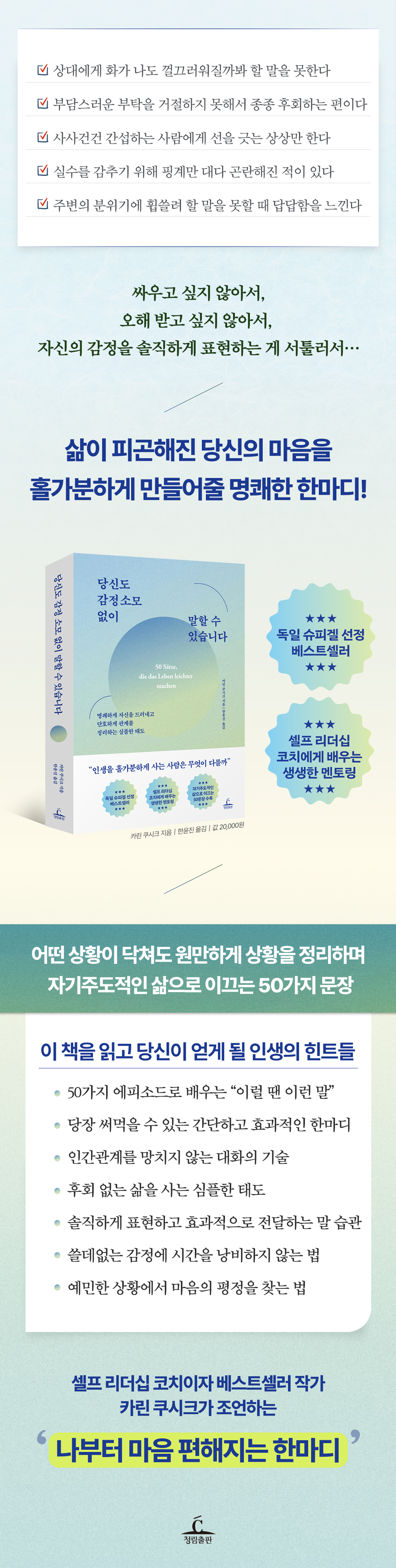
“What makes people who live life with ease different?”
You can convey your point gently and to the point without showing your sharp feelings!
50 Tips to Avoid Dramatic Conflict and Create Peaceful Situations
Bestseller selected by Germany's Der Spiegel
Vivid mentoring from a self-leadership coach
Includes 50 sentences that will lead you to a self-directed life.
As we go through life, there will inevitably come moments when our emotions become intense.
Sometimes we get hurt when we can't deal with the unexpected rude remarks of others, and sometimes we get angry but hold back what we want to say for fear of hurting the other person's feelings.
Even when receiving an embarrassing request, there are times when you have a hard time refusing or hesitate and are unable to properly express your honest feelings.
If you don't convey what you want to say to the other person clearly, you will end up getting tired yourself.
When faced with life's various twists and turns or dramatic situations, is there a way to resolve them with clarity and ease, without having to deal with them emotionally?
This book provides 50 effective phrases that can help you take control of any situation.
The author, who has been a self-leadership coaching expert in Germany for 22 years, sets up various problem situations based on his own experiences as well as the stories of those who have shared their concerns, and advises on resolving them with simple and wise words.
When I first understand my own feelings and honestly convey what I want to say, I can persuade the other person without hurting their feelings or misunderstandings.
Also, through this process, you will become more mature internally and be able to skillfully lead a conversation with anyone.
If you're tired of life because you don't want to fight, don't want to be misunderstood, or find it difficult to express your feelings honestly, try practicing the 50 phrases suggested in this book.
You will be able to quickly resolve any situation you encounter, and your life will become much easier.
You can convey your point gently and to the point without showing your sharp feelings!
50 Tips to Avoid Dramatic Conflict and Create Peaceful Situations
Bestseller selected by Germany's Der Spiegel
Vivid mentoring from a self-leadership coach
Includes 50 sentences that will lead you to a self-directed life.
As we go through life, there will inevitably come moments when our emotions become intense.
Sometimes we get hurt when we can't deal with the unexpected rude remarks of others, and sometimes we get angry but hold back what we want to say for fear of hurting the other person's feelings.
Even when receiving an embarrassing request, there are times when you have a hard time refusing or hesitate and are unable to properly express your honest feelings.
If you don't convey what you want to say to the other person clearly, you will end up getting tired yourself.
When faced with life's various twists and turns or dramatic situations, is there a way to resolve them with clarity and ease, without having to deal with them emotionally?
This book provides 50 effective phrases that can help you take control of any situation.
The author, who has been a self-leadership coaching expert in Germany for 22 years, sets up various problem situations based on his own experiences as well as the stories of those who have shared their concerns, and advises on resolving them with simple and wise words.
When I first understand my own feelings and honestly convey what I want to say, I can persuade the other person without hurting their feelings or misunderstandings.
Also, through this process, you will become more mature internally and be able to skillfully lead a conversation with anyone.
If you're tired of life because you don't want to fight, don't want to be misunderstood, or find it difficult to express your feelings honestly, try practicing the 50 phrases suggested in this book.
You will be able to quickly resolve any situation you encounter, and your life will become much easier.
- You can preview some of the book's contents.
Preview
index
Prologue: 50 Tips to Make Your Life Easier
Part 1: Expressing My Feelings Honestly
01 I decide who will make me angry
02 I'm not doing this to fight you, I'm doing it for me
03 I admire that about you
04 I completely understand you, and what I want is a little different.
05 I don't know
06 I want to have some time alone now.
07 If I didn't do that, I wouldn't have been able to endure it.
08 Everything sounds logical, but my feelings advise something different.
I got the time wrong
Part 2: Make sure to convey what you want to say clearly.
10 'Want' is the same as 'Have to'
11 I don't think it's my responsibility
12 I just realized I'm not interested in this topic
13 I'm not sure what that means
14 When someone points a finger, the other finger points back at him.
15 I think it's your problem
16 I think it's about you, not me.
17 I will not grant you such a privilege.
18 I don't even want to support your weak side.
Part 3: How to Build Self-Directed Relationships
19 I hope you get better soon
20 'I don't know' means 'no'
21 I'm truly sorry if I gave you the impression that you could speak to me in that way.
22 I don't want to make time for that right now.
23 Let's finish this first
24 The decision was overturned
25 Now I want to face myself
26 I want to remain a professional in this field.
27 I have too much to do that…
Part 4 If you want to resolve misunderstandings and conflicts amicably
28 I'm sorry
29 I'd rather not make promises now.
30 As I said
31 Let's acknowledge the differences!
32 I understand fully
33 We just don't fit
34 I fully understand
35 Fortunately
36 Thank you for your compliments
37 My best is only meaningful if you do your best too.
38 You are right
Part 5: The Art of Conversation for Inner Growth
39 First, I need to forgive myself.
40 No need to worry
41 I was wrong
42 It was just like that originally
43 I want to be happier for you
44 I'll just do this here
45 I won't take it personally
46 Don't talk about people, share your opinions with them.
47 I don't know at all, so I'm trying it now.
48 The choice is always yours
49 Okay, let's hear what you have to say.
50 Then I'll just pass it over lightly
Epilogue: Change Comes When Honesty Becomes a Habit
Part 1: Expressing My Feelings Honestly
01 I decide who will make me angry
02 I'm not doing this to fight you, I'm doing it for me
03 I admire that about you
04 I completely understand you, and what I want is a little different.
05 I don't know
06 I want to have some time alone now.
07 If I didn't do that, I wouldn't have been able to endure it.
08 Everything sounds logical, but my feelings advise something different.
I got the time wrong
Part 2: Make sure to convey what you want to say clearly.
10 'Want' is the same as 'Have to'
11 I don't think it's my responsibility
12 I just realized I'm not interested in this topic
13 I'm not sure what that means
14 When someone points a finger, the other finger points back at him.
15 I think it's your problem
16 I think it's about you, not me.
17 I will not grant you such a privilege.
18 I don't even want to support your weak side.
Part 3: How to Build Self-Directed Relationships
19 I hope you get better soon
20 'I don't know' means 'no'
21 I'm truly sorry if I gave you the impression that you could speak to me in that way.
22 I don't want to make time for that right now.
23 Let's finish this first
24 The decision was overturned
25 Now I want to face myself
26 I want to remain a professional in this field.
27 I have too much to do that…
Part 4 If you want to resolve misunderstandings and conflicts amicably
28 I'm sorry
29 I'd rather not make promises now.
30 As I said
31 Let's acknowledge the differences!
32 I understand fully
33 We just don't fit
34 I fully understand
35 Fortunately
36 Thank you for your compliments
37 My best is only meaningful if you do your best too.
38 You are right
Part 5: The Art of Conversation for Inner Growth
39 First, I need to forgive myself.
40 No need to worry
41 I was wrong
42 It was just like that originally
43 I want to be happier for you
44 I'll just do this here
45 I won't take it personally
46 Don't talk about people, share your opinions with them.
47 I don't know at all, so I'm trying it now.
48 The choice is always yours
49 Okay, let's hear what you have to say.
50 Then I'll just pass it over lightly
Epilogue: Change Comes When Honesty Becomes a Habit
Detailed image
Into the book
Do you want to prevent potential arguments or convey a specific message within yourself? If so, actively incorporate the words in this book into your daily conversations.
Some words are most effective when said alone, and can serve as a reminder of key points.
If you look around, there are many people who seem like giants in terms of the knowledge they have accumulated, but in reality, they are like dwarfs.
It's a sad reality.
So I try to find shortcuts in any situation.
We strive to leverage our knowledge to generate new ideas that will help us cope quickly, reliably, and with greater ease.
That is the theme of this book.
--- p.6 From "Prologue_.50 Tips to Make Your Life Easier"
Do you believe your current emotions are due to your surroundings? Make it clear that such thoughts are all illusions.
In reality, your reaction to your surroundings depends and was dependent on your own personal way.
If you've decided that, from now on, you're going to decide for yourself who and what is allowed to upset you, then you've taken the first step.
--- p.19 From “I Decide Who Will Make Me Angry”, Part 1, Chapter 1
What should we do when someone tries to shift tasks and processes that should be theirs onto us? If we find ourselves in a situation where we're not fully capable of handling it, we should confront this bizarre projection directly and say, "I think it's your problem."
In short, it's a great way to get everything organized in one go.
Moreover, this sentence acts like a litmus paper.
Because the moment you say it to someone, they will know if it is really true.
--- pp.128-129 From “I Think It’s Your Problem”, Part 2, Chapter 15
The moment you admit that “I don’t know” is always a no, if you feel a surge of rejection, or perhaps anger, rising inside you, that’s a sign.
Both are very useful emotions.
This is because the immediate, outburst of “What?” in anger tells us two things: “That’s what I want!” and “Something is blocking my path.”
Once these two things are clear, all objections and reasons can be calmly sorted out.
Then, from that moment on, you can fully admit, “Yes, I want that.”
--- p.165 From “Part 3, Chapter 20, ‘I don’t know’ means ‘no’”
Phrases like “I will keep that in mind,” “I already know,” and “I heard it well” all mean the same thing: “Your expectations have been met.”
So, it all works.
Sometimes people want to hear that you will listen to them.
That alone makes the world almost function properly.
So let's give them what they want.
Then life becomes much easier.
--- p.256-257 From "Part 4, Chapter 32, I Understood"
Anxiety is not visible at first glance.
So the situation becomes more difficult.
Inferiority complexes, such as arrogance, emerge when a person is aggressive or cynical.
There are various ways to disguise this complex.
“I won’t take it personally” is something I would definitely prescribe to everyone involved in this matter.
Perhaps the other person is acting or saying that to themselves, not to you.
--- p.352 From “I Won’t Take It Personally, Part 5, Chapter 45”
What I'm talking about is a change in attitude.
It is a vast plain of enlightenment and power.
Enlightenment becomes powerful only when practiced.
Otherwise, it's just a vague theory.
Therefore, I appeal to you:
I encourage you to try the words in this book, experience their effects firsthand, and be amazed at the changes in reactions from those around you.
Then, there will definitely be a better method or path than the existing one.
Some words are most effective when said alone, and can serve as a reminder of key points.
If you look around, there are many people who seem like giants in terms of the knowledge they have accumulated, but in reality, they are like dwarfs.
It's a sad reality.
So I try to find shortcuts in any situation.
We strive to leverage our knowledge to generate new ideas that will help us cope quickly, reliably, and with greater ease.
That is the theme of this book.
--- p.6 From "Prologue_.50 Tips to Make Your Life Easier"
Do you believe your current emotions are due to your surroundings? Make it clear that such thoughts are all illusions.
In reality, your reaction to your surroundings depends and was dependent on your own personal way.
If you've decided that, from now on, you're going to decide for yourself who and what is allowed to upset you, then you've taken the first step.
--- p.19 From “I Decide Who Will Make Me Angry”, Part 1, Chapter 1
What should we do when someone tries to shift tasks and processes that should be theirs onto us? If we find ourselves in a situation where we're not fully capable of handling it, we should confront this bizarre projection directly and say, "I think it's your problem."
In short, it's a great way to get everything organized in one go.
Moreover, this sentence acts like a litmus paper.
Because the moment you say it to someone, they will know if it is really true.
--- pp.128-129 From “I Think It’s Your Problem”, Part 2, Chapter 15
The moment you admit that “I don’t know” is always a no, if you feel a surge of rejection, or perhaps anger, rising inside you, that’s a sign.
Both are very useful emotions.
This is because the immediate, outburst of “What?” in anger tells us two things: “That’s what I want!” and “Something is blocking my path.”
Once these two things are clear, all objections and reasons can be calmly sorted out.
Then, from that moment on, you can fully admit, “Yes, I want that.”
--- p.165 From “Part 3, Chapter 20, ‘I don’t know’ means ‘no’”
Phrases like “I will keep that in mind,” “I already know,” and “I heard it well” all mean the same thing: “Your expectations have been met.”
So, it all works.
Sometimes people want to hear that you will listen to them.
That alone makes the world almost function properly.
So let's give them what they want.
Then life becomes much easier.
--- p.256-257 From "Part 4, Chapter 32, I Understood"
Anxiety is not visible at first glance.
So the situation becomes more difficult.
Inferiority complexes, such as arrogance, emerge when a person is aggressive or cynical.
There are various ways to disguise this complex.
“I won’t take it personally” is something I would definitely prescribe to everyone involved in this matter.
Perhaps the other person is acting or saying that to themselves, not to you.
--- p.352 From “I Won’t Take It Personally, Part 5, Chapter 45”
What I'm talking about is a change in attitude.
It is a vast plain of enlightenment and power.
Enlightenment becomes powerful only when practiced.
Otherwise, it's just a vague theory.
Therefore, I appeal to you:
I encourage you to try the words in this book, experience their effects firsthand, and be amazed at the changes in reactions from those around you.
Then, there will definitely be a better method or path than the existing one.
--- pp.389-390 「Epilogue--- pp. Change comes when honesty becomes a habit」 from
Publisher's Review
Life's problems can be solved with a simple word.
_ 'Me-Message' to reduce time wasted on worries and regrets
As we live, we often encounter situations where we later regret or blame ourselves, thinking, “I should have said that back then.”
There may be things you wanted to say but couldn't think of at the time, or you may want to get angry but avoid making a big deal out of it, so you may end up feeling more emotionally distressed than the person who made you feel bad.
If anger builds up in your heart, you will misunderstand the other person, and eventually the relationship will become irreparably damaged.
Why can't we apply the obvious truths of "Be honest about your feelings" and "Be clear about what you want to say" to real-life situations? Why do we feel like we're losing out when we're simply being considerate of the other person and holding back on what we want to say?
The author suggests using 'I-messages' as an effective solution.
If the owner of a store you frequent won't stop talking about his personal life and you don't want to know, how would you respond? Would you be patient, smile kindly, and agree with every word? That's not a good solution.
Instead, say, “I’m sorry.
I'm not in a position to talk right now.
If you say, “I want to take a break,” he will stop talking immediately.
Meanwhile, what if you're suddenly assigned a new, unrelated task during an important meeting at work? In such a situation, you need to muster up the courage to say, "I don't think this is something I should be responsible for."
Let's say firmly, "I have nothing to do with that business."
If you respond clearly in this 'I-message' order, you can solve the problem without much effort.
A wise attitude that doesn't lose me determines the difficulty of life.
_ Self-directed response to calm down and resolve anger
I can't feel good about someone who does something wrong to me, loses control, gets angry, and acts shamelessly.
In this situation, if you think, 'Why is that person attacking me?', you will likely get angry and get swept up in the situation.
If you stop feeling agitated and accept it as a suggestion rather than an attack, new opportunities will open up.
You can control your own angry feelings and look at the person expressing his or her emotions properly.
If you approach the other person in a detached manner, you may be able to avoid getting caught up in the confusion and try to resolve it in a different way.
There comes a time when everyone loses their composure.
When you meet a rude person who doesn't hesitate to 'bully' you, when you have to wait in a long line at a popular restaurant and they cut in front of you, when you have to clean up a problem caused by someone else's mistake...
Of course, it's a situation where you can't help but get angry, but since emotions are reactions that arise from each person's thoughts, let's start by trying to find some space for ourselves.
The author advises that it helps to believe in yourself and be clear about your intentions.
When you calmly and calmly express your sincerity and generosity to someone who is provoking your anger, you can become a problem solver who can dominate the situation.
If you have the mindset that “I can decide who gets angry at me,” you can live a life of your own.
Change comes when honesty becomes a habit.
_ The art of conversation that eliminates worries and leads to inner growth
We don't want to seem incompetent, so we try to hide our mistakes or avoid pointing them out ourselves.
This is because I am very afraid that if I admit my mistakes, others may attack me.
For example, if you cause financial damage to your company due to a wrong decision, and you try to avoid responsibility by using vague language, you will inevitably lose the trust of your colleagues, and you will also waste the time of unrelated people in the process of recovering from the loss.
In times like these, be honest and say, “I’m sorry.
It is much more effective to admit your mistakes by saying, “My decision was wrong.”
Speaking out about uncomfortable things is not a 'failure'.
Rather, it can be more beneficial to you, help you make courageous decisions, and even lead to inner growth.
The author advises not to allow little things to ruin great happiness.
I also recommend that you apply at least 4 or 5 of the 50 sentences in this book to your daily life.
Putting your will into action is harder than you think.
However, in order to properly convey what you want to say without emotional exhaustion at a crucial moment, it is important to practice in everyday life.
Try substituting any sentence from this book into a variety of situations, from conversations with close friends, family, and coworkers to conversations with strangers you've never met before.
With just a little courage, you can live life more freely, avoid being swept up in complex situations, and live a life in your own hands.
_ 'Me-Message' to reduce time wasted on worries and regrets
As we live, we often encounter situations where we later regret or blame ourselves, thinking, “I should have said that back then.”
There may be things you wanted to say but couldn't think of at the time, or you may want to get angry but avoid making a big deal out of it, so you may end up feeling more emotionally distressed than the person who made you feel bad.
If anger builds up in your heart, you will misunderstand the other person, and eventually the relationship will become irreparably damaged.
Why can't we apply the obvious truths of "Be honest about your feelings" and "Be clear about what you want to say" to real-life situations? Why do we feel like we're losing out when we're simply being considerate of the other person and holding back on what we want to say?
The author suggests using 'I-messages' as an effective solution.
If the owner of a store you frequent won't stop talking about his personal life and you don't want to know, how would you respond? Would you be patient, smile kindly, and agree with every word? That's not a good solution.
Instead, say, “I’m sorry.
I'm not in a position to talk right now.
If you say, “I want to take a break,” he will stop talking immediately.
Meanwhile, what if you're suddenly assigned a new, unrelated task during an important meeting at work? In such a situation, you need to muster up the courage to say, "I don't think this is something I should be responsible for."
Let's say firmly, "I have nothing to do with that business."
If you respond clearly in this 'I-message' order, you can solve the problem without much effort.
A wise attitude that doesn't lose me determines the difficulty of life.
_ Self-directed response to calm down and resolve anger
I can't feel good about someone who does something wrong to me, loses control, gets angry, and acts shamelessly.
In this situation, if you think, 'Why is that person attacking me?', you will likely get angry and get swept up in the situation.
If you stop feeling agitated and accept it as a suggestion rather than an attack, new opportunities will open up.
You can control your own angry feelings and look at the person expressing his or her emotions properly.
If you approach the other person in a detached manner, you may be able to avoid getting caught up in the confusion and try to resolve it in a different way.
There comes a time when everyone loses their composure.
When you meet a rude person who doesn't hesitate to 'bully' you, when you have to wait in a long line at a popular restaurant and they cut in front of you, when you have to clean up a problem caused by someone else's mistake...
Of course, it's a situation where you can't help but get angry, but since emotions are reactions that arise from each person's thoughts, let's start by trying to find some space for ourselves.
The author advises that it helps to believe in yourself and be clear about your intentions.
When you calmly and calmly express your sincerity and generosity to someone who is provoking your anger, you can become a problem solver who can dominate the situation.
If you have the mindset that “I can decide who gets angry at me,” you can live a life of your own.
Change comes when honesty becomes a habit.
_ The art of conversation that eliminates worries and leads to inner growth
We don't want to seem incompetent, so we try to hide our mistakes or avoid pointing them out ourselves.
This is because I am very afraid that if I admit my mistakes, others may attack me.
For example, if you cause financial damage to your company due to a wrong decision, and you try to avoid responsibility by using vague language, you will inevitably lose the trust of your colleagues, and you will also waste the time of unrelated people in the process of recovering from the loss.
In times like these, be honest and say, “I’m sorry.
It is much more effective to admit your mistakes by saying, “My decision was wrong.”
Speaking out about uncomfortable things is not a 'failure'.
Rather, it can be more beneficial to you, help you make courageous decisions, and even lead to inner growth.
The author advises not to allow little things to ruin great happiness.
I also recommend that you apply at least 4 or 5 of the 50 sentences in this book to your daily life.
Putting your will into action is harder than you think.
However, in order to properly convey what you want to say without emotional exhaustion at a crucial moment, it is important to practice in everyday life.
Try substituting any sentence from this book into a variety of situations, from conversations with close friends, family, and coworkers to conversations with strangers you've never met before.
With just a little courage, you can live life more freely, avoid being swept up in complex situations, and live a life in your own hands.
GOODS SPECIFICS
- Date of issue: January 24, 2025
- Page count, weight, size: 400 pages | 634g | 145*210*26mm
- ISBN13: 9788935214679
- ISBN10: 8935214671
You may also like
카테고리
korean


korean

![GQ KOREA Mark (Monthly): December [2025]](http://librairie.coreenne.fr/cdn/shop/files/8ef265dbbfbf186523ed75ba7319009d.jpg?v=1765340328&width=3840)


