

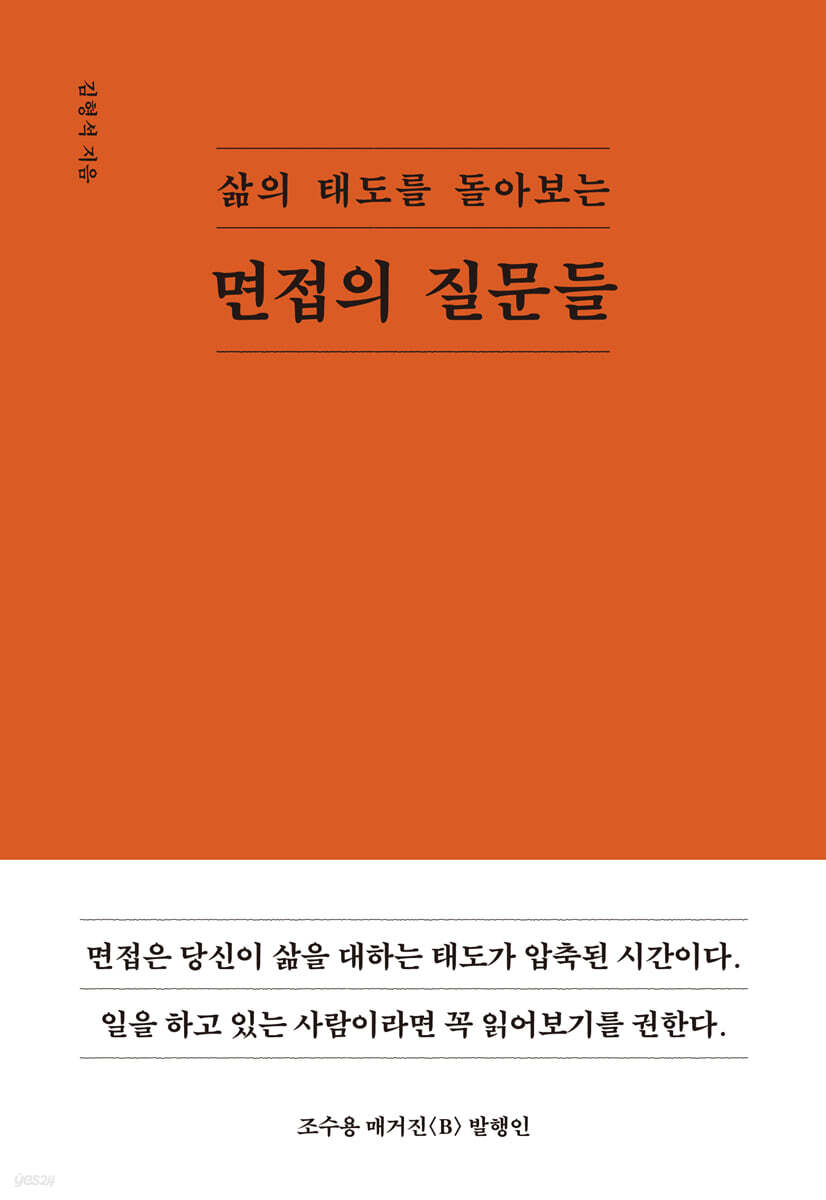
Interview questions
 |
Description
Book Introduction
Through the mirror called interview
A very original book that makes me reflect on work, my work attitude, and myself.
Diversity CEO Kim Hyung-seok, who has gained great sympathy from office workers by posting on LinkedIn his experience working at large corporations such as LG Electronics, Naver, Facebook, and Kakao, as well as his observations of his superiors, colleagues, and team members, recorded over 1.7 million impressions in just two months, talks about the meaning of work and attitudes toward work through the mirror of an interview.
This book has a unique structure, unfolding over time from the interview's beginning, when the interviewer asks the first question, through the conversation, and until the interview ends.
This book has the advantage of providing a sense of immersion by allowing readers to visualize the interview situation in their minds, but readers who have actually decided to change jobs and are preparing for an interview can also use this book as a simulation model.
By identifying what to keep in mind and what to pay attention to at each step, you will be able to avoid unnecessary mistakes.
Jo Soo-yong, publisher of magazine [B], recommended the book, saying, “An interview is a compressed time of your attitude toward life,” and “I highly recommend this book to anyone who is working.” Former Kakao CEO Yeo Min-soo explained his recommendation, saying, “It’s just a story written using the format and medium of an ‘interview,’ but what he really wanted to say was, as expected, stories about ‘attitudes toward work, people you want to work with, and the definition of being good at work. ’”
A very original book that makes me reflect on work, my work attitude, and myself.
Diversity CEO Kim Hyung-seok, who has gained great sympathy from office workers by posting on LinkedIn his experience working at large corporations such as LG Electronics, Naver, Facebook, and Kakao, as well as his observations of his superiors, colleagues, and team members, recorded over 1.7 million impressions in just two months, talks about the meaning of work and attitudes toward work through the mirror of an interview.
This book has a unique structure, unfolding over time from the interview's beginning, when the interviewer asks the first question, through the conversation, and until the interview ends.
This book has the advantage of providing a sense of immersion by allowing readers to visualize the interview situation in their minds, but readers who have actually decided to change jobs and are preparing for an interview can also use this book as a simulation model.
By identifying what to keep in mind and what to pay attention to at each step, you will be able to avoid unnecessary mistakes.
Jo Soo-yong, publisher of magazine [B], recommended the book, saying, “An interview is a compressed time of your attitude toward life,” and “I highly recommend this book to anyone who is working.” Former Kakao CEO Yeo Min-soo explained his recommendation, saying, “It’s just a story written using the format and medium of an ‘interview,’ but what he really wanted to say was, as expected, stories about ‘attitudes toward work, people you want to work with, and the definition of being good at work. ’”
- You can preview some of the book's contents.
Preview
index
Prologue: What is an Interview?
[The interview begins]
Two questions that form the backbone of the interview
Why this company?
All questions are interconnected
Answering honestly
There is no right answer
[When the interview begins in earnest]
Why do interviews start with self-introductions?
Could you please explain the work you were responsible for?
After hearing about your responsibilities, what questions will the interviewer ask?
Have you ever experienced failure?
How much effort did you put in?
Have you tried our products?
What if we don't hire you?
Don't be negative
Ask what you don't know
Tiki-taka is more important than you think.
[If there is a moment of tension]
When will the interview result be decided?
What will the interviewer ask about my career?
What does length of service mean?
If you change to a different industry or job
What if there is a gap in your career?
How much influence do schools and departments have?
Money Talk
What's different about the final interview?
If you are new…
[Maybe to tell this story]
Have you ever been completely absorbed in something?
When do you feel like working?
What is most important?
[Interview Conclusion]
Do you have any questions?
Let's look back at the interview
A little more comfortable, a little more enjoyable
[The interview begins]
Two questions that form the backbone of the interview
Why this company?
All questions are interconnected
Answering honestly
There is no right answer
[When the interview begins in earnest]
Why do interviews start with self-introductions?
Could you please explain the work you were responsible for?
After hearing about your responsibilities, what questions will the interviewer ask?
Have you ever experienced failure?
How much effort did you put in?
Have you tried our products?
What if we don't hire you?
Don't be negative
Ask what you don't know
Tiki-taka is more important than you think.
[If there is a moment of tension]
When will the interview result be decided?
What will the interviewer ask about my career?
What does length of service mean?
If you change to a different industry or job
What if there is a gap in your career?
How much influence do schools and departments have?
Money Talk
What's different about the final interview?
If you are new…
[Maybe to tell this story]
Have you ever been completely absorbed in something?
When do you feel like working?
What is most important?
[Interview Conclusion]
Do you have any questions?
Let's look back at the interview
A little more comfortable, a little more enjoyable
Detailed image

Into the book
As for the reason for changing jobs, it is best for the applicant to take sufficient time to think of a reason that is convincing from the interviewer's perspective.
Rather than lying or trying to make things up, it's important to clearly define what you're thirsty for, what efforts you've made to address it, and what's most important to you now as you look for a new job.
---From "Two Questions That Form the Backbone of an Interview"
Rather than trying to pretend to be someone you're not, it's better to answer honestly.
It's better to actively reveal your personality, abilities, and values, and see if the interviewer can recognize those values.
Interviews are a process by which the company selects applicants, but they are also a process by which applicants evaluate the company.
First, let's think about what honesty is.
Being 'honest' doesn't mean you can say whatever comes to mind.
Just as being 'free' does not mean being able to do whatever one wants without any restrictions, there should be no misunderstanding about being honest.
---From "Answering Honestly"
There are some principles to follow to take control of the interview.
The point is, you should never memorize your self-introduction.
As I mentioned before, an interview is bound to be a nerve-wracking situation for anyone.
Unless it's performed by highly trained, professional actors, a 'memorized story' has no life.
The pressure to say exactly what you've memorized causes you to unconsciously recite your lines stiffly like a robot, and if you can't remember the script, you become speechless.
If you are not confident in what you have memorized, your voice will become quieter and slower, which will break the interviewer's concentration.
The exact opposite of what happens when you try to get someone's attention.
---From "Why do interviews start with self-introductions?"
The same goes for work.
If you don't understand the work instructions, it's better to think about the meaning and content of the instructions and ask questions again rather than just starting.
Unless it's an exceptional situation that requires urgent action, the surest way to know when you're not sure is to ask.
When you don't know something, don't pretend to know it.
You can find out what the interviewer wants to ask by asking questions.
If necessary, you can ask for understanding by saying, "Can I think about it for a moment and then tell you?"
No interviewer will respond with, 'No, you have to answer right away.'
---From "Ask What You Don't Know"
Interviews usually last from 30 minutes to an hour.
It certainly isn't a long time to fully understand a person.
However, first judgments about applicants are often made within about 10 minutes.
Of course, this does not mean that the decision is final.
This is because the decision on pass/fail is finalized after the interviewers gather and discuss their opinions after the individual interviews are over.
But in each interview, the interviewer's mind is made up much earlier than the applicant thinks.
---From "When will the interview result be decided?"
On the other hand, people who think that 'work is originally fun' stop for a moment and think when they feel that it is no longer fun.
Check to see what changes have occurred, why you feel that way, and what is distracting you from concentrating.
You think about how to get out of that situation and get back to a 'happy state', make hypotheses, put them into practice, and then review them.
When you work this way and reflect on yourself, you realize one important thing.
You will discover the difference between an environment where you can concentrate on work and one where you cannot.
Rather than lying or trying to make things up, it's important to clearly define what you're thirsty for, what efforts you've made to address it, and what's most important to you now as you look for a new job.
---From "Two Questions That Form the Backbone of an Interview"
Rather than trying to pretend to be someone you're not, it's better to answer honestly.
It's better to actively reveal your personality, abilities, and values, and see if the interviewer can recognize those values.
Interviews are a process by which the company selects applicants, but they are also a process by which applicants evaluate the company.
First, let's think about what honesty is.
Being 'honest' doesn't mean you can say whatever comes to mind.
Just as being 'free' does not mean being able to do whatever one wants without any restrictions, there should be no misunderstanding about being honest.
---From "Answering Honestly"
There are some principles to follow to take control of the interview.
The point is, you should never memorize your self-introduction.
As I mentioned before, an interview is bound to be a nerve-wracking situation for anyone.
Unless it's performed by highly trained, professional actors, a 'memorized story' has no life.
The pressure to say exactly what you've memorized causes you to unconsciously recite your lines stiffly like a robot, and if you can't remember the script, you become speechless.
If you are not confident in what you have memorized, your voice will become quieter and slower, which will break the interviewer's concentration.
The exact opposite of what happens when you try to get someone's attention.
---From "Why do interviews start with self-introductions?"
The same goes for work.
If you don't understand the work instructions, it's better to think about the meaning and content of the instructions and ask questions again rather than just starting.
Unless it's an exceptional situation that requires urgent action, the surest way to know when you're not sure is to ask.
When you don't know something, don't pretend to know it.
You can find out what the interviewer wants to ask by asking questions.
If necessary, you can ask for understanding by saying, "Can I think about it for a moment and then tell you?"
No interviewer will respond with, 'No, you have to answer right away.'
---From "Ask What You Don't Know"
Interviews usually last from 30 minutes to an hour.
It certainly isn't a long time to fully understand a person.
However, first judgments about applicants are often made within about 10 minutes.
Of course, this does not mean that the decision is final.
This is because the decision on pass/fail is finalized after the interviewers gather and discuss their opinions after the individual interviews are over.
But in each interview, the interviewer's mind is made up much earlier than the applicant thinks.
---From "When will the interview result be decided?"
On the other hand, people who think that 'work is originally fun' stop for a moment and think when they feel that it is no longer fun.
Check to see what changes have occurred, why you feel that way, and what is distracting you from concentrating.
You think about how to get out of that situation and get back to a 'happy state', make hypotheses, put them into practice, and then review them.
When you work this way and reflect on yourself, you realize one important thing.
You will discover the difference between an environment where you can concentrate on work and one where you cannot.
---From "When do you feel like working?"
Publisher's Review
Through the mirror called interview
It makes me reflect on work, my work attitude, and myself.
A very original book
Diversity CEO Kim Hyung-seok, who has gained great sympathy from office workers by posting on LinkedIn his experience working at large corporations such as LG Electronics, Naver, Facebook, and Kakao, as well as his observations of his superiors, colleagues, and team members, recorded over 1.7 million impressions in just two months, talks about the meaning of work and attitudes toward work through the mirror of an interview.
An interview is a process that companies use when hiring, and it is a place where two people with a common goal meet from different perspectives.
Applicants talk about their values and capabilities, and the interviewer determines whether the applicant is a good fit for the position and what role they would play if they worked together.
Interviewers and applicants build mutual understanding and bridge the gap through a question-and-answer format of conversation.
"Interview Questions" guides applicants, especially those with experience, to think about themselves and their work by looking at the interview situation from a third-party perspective.
An interview is not a time to fool yourself into thinking you're going to get into a certain company, but rather a time to think deeply about why you want to leave your previous company and find a new one, and then tell someone about your understanding of that.
And in the process, you will naturally be able to reflect on the essence of work, what it means to do a good job, and even your own attitude toward work and life.
This book has a unique structure, unfolding over time from the interview's beginning, when the interviewer asks the first question, through the conversation, and until the interview ends.
This book has the advantage of providing a sense of immersion by allowing readers to visualize the interview situation in their minds, but readers who have actually decided to change jobs and are preparing for an interview can also use this book as a simulation model.
By identifying what to keep in mind and what to pay attention to at each step, you will be able to avoid unnecessary mistakes.
Magazine [B] publisher Cho Su-yong recommended the book, saying, “An interview is a compressed time of your attitude toward life,” and “I highly recommend this book to anyone who is working.” Former Kakao CEO Yeo Min-soo explained his recommendation, saying, “It’s just a story written using the format and medium of an ‘interview,’ but what he really wanted to say was, as expected, stories about ‘attitudes toward work, people you want to work with, and the definition of being good at work. ’”
In his first book, "Interview Questions," author Kim Hyung-seok successfully weaves the easily overlooked moments of an interview into a unique work-related essay from his own perspective.
That's why his second book is so anticipated.
It makes me reflect on work, my work attitude, and myself.
A very original book
Diversity CEO Kim Hyung-seok, who has gained great sympathy from office workers by posting on LinkedIn his experience working at large corporations such as LG Electronics, Naver, Facebook, and Kakao, as well as his observations of his superiors, colleagues, and team members, recorded over 1.7 million impressions in just two months, talks about the meaning of work and attitudes toward work through the mirror of an interview.
An interview is a process that companies use when hiring, and it is a place where two people with a common goal meet from different perspectives.
Applicants talk about their values and capabilities, and the interviewer determines whether the applicant is a good fit for the position and what role they would play if they worked together.
Interviewers and applicants build mutual understanding and bridge the gap through a question-and-answer format of conversation.
"Interview Questions" guides applicants, especially those with experience, to think about themselves and their work by looking at the interview situation from a third-party perspective.
An interview is not a time to fool yourself into thinking you're going to get into a certain company, but rather a time to think deeply about why you want to leave your previous company and find a new one, and then tell someone about your understanding of that.
And in the process, you will naturally be able to reflect on the essence of work, what it means to do a good job, and even your own attitude toward work and life.
This book has a unique structure, unfolding over time from the interview's beginning, when the interviewer asks the first question, through the conversation, and until the interview ends.
This book has the advantage of providing a sense of immersion by allowing readers to visualize the interview situation in their minds, but readers who have actually decided to change jobs and are preparing for an interview can also use this book as a simulation model.
By identifying what to keep in mind and what to pay attention to at each step, you will be able to avoid unnecessary mistakes.
Magazine [B] publisher Cho Su-yong recommended the book, saying, “An interview is a compressed time of your attitude toward life,” and “I highly recommend this book to anyone who is working.” Former Kakao CEO Yeo Min-soo explained his recommendation, saying, “It’s just a story written using the format and medium of an ‘interview,’ but what he really wanted to say was, as expected, stories about ‘attitudes toward work, people you want to work with, and the definition of being good at work. ’”
In his first book, "Interview Questions," author Kim Hyung-seok successfully weaves the easily overlooked moments of an interview into a unique work-related essay from his own perspective.
That's why his second book is so anticipated.
GOODS SPECIFICS
- Date of issue: November 29, 2024
- Format: Hardcover book binding method guide
- Page count, weight, size: 200 pages | 278g | 128*188*14mm
- ISBN13: 9791193865095
- ISBN10: 1193865093
You may also like
카테고리
korean


korean

![GQ KOREA Mark (Monthly): December [2025]](http://librairie.coreenne.fr/cdn/shop/files/8ef265dbbfbf186523ed75ba7319009d.jpg?v=1765340328&width=3840)


