

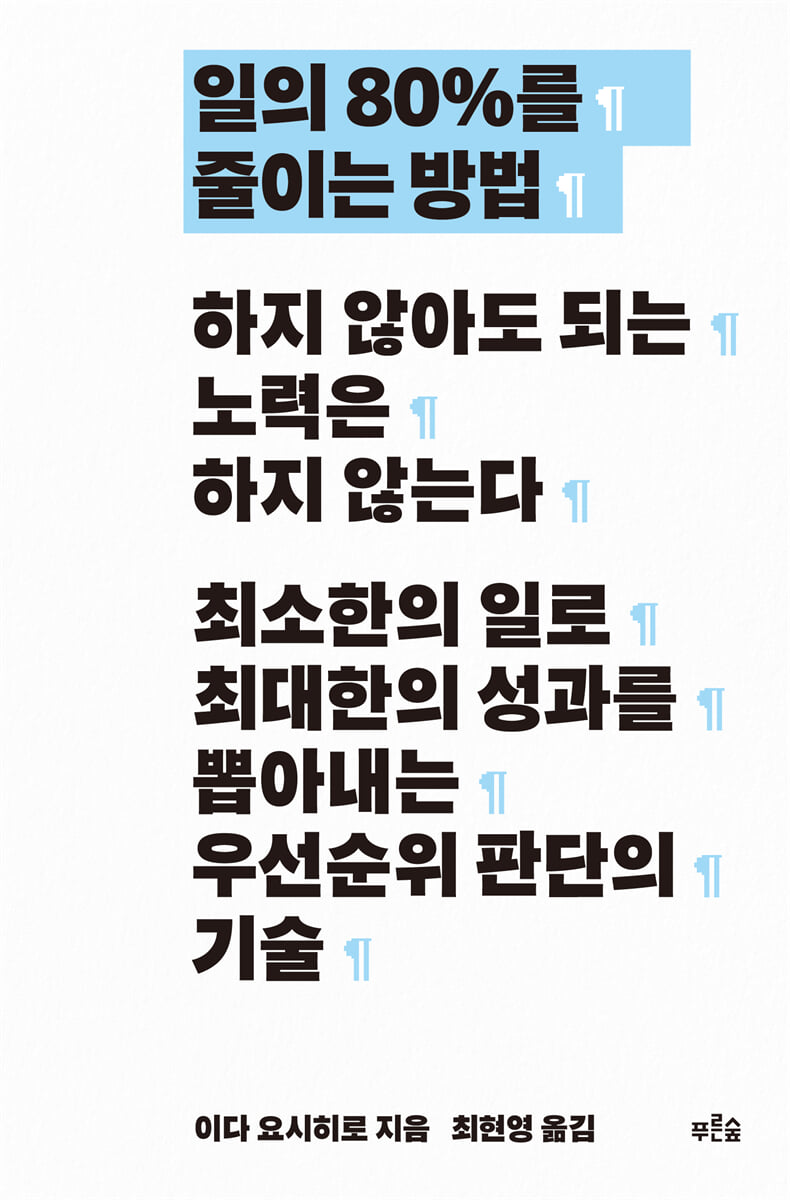
How to reduce work by 80%
 |
Description
Book Introduction
Don't make efforts that don't need to be made.
The art of prioritizing to achieve maximum results with minimal effort
A must-read for hard workers who want to work more efficiently and achieve higher performance, "How to Reduce 80% of Work" has been published by Purunsup Publishing.
This book presents a revolutionary solution that can reduce work by 80%.
The author never argues that we are lacking or incompetent, but rather that we have too much work to do. He teaches us, step by step, the techniques of selection and concentration that will allow us to achieve the best results within a given time with extreme efficiency.
Ultimately, work management is about using limited time efficiently.
When you choose what not to do, it becomes clear what to do.
After reading this book, you will be able to achieve maximum efficiency without wasting time or effort on useless things.
The art of prioritizing to achieve maximum results with minimal effort
A must-read for hard workers who want to work more efficiently and achieve higher performance, "How to Reduce 80% of Work" has been published by Purunsup Publishing.
This book presents a revolutionary solution that can reduce work by 80%.
The author never argues that we are lacking or incompetent, but rather that we have too much work to do. He teaches us, step by step, the techniques of selection and concentration that will allow us to achieve the best results within a given time with extreme efficiency.
Ultimately, work management is about using limited time efficiently.
When you choose what not to do, it becomes clear what to do.
After reading this book, you will be able to achieve maximum efficiency without wasting time or effort on useless things.
- You can preview some of the book's contents.
Preview
index
Prologue: Why You Should Quit 80% of Your Job
The moment I unplugged my desk phone
Letting go of perfectionism frees up time and space in your mind.
A mindset that reduces 80% of your day
Question the premise that "this much should be done."
The Surprising Pitfalls of Perfectionism
Conscientious people tend to take on more effort than necessary.
If you can achieve the same results in a third of the time
Let's start by organizing our bags.
Don't waste energy on low-value tasks
Finish your work while it's fresh
Is it necessary meticulousness or simply selfish greed?
Habit 1: Reduce Your Work by 80%
2. Make a list of things you won't do.
It's not that I'm clueless, it's that I have too much to do.
How to Train Your Power of Choice
Focus on what you want rather than what others expect
The countless benefits of a 'not-to-do list'
Let's get rid of the illusion that we have to do everything.
Habit 2: Reduce Your Work by 80%
3 How to keep things moving forward without stopping
Worried about perfect responses? Speed is key!
The best time to take action is always 'now.'
Why Perfectionists Don't Act Immediately
In my opinion, if the other person agrees with even 20 points, it's a 'passing score'.
Pass the ball as soon as you receive it, don't keep it!
Choose one, discard one
Writing down the pros and cons on paper makes it easier to make a decision.
Don't be bound by your initial judgment
Situations are always changing, so be aware of the 'present moment'.
How to cope when you don't know where to start
Work filtering that delivers maximum results with minimal effort
Goal setting method that serves as a compass for the entire process
Exploiting the desire to be recognized by others
3 Habits to Reduce Your Work by 80%
4 Eliminate switching costs
Anyone who juggles multiple tasks gets tired.
Only one browser tab, no multitasking
Four Ways to Create a Situation That Forces You to Focus
Reduce the number of transitions and bring out your true potential.
How to Create a Work Repository That Will Save You Time
How many work repositories do you currently have?
Paper is 'thrown away', digital is 'keep'
4 Habits to Reduce Your Workload by 80%
5. With a Plan B, you don't have to worry about delays or problems.
Why Foreign Companies Don't Take Issues with Work Delays
No matter how thoroughly you prepare, unexpected situations can occur.
Plan B to save you: Always have an alternative.
Five Backup Methods to Recover from Work Delays
Always pay attention to new methods
Let's proceed with work with confidence through risk management.
Multiple backup plans are better than one.
When working in a team, make sure to reserve some spare time.
5 Habits to Reduce Work by 80%
6. Getting others on your side makes work much easier.
The ability to ask for favors is a great business skill.
The power to rely on others learned while studying abroad in the United States
How to Ask for and Get Help Wisely
Learn the art of refusing while respecting the other person.
People with excellent work skills always focus on 'people'.
Don't arbitrarily assume the other person's intentions.
The "cheat keys" to good collaboration: flexibility and consideration.
6 Habits That Will Reduce Your Work by 80%
7. There's no reason to panic if things don't go as planned.
Having problems is part of the process.
When you need the most honest and fastest choice possible
The more anxious you are, the more polite you should be to yourself as you would to others.
7 Habits That Will Reduce Your Work by 80%
8 Various tools to organize your daily life
Think in the morning, recharge in the afternoon
It's a relief to prepare tomorrow's tasks the night before!
Use a digital calendar to boost your self-esteem.
The savior of forgetful people: the reminder function
Be sure to visualize the process
8 Habits That Will Reduce Your Work by 80%
9 Ways to Use Your Scrap Time to Make a Big Difference
Changing your sense of time can make the impossible possible.
From '24 hours' to '86400 seconds' in a day
Tips to avoid wasting your spare time
Time blocking thinking
9 Habits That Will Reduce Your Work by 80%
Save 10 Hours & Increase Efficiency! Internet Utilization Technology
Use templates and formats as much as possible.
Three Case Studies of Optimizing Daily Work with Templates and Formats
'Register frequently used phrases' and 'Voice input' for quick and easy responses
Let's do our daily tasks smartly.
10 Habits That Will Reduce Your Workload by 80%
Epilogue: Work Management: Making the Most of Limited Time
The moment I unplugged my desk phone
Letting go of perfectionism frees up time and space in your mind.
A mindset that reduces 80% of your day
Question the premise that "this much should be done."
The Surprising Pitfalls of Perfectionism
Conscientious people tend to take on more effort than necessary.
If you can achieve the same results in a third of the time
Let's start by organizing our bags.
Don't waste energy on low-value tasks
Finish your work while it's fresh
Is it necessary meticulousness or simply selfish greed?
Habit 1: Reduce Your Work by 80%
2. Make a list of things you won't do.
It's not that I'm clueless, it's that I have too much to do.
How to Train Your Power of Choice
Focus on what you want rather than what others expect
The countless benefits of a 'not-to-do list'
Let's get rid of the illusion that we have to do everything.
Habit 2: Reduce Your Work by 80%
3 How to keep things moving forward without stopping
Worried about perfect responses? Speed is key!
The best time to take action is always 'now.'
Why Perfectionists Don't Act Immediately
In my opinion, if the other person agrees with even 20 points, it's a 'passing score'.
Pass the ball as soon as you receive it, don't keep it!
Choose one, discard one
Writing down the pros and cons on paper makes it easier to make a decision.
Don't be bound by your initial judgment
Situations are always changing, so be aware of the 'present moment'.
How to cope when you don't know where to start
Work filtering that delivers maximum results with minimal effort
Goal setting method that serves as a compass for the entire process
Exploiting the desire to be recognized by others
3 Habits to Reduce Your Work by 80%
4 Eliminate switching costs
Anyone who juggles multiple tasks gets tired.
Only one browser tab, no multitasking
Four Ways to Create a Situation That Forces You to Focus
Reduce the number of transitions and bring out your true potential.
How to Create a Work Repository That Will Save You Time
How many work repositories do you currently have?
Paper is 'thrown away', digital is 'keep'
4 Habits to Reduce Your Workload by 80%
5. With a Plan B, you don't have to worry about delays or problems.
Why Foreign Companies Don't Take Issues with Work Delays
No matter how thoroughly you prepare, unexpected situations can occur.
Plan B to save you: Always have an alternative.
Five Backup Methods to Recover from Work Delays
Always pay attention to new methods
Let's proceed with work with confidence through risk management.
Multiple backup plans are better than one.
When working in a team, make sure to reserve some spare time.
5 Habits to Reduce Work by 80%
6. Getting others on your side makes work much easier.
The ability to ask for favors is a great business skill.
The power to rely on others learned while studying abroad in the United States
How to Ask for and Get Help Wisely
Learn the art of refusing while respecting the other person.
People with excellent work skills always focus on 'people'.
Don't arbitrarily assume the other person's intentions.
The "cheat keys" to good collaboration: flexibility and consideration.
6 Habits That Will Reduce Your Work by 80%
7. There's no reason to panic if things don't go as planned.
Having problems is part of the process.
When you need the most honest and fastest choice possible
The more anxious you are, the more polite you should be to yourself as you would to others.
7 Habits That Will Reduce Your Work by 80%
8 Various tools to organize your daily life
Think in the morning, recharge in the afternoon
It's a relief to prepare tomorrow's tasks the night before!
Use a digital calendar to boost your self-esteem.
The savior of forgetful people: the reminder function
Be sure to visualize the process
8 Habits That Will Reduce Your Work by 80%
9 Ways to Use Your Scrap Time to Make a Big Difference
Changing your sense of time can make the impossible possible.
From '24 hours' to '86400 seconds' in a day
Tips to avoid wasting your spare time
Time blocking thinking
9 Habits That Will Reduce Your Work by 80%
Save 10 Hours & Increase Efficiency! Internet Utilization Technology
Use templates and formats as much as possible.
Three Case Studies of Optimizing Daily Work with Templates and Formats
'Register frequently used phrases' and 'Voice input' for quick and easy responses
Let's do our daily tasks smartly.
10 Habits That Will Reduce Your Workload by 80%
Epilogue: Work Management: Making the Most of Limited Time
Detailed image

Into the book
At some point, I made a drastic change to how I worked, and not only did my time change, but my life changed 180 degrees.
That's because I learned that 'there's no need to work hard to do everything perfectly on your own.'
"Huh? You're saying I'm not working hard?" Some of you might be taken aback by my words and ask, but this shift in mindset has completely transformed my life.
--- p.12, from the prologue
Until now, I've worked with the motto of "working hard, putting in the effort, putting in the effort," and "working with passion and perseverance." However, what the company required was a "work style that aims to achieve results within a set timeframe."
To fulfill my role, I had to immediately and fundamentally change my way of working and thinking.
--- p.13, from the prologue
However, when I moved to a foreign company, I felt deeply that the old way of working hard and long hours wouldn't work.
Because we were required to deliver results within regular business hours.
To fulfill my role, I needed to fundamentally rethink my work methods and mindset up until then.
As a result, what I realized was that I needed to let go of my 'obsession with perfection.'
That way, I could use the time given to me meaningfully without overexerting myself.
--- p.29, 「1.
From “The mindset that reduces work by 80%”
The thing to keep in mind is the premise that 'if it's not important, don't do it.'
Here, 'important matter' means 'something of great importance or seriousness', 'something of great influence'.
In other words, think of it as 'excluding anything that is not absolutely necessary'.
People who are good at managing work are not necessarily those who have excellent ability to drive things forward.
He is a person who is good at distinguishing between things he 'must do' and things he 'doesn't have to do'.
They pour all their energy into what they want to do and what they have to do, but they don't care about anything else.
--- p.37, 「1.
A mindset that reduces work by 80%
I really hope you all will make this attitude of prioritizing speed your own.
Think of the 'performance value of work' as 'quality of work ÷ time required'.
This means that not only is quality important through flawless work execution, but 'time required' is also important.
Some people might think, 'Then how is this different from doing work roughly (lowering the level of completion)?' But that is not the case at all.
It's not about 'doing things half-heartedly', it's about maintaining the quality of the work required and delivering results as quickly as possible.
The idea is to present what the person requesting the work to you as quickly as possible, in the bare minimum possible form, and then leave it up to the client to decide whether to pass it as is or revise it.
Then, you may realize that you've been taking your work too seriously, and you'll be less likely to get caught up in unnecessary emotions.
--- pp.41-42, 「1.
A mindset that reduces work by 80%
Many people struggle with poor work management, but the root of their problems isn't actually a problem with their work management methods, but simply because they have too much work to do.
Basically, only do critical tasks, that is, tasks that will cause major problems if not done, and that cannot be fixed after the fact.
But before that, there are some countermeasures worth trying.
This is the task of creating a list of things not to do, as introduced in the introduction.
By making this list, you can help yourself narrow down your to-do list.
You don't have to be completely immersed in everything you do.
--- p.54, 「2.
Make a list of things not to do
A characteristic of people who do not respond quickly is that they tend to focus on themselves rather than the other person.
For example, the other party may want a quick response, even if it's just an overview, rather than detailed information like the boss in the example above.
However, people who do not respond immediately prioritize what they want to say, such as being organized and polished, over what the other person wants.
--- pp.71-72, 「3.
How to keep things flowing without stopping
Everyone plans and establishes order and procedures in their daily lives.
However, during this process, it is very important to ask yourself, 'Do I really need this act of preparation?'
If you get stuck in the mindset of 'I'll prepare from ○○ and then start,' you can easily fall into the trap of thinking that you can't start if you're not prepared.
As a result, important tasks that really need to be done are delayed.
--- p.74, 「3.
How to keep things flowing without stopping
If you aim for 70% completion and make an effective presentation, you will ultimately achieve better results than if you aim for 100% completion.
If you recognize that you have perfectionist tendencies, try aiming for an appropriate level that the other person will accept.
That level is roughly a 70 point completion rate.
Rather than aiming for perfection, it is important to aim for a 'reasonable 70 points' and focus on 'making progress on the task' by moving your body.
--- p.79, 「3.
How to keep things flowing without stopping
In fact, when there is a partner, the level of acceptance is more important than the level of satisfaction.
To put it extremely, even if you evaluate yourself as having a score of '20', if the other person agrees with it, that is enough and it is a passing grade.
--- p.80, 「3.
How to keep things flowing without stopping
Of all the people I've met who are highly capable and know the ropes of work, there's one thing they all have in common.
It means not holding on to the work you need to do or the work you have been asked to do by others (called a 'ball') but passing it on immediately.
That is, instead of keeping the ball in your hand, you quickly pass it to the next person.
This will make the overall workflow smoother.
--- p.83, 「3.
How to keep things flowing without stopping
When making plans for anything, people seem to unconsciously harbor somewhat unrealistic expectations of 'hoping it will turn out this way'.
But actually, if you think about it as a natural occurrence, it helps things run much more smoothly.
--- p.210, 「7.
There's no reason to panic if things don't go as planned.
This 'free time' can be transformed into a special time that you can use freely, depending on your mindset.
I often do this exercise in my work and time management training.
If you have a limited amount of time, such as 3 or 10 minutes, think about what you will do with that time.
If you plan out your to-do list in advance, you can do it right away when you have some spare time without having to worry about what to do.
--- p.256, 「9.
How to Use Your Scrap Time to Make a Big Difference
What we should truly pursue is not simply outstanding work ability, but 'our own wise choices.'
It's a choice about what to prioritize and what to discard.
That's because I learned that 'there's no need to work hard to do everything perfectly on your own.'
"Huh? You're saying I'm not working hard?" Some of you might be taken aback by my words and ask, but this shift in mindset has completely transformed my life.
--- p.12, from the prologue
Until now, I've worked with the motto of "working hard, putting in the effort, putting in the effort," and "working with passion and perseverance." However, what the company required was a "work style that aims to achieve results within a set timeframe."
To fulfill my role, I had to immediately and fundamentally change my way of working and thinking.
--- p.13, from the prologue
However, when I moved to a foreign company, I felt deeply that the old way of working hard and long hours wouldn't work.
Because we were required to deliver results within regular business hours.
To fulfill my role, I needed to fundamentally rethink my work methods and mindset up until then.
As a result, what I realized was that I needed to let go of my 'obsession with perfection.'
That way, I could use the time given to me meaningfully without overexerting myself.
--- p.29, 「1.
From “The mindset that reduces work by 80%”
The thing to keep in mind is the premise that 'if it's not important, don't do it.'
Here, 'important matter' means 'something of great importance or seriousness', 'something of great influence'.
In other words, think of it as 'excluding anything that is not absolutely necessary'.
People who are good at managing work are not necessarily those who have excellent ability to drive things forward.
He is a person who is good at distinguishing between things he 'must do' and things he 'doesn't have to do'.
They pour all their energy into what they want to do and what they have to do, but they don't care about anything else.
--- p.37, 「1.
A mindset that reduces work by 80%
I really hope you all will make this attitude of prioritizing speed your own.
Think of the 'performance value of work' as 'quality of work ÷ time required'.
This means that not only is quality important through flawless work execution, but 'time required' is also important.
Some people might think, 'Then how is this different from doing work roughly (lowering the level of completion)?' But that is not the case at all.
It's not about 'doing things half-heartedly', it's about maintaining the quality of the work required and delivering results as quickly as possible.
The idea is to present what the person requesting the work to you as quickly as possible, in the bare minimum possible form, and then leave it up to the client to decide whether to pass it as is or revise it.
Then, you may realize that you've been taking your work too seriously, and you'll be less likely to get caught up in unnecessary emotions.
--- pp.41-42, 「1.
A mindset that reduces work by 80%
Many people struggle with poor work management, but the root of their problems isn't actually a problem with their work management methods, but simply because they have too much work to do.
Basically, only do critical tasks, that is, tasks that will cause major problems if not done, and that cannot be fixed after the fact.
But before that, there are some countermeasures worth trying.
This is the task of creating a list of things not to do, as introduced in the introduction.
By making this list, you can help yourself narrow down your to-do list.
You don't have to be completely immersed in everything you do.
--- p.54, 「2.
Make a list of things not to do
A characteristic of people who do not respond quickly is that they tend to focus on themselves rather than the other person.
For example, the other party may want a quick response, even if it's just an overview, rather than detailed information like the boss in the example above.
However, people who do not respond immediately prioritize what they want to say, such as being organized and polished, over what the other person wants.
--- pp.71-72, 「3.
How to keep things flowing without stopping
Everyone plans and establishes order and procedures in their daily lives.
However, during this process, it is very important to ask yourself, 'Do I really need this act of preparation?'
If you get stuck in the mindset of 'I'll prepare from ○○ and then start,' you can easily fall into the trap of thinking that you can't start if you're not prepared.
As a result, important tasks that really need to be done are delayed.
--- p.74, 「3.
How to keep things flowing without stopping
If you aim for 70% completion and make an effective presentation, you will ultimately achieve better results than if you aim for 100% completion.
If you recognize that you have perfectionist tendencies, try aiming for an appropriate level that the other person will accept.
That level is roughly a 70 point completion rate.
Rather than aiming for perfection, it is important to aim for a 'reasonable 70 points' and focus on 'making progress on the task' by moving your body.
--- p.79, 「3.
How to keep things flowing without stopping
In fact, when there is a partner, the level of acceptance is more important than the level of satisfaction.
To put it extremely, even if you evaluate yourself as having a score of '20', if the other person agrees with it, that is enough and it is a passing grade.
--- p.80, 「3.
How to keep things flowing without stopping
Of all the people I've met who are highly capable and know the ropes of work, there's one thing they all have in common.
It means not holding on to the work you need to do or the work you have been asked to do by others (called a 'ball') but passing it on immediately.
That is, instead of keeping the ball in your hand, you quickly pass it to the next person.
This will make the overall workflow smoother.
--- p.83, 「3.
How to keep things flowing without stopping
When making plans for anything, people seem to unconsciously harbor somewhat unrealistic expectations of 'hoping it will turn out this way'.
But actually, if you think about it as a natural occurrence, it helps things run much more smoothly.
--- p.210, 「7.
There's no reason to panic if things don't go as planned.
This 'free time' can be transformed into a special time that you can use freely, depending on your mindset.
I often do this exercise in my work and time management training.
If you have a limited amount of time, such as 3 or 10 minutes, think about what you will do with that time.
If you plan out your to-do list in advance, you can do it right away when you have some spare time without having to worry about what to do.
--- p.256, 「9.
How to Use Your Scrap Time to Make a Big Difference
What we should truly pursue is not simply outstanding work ability, but 'our own wise choices.'
It's a choice about what to prioritize and what to discard.
--- p.287, from the epilogue
Publisher's Review
“It’s not that you’re incompetent, it’s that you have too much work to do.”
Why does work never seem to decrease no matter how much I do? I have a lot of work to do, yet I'm constantly receiving orders.
Before I knew it, I had a ton of work to do and I was always pressed for time.
Are your feelings of overwork and psychological burden justified? What if working too much, working too hard, and exhausting yourself doesn't help you achieve high performance? In this book, author Yoshihiro Ida clearly defines the problem as not incompetence but overwork. He then proposes an innovative solution: reduce your workload by 80%.
The author has worked with people from diverse cultures in various companies both domestically and internationally, and has held a wide range of positions, from software development projects to marketing leadership.
Currently, we provide over 100 business management consulting services annually.
With this accumulated know-how, this book literally explains everything from 'Why you should reduce your work by 80%' to 'How to reduce your work by 80%'.
From how to efficiently complete a given task to the essential skills of making requests and refusing, we introduce the secrets to achieving peak performance within a given time frame.
“People who are good at their jobs know what they have to do and
“I am a person who is good at distinguishing between things that do not need to be done.”
The author, who was recognized as being honest and hard-working, was faced with a completely new environment when he moved from a venture company to a global company.
The team leader demanded that 'work be finished on time and results be achieved.'
It was a completely different order from my previous job, where attitudes like 'diligence' and 'sincerity' were highly valued.
Afterwards, I completely changed my work methods and way of thinking to adapt to the changed environment and fulfill my given role and achieve results.
If in the past, we pushed forward with the amount of time and effort without hesitation, even working overtime, now the 'performance value of work' is embodied in the formula 'quality of work ÷ time required'.
In other words, the standard changed 180 degrees from pursuing perfection to prioritizing speed.
Then I realized something important that changed my life.
The truth is that people who are good at their jobs are those who can distinguish between things that must be done and things that do not need to be done.
In order to achieve results within a given timeframe, the 'skill of prioritization' to achieve maximum results with minimum effort was essential.
Just putting in as much time and effort as possible doesn't necessarily lead to good results.
All it took was determination.
Let's make 'One Touch Pass' our work motto.
The first rule of prioritization is not to do anything that you don't need to do.
The author says that the idea that one must do everything is a mistake.
It means letting go of all the excessive efforts to do things perfectly or arbitrary standards of 'I should do this much', and setting standards for the people I work with.
I present the minimum requirements to the person who commissioned me to do the work as quickly as possible, and then leave it up to them to decide whether to pass or revise it.
The so-called 'one-touch pass' is the key.
Rather than spending a long time trying to achieve a "perfect 100 points," it's more important to aim for a "good 70 points" and then get started on the task to make progress.
You should never keep the ball in your hand.
It's easy to think that you pass the ball to someone else as soon as you receive it.
That way, work can run smoothly.
When you choose what not to do, it becomes clear what to do.
What we should truly pursue is not simply outstanding work ability, but 'my wise choice.'
It's a choice about what to prioritize and what to discard.
So how can we make wise choices? The author also provides specific instructions on how to create a "not-to-do list" to cultivate the power of choice.
First of all, the premise is the will to quit on your own.
Find something you don't need to do in the first place.
And then we ask the question, 'Why should I do this?'
Especially things you do out of habit are top candidates for the list of things not to do.
It is also important not to force yourself to list things you cannot keep.
Unnecessary pressure does not help performance at all.
When writing a list, it is important to be specific, such as "I will not use social media until OO task is finished," rather than "I will not use social media."
Using this list of things you won't do will help you gain confidence in your ability to take control of your daily life.
Multitasking is just an addiction
To kill two birds with one stone, productivity and performance, you must do only one thing at a time.
Doing multiple tasks at the same time can make you feel like you're doing a good job, but it's all an illusion.
As the smartphone era has passed its 10th year, it is no exaggeration to say that our brains have become accustomed to multitasking.
The author says that multitasking causes the brain to repeatedly switch between tasks, which puts a great burden on the brain.
In other words, ‘switching costs’ are bound to occur.
Multitasking is an addiction that can be difficult to break, but it is something that should be avoided at all costs, as it lowers both productivity and performance.
In this process, it is effective to utilize the '4 ways to create a situation where you have no choice but to concentrate' introduced by the author in the book.
First, identify the factors that interfere with your concentration.
There can be many distractions, such as phone notifications or a messy desk.
Second, set a 20-minute rule.
Set your focus time to suit yourself, but if it's too long, you risk being distracted by other things, so we recommend keeping it under 30 minutes.
Third, similar types of work are grouped together.
Email replies are sent at set times several times a day and all at once.
Fourth, write down any thoughts that suddenly come to mind and deal with them later.
If an idea unrelated to what you're doing comes to mind, just jot it down and then get right back to what you were doing.
This book points out to conscientious perfectionists the "80% of the work you don't need to do" and offers concrete ways to let go of excessive standards and unnecessary tasks.
The author says that it's not that you can't do the work, but that there are too many things you 'think you should do', and that you should question the premise that 'you should do this much'.
It is a textbook on work and time management that will help you achieve maximum results with minimum effort.
Why does work never seem to decrease no matter how much I do? I have a lot of work to do, yet I'm constantly receiving orders.
Before I knew it, I had a ton of work to do and I was always pressed for time.
Are your feelings of overwork and psychological burden justified? What if working too much, working too hard, and exhausting yourself doesn't help you achieve high performance? In this book, author Yoshihiro Ida clearly defines the problem as not incompetence but overwork. He then proposes an innovative solution: reduce your workload by 80%.
The author has worked with people from diverse cultures in various companies both domestically and internationally, and has held a wide range of positions, from software development projects to marketing leadership.
Currently, we provide over 100 business management consulting services annually.
With this accumulated know-how, this book literally explains everything from 'Why you should reduce your work by 80%' to 'How to reduce your work by 80%'.
From how to efficiently complete a given task to the essential skills of making requests and refusing, we introduce the secrets to achieving peak performance within a given time frame.
“People who are good at their jobs know what they have to do and
“I am a person who is good at distinguishing between things that do not need to be done.”
The author, who was recognized as being honest and hard-working, was faced with a completely new environment when he moved from a venture company to a global company.
The team leader demanded that 'work be finished on time and results be achieved.'
It was a completely different order from my previous job, where attitudes like 'diligence' and 'sincerity' were highly valued.
Afterwards, I completely changed my work methods and way of thinking to adapt to the changed environment and fulfill my given role and achieve results.
If in the past, we pushed forward with the amount of time and effort without hesitation, even working overtime, now the 'performance value of work' is embodied in the formula 'quality of work ÷ time required'.
In other words, the standard changed 180 degrees from pursuing perfection to prioritizing speed.
Then I realized something important that changed my life.
The truth is that people who are good at their jobs are those who can distinguish between things that must be done and things that do not need to be done.
In order to achieve results within a given timeframe, the 'skill of prioritization' to achieve maximum results with minimum effort was essential.
Just putting in as much time and effort as possible doesn't necessarily lead to good results.
All it took was determination.
Let's make 'One Touch Pass' our work motto.
The first rule of prioritization is not to do anything that you don't need to do.
The author says that the idea that one must do everything is a mistake.
It means letting go of all the excessive efforts to do things perfectly or arbitrary standards of 'I should do this much', and setting standards for the people I work with.
I present the minimum requirements to the person who commissioned me to do the work as quickly as possible, and then leave it up to them to decide whether to pass or revise it.
The so-called 'one-touch pass' is the key.
Rather than spending a long time trying to achieve a "perfect 100 points," it's more important to aim for a "good 70 points" and then get started on the task to make progress.
You should never keep the ball in your hand.
It's easy to think that you pass the ball to someone else as soon as you receive it.
That way, work can run smoothly.
When you choose what not to do, it becomes clear what to do.
What we should truly pursue is not simply outstanding work ability, but 'my wise choice.'
It's a choice about what to prioritize and what to discard.
So how can we make wise choices? The author also provides specific instructions on how to create a "not-to-do list" to cultivate the power of choice.
First of all, the premise is the will to quit on your own.
Find something you don't need to do in the first place.
And then we ask the question, 'Why should I do this?'
Especially things you do out of habit are top candidates for the list of things not to do.
It is also important not to force yourself to list things you cannot keep.
Unnecessary pressure does not help performance at all.
When writing a list, it is important to be specific, such as "I will not use social media until OO task is finished," rather than "I will not use social media."
Using this list of things you won't do will help you gain confidence in your ability to take control of your daily life.
Multitasking is just an addiction
To kill two birds with one stone, productivity and performance, you must do only one thing at a time.
Doing multiple tasks at the same time can make you feel like you're doing a good job, but it's all an illusion.
As the smartphone era has passed its 10th year, it is no exaggeration to say that our brains have become accustomed to multitasking.
The author says that multitasking causes the brain to repeatedly switch between tasks, which puts a great burden on the brain.
In other words, ‘switching costs’ are bound to occur.
Multitasking is an addiction that can be difficult to break, but it is something that should be avoided at all costs, as it lowers both productivity and performance.
In this process, it is effective to utilize the '4 ways to create a situation where you have no choice but to concentrate' introduced by the author in the book.
First, identify the factors that interfere with your concentration.
There can be many distractions, such as phone notifications or a messy desk.
Second, set a 20-minute rule.
Set your focus time to suit yourself, but if it's too long, you risk being distracted by other things, so we recommend keeping it under 30 minutes.
Third, similar types of work are grouped together.
Email replies are sent at set times several times a day and all at once.
Fourth, write down any thoughts that suddenly come to mind and deal with them later.
If an idea unrelated to what you're doing comes to mind, just jot it down and then get right back to what you were doing.
This book points out to conscientious perfectionists the "80% of the work you don't need to do" and offers concrete ways to let go of excessive standards and unnecessary tasks.
The author says that it's not that you can't do the work, but that there are too many things you 'think you should do', and that you should question the premise that 'you should do this much'.
It is a textbook on work and time management that will help you achieve maximum results with minimum effort.
GOODS SPECIFICS
- Date of issue: September 19, 2024
- Page count, weight, size: 288 pages | 366g | 135*205*19mm
- ISBN13: 9791172540234
You may also like
카테고리
korean


korean

![ELLE 엘르 스페셜 에디션 A형 : 12월 [2025]](http://librairie.coreenne.fr/cdn/shop/files/b8e27a3de6c9538896439686c6b0e8fb.jpg?v=1766436872&width=3840)


