

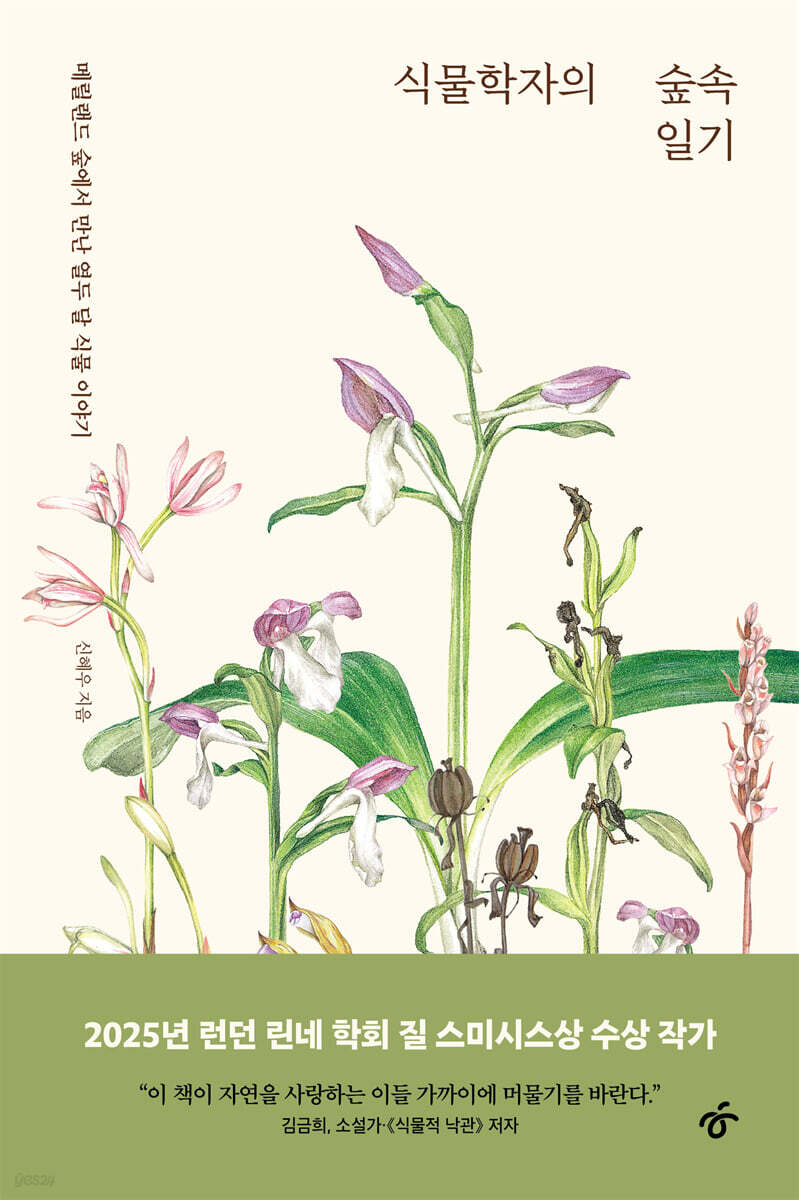
A Botanist's Forest Diary
 |
Description
Book Introduction
★ Books recommended by author Kim Geum-hee
★The first Korean to win the Jill Smithies Award from the Linnean Society of London in 2025
★The first Korean artist to win the gold medal and best exhibition award at the Royal Society of Botanical Arts International Exhibition
“Fungi, rotten branches and fallen leaves, and microorganisms mixed with soil that help orchid growth.
Animals carrying the flowers and pollen of the blooming dogwood trees…
Shin Hye-woo, a botanist who draws pictures
A tender record that reminds us of the beautiful order of nature.
Shin Hye-woo, a botanist who draws and author of “Botanist’s Notes” and “Neighborhood Plant Consultation Center,” has published a new work, “Botanist’s Forest Diary.”
If the previous work conveyed information about plants and the warm wisdom of life learned from them through mystical pictures and delicate writing, this collection of essays tells the story of plants in the four seasons and twelve months of the year in the Maryland forests, where he walked every day while working as a researcher at the Smithsonian Institute in the United States.
You can also see a gorgeously designed four-season plant design by the artist who won the 2025 Linnean Society of London Gill Smithies Medal.
The Jill Smithies Medal is a highly prestigious award given to a botanical artist recognized for excellence in drawing to aid the scientific identification of plants, and this award is the first for a Korean.
The author had previously worked as a researcher in Maryland for a year.
But my memories from that time were all about the lonely and painful life in a foreign land.
Arriving back in Maryland after four years filled with worry and fear, the author encountered a forest that embraced him warmly.
From then on, whenever I felt complicated, I just walked through the forest.
This book is a record of communication with the plants I encountered in the forest.
Because it is a story about forests and plants seen through the eyes of a scholar, its resonance is unique.
As author Kim Geum-hee, who recommended this book, said, he is “a person who knows the scientific processes that occur inside a tree when it decides to discard unnecessary leaves and flowers, and a person who knows the truth behind the phenomenon that when a light snow falls, plants prepare to take off for tomorrow under the comforting protection.”
Therefore, this book can rightly be described as “a gentle record and gentle guide that awakens us to the beautiful order of nature: harmony, connection, and circulation.”
“As we live, we expand our knowledge one by one based on our experiences.
The more experience you have, the broader and easier it is to understand.
Predictions also become easier.
But can nature truly be predicted with human knowledge? We must always keep an open mind when studying nature.
Because nature is complex, vast, and diverse.
I will have to come back here again next year for this orchid, the last of the seventh species.
But that's okay.
I don't think I was unlucky.
“Because this swamp orchid constantly made me realize my own prejudices.” (p. 119)
★The first Korean to win the Jill Smithies Award from the Linnean Society of London in 2025
★The first Korean artist to win the gold medal and best exhibition award at the Royal Society of Botanical Arts International Exhibition
“Fungi, rotten branches and fallen leaves, and microorganisms mixed with soil that help orchid growth.
Animals carrying the flowers and pollen of the blooming dogwood trees…
Shin Hye-woo, a botanist who draws pictures
A tender record that reminds us of the beautiful order of nature.
Shin Hye-woo, a botanist who draws and author of “Botanist’s Notes” and “Neighborhood Plant Consultation Center,” has published a new work, “Botanist’s Forest Diary.”
If the previous work conveyed information about plants and the warm wisdom of life learned from them through mystical pictures and delicate writing, this collection of essays tells the story of plants in the four seasons and twelve months of the year in the Maryland forests, where he walked every day while working as a researcher at the Smithsonian Institute in the United States.
You can also see a gorgeously designed four-season plant design by the artist who won the 2025 Linnean Society of London Gill Smithies Medal.
The Jill Smithies Medal is a highly prestigious award given to a botanical artist recognized for excellence in drawing to aid the scientific identification of plants, and this award is the first for a Korean.
The author had previously worked as a researcher in Maryland for a year.
But my memories from that time were all about the lonely and painful life in a foreign land.
Arriving back in Maryland after four years filled with worry and fear, the author encountered a forest that embraced him warmly.
From then on, whenever I felt complicated, I just walked through the forest.
This book is a record of communication with the plants I encountered in the forest.
Because it is a story about forests and plants seen through the eyes of a scholar, its resonance is unique.
As author Kim Geum-hee, who recommended this book, said, he is “a person who knows the scientific processes that occur inside a tree when it decides to discard unnecessary leaves and flowers, and a person who knows the truth behind the phenomenon that when a light snow falls, plants prepare to take off for tomorrow under the comforting protection.”
Therefore, this book can rightly be described as “a gentle record and gentle guide that awakens us to the beautiful order of nature: harmony, connection, and circulation.”
“As we live, we expand our knowledge one by one based on our experiences.
The more experience you have, the broader and easier it is to understand.
Predictions also become easier.
But can nature truly be predicted with human knowledge? We must always keep an open mind when studying nature.
Because nature is complex, vast, and diverse.
I will have to come back here again next year for this orchid, the last of the seventh species.
But that's okay.
I don't think I was unlucky.
“Because this swamp orchid constantly made me realize my own prejudices.” (p. 119)
- You can preview some of the book's contents.
Preview
index
Prologue - Walking in step with the plants and seasons
Part 1 Winter
january
Plants of Today and Plants of Tomorrow
The place where the snow fell and left
february
One step, reminiscent of broccoli flowers
Crocuses that created a secret garden
Part 2 Spring
March
The first flower to herald spring in the West
One day when pear blossoms bloom, clearing up a misunderstanding about pear trees.
april
April showers call forth May flowers.
Just because the petals fall doesn't mean the flower is gone.
When a bud sprouts on a broken branch
May
Leaves more beautiful than flowers
Because the tree is there
Beautiful lights embroidered on the plants
How did we come to know each other?
Part 3 Summer
June
The beauty of invisible creatures
From the darkness of the forest
Cute Plant Explorer
July
Summer fruits in the recording
Even 'eating plants' had a beginning
Nature has no prejudice
For a dead tulip tree to become soil
August
In midsummer, looking at the growth and wounds of trees
Flowers bloom sincerely and truly.
Finding a new path on Amazon
Why do we fall in love at first sight?
How we, the little ones, meet the big tree
Part 4 Fall
September
The season when plants plant seeds
Far beyond the pau pau field
Naturally and leisurely
Beans grow where beans are planted
october
Even flowers that don't bloom don't forget their role.
Even a small bush is a forest to someone.
November
Same plant, different life
What are we doing for other creatures?
The Journey of Cranberry, a Small Tree Living in the Swamp
Science Relay
Now is the time to end it
Seven languages
Part 5: Winter Again
december
A tree like a gift found in the winter forest
The Fate of a Fallen Leaf
Alone in the foggy forest
Epilogue - Standing on the East Side of the Pacific
supplement
Acknowledgements
Part 1 Winter
january
Plants of Today and Plants of Tomorrow
The place where the snow fell and left
february
One step, reminiscent of broccoli flowers
Crocuses that created a secret garden
Part 2 Spring
March
The first flower to herald spring in the West
One day when pear blossoms bloom, clearing up a misunderstanding about pear trees.
april
April showers call forth May flowers.
Just because the petals fall doesn't mean the flower is gone.
When a bud sprouts on a broken branch
May
Leaves more beautiful than flowers
Because the tree is there
Beautiful lights embroidered on the plants
How did we come to know each other?
Part 3 Summer
June
The beauty of invisible creatures
From the darkness of the forest
Cute Plant Explorer
July
Summer fruits in the recording
Even 'eating plants' had a beginning
Nature has no prejudice
For a dead tulip tree to become soil
August
In midsummer, looking at the growth and wounds of trees
Flowers bloom sincerely and truly.
Finding a new path on Amazon
Why do we fall in love at first sight?
How we, the little ones, meet the big tree
Part 4 Fall
September
The season when plants plant seeds
Far beyond the pau pau field
Naturally and leisurely
Beans grow where beans are planted
october
Even flowers that don't bloom don't forget their role.
Even a small bush is a forest to someone.
November
Same plant, different life
What are we doing for other creatures?
The Journey of Cranberry, a Small Tree Living in the Swamp
Science Relay
Now is the time to end it
Seven languages
Part 5: Winter Again
december
A tree like a gift found in the winter forest
The Fate of a Fallen Leaf
Alone in the foggy forest
Epilogue - Standing on the East Side of the Pacific
supplement
Acknowledgements
Detailed image

Into the book
When it rained in the summer, when the leaves were spreading out, I used to stand still here and there in the forest.
It was to hear the sound of raindrops falling on leaves of different shapes and sizes.
I also watched the fallen leaves float down the river in a line, listening to the sound of tree branches rustling in the autumn breeze.
I looked at the autumn colors of each leaf and tried to guess what species it was.
The fallen leaves floating down the river to the sea seemed like autumn's wave of goodbye.
In the early morning, when frost falls on the grass, a thick fog sometimes creates a mysterious atmosphere, and before we know it, winter stands behind that fog.
--- p.9
Snow is ice, but it is fluffy because it contains dense air between the snowflakes.
It acts like a blanket to block out the cold air.
It maintains a constant temperature while covered with snow, preventing organisms from being harmed by rapid temperature changes or from losing their biological rhythm by confusing the seasons.
If the problem is something that cannot be solved for a long time or forever, like the harsh cold of midwinter, it may be better to put it aside for a while.
Covering means covering, but it also means that the inside is warm and protected.
--- p.25
One day, I told a colleague who didn't know what kind of flower was blooming on the hill at the research institute that it was a pear blossom and warned him not to eat the pear because it ripens in the fall and is full of stone cells.
He said that he didn't know why people eat Western pears since they don't taste good anyway.
A colleague who was listening to the story suddenly asked, “Have you been waiting?”
When I didn't understand, my colleague asked me if I had made him do it later.
I asked what they meant by ripening, since it wasn't even a persimmon or an avocado.
My colleague replied as if it was obvious, “You wait until you eat a pear, just like an avocado.”
--- p.49
If you think about the process of petals falling one by one, there is no process that is not amazing among the precisely calculated movements of the plant.
Also, all processes must be performed in order.
It also means throwing away and disappearing.
Just as letting go is important in our lives.
It may seem obvious that everything falls down, but one scientist got curious and discovered gravity.
In this way, everything in nature is in fact very mysterious and inevitable.
That's why it's more beautiful.
There are also many days when the fallen cherry blossom petals turn the color of dirt and are trampled underfoot, and when the cherry blossoms fall and green leaves grow lush, and people do not pay attention to the cherry blossom trees.
--- p.60
When I was little, I loved the smell of rain.
I was surprised to learn that one of the causes of the smell of rain is the smell of bacteria and mold in the soil.
Microorganisms exist not only in the soil but also in the air and raindrops.
Among the scents of flowers, there are many cases where the scent is not the flower itself, but rather the scent of microorganisms within the flower.
Animals that carry pollen also carry fragrant microorganisms along with the pollen.
He is a perfume delivery man.
Microorganisms also live in the leaves, stems, and roots of plants.
Not only on the surface of the plant, but also inside the plant's body.
--- p.90
I thought again about the black debris piled high on the forest floor.
It seemed that there was no right or wrong in nature.
I may feel sad when I see a dead plant, and I may say that microorganisms like viruses and bacteria are bad for my body, but those are just my feelings and judgments from a human perspective.
So it seemed like there was nothing sad or bad about it.
The black members that make up the floor are connected to living plants whose green leaves glisten in the June sunlight.
So solid that it's hard to say they're separate.
--- p.96
At the threshold of midsummer, eat a fruit.
The fruit gives us a refreshing break from the warm sunlight, the muggy heat, the damp monsoon rain, the insects in the forest, and our weary selves.
I recall the fruit I ate shining brightly in the greenery.
Its taste also reminds me of the summer sun, heat, rain, and the toil of insects.
Like forest animals eating fruit, we realize how we were a part of nature's cycle in the beginning, and how beautiful and peaceful it was.
--- p.109
As we live, we gradually expand our knowledge based on our experiences.
The more experience you have, the broader and easier it is to understand.
Predictions also become easier.
But can nature truly be predicted with human knowledge? We must always keep an open mind when studying nature.
Because nature is complex, vast, and diverse.
I will have to come back here again next year for this orchid, the last of the seventh species.
But that's okay.
I don't think I was unlucky.
Because this wetland orchid constantly reminds me of my own prejudices.
--- p.119
Fungi do true decomposition, not just physically breaking down things into smaller pieces, but also turning organic matter into inorganic matter.
For wood to become inorganic, cellulose and lignin must be broken down, and this can be done in nature by wood-decaying fungi.
The fungi carry out their work peacefully in the forest without much force or loud noise.
So that other creatures can use the minerals they create.
Fungi are clearly not only decomposers but also reducers that circulate nature.
They know the true aesthetics of disappearance.
--- p.124
The disappearance of the peloton is quite impressive compared to the human encounter.
While alive, peloton provides nitrogen and carbon to orchids, but just before it dies, it expands and decomposes, providing large amounts of nitrogen and carbon to orchids at once.
It is sacrificial to deliver nutrients while killing your own cells, but it is even more sacrificial to give more nutrients just before death.
It was to hear the sound of raindrops falling on leaves of different shapes and sizes.
I also watched the fallen leaves float down the river in a line, listening to the sound of tree branches rustling in the autumn breeze.
I looked at the autumn colors of each leaf and tried to guess what species it was.
The fallen leaves floating down the river to the sea seemed like autumn's wave of goodbye.
In the early morning, when frost falls on the grass, a thick fog sometimes creates a mysterious atmosphere, and before we know it, winter stands behind that fog.
--- p.9
Snow is ice, but it is fluffy because it contains dense air between the snowflakes.
It acts like a blanket to block out the cold air.
It maintains a constant temperature while covered with snow, preventing organisms from being harmed by rapid temperature changes or from losing their biological rhythm by confusing the seasons.
If the problem is something that cannot be solved for a long time or forever, like the harsh cold of midwinter, it may be better to put it aside for a while.
Covering means covering, but it also means that the inside is warm and protected.
--- p.25
One day, I told a colleague who didn't know what kind of flower was blooming on the hill at the research institute that it was a pear blossom and warned him not to eat the pear because it ripens in the fall and is full of stone cells.
He said that he didn't know why people eat Western pears since they don't taste good anyway.
A colleague who was listening to the story suddenly asked, “Have you been waiting?”
When I didn't understand, my colleague asked me if I had made him do it later.
I asked what they meant by ripening, since it wasn't even a persimmon or an avocado.
My colleague replied as if it was obvious, “You wait until you eat a pear, just like an avocado.”
--- p.49
If you think about the process of petals falling one by one, there is no process that is not amazing among the precisely calculated movements of the plant.
Also, all processes must be performed in order.
It also means throwing away and disappearing.
Just as letting go is important in our lives.
It may seem obvious that everything falls down, but one scientist got curious and discovered gravity.
In this way, everything in nature is in fact very mysterious and inevitable.
That's why it's more beautiful.
There are also many days when the fallen cherry blossom petals turn the color of dirt and are trampled underfoot, and when the cherry blossoms fall and green leaves grow lush, and people do not pay attention to the cherry blossom trees.
--- p.60
When I was little, I loved the smell of rain.
I was surprised to learn that one of the causes of the smell of rain is the smell of bacteria and mold in the soil.
Microorganisms exist not only in the soil but also in the air and raindrops.
Among the scents of flowers, there are many cases where the scent is not the flower itself, but rather the scent of microorganisms within the flower.
Animals that carry pollen also carry fragrant microorganisms along with the pollen.
He is a perfume delivery man.
Microorganisms also live in the leaves, stems, and roots of plants.
Not only on the surface of the plant, but also inside the plant's body.
--- p.90
I thought again about the black debris piled high on the forest floor.
It seemed that there was no right or wrong in nature.
I may feel sad when I see a dead plant, and I may say that microorganisms like viruses and bacteria are bad for my body, but those are just my feelings and judgments from a human perspective.
So it seemed like there was nothing sad or bad about it.
The black members that make up the floor are connected to living plants whose green leaves glisten in the June sunlight.
So solid that it's hard to say they're separate.
--- p.96
At the threshold of midsummer, eat a fruit.
The fruit gives us a refreshing break from the warm sunlight, the muggy heat, the damp monsoon rain, the insects in the forest, and our weary selves.
I recall the fruit I ate shining brightly in the greenery.
Its taste also reminds me of the summer sun, heat, rain, and the toil of insects.
Like forest animals eating fruit, we realize how we were a part of nature's cycle in the beginning, and how beautiful and peaceful it was.
--- p.109
As we live, we gradually expand our knowledge based on our experiences.
The more experience you have, the broader and easier it is to understand.
Predictions also become easier.
But can nature truly be predicted with human knowledge? We must always keep an open mind when studying nature.
Because nature is complex, vast, and diverse.
I will have to come back here again next year for this orchid, the last of the seventh species.
But that's okay.
I don't think I was unlucky.
Because this wetland orchid constantly reminds me of my own prejudices.
--- p.119
Fungi do true decomposition, not just physically breaking down things into smaller pieces, but also turning organic matter into inorganic matter.
For wood to become inorganic, cellulose and lignin must be broken down, and this can be done in nature by wood-decaying fungi.
The fungi carry out their work peacefully in the forest without much force or loud noise.
So that other creatures can use the minerals they create.
Fungi are clearly not only decomposers but also reducers that circulate nature.
They know the true aesthetics of disappearance.
--- p.124
The disappearance of the peloton is quite impressive compared to the human encounter.
While alive, peloton provides nitrogen and carbon to orchids, but just before it dies, it expands and decomposes, providing large amounts of nitrogen and carbon to orchids at once.
It is sacrificial to deliver nutrients while killing your own cells, but it is even more sacrificial to give more nutrients just before death.
--- p.208
Publisher's Review
“In the forest, there is no right or wrong, good or bad, happy or sad.”
Botanical Reflections While Walking Through Maryland Forests
The author introduces the plants he encountered in the forest one by one and tells of the time he spent in the forest.
Walking through a frozen forest in the middle of winter, we talk about an episode about cranefly orchids that sprout leaves in winter, and about the providence of nature that covers the seeds and various microorganisms of plants warmly when snow piles up throughout the winter, allowing us to see fresh green leaves in spring.
In early spring, he enters a closed research building with a senior researcher and encounters a secret garden covered in crocus flowers, a moment of wonder, and through the story of the Orchid Show (orchid flower festival) held in spring, he unfolds the world of fungi that sprouted the gorgeous flowers.
He also tells a funny anecdote about a 'misunderstanding' about Western pears while looking at pear blossoms in full bloom on one side of the lab one day in March, a story about tulip tree blossoms found in the Maryland forest in May, the process by which the flowers decompose and seep into the soil to become nutrients, and a surprising story about how the powdered tulip tree branches are used to make nutrients for orchids.
It's a mysterious and surprising fact that the umbrella-shaped mayapple has highly toxic leaves throughout its entirety, but its yellow fruit is structured to be non-toxic, so as not to harm the animals that disperse its seeds.
“I had a vague idea that in the forest there would be nothing right or wrong, good or bad, happy or sad.
Some people summarize the way organisms survive with the word competition.
But I think that competition and symbiosis are too fragmentary to explain nature.
Rather, the words harmony, connection, and circulation are more appropriate.
Everything in nature is harmoniously connected and circulates.
When something is added, it comes from something else.
“The link is each individual, and the way each individual lives is unique to that individual, but ultimately it affects itself, other individuals, and the surrounding environment.” (p. 97)
“Every process in a plant is important.
“Even things that are thrown away and disappear”
On the natural order of harmony, connection, and circulation
This book also reveals nature's mysterious mechanisms that change with the seasons.
Cherry blossoms, the harbingers of spring: When cherry blossom petals fall, scars remain where they once stood.
Plants also try to heal their wounds on their own.
The scientific community predicted that plants would heal the wounds by covering the surface of fallen petals with a substance called 'lignin'.
However, Korean scientists discovered that lignin is produced along the surface where the petals are cut, not where they fall.
Lignin fills in the spaces between the cells of the surface to be separated, making the surface smooth, and the petals are cut smoothly and precisely along that surface.
Summer Green, Downy Rattlesnake Plantain (Orchid): Orchid seeds lack the nutrients to germinate on their own and require the help of a special fungus.
The fungus delivers external nutrients to the orchid seeds.
And although it hasn't been studied much, the fungus needs the help of certain bacteria to thrive.
The bacteria help the fungus, and the fungus helps the orchid.
When you think about this ecosystem, the countless microorganisms that are invisible to the eye are truly amazing.
Ruby of Autumn, Cranberry: When you pick up cranberries, you'll notice they're lighter than you think and float in water when you wash them.
When cut horizontally, four air sacs can be observed, containing a mixture of gases such as nitrogen, carbon dioxide, and oxygen.
Cranberries that live in wetlands can disperse their seeds by using air sacs inside the fruit to drift along the water.
Thanks to this, you can see the air pockets popping as you boil the cranberry sauce.
The master of winter, the holly: When the leaves of the broadleaf trees fall and the forest is empty, sunlight reaches the lower areas.
Without competitors to steal sunlight, the relatively slow-growing, short holly tree can enjoy all the sunlight on its own.
It leisurely photosynthesizes by keeping its green leaves alone when deciduous trees drop their leaves in winter.
Instead, it makes its leaves hard, thick, and pointed to withstand the winter cold.
“If you think about the process of petals falling one by one, there is no process that is not amazing among the precisely calculated movements of the plant.
Also, all processes must be performed in order.
It also means throwing away and disappearing.
Just as letting go is important in our lives.
It may seem obvious that everything falls down, but one scientist got curious and discovered gravity.
In this way, everything in nature is in fact very mysterious and inevitable.
That's why it's more beautiful.
“There are also many days when the fallen cherry blossom petals turn the color of dirt and are trampled underfoot, and when the cherry blossoms fall and green leaves grow lush and people do not pay attention to the cherry trees.” (p. 60)
“Just as nature cannot be predicted by human knowledge,
“Plants always make me aware of my own prejudices.”
A story of a botanist contemplating the future and a human facing nature.
The author also confesses her intimate times as a female scientist and shares with readers her own experience of growing through the process of understanding and learning about plants.
If the time before was spent studying or drawing alone among his favorite plants, the three years he spent in Maryland were a process of healing the wounds he had suffered in various relationships and the times when he doubted his talent as a botanist.
Through the friendships I developed with my lab colleagues, the affectionate relationship with my grandmother and biology teacher, the warm consideration of my senior researchers, and the experiences I had with students I met in the Amazon and people I volunteered with on farms, it was a time for me to grow as a person who encounters nature.
Ultimately, what the author wanted to convey in this book was an unbiased view of others, as is the case with nature, and love for the world and people.
That is why the recommendation by author Kim Geum-hee, who said, “I hope this book, as a gentle ‘sniffer dog,’ will stay close to those who love nature,” is so touching.
“At the threshold of midsummer, eat a fruit.
The fruit gives us a refreshing break from the warm sunlight, the muggy heat, the damp monsoon rain, the insects in the forest, and our weary selves.
I recall the fruit I ate shining brightly in the greenery.
Its taste also reminds me of the summer sun, heat, rain, and the toil of insects.
“Like forest animals eating fruit, we realize what a cycle we were in nature in the beginning, and how beautiful and peaceful it was.” (p. 109)
Botanical Reflections While Walking Through Maryland Forests
The author introduces the plants he encountered in the forest one by one and tells of the time he spent in the forest.
Walking through a frozen forest in the middle of winter, we talk about an episode about cranefly orchids that sprout leaves in winter, and about the providence of nature that covers the seeds and various microorganisms of plants warmly when snow piles up throughout the winter, allowing us to see fresh green leaves in spring.
In early spring, he enters a closed research building with a senior researcher and encounters a secret garden covered in crocus flowers, a moment of wonder, and through the story of the Orchid Show (orchid flower festival) held in spring, he unfolds the world of fungi that sprouted the gorgeous flowers.
He also tells a funny anecdote about a 'misunderstanding' about Western pears while looking at pear blossoms in full bloom on one side of the lab one day in March, a story about tulip tree blossoms found in the Maryland forest in May, the process by which the flowers decompose and seep into the soil to become nutrients, and a surprising story about how the powdered tulip tree branches are used to make nutrients for orchids.
It's a mysterious and surprising fact that the umbrella-shaped mayapple has highly toxic leaves throughout its entirety, but its yellow fruit is structured to be non-toxic, so as not to harm the animals that disperse its seeds.
“I had a vague idea that in the forest there would be nothing right or wrong, good or bad, happy or sad.
Some people summarize the way organisms survive with the word competition.
But I think that competition and symbiosis are too fragmentary to explain nature.
Rather, the words harmony, connection, and circulation are more appropriate.
Everything in nature is harmoniously connected and circulates.
When something is added, it comes from something else.
“The link is each individual, and the way each individual lives is unique to that individual, but ultimately it affects itself, other individuals, and the surrounding environment.” (p. 97)
“Every process in a plant is important.
“Even things that are thrown away and disappear”
On the natural order of harmony, connection, and circulation
This book also reveals nature's mysterious mechanisms that change with the seasons.
Cherry blossoms, the harbingers of spring: When cherry blossom petals fall, scars remain where they once stood.
Plants also try to heal their wounds on their own.
The scientific community predicted that plants would heal the wounds by covering the surface of fallen petals with a substance called 'lignin'.
However, Korean scientists discovered that lignin is produced along the surface where the petals are cut, not where they fall.
Lignin fills in the spaces between the cells of the surface to be separated, making the surface smooth, and the petals are cut smoothly and precisely along that surface.
Summer Green, Downy Rattlesnake Plantain (Orchid): Orchid seeds lack the nutrients to germinate on their own and require the help of a special fungus.
The fungus delivers external nutrients to the orchid seeds.
And although it hasn't been studied much, the fungus needs the help of certain bacteria to thrive.
The bacteria help the fungus, and the fungus helps the orchid.
When you think about this ecosystem, the countless microorganisms that are invisible to the eye are truly amazing.
Ruby of Autumn, Cranberry: When you pick up cranberries, you'll notice they're lighter than you think and float in water when you wash them.
When cut horizontally, four air sacs can be observed, containing a mixture of gases such as nitrogen, carbon dioxide, and oxygen.
Cranberries that live in wetlands can disperse their seeds by using air sacs inside the fruit to drift along the water.
Thanks to this, you can see the air pockets popping as you boil the cranberry sauce.
The master of winter, the holly: When the leaves of the broadleaf trees fall and the forest is empty, sunlight reaches the lower areas.
Without competitors to steal sunlight, the relatively slow-growing, short holly tree can enjoy all the sunlight on its own.
It leisurely photosynthesizes by keeping its green leaves alone when deciduous trees drop their leaves in winter.
Instead, it makes its leaves hard, thick, and pointed to withstand the winter cold.
“If you think about the process of petals falling one by one, there is no process that is not amazing among the precisely calculated movements of the plant.
Also, all processes must be performed in order.
It also means throwing away and disappearing.
Just as letting go is important in our lives.
It may seem obvious that everything falls down, but one scientist got curious and discovered gravity.
In this way, everything in nature is in fact very mysterious and inevitable.
That's why it's more beautiful.
“There are also many days when the fallen cherry blossom petals turn the color of dirt and are trampled underfoot, and when the cherry blossoms fall and green leaves grow lush and people do not pay attention to the cherry trees.” (p. 60)
“Just as nature cannot be predicted by human knowledge,
“Plants always make me aware of my own prejudices.”
A story of a botanist contemplating the future and a human facing nature.
The author also confesses her intimate times as a female scientist and shares with readers her own experience of growing through the process of understanding and learning about plants.
If the time before was spent studying or drawing alone among his favorite plants, the three years he spent in Maryland were a process of healing the wounds he had suffered in various relationships and the times when he doubted his talent as a botanist.
Through the friendships I developed with my lab colleagues, the affectionate relationship with my grandmother and biology teacher, the warm consideration of my senior researchers, and the experiences I had with students I met in the Amazon and people I volunteered with on farms, it was a time for me to grow as a person who encounters nature.
Ultimately, what the author wanted to convey in this book was an unbiased view of others, as is the case with nature, and love for the world and people.
That is why the recommendation by author Kim Geum-hee, who said, “I hope this book, as a gentle ‘sniffer dog,’ will stay close to those who love nature,” is so touching.
“At the threshold of midsummer, eat a fruit.
The fruit gives us a refreshing break from the warm sunlight, the muggy heat, the damp monsoon rain, the insects in the forest, and our weary selves.
I recall the fruit I ate shining brightly in the greenery.
Its taste also reminds me of the summer sun, heat, rain, and the toil of insects.
“Like forest animals eating fruit, we realize what a cycle we were in nature in the beginning, and how beautiful and peaceful it was.” (p. 109)
GOODS SPECIFICS
- Date of issue: April 1, 2025
- Page count, weight, size: 264 pages | 312g | 130*190*16mm
- ISBN13: 9791172132347
You may also like
카테고리
korean


korean

![GQ KOREA Mark (Monthly): December [2025]](http://librairie.coreenne.fr/cdn/shop/files/8ef265dbbfbf186523ed75ba7319009d.jpg?v=1765340328&width=3840)


