

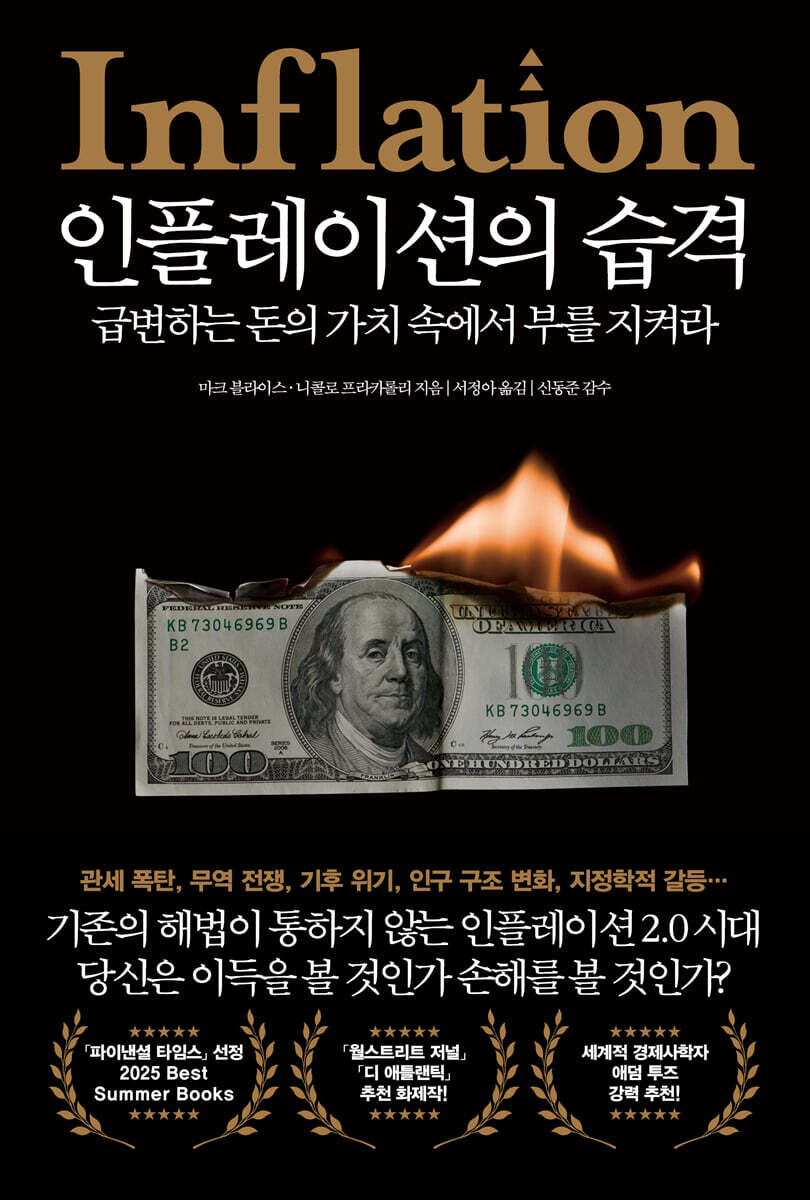
Inflation's onslaught
 |
Description
Book Introduction
★ Financial Times Best Summer Book of 2025 ★
★ A hot topic recommended by the Wall Street Journal and The Atlantic! ★
★ Highly recommended by world-renowned economic historian Adam Tooze! ★
“My salary is the same, but why have the prices of my grocery shopping doubled?”
Tariff bombs, trade wars, the climate crisis, demographic shifts, geopolitical conflicts…
The era of Inflation 2.0, where existing solutions no longer work.
Will you gain or lose?
South Korea's consumer price inflation rate in 2024 was 2.3%.
However, the perceived cost of living, including daily necessities and eating out, turned out to be much higher than that.
The news says 'price stability,' but citizens feel their wallets getting thinner every month.
What's even more puzzling is that while some people are helplessly suffering losses in a situation where prices are rising faster than wages, others are making money.
Why is inflation an opportunity for some and a disaster for others?
"Inflation Attack," written by world-renowned political economist Mark Blyth and World Bank economist Niccolò Fraccarolli, answers this question armed with various data and logic.
The two authors sharply examine how inflation is not simply a matter of rising prices, but rather a political issue surrounding power and distribution.
The book also notes that inflation in the 2020s is quite different from that of the past.
Central banks and governments still cling to the old prescription that "raising interest rates will control inflation," but the authors present a clear counterargument.
The main culprits behind the post-pandemic price increases were not “too much money,” but supply chain disruptions, energy crises, and climate disasters.
No matter how much interest rates are raised, the collapsed supply chain will not recover.
Rather, it kills small and medium-sized businesses, increases unemployment, and increases the burden of loan interest on ordinary citizens.
Ultimately, who pays the price of inflation becomes a matter of political choice.
What is more serious is the future from now on.
Crop failures and natural disasters caused by the climate crisis are now commonplace.
The US-China trade war and tariff bomb are fragmenting global supply chains.
The rapid aging of the population creates a labor shortage and upward pressure on wages.
The enormous costs of decarbonization will continue to drive up energy prices.
With all these factors exploding simultaneously, an era of structural inflation is dawning, pushing up prices.
What we need now is not a vague fear of inflation or outdated countermeasures, but the wisdom to accurately understand its structure and respond strategically.
"Inflation Attack" will serve as a compass to protect your wealth amidst the rapidly changing value of money and wisely navigate the new era of inflation.
★ A hot topic recommended by the Wall Street Journal and The Atlantic! ★
★ Highly recommended by world-renowned economic historian Adam Tooze! ★
“My salary is the same, but why have the prices of my grocery shopping doubled?”
Tariff bombs, trade wars, the climate crisis, demographic shifts, geopolitical conflicts…
The era of Inflation 2.0, where existing solutions no longer work.
Will you gain or lose?
South Korea's consumer price inflation rate in 2024 was 2.3%.
However, the perceived cost of living, including daily necessities and eating out, turned out to be much higher than that.
The news says 'price stability,' but citizens feel their wallets getting thinner every month.
What's even more puzzling is that while some people are helplessly suffering losses in a situation where prices are rising faster than wages, others are making money.
Why is inflation an opportunity for some and a disaster for others?
"Inflation Attack," written by world-renowned political economist Mark Blyth and World Bank economist Niccolò Fraccarolli, answers this question armed with various data and logic.
The two authors sharply examine how inflation is not simply a matter of rising prices, but rather a political issue surrounding power and distribution.
The book also notes that inflation in the 2020s is quite different from that of the past.
Central banks and governments still cling to the old prescription that "raising interest rates will control inflation," but the authors present a clear counterargument.
The main culprits behind the post-pandemic price increases were not “too much money,” but supply chain disruptions, energy crises, and climate disasters.
No matter how much interest rates are raised, the collapsed supply chain will not recover.
Rather, it kills small and medium-sized businesses, increases unemployment, and increases the burden of loan interest on ordinary citizens.
Ultimately, who pays the price of inflation becomes a matter of political choice.
What is more serious is the future from now on.
Crop failures and natural disasters caused by the climate crisis are now commonplace.
The US-China trade war and tariff bomb are fragmenting global supply chains.
The rapid aging of the population creates a labor shortage and upward pressure on wages.
The enormous costs of decarbonization will continue to drive up energy prices.
With all these factors exploding simultaneously, an era of structural inflation is dawning, pushing up prices.
What we need now is not a vague fear of inflation or outdated countermeasures, but the wisdom to accurately understand its structure and respond strategically.
"Inflation Attack" will serve as a compass to protect your wealth amidst the rapidly changing value of money and wisely navigate the new era of inflation.
- You can preview some of the book's contents.
Preview
index
Reviewer's note
Introduction: What We Know About Inflation
Who is Blamed for Inflation? | Winners, Losers, Users, and Perpetrators of Inflation | Coping with the Unpredictable Inflation | Chapter Contents
Chapter 1: 5 Things They Don't Tell You About Inflation
1.
Good Inflation, Bad Inflation, Ugly Inflation | 2.
How to Measure Inflation | 3.
What you measure matters | 4.
Why House Price Inflation Is Hard to Measure | 5.
Why bother with complex statistics?
Chapter 2: Why We Respond to Inflation by Raising Interest Rates
If We Had a Hammer: Interest Rates and Inflation | The 1970s Story, Act 1: Volcker's Hammer and the Politics of Distribution | Price Controls: A Taboo Policy | The 1970s Story, Act 2: Richard Nixon's Price Controls | The Price Control Experiment in the 2020s: Mixed Results and Their Background | Means Beyond Interest Rate and Price Controls: Taxes, Agreements, and Buffer Blockers | Who Benefits and What from Alternatives to Interest Rate Hikes?
Chapter 3: Inflation Discourse and the Politics of Blame
The Causes of Inflation and Its Victims | Type 1: Too Much Money | Type 2: Excessively High Employment | Type 3: Supply Issues, But Temporary | Type 4: Corporate Greed | Inflation Driven by Structural Factors | Inflation Discourse and Politics
Chapter 4: The Reality of Hyperinflation
Hyperinflation: The Myth of Exaggerated Fears | 1.
Venezuela: Oil's Blessing Becomes a Curse | 2.
Zimbabwe: Reform Failure, Currency Collapse | 3.
Argentina: The Trap of Populism and the Currency Crisis | 4.
Germany: Weaponizing Inflation | Hyperinflation is an extremely exceptional phenomenon.
Chapter 5: Why We Failed to Predict Inflation
The Language of Power: Economics | The 1970s: A Turning Point in the Economic Paradigm | The New Religion of Price Stability Targeting and Central Bank Independence | Reassessing the Causes of the Great Easing | The Global Financial Crisis That Changed Our Idea of Inflation | Revisiting the Official Narrative of History | Returning to the Queen's Question
Chapter 6: Is the War on Inflation a Class War?
The Central Bank's Two Weapons | Winners, Losers, and Users: The Income Effect, the Fisher Effect, and the Consumption Effect | Inflation Inequality Across Countries | Inflation and Class Conflict: Workers vs. Firms | Markups Boost Corporate Profits | Are Banks Really Victims of Inflation?
Conclusion: Is the Era of Inflation Over?
A Deflationary Future? | A Future of Inflation? | A Cautionary Tale: Supply-Side Disruption | The Way Forward
Acknowledgements | Note
Introduction: What We Know About Inflation
Who is Blamed for Inflation? | Winners, Losers, Users, and Perpetrators of Inflation | Coping with the Unpredictable Inflation | Chapter Contents
Chapter 1: 5 Things They Don't Tell You About Inflation
1.
Good Inflation, Bad Inflation, Ugly Inflation | 2.
How to Measure Inflation | 3.
What you measure matters | 4.
Why House Price Inflation Is Hard to Measure | 5.
Why bother with complex statistics?
Chapter 2: Why We Respond to Inflation by Raising Interest Rates
If We Had a Hammer: Interest Rates and Inflation | The 1970s Story, Act 1: Volcker's Hammer and the Politics of Distribution | Price Controls: A Taboo Policy | The 1970s Story, Act 2: Richard Nixon's Price Controls | The Price Control Experiment in the 2020s: Mixed Results and Their Background | Means Beyond Interest Rate and Price Controls: Taxes, Agreements, and Buffer Blockers | Who Benefits and What from Alternatives to Interest Rate Hikes?
Chapter 3: Inflation Discourse and the Politics of Blame
The Causes of Inflation and Its Victims | Type 1: Too Much Money | Type 2: Excessively High Employment | Type 3: Supply Issues, But Temporary | Type 4: Corporate Greed | Inflation Driven by Structural Factors | Inflation Discourse and Politics
Chapter 4: The Reality of Hyperinflation
Hyperinflation: The Myth of Exaggerated Fears | 1.
Venezuela: Oil's Blessing Becomes a Curse | 2.
Zimbabwe: Reform Failure, Currency Collapse | 3.
Argentina: The Trap of Populism and the Currency Crisis | 4.
Germany: Weaponizing Inflation | Hyperinflation is an extremely exceptional phenomenon.
Chapter 5: Why We Failed to Predict Inflation
The Language of Power: Economics | The 1970s: A Turning Point in the Economic Paradigm | The New Religion of Price Stability Targeting and Central Bank Independence | Reassessing the Causes of the Great Easing | The Global Financial Crisis That Changed Our Idea of Inflation | Revisiting the Official Narrative of History | Returning to the Queen's Question
Chapter 6: Is the War on Inflation a Class War?
The Central Bank's Two Weapons | Winners, Losers, and Users: The Income Effect, the Fisher Effect, and the Consumption Effect | Inflation Inequality Across Countries | Inflation and Class Conflict: Workers vs. Firms | Markups Boost Corporate Profits | Are Banks Really Victims of Inflation?
Conclusion: Is the Era of Inflation Over?
A Deflationary Future? | A Future of Inflation? | A Cautionary Tale: Supply-Side Disruption | The Way Forward
Acknowledgements | Note
Detailed image

Into the book
As I will discuss in more detail in the conclusion, given the impact of climate change on insurance costs, the tariffs and sanctions stemming from worsening geopolitical tensions, and the growing protectionism fueled by nationalism, we may now be entering a world dominated by inflation, akin to the London Bus.
In other words, inflationary factors can appear for a long time, like London buses, but then come all at once and become entangled, making the situation worse and worse.
That's exactly why you should read this book now.
What we experienced in 2021-2025 was only a precursor to the new normal.
We are now returning to a world where inflationary tendencies are stronger than ever before, and for reasons different from those often offered by the media and experts.
To survive such a future, we must first change our perception of inflation.
--- p.27, from “Introduction_What Do We Know About Inflation”
The point is that how we measure inflation affects how we perceive it.
How we perceive inflation determines how we respond to it and who ultimately bears the burden.
Inflation has a redistributive effect.
This is what the experts tell you.
But what they don't tell us is that the way inflation is measured also has redistributive effects.
This situation brings to mind the famous words of former British Prime Minister Margaret Thatcher: “I did not lie, I just told the truth sparingly.”
--- p.62-63, from “Chapter 1_5 Things They Don’t Tell You About Inflation”
As such, the policies we explored in Chapter 2 are not conflicting means.
Rather, it can be seen as a set of tools that provide options beyond the hammer of interest rates.
The fight against inflation can be important, but we must not pursue just one tactic without regard for the costs.
When implementing policies, we must bear in mind not only the victims of inflation but also the victims of the war on inflation.
Raising interest rates has far-reaching effects across the economy, which could leave countless people worse off.
That's why it must be used with caution.
Policies that could cushion the blow of interest rate hikes may be difficult to implement properly, but they are well worth the effort.
--- p.102-103, from “Chapter 2_Reasons for Responding to Inflation by Raising Interest Rates”
Inflationary discourse has power, and that power operates through rhetoric.
This is the usefulness of rhetoric.
Even when confronted with contrary evidence, we are swayed by plausible arguments and end up accepting various claims.
Moreover, rhetoric is used by proponents of a discourse to defend their preferred narrative while ignoring contrary evidence.
That's why we need to pay close attention to what each inflation discourse is trying to convey, and who is presenting it to us.
Those who are in a position to blame others for inflation are not the ones who suffer from it.
--- p.150-151, from “Chapter 3_Inflation Discourse and the Politics of Passing the Blame”
The causes of hyperinflation are diverse and defy generalization: reliance on a single sector—oil exports (Venezuela), failed land reform (Zimbabwe), political coalitions that failed to pass on the costs of inflation to specific groups (Argentina), and the ambition to stop paying reparations (Germany).
Hyperinflation occurs in moments of extreme crisis, often preceded by a virtually dysfunctional economy, where inflationary pressures have accumulated over several years.
Above all, hyperinflation is surprisingly rare.
Knowing these facts, even when inflation hardliners warn that "our country could end up like Argentina" or that "inflation led to the Nazis' rise to power," we can remember that we do not have the structural vulnerabilities or political situation that Argentina had, and that it was deflation, not inflation, that brought the Nazis to power.
--- p.203, from “Chapter 4_The Reality of Hyperinflation”
If the great inflation of the 1970s was in fact merely a collection of factors that were temporary and decayed on their own, then faith in the heroic actions of central bankers, the foresight of politicians, the inherent role of economists as truth-tellers, and the authority and prestige of the theory that economists' views and expectations dictate everything is bound to be shaken.
In addition, questions arise about the contemporary interpretation of inflation and countermeasures.
Beaver got into trouble and sparked controversy on Twitter for pointing out just that fact.
In fact, for the past 30 years, no one has wanted to hear an alternative interpretation of history.
After all, after the economy experienced disinflation in the 1980s, everything seemed to be going pretty well.
--- p.223-224, from “Chapter 5_Why Inflation Could Not Be Predicted”
Examining how inflation determines winners and losers ultimately leads us back to the question of whether the war against inflation is a class war, and whether it must be so.
First of all, to answer your first question briefly, yes.
The war against inflation is a war of classes.
Inflation hits the poor hardest, and they are the least compensated when prices fall.
The automatic interest rate hikes that come with inflation make life more difficult for low-income individuals and families.
As the purchasing power of their income decreases, they face higher costs for rent payments and mortgage repayments.
--- p.285, from “Chapter 6_Is the War on Inflation a Class War?”
In conclusion, there are two things to remember.
First, no matter how the future unfolds, in a situation where inflation dominates, if you cannot take advantage of inflation, you will inevitably be exploited in some way.
Second, inflation doesn't make everyone a loser.
No matter what people say, someone will always win.
In other words, inflationary factors can appear for a long time, like London buses, but then come all at once and become entangled, making the situation worse and worse.
That's exactly why you should read this book now.
What we experienced in 2021-2025 was only a precursor to the new normal.
We are now returning to a world where inflationary tendencies are stronger than ever before, and for reasons different from those often offered by the media and experts.
To survive such a future, we must first change our perception of inflation.
--- p.27, from “Introduction_What Do We Know About Inflation”
The point is that how we measure inflation affects how we perceive it.
How we perceive inflation determines how we respond to it and who ultimately bears the burden.
Inflation has a redistributive effect.
This is what the experts tell you.
But what they don't tell us is that the way inflation is measured also has redistributive effects.
This situation brings to mind the famous words of former British Prime Minister Margaret Thatcher: “I did not lie, I just told the truth sparingly.”
--- p.62-63, from “Chapter 1_5 Things They Don’t Tell You About Inflation”
As such, the policies we explored in Chapter 2 are not conflicting means.
Rather, it can be seen as a set of tools that provide options beyond the hammer of interest rates.
The fight against inflation can be important, but we must not pursue just one tactic without regard for the costs.
When implementing policies, we must bear in mind not only the victims of inflation but also the victims of the war on inflation.
Raising interest rates has far-reaching effects across the economy, which could leave countless people worse off.
That's why it must be used with caution.
Policies that could cushion the blow of interest rate hikes may be difficult to implement properly, but they are well worth the effort.
--- p.102-103, from “Chapter 2_Reasons for Responding to Inflation by Raising Interest Rates”
Inflationary discourse has power, and that power operates through rhetoric.
This is the usefulness of rhetoric.
Even when confronted with contrary evidence, we are swayed by plausible arguments and end up accepting various claims.
Moreover, rhetoric is used by proponents of a discourse to defend their preferred narrative while ignoring contrary evidence.
That's why we need to pay close attention to what each inflation discourse is trying to convey, and who is presenting it to us.
Those who are in a position to blame others for inflation are not the ones who suffer from it.
--- p.150-151, from “Chapter 3_Inflation Discourse and the Politics of Passing the Blame”
The causes of hyperinflation are diverse and defy generalization: reliance on a single sector—oil exports (Venezuela), failed land reform (Zimbabwe), political coalitions that failed to pass on the costs of inflation to specific groups (Argentina), and the ambition to stop paying reparations (Germany).
Hyperinflation occurs in moments of extreme crisis, often preceded by a virtually dysfunctional economy, where inflationary pressures have accumulated over several years.
Above all, hyperinflation is surprisingly rare.
Knowing these facts, even when inflation hardliners warn that "our country could end up like Argentina" or that "inflation led to the Nazis' rise to power," we can remember that we do not have the structural vulnerabilities or political situation that Argentina had, and that it was deflation, not inflation, that brought the Nazis to power.
--- p.203, from “Chapter 4_The Reality of Hyperinflation”
If the great inflation of the 1970s was in fact merely a collection of factors that were temporary and decayed on their own, then faith in the heroic actions of central bankers, the foresight of politicians, the inherent role of economists as truth-tellers, and the authority and prestige of the theory that economists' views and expectations dictate everything is bound to be shaken.
In addition, questions arise about the contemporary interpretation of inflation and countermeasures.
Beaver got into trouble and sparked controversy on Twitter for pointing out just that fact.
In fact, for the past 30 years, no one has wanted to hear an alternative interpretation of history.
After all, after the economy experienced disinflation in the 1980s, everything seemed to be going pretty well.
--- p.223-224, from “Chapter 5_Why Inflation Could Not Be Predicted”
Examining how inflation determines winners and losers ultimately leads us back to the question of whether the war against inflation is a class war, and whether it must be so.
First of all, to answer your first question briefly, yes.
The war against inflation is a war of classes.
Inflation hits the poor hardest, and they are the least compensated when prices fall.
The automatic interest rate hikes that come with inflation make life more difficult for low-income individuals and families.
As the purchasing power of their income decreases, they face higher costs for rent payments and mortgage repayments.
--- p.285, from “Chapter 6_Is the War on Inflation a Class War?”
In conclusion, there are two things to remember.
First, no matter how the future unfolds, in a situation where inflation dominates, if you cannot take advantage of inflation, you will inevitably be exploited in some way.
Second, inflation doesn't make everyone a loser.
No matter what people say, someone will always win.
--- p.308, from “Conclusion: Is the Era of Inflation Over?”
Publisher's Review
“Now we have multiple inflation factors coming together and intertwining,
We have entered the era of the so-called 'London Bus'.
To adapt to the new era, read the 'structure' rather than the 'interest rate'.
“Inflation doesn’t hurt everyone equally!”
The True Face of Inflation, According to a World-Class Political Economist
We often think of inflation as a neutral economic phenomenon.
I believe that when prices rise, everyone suffers equally.
But "Inflation Attack" proves that this is a naive delusion.
Inflation never affects everyone equally.
Some people lose out, but others gain enormously.
The authors directly criticize the conventional view that explains inflation as a phenomenon of "excess demand"—too much money chasing too few goods.
Real inflation is the result of a complex mix of factors, including supply chain disruptions, soaring energy prices, price pass-through by monopolies, and geopolitical conflicts.
More importantly, who bears the costs and who benefits from the process of responding to inflation is determined politically.
For example, if the central bank raises interest rates, prices may be controlled.
But in the process, unemployment increases, and ultimately, workers and ordinary people pay the price.
On the other hand, those who own assets enjoy interest income at high interest rates.
The authors ask who benefits from inflationary policies and who is forced to make sacrifices.
Inflation is a political issue surrounding power and distribution before it is an economic issue.
The book begins by pointing out five facts that the media and experts don't tell you.
Although we use the term "inflation" so often, we are actually surprisingly ignorant about it.
A closer look at how inflation is measured, what items fall within the measurement range, and whether the measurement method is consistent across time periods and countries reveals how much of the inflation index we take for granted is a political product.
The book also goes beyond fragmentary knowledge to explain why the things that have the biggest impact on our lives, like housing prices, are not properly measured, and that not all inflation is created equal—there is good inflation, bad inflation, and ugly inflation.
This gives readers the insight to see beyond government announcements and news headlines.
As you read this book, you will gain insight into the nature of inflation that you previously didn't know about, and gain the insights to strategically choose your position.
Prepare for Inflation 2.0
Climate, geopolitics, and aging create new rules of the game.
The Political Economy of Inflation: What Economics Textbooks Don't Tell You
Another key takeaway from this book is the insight that we have entered an era of "Inflation 2.0," a time entirely different from the past.
For 40 years since the 1980s, the world has lived in an era of low prices, low interest rates, and low growth.
Globalization and technological advancements have stabilized prices, and inflation is now considered a relic of the past.
But now the tables are turned.
First, the climate crisis brings about permanent supply shocks.
Floods, droughts, and wildfires disrupt agriculture and energy production, and the decarbonization transition is costly.
Second, geopolitical conflicts fragment global supply chains.
The US-China trade war, tariff bombs, and economic coercion are reversing the benefits of globalization.
Third, demographic changes create labor shortages and upward pressure on wages.
Aging populations and low birth rates are fundamentally changing the economic structure not only in developed countries but also in emerging countries such as China and Korea.
These complex factors suggest that this is no longer a 'temporary price increase', but rather a signal of a structural shift in the economy.
The authors warn that these structural changes could cause inflationary forces to surge at once.
This is not a world where resolving a single factor, as in the past, is the end, but a world where multiple shocks occur simultaneously and interact.
In this environment, economics textbooks and policy manuals of the past may become useless.
"Inflation Attack" provides a lens through which to understand this new environment.
The political economic analytical framework presented in this book will enable readers to anticipate and prepare for the coming inflation shock.
"Inflation discourse is the language of politics, not economics."
A broader perspective on the power games behind economic news.
A provocative and compelling economic book that overturns conventional wisdom surrounding inflation.
The book systematically and logically explains inflation over six chapters.
As mentioned earlier, Chapter 1 reveals the truth about inflation that the media and experts don't tell you.
We dissect why there is such a difference between the inflation rate announced by the government and the rate perceived by citizens, and why important items such as housing are excluded or distorted from the index.
The key point is that what to measure as inflation is not a technical question but a political choice.
Next, we explore why central banks always resort to raising interest rates, and demonstrate through the successful examples of price control policies implemented in several European countries that there are various other response tools besides raising interest rates.
While not denying the role of interest rate policy, the authors emphasize that the policy portfolio should be adjusted according to the nature of the supply shock.
The book's highlight is its dissection of the four narratives surrounding inflation: fiscal spending, wage increases, supply shocks, and corporate greed.
Each discourse sharply analyzes who it blames, what solutions it proposes, and whose interests it ultimately represents.
This will help readers develop an eye for understanding the power games behind economic news.
It also dispels unnecessary fear by verifying the reality of hyperinflation through historical examples and traces why economists failed to predict this inflation through the "established history" of economics in the 1970s.
The most crucial question appears at the end.
"Is the War on Inflation a Class War?" The authors reveal who benefits and loses from inflation, and who exploits it for their own gain.
The conclusion presents two future scenarios, warning that the era of low inflation over the past three decades is over and that we must prepare for structural inflationary pressures created by the climate crisis, geopolitical realignment, and an aging population.
Each chapter is supported by real-world data and historical examples, and the authors use their characteristically sharp insights and meticulous writing style to clearly unravel complex economic theories.
"If you can't avoid it, read the structure and take advantage."
Inflation Survival Strategies to Protect Your Wealth
A must-read for everyone living in an inflationary era, from salaried workers to the wealthy.
The ultimate message of "Inflation Attack" is clear.
If inflation cannot be avoided, we must understand its structure precisely and respond strategically.
The authors provide concrete insights for preserving and growing wealth in an era of inflation.
First, inflation exacerbates inequality.
Those who own assets benefit from rising asset prices, while those who rely on wages suffer from a decline in purchasing power.
Therefore, at the individual level, it is important to secure inflation hedges such as real assets, stocks, and real estate.
Second, policy choices determine winners and losers.
Austerity policies may control prices but increase unemployment, while expansionary policies may stimulate growth but worsen inflation.
As citizens, we must critically consider which policies represent whose interests.
Third, the new era of inflation demands a new economic order.
The authors argue that rather than simply returning to the past, we need a new policy paradigm suited to the climate crisis and geopolitical shifts.
The key elements are supply chain diversification, green transition, revitalizing industrial policy, and strengthening the social safety net.
This book overturns conventional wisdom surrounding inflation and helps us prepare for the new economic environment we will live in.
Praised by world-renowned scholars, this provocative and compelling economics book will be an essential guide for navigating uncertain times.
As Adam Tooze said.
“We need a new inflation strategy.
This book is the starting point.”
We have entered the era of the so-called 'London Bus'.
To adapt to the new era, read the 'structure' rather than the 'interest rate'.
“Inflation doesn’t hurt everyone equally!”
The True Face of Inflation, According to a World-Class Political Economist
We often think of inflation as a neutral economic phenomenon.
I believe that when prices rise, everyone suffers equally.
But "Inflation Attack" proves that this is a naive delusion.
Inflation never affects everyone equally.
Some people lose out, but others gain enormously.
The authors directly criticize the conventional view that explains inflation as a phenomenon of "excess demand"—too much money chasing too few goods.
Real inflation is the result of a complex mix of factors, including supply chain disruptions, soaring energy prices, price pass-through by monopolies, and geopolitical conflicts.
More importantly, who bears the costs and who benefits from the process of responding to inflation is determined politically.
For example, if the central bank raises interest rates, prices may be controlled.
But in the process, unemployment increases, and ultimately, workers and ordinary people pay the price.
On the other hand, those who own assets enjoy interest income at high interest rates.
The authors ask who benefits from inflationary policies and who is forced to make sacrifices.
Inflation is a political issue surrounding power and distribution before it is an economic issue.
The book begins by pointing out five facts that the media and experts don't tell you.
Although we use the term "inflation" so often, we are actually surprisingly ignorant about it.
A closer look at how inflation is measured, what items fall within the measurement range, and whether the measurement method is consistent across time periods and countries reveals how much of the inflation index we take for granted is a political product.
The book also goes beyond fragmentary knowledge to explain why the things that have the biggest impact on our lives, like housing prices, are not properly measured, and that not all inflation is created equal—there is good inflation, bad inflation, and ugly inflation.
This gives readers the insight to see beyond government announcements and news headlines.
As you read this book, you will gain insight into the nature of inflation that you previously didn't know about, and gain the insights to strategically choose your position.
Prepare for Inflation 2.0
Climate, geopolitics, and aging create new rules of the game.
The Political Economy of Inflation: What Economics Textbooks Don't Tell You
Another key takeaway from this book is the insight that we have entered an era of "Inflation 2.0," a time entirely different from the past.
For 40 years since the 1980s, the world has lived in an era of low prices, low interest rates, and low growth.
Globalization and technological advancements have stabilized prices, and inflation is now considered a relic of the past.
But now the tables are turned.
First, the climate crisis brings about permanent supply shocks.
Floods, droughts, and wildfires disrupt agriculture and energy production, and the decarbonization transition is costly.
Second, geopolitical conflicts fragment global supply chains.
The US-China trade war, tariff bombs, and economic coercion are reversing the benefits of globalization.
Third, demographic changes create labor shortages and upward pressure on wages.
Aging populations and low birth rates are fundamentally changing the economic structure not only in developed countries but also in emerging countries such as China and Korea.
These complex factors suggest that this is no longer a 'temporary price increase', but rather a signal of a structural shift in the economy.
The authors warn that these structural changes could cause inflationary forces to surge at once.
This is not a world where resolving a single factor, as in the past, is the end, but a world where multiple shocks occur simultaneously and interact.
In this environment, economics textbooks and policy manuals of the past may become useless.
"Inflation Attack" provides a lens through which to understand this new environment.
The political economic analytical framework presented in this book will enable readers to anticipate and prepare for the coming inflation shock.
"Inflation discourse is the language of politics, not economics."
A broader perspective on the power games behind economic news.
A provocative and compelling economic book that overturns conventional wisdom surrounding inflation.
The book systematically and logically explains inflation over six chapters.
As mentioned earlier, Chapter 1 reveals the truth about inflation that the media and experts don't tell you.
We dissect why there is such a difference between the inflation rate announced by the government and the rate perceived by citizens, and why important items such as housing are excluded or distorted from the index.
The key point is that what to measure as inflation is not a technical question but a political choice.
Next, we explore why central banks always resort to raising interest rates, and demonstrate through the successful examples of price control policies implemented in several European countries that there are various other response tools besides raising interest rates.
While not denying the role of interest rate policy, the authors emphasize that the policy portfolio should be adjusted according to the nature of the supply shock.
The book's highlight is its dissection of the four narratives surrounding inflation: fiscal spending, wage increases, supply shocks, and corporate greed.
Each discourse sharply analyzes who it blames, what solutions it proposes, and whose interests it ultimately represents.
This will help readers develop an eye for understanding the power games behind economic news.
It also dispels unnecessary fear by verifying the reality of hyperinflation through historical examples and traces why economists failed to predict this inflation through the "established history" of economics in the 1970s.
The most crucial question appears at the end.
"Is the War on Inflation a Class War?" The authors reveal who benefits and loses from inflation, and who exploits it for their own gain.
The conclusion presents two future scenarios, warning that the era of low inflation over the past three decades is over and that we must prepare for structural inflationary pressures created by the climate crisis, geopolitical realignment, and an aging population.
Each chapter is supported by real-world data and historical examples, and the authors use their characteristically sharp insights and meticulous writing style to clearly unravel complex economic theories.
"If you can't avoid it, read the structure and take advantage."
Inflation Survival Strategies to Protect Your Wealth
A must-read for everyone living in an inflationary era, from salaried workers to the wealthy.
The ultimate message of "Inflation Attack" is clear.
If inflation cannot be avoided, we must understand its structure precisely and respond strategically.
The authors provide concrete insights for preserving and growing wealth in an era of inflation.
First, inflation exacerbates inequality.
Those who own assets benefit from rising asset prices, while those who rely on wages suffer from a decline in purchasing power.
Therefore, at the individual level, it is important to secure inflation hedges such as real assets, stocks, and real estate.
Second, policy choices determine winners and losers.
Austerity policies may control prices but increase unemployment, while expansionary policies may stimulate growth but worsen inflation.
As citizens, we must critically consider which policies represent whose interests.
Third, the new era of inflation demands a new economic order.
The authors argue that rather than simply returning to the past, we need a new policy paradigm suited to the climate crisis and geopolitical shifts.
The key elements are supply chain diversification, green transition, revitalizing industrial policy, and strengthening the social safety net.
This book overturns conventional wisdom surrounding inflation and helps us prepare for the new economic environment we will live in.
Praised by world-renowned scholars, this provocative and compelling economics book will be an essential guide for navigating uncertain times.
As Adam Tooze said.
“We need a new inflation strategy.
This book is the starting point.”
GOODS SPECIFICS
- Date of issue: November 21, 2025
- Page count, weight, size: 352 pages | 152*225*30mm
- ISBN13: 9791173575983
- ISBN10: 1173575987
You may also like
카테고리
korean


korean

![GQ KOREA Mark (Monthly): December [2025]](http://librairie.coreenne.fr/cdn/shop/files/8ef265dbbfbf186523ed75ba7319009d.jpg?v=1765340328&width=3840)


