

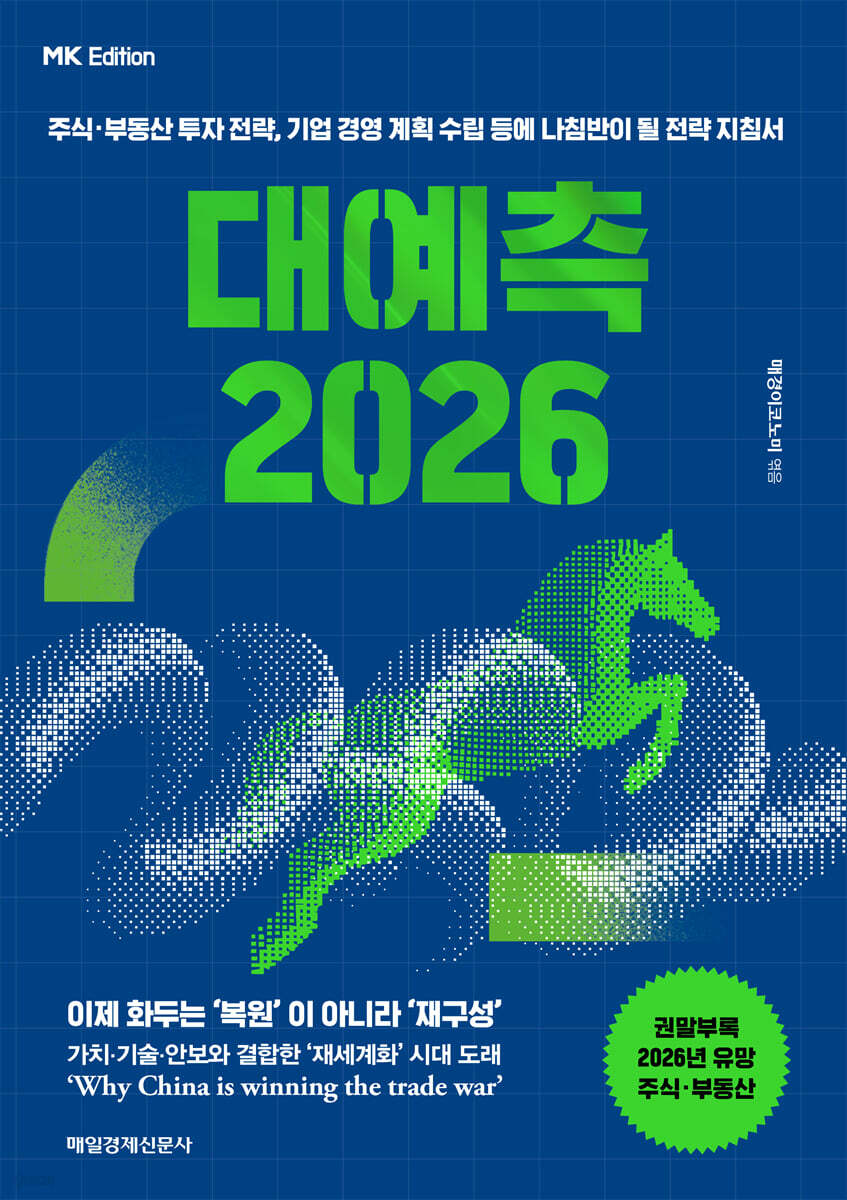
Grand Prediction 2026 (MK Edition)
 |
Description
Book Introduction
The economy in 2026 will be restructured, not recovered.
In the era of Super Trump, reglobalization, AI, high prices, and asset polarization
Are your assets and survival strategies ready?
Maeil Business Newspaper has been publishing “Grand Forecast” every year since 1992.
It has become the most authoritative future strategy guidebook in Korea, receiving love from all walks of life, including 100,000 Maeil Business Newspaper readers, businesspeople, scholars, and job seekers.
As the global economy restructures, what choices will we make in 2026?
This book, "The Great Forecast 2026," can serve as a compass that guides you through the fog, revealing the right investment strategy, management plan, and economic outlook.
Analyzing 11 New Trends for 2025
1.
Supply chain restructuring is shaking up the industry.
2. We have entered an era where experience becomes capital.
3.
Virtual assets are entering the institutional system.
4. Question design is a core competency in the AI era.
5. Survive jobs being eliminated by AI.
6. Adapt to the high prices that have become commonplace.
7.
There is an increasing number of modern people who even outsource their thinking.
8. Robots are entering our daily lives with physical AI.
9.
It is an era of fundamentalism and seeking originality.
10.
The trust economy emerges after the hacking incident.
11.
Is it possible to alleviate asset polarization?
In the era of Super Trump, reglobalization, AI, high prices, and asset polarization
Are your assets and survival strategies ready?
Maeil Business Newspaper has been publishing “Grand Forecast” every year since 1992.
It has become the most authoritative future strategy guidebook in Korea, receiving love from all walks of life, including 100,000 Maeil Business Newspaper readers, businesspeople, scholars, and job seekers.
As the global economy restructures, what choices will we make in 2026?
This book, "The Great Forecast 2026," can serve as a compass that guides you through the fog, revealing the right investment strategy, management plan, and economic outlook.
Analyzing 11 New Trends for 2025
1.
Supply chain restructuring is shaking up the industry.
2. We have entered an era where experience becomes capital.
3.
Virtual assets are entering the institutional system.
4. Question design is a core competency in the AI era.
5. Survive jobs being eliminated by AI.
6. Adapt to the high prices that have become commonplace.
7.
There is an increasing number of modern people who even outsource their thinking.
8. Robots are entering our daily lives with physical AI.
9.
It is an era of fundamentalism and seeking originality.
10.
The trust economy emerges after the hacking incident.
11.
Is it possible to alleviate asset polarization?
- You can preview some of the book's contents.
Preview
index
preface
Chapter 1: Economic Magnifying Glass
· 2026 New Trend: 'RECALIBRATE'
Slowing down and balancing the years of experience and the ability to ask good questions are capital
· Korean economy
Entering a chronic low-growth phase, even a 1% growth rate is a challenge.
· World economy
Crisis and opportunity coexist… Low growth remains unavoidable, tariff war shock remains… US-China conflict remains a variable
Chapter 2: Top 10 Issues of 2026
· After the conclusion of Korea-US tariff negotiations
Tariffs "rules set"... Korean automakers breathe a sigh of relief, but protectionism continues with "Super Trump" trade.
· Inter-Korean relations
Kim Jong-un's rise to prominence after attending China's military parade, Trump's resolve 'vigorously'... US-North Korea summit?
Will the Chinese economy regain strength amid the US-China conflict?
Potential overcomes pessimism... Greater China stock market revival, policy and economic cycles usher in a second bull market.
Local elections
Local elections are essentially a midterm evaluation of the government. The administration is evaluated and conservatives are tested.
· KOSPI index exceeds 4000 and reaches 5000
The KOSPI is on the verge of reaching 5,000, but there are prerequisites.
Will Seoul apartment prices continue to soar?
Even if real estate regulations continue, the "one-pole system" won't be easily broken.
· K-Culture
Short-form dramas and super IPs... Beyond platform dependency, new engine platforms are evolving into "global" platforms.
· Manufacturing industry hollowing out
The Exodus of Korean Manufacturing: The End of "Made in Korea"
· AI bubble theory
The AI bubble theory repeats itself every year: overheating vs. the train is on its way.
· Korean-style stablecoins and digital assets
NFTs in 2021, the metaverse in 2022, and stablecoins in 2026.
Chapter 3: The Korean Economy in Indicators
· Consumption
The dark tunnel is over. Stretching amidst mixed feelings of anticipation and concern.
· price
Even interest rate cuts failed to halt the economic slowdown, with the overall growth rate likely to remain below 2% in 2026.
· invest
Investor sentiment is like a "freezer," while AI semiconductors are like a "melting pot."
· Domestic interest rates
Interest rates are falling… US investment funds are a key variable, and market interest rates are expected to rise again when the economy recovers.
· Won exchange rate
"High-low, mid-high, low-low"... The won's strength is strengthening, sparking the US-China conflict... Korea is in a sandwich.
· Balance of payments
We survived on semiconductors... but high tariffs are the 'calm before the storm.'
· Employment
The service industry is experiencing a 'warmth' and the manufacturing industry is experiencing a 'cold wave'. It's clear on the outside, but there's a typhoon inside...
· Labor-management relations
Guidance on labor-management relations in turmoil ahead of the implementation of the Yellow Envelope Law
· Household debt and fiscal balance
Household debt has increased so much that the debate over fiscal soundness is heating up.
· Local economy
Incheon and Gyeonggi Province, fueled by the power of the metropolitan area, are laying the groundwork for the economies of Seoul, Busan, and Ulsan.
· Global Trade (FTA)
Is there no change in the strategy for expanding cooperation partners during the transition period to solidify the substance of FTA policy?
Chapter 4 Where is the world economy headed?
· International exchange rates
Trump's inflationary pressures continue to fuel extreme volatility.
· International interest rates
International interest rates are said to be in a "stabilization phase," but the US and Europe are lowering them, while Japan is trying to raise them.
· USA
Stagflation is more severe than expected, and there's no answer when the AI bubble bursts or the stock market slumps.
· china
A new challenge of "qualitative transformation" after a transitional period: an "all-round drive" ahead of the centennial of the founding of the military.
· japan
Japan's escape from deflation becomes clear, with consumption, exports, and facility investment rebounding.
· European Union
Recovery is showing signs of progress, but the economic axis shifts from manufacturing to tourism services, with mixed fortunes across countries.
India
Unfazed by Trump's tariffs, the country achieved 6% growth driven by domestic demand, reform, and manufacturing.
· brazil
Tax reform: Weighing both growth and trust, and interest rate cuts are key to price stability.
· Russia and Eastern Europe
Russia's cooling economy...Eastern Europe on the cusp of a long-term slowdown, with dramatic changes...Major economies posting 2.5% growth.
Southeast Asia
Domestic demand and price stability are welcome, but concerns about reciprocal tariffs and the Myanmar civil war are concerning.
· Middle East and Central Asia
The Middle East, with its mixed fortunes and sorrows, is experiencing war and oil price turmoil. Central Asia is opening new paths with new cities and ICT.
· Central and South America
Mexico's gradual recovery amid tariff risks, desperate for USMCA renegotiation
· Oceania
Australia's fundamentals are strong, but the real estate market is a fuse. New Zealand's population exodus will lead to hardship in 2026.
· Africa
The expiry of US patent tariffs is a "bad omen" for private investment and online shopping.
Chapter 5 Raw Material Prices
· Crude oil
Despite increased supply, demand continues to decline, with prices fluctuating between $50 and $65 per barrel.
· Agricultural products
Soaring stagflation 'stabilizes downward' If 'La Niña' occurs in the Southern Hemisphere...
· gold
Gold, the chaotic asset market of the dwarf world, close the door of confusion.
· Steel
China's prices are plummeting, while the US is soaring, trapped in an inescapable "overcapacity trap."
· Non-ferrous metals
Despite the easing monetary policy, copper and nickel are experiencing supply shortages due to a "temperature gap" across items.
· Rare metals
China has changed the supply-demand market. Rising prices are due to "Wang Xibang's" mindset.
Chapter 6 What Happens to the Asset Market?
1.
stock market
Stock Issue ① KOSPI Leading Stocks
The bullish momentum stems from the revival of the repressed secondary battery value chain, driven by performance, supply chain, and policy.
Stock Issue ② Nasdaq Leading Stocks
The Nasdaq's undefeated streak continues into 2026, with AI-themed products spreading across industries.
Stock Issue ③ ETF
The $18 Trillion ETF Market: The Themes Are Splitting. Trump's Second Term Is in Fluctuations: Precision Investing Is the Solution.
Stock Issue ④ IPO Market Observation Points
Introducing 'healthcare' BDCs will accelerate growth, even as interest rates decline.
Stock Issue ⑤ Virtual Assets
A Big Blur Between Virtual and Traditional Assets: Stablecoins, a Digital Goldmine
2.
real estate market
Real Estate Issue ① Reconstruction
Despite the housing shortage, Gangnam redevelopment subscriptions are booming.
Real Estate Issue ② Redevelopment
Seoul's plan to increase the floor area ratio for redevelopment in the Seongsu Strategic Redevelopment Zone and Noryangjin New Town is drawing attention.
Real Estate Issue ③ New Town
The government is also focusing on deregulation for the first phase of new city reconstruction in Bundang and Ilsan.
Real Estate Issue ④ Income-generating real estate
Small buildings attract attention amid expectations of officetels avoiding loan regulations, but commercial properties face a cold front.
Real Estate Issue ⑤ Jeonse
Seoul metropolitan area jeonse prices are expected to rise by around 5%, with monthly rents on the rise due to a decrease in housing supply.
Appendix: Where to Invest
1.
stock
① IT/electronic communications
Expanding AI investment in areas such as cloud computing and computing, and transforming the IT portfolio to focus on premium products.
② Finance
Investment attractiveness: Securities → Banks → Insurance, re-evaluated through advanced capital market policies.
③ Chemicals, oil refining, and energy
Domestic refining performance improves amid a favorable environment in which international oil prices are within the $60-$70 per barrel range.
④ Automobiles/Transportation
The unwavering hybrid trend continues, and aviation is recovering from the shock of the Muan accident.
⑤ Construction and heavy industry
A breakthrough in nuclear power plants: Clear weather expected by 2030
⑥ Education and Culture
Offline academy powerhouses worth keeping an eye on are the complete lineup, and the key to games is the new releases.
⑦ Consumer goods
Daiso and Musinsa vs. Premium Department Stores: The 2026 Distribution Market Driven by "Extreme Consumption"
⑧ Pharmaceuticals and Bio
A string of "big deals" has opened up a "lifeline" for technology transfers. China's bio sanctions and interest rate cuts are a welcome boost.
⑨ Small and medium-sized stocks
"Korean-American aunts" are drawing attention for their smart investment and the spread of personalized AI.
2.
real estate
① Apartment
Apgujeong and Daechi, the "undefeated" new construction areas, are being redeveloped, while Seongsu, Yeouido, and Mokdong are the "next affluent neighborhoods."
② Commercial building
Even with lower rents, commercial properties remain empty. Location, industry, and development determine success or failure.
③ Commercial real estate
Concerns over increased office supply are unfounded, with the CBD being reorganized into a financial cluster.
④ Land
Gangnam District, the District with the Highest Land Price Rise, Intensifies the Widening Polarization Between the Metropolitan Area and the Provinces
⑤ Auction
A flood of unprecedented auction properties is pouring in, making it worth targeting areas with a surge in development potential.
Chapter 1: Economic Magnifying Glass
· 2026 New Trend: 'RECALIBRATE'
Slowing down and balancing the years of experience and the ability to ask good questions are capital
· Korean economy
Entering a chronic low-growth phase, even a 1% growth rate is a challenge.
· World economy
Crisis and opportunity coexist… Low growth remains unavoidable, tariff war shock remains… US-China conflict remains a variable
Chapter 2: Top 10 Issues of 2026
· After the conclusion of Korea-US tariff negotiations
Tariffs "rules set"... Korean automakers breathe a sigh of relief, but protectionism continues with "Super Trump" trade.
· Inter-Korean relations
Kim Jong-un's rise to prominence after attending China's military parade, Trump's resolve 'vigorously'... US-North Korea summit?
Will the Chinese economy regain strength amid the US-China conflict?
Potential overcomes pessimism... Greater China stock market revival, policy and economic cycles usher in a second bull market.
Local elections
Local elections are essentially a midterm evaluation of the government. The administration is evaluated and conservatives are tested.
· KOSPI index exceeds 4000 and reaches 5000
The KOSPI is on the verge of reaching 5,000, but there are prerequisites.
Will Seoul apartment prices continue to soar?
Even if real estate regulations continue, the "one-pole system" won't be easily broken.
· K-Culture
Short-form dramas and super IPs... Beyond platform dependency, new engine platforms are evolving into "global" platforms.
· Manufacturing industry hollowing out
The Exodus of Korean Manufacturing: The End of "Made in Korea"
· AI bubble theory
The AI bubble theory repeats itself every year: overheating vs. the train is on its way.
· Korean-style stablecoins and digital assets
NFTs in 2021, the metaverse in 2022, and stablecoins in 2026.
Chapter 3: The Korean Economy in Indicators
· Consumption
The dark tunnel is over. Stretching amidst mixed feelings of anticipation and concern.
· price
Even interest rate cuts failed to halt the economic slowdown, with the overall growth rate likely to remain below 2% in 2026.
· invest
Investor sentiment is like a "freezer," while AI semiconductors are like a "melting pot."
· Domestic interest rates
Interest rates are falling… US investment funds are a key variable, and market interest rates are expected to rise again when the economy recovers.
· Won exchange rate
"High-low, mid-high, low-low"... The won's strength is strengthening, sparking the US-China conflict... Korea is in a sandwich.
· Balance of payments
We survived on semiconductors... but high tariffs are the 'calm before the storm.'
· Employment
The service industry is experiencing a 'warmth' and the manufacturing industry is experiencing a 'cold wave'. It's clear on the outside, but there's a typhoon inside...
· Labor-management relations
Guidance on labor-management relations in turmoil ahead of the implementation of the Yellow Envelope Law
· Household debt and fiscal balance
Household debt has increased so much that the debate over fiscal soundness is heating up.
· Local economy
Incheon and Gyeonggi Province, fueled by the power of the metropolitan area, are laying the groundwork for the economies of Seoul, Busan, and Ulsan.
· Global Trade (FTA)
Is there no change in the strategy for expanding cooperation partners during the transition period to solidify the substance of FTA policy?
Chapter 4 Where is the world economy headed?
· International exchange rates
Trump's inflationary pressures continue to fuel extreme volatility.
· International interest rates
International interest rates are said to be in a "stabilization phase," but the US and Europe are lowering them, while Japan is trying to raise them.
· USA
Stagflation is more severe than expected, and there's no answer when the AI bubble bursts or the stock market slumps.
· china
A new challenge of "qualitative transformation" after a transitional period: an "all-round drive" ahead of the centennial of the founding of the military.
· japan
Japan's escape from deflation becomes clear, with consumption, exports, and facility investment rebounding.
· European Union
Recovery is showing signs of progress, but the economic axis shifts from manufacturing to tourism services, with mixed fortunes across countries.
India
Unfazed by Trump's tariffs, the country achieved 6% growth driven by domestic demand, reform, and manufacturing.
· brazil
Tax reform: Weighing both growth and trust, and interest rate cuts are key to price stability.
· Russia and Eastern Europe
Russia's cooling economy...Eastern Europe on the cusp of a long-term slowdown, with dramatic changes...Major economies posting 2.5% growth.
Southeast Asia
Domestic demand and price stability are welcome, but concerns about reciprocal tariffs and the Myanmar civil war are concerning.
· Middle East and Central Asia
The Middle East, with its mixed fortunes and sorrows, is experiencing war and oil price turmoil. Central Asia is opening new paths with new cities and ICT.
· Central and South America
Mexico's gradual recovery amid tariff risks, desperate for USMCA renegotiation
· Oceania
Australia's fundamentals are strong, but the real estate market is a fuse. New Zealand's population exodus will lead to hardship in 2026.
· Africa
The expiry of US patent tariffs is a "bad omen" for private investment and online shopping.
Chapter 5 Raw Material Prices
· Crude oil
Despite increased supply, demand continues to decline, with prices fluctuating between $50 and $65 per barrel.
· Agricultural products
Soaring stagflation 'stabilizes downward' If 'La Niña' occurs in the Southern Hemisphere...
· gold
Gold, the chaotic asset market of the dwarf world, close the door of confusion.
· Steel
China's prices are plummeting, while the US is soaring, trapped in an inescapable "overcapacity trap."
· Non-ferrous metals
Despite the easing monetary policy, copper and nickel are experiencing supply shortages due to a "temperature gap" across items.
· Rare metals
China has changed the supply-demand market. Rising prices are due to "Wang Xibang's" mindset.
Chapter 6 What Happens to the Asset Market?
1.
stock market
Stock Issue ① KOSPI Leading Stocks
The bullish momentum stems from the revival of the repressed secondary battery value chain, driven by performance, supply chain, and policy.
Stock Issue ② Nasdaq Leading Stocks
The Nasdaq's undefeated streak continues into 2026, with AI-themed products spreading across industries.
Stock Issue ③ ETF
The $18 Trillion ETF Market: The Themes Are Splitting. Trump's Second Term Is in Fluctuations: Precision Investing Is the Solution.
Stock Issue ④ IPO Market Observation Points
Introducing 'healthcare' BDCs will accelerate growth, even as interest rates decline.
Stock Issue ⑤ Virtual Assets
A Big Blur Between Virtual and Traditional Assets: Stablecoins, a Digital Goldmine
2.
real estate market
Real Estate Issue ① Reconstruction
Despite the housing shortage, Gangnam redevelopment subscriptions are booming.
Real Estate Issue ② Redevelopment
Seoul's plan to increase the floor area ratio for redevelopment in the Seongsu Strategic Redevelopment Zone and Noryangjin New Town is drawing attention.
Real Estate Issue ③ New Town
The government is also focusing on deregulation for the first phase of new city reconstruction in Bundang and Ilsan.
Real Estate Issue ④ Income-generating real estate
Small buildings attract attention amid expectations of officetels avoiding loan regulations, but commercial properties face a cold front.
Real Estate Issue ⑤ Jeonse
Seoul metropolitan area jeonse prices are expected to rise by around 5%, with monthly rents on the rise due to a decrease in housing supply.
Appendix: Where to Invest
1.
stock
① IT/electronic communications
Expanding AI investment in areas such as cloud computing and computing, and transforming the IT portfolio to focus on premium products.
② Finance
Investment attractiveness: Securities → Banks → Insurance, re-evaluated through advanced capital market policies.
③ Chemicals, oil refining, and energy
Domestic refining performance improves amid a favorable environment in which international oil prices are within the $60-$70 per barrel range.
④ Automobiles/Transportation
The unwavering hybrid trend continues, and aviation is recovering from the shock of the Muan accident.
⑤ Construction and heavy industry
A breakthrough in nuclear power plants: Clear weather expected by 2030
⑥ Education and Culture
Offline academy powerhouses worth keeping an eye on are the complete lineup, and the key to games is the new releases.
⑦ Consumer goods
Daiso and Musinsa vs. Premium Department Stores: The 2026 Distribution Market Driven by "Extreme Consumption"
⑧ Pharmaceuticals and Bio
A string of "big deals" has opened up a "lifeline" for technology transfers. China's bio sanctions and interest rate cuts are a welcome boost.
⑨ Small and medium-sized stocks
"Korean-American aunts" are drawing attention for their smart investment and the spread of personalized AI.
2.
real estate
① Apartment
Apgujeong and Daechi, the "undefeated" new construction areas, are being redeveloped, while Seongsu, Yeouido, and Mokdong are the "next affluent neighborhoods."
② Commercial building
Even with lower rents, commercial properties remain empty. Location, industry, and development determine success or failure.
③ Commercial real estate
Concerns over increased office supply are unfounded, with the CBD being reorganized into a financial cluster.
④ Land
Gangnam District, the District with the Highest Land Price Rise, Intensifies the Widening Polarization Between the Metropolitan Area and the Provinces
⑤ Auction
A flood of unprecedented auction properties is pouring in, making it worth targeting areas with a surge in development potential.
Into the book
Advances in AI are shaking up the global labor market.
Large-scale restructuring continues, particularly among global big tech companies, and, unexpectedly, developers are being the first to be laid off.
A paradoxical phenomenon is unfolding: those who were once at the center of the digital transformation are now being replaced by technological advancements.
Companies in the US, Europe, India, and other countries that have adopted AI and automation technologies are reducing their workforces for cost efficiency reasons.
In 2025 alone, over 130,000 tech workers lost their jobs at major Big Tech companies, including Alphabet (Google), Meta (Facebook), and Microsoft.
Companies are accelerating the restructuring of their work by distinguishing between tasks that AI can do better and tasks that people should focus on.
In fact, Alphabet and Microsoft are using AI to write more than 30% of their code on some projects.
This trend is expected to accelerate after 2026.
Governments around the world are reviewing their workforce transition policies, and companies are prioritizing "updatability" over "stability" in their workforce.
The key word in the labor market is no longer ‘stability’ but ‘survival’.
--- p.18-19, from “2026 New Trend RECALIBRATE”
Greater China stock markets in 2026 are likely to reflect medium- to long-term potential rather than the pessimistic outlook that has persisted since the pandemic.
It created the conditions for a full-blown bull market, with corporate profits and stock prices recovering.
The basis is five changes that have occurred since 2025.
First, market confidence has increased during the US-China conflict in 2025.
China's supply chain, purchasing power, and external defense capabilities against export and technology sanctions have been highlighted.
In a changing global trade landscape, the impact of US-China decoupling is expected to be mitigated in the medium to long term and global influence expanded.
In 2026, the Greater China stock market is expected to reflect growth in exports outside the US, the initial success of the indirect export strategy, and expectations for domestic semiconductor production.
It is noteworthy that in 2025, the trading volume of technology, media, and telecommunications (TMT) and semiconductors will approach 40% and 10%, respectively, in the Chinese stock market.
This means that the market is already actively reflecting China's direction toward technological independence.
--- p.46-47, from “Will the Chinese economy regain strength amid the US-China conflict?”
The Seoul apartment market in 2026 will be a tense year, with upward pressure from the "supply cliff" and downward pressure from "high-intensity financial regulations" clashing head-on.
In this complex and multifaceted environment, end users must respond wisely by following these principles:
First, we must prioritize ‘fund management and procurement’ and ‘debt repayment ability’ over ‘timing.’
With the supply shortage worsening in 2026 and rising jeonse prices, it is not advisable to simply wait for Seoul apartment prices to fall.
If you have been planning to buy a home, it is better to design a loan within a range that you can afford and hold it for the long term, even in a stressful DSR environment, rather than simply postponing the purchase.
Since the preference for a 'smart home' may continue for the time being, you should make plans to purchase a home using various methods such as auctions, sales, and purchasing an existing home.
At this time, securing financial soundness is more important than excessive 'zero-sum'.
--- p.69, from “Will Seoul Apartment Prices Continue to Soar?”
Some say it is “too early” to discuss the bubble theory.
If we consider the release of OpenAI ChatGPT in November 2022 as the starting point of the AI paradigm, then the AI paradigm has been in place for less than three years.
Moon Nam-jung, an analyst at Daishin Securities, said, “The past internet and mobile revolutions lasted about 18 and 15 years, respectively,” adding, “Considering the current AI revolution lasting about three years, it is premature to discuss an AI bubble.”
An AI startup CTO who requested anonymity also said, “The innovation brought about by generative AI has only just taken its first steps, and the pace of technological development has been so rapid that there has not been enough time for it to spread throughout industry and society.”
The fact that Big Tech is still pouring huge amounts of money also refutes the AI bubble theory.
Most big tech companies have raised their capital expenditure (CAPEX) guidance (outlook) during their 2025 earnings announcements.
In particular, what stands out is the inevitable expansion of facility investment due to increased actual demand, unlike in previous years.
The most notable one is Meta. The possibility of an AI reorganization sparked speculation about an AI bubble, but the company raised its capital investment guidance.
In its Q2 2025 earnings call, Meta raised its annual capital expenditure guidance lower end from $64 billion to $66 billion.
--- p.85, from "AI Bubble Theory"
Forecasting Korea's job market in 2026 is like navigating a thick fog.
Various indicators send hopeful signals of "gradual improvement," but peeling back the layers reveals the "inconvenient truth" of precarious growth relying on specific industries and deepening polarization across industries.
While the service industry struggles to create jobs, the prevailing analysis is that the cold spell in the manufacturing and construction industries, the backbone of our economy, will be prolonged and further exacerbate the phenomenon of 'employment polarization.'
It is no exaggeration to say that the service industry will virtually dominate the labor market in 2025.
The employment rate in the first half of 2025 recorded 61.8% in the first quarter and 63.5% in the second quarter, continuing a steady upward trend since 2020.
The number of employed people also showed a seemingly positive trend, with a larger increase than in the second half of 2024.
At the center of this growth was undoubtedly the ‘health and social welfare service industry.’
This is not simply a temporary phenomenon caused by a good economy.
--- p.118, from “Employment”
The U.S. stock market is also likely to continue its upward trend in 2026.
In general, there are three factors used to determine the direction of an index.
① Performance ② Valuation multiple ③ Liquidity environment.
In addition, the exogenous variable of policy effects must also be closely examined.
First, let's look at the performance outlook.
The S&P 500's earnings growth rate is expected to be approximately 13.5% in 2026.
Earnings per share (EPS) based on the index are expected to surpass $300, a record high.
In 2026, the U.S. stock market is expected to continue to improve fundamentals based on solid performance improvements.
This is believed to be able to raise the index's low point while simultaneously alleviating volatility.
Next, there is a possibility that the valuation will improve.
There are likely to be four more rate cuts, starting with the September 2025 cut.
Interest rate cuts are generally good news for the stock market.
This is because liquidity increases and the value of safe assets decreases, causing money to flow into risky assets.
The liquidity environment is also positive.
Unlike other advanced countries, the United States is seeing growth in both M1 (narrow money) and M2 (broad money).
In particular, after 2025, the M2 money circulation velocity will rapidly improve, supporting the rise in nominal asset prices.
Large-scale restructuring continues, particularly among global big tech companies, and, unexpectedly, developers are being the first to be laid off.
A paradoxical phenomenon is unfolding: those who were once at the center of the digital transformation are now being replaced by technological advancements.
Companies in the US, Europe, India, and other countries that have adopted AI and automation technologies are reducing their workforces for cost efficiency reasons.
In 2025 alone, over 130,000 tech workers lost their jobs at major Big Tech companies, including Alphabet (Google), Meta (Facebook), and Microsoft.
Companies are accelerating the restructuring of their work by distinguishing between tasks that AI can do better and tasks that people should focus on.
In fact, Alphabet and Microsoft are using AI to write more than 30% of their code on some projects.
This trend is expected to accelerate after 2026.
Governments around the world are reviewing their workforce transition policies, and companies are prioritizing "updatability" over "stability" in their workforce.
The key word in the labor market is no longer ‘stability’ but ‘survival’.
--- p.18-19, from “2026 New Trend RECALIBRATE”
Greater China stock markets in 2026 are likely to reflect medium- to long-term potential rather than the pessimistic outlook that has persisted since the pandemic.
It created the conditions for a full-blown bull market, with corporate profits and stock prices recovering.
The basis is five changes that have occurred since 2025.
First, market confidence has increased during the US-China conflict in 2025.
China's supply chain, purchasing power, and external defense capabilities against export and technology sanctions have been highlighted.
In a changing global trade landscape, the impact of US-China decoupling is expected to be mitigated in the medium to long term and global influence expanded.
In 2026, the Greater China stock market is expected to reflect growth in exports outside the US, the initial success of the indirect export strategy, and expectations for domestic semiconductor production.
It is noteworthy that in 2025, the trading volume of technology, media, and telecommunications (TMT) and semiconductors will approach 40% and 10%, respectively, in the Chinese stock market.
This means that the market is already actively reflecting China's direction toward technological independence.
--- p.46-47, from “Will the Chinese economy regain strength amid the US-China conflict?”
The Seoul apartment market in 2026 will be a tense year, with upward pressure from the "supply cliff" and downward pressure from "high-intensity financial regulations" clashing head-on.
In this complex and multifaceted environment, end users must respond wisely by following these principles:
First, we must prioritize ‘fund management and procurement’ and ‘debt repayment ability’ over ‘timing.’
With the supply shortage worsening in 2026 and rising jeonse prices, it is not advisable to simply wait for Seoul apartment prices to fall.
If you have been planning to buy a home, it is better to design a loan within a range that you can afford and hold it for the long term, even in a stressful DSR environment, rather than simply postponing the purchase.
Since the preference for a 'smart home' may continue for the time being, you should make plans to purchase a home using various methods such as auctions, sales, and purchasing an existing home.
At this time, securing financial soundness is more important than excessive 'zero-sum'.
--- p.69, from “Will Seoul Apartment Prices Continue to Soar?”
Some say it is “too early” to discuss the bubble theory.
If we consider the release of OpenAI ChatGPT in November 2022 as the starting point of the AI paradigm, then the AI paradigm has been in place for less than three years.
Moon Nam-jung, an analyst at Daishin Securities, said, “The past internet and mobile revolutions lasted about 18 and 15 years, respectively,” adding, “Considering the current AI revolution lasting about three years, it is premature to discuss an AI bubble.”
An AI startup CTO who requested anonymity also said, “The innovation brought about by generative AI has only just taken its first steps, and the pace of technological development has been so rapid that there has not been enough time for it to spread throughout industry and society.”
The fact that Big Tech is still pouring huge amounts of money also refutes the AI bubble theory.
Most big tech companies have raised their capital expenditure (CAPEX) guidance (outlook) during their 2025 earnings announcements.
In particular, what stands out is the inevitable expansion of facility investment due to increased actual demand, unlike in previous years.
The most notable one is Meta. The possibility of an AI reorganization sparked speculation about an AI bubble, but the company raised its capital investment guidance.
In its Q2 2025 earnings call, Meta raised its annual capital expenditure guidance lower end from $64 billion to $66 billion.
--- p.85, from "AI Bubble Theory"
Forecasting Korea's job market in 2026 is like navigating a thick fog.
Various indicators send hopeful signals of "gradual improvement," but peeling back the layers reveals the "inconvenient truth" of precarious growth relying on specific industries and deepening polarization across industries.
While the service industry struggles to create jobs, the prevailing analysis is that the cold spell in the manufacturing and construction industries, the backbone of our economy, will be prolonged and further exacerbate the phenomenon of 'employment polarization.'
It is no exaggeration to say that the service industry will virtually dominate the labor market in 2025.
The employment rate in the first half of 2025 recorded 61.8% in the first quarter and 63.5% in the second quarter, continuing a steady upward trend since 2020.
The number of employed people also showed a seemingly positive trend, with a larger increase than in the second half of 2024.
At the center of this growth was undoubtedly the ‘health and social welfare service industry.’
This is not simply a temporary phenomenon caused by a good economy.
--- p.118, from “Employment”
The U.S. stock market is also likely to continue its upward trend in 2026.
In general, there are three factors used to determine the direction of an index.
① Performance ② Valuation multiple ③ Liquidity environment.
In addition, the exogenous variable of policy effects must also be closely examined.
First, let's look at the performance outlook.
The S&P 500's earnings growth rate is expected to be approximately 13.5% in 2026.
Earnings per share (EPS) based on the index are expected to surpass $300, a record high.
In 2026, the U.S. stock market is expected to continue to improve fundamentals based on solid performance improvements.
This is believed to be able to raise the index's low point while simultaneously alleviating volatility.
Next, there is a possibility that the valuation will improve.
There are likely to be four more rate cuts, starting with the September 2025 cut.
Interest rate cuts are generally good news for the stock market.
This is because liquidity increases and the value of safe assets decreases, causing money to flow into risky assets.
The liquidity environment is also positive.
Unlike other advanced countries, the United States is seeing growth in both M1 (narrow money) and M2 (broad money).
In particular, after 2025, the M2 money circulation velocity will rapidly improve, supporting the rise in nominal asset prices.
--- p.234-235, from “Stock Issue 2: Nasdaq Leading Stocks”
Publisher's Review
2026: Welcome an economy of reconstruction, not recovery.
“Is growth over?”
Now is the time to ask for directions.
The economy of 2026 stands at a turning point that is completely different from previous years.
The post-pandemic world has yet to fully emerge from the tunnel of uncertainty.
High interest rates and inflation have become the norm, asset polarization has deepened, and artificial intelligence (AI) is rapidly replacing human labor.
The core of industry is being shaken, and supply chains are being reorganized according to geopolitical variables.
In an era where complex crises are simultaneously looming, what we must grasp is not a return to the past, but rather a strategic restructuring and setting a direction for the future.
《The Great Prediction 2026》 addresses these contemporary issues head-on.
In an era where the word "recovery" no longer holds true, the key question is how to redesign the existing order.
This book is an economic strategy guide that provides the closest answer to that question.
The keyword is 'RECALIBRATE'
The key word presented in this year's "Grand Forecast 2026" is RECALIBRATE.
2026 highlights the need for fine-tuning not only the economic order but also mindsets, policies, and corporate strategies.
The era of Super Trump, resurfacing with the possibility of former President Trump's return; reglobalization centered on security, technology, and values; the power of inquiry that creates gaps in the AI era; virtual assets incorporated into the institutional system; and an era in which the immaterial value of "trust" becomes a core asset. These changes are analyzed in "The Great Prediction 2026."
This book provides a three-dimensional interpretation of the economic environment in 2026, focusing on six key issues.
First, "rebalancing," presented as this year's keyword, signifies that we can no longer simply wait for recovery or a rebound at a time when the axes of all industries and finance are shaking.
In particular, supply chain restructuring shakes the very foundations of industrial structure, and is addressed not simply as a supply and demand issue but as a shift in the global trade order.
At the same time, the institutionalization of virtual assets redefines the boundaries of finance and raises fundamental questions about the foundation of trust in the existing monetary system.
The impact of technological advancements is also sharply analyzed throughout the book.
The popularization of generative AI has the duality of being a tool to increase individual productivity, but also paralyzing human thinking ability.
The book emphasizes that we are entering an era where AI will go beyond simply replacing jobs, and where the ability to question and think will itself become the criteria for the gap.
So, he says that the new competitive edge is not simply a question of whether or not to introduce technology, but rather what questions can be asked.
What's interesting these days is that the spread of AI technology is even outsourcing human thinking skills.
In an era where you can get results by simply entering commands, those who don't think will eventually lose their jobs to AI.
《Grand Forecast 2026》 provides insights that cross the boundaries of technology, society, policy, and finance, and goes beyond simply listing forecasts to present criteria for judgment.
Another noteworthy trend is the rise of ‘trust.’
In an era where hacking and data breaches are commonplace, trust in the digital space is being redefined as a foundation for economic activity, transcending the traditional intangible asset.
《Grand Prediction 2026》 calls this the "Trust Economy," and predicts that in the future economic order, "transparency" and "trust" will play a role as valuable as currency.
2026: An Economic Compass to Stay on Track
This book provides an in-depth analysis of key economic issues in each chapter.
Based on expert insights and actual data, it comprehensively covers not only stock and real estate investment strategies, but also the macroeconomy, including consumer trends, price movements, employment structure, and international affairs.
The appendix at the end of the book presents outlooks for each industry and asset class to watch for in 2026, providing readers with practical strategies they can immediately implement.
These days, it is said that predictions are difficult.
But that doesn't mean we can just wait.
The higher the uncertainty, the more grounded judgment is needed, not vague optimism.
《The Great Forecast 2026》 guides individuals and businesses alike to read the trends amidst scattered variables and "recalibrate" their own future strategies.
This is a must-read book, a compass that you must read now to avoid losing your way.
“Is growth over?”
Now is the time to ask for directions.
The economy of 2026 stands at a turning point that is completely different from previous years.
The post-pandemic world has yet to fully emerge from the tunnel of uncertainty.
High interest rates and inflation have become the norm, asset polarization has deepened, and artificial intelligence (AI) is rapidly replacing human labor.
The core of industry is being shaken, and supply chains are being reorganized according to geopolitical variables.
In an era where complex crises are simultaneously looming, what we must grasp is not a return to the past, but rather a strategic restructuring and setting a direction for the future.
《The Great Prediction 2026》 addresses these contemporary issues head-on.
In an era where the word "recovery" no longer holds true, the key question is how to redesign the existing order.
This book is an economic strategy guide that provides the closest answer to that question.
The keyword is 'RECALIBRATE'
The key word presented in this year's "Grand Forecast 2026" is RECALIBRATE.
2026 highlights the need for fine-tuning not only the economic order but also mindsets, policies, and corporate strategies.
The era of Super Trump, resurfacing with the possibility of former President Trump's return; reglobalization centered on security, technology, and values; the power of inquiry that creates gaps in the AI era; virtual assets incorporated into the institutional system; and an era in which the immaterial value of "trust" becomes a core asset. These changes are analyzed in "The Great Prediction 2026."
This book provides a three-dimensional interpretation of the economic environment in 2026, focusing on six key issues.
First, "rebalancing," presented as this year's keyword, signifies that we can no longer simply wait for recovery or a rebound at a time when the axes of all industries and finance are shaking.
In particular, supply chain restructuring shakes the very foundations of industrial structure, and is addressed not simply as a supply and demand issue but as a shift in the global trade order.
At the same time, the institutionalization of virtual assets redefines the boundaries of finance and raises fundamental questions about the foundation of trust in the existing monetary system.
The impact of technological advancements is also sharply analyzed throughout the book.
The popularization of generative AI has the duality of being a tool to increase individual productivity, but also paralyzing human thinking ability.
The book emphasizes that we are entering an era where AI will go beyond simply replacing jobs, and where the ability to question and think will itself become the criteria for the gap.
So, he says that the new competitive edge is not simply a question of whether or not to introduce technology, but rather what questions can be asked.
What's interesting these days is that the spread of AI technology is even outsourcing human thinking skills.
In an era where you can get results by simply entering commands, those who don't think will eventually lose their jobs to AI.
《Grand Forecast 2026》 provides insights that cross the boundaries of technology, society, policy, and finance, and goes beyond simply listing forecasts to present criteria for judgment.
Another noteworthy trend is the rise of ‘trust.’
In an era where hacking and data breaches are commonplace, trust in the digital space is being redefined as a foundation for economic activity, transcending the traditional intangible asset.
《Grand Prediction 2026》 calls this the "Trust Economy," and predicts that in the future economic order, "transparency" and "trust" will play a role as valuable as currency.
2026: An Economic Compass to Stay on Track
This book provides an in-depth analysis of key economic issues in each chapter.
Based on expert insights and actual data, it comprehensively covers not only stock and real estate investment strategies, but also the macroeconomy, including consumer trends, price movements, employment structure, and international affairs.
The appendix at the end of the book presents outlooks for each industry and asset class to watch for in 2026, providing readers with practical strategies they can immediately implement.
These days, it is said that predictions are difficult.
But that doesn't mean we can just wait.
The higher the uncertainty, the more grounded judgment is needed, not vague optimism.
《The Great Forecast 2026》 guides individuals and businesses alike to read the trends amidst scattered variables and "recalibrate" their own future strategies.
This is a must-read book, a compass that you must read now to avoid losing your way.
GOODS SPECIFICS
- Date of issue: November 7, 2025
- Page count, weight, size: 352 pages | 172*238*14mm
- ISBN13: 9791164848317
You may also like
카테고리
korean


korean

![GQ KOREA Mark (Monthly): December [2025]](http://librairie.coreenne.fr/cdn/shop/files/8ef265dbbfbf186523ed75ba7319009d.jpg?v=1765340328&width=3840)


