

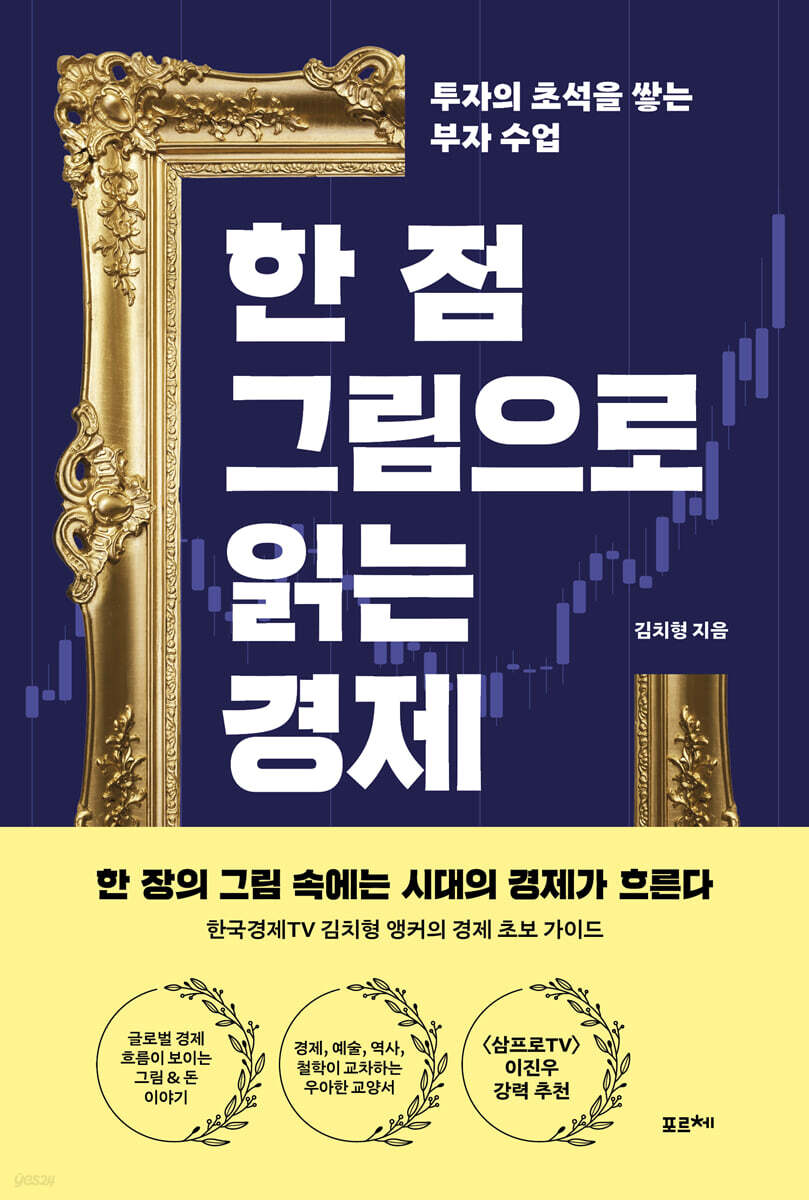
Reading the Economy in One Dot
 |
Description
Book Introduction
★Reporter Jinwoo Lee of Sampro TV recommends Dr. Chunwook Hong for "The Flow of Money Repeats."
One look at the dot picture reveals economic principles and investment!
Economic Stories from Famous Paintings, as Revealed by Korea Economic TV Anchor Kim Q
The first thing to learn to become rich is to understand economic principles.
To invest, you need to know the economy, and to understand economic trends, you need to read economic news.
However, economic news is difficult to see and understand every day.
The author is an anchor for Korea Economic TV and MBC Radio's "Weekend Kimchi-hyung's News High Kick," and is an economic news curator who explains complex economic issues clearly and easily.
The author, seeing that many people have difficulty understanding economic news, wrote stories under the pseudonym 'Kim Q' that help modern people easily and enjoyably understand the economic principles they must know by looking at a single picture.
This book is the author's first, and it uses the scenes in the pictures as clues to unravel the economic structure of the era, allowing readers to read difficult economic knowledge in an easy and fun illustrated economic story.
Additionally, the author provides a practical economics lesson by explaining how words like stocks, tariffs, supply chains, and energy prices appear every day, but actually connect to our lives.
Readers who have previously struggled with economics will be able to grasp key economic issues and global market trends simply by admiring a famous painting and reading Kim Q's commentary.
One look at the dot picture reveals economic principles and investment!
Economic Stories from Famous Paintings, as Revealed by Korea Economic TV Anchor Kim Q
The first thing to learn to become rich is to understand economic principles.
To invest, you need to know the economy, and to understand economic trends, you need to read economic news.
However, economic news is difficult to see and understand every day.
The author is an anchor for Korea Economic TV and MBC Radio's "Weekend Kimchi-hyung's News High Kick," and is an economic news curator who explains complex economic issues clearly and easily.
The author, seeing that many people have difficulty understanding economic news, wrote stories under the pseudonym 'Kim Q' that help modern people easily and enjoyably understand the economic principles they must know by looking at a single picture.
This book is the author's first, and it uses the scenes in the pictures as clues to unravel the economic structure of the era, allowing readers to read difficult economic knowledge in an easy and fun illustrated economic story.
Additionally, the author provides a practical economics lesson by explaining how words like stocks, tariffs, supply chains, and energy prices appear every day, but actually connect to our lives.
Readers who have previously struggled with economics will be able to grasp key economic issues and global market trends simply by admiring a famous painting and reading Kim Q's commentary.
- You can preview some of the book's contents.
Preview
index
Recommendation 4
Prologue 8
Chapter 1: The Maze of Taxes: The Path of Money as Seen in Pictures
Trump Tariffs and Monet's Customs Series 16
Royal Shoes, High Heels, and Taxes 29
Violence Between Humans and Nature, and Labor 41
Potato, the Unsung Hero of America's Founding 56
Chapter 2: The Secrets of Trade and Finance that Connect the World
The Intricate Global Supply Chain 71
Venus's Skin and Egg-Shaped Theory 82
How Jews So Controlled Finance? 95
How much should I get for this? 104
Seurat's Pointillism and the FOMC Dot Plot 117
Edgar Degas and Reading Room 131
Chapter 3: Light and Desire, Behind the Scenes of Industry
Yellow streetlights and painter 148
Oil Fields and the Oil Rush 161
Humanity's Cruelty to Light: The Sperm Whale Story, Part 176
The Fall of the Diamond and the Death of Maximilian I (186)
Choker Necklace and Guillotine 199
Chapter 4: Survival of Business and Technology
Pearl Necklace and Samsung's Anycall Myth 214
Opera glasses and ASML 225
The Burned Old Stock Exchange and Famous Paintings 237
A Choice for Survival? A Betrayal? 247
Printmaking, which led to the mass production of paintings 262
Prologue 8
Chapter 1: The Maze of Taxes: The Path of Money as Seen in Pictures
Trump Tariffs and Monet's Customs Series 16
Royal Shoes, High Heels, and Taxes 29
Violence Between Humans and Nature, and Labor 41
Potato, the Unsung Hero of America's Founding 56
Chapter 2: The Secrets of Trade and Finance that Connect the World
The Intricate Global Supply Chain 71
Venus's Skin and Egg-Shaped Theory 82
How Jews So Controlled Finance? 95
How much should I get for this? 104
Seurat's Pointillism and the FOMC Dot Plot 117
Edgar Degas and Reading Room 131
Chapter 3: Light and Desire, Behind the Scenes of Industry
Yellow streetlights and painter 148
Oil Fields and the Oil Rush 161
Humanity's Cruelty to Light: The Sperm Whale Story, Part 176
The Fall of the Diamond and the Death of Maximilian I (186)
Choker Necklace and Guillotine 199
Chapter 4: Survival of Business and Technology
Pearl Necklace and Samsung's Anycall Myth 214
Opera glasses and ASML 225
The Burned Old Stock Exchange and Famous Paintings 237
A Choice for Survival? A Betrayal? 247
Printmaking, which led to the mass production of paintings 262
Detailed image

Into the book
The wheat trade was rampant, and to stop it, customs huts, as painted by Monet, were built all over the French coast facing England.
Eventually, the economies of France and its allies suffered as trade with Britain was cut off.
On the other hand, when trade through France and other countries was blocked, Britain found a breakthrough by expanding trade with North and South America via the Atlantic Ocean.
There has never been a government in history that won the hearts of the people without solving the problem of making a living.
The Continental System was one of the decisive factors that led to Napoleon's downfall.
--- From "Trump Tariffs and Monet's Customs Series"
France, in financial crisis, collected all kinds of taxes.
The most absurd and harsh of these taxes was the salt tax, called the 'Gabelle'.
There was a mandatory annual salt purchase quota, and each time salt was purchased, a tax of about ten times the price of the salt was paid.
(…) The excessive burden of the salt tax was a burden, but what made the common people even more angry was the fact that nobles and religious people were exempt from this salt tax.
--- From "The Royal Shoes, High Heels and Taxes"
The era of plantations, which actively utilized slavery, and the current era, which seeks to replace human labor with robots, are intertwined in their pursuit of maximizing efficiency and productivity.
In the past, the problem was making people work without paying them, but now it is time to worry about the problem of not providing jobs at all.
--- From "Violence Between Humans and Nature, and Labor"
Another fun aspect of looking at Quentin Massis's paintings is that he satirizes human greed for money through the arrangement of objects in the paintings and the facial expressions of the characters.
In this picture, the wife is shown with her eyes glued to the money and a book (Bible) on the table, and the man is counting the money while holding the Bible in his hand.
At that time, money changers could be seen as equivalent to pawn shops or moneylenders today.
People around me liked money changers who took valuable items as collateral and lent money at high interest rates.
There is no Lee.
Moreover, since most of them were Jews and persecuted among the Gentiles, it can be said that the social gaze toward them was naturally incorporated into his paintings.
--- From "How the Jews Got a Firm Control of Finance"
In the late 1600s, the city of Amsterdam led the Dutch Golden Age, and its street lighting system played a part in this.
As the pitch-black darkness was banished, accidents and crime in Amsterdam decreased, and as people were more active, merchants' incomes increased.
But there was a price to pay: the city of Amsterdam raised taxes to pay for the installation and maintenance of street lights.
There is no record of exactly how much the tax was raised, but there is evidence that the tax was raised to cover the cost of installing streetlights.
--- From "The Yellow Streetlight and the Painter"
Maximilian I's diamond ring became the inspiration for De Beers' 1947 advertising campaign.
This advertising copy, which is still used today, is a representative example of a successful campaign in the advertising industry.
De Beers was once a monopoly that dominated the global natural diamond market.
It is also one of the companies competing with Van Cleef & Arpels, which has recently become an issue in the political world, for the global diamond market.
--- From "The Fall of the Diamond and Maximilian I"
Perhaps it was because it was a stock exchange? Their funding for the production of these paintings also followed the logic of the capital market.
The positions of the figures depicted in the work “At the Copenhagen Stock Exchange” were subject to a sort of seat fee, with the stock exchange collecting money from them under the pretext of donation to cover the production costs of the painting.
The most prominent seats in the front were 800 DKK, the crowded middle seats were 500 DKK, and the seats behind them were 300 DKK.
In fact, in the center of this painting are Carl Frederik Tietgen and Johan Hansen, two figures who cannot be left out of Danish economic history.
--- From "The Burned Old Stock Exchange and Famous Paintings"
As printing technology became widespread, the number of books published increased significantly.
It is estimated that around 200 million books were published in Europe around the end of the 15th century.
The rapid increase in books led to a decrease in illiteracy and expanded the scope of knowledge sharing.
As a result, the pace of social development accelerates and cracks begin to appear in class society.
Entering the 18th century, the number of books published increased further, exceeding 1 billion.
People's thinking deepened, and humanity went through the Renaissance and the Reformation, leading to the Industrial Revolution.
Eventually, the economies of France and its allies suffered as trade with Britain was cut off.
On the other hand, when trade through France and other countries was blocked, Britain found a breakthrough by expanding trade with North and South America via the Atlantic Ocean.
There has never been a government in history that won the hearts of the people without solving the problem of making a living.
The Continental System was one of the decisive factors that led to Napoleon's downfall.
--- From "Trump Tariffs and Monet's Customs Series"
France, in financial crisis, collected all kinds of taxes.
The most absurd and harsh of these taxes was the salt tax, called the 'Gabelle'.
There was a mandatory annual salt purchase quota, and each time salt was purchased, a tax of about ten times the price of the salt was paid.
(…) The excessive burden of the salt tax was a burden, but what made the common people even more angry was the fact that nobles and religious people were exempt from this salt tax.
--- From "The Royal Shoes, High Heels and Taxes"
The era of plantations, which actively utilized slavery, and the current era, which seeks to replace human labor with robots, are intertwined in their pursuit of maximizing efficiency and productivity.
In the past, the problem was making people work without paying them, but now it is time to worry about the problem of not providing jobs at all.
--- From "Violence Between Humans and Nature, and Labor"
Another fun aspect of looking at Quentin Massis's paintings is that he satirizes human greed for money through the arrangement of objects in the paintings and the facial expressions of the characters.
In this picture, the wife is shown with her eyes glued to the money and a book (Bible) on the table, and the man is counting the money while holding the Bible in his hand.
At that time, money changers could be seen as equivalent to pawn shops or moneylenders today.
People around me liked money changers who took valuable items as collateral and lent money at high interest rates.
There is no Lee.
Moreover, since most of them were Jews and persecuted among the Gentiles, it can be said that the social gaze toward them was naturally incorporated into his paintings.
--- From "How the Jews Got a Firm Control of Finance"
In the late 1600s, the city of Amsterdam led the Dutch Golden Age, and its street lighting system played a part in this.
As the pitch-black darkness was banished, accidents and crime in Amsterdam decreased, and as people were more active, merchants' incomes increased.
But there was a price to pay: the city of Amsterdam raised taxes to pay for the installation and maintenance of street lights.
There is no record of exactly how much the tax was raised, but there is evidence that the tax was raised to cover the cost of installing streetlights.
--- From "The Yellow Streetlight and the Painter"
Maximilian I's diamond ring became the inspiration for De Beers' 1947 advertising campaign.
This advertising copy, which is still used today, is a representative example of a successful campaign in the advertising industry.
De Beers was once a monopoly that dominated the global natural diamond market.
It is also one of the companies competing with Van Cleef & Arpels, which has recently become an issue in the political world, for the global diamond market.
--- From "The Fall of the Diamond and Maximilian I"
Perhaps it was because it was a stock exchange? Their funding for the production of these paintings also followed the logic of the capital market.
The positions of the figures depicted in the work “At the Copenhagen Stock Exchange” were subject to a sort of seat fee, with the stock exchange collecting money from them under the pretext of donation to cover the production costs of the painting.
The most prominent seats in the front were 800 DKK, the crowded middle seats were 500 DKK, and the seats behind them were 300 DKK.
In fact, in the center of this painting are Carl Frederik Tietgen and Johan Hansen, two figures who cannot be left out of Danish economic history.
--- From "The Burned Old Stock Exchange and Famous Paintings"
As printing technology became widespread, the number of books published increased significantly.
It is estimated that around 200 million books were published in Europe around the end of the 15th century.
The rapid increase in books led to a decrease in illiteracy and expanded the scope of knowledge sharing.
As a result, the pace of social development accelerates and cracks begin to appear in class society.
Entering the 18th century, the number of books published increased further, exceeding 1 billion.
People's thinking deepened, and humanity went through the Renaissance and the Reformation, leading to the Industrial Revolution.
--- From "Prints That Led to the Mass Production of Paintings"
Publisher's Review
How to understand art, history, and economics all at once
The secrets of capital, trade, technology, and finance hidden in the picture
The most accessible and artistically presented "curated economics textbook"
Often, art remains as 'high art'.
But it is not only nobility that actually permeates the work.
Life, that is, economic activity, is embedded in it.
This book allows readers who find economics books centered on numbers and graphs to naturally understand the flow of industry, trade, and capital through the familiar medium of famous paintings.
In Chapter 1, we learn about the principles of taxation and protectionism through Monet's Normandy landscapes and Louis XIV's red high heels.
Chapter 2 examines the roots of finance and investment through Botticelli's Venus and Degas's studio, while Chapter 3 explains the logic of industrialization and energy transition through Van Gogh's yellow streetlights and exploding oil fields.
Chapter 4 shows the survival strategies of corporations and technology through the betrayal of David, who painted Napoleon, and the mass reproduction of prints.
A single picture becomes a lesson in economic history, and a new study of economics through narrative.
Looking at the picture, you can read the economic news!
From the CPTPP to bank runs, a beginner's guide to reading economic news.
This book first helps readers understand the structure of the economy through famous paintings, then helps them interpret the words in the news on their own. Once-difficult terms like "CPTPP," "Fed," "FOMC," "Federal Reserve," "tariffs," "supply chain," and "bank run" begin to take on meaning as they connect with the stories depicted in the paintings.
The author's expertise, gained through years of experience as an anchor on Korea Economic TV, allows even novice investors to understand economic articles and market changes as "contextual stories."
Even readers who have not majored in economics can naturally learn economic principles through pictures, and even gain the ability to understand the context of news.
This book is for beginner investors who find economics books burdensome, educated readers in their 40s and 50s who don't want to lose their intellectual curiosity, and all readers who look forward to the intersection of art and economics.
The moment you read this book, you will immediately begin to see how the world works.
The secrets of capital, trade, technology, and finance hidden in the picture
The most accessible and artistically presented "curated economics textbook"
Often, art remains as 'high art'.
But it is not only nobility that actually permeates the work.
Life, that is, economic activity, is embedded in it.
This book allows readers who find economics books centered on numbers and graphs to naturally understand the flow of industry, trade, and capital through the familiar medium of famous paintings.
In Chapter 1, we learn about the principles of taxation and protectionism through Monet's Normandy landscapes and Louis XIV's red high heels.
Chapter 2 examines the roots of finance and investment through Botticelli's Venus and Degas's studio, while Chapter 3 explains the logic of industrialization and energy transition through Van Gogh's yellow streetlights and exploding oil fields.
Chapter 4 shows the survival strategies of corporations and technology through the betrayal of David, who painted Napoleon, and the mass reproduction of prints.
A single picture becomes a lesson in economic history, and a new study of economics through narrative.
Looking at the picture, you can read the economic news!
From the CPTPP to bank runs, a beginner's guide to reading economic news.
This book first helps readers understand the structure of the economy through famous paintings, then helps them interpret the words in the news on their own. Once-difficult terms like "CPTPP," "Fed," "FOMC," "Federal Reserve," "tariffs," "supply chain," and "bank run" begin to take on meaning as they connect with the stories depicted in the paintings.
The author's expertise, gained through years of experience as an anchor on Korea Economic TV, allows even novice investors to understand economic articles and market changes as "contextual stories."
Even readers who have not majored in economics can naturally learn economic principles through pictures, and even gain the ability to understand the context of news.
This book is for beginner investors who find economics books burdensome, educated readers in their 40s and 50s who don't want to lose their intellectual curiosity, and all readers who look forward to the intersection of art and economics.
The moment you read this book, you will immediately begin to see how the world works.
GOODS SPECIFICS
- Date of issue: November 26, 2025
- Page count, weight, size: 276 pages | 472g | 145*215*17mm
- ISBN13: 9791194634676
- ISBN10: 1194634672
You may also like
카테고리
korean


korean

![GQ KOREA Mark (Monthly): December [2025]](http://librairie.coreenne.fr/cdn/shop/files/8ef265dbbfbf186523ed75ba7319009d.jpg?v=1765340328&width=3840)


