

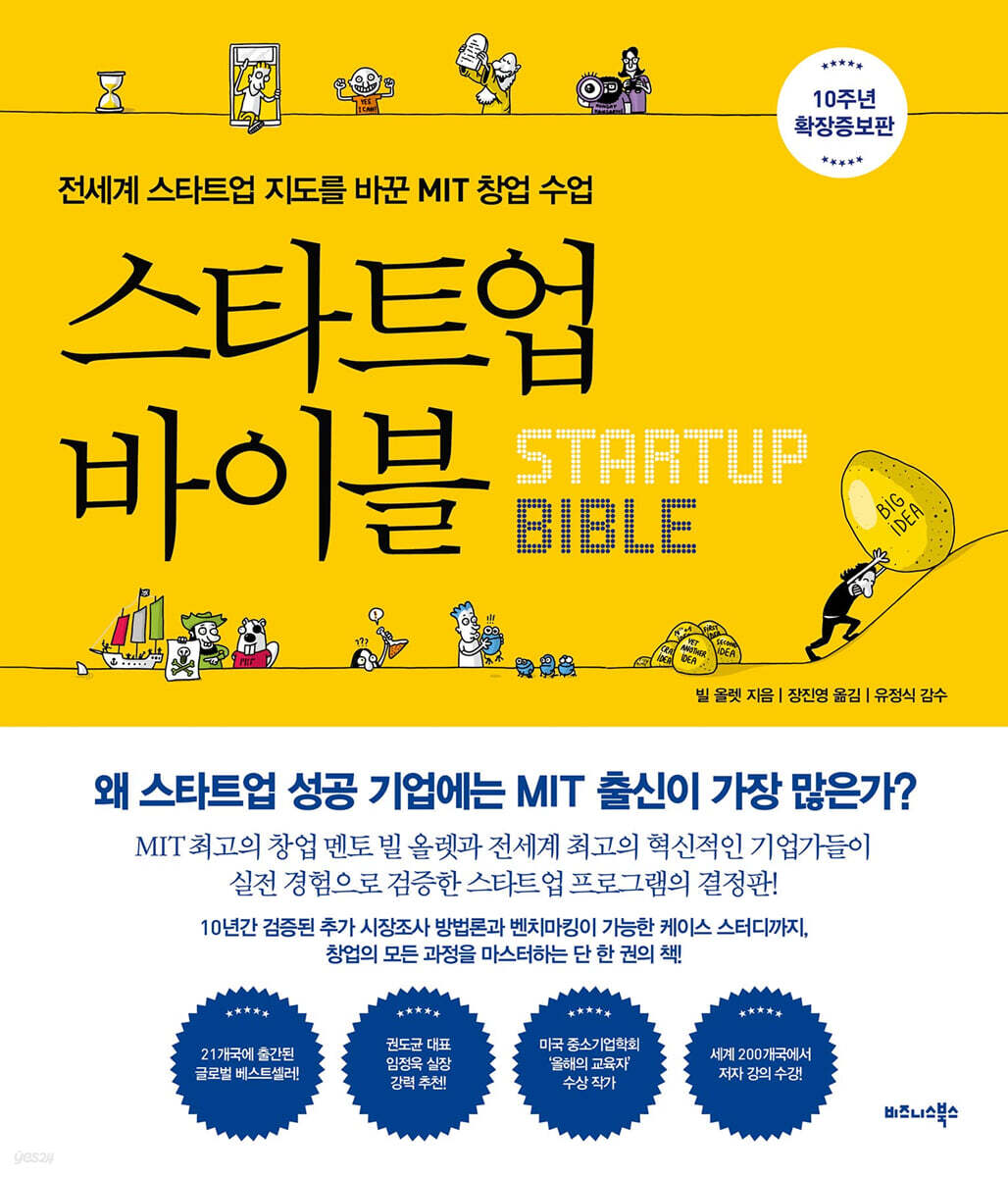
Startup Bible (10th Anniversary Expanded Edition)
 |
Description
Book Introduction
◆ “Entrepreneurship is not a talent, but a skill that can be learned and mastered!”
◆ The secrets to startup success revealed by MIT, the world's best entrepreneurship academy!
“A textbook-like book designed to help you master and train every single step of the entrepreneurial process!”
- Kwon Do-gyun, CEO of Primer
The world's most popular entrepreneurship textbook, "Startup Bible," has returned with an expanded and expanded edition to celebrate its 10th anniversary.
Translated into 21 languages worldwide since its initial publication and used as a textbook by hundreds of thousands of aspiring entrepreneurs, this book has undergone a complete retranslation, with a newly designed cover and text, three additional chapters that further upgrade the entrepreneurial process, market research, and customer analysis.
In particular, this expanded edition vividly conveys how the MIT entrepreneurship program is applied in practice by detailing each step of the author's entrepreneurial process to create a startup.
Bill Aulett, director of the MIT Center for Entrepreneurship, is at the center of MIT's entrepreneurship boom.
Over the past 16 years, he has worked with numerous faculty members, global business leaders, and outstanding startup teams from around the world to conduct various startup courses, creating the "24-Step Entrepreneurship Program," an essential tool for aspiring entrepreneurs.
The 10th Anniversary Expanded Edition of "Startup Bible" is the ultimate startup guide, featuring the 24-step startup program and vivid, concrete startup case studies from MIT students.
This book has evolved to accommodate the new startup environment of platform business and the AI revolution.
Armed with sparkling ideas, passion, and a spirit of adventure, it contains everything aspiring entrepreneurs need to know to succeed in their startups: how to understand the market and product, analyze customers, design sales strategies, establish pricing systems, and even determine business models and explore future growth strategies.
◆ The secrets to startup success revealed by MIT, the world's best entrepreneurship academy!
“A textbook-like book designed to help you master and train every single step of the entrepreneurial process!”
- Kwon Do-gyun, CEO of Primer
The world's most popular entrepreneurship textbook, "Startup Bible," has returned with an expanded and expanded edition to celebrate its 10th anniversary.
Translated into 21 languages worldwide since its initial publication and used as a textbook by hundreds of thousands of aspiring entrepreneurs, this book has undergone a complete retranslation, with a newly designed cover and text, three additional chapters that further upgrade the entrepreneurial process, market research, and customer analysis.
In particular, this expanded edition vividly conveys how the MIT entrepreneurship program is applied in practice by detailing each step of the author's entrepreneurial process to create a startup.
Bill Aulett, director of the MIT Center for Entrepreneurship, is at the center of MIT's entrepreneurship boom.
Over the past 16 years, he has worked with numerous faculty members, global business leaders, and outstanding startup teams from around the world to conduct various startup courses, creating the "24-Step Entrepreneurship Program," an essential tool for aspiring entrepreneurs.
The 10th Anniversary Expanded Edition of "Startup Bible" is the ultimate startup guide, featuring the 24-step startup program and vivid, concrete startup case studies from MIT students.
This book has evolved to accommodate the new startup environment of platform business and the AI revolution.
Armed with sparkling ideas, passion, and a spirit of adventure, it contains everything aspiring entrepreneurs need to know to succeed in their startups: how to understand the market and product, analyze customers, design sales strategies, establish pricing systems, and even determine business models and explore future growth strategies.
- You can preview some of the book's contents.
Preview
index
Reviewer's Note │ A Practical Guide to Helping Korean Startups Grow Strongly
Preface to the Expanded Edition │ The Secrets of Startup Success in the AI Era, Even More Upgraded
Introduction │ Breaking News: Entrepreneurship Can Be Taught!
Entering the Entrepreneurship Program │ Six Themes of the 24-Step Entrepreneurship Program
Tracking Progress │ Using the Entrepreneurship Training Canvas
Before starting Step 0
Step 1: Segment your market
Step 1A: Conduct primary market research.
Select a second-stage hub market
Step 3: Identify the end users
Estimate the total effective market size of the Stage 4 hub market.
Define the persona of your fifth-stage market.
Step 6: Create a full lifecycle usage scenario.
Step 7: Define a rough product specification.
Step 8: Quantify Your Value Proposition
Step 9: Survey 10 potential customers
Step 10: Define your core competencies
Step 11: Visualize Your Competitive Position
Step 12: Analyze Your Customer's Decision-Making Unit
Step 13: Understand Your Paying Customer's Purchasing Process
Step 13A: Design Windows of Opportunity and Triggers
Step 14: Estimate the total available market size of the follow-up market.
Step 15: Design a Business Model
Establish a 16-step pricing system.
Step 17: Predict the Lifetime Value of Acquired Customers
Step 18: Design a Scalable Revenue Engine
Step 19: Analyze Customer Acquisition Costs
Step 20: Identify the Core Assumptions
Step 21: Verify the Core Assumptions
Step 22: Define a Minimum Viable Product
Step 23: Verify the Minimum Viable Product
Step 24: Develop a Product Plan
Completing the final 24-step entrepreneurship program
Glossary of Terms
Acknowledgements
main
Preface to the Expanded Edition │ The Secrets of Startup Success in the AI Era, Even More Upgraded
Introduction │ Breaking News: Entrepreneurship Can Be Taught!
Entering the Entrepreneurship Program │ Six Themes of the 24-Step Entrepreneurship Program
Tracking Progress │ Using the Entrepreneurship Training Canvas
Before starting Step 0
Step 1: Segment your market
Step 1A: Conduct primary market research.
Select a second-stage hub market
Step 3: Identify the end users
Estimate the total effective market size of the Stage 4 hub market.
Define the persona of your fifth-stage market.
Step 6: Create a full lifecycle usage scenario.
Step 7: Define a rough product specification.
Step 8: Quantify Your Value Proposition
Step 9: Survey 10 potential customers
Step 10: Define your core competencies
Step 11: Visualize Your Competitive Position
Step 12: Analyze Your Customer's Decision-Making Unit
Step 13: Understand Your Paying Customer's Purchasing Process
Step 13A: Design Windows of Opportunity and Triggers
Step 14: Estimate the total available market size of the follow-up market.
Step 15: Design a Business Model
Establish a 16-step pricing system.
Step 17: Predict the Lifetime Value of Acquired Customers
Step 18: Design a Scalable Revenue Engine
Step 19: Analyze Customer Acquisition Costs
Step 20: Identify the Core Assumptions
Step 21: Verify the Core Assumptions
Step 22: Define a Minimum Viable Product
Step 23: Verify the Minimum Viable Product
Step 24: Develop a Product Plan
Completing the final 24-step entrepreneurship program
Glossary of Terms
Acknowledgements
main
Detailed image

Into the book
“Strictly speaking, “Startup Bible” is a book compiled from the lecture materials I created.
This book is a reflection of my decades of experience as an entrepreneur, as well as my experience teaching entrepreneurship at MIT and in workshops around the world.
“I have repeatedly discussed and redefined the concept of entrepreneurship with thousands of outstanding entrepreneurs, and the results are contained in this book.”
--- From the "Preface to the Expanded Edition"
“Entrepreneurship is not a gene that only a lucky few are born with.
According to research by the late MIT professor Edward Roberts, the more experience you have in starting a business, the greater your chances of success as an entrepreneur.
Entrepreneurship is not a gut feeling or an instinct.
Entrepreneurship is a systematic process that can be learned through education.
In short, entrepreneurship is a skill, not an innate ability.”
--- From the introduction, "Breaking News: Entrepreneurship Can Be Taught!"
“At the beginning of every lecture, I emphasize the most fundamental first principle of entrepreneurship.
First, we ask, 'What is the single necessary and sufficient condition for business?'
Most people answer 'a new idea', but that is not the right answer.
Having a new idea doesn't guarantee a successful business.
Other answers include product, technology, customer needs, business plan, vision, strong team, CEO, funding, investors, business strategy, competitive advantage, and corporate values.
All of these are important conditions for starting a business, but they are not the right answers.
The only necessary and sufficient condition for any business is a 'paying customer' who is willing to pay for and use the product.
“The moment you acquire a paying customer, your business begins.”
--- From "Step 1: Segment the Market"
“The step of defining a persona is important for entrepreneurs in many ways.
Founders must ensure that newly formed teams are focused on solving customer problems and capturing market opportunities in entirely new ways.
The founding team doesn't have the luxury of wasting time internally debating direction.
At this point, personas not only provide actionable solutions quickly, but also provide powerful motivation to the entire founding team.
Behavioral economists have long known that narratives are powerful motivating tools.
Personas provide a narrative description of who your customers are and why solving their problems is important.
“After understanding your customers and understanding their reasons for solving their problems, the startup team can align on personas and focus on a single goal.”
--- "Step 5: Define the persona of your key market."
“One of the most common questions I get from customers is, ‘What makes your product different from your competitors’?’
A description of the technical and functional aspects of a product does not answer the question correctly.
The right answer is to explain how your product can help you make money, save lives, reduce your carbon footprint, improve your sleep quality, get to market faster, or increase your credibility.
And explain specifically how it is better than other products.
“Customers find a product much more appealing when they hear about the benefits it will provide than when they are simply told its features.”
--- From "Step 11: Visualize Your Competitive Position"
“Sometimes entrepreneurs think they are in a special situation where they can ignore unit economics, but that’s not the case.
To be clear, if the lifetime value of an acquired customer never exceeds the cost of acquiring the customer, the business will not be sustainable in the long term.
Businesses have many costs beyond marketing and sales.
If you want to reinvest your profits, it's not enough for the lifetime value of an acquired customer to be equal to or slightly greater than the cost of acquiring the customer.
David Skok, founder and venture capitalist, advises that for software-as-a-service companies, the lifetime value of an acquired customer should be at least three times the cost of acquiring the customer.
--- From "Step 17: Predict the Lifetime Value of Acquired Customers"
“Calculating your customer acquisition cost begins with designing a scalable revenue engine.
In the previous steps, we didn't cover exact cost figures, but now, based on that data, we'll get more specific about what it costs to acquire a single customer in sales and marketing.
After calculating your customer acquisition cost at this stage, you can revisit your sales strategy to find ways to reduce your customer acquisition costs or increase the lifetime value of your acquired customers.
“Customer acquisition costs, along with the lifetime value of acquired customers, help us understand the key drivers of our business and serve as important first-step metrics for assessing sustainability and profitability.”
--- From "Step 19: 'Analyze Customer Acquisition Costs'"
“If you have captured a key market, it is now time to expand your business to the next market.
At the heart of market expansion will be a carefully crafted product plan.
Product planning allows you to systematically leverage your accumulated assets to gain a unique competitive advantage that your competitors cannot match when entering the next market.
Product planning likely begins with improving existing products, but it can also begin with developing new ones.
In other words, product planning is the process of establishing specific strategies to expand market influence based on previous success.
“If you analyzed the total available market size of the follow-on market in Step 14 and developed a market expansion plan, it is now time to concretize and implement that plan.”
This book is a reflection of my decades of experience as an entrepreneur, as well as my experience teaching entrepreneurship at MIT and in workshops around the world.
“I have repeatedly discussed and redefined the concept of entrepreneurship with thousands of outstanding entrepreneurs, and the results are contained in this book.”
--- From the "Preface to the Expanded Edition"
“Entrepreneurship is not a gene that only a lucky few are born with.
According to research by the late MIT professor Edward Roberts, the more experience you have in starting a business, the greater your chances of success as an entrepreneur.
Entrepreneurship is not a gut feeling or an instinct.
Entrepreneurship is a systematic process that can be learned through education.
In short, entrepreneurship is a skill, not an innate ability.”
--- From the introduction, "Breaking News: Entrepreneurship Can Be Taught!"
“At the beginning of every lecture, I emphasize the most fundamental first principle of entrepreneurship.
First, we ask, 'What is the single necessary and sufficient condition for business?'
Most people answer 'a new idea', but that is not the right answer.
Having a new idea doesn't guarantee a successful business.
Other answers include product, technology, customer needs, business plan, vision, strong team, CEO, funding, investors, business strategy, competitive advantage, and corporate values.
All of these are important conditions for starting a business, but they are not the right answers.
The only necessary and sufficient condition for any business is a 'paying customer' who is willing to pay for and use the product.
“The moment you acquire a paying customer, your business begins.”
--- From "Step 1: Segment the Market"
“The step of defining a persona is important for entrepreneurs in many ways.
Founders must ensure that newly formed teams are focused on solving customer problems and capturing market opportunities in entirely new ways.
The founding team doesn't have the luxury of wasting time internally debating direction.
At this point, personas not only provide actionable solutions quickly, but also provide powerful motivation to the entire founding team.
Behavioral economists have long known that narratives are powerful motivating tools.
Personas provide a narrative description of who your customers are and why solving their problems is important.
“After understanding your customers and understanding their reasons for solving their problems, the startup team can align on personas and focus on a single goal.”
--- "Step 5: Define the persona of your key market."
“One of the most common questions I get from customers is, ‘What makes your product different from your competitors’?’
A description of the technical and functional aspects of a product does not answer the question correctly.
The right answer is to explain how your product can help you make money, save lives, reduce your carbon footprint, improve your sleep quality, get to market faster, or increase your credibility.
And explain specifically how it is better than other products.
“Customers find a product much more appealing when they hear about the benefits it will provide than when they are simply told its features.”
--- From "Step 11: Visualize Your Competitive Position"
“Sometimes entrepreneurs think they are in a special situation where they can ignore unit economics, but that’s not the case.
To be clear, if the lifetime value of an acquired customer never exceeds the cost of acquiring the customer, the business will not be sustainable in the long term.
Businesses have many costs beyond marketing and sales.
If you want to reinvest your profits, it's not enough for the lifetime value of an acquired customer to be equal to or slightly greater than the cost of acquiring the customer.
David Skok, founder and venture capitalist, advises that for software-as-a-service companies, the lifetime value of an acquired customer should be at least three times the cost of acquiring the customer.
--- From "Step 17: Predict the Lifetime Value of Acquired Customers"
“Calculating your customer acquisition cost begins with designing a scalable revenue engine.
In the previous steps, we didn't cover exact cost figures, but now, based on that data, we'll get more specific about what it costs to acquire a single customer in sales and marketing.
After calculating your customer acquisition cost at this stage, you can revisit your sales strategy to find ways to reduce your customer acquisition costs or increase the lifetime value of your acquired customers.
“Customer acquisition costs, along with the lifetime value of acquired customers, help us understand the key drivers of our business and serve as important first-step metrics for assessing sustainability and profitability.”
--- From "Step 19: 'Analyze Customer Acquisition Costs'"
“If you have captured a key market, it is now time to expand your business to the next market.
At the heart of market expansion will be a carefully crafted product plan.
Product planning allows you to systematically leverage your accumulated assets to gain a unique competitive advantage that your competitors cannot match when entering the next market.
Product planning likely begins with improving existing products, but it can also begin with developing new ones.
In other words, product planning is the process of establishing specific strategies to expand market influence based on previous success.
“If you analyzed the total available market size of the follow-on market in Step 14 and developed a market expansion plan, it is now time to concretize and implement that plan.”
--- From "Step 24: Establish a Product Plan"
Publisher's Review
Don't just start! Prepare in advance!
A 24-step entrepreneurship program you can start following right after reading!
You have a novel idea but don't know where to start. Or you've already started a business but are having trouble finding a market. Where should you start?
The 10th Anniversary Expanded Edition of "The Startup Bible" reveals the surprising secrets that turned MIT students into entrepreneurial geniuses.
The author says he wrote this book to provide a map that aspiring entrepreneurs must keep in mind as they navigate the "confusing and frightening entrepreneurial journey" they've never experienced before.
He emphasizes that starting a business isn't something that can be done in a school dorm or a garage, nor is it something that can only be done by people with great entrepreneurial genes like Steve Jobs or Mark Zuckerberg.
Anyone can become an outstanding entrepreneur if they prepare and study enough in advance.
The greatest strength of this book is that it is not a book that provides theoretical explanations or outlooks on entrepreneurship, but rather allows you to directly follow and review the essential parts of running your own business.
The author says that before starting a business, you must seriously consider six themes: "Who are your customers?", "What can you do for them?", "How do customers buy your products?", "How will you develop a revenue-generating strategy?", "How will you plan and design your products?", and "How will you develop a business expansion strategy?"
And by providing a 24-step guide tailored to these six themes, we help aspiring entrepreneurs transform their startup ideas into feasible and highly successful items.
In addition to theoretical explanations, examples suitable for each stage are also provided.
It is interesting because it includes not only various case studies from students but also the story of a company co-founded by the author and an MIT student.
The author co-founded a 3D stereoscopic imaging technology company called Senseable Technologies with a student named Thomas Massey, who was a technology developer, and transformed the company into a multi-million dollar company through a 24-step program.
He brainstormed to create a list of potential markets, conducted market research to select specific markets to target, and then created detailed customer profiles, shared them with his staff, and focused precisely on his target customers.
This series of processes, which reduces trial and error, clearly demonstrates how efficiency and effectiveness can be maximized when a scientific approach is taken, rather than a traditional, rule-of-thumb approach to starting a business.
Redefine your customer! Imagine it concretely!
A comprehensive guide to essential knowledge for aspiring entrepreneurs!
This 10th Anniversary Expanded Edition presents illustrations that best summarize the content at each stage and essential tasks, clearly showing readers what to check and understand at each stage.
This book is neither a simple business strategy book nor a business start-up guide.
It's a thoroughly practical 'toolbox' that helps you grow your own business by following the manual.
Rather than saying that 'market research' is important, this book provides specific examples of 'how to conduct market research', and instead of saying that 'customer research' is important, it explains in great detail 'how to set target customers and what methods to use to share target customer profiles with employees.'
This book gives wings to successful entrepreneurship by adding systematic methodology and know-how to good ideas, technology, and passion.
Additionally, success and failure cases are presented in detail for each stage to distinguish between what to learn and what to be careful of.
This book will serve as a map for those planning a new business, showing them where to go, and for those already in business, it will serve as a good opportunity to reexamine their business direction and strategy.
A 24-step entrepreneurship program you can start following right after reading!
You have a novel idea but don't know where to start. Or you've already started a business but are having trouble finding a market. Where should you start?
The 10th Anniversary Expanded Edition of "The Startup Bible" reveals the surprising secrets that turned MIT students into entrepreneurial geniuses.
The author says he wrote this book to provide a map that aspiring entrepreneurs must keep in mind as they navigate the "confusing and frightening entrepreneurial journey" they've never experienced before.
He emphasizes that starting a business isn't something that can be done in a school dorm or a garage, nor is it something that can only be done by people with great entrepreneurial genes like Steve Jobs or Mark Zuckerberg.
Anyone can become an outstanding entrepreneur if they prepare and study enough in advance.
The greatest strength of this book is that it is not a book that provides theoretical explanations or outlooks on entrepreneurship, but rather allows you to directly follow and review the essential parts of running your own business.
The author says that before starting a business, you must seriously consider six themes: "Who are your customers?", "What can you do for them?", "How do customers buy your products?", "How will you develop a revenue-generating strategy?", "How will you plan and design your products?", and "How will you develop a business expansion strategy?"
And by providing a 24-step guide tailored to these six themes, we help aspiring entrepreneurs transform their startup ideas into feasible and highly successful items.
In addition to theoretical explanations, examples suitable for each stage are also provided.
It is interesting because it includes not only various case studies from students but also the story of a company co-founded by the author and an MIT student.
The author co-founded a 3D stereoscopic imaging technology company called Senseable Technologies with a student named Thomas Massey, who was a technology developer, and transformed the company into a multi-million dollar company through a 24-step program.
He brainstormed to create a list of potential markets, conducted market research to select specific markets to target, and then created detailed customer profiles, shared them with his staff, and focused precisely on his target customers.
This series of processes, which reduces trial and error, clearly demonstrates how efficiency and effectiveness can be maximized when a scientific approach is taken, rather than a traditional, rule-of-thumb approach to starting a business.
Redefine your customer! Imagine it concretely!
A comprehensive guide to essential knowledge for aspiring entrepreneurs!
This 10th Anniversary Expanded Edition presents illustrations that best summarize the content at each stage and essential tasks, clearly showing readers what to check and understand at each stage.
This book is neither a simple business strategy book nor a business start-up guide.
It's a thoroughly practical 'toolbox' that helps you grow your own business by following the manual.
Rather than saying that 'market research' is important, this book provides specific examples of 'how to conduct market research', and instead of saying that 'customer research' is important, it explains in great detail 'how to set target customers and what methods to use to share target customer profiles with employees.'
This book gives wings to successful entrepreneurship by adding systematic methodology and know-how to good ideas, technology, and passion.
Additionally, success and failure cases are presented in detail for each stage to distinguish between what to learn and what to be careful of.
This book will serve as a map for those planning a new business, showing them where to go, and for those already in business, it will serve as a good opportunity to reexamine their business direction and strategy.
GOODS SPECIFICS
- Date of issue: November 17, 2025
- Format: Hardcover book binding method guide
- Page count, weight, size: 496 pages | 1,192g | 190*220*35mm
- ISBN13: 9791162544440
- ISBN10: 1162544449
You may also like
카테고리
korean


korean

![GQ KOREA Mark (Monthly): December [2025]](http://librairie.coreenne.fr/cdn/shop/files/8ef265dbbfbf186523ed75ba7319009d.jpg?v=1765340328&width=3840)


