

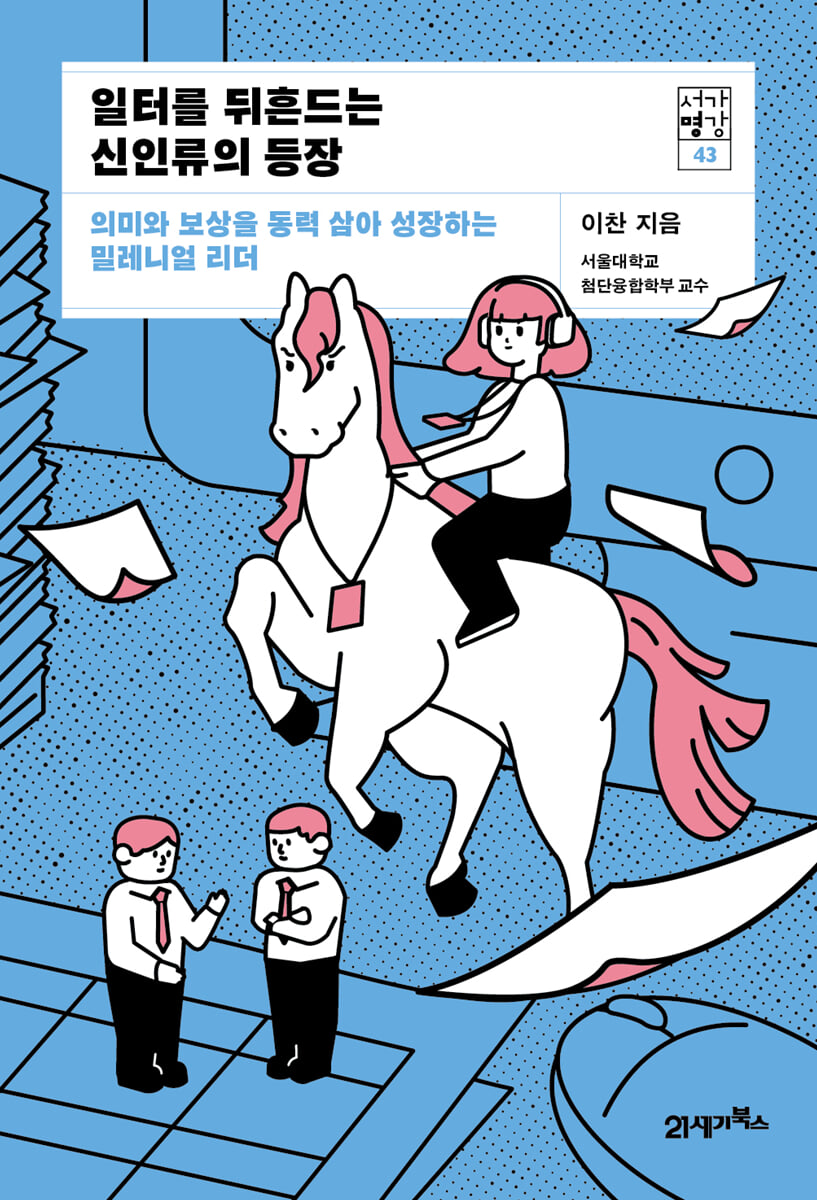
The emergence of a new breed of people shaking up the workplace
 |
Description
Book Introduction
"Seogamyeonggang": A famous lecture you can attend without going to Seoul National University.
From a passive practitioner burdened by his position
Transforming into an irreplaceable leader who collaborates with everyone
Discover Korea's finest lectures in book form! The 43rd volume in the "Seogamyeonggang" series, featuring carefully curated lectures by current Seoul National University faculty, has been published.
The Seoga Myunggang series, which transcribes the lectures of Seoul National University's top professors in various fields, including history, philosophy, science, medicine, and art, into books, provides readers with the expansion of knowledge and the joy of learning.
Millennials, the generation that suddenly appeared in organizations, making Generation X feel uneasy and bewildering baby boomers.
They have returned to us as leaders.
Those who repeatedly quit and change jobs at the company they had worked hard to get into after fierce competition are gradually rising to leadership positions within the organization.
Can we expect them to develop the skills of "bridge leaders" or instill "boss-style leadership" in them? Considering the unique characteristics of each generation, such outdated thinking will never produce good leaders.
It is in the same vein that leading companies of the future have set "attracting leaders with healthy leadership skills" as their top priority, rather than securing AI technology.
This book is a redefinition of leadership, based on the concerns raised by Professor Lee Chan, a human resources development scholar who experienced the changing times before anyone else.
The author says:
The essence of the crisis facing companies today lies in their failure to properly understand the "new leaders" who can handle change and lead organizations toward sustainable growth.
Those ‘new leaders’ are millennials.
This book offers the most realistic analysis of the capabilities that Millennials, the new generation of leaders, must cultivate. It also introduces how companies leading the future are restructuring their personnel and organizations to keep pace with the times.
By weaving together real-world examples and timely theories, this book redefines leadership, a concept that everyone, regardless of generation, should keep in mind.
From a passive practitioner burdened by his position
Transforming into an irreplaceable leader who collaborates with everyone
Discover Korea's finest lectures in book form! The 43rd volume in the "Seogamyeonggang" series, featuring carefully curated lectures by current Seoul National University faculty, has been published.
The Seoga Myunggang series, which transcribes the lectures of Seoul National University's top professors in various fields, including history, philosophy, science, medicine, and art, into books, provides readers with the expansion of knowledge and the joy of learning.
Millennials, the generation that suddenly appeared in organizations, making Generation X feel uneasy and bewildering baby boomers.
They have returned to us as leaders.
Those who repeatedly quit and change jobs at the company they had worked hard to get into after fierce competition are gradually rising to leadership positions within the organization.
Can we expect them to develop the skills of "bridge leaders" or instill "boss-style leadership" in them? Considering the unique characteristics of each generation, such outdated thinking will never produce good leaders.
It is in the same vein that leading companies of the future have set "attracting leaders with healthy leadership skills" as their top priority, rather than securing AI technology.
This book is a redefinition of leadership, based on the concerns raised by Professor Lee Chan, a human resources development scholar who experienced the changing times before anyone else.
The author says:
The essence of the crisis facing companies today lies in their failure to properly understand the "new leaders" who can handle change and lead organizations toward sustainable growth.
Those ‘new leaders’ are millennials.
This book offers the most realistic analysis of the capabilities that Millennials, the new generation of leaders, must cultivate. It also introduces how companies leading the future are restructuring their personnel and organizations to keep pace with the times.
By weaving together real-world examples and timely theories, this book redefines leadership, a concept that everyone, regardless of generation, should keep in mind.
- You can preview some of the book's contents.
Preview
index
Before reading this book _Classification of academic disciplines, 6 key keywords
Introduction: 11 Millennial Leaders: The Key Players of Evolution and the One Who Will Halt Degeneration
Part 1: Every Follower Eventually Becomes a Leader
Workplaces: A Scene of Generational Change 19
What kind of team member was I, and what kind of team leader am I now? 35
Praise and affirmation are the most powerful blessings. 47
Q/A Ask and Answer 55
Part 2: The Irreversible Qualities of a Leader Who Transcends Era
Trust is everything, from civil servants to Googlers. 61
The Leader's Secret: Leverage Coaching 77
Do you know the leader's MBTI and SCAF? 89
Q/A Ask and Answer 94
Part 3: What Good Leaders Don't Give Up
If you use it wrong, you'll end up doing it wrong: Talent Management 101
How to Elevate Your Team's Performance: The 70-20-10 Rule 110
The Best Learning Place, On-the-Site: S-OJT 118
They Want Fairness in the Workplace: Performance Appraisals 125
Q/A Ask and Answer 143
Part 4: The Turbulent Workplace for Millennial Leaders
AI is the colleague you will work with in the future. 149
In a workplace brimming with innovation, the emergence of a new breed of humans? 157
Recruitment is the most powerful branding 177
Q/A Ask and Answer 188
Outgoing Writing _ May a Leader Who Leaves a Mark Become Everyone's Future Strategy 191
Reference 193
Introduction: 11 Millennial Leaders: The Key Players of Evolution and the One Who Will Halt Degeneration
Part 1: Every Follower Eventually Becomes a Leader
Workplaces: A Scene of Generational Change 19
What kind of team member was I, and what kind of team leader am I now? 35
Praise and affirmation are the most powerful blessings. 47
Q/A Ask and Answer 55
Part 2: The Irreversible Qualities of a Leader Who Transcends Era
Trust is everything, from civil servants to Googlers. 61
The Leader's Secret: Leverage Coaching 77
Do you know the leader's MBTI and SCAF? 89
Q/A Ask and Answer 94
Part 3: What Good Leaders Don't Give Up
If you use it wrong, you'll end up doing it wrong: Talent Management 101
How to Elevate Your Team's Performance: The 70-20-10 Rule 110
The Best Learning Place, On-the-Site: S-OJT 118
They Want Fairness in the Workplace: Performance Appraisals 125
Q/A Ask and Answer 143
Part 4: The Turbulent Workplace for Millennial Leaders
AI is the colleague you will work with in the future. 149
In a workplace brimming with innovation, the emergence of a new breed of humans? 157
Recruitment is the most powerful branding 177
Q/A Ask and Answer 188
Outgoing Writing _ May a Leader Who Leaves a Mark Become Everyone's Future Strategy 191
Reference 193
Detailed image

Into the book
In an age where relationships are more important than performance and empathy is more important than authority, the position of leadership is no longer perceived as a privilege but rather a position of isolation.
Leaderphobia, the blanket rejection of leadership roles across society, regardless of the specific era or situation, may be a signal from a society where trust has collapsed.
--- From "Introductory Note | Millennial Leaders: The Key Players of Evolution That Will Halt Decline"
Generation MZ has '3 yo'.
The first one asks for an explanation of the exact content and purpose of the task being directed, such as “This?”
The second is “Me?”, which asks for an explanation of why, among many members, it is you who should perform the task.
The third is “Why?”, which asks the company to explain the reason for doing the task, its necessity, and the expected results.
In other words, the MZ generation tends to accept instructions only if the task is something they can accept themselves, and they demand two-way communication, not one-way communication.
--- From "Part 1: Every Follower Eventually Becomes a Leader | The Workplace: A Scene of Generational Change"
Leadership should also vary depending on the member's experience and situation.
We need to provide teaching to new employees, counseling to team members with psychological issues or concerns, consulting to employees in need of knowledge and experience, mentoring to team members with sufficient work experience, and coaching to employees with a strong desire to grow.
Leadership must be constantly changing depending on the situation, the team's development stage, and the level of its team members to achieve the desired results.
--- From "Part 1: Every Follower Eventually Becomes a Leader | What Kind of Team Member Was I, and What Kind of Team Leader Am I Now?"
Facebook leaders' philosophy in hiring is to hire people who are better than themselves.
I believe that the leader's role is to select employees who are better than the leader, and not to give them directives, but to create an environment and support them so that they can demonstrate their capabilities.
For example, if 100 employees are selected, ten team leaders will come out in order and present the work done in their departments.
After hearing the presentation, the employees decide which department they want to go to after hearing the team leader's presentation.
Team leaders lay the foundation for effective and attractive operations within their departments, and allow members to directly select the departments they want to work in, thereby improving team efficiency and organizational culture.
--- From "The Irreversible Qualities of a Leader Who Transcends the Second Era | Trust is Everything for Civil Servants and Googlers"
Many companies and organizations are currently trying to incorporate positive inquiry into their work.
When new product sales decline, meetings are usually held with the question, “Why aren’t the products selling?”
But positive inquiry asks, “Why did people who bought our product choose our product, even if it wasn’t as expected?”
Strengthening the strengths and characteristics discovered through these questions is positive exploration.
Rather than focusing on the problem, it is about approaching the operation of the advantage from a new perspective.
--- From "The Irreversible Qualities of a Leader Who Transcends the 2nd Era | A Leader's Secret: Use Coaching"
It is also pointed out that it is not the employees but the system that causes quiet resignations, such as bad bosses who live off of the organization, management's refusal to raise wages, and the denial of promotion opportunities.
In a workplace where the future is unclear, it is inevitable that employees will lose motivation, and this is a natural decision for such employees.
Experts believe that changes in the work environment, such as worker burnout and the spread of remote work, have also had an impact.
--- From "Part 3: What Good Leaders Don't Give Up | If You Use It Wrong, You Can't Help It: Talent Management"
Talent is a person with ability.
Competency refers to the knowledge, skills, and attitudes required to successfully perform a specific job.
Looking at it in more detail, knowledge refers to relevant information, knowledge, and insights that are used in work, skills refer to learning tools, techniques, and processes, and attitude refers to the attitude, mindset, and behavioral style when performing work.
Knowledge, skills, and attitude do not exist separately, but are in a relationship of ‘knowledge × skills × attitude.’
It's a concept of multiplication, not addition.
If any one of them becomes 0, they all become 0.
Leaderphobia, the blanket rejection of leadership roles across society, regardless of the specific era or situation, may be a signal from a society where trust has collapsed.
--- From "Introductory Note | Millennial Leaders: The Key Players of Evolution That Will Halt Decline"
Generation MZ has '3 yo'.
The first one asks for an explanation of the exact content and purpose of the task being directed, such as “This?”
The second is “Me?”, which asks for an explanation of why, among many members, it is you who should perform the task.
The third is “Why?”, which asks the company to explain the reason for doing the task, its necessity, and the expected results.
In other words, the MZ generation tends to accept instructions only if the task is something they can accept themselves, and they demand two-way communication, not one-way communication.
--- From "Part 1: Every Follower Eventually Becomes a Leader | The Workplace: A Scene of Generational Change"
Leadership should also vary depending on the member's experience and situation.
We need to provide teaching to new employees, counseling to team members with psychological issues or concerns, consulting to employees in need of knowledge and experience, mentoring to team members with sufficient work experience, and coaching to employees with a strong desire to grow.
Leadership must be constantly changing depending on the situation, the team's development stage, and the level of its team members to achieve the desired results.
--- From "Part 1: Every Follower Eventually Becomes a Leader | What Kind of Team Member Was I, and What Kind of Team Leader Am I Now?"
Facebook leaders' philosophy in hiring is to hire people who are better than themselves.
I believe that the leader's role is to select employees who are better than the leader, and not to give them directives, but to create an environment and support them so that they can demonstrate their capabilities.
For example, if 100 employees are selected, ten team leaders will come out in order and present the work done in their departments.
After hearing the presentation, the employees decide which department they want to go to after hearing the team leader's presentation.
Team leaders lay the foundation for effective and attractive operations within their departments, and allow members to directly select the departments they want to work in, thereby improving team efficiency and organizational culture.
--- From "The Irreversible Qualities of a Leader Who Transcends the Second Era | Trust is Everything for Civil Servants and Googlers"
Many companies and organizations are currently trying to incorporate positive inquiry into their work.
When new product sales decline, meetings are usually held with the question, “Why aren’t the products selling?”
But positive inquiry asks, “Why did people who bought our product choose our product, even if it wasn’t as expected?”
Strengthening the strengths and characteristics discovered through these questions is positive exploration.
Rather than focusing on the problem, it is about approaching the operation of the advantage from a new perspective.
--- From "The Irreversible Qualities of a Leader Who Transcends the 2nd Era | A Leader's Secret: Use Coaching"
It is also pointed out that it is not the employees but the system that causes quiet resignations, such as bad bosses who live off of the organization, management's refusal to raise wages, and the denial of promotion opportunities.
In a workplace where the future is unclear, it is inevitable that employees will lose motivation, and this is a natural decision for such employees.
Experts believe that changes in the work environment, such as worker burnout and the spread of remote work, have also had an impact.
--- From "Part 3: What Good Leaders Don't Give Up | If You Use It Wrong, You Can't Help It: Talent Management"
Talent is a person with ability.
Competency refers to the knowledge, skills, and attitudes required to successfully perform a specific job.
Looking at it in more detail, knowledge refers to relevant information, knowledge, and insights that are used in work, skills refer to learning tools, techniques, and processes, and attitude refers to the attitude, mindset, and behavioral style when performing work.
Knowledge, skills, and attitude do not exist separately, but are in a relationship of ‘knowledge × skills × attitude.’
It's a concept of multiplication, not addition.
If any one of them becomes 0, they all become 0.
--- From "Part 4: The Turbulent Workplaces of Millennial Leaders | The Rise of a New Human Race in a Workplace Full of Innovation?"
Publisher's Review
“Millennials, the center of generational theory, have returned as leaders!”
In an age of chaos, the only leadership that can put businesses and individuals on a growth trajectory is
While the wave of AI and automation is transforming the corporate landscape in real time, unfortunately, many tasks within organizations remain that can only be accomplished by humans.
The representative task is HRD (Human Resources Development).
Can AI analyze corporate systems and organizational cultures, which operate as if they were a single ecosystem? From small and medium-sized enterprises to large corporations, from established companies to startups, no matter how much analysis is done and input into AI, a clear and compelling solution remains elusive.
In this chaotic world, those born in the 90s have suddenly risen to leadership positions.
Once called "these days' kids" and at the center of generational conflict, they have now become mid-level managers with over a decade of experience, and are now being asked by the company to act as a bridge between generations and systems.
However, the title of ‘leader’ is still unfamiliar and burdensome to them.
This phenomenon, also known as “leader phobia” or “conscious unbossing,” clearly demonstrates the reality that the capabilities of a “bridge manager” and “boss leadership” can no longer cultivate good leaders.
"The Emergence of a New Humanity Shaking Up the Workplace: Millennial Leaders Driven by Meaning and Rewards" begins with this very question.
Professor Lee Chan, an expert who worked in HR at Lego Korea and LG Electronics USA before returning to academia and studying human resource development (HRD), delves into the root cause of the “age of lack of good leaders” based on numerous real-world cases encountered through lectures and consulting.
In a reality where outdated practices like seniority, report-driven management, and generational disconnection still hold organizations back, this book demonstrates how millennial leaders can reshape the workplace around "meaning and reward."
Unlike existing leadership discourse that focuses on the 'boss-type leader' who carries the fate of the company, it goes beyond the 'attitude' of the leader and addresses the issue of the 'environment'.
This book sharply analyzes the reasons why more and more executives are reluctant to take on new roles, the structural reasons why talented individuals are leaving organizations, and the risks companies face when they ignore these trends.
At the same time, we introduce solutions that can be applied immediately in the field.
This book is packed with practical leadership strategies to bridge the gap between changing generations and organizations, including communication methods that attract positive followers, strategies that connect recruitment to corporate branding, and designing a healthy organizational culture that goes beyond welfare.
This book is a compassionate guide and practical manual that empowers millennial leaders to lead their organizations in their own unique way, while helping established leaders understand and embrace the waves of change.
Professor Lee Chan says:
“AI can only improve work efficiency.
But ultimately, it's people who gather, lead, and develop people." In this age of innovation, what is the "human leadership" most needed by companies and their members? "The Rise of a New Humanity Shaking Up the Workplace" offers the answer.
In an age of chaos, the only leadership that can put businesses and individuals on a growth trajectory is
While the wave of AI and automation is transforming the corporate landscape in real time, unfortunately, many tasks within organizations remain that can only be accomplished by humans.
The representative task is HRD (Human Resources Development).
Can AI analyze corporate systems and organizational cultures, which operate as if they were a single ecosystem? From small and medium-sized enterprises to large corporations, from established companies to startups, no matter how much analysis is done and input into AI, a clear and compelling solution remains elusive.
In this chaotic world, those born in the 90s have suddenly risen to leadership positions.
Once called "these days' kids" and at the center of generational conflict, they have now become mid-level managers with over a decade of experience, and are now being asked by the company to act as a bridge between generations and systems.
However, the title of ‘leader’ is still unfamiliar and burdensome to them.
This phenomenon, also known as “leader phobia” or “conscious unbossing,” clearly demonstrates the reality that the capabilities of a “bridge manager” and “boss leadership” can no longer cultivate good leaders.
"The Emergence of a New Humanity Shaking Up the Workplace: Millennial Leaders Driven by Meaning and Rewards" begins with this very question.
Professor Lee Chan, an expert who worked in HR at Lego Korea and LG Electronics USA before returning to academia and studying human resource development (HRD), delves into the root cause of the “age of lack of good leaders” based on numerous real-world cases encountered through lectures and consulting.
In a reality where outdated practices like seniority, report-driven management, and generational disconnection still hold organizations back, this book demonstrates how millennial leaders can reshape the workplace around "meaning and reward."
Unlike existing leadership discourse that focuses on the 'boss-type leader' who carries the fate of the company, it goes beyond the 'attitude' of the leader and addresses the issue of the 'environment'.
This book sharply analyzes the reasons why more and more executives are reluctant to take on new roles, the structural reasons why talented individuals are leaving organizations, and the risks companies face when they ignore these trends.
At the same time, we introduce solutions that can be applied immediately in the field.
This book is packed with practical leadership strategies to bridge the gap between changing generations and organizations, including communication methods that attract positive followers, strategies that connect recruitment to corporate branding, and designing a healthy organizational culture that goes beyond welfare.
This book is a compassionate guide and practical manual that empowers millennial leaders to lead their organizations in their own unique way, while helping established leaders understand and embrace the waves of change.
Professor Lee Chan says:
“AI can only improve work efficiency.
But ultimately, it's people who gather, lead, and develop people." In this age of innovation, what is the "human leadership" most needed by companies and their members? "The Rise of a New Humanity Shaking Up the Workplace" offers the answer.
GOODS SPECIFICS
- Date of issue: November 20, 2025
- Page count, weight, size: 200 pages | 128*188*20mm
- ISBN13: 9791173576232
- ISBN10: 1173576231
You may also like
카테고리
korean


korean

![GQ KOREA Mark (Monthly): December [2025]](http://librairie.coreenne.fr/cdn/shop/files/8ef265dbbfbf186523ed75ba7319009d.jpg?v=1765340328&width=3840)


