

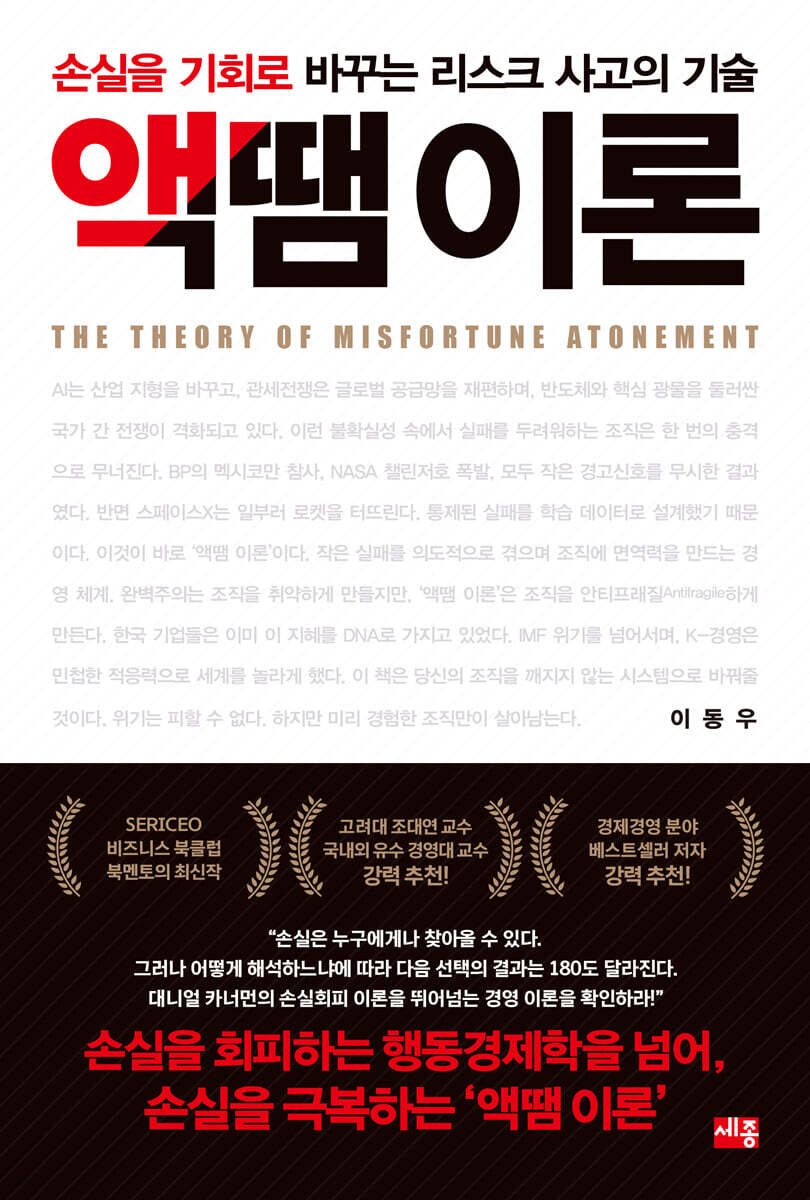
Soldering theory
 |
Description
Book Introduction
Korean Management Philosophy: Turning Failure into Assets
In an age of uncertainty, how do successful organizations deal with failure?
Rather than simply dismissing a crisis as bad luck, turn failure into an opportunity for strategic growth.
K-Management's new philosophy, "soldering theory," is gaining attention.
With unpredictable changes like OTT, artificial intelligence, the metaverse, and global supply chain crises becoming the norm, businesses and organizations need survival strategies that foster "resilience" rather than pursuing "perfection."
Professor Lee Dong-woo presents the answer in this book.
"Theory of Solving Problems" is the first attempt to expand the Korean term "soldering" (a type of "savings"), a common term in everyday Korean, into a modern management philosophy. It reinterprets it as a strategic thinking system that enhances an organization's ability to respond to crises through intentional, small-scale failures.
This theory goes beyond simple acceptance of failure and proposes a culture, system, and mindset that views failure as a "planned experiment" and allows for learning.
Global cases, such as SpaceX's rocket explosion and the Tylenol recall, are introduced throughout the book.
Above all, the book's excellence lies in systematizing the paradox of time, loss aversion, and collective wisdom about unpredictability, all contained in the expression "I've soldered my teeth," into a management strategy, elevating the uniquely Korean way of thinking to global management discourse.
The core of the soldering theory is a friendly mindset that accepts failure as a controllable experiment, designing for intentional small failures, self-destruction and experimentation, a portfolio approach, an iterative feedback structure, psychological safety from failure, and a culture that turns failure into a learning asset.
These seven principles are practical strategies for strengthening crisis response, and they guide you through specific applications in leadership, innovation, and organizational operations.
Real-world examples like Tylenol, Toyota, BP, Samsung Electronics, Netflix, and SpaceX make the theory more persuasive.
“There is no success without failure.
As the author says, “Perfection, not repetition and learning, is the survival strategy,” “The Soldering Theory” presents new possibilities to the Korean management world, which has been dependent on foreign theories.
Beyond K-pop and K-dramas, this book, which serves as the foundation for a new trend called K-management, is not simply a management book; it provides insight to everyone who is not afraid of failure and seeks to use it as an opportunity for growth.
When the everyday language of "soldering" becomes a global survival strategy, we will discover the wisdom to turn crisis into opportunity in our own way.
In an age of uncertainty, how do successful organizations deal with failure?
Rather than simply dismissing a crisis as bad luck, turn failure into an opportunity for strategic growth.
K-Management's new philosophy, "soldering theory," is gaining attention.
With unpredictable changes like OTT, artificial intelligence, the metaverse, and global supply chain crises becoming the norm, businesses and organizations need survival strategies that foster "resilience" rather than pursuing "perfection."
Professor Lee Dong-woo presents the answer in this book.
"Theory of Solving Problems" is the first attempt to expand the Korean term "soldering" (a type of "savings"), a common term in everyday Korean, into a modern management philosophy. It reinterprets it as a strategic thinking system that enhances an organization's ability to respond to crises through intentional, small-scale failures.
This theory goes beyond simple acceptance of failure and proposes a culture, system, and mindset that views failure as a "planned experiment" and allows for learning.
Global cases, such as SpaceX's rocket explosion and the Tylenol recall, are introduced throughout the book.
Above all, the book's excellence lies in systematizing the paradox of time, loss aversion, and collective wisdom about unpredictability, all contained in the expression "I've soldered my teeth," into a management strategy, elevating the uniquely Korean way of thinking to global management discourse.
The core of the soldering theory is a friendly mindset that accepts failure as a controllable experiment, designing for intentional small failures, self-destruction and experimentation, a portfolio approach, an iterative feedback structure, psychological safety from failure, and a culture that turns failure into a learning asset.
These seven principles are practical strategies for strengthening crisis response, and they guide you through specific applications in leadership, innovation, and organizational operations.
Real-world examples like Tylenol, Toyota, BP, Samsung Electronics, Netflix, and SpaceX make the theory more persuasive.
“There is no success without failure.
As the author says, “Perfection, not repetition and learning, is the survival strategy,” “The Soldering Theory” presents new possibilities to the Korean management world, which has been dependent on foreign theories.
Beyond K-pop and K-dramas, this book, which serves as the foundation for a new trend called K-management, is not simply a management book; it provides insight to everyone who is not afraid of failure and seeks to use it as an opportunity for growth.
When the everyday language of "soldering" becomes a global survival strategy, we will discover the wisdom to turn crisis into opportunity in our own way.
- You can preview some of the book's contents.
Preview
index
Recommendation
Prologue: A New K-Management Strategy: "Theory of Solving Losses"
Chapter 1: Innovation in Crisis Management Philosophy: The Strategic Value of Small Losses
A linguistic innovation called 'aekttam'
The power of decision-making based on positive psychology
Evolving Koreans' Risk Perceptions, as Seen Through Data
The Digital Evolution of Soldering: The Role of Collective Emotion and Content in the Social Media Era
The Risk-Reward Dynamics of Proverbs
Insights into Risk Diversification from War History
The Roots of Korean Strategic Thinking
Chapter 2: Mindset Management in an Age of Uncertainty
Rationalization vs. Strategic Accommodation
The Uncertainty Principle and the Normalization of Operational Risk
The illusion of control and comfort strategies
Red Teaming as a Risk Response Strategy
The Wisdom of Acceptance and Reinterpretation
The Potential of Brain Neuroscience and Leadership Learning
Antifragile Building Strategy
Correct and incorrect soldering
An era where fairness becomes a strategy
The Soldering Mindset: A Psychological Strategy for Turning Failure into Opportunity
Philosophy of Execution: The Persistence Strategy of Giuje and Leadership
Chapter 3: Leadership that Turns Failure into Assets
A new definition of failure and success
The depth of failure creates the height of management.
A Failure-Driven Innovation System: Silicon Valley's "Fail Fast" Philosophy
The psychology of jealousy leads to differences in strategy.
Failure Management Leading to Sustainable Growth
Chapter 4: Disruptive Innovation and the Transition to Sustainable Management
An innovative methodology for dealing with failure and frustration
Applying Disruptive Innovation in an Uncertain Environment
ASML's Blue Ocean Strategy, Reinforced by Soldering Theory, Wins
A business comedy where decoupling and soldering theories meet.
The 21st century core competency is a combination of flexibility and resilience.
Sustainable Management Beyond ESG
The Defeat Syndrome and the Evolution of Leadership
Chapter 5: Insights into Restoring Corporate Value in a Crisis
Design and implementation of intended failure scenarios
A Textbook for Restoring Corporate Trust: The Tylenol Case
Rebuilding Quality Management Systems After Failure: Toyota's Recalls
The Cost of Leadership Absence: BP's Deepwater Horizon Disaster
The Power of Transparency and Response: The SKT, KT, and Lotte Card Hacking Incidents
Risk-Taking Entrepreneurship: SpaceX's Experimental Model
The difference between excuses and strategic responsibility
Chapter 6: Prepare for the Future with a Soldering Management Strategy
Timing and Decision Factors for Risk Response
Core Principle 1.
A friendly mindset that actively embraces failure
Core Principle 2.
The principle of continuous self-destruction
Core Principle 3.
Portfolio Approach Principles
Core Principle 4.
Antifragility principle
Core Principle 5.
Iterative Feedback Principle
Core Principle 6.
The principle of patience and perseverance
Core Principle 7.
Learner Mindset Principles
Building Brand Trust with Positive Failure Narratives
Epilogue: The K-Management Counterattack: From Korean Intuition to Global Strategy
References
Prologue: A New K-Management Strategy: "Theory of Solving Losses"
Chapter 1: Innovation in Crisis Management Philosophy: The Strategic Value of Small Losses
A linguistic innovation called 'aekttam'
The power of decision-making based on positive psychology
Evolving Koreans' Risk Perceptions, as Seen Through Data
The Digital Evolution of Soldering: The Role of Collective Emotion and Content in the Social Media Era
The Risk-Reward Dynamics of Proverbs
Insights into Risk Diversification from War History
The Roots of Korean Strategic Thinking
Chapter 2: Mindset Management in an Age of Uncertainty
Rationalization vs. Strategic Accommodation
The Uncertainty Principle and the Normalization of Operational Risk
The illusion of control and comfort strategies
Red Teaming as a Risk Response Strategy
The Wisdom of Acceptance and Reinterpretation
The Potential of Brain Neuroscience and Leadership Learning
Antifragile Building Strategy
Correct and incorrect soldering
An era where fairness becomes a strategy
The Soldering Mindset: A Psychological Strategy for Turning Failure into Opportunity
Philosophy of Execution: The Persistence Strategy of Giuje and Leadership
Chapter 3: Leadership that Turns Failure into Assets
A new definition of failure and success
The depth of failure creates the height of management.
A Failure-Driven Innovation System: Silicon Valley's "Fail Fast" Philosophy
The psychology of jealousy leads to differences in strategy.
Failure Management Leading to Sustainable Growth
Chapter 4: Disruptive Innovation and the Transition to Sustainable Management
An innovative methodology for dealing with failure and frustration
Applying Disruptive Innovation in an Uncertain Environment
ASML's Blue Ocean Strategy, Reinforced by Soldering Theory, Wins
A business comedy where decoupling and soldering theories meet.
The 21st century core competency is a combination of flexibility and resilience.
Sustainable Management Beyond ESG
The Defeat Syndrome and the Evolution of Leadership
Chapter 5: Insights into Restoring Corporate Value in a Crisis
Design and implementation of intended failure scenarios
A Textbook for Restoring Corporate Trust: The Tylenol Case
Rebuilding Quality Management Systems After Failure: Toyota's Recalls
The Cost of Leadership Absence: BP's Deepwater Horizon Disaster
The Power of Transparency and Response: The SKT, KT, and Lotte Card Hacking Incidents
Risk-Taking Entrepreneurship: SpaceX's Experimental Model
The difference between excuses and strategic responsibility
Chapter 6: Prepare for the Future with a Soldering Management Strategy
Timing and Decision Factors for Risk Response
Core Principle 1.
A friendly mindset that actively embraces failure
Core Principle 2.
The principle of continuous self-destruction
Core Principle 3.
Portfolio Approach Principles
Core Principle 4.
Antifragility principle
Core Principle 5.
Iterative Feedback Principle
Core Principle 6.
The principle of patience and perseverance
Core Principle 7.
Learner Mindset Principles
Building Brand Trust with Positive Failure Narratives
Epilogue: The K-Management Counterattack: From Korean Intuition to Global Strategy
References
Detailed image

Into the book
The difference between a soldering iron and an excuse can be summarized in one word.
Soldering begins with the question, “What can I learn from this situation?” whereas excuses begin with the question, “Who is to blame for this situation?”
The former brings growth and development, while the latter brings stagnation and regression.
Just as one person might expect a rainbow while another might worry about catching a cold when exposed to the same rain, the same failure can lead to completely different outcomes depending on how you approach it.
So which one do you prefer, soldering or excuses?
--- p.120
The biggest difference between Murphy's Law and the theory of soldering iron is their 'attitude toward uncertainty.'
Murphy's Law exposes the harsh realities of structural flaws, human error, and the probability of events, and encourages an enlightened attitude of "so let's be more prepared."
It is an expression of a proactive attitude to systematically manage and prepare for uncertainty.
On the other hand, the theory of soldering is an expression of a passive attitude that neutralizes or 'prepays for' the uncertain power of fate or energy through minor misfortune experiences, and attempts to psychologically block out the great misfortune that may come later.
--- p.128
In conclusion, Silicon Valley's 'Fail Fast' philosophy and Korea's 'Fail Fast' theory are like twins that grew up in different cultural soils.
Both contain the wisdom of 'reaching great success through small failures', but there are subtle differences in their approaches.
'Fail Fast' is more aggressive and intentional, while the soldering theory is more accepting and philosophical.
But by properly combining these two approaches, we can create a powerful culture that combines the demands of modern innovation with the depth of traditional wisdom.
--- p.239
Masters of the theory of failure aren't simply people who "never give up," but rather possess advanced cognitive, emotional, and social skills that allow them to creatively utilize failure.
They have constant energy like energizers, but the source of that energy comes not from external success, but from internal learning and growth.
The reason we can focus on the present is because we don't get caught up in past failures or future successes, but rather believe in the possibilities of this moment.
Aren't these the very people most needed in today's uncertain society?
--- p.252
Sustainability through liquid soldering is about becoming a 'strong company' rather than simply a 'good company'.
A company that is not afraid of failure, turns crises into opportunities, and uses change as a driving force for growth.
Only such companies can achieve true sustainability in the 21st century.
So what we need is 'sustainability in collecting failures'.
This is not to deny the existing definition of sustainability, but rather to upgrade it to fit the realities of the 21st century.
It's not about "sacrifice the present for future generations," but rather "prepare for future success through present failures."
Isn't this the true sustainability we need in these unpredictable times?
--- p.308
BP's case offers important lessons for modern businesses.
The crisis is inevitable.
But how we handle a crisis is a matter of choice.
Should they take small losses and seize big opportunities, or avoid small losses and incur even greater losses? BP chose the latter, and the results were disastrous.
Let's hope that when other companies face similar crises in the future, they don't follow in BP's footsteps.
Instead, I hope that you will embrace the wisdom of the theory of liquid soldering and demonstrate true leadership that turns crises into opportunities.
That may be the most valuable lesson the BP incident has left us with.
--- p.351
The theory of soldering is also deeply ingrained in SpaceX's cultural DNA.
Within the company, we don't punish failed projects; rather, we encourage sharing the lessons learned through "fast failures."
Musk tells his employees, “If you’re not failing, you’re not innovative enough.”
This culture encourages engineers to continually explore new possibilities rather than settle for existing solutions.
In fact, many of SpaceX's innovations started as "ridiculous" ideas.
From the Raptor Engine's use of methane fuel, to the stainless steel rocket hull, to the plan to build a colony on Mars, these were all challenges that seemed impossible to conventional wisdom.
--- p.366
In organizations where a culture of blundering is established, mistakes and failures are seen as learning opportunities.
Representative examples include systems like Google's 'Failure Party' and Amazon's 'Failure Award'.
In these organizations, members do not hide their mistakes but rather actively share them.
Communicate transparently with the mindset of, “I made this mistake, and I hope others don’t make the same mistake.”
This increases the learning rate of the entire organization and enables quicker response in crisis situations.
On the other hand, in organizations where a culture of excuses dominates, mistakes and failures are punishable.
Members try to hide mistakes and pass the blame to each other when problems arise.
Excuses like “It’s not my fault,” “I didn’t know,” and “I did what I was told to do” are rampant.
In such organizations, information is distorted and the essence of the problem is obscured.
In a crisis situation, it becomes even more serious, making it difficult to grasp the exact situation.
Soldering begins with the question, “What can I learn from this situation?” whereas excuses begin with the question, “Who is to blame for this situation?”
The former brings growth and development, while the latter brings stagnation and regression.
Just as one person might expect a rainbow while another might worry about catching a cold when exposed to the same rain, the same failure can lead to completely different outcomes depending on how you approach it.
So which one do you prefer, soldering or excuses?
--- p.120
The biggest difference between Murphy's Law and the theory of soldering iron is their 'attitude toward uncertainty.'
Murphy's Law exposes the harsh realities of structural flaws, human error, and the probability of events, and encourages an enlightened attitude of "so let's be more prepared."
It is an expression of a proactive attitude to systematically manage and prepare for uncertainty.
On the other hand, the theory of soldering is an expression of a passive attitude that neutralizes or 'prepays for' the uncertain power of fate or energy through minor misfortune experiences, and attempts to psychologically block out the great misfortune that may come later.
--- p.128
In conclusion, Silicon Valley's 'Fail Fast' philosophy and Korea's 'Fail Fast' theory are like twins that grew up in different cultural soils.
Both contain the wisdom of 'reaching great success through small failures', but there are subtle differences in their approaches.
'Fail Fast' is more aggressive and intentional, while the soldering theory is more accepting and philosophical.
But by properly combining these two approaches, we can create a powerful culture that combines the demands of modern innovation with the depth of traditional wisdom.
--- p.239
Masters of the theory of failure aren't simply people who "never give up," but rather possess advanced cognitive, emotional, and social skills that allow them to creatively utilize failure.
They have constant energy like energizers, but the source of that energy comes not from external success, but from internal learning and growth.
The reason we can focus on the present is because we don't get caught up in past failures or future successes, but rather believe in the possibilities of this moment.
Aren't these the very people most needed in today's uncertain society?
--- p.252
Sustainability through liquid soldering is about becoming a 'strong company' rather than simply a 'good company'.
A company that is not afraid of failure, turns crises into opportunities, and uses change as a driving force for growth.
Only such companies can achieve true sustainability in the 21st century.
So what we need is 'sustainability in collecting failures'.
This is not to deny the existing definition of sustainability, but rather to upgrade it to fit the realities of the 21st century.
It's not about "sacrifice the present for future generations," but rather "prepare for future success through present failures."
Isn't this the true sustainability we need in these unpredictable times?
--- p.308
BP's case offers important lessons for modern businesses.
The crisis is inevitable.
But how we handle a crisis is a matter of choice.
Should they take small losses and seize big opportunities, or avoid small losses and incur even greater losses? BP chose the latter, and the results were disastrous.
Let's hope that when other companies face similar crises in the future, they don't follow in BP's footsteps.
Instead, I hope that you will embrace the wisdom of the theory of liquid soldering and demonstrate true leadership that turns crises into opportunities.
That may be the most valuable lesson the BP incident has left us with.
--- p.351
The theory of soldering is also deeply ingrained in SpaceX's cultural DNA.
Within the company, we don't punish failed projects; rather, we encourage sharing the lessons learned through "fast failures."
Musk tells his employees, “If you’re not failing, you’re not innovative enough.”
This culture encourages engineers to continually explore new possibilities rather than settle for existing solutions.
In fact, many of SpaceX's innovations started as "ridiculous" ideas.
From the Raptor Engine's use of methane fuel, to the stainless steel rocket hull, to the plan to build a colony on Mars, these were all challenges that seemed impossible to conventional wisdom.
--- p.366
In organizations where a culture of blundering is established, mistakes and failures are seen as learning opportunities.
Representative examples include systems like Google's 'Failure Party' and Amazon's 'Failure Award'.
In these organizations, members do not hide their mistakes but rather actively share them.
Communicate transparently with the mindset of, “I made this mistake, and I hope others don’t make the same mistake.”
This increases the learning rate of the entire organization and enables quicker response in crisis situations.
On the other hand, in organizations where a culture of excuses dominates, mistakes and failures are punishable.
Members try to hide mistakes and pass the blame to each other when problems arise.
Excuses like “It’s not my fault,” “I didn’t know,” and “I did what I was told to do” are rampant.
In such organizations, information is distorted and the essence of the problem is obscured.
In a crisis situation, it becomes even more serious, making it difficult to grasp the exact situation.
--- p.371
Publisher's Review
A time of transformation: turning failure into strategy
Rapid changes in technology and society, including OTT, artificial intelligence, the metaverse, and the global supply chain crisis, have made unpredictability the new "default."
In this environment, organizations can no longer survive with perfect plans and watertight strategies alone.
Crisis is no longer the exception but the norm, and risk has become a constant we must live with rather than something to be controlled.
What businesses and organizations need now is not a culture that avoids failure, but the flexibility to handle and leverage failure—in other words, organizational resilience and immunity.
"The Soldering Theory" identifies this turning point and suggests that organizations can become stronger by intentionally designing and experiencing small failures rather than fearing or hiding them.
Perfection is only a theoretical ideal; actionable strategies are based on repetition and learning.
To prevent a major, destructive crisis, organizations should instead experience small failures in a controlled environment, thereby identifying and addressing system vulnerabilities.
This book goes beyond the simple consolation that "failure is okay," and emphasizes the need to redesign organizations so that failure is a necessary component of survival.
A Business Reinterpretation of the Phrase "It's Soldered"
Everyone has probably said “I’ve had a stroke of luck” at least once in their life.
When experiencing an unexpected accident or loss, it is interpreted as a 'defensive incident' that prevents a greater misfortune.
This short expression contains a collective wisdom about time and danger that goes beyond mere comfort or superstition.
The mindset of reinterpreting current losses as investments in future security is a psychological skill and cultural survival strategy for surviving in an uncertain world.
Professor Lee Dong-woo does not view this familiar expression as simply emotional avoidance.
Rather, the term 'weighing the losses' is seen as a psychological structure of accepting inevitable losses, but reflecting on the flaws in oneself and the system through that experience and preparing for the next time.
"Theory of Soldering" translates this folk sentiment into the language of modern management strategy, expanding it into a structural way of thinking that allows us to manage uncertainty by experiencing and controlling failure in advance.
This interpretation can be said to be a unique characteristic of K-management, which is different from Western risk management methods.
The view that even if short-term losses are accepted, they serve as "insurance" against greater crises in the future is an expression of the practical wisdom that Korean society has cultivated over a long period of uncertainty and competition.
Ultimately, soldering is not about 'how to endure' failure, but about 'how to utilize' failure.
Global examples of designing and leveraging failure
What makes "Theory of Soldering" so remarkable is that it goes beyond simply presenting the concept, proving its effectiveness through concrete examples of companies that have actually used failure as a strategy.
SpaceX is a representative example of a company that actively uses rocket launch failures as a ‘learning opportunity’ rather than a ‘failure.’
Elon Musk redefined rocket explosions with the technical term RUD (Rapid Unscheduled Disassembly), and organizations analyzed failures rather than hiding them, incorporating them into the next experiment.
As a result, it became the world's fastest-growing space company.
Other challenges, such as the Tylenol recall, Toyota's recall response, and Netflix's Quickster failure, initially appeared as risks, but ultimately became growth assets that brought trust and opportunities for recovery to the organization.
What these companies have in common is that they do not hide their failures, but rather actively analyze and share them at the organizational level, and reflect them in their subsequent strategies.
On the other hand, cases like BP's Deepwater Horizon disaster where failures were covered up or downplayed resulted in a loss of social trust and even threatened the survival of the company.
Through these cases, Professor Lee Dong-woo repeatedly emphasizes that it is not the failure itself, but how a company responds to it that determines its fate.
The soldering theory shows that the key is not to hide or avoid failure, but to transform it into planned experimentation and create a structure for continuous learning throughout the organization.
7 Strategic Principles Your Organization Can Implement
『Theory of Soldering』 does not stop at simply presenting concepts.
This book presents seven actionable principles for organizations to follow to strategically embrace and leverage failure.
First, we need a 'failure-friendly mindset' that views failure as a controllable experiment.
By designing failure as a predictable experiment rather than a misfortune, organizations can detect crises early and build resilience.
Second, ‘continuous self-destruction’ is required to be able to tear down old structures on one’s own.
Only organizations that do not rest on their laurels and bring about change from within can stay ahead of environmental changes.
Third, a 'portfolio approach' that can tolerate some failures in various attempts is important.
By decentralizing the structure so that it is not shaken by a single failure, experiments become sustainable and the organization becomes more resilient.
Fourth, we must have an 'iterative feedback structure' that allows us to quickly learn and reflect after failure.
Learning speed is competitiveness, and the more agile an organization is, the more agile it is in responding to change.
Fifth, a ‘psychological safety’ that creates an environment where people are not afraid of failure must be established.
When organizations can expose failures rather than hide them, they can recover and grow more quickly.
Sixth, a culture based on ‘patience and perseverance’ is more important than short-term results.
Innovation doesn't happen overnight, and the ability to endure failure is what leads to sustainability.
Seventh, we need a 'learner mindset' that interprets failure as a learning opportunity rather than a stigma.
An individual's failure experience becomes a strategic asset that can be shared and utilized by the entire organization.
These seven principles apply to any business, regardless of size or industry. In fact, many organizations are adopting this philosophy and transforming their cultures into ones that are resilient to failure.
Survival Strategies for Everyone Who Isn't Afraid of Failure
Although "Theory of Soldering" is a book for managers and practitioners, its target audience is by no means limited to businesses.
This book provides practical life strategies for anyone who takes risks, including entrepreneurs, freelancers, teachers, self-employed people, and artists.
Failure is not something that only certain professions experience; it is a reality that everyone encounters repeatedly in their daily lives.
This book proposes a new perspective: one that views failure not simply as "failure," but as a small experiment, a learning process, and a preemptive measure to avoid crisis.
This allows us to have both a strong inner self and flexible thinking as we live in an age of high unpredictability.
If failure cannot be completely avoided, the ability to design and interpret it is the most powerful survival tool.
"Theory of Soldering" is a Korean-style practical management book that responds to the needs of the times and provides both emotional comfort and practical strategies.
This theory, which originated from the emotions and experiences of Koreans, now goes beyond management to become a guide for everyday resilience and a shift in mindset.
For those who are not afraid of failure and are contemplating how to live with it, this book will be the most realistic and warm guide.
Rapid changes in technology and society, including OTT, artificial intelligence, the metaverse, and the global supply chain crisis, have made unpredictability the new "default."
In this environment, organizations can no longer survive with perfect plans and watertight strategies alone.
Crisis is no longer the exception but the norm, and risk has become a constant we must live with rather than something to be controlled.
What businesses and organizations need now is not a culture that avoids failure, but the flexibility to handle and leverage failure—in other words, organizational resilience and immunity.
"The Soldering Theory" identifies this turning point and suggests that organizations can become stronger by intentionally designing and experiencing small failures rather than fearing or hiding them.
Perfection is only a theoretical ideal; actionable strategies are based on repetition and learning.
To prevent a major, destructive crisis, organizations should instead experience small failures in a controlled environment, thereby identifying and addressing system vulnerabilities.
This book goes beyond the simple consolation that "failure is okay," and emphasizes the need to redesign organizations so that failure is a necessary component of survival.
A Business Reinterpretation of the Phrase "It's Soldered"
Everyone has probably said “I’ve had a stroke of luck” at least once in their life.
When experiencing an unexpected accident or loss, it is interpreted as a 'defensive incident' that prevents a greater misfortune.
This short expression contains a collective wisdom about time and danger that goes beyond mere comfort or superstition.
The mindset of reinterpreting current losses as investments in future security is a psychological skill and cultural survival strategy for surviving in an uncertain world.
Professor Lee Dong-woo does not view this familiar expression as simply emotional avoidance.
Rather, the term 'weighing the losses' is seen as a psychological structure of accepting inevitable losses, but reflecting on the flaws in oneself and the system through that experience and preparing for the next time.
"Theory of Soldering" translates this folk sentiment into the language of modern management strategy, expanding it into a structural way of thinking that allows us to manage uncertainty by experiencing and controlling failure in advance.
This interpretation can be said to be a unique characteristic of K-management, which is different from Western risk management methods.
The view that even if short-term losses are accepted, they serve as "insurance" against greater crises in the future is an expression of the practical wisdom that Korean society has cultivated over a long period of uncertainty and competition.
Ultimately, soldering is not about 'how to endure' failure, but about 'how to utilize' failure.
Global examples of designing and leveraging failure
What makes "Theory of Soldering" so remarkable is that it goes beyond simply presenting the concept, proving its effectiveness through concrete examples of companies that have actually used failure as a strategy.
SpaceX is a representative example of a company that actively uses rocket launch failures as a ‘learning opportunity’ rather than a ‘failure.’
Elon Musk redefined rocket explosions with the technical term RUD (Rapid Unscheduled Disassembly), and organizations analyzed failures rather than hiding them, incorporating them into the next experiment.
As a result, it became the world's fastest-growing space company.
Other challenges, such as the Tylenol recall, Toyota's recall response, and Netflix's Quickster failure, initially appeared as risks, but ultimately became growth assets that brought trust and opportunities for recovery to the organization.
What these companies have in common is that they do not hide their failures, but rather actively analyze and share them at the organizational level, and reflect them in their subsequent strategies.
On the other hand, cases like BP's Deepwater Horizon disaster where failures were covered up or downplayed resulted in a loss of social trust and even threatened the survival of the company.
Through these cases, Professor Lee Dong-woo repeatedly emphasizes that it is not the failure itself, but how a company responds to it that determines its fate.
The soldering theory shows that the key is not to hide or avoid failure, but to transform it into planned experimentation and create a structure for continuous learning throughout the organization.
7 Strategic Principles Your Organization Can Implement
『Theory of Soldering』 does not stop at simply presenting concepts.
This book presents seven actionable principles for organizations to follow to strategically embrace and leverage failure.
First, we need a 'failure-friendly mindset' that views failure as a controllable experiment.
By designing failure as a predictable experiment rather than a misfortune, organizations can detect crises early and build resilience.
Second, ‘continuous self-destruction’ is required to be able to tear down old structures on one’s own.
Only organizations that do not rest on their laurels and bring about change from within can stay ahead of environmental changes.
Third, a 'portfolio approach' that can tolerate some failures in various attempts is important.
By decentralizing the structure so that it is not shaken by a single failure, experiments become sustainable and the organization becomes more resilient.
Fourth, we must have an 'iterative feedback structure' that allows us to quickly learn and reflect after failure.
Learning speed is competitiveness, and the more agile an organization is, the more agile it is in responding to change.
Fifth, a ‘psychological safety’ that creates an environment where people are not afraid of failure must be established.
When organizations can expose failures rather than hide them, they can recover and grow more quickly.
Sixth, a culture based on ‘patience and perseverance’ is more important than short-term results.
Innovation doesn't happen overnight, and the ability to endure failure is what leads to sustainability.
Seventh, we need a 'learner mindset' that interprets failure as a learning opportunity rather than a stigma.
An individual's failure experience becomes a strategic asset that can be shared and utilized by the entire organization.
These seven principles apply to any business, regardless of size or industry. In fact, many organizations are adopting this philosophy and transforming their cultures into ones that are resilient to failure.
Survival Strategies for Everyone Who Isn't Afraid of Failure
Although "Theory of Soldering" is a book for managers and practitioners, its target audience is by no means limited to businesses.
This book provides practical life strategies for anyone who takes risks, including entrepreneurs, freelancers, teachers, self-employed people, and artists.
Failure is not something that only certain professions experience; it is a reality that everyone encounters repeatedly in their daily lives.
This book proposes a new perspective: one that views failure not simply as "failure," but as a small experiment, a learning process, and a preemptive measure to avoid crisis.
This allows us to have both a strong inner self and flexible thinking as we live in an age of high unpredictability.
If failure cannot be completely avoided, the ability to design and interpret it is the most powerful survival tool.
"Theory of Soldering" is a Korean-style practical management book that responds to the needs of the times and provides both emotional comfort and practical strategies.
This theory, which originated from the emotions and experiences of Koreans, now goes beyond management to become a guide for everyday resilience and a shift in mindset.
For those who are not afraid of failure and are contemplating how to live with it, this book will be the most realistic and warm guide.
GOODS SPECIFICS
- Date of issue: November 25, 2025
- Page count, weight, size: 500 pages | 746g | 152*225*30mm
- ISBN13: 9791199512412
- ISBN10: 1199512419
You may also like
카테고리
korean


korean

![GQ KOREA Mark (Monthly): December [2025]](http://librairie.coreenne.fr/cdn/shop/files/8ef265dbbfbf186523ed75ba7319009d.jpg?v=1765340328&width=3840)


