

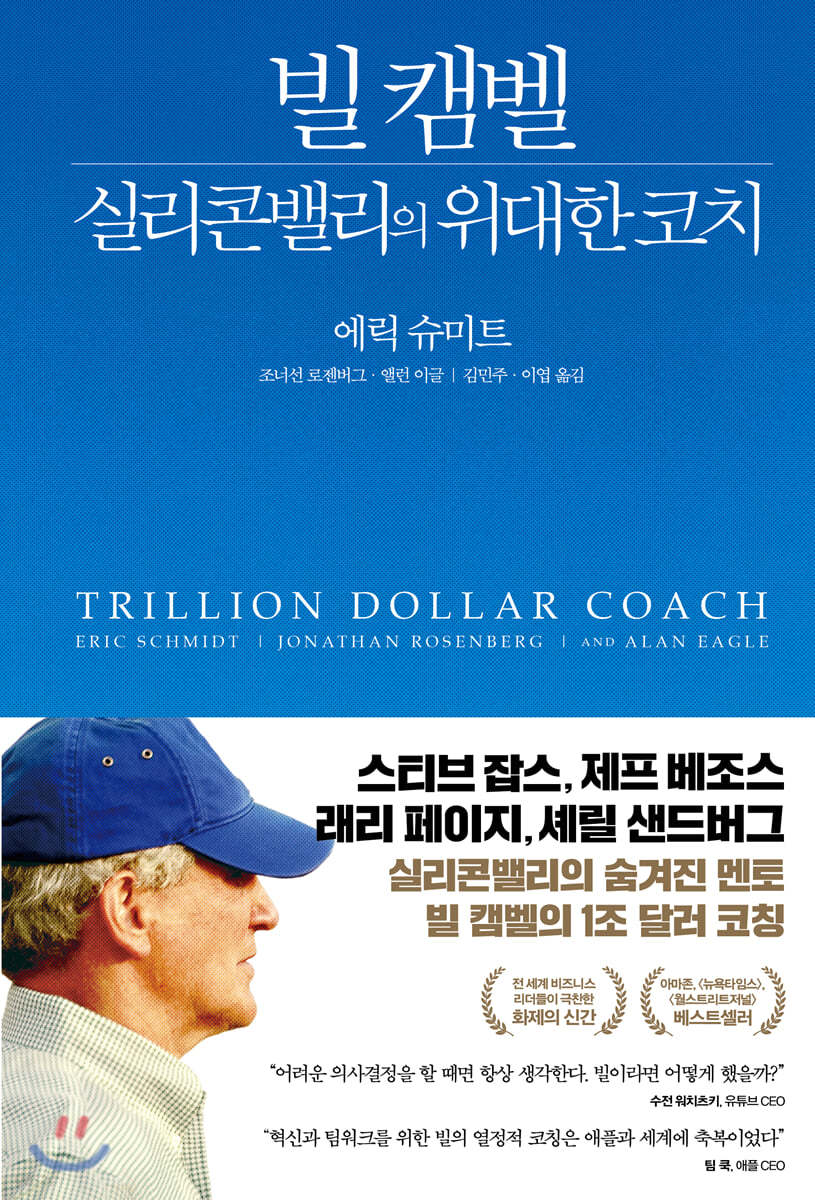
Bill Campbell, Silicon Valley's Great Coach
 |
Description
Book Introduction
- A word from MD
-
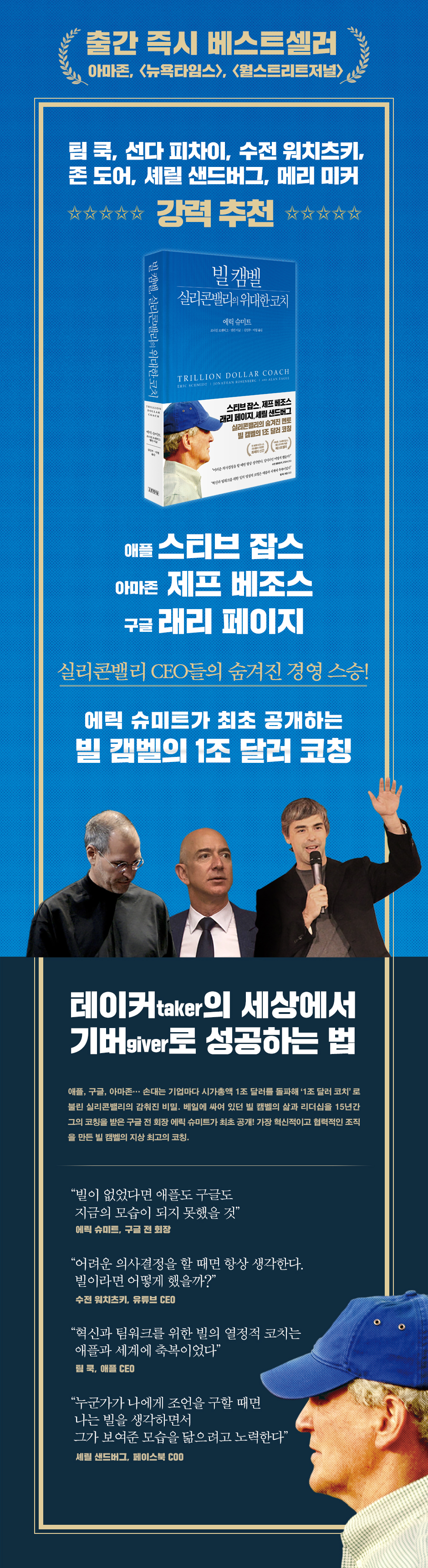
He was 'Silicon Valley's hidden secret'He was called the "Trillion Dollar Coach" because every company he touched, including Apple, Google, and Amazon, had a market capitalization of over $1 trillion.
The life and leadership principles of Bill Campbell, a great mentor to now-star Silicon Valley CEOs, are revealed for the first time by former Google Chairman Eric Schmidt.
How did Bill Mann's coaching, which prioritized collaboration and trust, transform the team?August 4, 2020. Park Jeong-yoon, Economics and Management PD
Steve Jobs, Jeff Bezos, Larry Page, Sheryl Sandberg…
Behind Silicon Valley's greatest CEOs lies a hidden mentor.
Bill Campbell's $1 Trillion Coaching Revealed for the First Time by Former Google Chairman Eric Schmidt
Apple, Google, Facebook, Twitter, eBay, Intuit… Behind the great CEOs of Silicon Valley, there was a hidden mentor, Bill Campbell.
He was called the “Trillion Dollar Coach” because every company he touched surpassed a trillion dollars in market capitalization, and former Google CEO Eric Schmidt even said, “Without him, neither Apple nor Google would have become what they are today.”
He took a walk with Steve Jobs every Sunday, was mentored by the founders of Google, and saved Jeff Bezos from being fired from Amazon.
As Intuit founder Scott Cook put it, “No one has had a more significant or far-reaching impact on Silicon Valley leaders than Bill Campbell.”
Bill Campbell was called "Silicon Valley's best-kept secret" because he preferred to stay out of the spotlight.
How did he transform autocratic leaders into humane leaders and transform idiosyncratic employees into dedicated team players? Eric Schmidt, who received weekly coaching from Bill Campbell for 15 years, published "Bill Campbell: Silicon Valley's Trillion Dollar Coach" (original title: Bill Campbell, Silicon Valley's Trillion Dollar Coach) to pass on his teachings to future generations.
Based on interviews with over 80 people who worked with Bill, this book reveals for the first time the life and leadership principles of Bill Campbell, which were shrouded in secrecy.
This is Bill Campbell's world-class coaching on how to build the most innovative and collaborative organizations through collaboration, not competition, and trust, not command.
Behind Silicon Valley's greatest CEOs lies a hidden mentor.
Bill Campbell's $1 Trillion Coaching Revealed for the First Time by Former Google Chairman Eric Schmidt
Apple, Google, Facebook, Twitter, eBay, Intuit… Behind the great CEOs of Silicon Valley, there was a hidden mentor, Bill Campbell.
He was called the “Trillion Dollar Coach” because every company he touched surpassed a trillion dollars in market capitalization, and former Google CEO Eric Schmidt even said, “Without him, neither Apple nor Google would have become what they are today.”
He took a walk with Steve Jobs every Sunday, was mentored by the founders of Google, and saved Jeff Bezos from being fired from Amazon.
As Intuit founder Scott Cook put it, “No one has had a more significant or far-reaching impact on Silicon Valley leaders than Bill Campbell.”
Bill Campbell was called "Silicon Valley's best-kept secret" because he preferred to stay out of the spotlight.
How did he transform autocratic leaders into humane leaders and transform idiosyncratic employees into dedicated team players? Eric Schmidt, who received weekly coaching from Bill Campbell for 15 years, published "Bill Campbell: Silicon Valley's Trillion Dollar Coach" (original title: Bill Campbell, Silicon Valley's Trillion Dollar Coach) to pass on his teachings to future generations.
Based on interviews with over 80 people who worked with Bill, this book reveals for the first time the life and leadership principles of Bill Campbell, which were shrouded in secrecy.
This is Bill Campbell's world-class coaching on how to build the most innovative and collaborative organizations through collaboration, not competition, and trust, not command.
- You can preview some of the book's contents.
Preview
index
Introduction: A book on personal development that helps people realize their potential.
1.
A hug between a caddy and the CEO
2.
Positions make managers, people make leaders.
3.
Build trust
4.
Team First
5.
The power of love
6.
Criteria for success
Translator's Note: Legendary Silicon Valley Coach
Recommendation: How many of the people you've worked with have grown into great leaders?
main
Search
1.
A hug between a caddy and the CEO
2.
Positions make managers, people make leaders.
3.
Build trust
4.
Team First
5.
The power of love
6.
Criteria for success
Translator's Note: Legendary Silicon Valley Coach
Recommendation: How many of the people you've worked with have grown into great leaders?
main
Search
Detailed image
Into the book
Sheryl Sandberg and I used to lament that bookstores had self-help books but no help-others section.
"Bill Campbell, Silicon Valley's Great Coach" is a book that fits well in the personal development section.
This book will serve as a guide to helping and challenging people, truly prioritizing them rather than offering lip service, and helping them realize their potential.
--- p.16
Bill coached us and everyone else, showing his "disciples" how to coach others and teams, which in turn helped them become better leaders.
And every time we faced a new situation, we asked ourselves, “What would Bill do?”
How would a coach handle this situation?
--- p.50
How can you gather people together and get their help to succeed? You can't do it by becoming a dictator.
But it's not like we can tell them what to do one by one.
Make them feel like they're in the same boat with you, and thereby confirm that their worth is being properly assessed.
Listen carefully and concentrate.
This is what great managers do.
--- p.62
Bill believed that one of the core jobs of a manager was to facilitate decision-making.
And he had his own know-how.
He didn't particularly insist on a democratic approach.
(…) Bill wanted an organization like an ensemble where ideas and thoughts were exchanged and coordinated until the last moment to produce the best results, and he always tried to create an environment free from office politics.
--- p.83
Perhaps if we view relationships between people (friendships, romantic relationships, family ties, and business relationships) as an economy, then trust might be the currency of that economy. At least, that's what Bill Campbell thought.
If Bill doesn't trust you, then you and Bill have no relationship.
If you and Bill trust each other, that mutual trust is the foundation that makes every aspect of your relationship possible.
Trust is important in all relationships, but it is especially essential in most business relationships, where it sits alongside the reciprocal exchange of personal goals and values.
--- p.114~115
Even during important conversations, Bill didn't make a clear statement.
Bill didn't say which way the decision should be made.
He was simply helping people make decisions.
When moments like these arise, he stands behind people, drawing out their perspectives and bridging the communication gap, eliminating any room for misunderstanding.
--- p.199
We learned from Bill that it is safe to love.
And the people on your team are no different from anyone else.
If we can break down the wall that separates our professional selves from our human selves and embrace the person for who he or she is, the team will be stronger.
--- p.209~210
“Count how many people I’ve worked with or helped in some way have grown into great leaders.” (…) That’s how Bill measured success.
"Bill Campbell, Silicon Valley's Great Coach" is a book that fits well in the personal development section.
This book will serve as a guide to helping and challenging people, truly prioritizing them rather than offering lip service, and helping them realize their potential.
--- p.16
Bill coached us and everyone else, showing his "disciples" how to coach others and teams, which in turn helped them become better leaders.
And every time we faced a new situation, we asked ourselves, “What would Bill do?”
How would a coach handle this situation?
--- p.50
How can you gather people together and get their help to succeed? You can't do it by becoming a dictator.
But it's not like we can tell them what to do one by one.
Make them feel like they're in the same boat with you, and thereby confirm that their worth is being properly assessed.
Listen carefully and concentrate.
This is what great managers do.
--- p.62
Bill believed that one of the core jobs of a manager was to facilitate decision-making.
And he had his own know-how.
He didn't particularly insist on a democratic approach.
(…) Bill wanted an organization like an ensemble where ideas and thoughts were exchanged and coordinated until the last moment to produce the best results, and he always tried to create an environment free from office politics.
--- p.83
Perhaps if we view relationships between people (friendships, romantic relationships, family ties, and business relationships) as an economy, then trust might be the currency of that economy. At least, that's what Bill Campbell thought.
If Bill doesn't trust you, then you and Bill have no relationship.
If you and Bill trust each other, that mutual trust is the foundation that makes every aspect of your relationship possible.
Trust is important in all relationships, but it is especially essential in most business relationships, where it sits alongside the reciprocal exchange of personal goals and values.
--- p.114~115
Even during important conversations, Bill didn't make a clear statement.
Bill didn't say which way the decision should be made.
He was simply helping people make decisions.
When moments like these arise, he stands behind people, drawing out their perspectives and bridging the communication gap, eliminating any room for misunderstanding.
--- p.199
We learned from Bill that it is safe to love.
And the people on your team are no different from anyone else.
If we can break down the wall that separates our professional selves from our human selves and embrace the person for who he or she is, the team will be stronger.
--- p.209~210
“Count how many people I’ve worked with or helped in some way have grown into great leaders.” (…) That’s how Bill measured success.
--- p.250
Publisher's Review
Steve Jobs, Jeff Bezos, Larry Page, Sheryl Sandberg…
Behind Silicon Valley's greatest CEOs lies a hidden mentor.
Bill Campbell's $1 Trillion Coaching Revealed for the First Time by Former Google Chairman Eric Schmidt
Hundreds of Silicon Valley leaders gathered, including Jeff Bezos (Amazon), Larry Page, Sergey Brin (Google), Tim Cook (Apple), and Mark Zuckerberg (Facebook).
It is rare to see so many leaders in one place.
This was the place to commemorate Bill Campbell, who passed away in 2016.
What kind of person was he to deserve such treatment?
Bill Campbell played a crucial role in the success of great Silicon Valley companies such as Apple, Google, and Intuit.
He was called the “Trillion Dollar Coach” because every company he touched surpassed a trillion dollars in market capitalization, and former Google CEO Eric Schmidt even said, “Without him, neither Apple nor Google would have become what they are today.”
He took a walk with Steve Jobs every Sunday, was mentored by the founders of Google, and saved Jeff Bezos from being fired from Amazon.
Now that he's gone, many Silicon Valley leaders find themselves asking, "What would Bill do?" when making important decisions.
As Intuit founder Scott Cook put it, “No one has had a more significant or far-reaching impact on Silicon Valley leaders than Bill Campbell.”
The surprising thing is that he was an unknown football coach until he was 39.
After failing to make a name for himself in the football world, he entered the business world at an advertising agency called Walter Thompson. With his characteristic passion and leadership, he went on to become a marketing executive at Kodak and then Apple within five years.
He transplanted the winning formula of team sports into business, creating a corporate culture of "team play" at companies like Apple and Google. The community spirit, culture of respect, and community of cooperation he left behind are still the driving force behind innovation in Silicon Valley.
Bill Campbell was called "Silicon Valley's best-kept secret" because he preferred to stay out of the spotlight.
Eric Schmidt, who received coaching from Bill once a week for 10 years, published Bill Campbell, Silicon Valley's Greatest Coach (original title: Trillion Dollar Coach) to pass on his teachings to future generations.
Based on interviews with over 80 people who worked with Bill, this is the first-ever reveal of Bill Campbell's life and leadership story, shrouded in mystery.
Your success depends on helping others succeed.
How to Succeed as a Giver in a World of Takers
Bill Campbell's secret to success as a leader was his attitude of respecting his employees before his techniques.
Bill used to say, “Our titles make us managers, but it’s our people who make us leaders.”
“Bill cared about people.
He respected everyone, learned their names, and greeted them warmly.
He also paid attention to his colleagues' families, and his actions spoke louder than words." Bill was so trusted because his genuine concern for people was conveyed to others.
People come first
When asked, “What keeps you up at night?” Bill always gave the same answer.
“The well-being and success of my subordinates.”
He cared not only about his employees' work but also about their lives.
I always started conversations with small talk and got to know people as human beings before they became employees.
Google's "trip report" culture, where meetings begin with a discussion of what happened over the weekend, was also designed to foster camaraderie.
He chartered a jet to fly an employee with health problems back to the East Coast to be with her husband, and he was the first to learn that Steve Jobs had pancreatic cancer, visiting his home almost every day to care for him.
Help others with sincerity
Bill Campbell's small talk naturally turned to work and family, leading to the question, "So, how can I help you?"
When Bill learned that Jonathan Rosenberg's secretary, Chade, was preparing for law school exams, he told Jonathan, "Tell Chade he can leave anytime and write him a letter of recommendation."
Susan Wojcicki once wanted to attend an IT-related event, but couldn't get an invitation.
Bill, who learned of this, immediately got an invitation, saying, "This is ridiculous."
Adam Grant said, “Whenever I interviewed people in Silicon Valley who were known for their generosity, they always said, ‘Bill Campbell opened up a new worldview.’”
Love the founder's vision
Bill Campbell had a special respect for those who had the courage and ability to start a business.
It was not just because they were founders, but because of the love and vision they had for the company.
It was Bill Campbell who saved Jeff Bezos when the Amazon board asked him to step down as CEO in 2000, and it was Bill who coordinated and created synergy between the Google founders and Eric Schmidt when they clashed.
He wasn't just loyal to the founders; he smoothed over their rough edges and turned them into respected leaders.
The best innovation comes from collaboration, not competition.
From a 'competitive team' to a 'collaborating community'
In team sports, when a standout player breaks the teamwork and tries to show off his individual skills, the team falls apart.
Even in the business world, teams made up of people who are willing to sacrifice individual performance for the sake of the team generally perform better than those who aren't.
When individuals are caught up in internal competition for promotion, it is difficult for them to fully demonstrate their capabilities.
Bill Campbell's greatness lies in his understanding of the importance of a culture of cooperation to team success and in his ability to create a unified community with a common goal.
The authors explain how Bill created a community culture, saying, “Without Bill, Google would not be what it is today.”
Team comes first
“You can’t do anything without a team.” Problem solving wasn’t a concern for Bill.
Instead of analyzing the problem, he checked who was best suited to solve it, whether he was assigned to the right team, and whether he was given the support he needed to succeed.
He also believed that a team could only succeed if it was willing to sacrifice personal goals for the team's goals.
When Eric Schmidt was asked to resign as chairman of the board in 2004 and decided to leave in disappointment, it was Bill who persuaded him.
The reason was simple.
This was the best decision for the company and Google still needed him.
For the next 14 years, Eric served as CEO and built Google into what it is today, and in 2007, he regained the chairmanship.
Team spirit comes from trust.
Trust is the most important thing when building a team.
Trust is the confidence that you will be safe even if you show weakness.
Bill always built relationships with people where it was okay to be natural and demand transparency from them as well.
You could always trust what Bill said.
Employees who have this kind of "psychological safety" are more committed and willing to sacrifice personal achievements for the sake of the team's success.
The important thing is that as trust is built, it becomes easier to voice dissenting opinions.
In a trusting relationship, differences of opinion are much less emotionally draining.
Bill listened to his opponents, but he never hesitated to speak harshly when necessary.
Coming up with the best idea is more important than reaching a consensus.
Bill believed that to make good decisions, everyone's honest opinions needed to be considered.
In the 1980s Silicon Valley, a predominantly white male computer science major with an MBA, women, people of color, and people with less-than-ideal educations were actively encouraged to sit at the table, speak up, and rise to executive positions.
He also created an environment where innovation could flourish by ensuring that eccentric geniuses with quirky personalities were treated fairly and by cultivating their character.
It's no exaggeration to say that today's horizontal culture in Silicon Valley is Bill Campbell's legacy.
A great leader is nothing less than a good coach.
Why Coaching Leadership Matters Today
“In today’s business environment, where speed and innovation are paramount, teams that operate as a single community are essential for success,” says Eric Schmidt.
To maintain an appropriate level of tension and develop the team into a community, a coaching leader is needed to guide the entire team.
A mentor imparts wisdom, but a coach guides you to find your own answers.
Coaches resolve tensions between people caused by misunderstandings and transform individuals who were once competitors into colleagues who work together toward a common goal.
Coaching leadership is increasingly important in today's business environment, where creativity is valued over efficiency, diversity over uniformity, and horizontal structures over vertical ones.
Coaching is not a professional field.
The person best suited to coach a team is the manager who leads that team.
The great coach Bill Campbell summed up the role of a leader in one word:
“Make them feel like they are in the same boat with you, and by doing so, make sure that their worth is properly assessed.
Listen carefully and concentrate.
“This is what great managers do.”
The most fascinating part of Bill's story is that the more you read about him, the more opportunities you find to become like him.
You will learn to treat people with respect and dignity, and the immense commitment it takes to take the time to truly care about the lives of your team members.
“I would like to recommend this book not only to business executives, but also to leaders in society and anyone who wants to become a good leader.
I hope leaders learn from Bill Campbell's coaching to achieve true success.
“If leaders’ mindsets change through this type of coaching, the workplace will become a more exciting and rewarding place for employees.” (_From the recommendation)
Behind Silicon Valley's greatest CEOs lies a hidden mentor.
Bill Campbell's $1 Trillion Coaching Revealed for the First Time by Former Google Chairman Eric Schmidt
Hundreds of Silicon Valley leaders gathered, including Jeff Bezos (Amazon), Larry Page, Sergey Brin (Google), Tim Cook (Apple), and Mark Zuckerberg (Facebook).
It is rare to see so many leaders in one place.
This was the place to commemorate Bill Campbell, who passed away in 2016.
What kind of person was he to deserve such treatment?
Bill Campbell played a crucial role in the success of great Silicon Valley companies such as Apple, Google, and Intuit.
He was called the “Trillion Dollar Coach” because every company he touched surpassed a trillion dollars in market capitalization, and former Google CEO Eric Schmidt even said, “Without him, neither Apple nor Google would have become what they are today.”
He took a walk with Steve Jobs every Sunday, was mentored by the founders of Google, and saved Jeff Bezos from being fired from Amazon.
Now that he's gone, many Silicon Valley leaders find themselves asking, "What would Bill do?" when making important decisions.
As Intuit founder Scott Cook put it, “No one has had a more significant or far-reaching impact on Silicon Valley leaders than Bill Campbell.”
The surprising thing is that he was an unknown football coach until he was 39.
After failing to make a name for himself in the football world, he entered the business world at an advertising agency called Walter Thompson. With his characteristic passion and leadership, he went on to become a marketing executive at Kodak and then Apple within five years.
He transplanted the winning formula of team sports into business, creating a corporate culture of "team play" at companies like Apple and Google. The community spirit, culture of respect, and community of cooperation he left behind are still the driving force behind innovation in Silicon Valley.
Bill Campbell was called "Silicon Valley's best-kept secret" because he preferred to stay out of the spotlight.
Eric Schmidt, who received coaching from Bill once a week for 10 years, published Bill Campbell, Silicon Valley's Greatest Coach (original title: Trillion Dollar Coach) to pass on his teachings to future generations.
Based on interviews with over 80 people who worked with Bill, this is the first-ever reveal of Bill Campbell's life and leadership story, shrouded in mystery.
Your success depends on helping others succeed.
How to Succeed as a Giver in a World of Takers
Bill Campbell's secret to success as a leader was his attitude of respecting his employees before his techniques.
Bill used to say, “Our titles make us managers, but it’s our people who make us leaders.”
“Bill cared about people.
He respected everyone, learned their names, and greeted them warmly.
He also paid attention to his colleagues' families, and his actions spoke louder than words." Bill was so trusted because his genuine concern for people was conveyed to others.
People come first
When asked, “What keeps you up at night?” Bill always gave the same answer.
“The well-being and success of my subordinates.”
He cared not only about his employees' work but also about their lives.
I always started conversations with small talk and got to know people as human beings before they became employees.
Google's "trip report" culture, where meetings begin with a discussion of what happened over the weekend, was also designed to foster camaraderie.
He chartered a jet to fly an employee with health problems back to the East Coast to be with her husband, and he was the first to learn that Steve Jobs had pancreatic cancer, visiting his home almost every day to care for him.
Help others with sincerity
Bill Campbell's small talk naturally turned to work and family, leading to the question, "So, how can I help you?"
When Bill learned that Jonathan Rosenberg's secretary, Chade, was preparing for law school exams, he told Jonathan, "Tell Chade he can leave anytime and write him a letter of recommendation."
Susan Wojcicki once wanted to attend an IT-related event, but couldn't get an invitation.
Bill, who learned of this, immediately got an invitation, saying, "This is ridiculous."
Adam Grant said, “Whenever I interviewed people in Silicon Valley who were known for their generosity, they always said, ‘Bill Campbell opened up a new worldview.’”
Love the founder's vision
Bill Campbell had a special respect for those who had the courage and ability to start a business.
It was not just because they were founders, but because of the love and vision they had for the company.
It was Bill Campbell who saved Jeff Bezos when the Amazon board asked him to step down as CEO in 2000, and it was Bill who coordinated and created synergy between the Google founders and Eric Schmidt when they clashed.
He wasn't just loyal to the founders; he smoothed over their rough edges and turned them into respected leaders.
The best innovation comes from collaboration, not competition.
From a 'competitive team' to a 'collaborating community'
In team sports, when a standout player breaks the teamwork and tries to show off his individual skills, the team falls apart.
Even in the business world, teams made up of people who are willing to sacrifice individual performance for the sake of the team generally perform better than those who aren't.
When individuals are caught up in internal competition for promotion, it is difficult for them to fully demonstrate their capabilities.
Bill Campbell's greatness lies in his understanding of the importance of a culture of cooperation to team success and in his ability to create a unified community with a common goal.
The authors explain how Bill created a community culture, saying, “Without Bill, Google would not be what it is today.”
Team comes first
“You can’t do anything without a team.” Problem solving wasn’t a concern for Bill.
Instead of analyzing the problem, he checked who was best suited to solve it, whether he was assigned to the right team, and whether he was given the support he needed to succeed.
He also believed that a team could only succeed if it was willing to sacrifice personal goals for the team's goals.
When Eric Schmidt was asked to resign as chairman of the board in 2004 and decided to leave in disappointment, it was Bill who persuaded him.
The reason was simple.
This was the best decision for the company and Google still needed him.
For the next 14 years, Eric served as CEO and built Google into what it is today, and in 2007, he regained the chairmanship.
Team spirit comes from trust.
Trust is the most important thing when building a team.
Trust is the confidence that you will be safe even if you show weakness.
Bill always built relationships with people where it was okay to be natural and demand transparency from them as well.
You could always trust what Bill said.
Employees who have this kind of "psychological safety" are more committed and willing to sacrifice personal achievements for the sake of the team's success.
The important thing is that as trust is built, it becomes easier to voice dissenting opinions.
In a trusting relationship, differences of opinion are much less emotionally draining.
Bill listened to his opponents, but he never hesitated to speak harshly when necessary.
Coming up with the best idea is more important than reaching a consensus.
Bill believed that to make good decisions, everyone's honest opinions needed to be considered.
In the 1980s Silicon Valley, a predominantly white male computer science major with an MBA, women, people of color, and people with less-than-ideal educations were actively encouraged to sit at the table, speak up, and rise to executive positions.
He also created an environment where innovation could flourish by ensuring that eccentric geniuses with quirky personalities were treated fairly and by cultivating their character.
It's no exaggeration to say that today's horizontal culture in Silicon Valley is Bill Campbell's legacy.
A great leader is nothing less than a good coach.
Why Coaching Leadership Matters Today
“In today’s business environment, where speed and innovation are paramount, teams that operate as a single community are essential for success,” says Eric Schmidt.
To maintain an appropriate level of tension and develop the team into a community, a coaching leader is needed to guide the entire team.
A mentor imparts wisdom, but a coach guides you to find your own answers.
Coaches resolve tensions between people caused by misunderstandings and transform individuals who were once competitors into colleagues who work together toward a common goal.
Coaching leadership is increasingly important in today's business environment, where creativity is valued over efficiency, diversity over uniformity, and horizontal structures over vertical ones.
Coaching is not a professional field.
The person best suited to coach a team is the manager who leads that team.
The great coach Bill Campbell summed up the role of a leader in one word:
“Make them feel like they are in the same boat with you, and by doing so, make sure that their worth is properly assessed.
Listen carefully and concentrate.
“This is what great managers do.”
The most fascinating part of Bill's story is that the more you read about him, the more opportunities you find to become like him.
You will learn to treat people with respect and dignity, and the immense commitment it takes to take the time to truly care about the lives of your team members.
“I would like to recommend this book not only to business executives, but also to leaders in society and anyone who wants to become a good leader.
I hope leaders learn from Bill Campbell's coaching to achieve true success.
“If leaders’ mindsets change through this type of coaching, the workplace will become a more exciting and rewarding place for employees.” (_From the recommendation)
GOODS SPECIFICS
- Date of publication: July 24, 2020
- Format: Hardcover book binding method guide
- Page count, weight, size: 276 pages | 590g | 150*223*20mm
- ISBN13: 9788934903338
- ISBN10: 8934903333
You may also like
카테고리
korean


korean

![GQ KOREA Mark (Monthly): December [2025]](http://librairie.coreenne.fr/cdn/shop/files/8ef265dbbfbf186523ed75ba7319009d.jpg?v=1765340328&width=3840)


