

Big Data: A New Language for Reading the World
 |
Description
Book Introduction
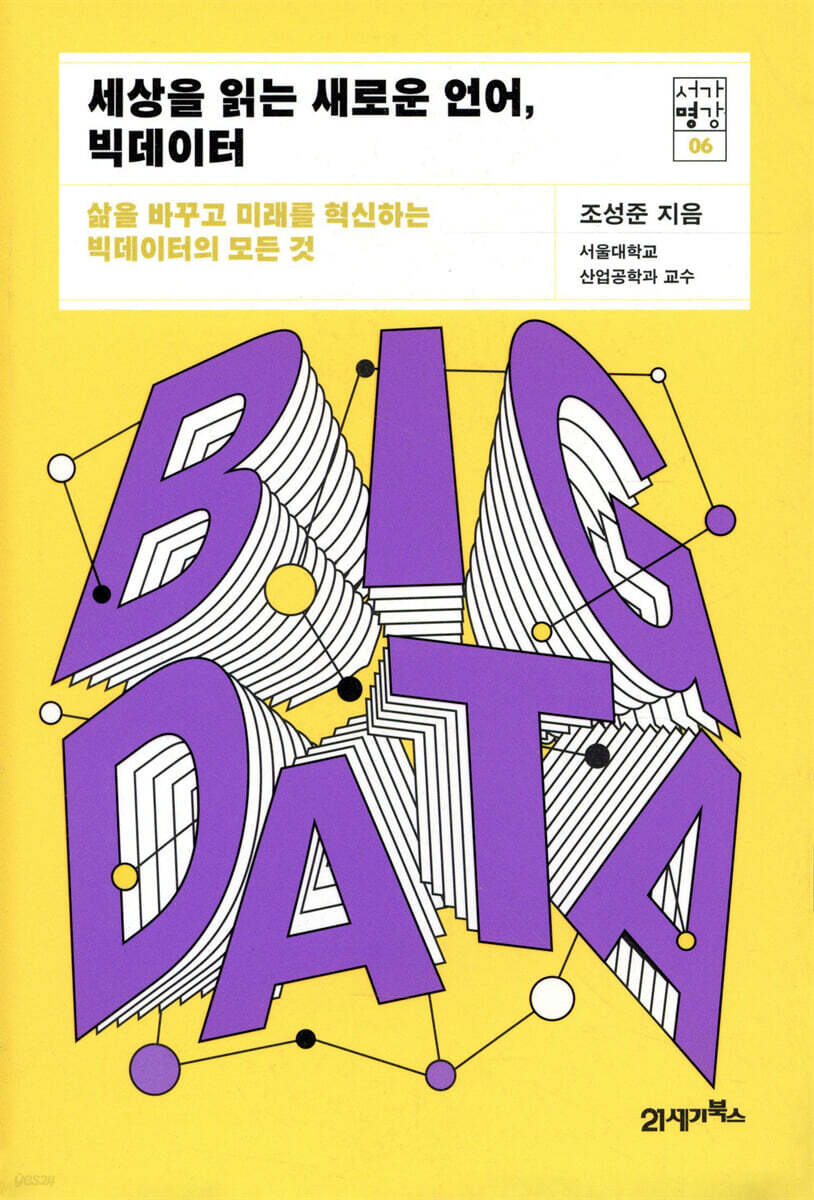
"Seogamyeonggang": A famous lecture you can attend without going to Seoul National University. Everything You Need to Know About Big Data: Changing Lives and Innovating the Future Discover Korea's finest lectures in book form! The sixth volume in the "Seogamyeonggang" series, featuring carefully curated lectures by current Seoul National University faculty, has been published. The Seoga Myunggang series, which transcribes the lectures of Seoul National University's top professors in various fields, including history, philosophy, science, medicine, and art, into books, provides readers with the expansion of knowledge and the joy of learning. "Big Data, a New Language for Reading the World" is a popular book written by Professor Seong-Jun Cho of the Department of Industrial Engineering at Seoul National University, South Korea's leading big data expert, about big data, a new resource and currency in the age of artificial intelligence. Even if we don't know the exact nature and status of big data, everyone feels the power of 'data'. In a world where virtually everything in our daily lives becomes data, how should we view big data? What is big data, and how is it created, stored, and utilized? As both consumers and producers of data, can we truly be considered owners of big data? How should we respond to secure and expand our rights? Understanding big data now will provide the answers to how we can achieve what we desire in the future. |
- You can preview some of the book's contents.
Preview
index
Before reading this book, the main keywords of the academic classification
Introduction: A world where everything in daily life becomes data.
Part 1: What is Big Data: The Technology that Opens the Future?
Why Everyone's Paying Attention to Big Data
The beginning of infinite possibilities
Big data is the brain of artificial intelligence.
Q/A Ask and Answer
Part 2: Using Big Data for a Better Life
Big data is at your fingertips.
There's nothing unpredictable about big data.
How to find out your customers' tastes and desires
Data Insights to Reduce Risk
The power of data analytics to track the flow of money
Q/A Ask and Answer
Part 3: How Big Data Became Value
Analytics, analyzing data
How is artificial intelligence implemented?
New areas of possibility discovered through machine learning
Q/A Ask and Answer
Part 4: Big Data: The Irrefutable Future
No Planning, No Insight
We need leaders who understand big data.
Public Data for Social Innovation
Who Will Own Big Data?
Q/A Ask and Answer
How to Get What You Want in the Big Data Era
Introduction: A world where everything in daily life becomes data.
Part 1: What is Big Data: The Technology that Opens the Future?
Why Everyone's Paying Attention to Big Data
The beginning of infinite possibilities
Big data is the brain of artificial intelligence.
Q/A Ask and Answer
Part 2: Using Big Data for a Better Life
Big data is at your fingertips.
There's nothing unpredictable about big data.
How to find out your customers' tastes and desires
Data Insights to Reduce Risk
The power of data analytics to track the flow of money
Q/A Ask and Answer
Part 3: How Big Data Became Value
Analytics, analyzing data
How is artificial intelligence implemented?
New areas of possibility discovered through machine learning
Q/A Ask and Answer
Part 4: Big Data: The Irrefutable Future
No Planning, No Insight
We need leaders who understand big data.
Public Data for Social Innovation
Who Will Own Big Data?
Q/A Ask and Answer
How to Get What You Want in the Big Data Era
Detailed image
Into the book
Living in the early 21st century, we have no doubt that artificial intelligence will bring about great changes in our lives.
Artificial intelligence is when computers learn big data and act intelligently.
Therefore, artificial intelligence cannot be implemented without big data.
It's like a car can't move without gasoline.
That's why data is also called a new resource or the currency of the new economy.
--- p.12
Image data and text data are virtually all converted to numbers before being processed by a computer.
Computers convert all the words and images in this world into numbers.
If the words used are semantically close concepts and have similar numeric codes, they can be useful for later analysis.
For example, the numeric codes corresponding to 'father' and 'dad' have similar values, while the numeric codes corresponding to 'father' and 'spaceship' have very different values.
--- p.39
When analysts turn big data into insights and business decision makers take action based on those insights, business value is achieved.
And the most important thing in the process is the final value.
Planning is thinking backwards about what insights we need to create this value and what data we need to create those insights.
--- p.75
When companies or public institutions say they want to use big data to derive insights, I always tell them to collect and visualize the data first.
Because there are so many things you can see and understand intuitively before applying complex analysis techniques.
Additionally, these visualization analyses may give you ideas about what you want to further understand and predict in future analysis steps.
--- p.166~167
Google, Facebook, and others naturally collect customer data while providing free internet services.
Google is probably the company with the most consumer data in the world.
Why does Google allow us to search for free? Because with just a single search term, we can see trends in global interest—who, what, and when—right in the palm of our hand.
Google is struggling to figure out how to make money with this massive amount of information.
--- p.263
In fact, the barriers to learning have been lowered dramatically compared to just a few years ago.
Now, anyone with an interest, regardless of major, can actively participate in the big data revolution.
Moreover, anyone can obtain big data.
In particular, data is not a limited resource like land.
The only way to acquire land is to pay a huge amount of money or to start a revolution and implement land reform.
But data is not a limited resource.
The possibility of having data is open to anyone, regardless of wealth, power or weakness.
It's like a new continent has been created.
If you make good use of this opportunity, there's no reason why you can't become the master of your data.
The plan to create the world I dream of is something we can do ourselves.
How about it, don't you want to give it a try?
Artificial intelligence is when computers learn big data and act intelligently.
Therefore, artificial intelligence cannot be implemented without big data.
It's like a car can't move without gasoline.
That's why data is also called a new resource or the currency of the new economy.
--- p.12
Image data and text data are virtually all converted to numbers before being processed by a computer.
Computers convert all the words and images in this world into numbers.
If the words used are semantically close concepts and have similar numeric codes, they can be useful for later analysis.
For example, the numeric codes corresponding to 'father' and 'dad' have similar values, while the numeric codes corresponding to 'father' and 'spaceship' have very different values.
--- p.39
When analysts turn big data into insights and business decision makers take action based on those insights, business value is achieved.
And the most important thing in the process is the final value.
Planning is thinking backwards about what insights we need to create this value and what data we need to create those insights.
--- p.75
When companies or public institutions say they want to use big data to derive insights, I always tell them to collect and visualize the data first.
Because there are so many things you can see and understand intuitively before applying complex analysis techniques.
Additionally, these visualization analyses may give you ideas about what you want to further understand and predict in future analysis steps.
--- p.166~167
Google, Facebook, and others naturally collect customer data while providing free internet services.
Google is probably the company with the most consumer data in the world.
Why does Google allow us to search for free? Because with just a single search term, we can see trends in global interest—who, what, and when—right in the palm of our hand.
Google is struggling to figure out how to make money with this massive amount of information.
--- p.263
In fact, the barriers to learning have been lowered dramatically compared to just a few years ago.
Now, anyone with an interest, regardless of major, can actively participate in the big data revolution.
Moreover, anyone can obtain big data.
In particular, data is not a limited resource like land.
The only way to acquire land is to pay a huge amount of money or to start a revolution and implement land reform.
But data is not a limited resource.
The possibility of having data is open to anyone, regardless of wealth, power or weakness.
It's like a new continent has been created.
If you make good use of this opportunity, there's no reason why you can't become the master of your data.
The plan to create the world I dream of is something we can do ourselves.
How about it, don't you want to give it a try?
--- p.274~275
Publisher's Review
How to get what you want in the age of artificial intelligence?
A new world opened up by big data!
Professor Seong-Jun Cho, a professor of industrial engineering at Seoul National University and chairman of the government's Public Data Strategy Committee, is considered one of the leading big data authorities in Korea and author of "Big Data: A New Language for Reading the World."
The author, who is active in fields such as big data, artificial intelligence, and machine learning, is invited by governments, public institutions, and leading companies to research, advise, and educate on big data and artificial intelligence, creating meaningful case studies in the field.
This book, "Big Data: A New Language for Reading the World," compiles the core concepts of big data based on corporate case studies and the author's research. It includes a precise definition of big data, one of the hottest topics of recent times, along with research and utilization methods on how big data creates value and drives innovation.
In this book, the author emphasizes, “Understanding big data will ultimately become the basic knowledge needed to consider how to survive in a world driven by big data.”
In other words, the opportunity to get what you want in the future lies in 'big data'.
No one doubts that artificial intelligence will bring about great changes in our lives in the future.
Big data is essential to implementing this artificial intelligence.
This is because artificial intelligence requires learning through big data.
This is why big data is called the new resource and currency of the artificial intelligence era.
The author predicts that the status of big data, which has changed significantly over the past decade, will be different again in the next ten years compared to now.
Not only is the amount of data growing explosively, but the computer technology that can process it is also improving dramatically.
We have gained the ability to read new values that we had not seen before through big data.
The importance of big data cannot be overemphasized.
Therefore, it can be said that understanding big data is also essential.
Marketing, sales, finance, medicine, society, administration, politics…
How far can we predict with big data?!
In this book, Professor Cho Seong-jun explains the complex process by which big data transforms into "insight" and creates value through various data analysis methods, including artificial intelligence, machine learning, and visualization, in a way that is easy for anyone, even non-specialists, to understand.
It also vividly demonstrates, through firsthand experience and witness, that we have entered a new era where insights discovered from big data can revolutionize the world.
The author also introduces a case in which a domestic film distributor predicted the number of viewers in advance through data analysis before release.
Until then, audience numbers were predicted based on experience, but this was not only inaccurate, but also had problems such as the cause being unknown when the prediction was wrong.
However, the author and the research team were able to predict the number of viewers on the first Saturday after release by securing and analyzing data on the genre, country, production company, actors, director, production cost, public awareness, and preference of all films released domestically.
These predictions become more accurate as data accumulates and analysis is repeated.
The innovations created by big data don't stop at corporate marketing.
This book also introduces examples of how public value has been created, such as by synthesizing location data generated through smartphone use, subscriber address data, and taxi boarding and alighting data via smart cards to create the optimal late-night bus route in Seoul.
Readers who have previously considered big data the exclusive domain of data scientists will discover its limitless potential when they see how the financial and non-financial benefits generated by utilizing big data can impact individual lives.
Who will own big data?
An undeniable future, big data that will rule the future!
We live in a world where everything in our daily lives becomes big data, thanks to smartphones, social media, and the Internet of Things.
The moment you turn on your phone, location data is generated, and the words you search on Google, the photos you post on Facebook and Instagram, and the patterns you use to click "like" are all data-driven.
However, it is mostly large corporations that actually own big data.
Because collecting and storing big data requires capital.
This is where many of the controversies surrounding big data begin.
Can individual privacy be protected? Could it be violated and manipulated by others? Can big data truly serve the public interest? The author of this book argues that we cannot be entirely optimistic about the bright future big data holds, and counters the negative perspectives that fuel fears of Big Brother.
“Will we advance into a new world, or will we remain stuck in the past for the sake of privacy?”
The author of this book recognizes that the changes brought about by big data are an inevitable future.
Technological advancement always comes with pros and cons.
The author argues that personal information can be protected by refining security policies and laws.
“Rather than giving up the productivity achieved by new technologies, it is important to find ways to minimize losses together,” he emphasizes.
Above all, we should pay more attention to the author's question: "What kind of sense of ownership should we have as producers of data?"
To secure and expand our rights, to know what to say to the makers of data-related regulations, and to build a confident future as masters of our own lives in the world big data will usher in, we need a sound understanding of big data.
A new world opened up by big data!
Professor Seong-Jun Cho, a professor of industrial engineering at Seoul National University and chairman of the government's Public Data Strategy Committee, is considered one of the leading big data authorities in Korea and author of "Big Data: A New Language for Reading the World."
The author, who is active in fields such as big data, artificial intelligence, and machine learning, is invited by governments, public institutions, and leading companies to research, advise, and educate on big data and artificial intelligence, creating meaningful case studies in the field.
This book, "Big Data: A New Language for Reading the World," compiles the core concepts of big data based on corporate case studies and the author's research. It includes a precise definition of big data, one of the hottest topics of recent times, along with research and utilization methods on how big data creates value and drives innovation.
In this book, the author emphasizes, “Understanding big data will ultimately become the basic knowledge needed to consider how to survive in a world driven by big data.”
In other words, the opportunity to get what you want in the future lies in 'big data'.
No one doubts that artificial intelligence will bring about great changes in our lives in the future.
Big data is essential to implementing this artificial intelligence.
This is because artificial intelligence requires learning through big data.
This is why big data is called the new resource and currency of the artificial intelligence era.
The author predicts that the status of big data, which has changed significantly over the past decade, will be different again in the next ten years compared to now.
Not only is the amount of data growing explosively, but the computer technology that can process it is also improving dramatically.
We have gained the ability to read new values that we had not seen before through big data.
The importance of big data cannot be overemphasized.
Therefore, it can be said that understanding big data is also essential.
Marketing, sales, finance, medicine, society, administration, politics…
How far can we predict with big data?!
In this book, Professor Cho Seong-jun explains the complex process by which big data transforms into "insight" and creates value through various data analysis methods, including artificial intelligence, machine learning, and visualization, in a way that is easy for anyone, even non-specialists, to understand.
It also vividly demonstrates, through firsthand experience and witness, that we have entered a new era where insights discovered from big data can revolutionize the world.
The author also introduces a case in which a domestic film distributor predicted the number of viewers in advance through data analysis before release.
Until then, audience numbers were predicted based on experience, but this was not only inaccurate, but also had problems such as the cause being unknown when the prediction was wrong.
However, the author and the research team were able to predict the number of viewers on the first Saturday after release by securing and analyzing data on the genre, country, production company, actors, director, production cost, public awareness, and preference of all films released domestically.
These predictions become more accurate as data accumulates and analysis is repeated.
The innovations created by big data don't stop at corporate marketing.
This book also introduces examples of how public value has been created, such as by synthesizing location data generated through smartphone use, subscriber address data, and taxi boarding and alighting data via smart cards to create the optimal late-night bus route in Seoul.
Readers who have previously considered big data the exclusive domain of data scientists will discover its limitless potential when they see how the financial and non-financial benefits generated by utilizing big data can impact individual lives.
Who will own big data?
An undeniable future, big data that will rule the future!
We live in a world where everything in our daily lives becomes big data, thanks to smartphones, social media, and the Internet of Things.
The moment you turn on your phone, location data is generated, and the words you search on Google, the photos you post on Facebook and Instagram, and the patterns you use to click "like" are all data-driven.
However, it is mostly large corporations that actually own big data.
Because collecting and storing big data requires capital.
This is where many of the controversies surrounding big data begin.
Can individual privacy be protected? Could it be violated and manipulated by others? Can big data truly serve the public interest? The author of this book argues that we cannot be entirely optimistic about the bright future big data holds, and counters the negative perspectives that fuel fears of Big Brother.
“Will we advance into a new world, or will we remain stuck in the past for the sake of privacy?”
The author of this book recognizes that the changes brought about by big data are an inevitable future.
Technological advancement always comes with pros and cons.
The author argues that personal information can be protected by refining security policies and laws.
“Rather than giving up the productivity achieved by new technologies, it is important to find ways to minimize losses together,” he emphasizes.
Above all, we should pay more attention to the author's question: "What kind of sense of ownership should we have as producers of data?"
To secure and expand our rights, to know what to say to the makers of data-related regulations, and to build a confident future as masters of our own lives in the world big data will usher in, we need a sound understanding of big data.
GOODS SPECIFICS
- Date of issue: August 21, 2019
- Page count, weight, size: 276 pages | 350g | 128*188*17mm
- ISBN13: 9788950982737
- ISBN10: 8950982730
You may also like
카테고리
korean


korean

![ELLE 엘르 스페셜 에디션 A형 : 12월 [2025]](http://librairie.coreenne.fr/cdn/shop/files/b8e27a3de6c9538896439686c6b0e8fb.jpg?v=1766436872&width=3840)


