

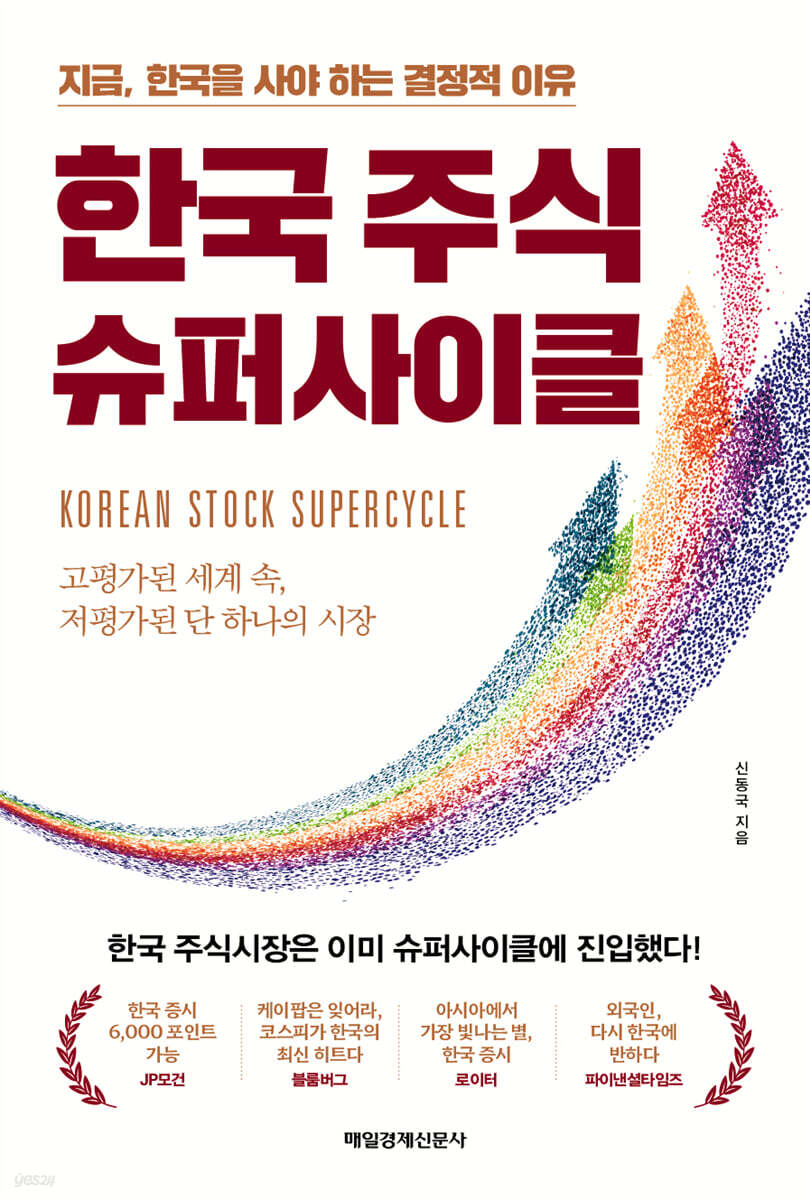
Korean stock supercycle
 |
Description
Book Introduction
“If you want to get rich, buy Korean stocks!”
KOSPI 5,000 is no longer a dream!
Record-breaking inflow of foreign capital, easing political and trade risks.
Structural reforms such as revision of the Commercial Act, stock cancellation, and dividend expansion are intertwined.
Korean stocks have finally entered a super cycle!
With foreign capital flowing in at record levels and political and trade risks easing, institutional reforms, including revisions to the Commercial Act, stock cancellations, and dividend increases, are gaining momentum.
Now, some are assessing that the Korean stock market is not simply rebounding, but entering an "unprecedented supercycle." JP Morgan mentioned the possibility of the KOSPI reaching 6,000, and Bloomberg reported that "KOSPI is now Korea's newest hit."
"The Korean Stock Supercycle" presents the data and systems that support these changes, as well as a new investment paradigm.
For the past 30 years, real estate has been at the center of the Korean asset market.
However, the author says, “Not everyone can become rich through real estate.
He emphasizes that “capital is now moving to ‘Korean stocks.’”
Shin Dong-guk, a financial engineering expert who worked at the Samsung Economic Research Institute and domestic asset management companies, predicted in late 2024, when the market was in a slump, that "stocks will now become safe assets."
His prediction became reality with the rebound in 2025.
The Korean market has entered a structural upward phase due to the combination of an undervalued market with a PBR of 1.2x, a large inflow of global funds, and the government's policy of strengthening shareholder rights.
"The Korean Stock Supercycle" analyzes this "capital migration" through economic data and actual investment flows, clearly showing why "Korean stocks" are becoming the new center of wealth now that the real estate-centered asset structure is collapsing.
KOSPI 5,000 is no longer a dream!
Record-breaking inflow of foreign capital, easing political and trade risks.
Structural reforms such as revision of the Commercial Act, stock cancellation, and dividend expansion are intertwined.
Korean stocks have finally entered a super cycle!
With foreign capital flowing in at record levels and political and trade risks easing, institutional reforms, including revisions to the Commercial Act, stock cancellations, and dividend increases, are gaining momentum.
Now, some are assessing that the Korean stock market is not simply rebounding, but entering an "unprecedented supercycle." JP Morgan mentioned the possibility of the KOSPI reaching 6,000, and Bloomberg reported that "KOSPI is now Korea's newest hit."
"The Korean Stock Supercycle" presents the data and systems that support these changes, as well as a new investment paradigm.
For the past 30 years, real estate has been at the center of the Korean asset market.
However, the author says, “Not everyone can become rich through real estate.
He emphasizes that “capital is now moving to ‘Korean stocks.’”
Shin Dong-guk, a financial engineering expert who worked at the Samsung Economic Research Institute and domestic asset management companies, predicted in late 2024, when the market was in a slump, that "stocks will now become safe assets."
His prediction became reality with the rebound in 2025.
The Korean market has entered a structural upward phase due to the combination of an undervalued market with a PBR of 1.2x, a large inflow of global funds, and the government's policy of strengthening shareholder rights.
"The Korean Stock Supercycle" analyzes this "capital migration" through economic data and actual investment flows, clearly showing why "Korean stocks" are becoming the new center of wealth now that the real estate-centered asset structure is collapsing.
- You can preview some of the book's contents.
Preview
index
Introduction: It's Time to Get on the Korean Stock Market, Where Everyone Can Get Rich
PART 1.
The Great Wealth Migration Awakens Korean Stocks
The End of the Real Estate Republic and the Beginning of the Korean Stock Supercycle
The US at the peak of its bubble, and Korea at the dawn of value.
South Korea's growth engine is turning again.
The End of Undervaluation, the Beginning of the Normalization of Korean Stocks
The Paradox of Low Interest Rates: Korean Stocks Rebound
A rising cycle triggered by the recovery of liquidity
The return of foreign buying is restoring confidence in the Korean stock market.
PART 2.
Korean Stock Investment Execution Strategy
A Glance at the Korean Stock Market: From KOSPI to Next Trading
How to Read the Market from a Foreign Investor's Perspective
The Korean stock market is asking for strategy at the beginning of its upward trend.
Get on the Rising Korean Stock Market with ETFs
This is how to select promising stocks.
Semiconductors: Essential Infrastructure for the AI Era
AI: A Disruptive Technology Reshaping Entire Industries
Secondary Batteries: The Center of Energy Hegemony After Electric Vehicles
Korea: A Supercycle Driven by LNG and Offshore Plants
Defense Industry: A State-Driven Growth Industry Shaped by Geopolitics
Nuclear Energy: A Strategic Asset in the Era of Energy Transition
K-Beauty: Exporting Brands and Experiences
PART 3.
The Korean stock market is beginning to resolve chronic negative factors.
Restoring market confidence begins with strengthening shareholder rights.
The Moment the Korean Peninsula's Risk Turns into Opportunity
Amid the US-China hegemony competition, Korea emerges as a strategic winner.
A major shift from a real estate-centric economy to a finance-centric nation
The timing of asset restructuring brought about by liquidity recovery and inflation
PART 4.
Investment Lessons from Repeated History
Theme-Driven Capitalism: Ecopro and Suzentech
Fantasy and Reality in Future Industries: NFTs and Shin Poong Pharmaceutical
How Market Leaders Changed After the Financial Crisis
The Recurring Bubble Pattern: Saerom Technology and Samchuly Bicycle
The Temptation of Political Themes and Investor Delusions
Preface: Korean Stocks at the Center of Wealth
References and Sources
Source of figures and diagrams
PART 1.
The Great Wealth Migration Awakens Korean Stocks
The End of the Real Estate Republic and the Beginning of the Korean Stock Supercycle
The US at the peak of its bubble, and Korea at the dawn of value.
South Korea's growth engine is turning again.
The End of Undervaluation, the Beginning of the Normalization of Korean Stocks
The Paradox of Low Interest Rates: Korean Stocks Rebound
A rising cycle triggered by the recovery of liquidity
The return of foreign buying is restoring confidence in the Korean stock market.
PART 2.
Korean Stock Investment Execution Strategy
A Glance at the Korean Stock Market: From KOSPI to Next Trading
How to Read the Market from a Foreign Investor's Perspective
The Korean stock market is asking for strategy at the beginning of its upward trend.
Get on the Rising Korean Stock Market with ETFs
This is how to select promising stocks.
Semiconductors: Essential Infrastructure for the AI Era
AI: A Disruptive Technology Reshaping Entire Industries
Secondary Batteries: The Center of Energy Hegemony After Electric Vehicles
Korea: A Supercycle Driven by LNG and Offshore Plants
Defense Industry: A State-Driven Growth Industry Shaped by Geopolitics
Nuclear Energy: A Strategic Asset in the Era of Energy Transition
K-Beauty: Exporting Brands and Experiences
PART 3.
The Korean stock market is beginning to resolve chronic negative factors.
Restoring market confidence begins with strengthening shareholder rights.
The Moment the Korean Peninsula's Risk Turns into Opportunity
Amid the US-China hegemony competition, Korea emerges as a strategic winner.
A major shift from a real estate-centric economy to a finance-centric nation
The timing of asset restructuring brought about by liquidity recovery and inflation
PART 4.
Investment Lessons from Repeated History
Theme-Driven Capitalism: Ecopro and Suzentech
Fantasy and Reality in Future Industries: NFTs and Shin Poong Pharmaceutical
How Market Leaders Changed After the Financial Crisis
The Recurring Bubble Pattern: Saerom Technology and Samchuly Bicycle
The Temptation of Political Themes and Investor Delusions
Preface: Korean Stocks at the Center of Wealth
References and Sources
Source of figures and diagrams
Detailed image

Into the book
Now, Korean investors' asset portfolios must change.
Overall, more than 85% of the assets of the elderly are concentrated in real estate, and although idle funds amount to hundreds of trillions of won, the net assets of an average household are practically limited to 'one house'.
The size of debt and the size of financial assets are similar.
The market shifts of 2025 require a fundamental shift in the asset structure of this generation.
Investors need to quickly restructure their portfolios starting now.
Over the next 30 years, we need to reduce the proportion of real estate assets and increase the proportion of stock assets.
Real estate is no longer a stable asset for individuals, and stocks are no longer assets that only enrich major shareholders.
Going forward, the main growth driver for individual assets will come from stocks.
--- p.26~27, from “The End of the Real Estate Republic and the Beginning of the Korean Stock Super Cycle”
Since Trump mentioned tariffs, the U.S. market has been experiencing a buying trend, led by individual investors, while institutional investors are maintaining a wait-and-see stance.
This trend is not simply a change in investment behavior; it shows that the market's trust structure is subtly shaking.
While many still trust the competitiveness of American companies, they appear increasingly skeptical of the U.S. government.
The United States today is only able to maintain a certain balance thanks to the trust and status it has built up in the past.
But while trust takes decades to build, it can be destroyed in just a few years, or even an instant.
--- p.35, from “The United States at the Peak of the Bubble, Korea at the Beginning of Value”
The Korean stock market quickly reflects these policy changes.
Wind and solar power stocks respond immediately to an increase in the renewable energy budget, and defense industry stocks respond immediately to an increase in defense spending.
Korea is a market where policies determine industry cycles.
In the past, stock prices would fall when economic indicators were weak, but now they can rise due to expectations of government stimulus measures.
Market participants are now more sensitive to policy language than economic indicators.
Those who read the direction of policy read the future of industry first.
--- p.43, from “South Korea’s Growth Engine Turns Again”
Since 2025, foreign financial institutions have been issuing positive evaluations of the Korean stock market.
In July, JP Morgan predicted that if the Lee Jae-myung administration accelerates its efforts to improve governance, including revising the Commercial Act, the KOSPI index could reach 5,000 points within two years.
This implies an upside potential of about 50% compared to the current level.
He also added an optimistic analysis predicting that the Korean stock market will record an average annual return of 11-12% over the next 10 years.
Ian Samson, a portfolio manager at global asset management firm Fidelity International, said, "Once shareholder-centered reforms are fully implemented, the KOSPI's PBR will recover to the 1x level," and assessed that an additional 10-20% increase is possible within this year.
Overall, more than 85% of the assets of the elderly are concentrated in real estate, and although idle funds amount to hundreds of trillions of won, the net assets of an average household are practically limited to 'one house'.
The size of debt and the size of financial assets are similar.
The market shifts of 2025 require a fundamental shift in the asset structure of this generation.
Investors need to quickly restructure their portfolios starting now.
Over the next 30 years, we need to reduce the proportion of real estate assets and increase the proportion of stock assets.
Real estate is no longer a stable asset for individuals, and stocks are no longer assets that only enrich major shareholders.
Going forward, the main growth driver for individual assets will come from stocks.
--- p.26~27, from “The End of the Real Estate Republic and the Beginning of the Korean Stock Super Cycle”
Since Trump mentioned tariffs, the U.S. market has been experiencing a buying trend, led by individual investors, while institutional investors are maintaining a wait-and-see stance.
This trend is not simply a change in investment behavior; it shows that the market's trust structure is subtly shaking.
While many still trust the competitiveness of American companies, they appear increasingly skeptical of the U.S. government.
The United States today is only able to maintain a certain balance thanks to the trust and status it has built up in the past.
But while trust takes decades to build, it can be destroyed in just a few years, or even an instant.
--- p.35, from “The United States at the Peak of the Bubble, Korea at the Beginning of Value”
The Korean stock market quickly reflects these policy changes.
Wind and solar power stocks respond immediately to an increase in the renewable energy budget, and defense industry stocks respond immediately to an increase in defense spending.
Korea is a market where policies determine industry cycles.
In the past, stock prices would fall when economic indicators were weak, but now they can rise due to expectations of government stimulus measures.
Market participants are now more sensitive to policy language than economic indicators.
Those who read the direction of policy read the future of industry first.
--- p.43, from “South Korea’s Growth Engine Turns Again”
Since 2025, foreign financial institutions have been issuing positive evaluations of the Korean stock market.
In July, JP Morgan predicted that if the Lee Jae-myung administration accelerates its efforts to improve governance, including revising the Commercial Act, the KOSPI index could reach 5,000 points within two years.
This implies an upside potential of about 50% compared to the current level.
He also added an optimistic analysis predicting that the Korean stock market will record an average annual return of 11-12% over the next 10 years.
Ian Samson, a portfolio manager at global asset management firm Fidelity International, said, "Once shareholder-centered reforms are fully implemented, the KOSPI's PBR will recover to the 1x level," and assessed that an additional 10-20% increase is possible within this year.
--- p.75, from “The Return of Foreign Buyers, Restoring Trust in the Korean Stock Market”
Publisher's Review
"Korean stocks are no longer risky assets; they are the most undervalued safe assets in the world."
In the midst of trust restoration and institutional change,
Korean stocks are emerging as a new center of wealth!
★ 6,000 points possible in the Korean stock market _ JP Morgan ★
Forget K-pop, KOSPI is Korea's newest hit _Bloomberg
★ Asia's Brightest Star, the Korean Stock Market _Reuters ★
★ Foreigners Fall in Love with Korea Again _ Financial Times ★
The era of real estate is coming to an end, and the center of assets is shifting.
For a long time, wealth accumulation in Korean society was centered on real estate.
Leverage through jeonse and the myth of "Gangnam's invincibility" led a generation, but that formula no longer works.
Only some areas are rising, while most are stagnant.
Real estate is no longer a ladder to wealth open to everyone.
The stock market, on the other hand, is different.
You can start with little capital and access to information is high.
It is an open asset that anyone can participate in.
"The Korean Stock Supercycle" interprets this change not as a temporary fad, but as a "major shift from residential assets to investment assets."
KOSPI 5,000 Points: A Realistic, Grounded Scenario
In October 2025, the KOSPI broke through the 4,000 mark for the first time ever.
This is not a short-term rebound, but a structural rise driven by performance, valuation, and institutional improvements.
The market's distrust is turning into trust through revisions to the Commercial Act, stock buybacks, and dividend increases.
A virtuous cycle has been formed in which trust attracts capital, and capital in turn strengthens trust.
Global investment firms rate Korea as the "most undervalued market in the world."
The KOSPI 5,000 is not an optimistic scenario, but a realistic scenario that has already been prepared.
As long as inflation and currency devaluation persist, stocks, not deposits, will inevitably take their place as the new safe asset.
Industry Supercycles: The Reality of Stock Price Rise
This rally is not a temporary rebound driven by themes or liquidity.
This is a structural rise that is intertwined with corporate performance recovery, supply chain restructuring, and institutional improvements.
Semiconductors and AI have established themselves as the infrastructure of future technologies, and secondary batteries have become a key energy hub in the electric vehicle era.
The shipbuilding, nuclear power, and defense industries are returning to the center of the global stage, benefiting from the restructuring of the global supply chain.
This trend is not simply a business cycle, but a signal that the constitution of Korean industry is fundamentally changing.
Industry and capital markets move in the same direction, and the rise in stock prices reflects this structural change.
Practical Strategies for Individual Investors
This book does not stop at the simple forecast that 'stock prices will rise.'
It specifically suggests how to seize opportunities in the flow of change.
It contains strategies that individuals can implement themselves, such as fractional buying using index and sector ETFs, industry-specific portfolio composition, and long-term rebalancing.
Additionally, by learning how to read the supply and demand flows of foreigners and institutions, you can develop a perspective that sees structural trends rather than short-term trading.
The author defines the coming era as one in which Korean stocks, not deposits, become the new safe asset.
Now is the beginning of that transition.
Trust attracts capital, and capital in turn breeds trust.
As a result, the Korean stock market is opening the door to a new era.
In the midst of trust restoration and institutional change,
Korean stocks are emerging as a new center of wealth!
★ 6,000 points possible in the Korean stock market _ JP Morgan ★
Forget K-pop, KOSPI is Korea's newest hit _Bloomberg
★ Asia's Brightest Star, the Korean Stock Market _Reuters ★
★ Foreigners Fall in Love with Korea Again _ Financial Times ★
The era of real estate is coming to an end, and the center of assets is shifting.
For a long time, wealth accumulation in Korean society was centered on real estate.
Leverage through jeonse and the myth of "Gangnam's invincibility" led a generation, but that formula no longer works.
Only some areas are rising, while most are stagnant.
Real estate is no longer a ladder to wealth open to everyone.
The stock market, on the other hand, is different.
You can start with little capital and access to information is high.
It is an open asset that anyone can participate in.
"The Korean Stock Supercycle" interprets this change not as a temporary fad, but as a "major shift from residential assets to investment assets."
KOSPI 5,000 Points: A Realistic, Grounded Scenario
In October 2025, the KOSPI broke through the 4,000 mark for the first time ever.
This is not a short-term rebound, but a structural rise driven by performance, valuation, and institutional improvements.
The market's distrust is turning into trust through revisions to the Commercial Act, stock buybacks, and dividend increases.
A virtuous cycle has been formed in which trust attracts capital, and capital in turn strengthens trust.
Global investment firms rate Korea as the "most undervalued market in the world."
The KOSPI 5,000 is not an optimistic scenario, but a realistic scenario that has already been prepared.
As long as inflation and currency devaluation persist, stocks, not deposits, will inevitably take their place as the new safe asset.
Industry Supercycles: The Reality of Stock Price Rise
This rally is not a temporary rebound driven by themes or liquidity.
This is a structural rise that is intertwined with corporate performance recovery, supply chain restructuring, and institutional improvements.
Semiconductors and AI have established themselves as the infrastructure of future technologies, and secondary batteries have become a key energy hub in the electric vehicle era.
The shipbuilding, nuclear power, and defense industries are returning to the center of the global stage, benefiting from the restructuring of the global supply chain.
This trend is not simply a business cycle, but a signal that the constitution of Korean industry is fundamentally changing.
Industry and capital markets move in the same direction, and the rise in stock prices reflects this structural change.
Practical Strategies for Individual Investors
This book does not stop at the simple forecast that 'stock prices will rise.'
It specifically suggests how to seize opportunities in the flow of change.
It contains strategies that individuals can implement themselves, such as fractional buying using index and sector ETFs, industry-specific portfolio composition, and long-term rebalancing.
Additionally, by learning how to read the supply and demand flows of foreigners and institutions, you can develop a perspective that sees structural trends rather than short-term trading.
The author defines the coming era as one in which Korean stocks, not deposits, become the new safe asset.
Now is the beginning of that transition.
Trust attracts capital, and capital in turn breeds trust.
As a result, the Korean stock market is opening the door to a new era.
GOODS SPECIFICS
- Date of issue: November 30, 2025
- Page count, weight, size: 272 pages | 480g | 152*225*18mm
- ISBN13: 9791164848324
You may also like
카테고리
korean


korean

![GQ KOREA Mark (Monthly): December [2025]](http://librairie.coreenne.fr/cdn/shop/files/8ef265dbbfbf186523ed75ba7319009d.jpg?v=1765340328&width=3840)


