

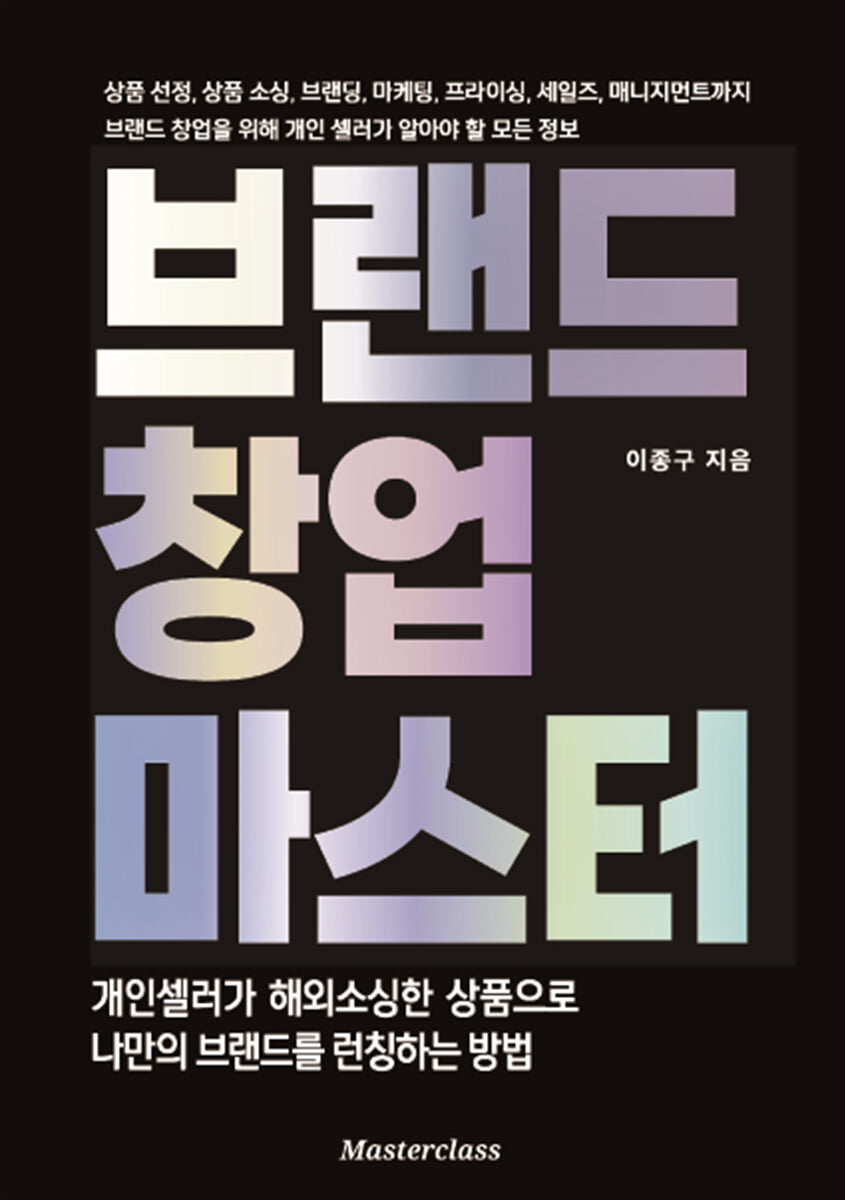
Brand Creation Master
 |
Description
Book Introduction
The first business book on how individual sellers can succeed in online commerce with their own brand.
To succeed as a brand, it's not about branding; it's about having a product that can become a brand.
Consumers never recognize a product as a brand if it is purchased cheaply.
Therefore, a product that can become a brand must be able to sell at a high price, and to do so, the product must have features that make it prettier, more special, novel, or more luxurious than existing products.
So where and how can individual sellers, often lacking capital and a network, source products with these characteristics? How can they, lacking platform sales capabilities, effectively promote these products to the public and drive purchases? How can brands launched by individual sellers establish themselves in the market as long-term growth brands, rather than just fleeting success like small brands? We'll uncover the answers to all these questions from CEO Jong-gu Lee, who has been at the forefront of the domestic overseas sourcing and retail industries for the past 24 years.
This book is not just a guide to successful branding cases. It contains specific and practical information that individual sellers need to know to succeed with their own brand in online commerce: product selection methods, product sourcing know-how, pricing policies, marketing, branding, and even pre-launch preparations and specific action plans after product launch.
For this reason, this book holds unparalleled value for both individual sellers preparing to launch a business and those running existing brands, compared to any other recently published books on branding and commerce.
To succeed as a brand, it's not about branding; it's about having a product that can become a brand.
Consumers never recognize a product as a brand if it is purchased cheaply.
Therefore, a product that can become a brand must be able to sell at a high price, and to do so, the product must have features that make it prettier, more special, novel, or more luxurious than existing products.
So where and how can individual sellers, often lacking capital and a network, source products with these characteristics? How can they, lacking platform sales capabilities, effectively promote these products to the public and drive purchases? How can brands launched by individual sellers establish themselves in the market as long-term growth brands, rather than just fleeting success like small brands? We'll uncover the answers to all these questions from CEO Jong-gu Lee, who has been at the forefront of the domestic overseas sourcing and retail industries for the past 24 years.
This book is not just a guide to successful branding cases. It contains specific and practical information that individual sellers need to know to succeed with their own brand in online commerce: product selection methods, product sourcing know-how, pricing policies, marketing, branding, and even pre-launch preparations and specific action plans after product launch.
For this reason, this book holds unparalleled value for both individual sellers preparing to launch a business and those running existing brands, compared to any other recently published books on branding and commerce.
index
INTRODUCITON
How Individual Sellers Become Brands
Maker, small brand, brand
1. WHY BRAND
1) Can individual sellers survive in the market without a brand?
· History of domestic online commerce individual sellers
The 1688 Product Crisis and the Era of Chinese Factory Sourcing
· Coupang and Naver's policy changes - The era of suffering for the lowest-priced products
2) Type of brand
· BTR, MAKER, BRAND
· Brand mix
· The pitfalls of small brands
3) What brand products should individual sellers challenge?
· Consumers' brand discrimination test
· What a brand looks like that can pass the discrimination test
4) The process by which a brand product is recognized as a brand by consumers.
· 4 stages of brand awareness
5) Benefits of a brand, what changes when you become a brand?
· Visible benefits of becoming a brand
· The invisible benefits of becoming a brand
2. PRODUCT
1) Products that can become brands
· What consumers expect from brands
· Pretty, special, novel, or luxurious
· Features of NEEDS products
2) How to find a product that can become a brand
· Time machine
· Products available in overseas markets through factory sourcing
· How to develop the ability to select products that will become your brand
3) Who are the customers of the brand's products?
· Characteristics of customers purchasing new brand products
· The law of product diffusion
· The three most important questions
4) Products that cannot become brands
· Products without brand DNA
· Products with low sales potential
5) 4-step brand product selection method
· Intersection that satisfies four conditions
· Does this product already exist on Earth? - Overseas market research
· Is this product something I can afford? - Sourcing Research
· Am I a good seller? - Assess your capabilities.
· Is the product competitive in the domestic market? - Domestic market research
6) Branded products aren't the only answer.
· I must choose something I can do better than others.
3. PRICE
1) Price to become a brand
· Consumers are not attracted to cheap products.
· Price recognized as a brand by consumers
· When will the price be reduced?
4. PLACE
1) Where the brand is sold
· Where should branded products be sold?
· Instagram + company mall
· Coupang and Naver Dictionary review work
· When to spread to other platforms
· If you need to sell urgently, sell below the surface.
· Wadiz, Tumblbug
· Overseas exports
5. Promotion
1) Branding
· Branding and framing work
· Seller's personality setting and acting
· Brand positioning
· How to use music in your branding work
· Personality setting - unexpectedness
· Personality setting - Appearance that seems fundamental
· Brand name and waves
2) Marketing
· Pre-Marketing
· Influencer Marketing
Community Marketing
Blog Marketing
· Retention Marketing
· Seasonal marketing
· CS Marketing
Offline marketing
6. OPERATION
1) Type of brand
Shop Brand vs. Product Brand
· Rational Brands vs. Emotional Brands
2) Brand operation
· Brand life cycle
· My voice and other people's voices
· Above-Surface Sales VS Below-Surface Sales
· At some point, a product brand must become a shop brand.
· Shop brands must create product brands.
· You must endure, but you must be quick and bold when it comes to letting go.
· Securing financial stability
· Even if the brand fails, the seller does not.
7. EXECUTION
1) ACTION PLAN TO BECOME A BRAND
· The method of becoming a brand varies depending on the seller and product.
· How to launch a brand with an emotional product
· How to launch a brand with a rational product
· Advertising cost execution ratio
8. SUPPLEMENT
1) Why brands don't grow, why brands lose their appeal
· 9 Reasons Why Brands Taste Good
· If the launch of follow-up products is delayed
· When follow-up products that are unrelated to the existing brand direction are launched
· In the case where the brand personality initially established in the branding stage becomes increasingly ordinary over time.
· If the price is lowered without a reasonable reason
· In case of indiscriminate expansion of the platform
· Loss of organizational competitiveness due to incentives that are evaluated based on sales
· If the brand owner causes a social controversy and the brand value plummets
· When cash flow problems arise due to indiscriminate external investment
· If you make an enemy
2) Seller MBTI
· Accuracy of MBTI in business
· Types of business that individual sellers can choose from
· B or R?
· P or G?
· A or E?
· Y or O?
3) 12 Business Insights
· The Hidden Wisdom of Business
· Business is an unfair game.
· In business, those who are picky succeed.
· You must sell products that have barriers to entry.
· The law of polar opposites
· How to do a good job
· How to use the environment
· Principles of fishing rods
· The law of 1,2,3,4
· The law of small and large
· GUTS
· What is the right age to start a business?
· Teach your children business as soon as possible.
EPILOGUE
· Perspective changes the outcome
· How long will it be before individual sellers can succeed in online commerce with little capital?
How Individual Sellers Become Brands
Maker, small brand, brand
1. WHY BRAND
1) Can individual sellers survive in the market without a brand?
· History of domestic online commerce individual sellers
The 1688 Product Crisis and the Era of Chinese Factory Sourcing
· Coupang and Naver's policy changes - The era of suffering for the lowest-priced products
2) Type of brand
· BTR, MAKER, BRAND
· Brand mix
· The pitfalls of small brands
3) What brand products should individual sellers challenge?
· Consumers' brand discrimination test
· What a brand looks like that can pass the discrimination test
4) The process by which a brand product is recognized as a brand by consumers.
· 4 stages of brand awareness
5) Benefits of a brand, what changes when you become a brand?
· Visible benefits of becoming a brand
· The invisible benefits of becoming a brand
2. PRODUCT
1) Products that can become brands
· What consumers expect from brands
· Pretty, special, novel, or luxurious
· Features of NEEDS products
2) How to find a product that can become a brand
· Time machine
· Products available in overseas markets through factory sourcing
· How to develop the ability to select products that will become your brand
3) Who are the customers of the brand's products?
· Characteristics of customers purchasing new brand products
· The law of product diffusion
· The three most important questions
4) Products that cannot become brands
· Products without brand DNA
· Products with low sales potential
5) 4-step brand product selection method
· Intersection that satisfies four conditions
· Does this product already exist on Earth? - Overseas market research
· Is this product something I can afford? - Sourcing Research
· Am I a good seller? - Assess your capabilities.
· Is the product competitive in the domestic market? - Domestic market research
6) Branded products aren't the only answer.
· I must choose something I can do better than others.
3. PRICE
1) Price to become a brand
· Consumers are not attracted to cheap products.
· Price recognized as a brand by consumers
· When will the price be reduced?
4. PLACE
1) Where the brand is sold
· Where should branded products be sold?
· Instagram + company mall
· Coupang and Naver Dictionary review work
· When to spread to other platforms
· If you need to sell urgently, sell below the surface.
· Wadiz, Tumblbug
· Overseas exports
5. Promotion
1) Branding
· Branding and framing work
· Seller's personality setting and acting
· Brand positioning
· How to use music in your branding work
· Personality setting - unexpectedness
· Personality setting - Appearance that seems fundamental
· Brand name and waves
2) Marketing
· Pre-Marketing
· Influencer Marketing
Community Marketing
Blog Marketing
· Retention Marketing
· Seasonal marketing
· CS Marketing
Offline marketing
6. OPERATION
1) Type of brand
Shop Brand vs. Product Brand
· Rational Brands vs. Emotional Brands
2) Brand operation
· Brand life cycle
· My voice and other people's voices
· Above-Surface Sales VS Below-Surface Sales
· At some point, a product brand must become a shop brand.
· Shop brands must create product brands.
· You must endure, but you must be quick and bold when it comes to letting go.
· Securing financial stability
· Even if the brand fails, the seller does not.
7. EXECUTION
1) ACTION PLAN TO BECOME A BRAND
· The method of becoming a brand varies depending on the seller and product.
· How to launch a brand with an emotional product
· How to launch a brand with a rational product
· Advertising cost execution ratio
8. SUPPLEMENT
1) Why brands don't grow, why brands lose their appeal
· 9 Reasons Why Brands Taste Good
· If the launch of follow-up products is delayed
· When follow-up products that are unrelated to the existing brand direction are launched
· In the case where the brand personality initially established in the branding stage becomes increasingly ordinary over time.
· If the price is lowered without a reasonable reason
· In case of indiscriminate expansion of the platform
· Loss of organizational competitiveness due to incentives that are evaluated based on sales
· If the brand owner causes a social controversy and the brand value plummets
· When cash flow problems arise due to indiscriminate external investment
· If you make an enemy
2) Seller MBTI
· Accuracy of MBTI in business
· Types of business that individual sellers can choose from
· B or R?
· P or G?
· A or E?
· Y or O?
3) 12 Business Insights
· The Hidden Wisdom of Business
· Business is an unfair game.
· In business, those who are picky succeed.
· You must sell products that have barriers to entry.
· The law of polar opposites
· How to do a good job
· How to use the environment
· Principles of fishing rods
· The law of 1,2,3,4
· The law of small and large
· GUTS
· What is the right age to start a business?
· Teach your children business as soon as possible.
EPILOGUE
· Perspective changes the outcome
· How long will it be before individual sellers can succeed in online commerce with little capital?
Detailed image

Publisher's Review
Powerful content that will shake up the Korean distribution industry
Interest in brands is growing among individual sellers more than ever.
This is because the online commerce startup craze among individual sellers, which began 5-6 years ago, has recently felt its limits due to the overheated competition among platforms to expose low-priced products, and brands have naturally emerged as an alternative.
However, even if we search around us with our eyes wide open, it is difficult to find information that teaches us how to succeed in business through branding.
Most lectures and books on branding simply define a brand or provide examples of successful brands. They rarely teach how to make money with a brand.
Furthermore, it is even more difficult for individual sellers, who lack capital and networks compared to general companies, to find and learn relevant information.
The author of this book, CEO Jong-gu Lee, successfully launched and operated Korea's first lifestyle shop brand, 'Cosni', on his own in the early 2000s when domestic brands were rare. Since then, he has been deeply involved in the success of numerous brands through the process of developing and incubating new brands at leading companies.
Based on this experience, he unhesitatingly explains in this book the specific methods by which individual sellers, lacking capital and networks, can succeed in the market with their own brands.
This book explains in detail not only the simple branding aspect but also all areas of the 4Ps (product, price, distribution, promotion) that we are familiar with, such as what preparations sellers should make in advance before launching a brand, what products can become brands, where and how they can be sourced, where, at what price, and in what form they should be sold, what methods are needed for the brand to continue to grow in the future, and what alternatives are available if brand product sales do not proceed as intended.
The book's highlight is that the type of brand each individual seller wishes to launch, the preparation process, and the post-launch management method must vary depending on their unique experience, capabilities, and financial situation. Furthermore, the book explains these details differently, tailored to each individual's individual circumstances.
This is a valuable know-how that the author could only have gained through the rise and fall of countless individual sellers over the past 24 years. Therefore, the value of this book should be highly regarded among individual sellers engaged in online commerce or dreaming of starting a business.
Interest in brands is growing among individual sellers more than ever.
This is because the online commerce startup craze among individual sellers, which began 5-6 years ago, has recently felt its limits due to the overheated competition among platforms to expose low-priced products, and brands have naturally emerged as an alternative.
However, even if we search around us with our eyes wide open, it is difficult to find information that teaches us how to succeed in business through branding.
Most lectures and books on branding simply define a brand or provide examples of successful brands. They rarely teach how to make money with a brand.
Furthermore, it is even more difficult for individual sellers, who lack capital and networks compared to general companies, to find and learn relevant information.
The author of this book, CEO Jong-gu Lee, successfully launched and operated Korea's first lifestyle shop brand, 'Cosni', on his own in the early 2000s when domestic brands were rare. Since then, he has been deeply involved in the success of numerous brands through the process of developing and incubating new brands at leading companies.
Based on this experience, he unhesitatingly explains in this book the specific methods by which individual sellers, lacking capital and networks, can succeed in the market with their own brands.
This book explains in detail not only the simple branding aspect but also all areas of the 4Ps (product, price, distribution, promotion) that we are familiar with, such as what preparations sellers should make in advance before launching a brand, what products can become brands, where and how they can be sourced, where, at what price, and in what form they should be sold, what methods are needed for the brand to continue to grow in the future, and what alternatives are available if brand product sales do not proceed as intended.
The book's highlight is that the type of brand each individual seller wishes to launch, the preparation process, and the post-launch management method must vary depending on their unique experience, capabilities, and financial situation. Furthermore, the book explains these details differently, tailored to each individual's individual circumstances.
This is a valuable know-how that the author could only have gained through the rise and fall of countless individual sellers over the past 24 years. Therefore, the value of this book should be highly regarded among individual sellers engaged in online commerce or dreaming of starting a business.
GOODS SPECIFICS
- Date of issue: June 13, 2025
- Page count, weight, size: 309 pages | 150*210*30mm
- ISBN13: 9791199146914
- ISBN10: 1199146919
You may also like
카테고리
korean


korean

![ELLE 엘르 스페셜 에디션 A형 : 12월 [2025]](http://librairie.coreenne.fr/cdn/shop/files/b8e27a3de6c9538896439686c6b0e8fb.jpg?v=1766436872&width=3840)


