

hegemony
 |
Description
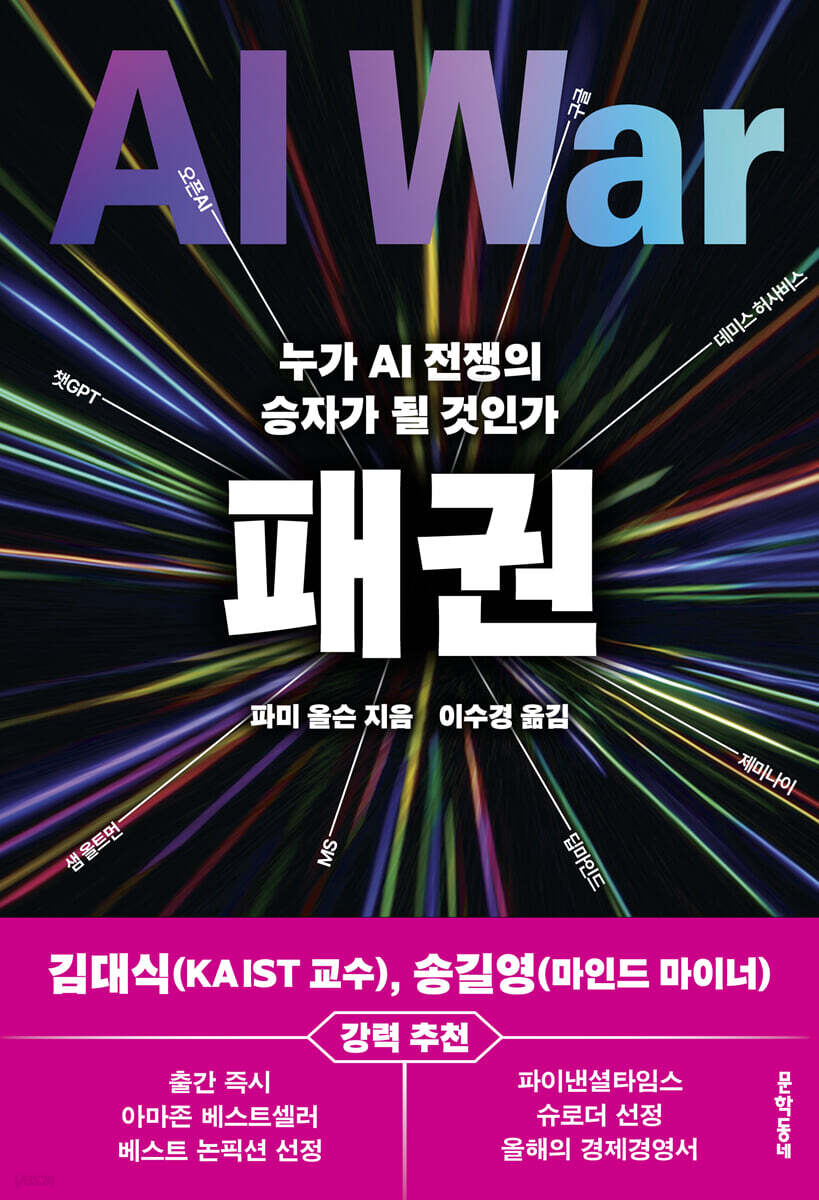
Book Introduction
★Highly recommended by Kim Dae-sik and Song Gil-young!★
★Amazon Bestseller, Best Nonfiction Selection★
★Almost Everything You Need to Know About AI Development and the War for Hegemony★
In the era of global AI competition,
Where will AI's future power go?
"A Rich Guide to the New World Awaiting Brave Humanity"
“Come in here and have a chat.” In November 2022, a webpage with a simple text box was posted online.
It was a completely new AI chatbot, 'ChatGPT', different from any technology previously released.
ChatGPT was more human than online counselors and more convenient than Google search.
It was the moment when the true nature of the competition between the world's two leading AI companies, OpenAI and Google DeepMind, was revealed.
Shortly thereafter, Google DeepMind also announced an AI chatbot, and in January 2025, a Chinese startup company announced 'DeepSeek', which shook up not only the AI industry but also the entire world.
The United States, nervous about DeepSec's achievements, launched a government-level AI development project called 'Stargate'.
In June of that year, our government also announced plans to invest 100 trillion won in the AI industry. Even now, the AI competition is becoming increasingly intense, with governments and capital partnering to compete.
In the rapidly changing AI era, who will seize the throne?
"Hegemony" provides a dense set of clues to answer these questions.
Based on 13 years of research and exclusive interviews with countless industry insiders, renowned technology columnist Fami Olson, a former reporter for the Wall Street Journal and Forbes, writes "Hegemony," a faithful investigative report predicting the direction of the AI era.
While focusing on the technological development process through the narratives of the two giants of the AI industry, Sam Altman of OpenAI and Demis Hassabis of Google DeepMind, it also provides a three-dimensional view of the economic, social, and cultural inflection points that inevitably follow this process.
Reading this book isn't just about understanding AI; it's about gaining insight into the tech industry, the economic trends surrounding it, and the essence of government policy that will drive the next decade. By tracing how AI technology integrates with the market, transforms the corporate landscape, and shapes power, you'll gain insight into the new economic trends and management strategies of big tech companies.
★Amazon Bestseller, Best Nonfiction Selection★
★Almost Everything You Need to Know About AI Development and the War for Hegemony★
In the era of global AI competition,
Where will AI's future power go?
"A Rich Guide to the New World Awaiting Brave Humanity"
“Come in here and have a chat.” In November 2022, a webpage with a simple text box was posted online.
It was a completely new AI chatbot, 'ChatGPT', different from any technology previously released.
ChatGPT was more human than online counselors and more convenient than Google search.
It was the moment when the true nature of the competition between the world's two leading AI companies, OpenAI and Google DeepMind, was revealed.
Shortly thereafter, Google DeepMind also announced an AI chatbot, and in January 2025, a Chinese startup company announced 'DeepSeek', which shook up not only the AI industry but also the entire world.
The United States, nervous about DeepSec's achievements, launched a government-level AI development project called 'Stargate'.
In June of that year, our government also announced plans to invest 100 trillion won in the AI industry. Even now, the AI competition is becoming increasingly intense, with governments and capital partnering to compete.
In the rapidly changing AI era, who will seize the throne?
"Hegemony" provides a dense set of clues to answer these questions.
Based on 13 years of research and exclusive interviews with countless industry insiders, renowned technology columnist Fami Olson, a former reporter for the Wall Street Journal and Forbes, writes "Hegemony," a faithful investigative report predicting the direction of the AI era.
While focusing on the technological development process through the narratives of the two giants of the AI industry, Sam Altman of OpenAI and Demis Hassabis of Google DeepMind, it also provides a three-dimensional view of the economic, social, and cultural inflection points that inevitably follow this process.
Reading this book isn't just about understanding AI; it's about gaining insight into the tech industry, the economic trends surrounding it, and the essence of government policy that will drive the next decade. By tracing how AI technology integrates with the market, transforms the corporate landscape, and shapes power, you'll gain insight into the new economic trends and management strategies of big tech companies.
- You can preview some of the book's contents.
Preview
index
prolog
Part 1.
Dream: Towards the greatest invention in human history
Chapter 1.
The Seeds of OpenAI
Chapter 2. Aspirations for the Dream of AI
Chapter 3.
A persistent belief in the future
Chapter 4. AGI, the Key to Saving Humanity
Chapter 5.
Towards Utopia, Towards Money
Chapter 6.
The prelude to competition
Part 2.
Goliaths: Are They Really Innovative?
Chapter 7.
AlphaGo, astonishing the world
Chapter 8.
“Everything is great”
Chapter 9.
Goliath's Paradox
Part 3.
Capital: A Noble Mission Bowing Before Money
Chapter 10.
In the end, size matters
Chapter 11.
frustrated dreams
Chapter 12.
broken promise
Part 4.
Competition: A fight for the future of humanity
Chapter 13.
Hello, ChatGPT
Chapter 14.
End of Humanity Marketing
Chapter 15.
Checkmate
Chapter 16: Where Will AI Take Us?
Acknowledgements
source
Part 1.
Dream: Towards the greatest invention in human history
Chapter 1.
The Seeds of OpenAI
Chapter 2. Aspirations for the Dream of AI
Chapter 3.
A persistent belief in the future
Chapter 4. AGI, the Key to Saving Humanity
Chapter 5.
Towards Utopia, Towards Money
Chapter 6.
The prelude to competition
Part 2.
Goliaths: Are They Really Innovative?
Chapter 7.
AlphaGo, astonishing the world
Chapter 8.
“Everything is great”
Chapter 9.
Goliath's Paradox
Part 3.
Capital: A Noble Mission Bowing Before Money
Chapter 10.
In the end, size matters
Chapter 11.
frustrated dreams
Chapter 12.
broken promise
Part 4.
Competition: A fight for the future of humanity
Chapter 13.
Hello, ChatGPT
Chapter 14.
End of Humanity Marketing
Chapter 15.
Checkmate
Chapter 16: Where Will AI Take Us?
Acknowledgements
source
Detailed image

Into the book
Despite their goal of elevating human life to a higher level, they ultimately handed over power to large corporations, and humanity's happiness and future ended up in the middle of a war between corporations for supremacy.
--- p.15
It is also somewhat natural that Altman used the language of computing when talking about humans.
For example, he once said in a magazine interview, “Humans can only learn two bits per second.”
A bit is the smallest unit of information processed by a computer, represented by a binary 0 or 1.
Altman used a metaphor to illustrate how limited human information processing capabilities are.
If we compare the human brain to the performance of a computer, the computer can process information at a much faster rate.
Computers could process gigabits or terabits per second.
--- p.63
You can program a machine to do some specific tasks quite well, but no machine can do everything.
If computers could not only calculate, but also predict, recognize images, converse, generate text, make plans, and even "imagine," they might become human-like beings.
--- p.84
According to a Vanity Fair article that covered that day's meeting, Musk said, "If AI gets out of control, humanity should be able to escape to Mars."
Then Hassabis responded as if he found it amusing.
“If it’s AI, it will follow people to Mars.” But Musk didn’t find this situation amusing at all.
--- p.101
Despite Google's enormous human and material resources, the company's strong motivation to protect its astronomically profitable advertising business hindered employees from pursuing innovative ideas.
Google Brain also had top-tier deep learning experts, but former employees say they were busy figuring out how to achieve management's unclear goals and strategies.
--- p.205
Partnering with Microsoft meant making a Faustian bargain, selling one's soul to the devil.
Now he would be developing AI technologies not for the benefit of humanity, but to help big business maintain its dominance and stay ahead in the cutthroat competition.
--- p.255
Some OpenAI staff were concerned about the speed with which the tool for generating fake photos was being released to the public.
OpenAI, which started out as a nonprofit focused on safe AI development, has evolved into one of the most aggressive AI companies on the market.
An anonymous OpenAI employee who participated in the safety testing of the model told Wired that OpenAI seems to be releasing its AI tools to the world to show off its technological prowess, even though “there’s still a very real possibility that they could cause harmful problems.”
--- p.318
News of Altman's dismissal was like an atomic bomb hitting the tech industry.
Everyone was shocked.
It seemed like a brutal ouster, just like Steve Jobs's ouster from Apple.
There was much speculation and rumor in Silicon Valley about why Sutskever had ousted Altman.
Is OpenAI finally close to developing AGI? Tweets like "What on earth did Sootskever learn?" are popping up everywhere.
The OpenAI board of directors offered no explanation, saying only that Altman “has not been consistently candid in his communications.”
--- p.15
It is also somewhat natural that Altman used the language of computing when talking about humans.
For example, he once said in a magazine interview, “Humans can only learn two bits per second.”
A bit is the smallest unit of information processed by a computer, represented by a binary 0 or 1.
Altman used a metaphor to illustrate how limited human information processing capabilities are.
If we compare the human brain to the performance of a computer, the computer can process information at a much faster rate.
Computers could process gigabits or terabits per second.
--- p.63
You can program a machine to do some specific tasks quite well, but no machine can do everything.
If computers could not only calculate, but also predict, recognize images, converse, generate text, make plans, and even "imagine," they might become human-like beings.
--- p.84
According to a Vanity Fair article that covered that day's meeting, Musk said, "If AI gets out of control, humanity should be able to escape to Mars."
Then Hassabis responded as if he found it amusing.
“If it’s AI, it will follow people to Mars.” But Musk didn’t find this situation amusing at all.
--- p.101
Despite Google's enormous human and material resources, the company's strong motivation to protect its astronomically profitable advertising business hindered employees from pursuing innovative ideas.
Google Brain also had top-tier deep learning experts, but former employees say they were busy figuring out how to achieve management's unclear goals and strategies.
--- p.205
Partnering with Microsoft meant making a Faustian bargain, selling one's soul to the devil.
Now he would be developing AI technologies not for the benefit of humanity, but to help big business maintain its dominance and stay ahead in the cutthroat competition.
--- p.255
Some OpenAI staff were concerned about the speed with which the tool for generating fake photos was being released to the public.
OpenAI, which started out as a nonprofit focused on safe AI development, has evolved into one of the most aggressive AI companies on the market.
An anonymous OpenAI employee who participated in the safety testing of the model told Wired that OpenAI seems to be releasing its AI tools to the world to show off its technological prowess, even though “there’s still a very real possibility that they could cause harmful problems.”
--- p.318
News of Altman's dismissal was like an atomic bomb hitting the tech industry.
Everyone was shocked.
It seemed like a brutal ouster, just like Steve Jobs's ouster from Apple.
There was much speculation and rumor in Silicon Valley about why Sutskever had ousted Altman.
Is OpenAI finally close to developing AGI? Tweets like "What on earth did Sootskever learn?" are popping up everywhere.
The OpenAI board of directors offered no explanation, saying only that Altman “has not been consistently candid in his communications.”
--- p.380
Publisher's Review
"Search gives you information, but AI gives you intelligence."
Two giants of AI development, Sam Altman and Hassabis
A three-dimensional view of the technology war
Following the convergence and disintegration of Silicon Valley's Big Tech industry!
Sam Altman of OpenAI and Demis Hassabis of Google DeepMind are both visionaries who dreamed of developing AI with limitless capabilities, and are innovators who have made a new mark on the AI industry and led it forward.
Sam Altman was a man of strong leadership and self-confidence since high school. He was fascinated by computers and the Internet. After entering Stanford University, he jumped into entrepreneurship and founded Y Combinator, a networking service that connects investors and entrepreneurs, emerging as a key figure in the Silicon Valley startup ecosystem.
For Sam Altman, AI was a tool that would enrich human life and a new business idea.
His goal was a practical and public-spirited one: to use AI to bring economic prosperity to all humanity, enabling them to live better lives.
Demis Hassabis, on the other hand, was a game developer and scientist.
As a scholar, I studied brain science and neuroscience to find the answer to the question, "What is intelligence?" and tried to implement the very way humans think using AI technology.
His ambition was not simply technological innovation, but to use AI technology to solve all the world's fundamental problems, including uncovering the origins of life and the nature of the universe, and curing diseases.
“If you solve the puzzle of intelligence, you can solve everything else,” he said.
DeepMind, founded by Hassabis, was the first AI startup to declare that it would not use AI technology commercially, especially for military purposes, and that it was a strictly ethical and science-driven organization.
Hassabis focused on developing an AGI model that mirrored the structure, memory, and cognitive abilities of the human brain, an approach that prioritized research outcomes over commercialization of the technology.
But as AI technology became increasingly feasible, Hassabis decided he needed capital and resources—namely, big tech companies—and joined hands with Google.
In 2014, DeepMind was acquired by Google and began developing more aggressively, shocking the world with AlphaGo, the first AI to beat humans.
Hassabis couldn't help but marvel at the intricate workings of the brain.
After closing the door to the elixir, he often found himself lost in thought.
Perhaps the key to developing software as smart as humans lies in the brain itself.
Anyway, I thought that we should study the brain deeply to understand it properly, because it is the only evidence in the world that shows that general intelligence is possible.
Is the brain merely a physical and biological organ, or is it something more? To find the answer, we needed to delve into neuroscience.
_Page 78 of the text
Altman burst onto the AI scene in 2015, a year after Google's acquisition of DeepMind, by co-founding the non-profit organization OpenAI with prominent Silicon Valley investors such as Elon Musk and Greg Brockman.
While he ostensibly aims to create a safe AGI for all of humanity, he soon realizes that he desperately lacks the funding and computing resources to secure the technology.
In particular, after his relationship with big-time investor Elon Musk soured, he struggled to find other investors in Silicon Valley.
Elon Musk originally intended to absorb OpenAI into Tesla to develop its technology more aggressively and to apply AI technology to autonomous driving and space engineering.
However, as Musk continued to try to commercialize OpenAI's technology, Sam Altman broke up with Elon Musk and instead secured massive investment through a strategic partnership with Microsoft.
The rationale he gave was that more money and resources were ultimately needed to safely develop the technology without interference from investors like Elon Musk.
Ironically, during this process, Altman feels pressured to first create an AI that can be released into the world immediately.
Ultimately, we successfully launched ChatGPT in November 2022, achieving commercialization of AI technology faster than anyone else.
In February 2018, OpenAI announced new donors and briefly announced that Musk was leaving the company.
But they glossed over Musk's resignation, stating that his departure was for ethical reasons.
The issue was that Tesla's AI research would create a conflict of interest with OpenAI.
(...) They thought that although Musk emphasizes the development of safe AI, he also has a strong desire to become the protagonist who creates the world's best AI.
Musk was already one of the world's richest men and wielded unprecedented influence over America's infrastructure. NASA was partnering with SpaceX to launch astronauts into space, Tesla was pioneering electric vehicles, and Musk's satellite internet company, Starlink, was accelerating the development of technologies that would later prove crucial in the Ukrainian War.
_Main text, pages 152-153
Demis Hassabis and Sam Altman had different paths, but their competition and struggles ultimately determined the pace and direction of AI technology development.
"Hegemony" doesn't just show the technological development process, investment attraction, and management strategies of these two companies. It vividly shows how AI technology is transformed into a management tool for giant Big Tech companies under the corporate logic of Silicon Valley through corporate structure, decision-making processes, conflicts between investors and management, and the timing of product launches.
In the complex triangle of technology, capital, and regulation,
Will AI be the hope of the future?
Surrounding technological development and ethics,
A surprising insight into the greatest dilemma of the 21st century.
Both Demis Hassabis and Sam Altman entered AI development with noble ideals, and they ran their companies with constant concern for the safety and ethics of their technology.
Was this couple's choice truly the right one? Ultimately, it wasn't.
Hassabis' DeepMind lost its independence when it was acquired by Google, AlphaGo was no longer an innovation, and DeepMind's project was relegated to being Google's advertising model and search engine tool.
Altman's OpenAI also tried to secure autonomy by establishing itself as a limited profit corporation, but Microsoft's influence continued to grow.
Ultimately, control of technology was handed over to Microsoft and Google, and the concentration of technology and wealth in the hands of a few companies became a reality.
Meanwhile, the AI industry promises a bright future, promising to use technology to increase productivity and make more useful information readily available.
But innovation comes at a price.
The AI industry, backed by big tech companies, collects and utilizes massive amounts of internet data for AI training, yet it doesn't disclose which data it uses.
In particular, OpenAI uses a vast amount of public data, including documents, news, papers, books, and community posts, to train its GPT model, but does not disclose the scope or source of the training data.
Data verification and social surveillance are becoming increasingly difficult, and AI technologies that have lost transparency are acquiring biased data and producing more biased data.
This has exacerbated the problem of hallucination, which involves the mass production and distribution of misinformation, and the EU is even considering legally regulating this in 2025.
In fact, cases where AI only outputs images of white men for the keyword 'CEO' or classifies black people as 'gorillas' show how serious AI bias is.
And this biased data is deeply embedded in our daily lives through social media and the media, without careful review or proper management of its impact on public perception.
Recently, Google's computer vision algorithm classified a black person as a gorilla.
It's called 'gorilla'.
Some try to explain this away by saying that the algorithm chose skin color as an important identifier for classifying humans.
If there had been even one Black person, or someone with a sense of racial awareness, on the AI software development team, a service that classifies Black people as gorillas would never have been launched.
_Page 189
"Hegemony" addresses these concerns, examining the male-dominated culture of the AI technology industry and how minorities are marginalized within it. The voices of young female engineers in AI development, non-developers, and those raising ethical concerns are often ignored or ridiculed. Those concerned about AI ethics emphasize that technological fairness must be ensured throughout the development process, arguing that technologies that fail to reflect the perspectives of minorities will ultimately lead to an unfair future for the majority of society.
At this point, "Hegemony" goes beyond technology and asks what choices we must make in this moment. How should we understand, utilize, and control AI? For whom is AI truly a technology? And what should a society in which AI and humanity coexist look like? The future of AI and humanity presents yet another set of social issues and ethical responsibilities that must be addressed.
Meanwhile, OpenAI and DeepMind have been working to build defenses against abuse of the high-performance AI systems they build.
DeepMind has been working to create a corporate governance structure that would prevent Google, a profit-driven monopoly, from using AGI as a means of making money.
The idea was to have a committee of expert advisors oversee the development and use of AI.
Altman and Musk founded OpenAI as a nonprofit research institute, promising to share the organization's research and patented technologies with other organizations as they near the point of developing superintelligent machines.
It was a path for the public good of humanity.
_Page 154 of the text
"A Rich Guide to the New World Awaiting Brave Humanity"
Between AI utopia and AI dystopia,
A must-read for a new era
In addition to Google acquiring DeepMind and Microsoft investing in OpenAI, countless other companies and countries are jumping into the AI industry, throwing the world into rapid chaos.
The struggle for hegemony brought about by the advancement of AI technology is no longer limited to the AI industry.
It is changing the global economy and the flow of capital, shaking the foundations of corporate strategy, restructuring the regulatory and public policy framework, and creating numerous social side effects.
Technology companies and governments around the world are grappling with these challenges and grappling with the fierce competition to stay at the forefront of AI development.
Another new direction is that China's DeepSec, mentioned earlier, is pursuing AI transparency through open source orientation.
South Korea, caught between China's openness and the West's commercialization, is also building a new AI ecosystem.
"Hegemony" neither prematurely optimistically predicts the outcome of this struggle for hegemony, nor is it pessimistic about the social issues surrounding AI.
This is a vivid, on-site report, providing a close-up view of the unfolding conflict between technology, capital, ethics, and power, and a faithful record of the first page of the new turning point we face today.
It contains insights on how we should utilize this technology, how companies can survive and grow, what investors should pay attention to, and how to usher in a new era beyond technology.
So far, the AI chapter's protagonists have been Sam Altman and Demis Hassabis, but who will take the lead in the future remains uncertain. The future of AI and humanity is a work in progress.
Two giants of AI development, Sam Altman and Hassabis
A three-dimensional view of the technology war
Following the convergence and disintegration of Silicon Valley's Big Tech industry!
Sam Altman of OpenAI and Demis Hassabis of Google DeepMind are both visionaries who dreamed of developing AI with limitless capabilities, and are innovators who have made a new mark on the AI industry and led it forward.
Sam Altman was a man of strong leadership and self-confidence since high school. He was fascinated by computers and the Internet. After entering Stanford University, he jumped into entrepreneurship and founded Y Combinator, a networking service that connects investors and entrepreneurs, emerging as a key figure in the Silicon Valley startup ecosystem.
For Sam Altman, AI was a tool that would enrich human life and a new business idea.
His goal was a practical and public-spirited one: to use AI to bring economic prosperity to all humanity, enabling them to live better lives.
Demis Hassabis, on the other hand, was a game developer and scientist.
As a scholar, I studied brain science and neuroscience to find the answer to the question, "What is intelligence?" and tried to implement the very way humans think using AI technology.
His ambition was not simply technological innovation, but to use AI technology to solve all the world's fundamental problems, including uncovering the origins of life and the nature of the universe, and curing diseases.
“If you solve the puzzle of intelligence, you can solve everything else,” he said.
DeepMind, founded by Hassabis, was the first AI startup to declare that it would not use AI technology commercially, especially for military purposes, and that it was a strictly ethical and science-driven organization.
Hassabis focused on developing an AGI model that mirrored the structure, memory, and cognitive abilities of the human brain, an approach that prioritized research outcomes over commercialization of the technology.
But as AI technology became increasingly feasible, Hassabis decided he needed capital and resources—namely, big tech companies—and joined hands with Google.
In 2014, DeepMind was acquired by Google and began developing more aggressively, shocking the world with AlphaGo, the first AI to beat humans.
Hassabis couldn't help but marvel at the intricate workings of the brain.
After closing the door to the elixir, he often found himself lost in thought.
Perhaps the key to developing software as smart as humans lies in the brain itself.
Anyway, I thought that we should study the brain deeply to understand it properly, because it is the only evidence in the world that shows that general intelligence is possible.
Is the brain merely a physical and biological organ, or is it something more? To find the answer, we needed to delve into neuroscience.
_Page 78 of the text
Altman burst onto the AI scene in 2015, a year after Google's acquisition of DeepMind, by co-founding the non-profit organization OpenAI with prominent Silicon Valley investors such as Elon Musk and Greg Brockman.
While he ostensibly aims to create a safe AGI for all of humanity, he soon realizes that he desperately lacks the funding and computing resources to secure the technology.
In particular, after his relationship with big-time investor Elon Musk soured, he struggled to find other investors in Silicon Valley.
Elon Musk originally intended to absorb OpenAI into Tesla to develop its technology more aggressively and to apply AI technology to autonomous driving and space engineering.
However, as Musk continued to try to commercialize OpenAI's technology, Sam Altman broke up with Elon Musk and instead secured massive investment through a strategic partnership with Microsoft.
The rationale he gave was that more money and resources were ultimately needed to safely develop the technology without interference from investors like Elon Musk.
Ironically, during this process, Altman feels pressured to first create an AI that can be released into the world immediately.
Ultimately, we successfully launched ChatGPT in November 2022, achieving commercialization of AI technology faster than anyone else.
In February 2018, OpenAI announced new donors and briefly announced that Musk was leaving the company.
But they glossed over Musk's resignation, stating that his departure was for ethical reasons.
The issue was that Tesla's AI research would create a conflict of interest with OpenAI.
(...) They thought that although Musk emphasizes the development of safe AI, he also has a strong desire to become the protagonist who creates the world's best AI.
Musk was already one of the world's richest men and wielded unprecedented influence over America's infrastructure. NASA was partnering with SpaceX to launch astronauts into space, Tesla was pioneering electric vehicles, and Musk's satellite internet company, Starlink, was accelerating the development of technologies that would later prove crucial in the Ukrainian War.
_Main text, pages 152-153
Demis Hassabis and Sam Altman had different paths, but their competition and struggles ultimately determined the pace and direction of AI technology development.
"Hegemony" doesn't just show the technological development process, investment attraction, and management strategies of these two companies. It vividly shows how AI technology is transformed into a management tool for giant Big Tech companies under the corporate logic of Silicon Valley through corporate structure, decision-making processes, conflicts between investors and management, and the timing of product launches.
In the complex triangle of technology, capital, and regulation,
Will AI be the hope of the future?
Surrounding technological development and ethics,
A surprising insight into the greatest dilemma of the 21st century.
Both Demis Hassabis and Sam Altman entered AI development with noble ideals, and they ran their companies with constant concern for the safety and ethics of their technology.
Was this couple's choice truly the right one? Ultimately, it wasn't.
Hassabis' DeepMind lost its independence when it was acquired by Google, AlphaGo was no longer an innovation, and DeepMind's project was relegated to being Google's advertising model and search engine tool.
Altman's OpenAI also tried to secure autonomy by establishing itself as a limited profit corporation, but Microsoft's influence continued to grow.
Ultimately, control of technology was handed over to Microsoft and Google, and the concentration of technology and wealth in the hands of a few companies became a reality.
Meanwhile, the AI industry promises a bright future, promising to use technology to increase productivity and make more useful information readily available.
But innovation comes at a price.
The AI industry, backed by big tech companies, collects and utilizes massive amounts of internet data for AI training, yet it doesn't disclose which data it uses.
In particular, OpenAI uses a vast amount of public data, including documents, news, papers, books, and community posts, to train its GPT model, but does not disclose the scope or source of the training data.
Data verification and social surveillance are becoming increasingly difficult, and AI technologies that have lost transparency are acquiring biased data and producing more biased data.
This has exacerbated the problem of hallucination, which involves the mass production and distribution of misinformation, and the EU is even considering legally regulating this in 2025.
In fact, cases where AI only outputs images of white men for the keyword 'CEO' or classifies black people as 'gorillas' show how serious AI bias is.
And this biased data is deeply embedded in our daily lives through social media and the media, without careful review or proper management of its impact on public perception.
Recently, Google's computer vision algorithm classified a black person as a gorilla.
It's called 'gorilla'.
Some try to explain this away by saying that the algorithm chose skin color as an important identifier for classifying humans.
If there had been even one Black person, or someone with a sense of racial awareness, on the AI software development team, a service that classifies Black people as gorillas would never have been launched.
_Page 189
"Hegemony" addresses these concerns, examining the male-dominated culture of the AI technology industry and how minorities are marginalized within it. The voices of young female engineers in AI development, non-developers, and those raising ethical concerns are often ignored or ridiculed. Those concerned about AI ethics emphasize that technological fairness must be ensured throughout the development process, arguing that technologies that fail to reflect the perspectives of minorities will ultimately lead to an unfair future for the majority of society.
At this point, "Hegemony" goes beyond technology and asks what choices we must make in this moment. How should we understand, utilize, and control AI? For whom is AI truly a technology? And what should a society in which AI and humanity coexist look like? The future of AI and humanity presents yet another set of social issues and ethical responsibilities that must be addressed.
Meanwhile, OpenAI and DeepMind have been working to build defenses against abuse of the high-performance AI systems they build.
DeepMind has been working to create a corporate governance structure that would prevent Google, a profit-driven monopoly, from using AGI as a means of making money.
The idea was to have a committee of expert advisors oversee the development and use of AI.
Altman and Musk founded OpenAI as a nonprofit research institute, promising to share the organization's research and patented technologies with other organizations as they near the point of developing superintelligent machines.
It was a path for the public good of humanity.
_Page 154 of the text
"A Rich Guide to the New World Awaiting Brave Humanity"
Between AI utopia and AI dystopia,
A must-read for a new era
In addition to Google acquiring DeepMind and Microsoft investing in OpenAI, countless other companies and countries are jumping into the AI industry, throwing the world into rapid chaos.
The struggle for hegemony brought about by the advancement of AI technology is no longer limited to the AI industry.
It is changing the global economy and the flow of capital, shaking the foundations of corporate strategy, restructuring the regulatory and public policy framework, and creating numerous social side effects.
Technology companies and governments around the world are grappling with these challenges and grappling with the fierce competition to stay at the forefront of AI development.
Another new direction is that China's DeepSec, mentioned earlier, is pursuing AI transparency through open source orientation.
South Korea, caught between China's openness and the West's commercialization, is also building a new AI ecosystem.
"Hegemony" neither prematurely optimistically predicts the outcome of this struggle for hegemony, nor is it pessimistic about the social issues surrounding AI.
This is a vivid, on-site report, providing a close-up view of the unfolding conflict between technology, capital, ethics, and power, and a faithful record of the first page of the new turning point we face today.
It contains insights on how we should utilize this technology, how companies can survive and grow, what investors should pay attention to, and how to usher in a new era beyond technology.
So far, the AI chapter's protagonists have been Sam Altman and Demis Hassabis, but who will take the lead in the future remains uncertain. The future of AI and humanity is a work in progress.
GOODS SPECIFICS
- Date of issue: June 23, 2025
- Page count, weight, size: 436 pages | 153*224*30mm
- ISBN13: 9791141610227
- ISBN10: 1141610221
You may also like
카테고리
korean


korean

![GQ KOREA Mark (Monthly): December [2025]](http://librairie.coreenne.fr/cdn/shop/files/8ef265dbbfbf186523ed75ba7319009d.jpg?v=1765340328&width=3840)


